精品解析:内蒙古自治区通辽市奈曼旗第三中学等2026年初中九年级阶段性教学质量监测试题英语
 切换试卷
切换试卷
2026-05-27
|
3份
|
30页
|
10人阅读
|
0人下载
资源信息
| 学段 | 初中 |
|---|---|
| 学科 | 英语 |
| 教材版本 | - |
| 年级 | 九年级 |
| 章节 | - |
| 类型 | 试卷 |
| 知识点 | - |
| 使用场景 | 中考复习-一模 |
| 学年 | 2026-2027 |
| 地区(省份) | 内蒙古自治区 |
| 地区(市) | 通辽市 |
| 地区(区县) | 奈曼旗 |
| 文件格式 | ZIP |
| 文件大小 | 13.78 MB |
| 发布时间 | 2026-05-27 |
| 更新时间 | 2026-05-27 |
| 作者 | 匿名 |
| 品牌系列 | - |
| 审核时间 | 2026-05-27 |
| 下载链接 | https://m.zxxk.com/soft/58080007.html |
| 价格 | 4.00储值(1储值=1元) |
| 来源 | 学科网 |
内容正文:
奈曼旗2026年初中九年级阶段性教学质量监测试题
英 语
注意事项:1.本试卷分笔试和听力两部分。考生先作答笔试部分(11小题开始),然后作答听力部分(1-10小题)。答卷前,考生务必将自己的学校、班级、姓名和准考证号填写在答题卡上。本试卷共8页,满分100分,考试时间90分钟。
2.作答时,将答案写在答题卡上,写在试卷上无效。
3.考试结束后,将试卷和答题卡一并交回。
听力部分
听力(共10小题;每小题1分,共10分)
听录音,根据各题要求选择最佳答案,并将答题卡上对应题目的答案标号涂黑。每项内容读两遍。
第一节(共3小题;每小题1分,共3分)
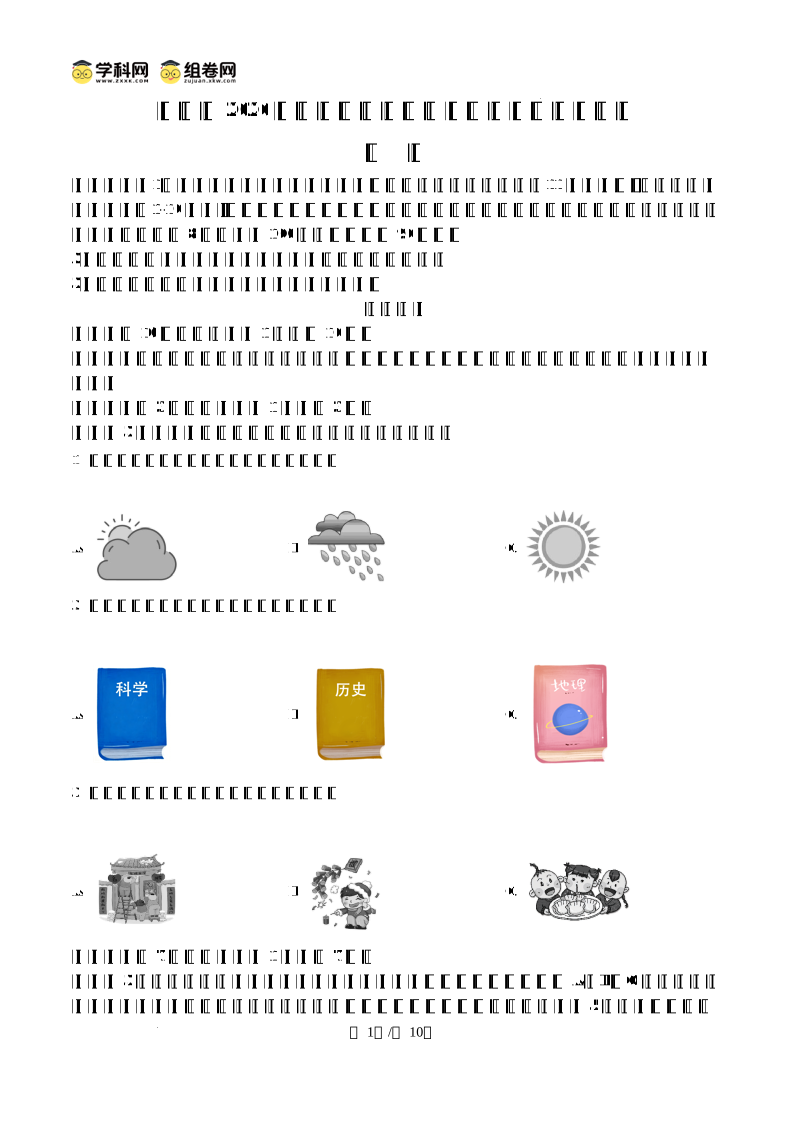
听下面3段对话,根据你听到的内容选出相应的图片。
1. 【此处可播放相关音频,请去附件查看】
A. B. C.
2. 【此处可播放相关音频,请去附件查看】
A. B. C.
3. 【此处可播放相关音频,请去附件查看】
A. B. C.
第二节(共7小题;每小题1分,共7分)
听下面3段对话或独白。每段对话或独白后有几个小题,从题中所给的A、B、C三个选项中选出最佳选项。听每段对话或独白前,你将有时间阅读各个小题,每小题5秒钟;听完后,各小题将给出5秒钟的作答时间。
听材料,回答两个小题。【此处可播放相关音频,请去附件查看】
4. How many languages can the smart guide speak?
A. Two. B. Three. C. Four.
5. What does the man think of the robots?
A. New. B. Noisy. C. Helpful.
听材料,回答两个小题。【此处可播放相关音频,请去附件查看】
6. When will Bill have the soccer match?
A. Next Sunday. B. Next Thursday. C. Next Tuesday.
7. How often do they practise soccer?
A. Every day. B. Once a week. C. Six days a week.
听材料,回答三个小题。【此处可播放相关音频,请去附件查看】
8. What is the Mutianyu Great Wall like?
A. It’s the oldest one.
B. It’s the most beautiful one.
C. It’s one of the best-protected parts.
9. How will the visitors go to the National Stadium?
A. By bus. B. By bike. C. On foot.
10. How much is the tour for two visitors?
A. 60 dollars. B. 100 dollars. C. 120 dollars.
笔试部分
一、情景交际(共5小题;每小题2分,共10分)
根据对话内容,从方框内的选项中选出能填入空白处的最佳选项,并在答题卡上将该项涂黑。选项中有两项为多余选项。
A: You must be excited about leaving for China tomorrow, Steve!
B: Yeah, Yaming. ____11____
A: Why do you feel that?
B: Well, for one thing, I don’t know how to use chopsticks very well. ____12____
A: Oh, I see. Well, one important thing is that you’re not supposed to start eating first if there are older people at the table.
B: ____13____ In the United States, it doesn’t matter.
A: Yeah, I know. It’s also impolite to stick your chopsticks into your food. You shouldn’t point at anyone with your chopsticks, either.
B: OK, I see. What else?
A: Oh, you should also remember that it’s impolite to talk with your mouth full.
B: I see. I think I’ll remember that.
A: ____14____ Your mouth is not supposed to make noise when you’re eating.
B: Oh, that’s unusual! ____15____ Making noise while eating means the food is delicious.
A: Haha, different countries, different rules. Enjoy your trip in China!
A. That’s interesting.
B. There’s one more thing you need to know.
C. How do you feel about coming to China?
D. I am looking forward to hearing from you.
E. For this, the custom in Japan is the opposite.
F. I don’t know the table manners there, either.
G. But I’m also a little nervous at the moment.
二、完形填空(共15小题;每小题1分,共15分)
阅读短文,从短文后各题所给的三个选项A、B、C中,选出可以填入空白处的最佳选项,并在答题卡上将该项涂黑。
Zhu Zhengyu, a 14-year-old girl from Ningbo, Zhejiang Province, did her mother a big favor (帮助)—closing a foreign trade deal in fluent English with an American customer.
The 2-minute video spread ____16____ online. Her confident performance attracted broad social attention and widespread ____17____. In the video, Zhu talked confidently with the overseas customer, ____18____ product details such as the specifications (规格) and price, and finally got an order for 1,200 units. “I work in ____19____ trade. My daughter has had a strong interest in ____20____ since childhood, so I often let her help me ____21____ customers,” Zhu’s mom said. “It is a source of ____22____ to see my daughter mastering some skills of foreign trade.”
Zhu says that she learns English by ____23____ every day. She shares that her ____24____ to mastering foreign languages lies in developing a sense of the language through practice. She also tries to ____25____ a good language environment by listening to bilingual (Chinese and English) news broadcasts.
Under her mother’s ____26____, she actively studies vocabulary for foreign trade and often writes down difficult words in notebooks. “The most ____27____ part,” she added, “is making learning a daily habit.”
In her spare time, Zhu improves ____28____ through various after-school activities, including taking part in English speech competitions and cross-cultural exchange clubs. Her experience shows that learning can be more ____29____ when combined with real-life practice. So, try to ____30____ your own ways to enjoy learning in practice!
16. A. slowly B. widely C. safely
17. A. courage B. luck C. praise
18. A. explained B. forgot C. changed
19. A. foreign B. local C. national
20. A. German B. French C. English
21. A. agree with B. work with C. communicate with
22. A. pity B. pride C. trouble
23. A. comparing B. practising C. reviewing
24. A. key B. ticket C. note
25. A. face B. create C. meet
26. A. doubt B. pressure C. influence
27. A. harmful B. impossible C. important
28. A. themselves B. herself C. ourselves
29. A. detailed B. effective C. awful
30. A. find B. offer C. avoid
三、阅读理解(共15小题;31-41每小题2分,第42小题1分,第43、44小题每小题2分, 第45小题3分,共30分)
阅读短文,从每题所给的三个选项(A、B和C)中,选出最佳选项,并在答题卡上将该项涂黑。
A
Young Inventors Challenge (YIC)
Our invention competition encourages students to work as a team to find new ways to solve today’s problems.
By taking part in YIC, students would develop their problem-solving skills. YIC hopes to develop future inventors to be the active change-makers of tomorrow.
Who can take part in it?
Teams of 2 to 5 young people aged between 13 and 17 from all over the world.
What do the teams have to do?
The theme is “Invention to Solve Environmental Problems”. You’re required to invent a product that can help protect the environment.100 teams will enter the final competition and they are required to invent and produce a working model.
How can you take part in it?
31. Who can take part in the competition?
A. Li Ming, 12, from Beijing, China.
B. A group of 6 students aged 15 from Australia.
C. A team of 2 — Sam,17, from China and Jack,17, from America.
32. In the final competition, the teams need to ________.
A. make working models B. work with each other C. give a 10-minute speech
33. What is the text?
A. A poster. B. A report. C. A diary.
B
Recently, an AI-generated (生成的) short film Huo Qubing has gained wide popularity across the world. It first became popular overseas and soon became a heated topic at home. Created by a professional team from Wuhan, the film presents impressive battle scenes and carries the true spirit of a great Chinese hero.
Huo Qubing was an outstanding general of the Western Han Dynasty. At a young age, he earned wide respect for his courage, talent and strong love for the nation. His story has inspired Chinese people for centuries.
To bring the short film to life, the team made lots of efforts. They generated about 1,700 AI images, selected 90 as key scenes, and produced nearly 500 AI-generated video clips. After careful editing (编辑), scoring and refinement (优化), they finished the film in about 48 working hours with a computing cost of around 3,000 yuan. Of course, besides this computing cost, the team also spent a great deal of time and energy in planning, designing, editing and music production.
The film marks major technological progress. AI saves creators much time and energy from heavy work, allowing small teams and individual creators to produce wonderful works that once only large companies could make. This makes video creation more open and inclusive.
Culturally, Huo Qubing builds a bridge between the world and China. The young hero’s story touches global viewers, and using AI to tell classic Chinese stories helps the world better understand Chinese history and values. This perfect mix of technology and culture shows how modern tools can help spread wonderful Chinese stories.
34. What can’t we know about Huo Qubing from the text?
A. He is the main character of an AI-generated short film.
B. He lived during the Western Han Dynasty when there was no war.
C. He became famous at an early age due to his talent and good qualities.
35. Which words can be used to describe the team’s work?
A. Simple and quick. B. Tiring and costly. C. Careful and professional.
36. What does the underlined word “inclusive” in Paragraph 4 probably mean?
A. Easy for more people to take part in.
B. Fast to spread worldwide.
C. Expensive to produce.
37. What is the text mainly about?
A. The life story of a famous Chinese ancient hero.
B. A popular AI-generated short film and its influence.
C. Ways to spread traditional Chinese culture globally.
C
Lenses (镜片) are useful tools that help us see things more clearly. They are widely used in our daily lives. They can help us read small words in books and take clear photos. They are also used to help people who have trouble seeing things clearly, like those who can’t see far away or those who can’t see things up close.
There are many kinds of lenses, but today we will talk about convex lenses and concave lenses.
Imagine you’re using a magnifying glass (放大镜) to read small words in a book. What happens when you move the glass closer to the words? The letters get bigger, right? That’s the power of a convex lens. Convex lenses are thicker in the middle and thinner at the sides. When light passes through a convex lens, it is brought together at a single point called the focus. This is why magnifying glasses, camera lenses, and even the lenses for some old people use convex lenses to see more clearly.
Different from convex lenses, concave lenses are thinner in the middle and thicker at the sides. When light passes through concave lenses, it spreads out. You can find concave lenses in your daily life. For example, if you are nearsighted (近视的), your glasses probably have concave lenses. You are nearsighted because the light entering your eyes does not focus exactly on the retina (视网膜). When you wear glasses with concave lenses, the light spreads out first and then enters the eyes, allowing it to focus correctly on the retina. In this way, you can see things clearly.
38. What is the first paragraph mainly about?
A. How lenses work. B. What lenses look like. C. What lenses are used for.
39. Which of the following have convex lenses according to the text?
a. cameras b. mirrors c. magnifying glasses d. nearsighted glasses
A. a, c B. a, d C. b, c
40. How do the concave lenses help nearsighted people see clearly?
A. B. C.
41. What is the purpose of the text?
A. To express feelings of using different lenses.
B. To give advice on how to learn physics well.
C. To offer information about science in daily life.
D
阅读短文,根据短文内容,完成下列各题。
Dr. Li Bo fan comes from a family of traditional Chinese medicine. He has loved this ancient medical art since he was a child, learning from his elders how to care for patients with kindness. After retiring (退休), he didn’t choose a comfortable life at home but decided to provide free medical treatment for people in mountainous areas. For 18 years, he has spent most of his time helping local people, especially those poor families that can’t afford medical care.
Every morning, many patients start to wait at his simple clinic (诊所). Dr. Li always gets up early to welcome them, listens to their problems patiently, and prescribes (开处方) effective and cheap medicines. The mountain roads are hard to walk, but when some elderly or disabled patients can’t come, he even walks for hours to visit them at home. Besides treating patients, he also teaches young doctors his medical skills. He takes them to the mountains to recognize herbs and shares his rich experience, hoping to pass on his knowledge.
Dr. Li’s spirit has touched many people. His story tells us that dedication (奉献) can make a big difference to others. ________
42. What did Dr. Li do after retiring?
___________________________________________________
43. What does Dr. Li do to pass on his knowledge?
___________________________________________________
44. Use a word to describe Dr. Li.
____________________________________________________
45. Write an ending for the text (within 15 words) : “________”.
___________________________________________________
四、语篇填空(共两节,20分)
第一节(共10小题;每小题1分,共10分)
阅读短文,在空白处填入一个适当的单词或括号内单词的正确形式。
Peter was a Grade 9 student. He always felt stressed because ____46____ his heavy schoolwork. One day, his sister gave him a box of colorful fuse beads. At the beginning, Peter thought it was just a toy for children. But when he picked up the small beads and put them on a board, he felt ____47____ (great) calm.
To ____48____ (he) surprise, he spent three hours finishing a pixel picture of a dog. During this time, he forgot all his worries. Making fuse beads brought him a great sense of ____49____ (achieve). From then on, he fell in love with this hobby. He spent almost all his free time creating different patterns.
However, something bad ____50____ (happen) last week. After sitting at his desk and ____51____ (work) on a large picture for five hours, Peter felt a terrible pain in his neck. He couldn’t even turn his head! His mother was very worried and took him to the hospital at once.
The doctor checked him and said it ____52____ (cause) by sitting for too long. He told Peter that although hobbies were good for the mind, health should always come ____53____ (one). If he didn’t change his habit, his neck would get ____54____ (bad).
Peter felt sorry for what he had done. Now, he still plays with fuse beads, but he always takes ____55____ break every thirty minutes.
From Peter’s story, we know that we should enjoy our hobbies reasonably.
第二节(共5小题;每小题2分,共10分)
阅读短文,从方框中选择适当的词或词组并用其正确形式填空,使短文通顺、意思完整。(每词或词组限用一次。)
although improve believe in understand who
You may notice that horses appear in many Chinese idioms. These horse-related idioms offer us a fascinating chance ____56____ Chinese culture and ancient wisdom.
“A horse that covers a thousand miles” is perhaps the most famous horse-related idiom. It describes someone with amazing talent or potential. Chinese parents often use this idiom to encourage their children, hoping they’ll become “thousand-mile horses” ____57____ achieve great things. The idiom comes from ancient times when people believed certain legendary horses could run 1,000 miles in a single day.
“A swift horse needs a good rider” adds another meaning to this idea. ____58____ talented people (swift horses) might be common, good leaders (good riders) who can discover talent are uncommon. This idiom reminds us that having talent isn’t enough—you need someone who ____59____ you and gives you opportunities.
“Ride a horse while looking for a better one” describes someone who keeps searching for better chances while managing their present situation. Chinese people use this idiom to describe practical, ambitious people who never stop ____60____ themselves.
五、书面表达(15分)
61. 法国作家雨果曾经说过:“进步,才是人应该有的现象。”。回首过往,从小学到中学,你所经历的变化一定给你带来了一些进步。请你根据下面的思维导图,以“Changes Make Me Progress”为题,给校英语周报投稿,谈谈你的变化及感受。
要求:1.包含以上思维导图中的所有信息,可适当发挥;
2.不少于80词,开头已给出,不计入总词数;
3.文中不得出现真实的人名、校名等信息。
Changes Make Me Progress
My life has changed a lot in the past few years.
_________________________________________________________________________________________________________________________________________________________________________________________________________________________________________________________________________________________________________________________________________________________________________________________________________________________________________________________________________________________________________________________________________________________________________________________________________________________________________________
第1页/共1页
学科网(北京)股份有限公司
$26年4月份九年级英语听力听录音,根据各题要求选择最佳答案,并将答题卡上对应题目的答案标号涂黑,每项内容读两遍。第一节听下面三段对话,根据你听到的内容选出相应的图片。One, I usually go to school on foot. What about you? Tom, I often . go to school by bike, but it's rainy today. So I took the bus. I usually go to school on foot. What about you? tom? I often go to school by bike, but it's rainy today, so I took the bus. Two. which subject do you like best. mary? Geology phy is so interesting for me, and I can learn a lot from IT. Which subject do you like best, mary? Geography is so interesting for me, and I can learn a lot from IT. Three, can you tell me anything about the chinese spring festival? sure. We have many traditions during IT, and eating dumplings is one of them. Can you tell me anything about the chinese spring festival? sure. We have many traditions during IT, and eating dumplings is one of them. 第二节,听下面三段对话或独白。每段对话或独白后有几个小题,从题中所给的ABC3个选项中选出最佳选项。听每段对话或独白前,你将有时间阅读各个小题,每小题5秒钟。听完后各小题将给出5秒钟的作答时间。听第四段材料,回答第四、五题。Hi, long time. no. See, I hear that you have moved to . a new community. Yeah, IT has cool ai. There is a smart guide in the service center. The answers questions in chinese. english and french sounds good. What else? We have some other robots that can play with kids, look after the elderly and help them with daily tasks. But sometimes there a bit noisy while working. Anyway. they're helpful. That's true. They make our lives more convenient. Hi, long time. no. See, I hear that you have moved to . a new community. Yeah, IT is cool. Ai, there is a smart guide in the service center. The answers questions in chinese. english and french sounds good. What else? We have some other robots that can play with kids, look after the elderly and help them with daily tasks. But sometimes there a bit noisy while working. Anyway. they're helpful. That's true. They make our lives more convenient. 听第五段材料,回答第六、七题。Hi bill, where are you going? I'm going . to the playground. It's five o'clock. It's time to go home. I want to practice soccer. I will take part in a soccer match . next thursday. Who are you going . to play with my friend's paul, tony, mike and other students in our school? How often do you practice . IT every day except sunday? You really work hard. I hope you will win the game. Thank you. Hi bill. Where are you going? I'm going . to the playground. It's five o'clock. It's time to go home. I want to practice soccer. I would take part in a soccer match next thursday. Who are you going to play with? My friend's paul, tony, mike and other students in our school? How often do you practice IT . every day except sunday? You really work hard. I hope you will win the game. Thank you. 听第六段材料,回答第8至10题。Hi everyone, do you like to visit the great wall? We have a tour for you in the morning. Our guide will pick you up from your hotel. At eight o'clock, we will drive you to the muti great wall. IT is one of the best protected parts. IT is popular among foreign visitors. The right will take you two hours to get there. He will see some watch towers there and enjoy the beautiful sites around. In the afternoon, we will take the bus to the national stadium. We will stay there for about two hours, so you can take some photos and about five P. M. We will send you back to the hotel. The Price of the tour is sixty dollars for one person and one hundred dollars for two. Hi everyone, do you like to visit the great wall? We have a tour for you in the morning. Our guide will pick you up from your hotel. At eight o'clock, we will drive you to the muti great wall. IT is one of the best protected parts. IT is popular among foreign visitors. The right will take you two hours to get there. He will see some watch towers there and enjoy the beautiful sites around. In the afternoon, we will take the bus to the national stadium. We will stay there for about two hours, so you can take some photos at about five P. M. We will send you back to the hotel. The Price of the tour is sixty dollars for one person and one hundred dollars for two.
奈曼旗2026年初中九年级阶段性教学质量监测试题
英 语
注意事项:1.本试卷分笔试和听力两部分。考生先作答笔试部分(11小题开始),然后作答听力部分(1-10小题)。答卷前,考生务必将自己的学校、班级、姓名和准考证号填写在答题卡上。本试卷共8页,满分100分,考试时间90分钟。
2.作答时,将答案写在答题卡上,写在试卷上无效。
3.考试结束后,将试卷和答题卡一并交回。
听力部分
听力(共10小题;每小题1分,共10分)
听录音,根据各题要求选择最佳答案,并将答题卡上对应题目的答案标号涂黑。每项内容读两遍。
第一节(共3小题;每小题1分,共3分)
听下面3段对话,根据你听到的内容选出相应的图片。
1. 【此处可播放相关音频,请去附件查看】
A. B. C.
【答案】B
【解析】
【原文】W: I usually go to school on foot. What about you, Tom?
M: I often go to school by bike. But it’s rainy today, so I took the bus.
2. 【此处可播放相关音频,请去附件查看】
A. B. C.
【答案】C
【解析】
【原文】M: Which subject do you like best, Mary?
W: Geography. It’s so interesting for me and I can learn a lot from it.
3. 【此处可播放相关音频,请去附件查看】
A. B. C.
【答案】C
【解析】
【原文】W: Can you tell me anything about the Chinese Spring Festival?
M: Sure. We have many traditions during it, and eating dumplings is one of them.
第二节(共7小题;每小题1分,共7分)
听下面3段对话或独白。每段对话或独白后有几个小题,从题中所给的A、B、C三个选项中选出最佳选项。听每段对话或独白前,你将有时间阅读各个小题,每小题5秒钟;听完后,各小题将给出5秒钟的作答时间。
听材料,回答两个小题。【此处可播放相关音频,请去附件查看】
4. How many languages can the smart guide speak?
A. Two. B. Three. C. Four.
5. What does the man think of the robots?
A. New. B. Noisy. C. Helpful.
【答案】4. B 5. C
【解析】
【原文】M: Hi, long time no see! I hear that you have moved to a new community.
W: Yeah. It has cool AI. There is a smart guide in the service center. It answers questions in Chinese, English and French.
M: Sounds good! What else?
W: We have some other robots that can play with kids, look after the elderly and help them with daily tasks. But sometimes they are a bit noisy while working.
M: Anyway, they are helpful.
W: That’s true. They make our lives more convenient.
听材料,回答两个小题。【此处可播放相关音频,请去附件查看】
6. When will Bill have the soccer match?
A. Next Sunday. B. Next Thursday. C. Next Tuesday.
7. How often do they practise soccer?
A. Every day. B. Once a week. C. Six days a week.
【答案】6. B 7. C
【解析】
【原文】W: Hi, Bill. Where are you going?
M: I’m going to the playground.
W: It’s five o’clock. It’s time to go home.
M: I want to practise soccer. I will take part in a soccer match next Thursday.
W: Who are you going to play with?
M: My friends Paul, Tony, Mike and other students in our school.
W: How often do you practise it?
M: Every day except Sunday.
W: You really work hard. I hope you will win the game.
M: Thank you.
听材料,回答三个小题。【此处可播放相关音频,请去附件查看】
8. What is the Mutianyu Great Wall like?
A. It’s the oldest one.
B. It’s the most beautiful one.
C. It’s one of the best-protected parts.
9. How will the visitors go to the National Stadium?
A. By bus. B. By bike. C. On foot.
10. How much is the tour for two visitors?
A. 60 dollars. B. 100 dollars. C. 120 dollars.
【答案】8. C 9. A 10. B
【解析】
【原文】 Hi, everyone! Do you like to visit the Great Wall? We have a tour for you. In the morning, our guide will pick you up from your hotel at 8 o’clock. We will drive you to the Mutianyu Great Wall. It is one of the best protected parts. It is popular among foreign visitors. The ride will take you two hours to get there. You will see some watchtowers there and enjoy the beautiful sights around. In the afternoon, we will take the bus to the National Stadium. We will stay there for about two hours, so you can take some photos. At about 5 p.m., we will send you back to the hotel. The price of the tour is 60 dollars for one person and 100 dollars for two.
笔试部分
一、情景交际(共5小题;每小题2分,共10分)
根据对话内容,从方框内的选项中选出能填入空白处的最佳选项,并在答题卡上将该项涂黑。选项中有两项为多余选项。
A: You must be excited about leaving for China tomorrow, Steve!
B: Yeah, Yaming. ____11____
A: Why do you feel that?
B: Well, for one thing, I don’t know how to use chopsticks very well. ____12____
A: Oh, I see. Well, one important thing is that you’re not supposed to start eating first if there are older people at the table.
B: ____13____ In the United States, it doesn’t matter.
A: Yeah, I know. It’s also impolite to stick your chopsticks into your food. You shouldn’t point at anyone with your chopsticks, either.
B: OK, I see. What else?
A: Oh, you should also remember that it’s impolite to talk with your mouth full.
B: I see. I think I’ll remember that.
A: ____14____ Your mouth is not supposed to make noise when you’re eating.
B: Oh, that’s unusual! ____15____ Making noise while eating means the food is delicious.
A: Haha, different countries, different rules. Enjoy your trip in China!
A. That’s interesting.
B. There’s one more thing you need to know.
C. How do you feel about coming to China?
D. I am looking forward to hearing from you.
E. For this, the custom in Japan is the opposite.
F. I don’t know the table manners there, either.
G. But I’m also a little nervous at the moment.
【答案】11. G 12. F 13. A 14. B 15. E
【解析】
【导语】本文是一段关于Steve即将前往中国,Yaming向他讲解中国餐桌礼仪的对话。
【11题详解】
上文A说Steve明天去中国肯定很激动,Steve承认后,后文A询问“你为什么会有这种感受”,Steve紧接着说自己的担忧,因此这里转折表达“我同时也有点紧张”,选G。
【12题详解】
Steve说了第一个担忧“不会用筷子”,后文A开始讲解中国餐桌礼仪,说明Steve的第二个担忧是“我也不了解那里的餐桌礼仪”,选F。
【13题详解】
A告诉Steve“有长辈在场不能先动筷”的中国规矩,Steve说美国没有这个讲究,因此他对这个不同的习俗做出回应“这挺有意思”,选A。
【14题详解】
A已经讲了几条餐桌规矩后,又补充了新规则“吃饭的时候不能发出声响”,因此用“还有一件事你需要知道”衔接下文,选B。
【15题详解】
Steve听到中国不能吃饭出声的规矩后表示很特别,后文提到“吃饭出声代表食物好吃”,这个习俗和中国相反,是日本的习惯,选E。
二、完形填空(共15小题;每小题1分,共15分)
阅读短文,从短文后各题所给的三个选项A、B、C中,选出可以填入空白处的最佳选项,并在答题卡上将该项涂黑。
Zhu Zhengyu, a 14-year-old girl from Ningbo, Zhejiang Province, did her mother a big favor (帮助)—closing a foreign trade deal in fluent English with an American customer.
The 2-minute video spread ____16____ online. Her confident performance attracted broad social attention and widespread ____17____. In the video, Zhu talked confidently with the overseas customer, ____18____ product details such as the specifications (规格) and price, and finally got an order for 1,200 units. “I work in ____19____ trade. My daughter has had a strong interest in ____20____ since childhood, so I often let her help me ____21____ customers,” Zhu’s mom said. “It is a source of ____22____ to see my daughter mastering some skills of foreign trade.”
Zhu says that she learns English by ____23____ every day. She shares that her ____24____ to mastering foreign languages lies in developing a sense of the language through practice. She also tries to ____25____ a good language environment by listening to bilingual (Chinese and English) news broadcasts.
Under her mother’s ____26____, she actively studies vocabulary for foreign trade and often writes down difficult words in notebooks. “The most ____27____ part,” she added, “is making learning a daily habit.”
In her spare time, Zhu improves ____28____ through various after-school activities, including taking part in English speech competitions and cross-cultural exchange clubs. Her experience shows that learning can be more ____29____ when combined with real-life practice. So, try to ____30____ your own ways to enjoy learning in practice!
16. A. slowly B. widely C. safely
17. A. courage B. luck C. praise
18. A. explained B. forgot C. changed
19. A. foreign B. local C. national
20. A. German B. French C. English
21. A. agree with B. work with C. communicate with
22. A. pity B. pride C. trouble
23. A. comparing B. practising C. reviewing
24. A. key B. ticket C. note
25. A. face B. create C. meet
26. A. doubt B. pressure C. influence
27. A. harmful B. impossible C. important
28. A. themselves B. herself C. ourselves
29. A. detailed B. effective C. awful
30. A. find B. offer C. avoid
【答案】16. B 17. C 18. A 19. A 20. C 21. C 22. B 23. B 24. A 25. B 26. C 27. C 28. B 29. B 30. A
【解析】
【导语】本文讲述了浙江宁波14岁女孩朱正语凭借流利的英语帮妈妈谈成外贸订单的故事,强调了实践对学习的重要性。
【16题详解】
句意:这个两分钟的视频在网上广泛传播。
根据“attracted broad social attention”可知,视频传播范围广,引起了广泛关注。widely意为“广泛地”,符合视频传播的语境;slowly意为“缓慢地”,safely意为“安全地”,均不符合引起广泛关注的语境。
【17题详解】
句意:她自信的表现引起了社会的广泛关注和赞扬。
根据“confident performance”可知,自信的表现通常会获得他人的认可与赞扬。praise意为“赞扬”,符合社会反应的语境;courage意为“勇气”,luck意为“运气”,不符合获得关注的结果。
【18题详解】
句意:在视频中,朱自信地与海外客户交谈,解释了产品细节。
根据“product details such as the specifications and price”可知,是在向客户说明细节。explained意为“解释”,符合谈生意时说明产品情况的语境;forgot意为“忘记”,changed意为“改变”,均不符合谈成订单的逻辑。
【19题详解】
句意:我从事外贸工作。
根据“closing a foreign trade deal”可知,妈妈从事的是对外贸易工作。foreign意为“外国的”,foreign trade指外贸,符合语境;local意为“当地的”,national意为“国家的”,与外贸不符。
【20题详解】
句意:我女儿从小就对英语有浓厚的兴趣。
根据“closing a foreign trade deal in fluent English”可知,女儿擅长的是英语。English意为“英语”,符合上文提到的语言技能;German意为“德语”,French意为“法语”,文中未提及。
【21题详解】
句意:所以我经常让她帮我与客户沟通。
根据“talked confidently with the overseas customer”可知,是帮助与客户交流。communicate with意为“与……沟通”,符合帮助谈生意的语境;agree with意为“同意”,work with意为“与……工作”,不如沟通准确。
【22题详解】
句意:看到女儿掌握了外贸相关的技能,我感到十分自豪。
根据“mastering some skills”可知,母亲对女儿的能力感到自豪。pride意为“骄傲”,符合母亲看到女儿成长的心情;pity意为“遗憾”,trouble意为“麻烦”,均不符合积极的情感色彩。
【23题详解】
句意:朱正语说,她靠每天练习来学习英语。
根据“developing a sense of the language through practice”可知,学习方法是练习。practising意为“练习”,符合通过实践学习语言的语境;comparing意为“比较”,reviewing意为“复习”,文中强调的是实践练习。
【24题详解】
句意:她分享道,掌握外语的关键在于通过练习培养语感。
根据“lies in developing a sense of the language”可知,这是掌握语言的核心要素。key意为“关键”,the key to是固定搭配,符合语境;ticket意为“票”,note意为“笔记”,均不符合句意逻辑。
【25题详解】
句意:她还会通过听双语新闻广播,努力营造良好的语言环境。
根据“by listening to bilingual news broadcasts”可知,这是在主动建立环境。create意为“创造”,符合营造学习环境的语境;face意为“面对”,meet意为“遇见”,均不符合主动营造的含义。
【26题详解】
句意:在妈妈的影响下,她主动学习外贸词汇。
根据“Zhu’s mom said... so I often let her help me”可知,妈妈的行为影响了女儿。influence意为“影响”,under one’s influence是固定搭配,符合语境;doubt意为“怀疑”,pressure意为“压力”,均不符合母女合作的语境。
【27题详解】
句意:最重要的一点,就是要让学习成为日常习惯。
根据“making learning a daily habit”可知,这是学习成功的重要因素。important意为“重要的”,符合强调习惯重要性的语境;harmful意为“有害的”,impossible意为“不可能的”,均不符合积极建议。
【28题详解】
句意:课余时间,朱正语通过各类课外活动提升自己。
主语是Zhu,反身代词应指代她自己。herself意为“她自己”,符合主语一致的原则;themselves意为“他们自己”,ourselves意为“我们自己”,人称不符。
【29题详解】
句意:她的经历证明:当学习和实际练习结合时,学习效率会更高。
根据“combined with real-life practice”可知,结合实践的学习效果更好。effective意为“有效的”,符合实践带来好结果的语境;detailed意为“详细的”,awful意为“糟糕的”,均不符合语境。
【30题详解】
句意:所以,快去找到属于你自己的、在练习中享受学习的方法吧!
文章呼吁找到适合自己的学习方法,find意为“找到”,符合鼓励探索学习方法的语境;offer意为“提供”,avoid意为“避免”,均不符合建议的逻辑。
三、阅读理解(共15小题;31-41每小题2分,第42小题1分,第43、44小题每小题2分, 第45小题3分,共30分)
阅读短文,从每题所给的三个选项(A、B和C)中,选出最佳选项,并在答题卡上将该项涂黑。
A
Young Inventors Challenge (YIC)
Our invention competition encourages students to work as a team to find new ways to solve today’s problems.
By taking part in YIC, students would develop their problem-solving skills. YIC hopes to develop future inventors to be the active change-makers of tomorrow.
Who can take part in it?
Teams of 2 to 5 young people aged between 13 and 17 from all over the world.
What do the teams have to do?
The theme is “Invention to Solve Environmental Problems”. You’re required to invent a product that can help protect the environment.100 teams will enter the final competition and they are required to invent and produce a working model.
How can you take part in it?
31. Who can take part in the competition?
A. Li Ming, 12, from Beijing, China.
B. A group of 6 students aged 15 from Australia.
C. A team of 2 — Sam,17, from China and Jack,17, from America.
32. In the final competition, the teams need to ________.
A. make working models B. work with each other C. give a 10-minute speech
33. What is the text?
A. A poster. B. A report. C. A diary.
【答案】31. C 32. A 33. A
【解析】
【导语】本文是一则关于青少年发明比赛的宣传海报,介绍了比赛的主题、奖励、参赛对象及参赛流程。
【31题详解】
根据“Teams of 2 to 5 young people aged between 13 and 17 from all over the world.”可知,参赛者须为13至17岁的2-5人小组,选项C中两人均17岁且是一个小组,符合要求。
【32题详解】
根据“100 teams will enter the final competition and they are required to invent and produce a working model.”可知,参赛者要制作可操作的模型(make working models)。
【33题详解】
根据文中的形式带有说明性的图片、步骤等信息,可推知此文最有可能是宣传海报。
B
Recently, an AI-generated (生成的) short film Huo Qubing has gained wide popularity across the world. It first became popular overseas and soon became a heated topic at home. Created by a professional team from Wuhan, the film presents impressive battle scenes and carries the true spirit of a great Chinese hero.
Huo Qubing was an outstanding general of the Western Han Dynasty. At a young age, he earned wide respect for his courage, talent and strong love for the nation. His story has inspired Chinese people for centuries.
To bring the short film to life, the team made lots of efforts. They generated about 1,700 AI images, selected 90 as key scenes, and produced nearly 500 AI-generated video clips. After careful editing (编辑), scoring and refinement (优化), they finished the film in about 48 working hours with a computing cost of around 3,000 yuan. Of course, besides this computing cost, the team also spent a great deal of time and energy in planning, designing, editing and music production.
The film marks major technological progress. AI saves creators much time and energy from heavy work, allowing small teams and individual creators to produce wonderful works that once only large companies could make. This makes video creation more open and inclusive.
Culturally, Huo Qubing builds a bridge between the world and China. The young hero’s story touches global viewers, and using AI to tell classic Chinese stories helps the world better understand Chinese history and values. This perfect mix of technology and culture shows how modern tools can help spread wonderful Chinese stories.
34. What can’t we know about Huo Qubing from the text?
A. He is the main character of an AI-generated short film.
B. He lived during the Western Han Dynasty when there was no war.
C. He became famous at an early age due to his talent and good qualities.
35. Which words can be used to describe the team’s work?
A. Simple and quick. B. Tiring and costly. C. Careful and professional.
36. What does the underlined word “inclusive” in Paragraph 4 probably mean?
A. Easy for more people to take part in.
B. Fast to spread worldwide.
C. Expensive to produce.
37. What is the text mainly about?
A. The life story of a famous Chinese ancient hero.
B. A popular AI-generated short film and its influence.
C. Ways to spread traditional Chinese culture globally.
【答案】34. B 35. C 36. A 37. B
【解析】
【导语】本文是一篇说明文,主要介绍了最近武汉的一个团队制作的AI短片《霍去病》走红海外并回流国内,引发热议的事。作品凭借霍去病勇毅爱国的精神内核打动全球观众,既展现AI技术对影视创作降本增效的变革力量,也为传统文化IP创新表达与国际传播提供了新路径,意义深远。
【34题详解】
根据第一段“Recently, an AI-generated (生成的) short film Huo Qubing has gained wide popularity across the world.”可知,霍去病是一个AI短片中的主角;根据第一段“Created by a professional team from Wuhan, the film presents impressive battle scenes and carries the true spirit of a great Chinese hero.”和第二段“Huo Qubing was an outstanding general of the Western Han Dynasty. At a young age, he earned wide respect for his courage, talent and strong love for the nation.”可知,霍去病生活的西汉时期多战乱,他是一位杰出的将军,因勇毅、有才和爱国而年少成名,因此B选项的说法与原文内容不符。
【35题详解】
通读第三段的内容可知,此段主要介绍了该团队制作AI短片《霍去病》的工作过程,从中可以看出他们花费了很多的心血,体现出了他们的认真和专业(Careful and professional)。
【36题详解】
前句提到“AI让小团队和个人创作者能制作出曾经只有大公司才能完成的作品”,后句总结“This makes video creation more open and inclusive”, and表并列,因此“inclusive”与“open”表意相近。
【37题详解】
通读全文可知,文章先介绍AI短片《霍去病》走红的背景,再讲述制作过程,最后分析其技术和文化层面的影响。
C
Lenses (镜片) are useful tools that help us see things more clearly. They are widely used in our daily lives. They can help us read small words in books and take clear photos. They are also used to help people who have trouble seeing things clearly, like those who can’t see far away or those who can’t see things up close.
There are many kinds of lenses, but today we will talk about convex lenses and concave lenses.
Imagine you’re using a magnifying glass (放大镜) to read small words in a book. What happens when you move the glass closer to the words? The letters get bigger, right? That’s the power of a convex lens. Convex lenses are thicker in the middle and thinner at the sides. When light passes through a convex lens, it is brought together at a single point called the focus. This is why magnifying glasses, camera lenses, and even the lenses for some old people use convex lenses to see more clearly.
Different from convex lenses, concave lenses are thinner in the middle and thicker at the sides. When light passes through concave lenses, it spreads out. You can find concave lenses in your daily life. For example, if you are nearsighted (近视的), your glasses probably have concave lenses. You are nearsighted because the light entering your eyes does not focus exactly on the retina (视网膜). When you wear glasses with concave lenses, the light spreads out first and then enters the eyes, allowing it to focus correctly on the retina. In this way, you can see things clearly.
38. What is the first paragraph mainly about?
A. How lenses work. B. What lenses look like. C. What lenses are used for.
39. Which of the following have convex lenses according to the text?
a. cameras b. mirrors c. magnifying glasses d. nearsighted glasses
A. a, c B. a, d C. b, c
40. How do the concave lenses help nearsighted people see clearly?
A. B. C.
41. What is the purpose of the text?
A. To express feelings of using different lenses.
B. To give advice on how to learn physics well.
C. To offer information about science in daily life.
【答案】38. C 39. A 40. C 41. C
【解析】
【导语】本文是一篇说明文,主要介绍了日常生活中常用的镜片——凸透镜和凹透镜,包括它们的外形特征、光学原理以及在放大镜、照相机、近视眼镜等场景中的实际应用。
【38题详解】
第一段主要讲述镜片的用途:“help us read small words in books and take clear photos”,“help people who have trouble seeing things clearly”,整段围绕镜片的功能展开。
【39题详解】
第三段明确指出:“magnifying glasses, camera lenses, and even the lenses for some old people use convex lenses”,即放大镜和照相机使用凸透镜,对应a和c。
【40题详解】
第四段说明凹透镜帮助近视者的原理:“When you wear glasses with concave lenses, the light spreads out first and then enters the eyes, allowing it to focus correctly on the retina”,即凹透镜先使光线发散,再进入眼睛后能正确聚焦在视网膜上。
【41题详解】
全文以科普口吻介绍凸透镜和凹透镜的特征与日常应用,属于向读者提供生活中的科学知识。
D
阅读短文,根据短文内容,完成下列各题。
Dr. Li Bo fan comes from a family of traditional Chinese medicine. He has loved this ancient medical art since he was a child, learning from his elders how to care for patients with kindness. After retiring (退休), he didn’t choose a comfortable life at home but decided to provide free medical treatment for people in mountainous areas. For 18 years, he has spent most of his time helping local people, especially those poor families that can’t afford medical care.
Every morning, many patients start to wait at his simple clinic (诊所). Dr. Li always gets up early to welcome them, listens to their problems patiently, and prescribes (开处方) effective and cheap medicines. The mountain roads are hard to walk, but when some elderly or disabled patients can’t come, he even walks for hours to visit them at home. Besides treating patients, he also teaches young doctors his medical skills. He takes them to the mountains to recognize herbs and shares his rich experience, hoping to pass on his knowledge.
Dr. Li’s spirit has touched many people. His story tells us that dedication (奉献) can make a big difference to others. ________
42. What did Dr. Li do after retiring?
___________________________________________________
43. What does Dr. Li do to pass on his knowledge?
___________________________________________________
44. Use a word to describe Dr. Li.
____________________________________________________
45. Write an ending for the text (within 15 words) : “________”.
___________________________________________________
【答案】42. He provided free medical treatment for people in mountainous areas.
43. He teaches young doctors his medical skills, takes them (to the mountains) to recognize herbs and shares his experience (to pass on his knowledge).
44. Kind./ Patient./ Selfless.
45. Let’s learn from Dr. Li and be a useful person to society!
【解析】
【导语】本文是一篇记叙文,主要介绍了李博帆医生出身中医世家,自幼随长辈出诊,耳濡目染“医者仁心”,退休后扎根偏远山区救治病人,及向年轻医生传授医术的感人事迹。
【42题详解】
原文第一段明确写道:“After retiring, he didn’t choose a comfortable life at home but decided to provide free medical treatment for people in mountainous areas.”,退休后,他没有选择安逸的居家生活,而是决定为山区人民提供免费医疗。故填He provided free medical treatment for people in mountainous areas.
【43题详解】
原文第二段结尾提到:“Besides treating patients, he also teaches young doctors his medical skills. He takes them to the mountains to recognize herbs and shares his rich experience, hoping to pass on his knowledge.”(除了治病,他还教年轻医生医疗技能。他带他们上山认草药,分享丰富经验,希望能传授他的知识。),即教技能、带认草药、分享经验。故填He teaches young doctors his medical skills, takes them (to the mountains) to recognize herbs and shares his experience (to pass on his knowledge).
【44题详解】
文中描述他免费看病(无私/selfless)、耐心听病人倾诉(耐心/patient)、对病人友善(善良/kind)。以上形容词均可合理概括人物品格。故填Kind./ Patient./ Selfless.
【45题详解】
文章结尾需要总结全文并升华主题。前文讲述李医生的奉献精神感动了许多人,结尾应呼吁读者学习这种精神,呼应“奉献让世界更美好”的主题。故填Let’s learn from Dr. Li and be a useful person to society!
四、语篇填空(共两节,20分)
第一节(共10小题;每小题1分,共10分)
阅读短文,在空白处填入一个适当的单词或括号内单词的正确形式。
Peter was a Grade 9 student. He always felt stressed because ____46____ his heavy schoolwork. One day, his sister gave him a box of colorful fuse beads. At the beginning, Peter thought it was just a toy for children. But when he picked up the small beads and put them on a board, he felt ____47____ (great) calm.
To ____48____ (he) surprise, he spent three hours finishing a pixel picture of a dog. During this time, he forgot all his worries. Making fuse beads brought him a great sense of ____49____ (achieve). From then on, he fell in love with this hobby. He spent almost all his free time creating different patterns.
However, something bad ____50____ (happen) last week. After sitting at his desk and ____51____ (work) on a large picture for five hours, Peter felt a terrible pain in his neck. He couldn’t even turn his head! His mother was very worried and took him to the hospital at once.
The doctor checked him and said it ____52____ (cause) by sitting for too long. He told Peter that although hobbies were good for the mind, health should always come ____53____ (one). If he didn’t change his habit, his neck would get ____54____ (bad).
Peter felt sorry for what he had done. Now, he still plays with fuse beads, but he always takes ____55____ break every thirty minutes.
From Peter’s story, we know that we should enjoy our hobbies reasonably.
【答案】46. of 47. greatly
48. his 49. achievement
50. happened
51. working
52. was caused
53. first 54. worse
55. a
【解析】
【导语】本文讲述了彼得通过拼豆缓解压力,但因久坐伤颈,后学会健康娱乐。
【46题详解】
句意:因为繁重的课业,他总感到压力很大。because of后接名词/名词短语表“因为”,符合此处结构,故填of。
【47题详解】
句意:可当他拿起小拼豆、把它们摆到模板上的时候,他感到出奇地平静。此处用副词修饰形容词calm,great变副词greatly,意为“非常”。
【48题详解】
句意: 令彼得惊讶的是,他整整花了三个小时,拼出了一幅小狗的像素画。to one's surprise为固定短语,意为“令某人惊讶的是”,用he的形容词性物主代词his。
【49题详解】
句意:拼豆给他带来了强烈的成就感。a sense of后接名词,动词achieve的名词是achievement,a sense of achievement意为“成就感”。
【50题详解】
句意: 然而,上周出了一件坏事。时间状语是last week(上周),句子用一般过去时,动词happen变过去式happened。
【51题详解】
句意:彼得坐在书桌前,对着一幅大图案一连拼了五个小时后,脖子疼得厉害。此处和前面的sitting并列,作介词after的宾语,需要用动名词形式working。
【52题详解】
句意:医生检查后说,脖子疼是久坐导致的。宾语从句主语it(指代脖子疼痛的问题)和动词cause是被动关系,且动作发生在过去,用一般过去时的被动语态,故填was caused。
【53题详解】
句意:虽然爱好对舒缓情绪有好处,但健康永远应该放在第一位。固定搭配come first表示“排在第一位,放在首要位置”,此处需要用one的序数词形式,故填first。
【54题详解】
句意:如果不改掉这个习惯,他脖子的问题会变得更糟。句意为“如果不改变习惯,他的脖子会变得更糟”,暗含和当前情况的比较,需要用bad的比较级worse。
【55题详解】
句意:现在,他依然玩拼豆,但每三十分钟一定会休息一次。固定搭配take a break表示“休息一下”,故填不定冠词a。
第二节(共5小题;每小题2分,共10分)
阅读短文,从方框中选择适当的词或词组并用其正确形式填空,使短文通顺、意思完整。(每词或词组限用一次。)
although improve believe in understand who
You may notice that horses appear in many Chinese idioms. These horse-related idioms offer us a fascinating chance ____56____ Chinese culture and ancient wisdom.
“A horse that covers a thousand miles” is perhaps the most famous horse-related idiom. It describes someone with amazing talent or potential. Chinese parents often use this idiom to encourage their children, hoping they’ll become “thousand-mile horses” ____57____ achieve great things. The idiom comes from ancient times when people believed certain legendary horses could run 1,000 miles in a single day.
“A swift horse needs a good rider” adds another meaning to this idea. ____58____ talented people (swift horses) might be common, good leaders (good riders) who can discover talent are uncommon. This idiom reminds us that having talent isn’t enough—you need someone who ____59____ you and gives you opportunities.
“Ride a horse while looking for a better one” describes someone who keeps searching for better chances while managing their present situation. Chinese people use this idiom to describe practical, ambitious people who never stop ____60____ themselves.
【答案】56. to understand
57. who 58. Although
59. believes in
60. improving
【解析】
【导语】本文通过介绍几个与“马”相关的中国成语,展现了这些成语背后蕴含的文化内涵与人生智慧,既体现了古人对人才的重视与期待,也传递了积极进取、不断提升自我的价值观。
【56题详解】
句意:这些与马相关的成语为我们提供了一个了解中国文化和古代智慧的绝佳机会。固定搭配a chance to do sth.“做某事的机会”,需要动词不定式;结合语境,成语是了解文化的窗口,因此用understand的不定式形式to understand。
【57题详解】
句意:中国父母常用这个成语鼓励孩子,希望他们成为能成就大事的“千里马”。这是一个定语从句,先行词是“thousand-mile horses”(指代人,即有潜力的孩子),关系代词用who,在从句中作主语,指代前面的人。
【58题详解】
句意:虽然有才华的人(千里马)可能很常见,但能发现人才的好领导(伯乐)却并不多见。前后句是转折关系(“常见”与“不常见”的对比),用Although“虽然”引导让步状语从句,符合逻辑。句首单词首字母大写。
【59题详解】
句意:这个成语提醒我们,光有天赋还不够——你需要一个相信你并给你机会的人。定语从句中,先行词是someone(单数),关系代词who指代它,谓语动词要用第三人称单数;结合语境,需要“相信你”的人,因此用believe in的第三人称单数形式believes in。
【60题详解】
句意:中国人用这个成语来形容那些务实、有抱负,从不停止提升自己的人。固定搭配stop doing sth.“停止做某事”,需要动名词;结合语境,这类人会不断“提升自己”,因此用improve的动名词形式improving。
五、书面表达(15分)
61. 法国作家雨果曾经说过:“进步,才是人应该有的现象。”。回首过往,从小学到中学,你所经历的变化一定给你带来了一些进步。请你根据下面的思维导图,以“Changes Make Me Progress”为题,给校英语周报投稿,谈谈你的变化及感受。
要求:1.包含以上思维导图中的所有信息,可适当发挥;
2.不少于80词,开头已给出,不计入总词数;
3.文中不得出现真实的人名、校名等信息。
Changes Make Me Progress
My life has changed a lot in the past few years.
_________________________________________________________________________________________________________________________________________________________________________________________________________________________________________________________________________________________________________________________________________________________________________________________________________________________________________________________________________________________________________________________________________________________________________________________________________________________________________________
【答案】
例文:
Changes Make Me Progress
My life has changed a lot in the past few years.
In primary school, I was short and thin, but now I am taller and stronger. I used to be shy, but now I am more outgoing.
As for my hobby, I used to like playing computer games. Now I enjoy reading books because they open my mind. In study, I had difficulty in math before. Now I work harder and ask teachers for help, so my grades have improved.
These changes make me feel proud and confident. I realize that change is not easy, but it helps us grow. I will face more changes bravely in the future.
【解析】
【详解】写作步骤
[第一步:审题立意]
确定文体:记叙文/成长变化类文章,以一般过去时和一般现在时为主
明确要点:外貌与性格的变化、爱好的变化、学习方面的变化、变化的原因或感受
确定人称:第一人称(I)为主
注意事项:不得出现真实的人名、校名等信息,需涵盖思维导图所有信息
[第二步:构思布局]
四段式结构:
开头段:已给出,引出变化话题
主体段一:描述外貌与性格的变化
主体段二:描述爱好和学习方面的变化
结尾段:分享变化的感受与感悟
[第三步:要点展开]
要点一:外貌与性格变化
外貌变化:short and thin/taller and stronger/have grown taller等
性格变化:used to be shy/more outgoing/shy/confident等
要点二:爱好的变化
过去爱好:liked playing computer games/watched too much TV等
现在爱好:enjoy reading books/playing basketball/listening to music等
变化原因:because they open my mind/it makes me happy等
要点三:学习方面的变化
过去状态:had difficulty in math/got low marks/felt upset等
现在状态:work harder/ask teachers for help/grades improved/made progress等
要点四:变化的原因或感受
感受表达:feel proud and confident/feel happy about these changes等
感悟表达:change is not easy but it helps us grow/face more changes bravely/grow into a better person等
第1页/共1页
学科网(北京)股份有限公司
$
资源预览图
1
2
3
相关资源
由于学科网是一个信息分享及获取的平台,不确保部分用户上传资料的 来源及知识产权归属。如您发现相关资料侵犯您的合法权益,请联系学科网,我们核实后将及时进行处理。