学易金卷:八年级英语下学期期末模拟卷·提升卷(无锡专用)
2026-05-28
|
6份
|
42页
|
68人阅读
|
1人下载
资源信息
| 学段 | 初中 |
|---|---|
| 学科 | 英语 |
| 教材版本 | 初中英语译林版八年级下册 |
| 年级 | 八年级 |
| 章节 | - |
| 类型 | 试卷 |
| 知识点 | - |
| 使用场景 | 同步教学-期末 |
| 学年 | 2026-2027 |
| 地区(省份) | 江苏省 |
| 地区(市) | 无锡市 |
| 地区(区县) | - |
| 文件格式 | ZIP |
| 文件大小 | 2.71 MB |
| 发布时间 | 2026-05-28 |
| 更新时间 | 2026-05-28 |
| 作者 | Mr Wang.教英语 |
| 品牌系列 | 学易金卷·期末模拟卷 |
| 审核时间 | 2026-05-28 |
| 下载链接 | https://m.zxxk.com/soft/58078781.html |
| 价格 | 4.00储值(1储值=1元) |
| 来源 | 学科网 |
摘要:
**基本信息**
立足译林版八年级下册,通过西湖旅游、AI应用等真实情境与Wilma励志故事、Oliver文学选段等人文素材,梯度考查语言运用与思维品质,适配期末综合检测需求。
**题型特征**
|题型|题量/分值|知识覆盖|命题特色|
|----|-----------|----------|----------|
|单项选择|14题/14分|it句型、情态动词、时态|对话情境贴近生活,如学习意义探讨|
|完形填空|10题/10分|上下文理解、词汇辨析|Wilma克服疾病故事渗透成长思维|
|阅读理解|13题/26分|海报信息、人物故事、科技说明|AI应用文本体现时代性,文学选段提升文化意识|
|词汇运用|10题/10分|动词、副词、名词|结合垃圾分类等话题考查词汇运用|
|书面表达|1题/20分|活动经历描述|关联“来这里,读世界”主题,融合语言输出与情感表达|
内容正文:
2025-2026学年八年级下学期期末模拟卷(无锡专用)
英语·全解全析
(考试时间:100分钟 试卷满分:100分)
注意事项:
1.本试卷分选择题和非选择题两部分。答卷前,考生务必将自己的姓名、准考证号填写在答题卡上。
2.回答选择题时,选出每小题答案后,用2B铅笔把答题卡上对应题目的答案标号涂黑。如需改动,用橡皮擦干净后,再选涂其他答案标号。写在本试卷上无效。
3.回答非选择题时,必须用黑色字迹的签字笔或者钢笔将答案写在答题卡相应位置上。写在本试卷上无效。
4.测试范围:八年级下册(新教材译林版)。
5. 难度系数:0.65。
6.考试结束后,将本试卷和答题卡一并交回。
第1卷(选择题 共50分)
一、单项选择 在A、B、C、D四个选项中,选出可以填入空白处的最佳选项。(本大题共14小题,每小题1分,共14分)
1.—I want to visit the Slender West Lake. Could you please tell me something about it?
—Sorry, I know just a little. You can read the ________ on its website.
A.interview B.introduction C.conversation D.conclusion
【答案】B
【详解】句意:——我想参观瘦西湖。你能告诉我一些关于它的事情吗?——抱歉,我只知道一点点。你可以在它的网站上阅读介绍。
考查名词辨析。interview采访;introduction介绍;conversation对话;conclusion结论。根据前文“I want to visit the Slender West Lake. Could you please tell me something about it?”可知,回答者建议对方去网站上获取信息,最合理的应是阅读对该景点的“介绍”。故选B。
2.—Why waste time studying? It feels useless sometimes.
—Just remember that the beautiful thing about learning is ________ can take it away from you.
A.someone B.everyone C.nobody D.anybody
【答案】C
【详解】句意:——为什么浪费时间学习?有时感觉毫无用处。 ——但请记住,学习的美好之处在于无人能夺走你所学的东西。
考查复合不定代词。someone某人;everyone每个人;nobody没有人;anybody任何人。根据问句“Why waste time studying? It feels useless sometimes.”可知,此处应反驳 “学习无用,不必浪费时间”的观点,需强调学习的价值——即学到的东西没人能夺走,应用“nobody”。故选C。
3.—It is kind _________ you to help me with my math, Jenny.
—That’s OK. It is necessary _________ us to help each other and work as a team.
A.of; of B.for; for C.for; of D.of; for
【答案】D
【详解】句意: ——Jenny,你帮我学数学真是太好了。 ——没关系。我们互相帮助、团队合作是必要的。
考查介词辨析。第一空:固定句型“It is+adj.+of sb. to do sth.”,用于评价人的品质(kind, nice, clever等形容词),强调“某人做某事很……”。此处“kind”描述Jenny的品质,用“of”。 第二空:固定句型“It is+adj.+for sb. to do sth.”,用于说明客观必要性或重要性(necessary, important等形容词),强调“做某事对某人来说是……”。此处“necessary”强调必要性,用“for”。故选D。
4.—Mum, I wonder if I can take part in the summer camp.
—Sure. You are ________ to decide things by yourself.
A.too old B.too young C.old enough D.enough old
【答案】C
【详解】句意:——妈妈,我想知道我是否能参加夏令营。——当然可以啦。你已经长大了,可以自己做决定了。
考查形容词辨析及enough后置。too old太大;too young太年轻;old enough足够大;enough old错误表达。根据“Mum, I wonder if I can take part in the summer camp.”以及“Sure”可知,妈妈认为孩子足够大了,可以去参加夏令营,old enough符合题意,enough修饰形容词要后置。故选C。
5.The book is quite difficult to understand, __________for the children under 10.
A.especially B.finally C.mostly D.hardly
【答案】A
【详解】句意:这本书相当难理解,尤其是对于10岁以下的儿童来说。
考查副词辨析。especially尤其、特别 ;finally最后、终于;mostly主要地、大部分; hardly几乎不。根据“The book is quite difficult to understand…”可知,这本书相当难理解,尤其是对于10岁以下的儿童来说,用especially表示强调。故选A。
6.In order to better protect giant pandas, we need to help ________ the giant pandas to go back to the wild.
A.count B.donate C.train D.invite
【答案】C
【详解】句意:为了更好地保护大熊猫,我们需要帮助训练大熊猫回到野外。
考查动词辨析。count数数;donate捐献;train训练;invite邀请。根据“help…the giant pandas to go back to the wild.”可知,此处指帮助“训练”大熊猫回到野外。故选C。
7.— What can we do for Project Hope?
— We can ________ leaflets to people in the street to collect things for it.
A.take out B.hand out C.find out D.put out
【答案】B
【详解】句意:——我们能为希望工程做些什么?——我们可以向街上的人们散发传单,为它收集东西。
take out取出;hand out分发;find out查明;put out扑灭。根据语境可知,为了收集物品需要向路人分发传单,hand out符合句意。
8.—Jiangsu City Football League ________ people’s attention in China.
—The news about it is on the hot search.
A.attracted B.has attracted C.attracts D.will attract
【答案】B
【详解】句意:——江苏城市足球联赛吸引了中国民众的关注。——关于它的新闻登上了热搜。
考查现在完成时。根据“The news about it is on the hot search”可知,“江苏城市足球联赛吸引关注”这一动作不仅发生在过去,而且其影响持续到了现在(热搜是现在的状态)。这种“过去发生的动作对现在造成影响”的情况,需用现在完成时,即“has attracted”(主语“Jiangsu City Football League”是单数,助动词用 has)符合语境。故选B。
9.—Can you tell me ________ people in the UK when we first meet each other?
—Yes. You can say “hello” or “nice to meet you” and shake your hand.
A.how to greet B.where to greet C.what to greet D.when to greet
【答案】A
【详解】句意:——你能告诉我在英国初次见面时如何问候别人吗?——可以。你可以说“你好”或“很高兴见到你”,然后握手。
考查特殊疑问词加不定式。how to greet怎样问候;where to greet在哪里问候;what to greet问候什么;when to greet什么时候问候。根据回答“say ‘hello’ or ‘nice to meet you’ and shake your hand”可知,描述了问候的具体方式,因此空白处表示“如何问候”。故选A。
10.—Must I bring my student card to renew these two books?
—No, you ________. You must bring your library card.
A.can’t B.may not C.don’t have to D.mustn’t
【答案】C
【详解】句意:——我必须带学生证来续借这两本书吗?——不,你不必。你必须带借书证。
考查情态动词辨析。can’t不能;may not可能不;don’t have to不必;mustn’t禁止。根据“You must bring your library card.”可知,不必带学生证,而是必须带借书证,此处是对must引导的一般疑问句的否定回答,应用don’t have to。故选C。
11.Plastic bottles and waste paper________ carefully by workers every day to make the environment better.
A.separate B.were separated
C.have separated D.are separated
【答案】D
【详解】句意:工人们每天都会仔细分拣塑料瓶和废纸,让环境变得更好。
考查一般现在时的被动语态。主语“Plastic bottles and waste paper”与“separate”之间是被动关系,所以用被动语态,其结构是“be + done”,根据“every day”可知,此处用一般现在时态,所以用“are separated”。故选D。
12.The restaurants in Shi Jin District in Rugao ________ for several months, but I ________ there so far.
A.have been open; haven’t been B.have opened; haven’t gone
C.have been open; haven’t gone D.have opened; haven’t been
【答案】A
【详解】句意:如皋市石津区的餐馆已经开了好几个月了,但我还没有去过。
考查现在完成时。根据“for several months”可知,第一空应用现在完成时,且表示延续性动作,故用have been open;第二空表达“至今未去过某地”,用haven’t been to,由于“there”为副词,要去掉to,即haven’t been。故选A。
13.The students were asked ________ some interesting pictures for the sick kids.
A.draw B.to draw C.drawing D.to drawing
【答案】B
【详解】句意:学生们被要求为生病的孩子们画一些有趣的画。
考查非谓语动词。根据短语be asked to do sth.“被要求做某事”可知,空处应选动词不定式to draw。故选B。
14.—It was very kind of you to help me look after my dog while I was away.
—________. I’m a dog person.
A.My pleasure B.With pleasure C.Not at all D.Never mind
【答案】A
【详解】句意:——你真是太好了,在我不在的时候帮我照顾我的狗。——这是我的荣幸。我是个爱狗的人。
考查情景交际用语。My pleasure这是我的荣幸,别客气;With pleasure乐意效劳;Not at all不用谢,别客气,没关系;Never mind没关系,别担心。根据语境可知,这里是对对方感谢自己帮忙照顾狗的回应,表达“这是我的荣幸”,用“My pleasure”更合适,而Not at all虽然也能回应感谢,但是表达的程度不如A选项强烈,故选A。
二、完形填空 阅读下面的短文,然后根据短文内容,在每小题所给的四个选项中,选出可以填入空白处的最佳选项。(本大题共10小题,每小题1分,共10分)
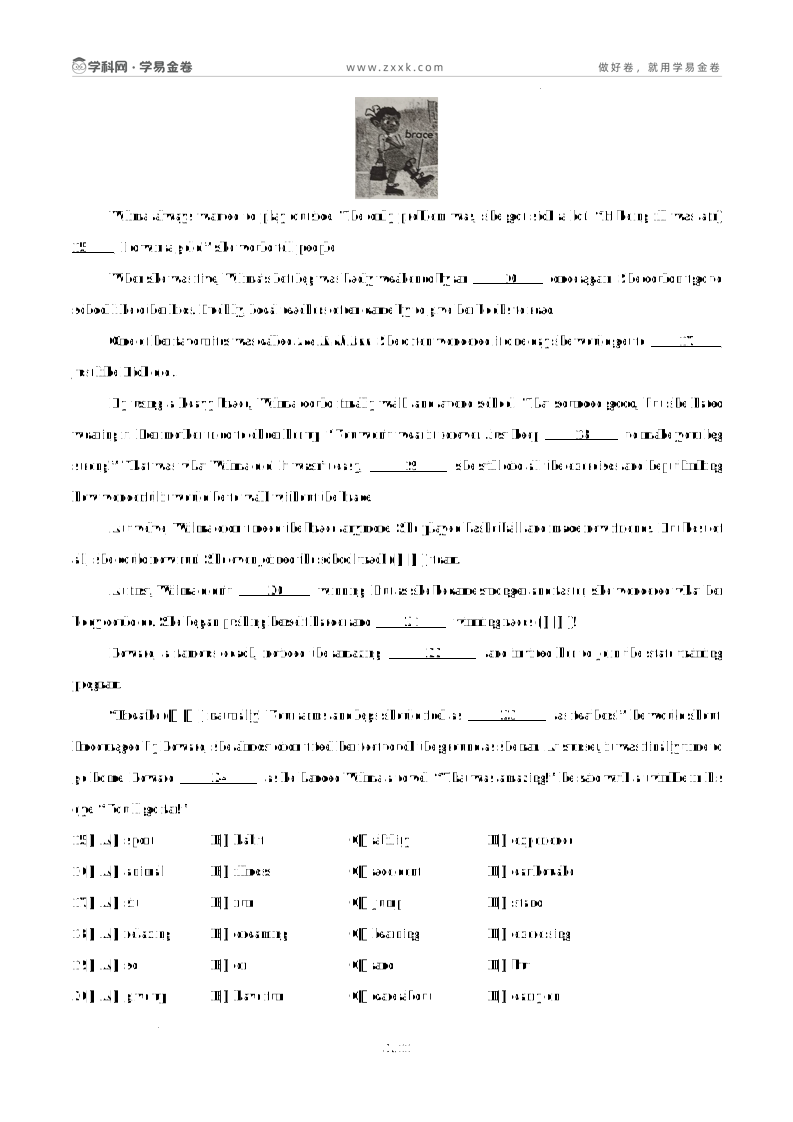
Wilma always wanted to play outside. The only problem was, she got sick a lot! “If being ill was a(n) 15 , I’d win a gold!” she would tell people.
When she was five, Wilma’s left leg was badly weakened by an 16 once again. She couldn’t go to school like other kids. Luckily, local teachers often came by to give her books to read.
One of her favourites was called See Dick Run. She often wondered if one day she would get to 17 , just like Dick did...
By using a heavy brace, Wilma could finally walk and attend school. That sounded good, but she hated wearing it. Her mother tried to cheer her up. “You won’t wear it forever. Just keep 18 to make your leg strong!” That was what Wilma did! It wasn’t easy, 19 she still did all the exercises and kept thinking how wonderful it would be to walk without the brace.
At twelve, Wilma didn’t need the brace anymore. She played basketball and made new friends. But best of all, she could now run! She even joined the school track (径赛) team.
At first, Wilma didn’t 20 winning. But as she became stronger and faster, she wondered what her body could do. She began pushing herself harder and 21 winning races (赛跑)!
Edward, a famous coach, noticed the amazing 22 and invited her to join the state training program.
“Breathe (呼吸) naturally! Your arms and legs should feel as 23 as feathers!” he would shout. Encouraged by Edward, she almost didn’t feel her feet touch the ground as she ran. At sunset, it was finally time to go home. Edward 24 as he handed Wilma a towel. “That was amazing!” he said with a twinkle in his eye. “You’ll go far!”
15.A.sport B.habit C.ability D.experience
16.A.animal B.illness C.accident D.earthquake
17.A.sit B.run C.jump D.stand
18.A.relaxing B.dreaming C.learning D.exercising
19.A.so B.or C.and D.but
20.A.give up B.have fun C.care about D.carry on
21.A.forgot B.minded C.finished D.started
22.A.runner B.swimmer C.climber D.rider
23.A.soft B.tidy C.light D.pretty
24.A.wrote B.smiled C.greeted D.complained
【答案】
15.A 16.B 17.B 18.D 19.D 20.C 21.D 22.A 23.C 24.B
【导语】本文讲述了一个名叫 Wilma 的女孩,她从小就经常生病,导致她的左腿变得虚弱。尽管如此,她通过不懈的努力和坚持锻炼,最终克服了困难,不仅能够正常行走,还能跑步并加入学校的田径队。在一位著名教练的鼓励和指导下,她不断进步,展现出了惊人的运动能力。
15.句意:如果生病是一种运动,我就能赢得金牌!
sport运动;habit习惯;ability能力;experience经历。根据“I’d win a gold”可知此处指她经常生病,所以如果生病是运动,自己会经常赢,。故选A。
16.句意:当她五岁的时候,Wilma 的左腿再次因为一场疾病而严重衰弱。
animal动物;illness疾病;accident事故;earthquake地震。根据“The only problem was, she got sick a lot”可知是因为一场疾病而严重衰弱。故选B。
17.句意:她常常想,有一天她是否也能像迪克一样跑步。
sit坐;run跑;jump跳;stand站。根据“One of her favourites was called See Dick Run”可知是像迪克一样跑步。故选B。
18.句意:只要继续锻炼,让你的腿变得强壮!
relaxing放松;dreaming梦;learning学习;exercising锻炼。根据“make your leg strong”可知是锻炼让腿变得强壮。故选D。
19.句意:这并不容易,但她仍然做了所有的练习,想着没有支架走路会是多么美妙的事情。
so所以;or或者;and和;but但是。前后两句是转折关系,用but连接。故选D。
20.句意:起初,Wilma并不在意获胜。
give up放弃;have fun玩得开心;care about关心;carry on继续。根据“But as she became stronger and faster, she wondered what her body could do”可知刚开始,她不在意赢。故选C。
21.句意:她开始更加努力地推动自己,并且开始赢得比赛!
forgot忘记;minded介意;finished完成;started开始。根据“She began pushing herself harder”可知她更加努力,所以开始赢得比赛。故选D。
22.句意:Edward,一位著名的教练,注意到了这位出色的跑步者,并邀请她加入州训练计划。
runner跑步者;swimmer游泳者;climber登山者;rider骑手。根据“winning races”可知是一名跑步者。故选A。
23.句意:你的胳膊和腿应该像羽毛一样轻!
soft柔软的;tidy整洁的;light轻的;pretty漂亮的。根据“feathers”可知是像羽毛一样轻。故选C。
24.句意:Edward微笑着递给Wilma一条毛巾。
wrote写;smiled微笑;greeted打招呼;complained抱怨。根据“That was amazing”可知他是微笑着的。故选B。
三、阅读理解 阅读下面的短文,然后根据短文内容,在每小题所给的四个选项中选出最佳选项。(本大题共13小题,每小题2分,共26分)
A
25.This poster can be most probably seen ________.
A.at a school B.at a cinema
C.in a company D.in a street
26.If Li Hua goes to see the film with her parents, they will pay _________ in all.
A.$7 B.$9 C.$10 D.$12
27.What can we learn from this poster?
①We need to buy tickets before June 27th.
②We can get free popcorn at family movie night.
③We’d better bring our own lawn chairs or blankets.
④The movie will be screened in the school dining hall if it rains.
A.①②③ B.②③④ C.①②④ D.①③④
【答案】25.A 26.D 27.A
【导语】本文是关于家庭电影夜晚的具体信息。
25.推理判断题。根据“EAST WOOD SCHOOL PTO PRESENTS”可以推断这个活动是在学校举行,故选A。
26.细节理解题。根据海报内容可知,孩子每个人2美元,家长每个人5美元,因此李华他们需要付12美元,故选D。
27.细节理解题。根据海报信息“buy tickets before June 27”、“free popcorn”以及“please bring your own lawn chair or blanket”可知,我们需要在6月27日之前购买门票,我们可以在家庭电影之夜获得免费爆米花,我们最好自带草坪椅或毯子。故选A。
B
Ron Clark is the writer of The Essential 55, a book about teaching students the rules for life. He helped many disadvantaged (弱势的) students and made a difference in their lives.
Clark’s story started at a primary school in North Carolina, the US. When he walked into his fifth-grade class, he met lots of problems. The children had little interest in studying and they often played or slept in class. To make a change, Clark wrote down 55 rules for them. Soon the students made progress in both study and life. They learned to respect others and to be the best of themselves.
Some rules from The Essential 55Rule 1: Make eye contact (交流).
Rule 2: Do your homework every night.
Rule 3: If someone asks you a question, you should ask a question in return.
Rule 4: Learn the names of other teachers in the school and greet them.
Rule 5: Do not save seats (占座) in the lunchroom.
Rule 6: Always say thank you when you receive something.
Rule 7: Never cut in line.
Clark doesn’t think it’s so hard to teach his students these rules. “I explain each rule, and then we role-play so that the students know how it works. The first week is just for practice. I will remind them of the rules they break. After this week, each time they break a rule, they need to go over it.” Clark hopes when his students leave his classroom, they can have skills that will help them for the rest of their lives.
28.What can we infer from the students’ changes according to the passage?
A.They disliked role-playing activities. B.Rules made them sleep more in class.
C.They still often cut in line after class. D.Clark’s rules helped them improve.
29.Here is an example. Which rule is it talking about?
A person asks, “How was your summer holiday?” It’s not polite enough to just say, “Good.” It’s better to say, “Good, thank you. How about yours?”
A.Rule 3. B.Rule 4. C.Rule 6. D.Rule 7.
30.What’s the main purpose of the article?
A.To list 55 school rules for students. B.To explain why rules are hard to follow.
C.To introduce a teacher’s ways of teaching. D.To recommend the book The Essential 55.
【答案】28.D 29.A 30.C
【导语】本文介绍罗恩・克拉克(Ron Clark),他著有《The Essential 55》,书中分享教导学生生活准则的55条规则。他在美国北卡罗来纳州小学任教时,面对问题学生,通过制定规则,让学生在学习和生活上进步,学会尊重他人、做最好的自己,展现其独特教学方式。
28.推理判断题。根据“Soon the students made progress in both study and life. They learned to respect others and to be the best of themselves.”可知,学生在学习和生活中进步。故选D。
29.细节理解题。根据“Rule 3: If someone asks you a question, you should ask a question in return.”可知,别人问问题,要回问;例子中“How was your summer holiday?”回应“Good, thank you. How about yours?”符合规则3。故选A。
30.主旨大意题。通读原文可知,本文主要介绍罗恩・克拉克用55条规则教学,帮助弱势学生,重点是他的教学方式。故选C。
C
“Where am I? ” said Oliver, lifting his head from his pillow. Mrs. Bedwin, Mr. Brownlow’s housekeeper, was sitting by Oliver’s bed. “Hush, my dear,” she said, “try to rest.” With these words, she smoothed Oliver’s hair back from his forehead.
“Imagine what your mother is thinking right now!” said Mrs. Bedwin.
“Perhaps she can see me,” whispered Oliver. “I feel she is here with me.”
“That was the fever, my dear,” said Mrs. Bedwin.
“I think it was,” said Oliver. “The angels are too happy in heaven to come to the bedside of a poor boy.” After saying these words, Oliver fell into a deep sleep.
Three days passed. Oliver was still too weak to walk, but he was able to sit in an armchair.
“You’re very kind to me, ma’am,” said Oliver.
“Just eat your soup,” said Mrs. Bedwin.
On the wall opposite there was a portrait (肖像画) of a young woman. Oliver stared at it. “What a beautiful face that lady has!” he said. But her eyes look so sad. She looks as if she is alive, and wants to speak to me.”
There was a soft knock at the door, and Mr. Brownlow came in.
“Poor boy,” said Mr. Brownlow. “How do you feel? ”
“Very happy, sir,” said Oliver, “and very grateful for your kindness to me.”
At that moment, Mr. Brownlow saw the similarity between Oliver’s features and another familiar (熟悉的) face.
“Mrs. Bedwin,” he said, “look at this! ” He pointed to the portrait on the wall and then to Oliver’s face. Oliver was the living copy of the portrait. The eyes, the head, the mouth… every feature was the same.
31.Where was Oliver at the very beginning?
A.On the bed. B.In an armchair. C.At the door. D.On the wall.
32.Which of the following pictures shows the change of Oliver’s feelings?
A. B. C. D.
33.Who might be the young woman in the portrait?
A.Mrs. Bedwin. B.Bedwin’s sister. C.Mrs. Brownlow. D.Oliver’s mother.
【答案】31.A 32.B 33.D
【导语】本文主要讲述了《雾都孤儿》中的片段,奥利弗因病重昏迷,布朗洛先生收留了他并悉心照料,并发现奥利弗的容貌酷似一幅少妇的画像。
31.细节理解题。根据第一段“‘Where am I?’ said Oliver, lifting his head from his pillow. Mrs. Bedwin, Mr. Brownlow’s housekeeper, was sitting by Oliver’s bed.”可知,奥利弗从枕头上抬起头来询问自己在哪里,布朗洛先生的管家比德温太太正坐在奥利弗的床边,说明刚开始奥利弗是在床上。故选A。
32.推理判断题。根据“‘The angels are too happy in heaven to come to the bedside of a poor boy.’ After saying these words, Oliver fell into a deep sleep.”可知,奥利弗觉得天上的天使们太快乐了,不会来到一个可怜男孩的床边,说明刚开始奥利弗是悲伤的;再根据“‘Very happy, sir,’ said Oliver, ‘and very grateful for your kindness to me.’”可知,奥利弗对布朗洛先生说自己很开心,并感谢布朗洛先生的好意,说明这时候奥利弗是开心的,由此可见奥利弗的感受是从伤心到开心。故选B。
33.推理判断题。根据最后一段“Oliver was the living copy of the portrait. The eyes, the head, the mouth… every feature was the same.”可知,奥利弗就是这幅肖像画的复制品,眼睛、头、嘴……每个特征都是一样的,说明画像上的年轻妇人很可能是奥利弗的母亲。故选D。
D
AI is shaking up the world now. It has been widely used in many different fields.
AI in Communication
Chatbots (聊天机器人), a kind of AI-driven tool, have become a necessary part of modern communication. They can understand and reply to users at once. Whether it’s on websites or mobile apps, chatbots can offer support in real time. Besides, AI users can control smart home tools through voice orders. AI is reshaping (重塑) the way we communicate in our daily lives.
AI in Transportation
AI makes a big difference to traffic. For example, some ride-sharing platforms (拼车平台) depend heavily on AI. They use AI to match passengers with drivers and provide better transportation services. And self-driving cars are a main example of AI’s use in transportation, too. With the help of AI, they can reduce accidents and help those unable to drive.
AI in Education
AI provides a smart way to education. It changes the way teachers teach and students learn. AI in classrooms can make teaching and learning more interesting, which helps students focus more on their studies. AI can also offer students support outside classrooms. For example, it can help with homework, answer questions, and provide explanations. By analyzing (分析) students’advantages, weaknesses and learning needs, AI can make suitable study plans for them. This can help students achieve their learning goals easier.
All in all, AI is shaping and will continue to shape our everyday experiences.
34.How do the AI users control smart home tools?
A.Through mobile phone. B.Through internet.
C.Through website. D.Through voice orders.
35.What does Paragraph 3 mainly talk about?
A.Research on AI in transportation.
B.Suggestions on AI in transportation.
C.Problems of AI in transportation.
D.Advantages of AI in transportation.
36.What does the underlined word “suitable” in Paragraph 4 mean?
A.New. B.Proper (合适的). C.Simple. D.Different.
37.Which of the following shows the structure (结构) of the passage?
A.①/②③④⑤ B.①/②③④/⑤
C.①②③④/⑤ D.①/②/③④⑤
【答案】34.D 35.D 36.B 37.B
【导语】本文介绍了AI 在通信聊天机器人、语音控制智能家居、交通拼车平台、自动驾驶、教育领域改变教学模式、定制学习计划领域应用,展现其对生活的辅助作用。
34.细节理解题。根据“Besides, AI users can control smart home tools through voice orders.”可知,人工智能用户通过语音指令控制智能家庭工具。故填D。
35.主旨大意题。根据“AI makes a big difference to traffic. For example...AI’s use in transportation, too. With the help of AI, they can reduce accidents and help those unable to drive.”可知,第三段主要讲人工智能在交通领域的优势。故填D。
36.词义猜测题。根据“By analyzing (分析) students’ advantages, weaknesses and learning needs, AI can make suitable study plans for them.”可知,通过分析学生的优缺点和学习需求,人工智能能制定合适的学习计划,“suitable”意思是“合适的”。故填B。
37.篇章结构题。第一段总述人工智能在很多领域广泛应用;第二、三、四段分别讲人工智能在通信、交通、教育领域的应用;第五段总结人工智能塑造并将继续塑造我们的日常体验。结构是①/②③④/⑤。故填B。
第II卷(非选择题共50分)
四、词汇运用(本大题共10小题,每小题1分,共10分)
(A)根据句意和汉语注释,写出单词的正确形式。
38.Nobody ________ (预料) the team to win the game, but they did anyway.
【答案】expected
【详解】句意:没有人预料到这个队伍会赢得比赛,但是无论怎样,他们做到了。expect“预料”,根据“but they did anyway”可知,句子为一般过去时,expect的过去式为expected。故填expected。
39.The doctor gave me some medicine to ______ (治疗) my cough.
【答案】treat
【详解】句意:医生给了我一些药来治疗我的咳嗽。此句用动词不定式表示医生开药的目的是治疗咳嗽,空处填动词原形。“治疗”用动词treat。故填treat。
40.Students should spend both time and money ________ (明智地).
【答案】wisely
【详解】句意:学生应该明智地使用时间和金钱。根据中文提示,wisely“明智地”符合题意,修饰动词“spend”。故填wisely。
41.It’s bad ________ (礼貌) to cut in on others when they are talking.
【答案】manners
【详解】句意:别人说话时插嘴是不礼貌的。根据“It’s bad...to cut in on others when they are talking.”及汉语提示可知此处表示在别人说话时插嘴是不礼貌的,名词manners意为“礼貌;礼仪”,常用复数形式,“bad manners”是固定搭配,意为“不礼貌的行为”。故填manners。
42.Please avoid littering in the streets, or you will be ________ (惩罚).
【答案】punished
【详解】句意:请勿在街上乱扔垃圾,否则你将受到惩罚。punish“惩罚”,此处是一般将来时的被动语态,动词用过去分词。故填punished。
(B)根据句意,写出括号内所给单词的适当形式。
43.The smart cleaning robot, after sweeping the floor, can clean ________ (it) to stay dust-free without our help.
【答案】itself
【详解】句意:这个智能清洁机器人在清扫完地板后,不用我们帮忙就能自我清洁以保持无尘。根据“The smart cleaning robot, after sweeping the floor, can clean...”以及提示词“it”可知,此处表示机器人自己清洁自己,应用反身代词。it的反身代词是itself“它自己”。故填itself。
44.It was an unforgettable experience. They had the four ________ (month) journey through the desert to have a close look at the wildlife.
【答案】months’
【详解】句意:那是一次难忘的经历。他们花了四个月的时间穿越沙漠,以便近距离观察野生动物。根据“four...journey”可知,此处需要一个形容词来修饰“journey”,“month”的复数形式的所有格“months’”来表示“四个月的”旅程。故填months’。
45.The man depended on your dog to make his way home because of his ________ (blind).
【答案】blindness
【详解】句意:那个人因为失明,要靠你的狗帮他回家。his是形容词性物主代词,后接名词,blindness“失明”,是名词。故填blindness。
46.We all know that nothing is ________ (possible) if we put our whole heart into it.
【答案】impossible
【详解】句意:我们都知道,如果我们全心投入,没有什么是不可能的。possible“可能的”,形容词。根据“nothing is… if we put our whole heart into it”可知,此处指如果全身心投入,没什么不可能。impossible“不可能的”,形容词,作表语。故填impossible。
47.Jimmy felt ________ (pride) than anyone else because he was recommended as “the Most Helpful Student” in our school.
【答案】prouder
【详解】句意:吉米比任何人都感到自豪,因为他被推荐为我们学校的“最乐于助人的学生”。根据句中的“than”可知,此处应用形容词的比较级形式,“pride”的形容词形式是“proud”,其比较级为“prouder”。故填prouder。
五、动词填空 根据句意,用括号内所给动词的适当形式填空。(本大题共10小题,每小题1分,共10分)
48.After the task you promised ________ (finish) and review, we’ll start the next one.
【答案】to finish
【详解】句意:在这个你承诺完成并审查的任务后,我们将开始下一个。根据“you promised ... ”可知,promise to do sth“承诺做某事”。故填to finish。
49.—With the development of AI, many students are used to ________ (choose) AI study tools to help with study matters.
—It is important for them to use AI tools wisely.
【答案】choosing
【详解】句意:——随着人工智能的发展,许多学生习惯于选择人工智能学习工具来帮助解决学习问题。——明智地使用人工智能工具对他们来说很重要。be used to后面接动词的ing形式,表示“习惯于做某事”。根据题干中的句子“With the development of AI, many students are used to…AI study tools to help with study matters.”可知,学生们习惯于选择人工智能学习工具来帮助他们学习。因此,应该选择动词choose的动名词形式choosing。故填choosing。
50.China Post will sell special stamps ________ (celebrate) the 100th birthday of the Palace Museum in October 2025.
【答案】to celebrate
【详解】句意:中国邮政将于2025年10月发行特别邮票,以庆祝故宫博物院成立100周年。celebrate“庆祝”,动词,空格处需填入动词的非谓语形式,表示发行邮票的目的。“to celebrate”在此作目的状语,说明动作sell“卖,发行”的目的。故填to celebrate。
51.The old man is seen ________ (walk) slowly along the quiet street every day after breakfast, enjoying the fresh air.
【答案】to walk
【详解】句意:人们看到这位老人每天早饭后沿着安静的街道慢慢散步,享受新鲜空气。根据“the old man”和“seen”可知,此处使用了被动语态“is seen”,“see sb. do sth.”是主动语态的固定搭配,意为“看见某人做某事”。当该结构变为被动语态时,需还原省略的不定式符号“to”,即“be seen to do sth.”。因此其后需接带“to”的不定式“to walk”。故填to walk。
52.I prefer ________ (get) up early in the morning to have enough time for a healthy breakfast.
【答案】getting
【详解】句意:我更喜欢早起,以便有足够的时间吃一顿健康的早餐。结合语境可知,此处强调一种长期的习惯或持续性的爱好,应用结构prefer doing sth,表示“更喜欢做某事”,故填getting。
53.Take a smartphone with you when travelling, or you ________ (lose) your way in a strange place.
【答案】will lose
【详解】句意:旅行时随身携带智能手机,否则你会在一个陌生的地方迷路。分析句子可知,此处是“祈使句+ or+陈述句”,此时的陈述句表示对未来的推测或警告,应用一般将来时的“will+动词原形”,此处表示“不带手机可能会在陌生的地方迷路”。故填will lose。
54.Our teacher reminds us ________(take)enough water when we go hiking.
【答案】to take
【详解】句意:当我们去徒步旅行时,我们的老师提醒我们带足够的水。根据句意,remind sb. to do sth.提醒某人去做某事,所以这里需要填动词不定式,故填to take。
55.I didn’t hear the phone ring last night because I ________ (sleep)soundly at that time.
【答案】was sleeping
【详解】句意:昨晚我没听到电话铃声,因为当时我正睡得很沉。时间状语“at that time”是过去进行时的典型标志,表示过去某一时刻正在进行的动作,结构为“was/were + 现在分词”,主语是I,所以助动词用was,故填was sleeping。
56.You look exhausted. You had better ________ (not stay) up late tonight.
【答案】not stay
【详解】句意:你看起来精疲力竭。今晚最好别熬夜。had better+动词原形,意为“最好不要做某事”,所以,此处应填not stay。
57.The manager won’t leave until 90 percent of the work _________ (finish) by the workers.
【答案】is finished
【详解】句意:经理要等工人们完成百分之九十的工作才会离开。not...until“直到……才”引导时间状语从句,主句是一般将来时won’t leave,从句需要用一般现在时表将来; 从句主语the work和动词finish为被动关系,要用被动语态“be+过去分词”;work是不可数名词,be动词用一般现在时的is,finish的过去分词是finished,故填is finished。
六、阅读表达 阅读下面的短文,然后根据短文内容回答问题,每小题答案不超过10个单词。(本大题共5小题,每小题2分,共10分)
The wind carried the good smell of fallen leaves and apples through the garden. I followed Grandpa as we walked along the rows of apple trees, each branch heavy with fruit. The sun hung low in the sky, making long golden shadows across the ground. Birds sang cheerfully and the air was fresh.
Grandpa stopped by an old tree with large branches and touched its rough trunk. “Let’s pick the apples here,” he said, handing me a basket.
I climbed on tiptoes to reach the juiciest apples and the basket began to be filled up quickly. I was proud of what I did. My hands smelled sweet from the apples, and I could already imagine the pies Grandma would make. Just then, I noticed a robin (知更鸟) picking a shiny red apple and flying towards a small nest (巢) hidden between the leaves. I tiptoed closer and looked inside the nest. There were tiny birds chirping softly, their beaks wide open, waiting for food. The robin placed the apple near them and gently fed the little ones. And I noticed how carefully it broke the apple into tiny pieces.
I froze. The apple I had just picked dropped from my fingers and landed with a soft sound on the ground. I looked at my basket, full of apples, and then at the robin’s nest. A wave of sorry washed over me. These apples weren’t just ours—they were part of the life here in the garden. Without thinking, I picked a few apples from my basket and put them carefully by the nest, “For your little ones.”
When I returned to Grandpa, he noticed my basket wasn’t as full as before. “What happened?” he asked.
I smiled shyly, “I shared some apples with the robin.”
Grandpa nodded, “Good work.”
I felt warm inside. The apples in my basket seemed sweeter than ever.
58.What were Grandpa and I going to do in the garden?
59.How did I feel when the basket was filled up with apples?
60.Why did the robin pick the apple and fly towards the nest?
61.Where did I put some apples in my basket?
62.Do you often share something with others? Why or why not?
【答案】58.(They were going to) Pick (the) apples (in the garden). 59.(I was/felt) Proud (of what I did/my job). 60.(Because) It should/wanted to/needed to feed tiny birds/its children/kids./To feed tiny birds/its children/kids. 61.By the (bird’s) nest. 62.Yes, because sharing makes me happy./No, because they can get their own.
【导语】本文讲述的是作者和爷爷在花园里摘苹果,作者看到知更鸟用苹果喂雏鸟的情景后,主动将摘到的苹果分给小鸟,最终得到爷爷认可的故事。
58.根据文中“Let’s pick the apples here”可知,作者和爷爷打算在花园里摘苹果,故填(They were going to) Pick (the) apples (in the garden).
59.根据文中“I was proud of what I did”可知,当篮子装满苹果时,作者感到自豪,故填(I was/felt) Proud (of what I did/my job).
60.根据文中“waiting for food”和“fed the little ones”可知,知更鸟摘苹果是为了喂雏鸟,故填(Because) It /should/wanted to/needed to feed tiny birds/its children/kids. /To feed tiny birds/its children/kids.
61.根据文中“put them carefully by the nest”可知,作者将苹果放在了鸟巢旁边,故填By the (bird’s) nest.
62.本题为开放性问题,答案需体现分享意识并给出合理理由。肯定回答“Yes, because sharing makes me happy”;否定回答需说明不分享的原因,如“No, because they can get their own”表示他人可自给自足,逻辑合理即可。故填Yes, because sharing makes me happy./No, because they can get their own.
七、书面表达 (本大题共20分)
上个月新华书店举行了“来这里,读世界”(Read the Word, Read the World)的主题活动,你作为校方代表做了读书心得交流,为了鼓励其他同学热爱阅读,你校英华电视台正在开展征文活动,要求介绍你的那次活动经历。你草拟了写作流程图,请根据下图用英语写一篇短文参加活动。
注意事项:
1.短文须根据流程图自拟,要求语句通顺、意思连贯、符合题意;
2.流程图中■部分非限定性内容,仅供参考;
3.词数在90个左右,短文开头已在答题卡上给出,不计入总词数;
4.短文中不得使用真实的个人姓名或学校名称;
5.短文必须写在答题卡指定的位置上。
Read the word, read the world! Last month, Xinhua Bookstore held a theme event to ________________________________________________________________________________________________________________________________________________________________________________________________________________________________________________________________________________________________________________
【答案】例文:
Read the word, read the world! Last month, Xinhua Bookstore held a theme event to encourage students to love reading. During the activity, some gave reading reports to share their main thoughts, while others did book reviews to express their ideas.
The book I talked about was Ordinary World by Lu Yao. I chose it because it shows how ordinary people face big difficulties but never give up. It teaches us about hope and working hard for our dreams.
The activity was meaningful. It let me connect with other book lovers. I hope more students will pick up books and explore different worlds through reading.
【详解】[总体分析]
①题材:本文是一篇材料作文。
②时态:时态以“一般过去时”为主。
③提示:文章围绕活动展开,考生可进行适当拓展,使内容更为丰富。
[写作步骤]
第一步,表明写作意图。开篇引出下文关于活动的介绍。
第二步,具体阐述写作内容。从“活动举办方、活动中的不同表现、自己分享的书籍及原因、活动的意义”这几个方面进行详细描述。
第三步,书写结语。呼吁更多的人加入,进行情感升华。
[亮点词汇]
①connect with与……联系
[高分句型]
①I chose it because it shows how ordinary people face big difficulties but never give up, teaching us about hope and working hard for our dreams. (because引导原因状语从句;how引导的宾语从句)
试卷第1页,共3页
1 / 19
学科网(北京)股份有限公司
$………………○………………内………………○………………装………………○………………订………………○………………线………………○………………
………………○………………外………………○………………装………………○………………订………………○………………线………………○………………
此卷只装订不密封
………………○………………内………………○………………装………………○………………订………………○………………线………………○………………
………………○………………外………………○………………装………………○………………订………………○………………线………………○………………
… 学校:______________姓名:_____________班级:_______________考号:______________________
2025-2026学年八年级下学期期末模拟卷(无锡专用)
英语
(考试时间:100分钟 试卷满分:100分)
注意事项:
1.本试卷分选择题和非选择题两部分。答卷前,考生务必将自己的姓名、准考证号填写在答题卡上。
2.回答选择题时,选出每小题答案后,用2B铅笔把答题卡上对应题目的答案标号涂黑。如需改动,用橡皮擦干净后,再选涂其他答案标号。写在本试卷上无效。
3.回答非选择题时,必须用黑色字迹的签字笔或者钢笔将答案写在答题卡相应位置上。写在本试卷上无效。
4.测试范围:八年级下册(新教材译林版)。
5. 难度系数:0.65。
6.考试结束后,将本试卷和答题卡一并交回。
第1卷(选择题 共50分)
一、单项选择 在A、B、C、D四个选项中,选出可以填入空白处的最佳选项。(本大题共14小题,每小题1分,共14分)
1.—I want to visit the Slender West Lake. Could you please tell me something about it?
—Sorry, I know just a little. You can read the ________ on its website.
A.interview B.introduction C.conversation D.conclusion
2.—Why waste time studying? It feels useless sometimes.
—Just remember that the beautiful thing about learning is ________ can take it away from you.
A.someone B.everyone C.nobody D.anybody
3.—It is kind _________ you to help me with my math, Jenny.
—That’s OK. It is necessary _________ us to help each other and work as a team.
A.of; of B.for; for C.for; of D.of; for
4.—Mum, I wonder if I can take part in the summer camp.
—Sure. You are ________ to decide things by yourself.
A.too old B.too young C.old enough D.enough old
5.The book is quite difficult to understand, __________for the children under 10.
A.especially B.finally C.mostly D.hardly
6.In order to better protect giant pandas, we need to help ________ the giant pandas to go back to the wild.
A.count B.donate C.train D.invite
7.— What can we do for Project Hope?
— We can ________ leaflets to people in the street to collect things for it.
A.take out B.hand out C.find out D.put out
8.—Jiangsu City Football League ________ people’s attention in China.
—The news about it is on the hot search.
A.attracted B.has attracted C.attracts D.will attract
9.—Can you tell me ________ people in the UK when we first meet each other?
—Yes. You can say “hello” or “nice to meet you” and shake your hand.
A.how to greet B.where to greet C.what to greet D.when to greet
10.—Must I bring my student card to renew these two books?
—No, you ________. You must bring your library card.
A.can’t B.may not C.don’t have to D.mustn’t
11.Plastic bottles and waste paper________ carefully by workers every day to make the environment better.
A.separate B.were separated
C.have separated D.are separated
12.The restaurants in Shi Jin District in Rugao ________ for several months, but I ________ there so far.
A.have been open; haven’t been B.have opened; haven’t gone
C.have been open; haven’t gone D.have opened; haven’t been
13.The students were asked ________ some interesting pictures for the sick kids.
A.draw B.to draw C.drawing D.to drawing
14.—It was very kind of you to help me look after my dog while I was away.
—________. I’m a dog person.
A.My pleasure B.With pleasure C.Not at all D.Never mind
二、完形填空 阅读下面的短文,然后根据短文内容,在每小题所给的四个选项中,选出可以填入空白处的最佳选项。(本大题共10小题,每小题1分,共10分)
Wilma always wanted to play outside. The only problem was, she got sick a lot! “If being ill was a(n) 15 , I’d win a gold!” she would tell people.
When she was five, Wilma’s left leg was badly weakened by an 16 once again. She couldn’t go to school like other kids. Luckily, local teachers often came by to give her books to read.
One of her favourites was called See Dick Run. She often wondered if one day she would get to 17 , just like Dick did...
By using a heavy brace, Wilma could finally walk and attend school. That sounded good, but she hated wearing it. Her mother tried to cheer her up. “You won’t wear it forever. Just keep 18 to make your leg strong!” That was what Wilma did! It wasn’t easy, 19 she still did all the exercises and kept thinking how wonderful it would be to walk without the brace.
At twelve, Wilma didn’t need the brace anymore. She played basketball and made new friends. But best of all, she could now run! She even joined the school track (径赛) team.
At first, Wilma didn’t 20 winning. But as she became stronger and faster, she wondered what her body could do. She began pushing herself harder and 21 winning races (赛跑)!
Edward, a famous coach, noticed the amazing 22 and invited her to join the state training program.
“Breathe (呼吸) naturally! Your arms and legs should feel as 23 as feathers!” he would shout. Encouraged by Edward, she almost didn’t feel her feet touch the ground as she ran. At sunset, it was finally time to go home. Edward 24 as he handed Wilma a towel. “That was amazing!” he said with a twinkle in his eye. “You’ll go far!”
15.A.sport B.habit C.ability D.experience
16.A.animal B.illness C.accident D.earthquake
17.A.sit B.run C.jump D.stand
18.A.relaxing B.dreaming C.learning D.exercising
19.A.so B.or C.and D.but
20.A.give up B.have fun C.care about D.carry on
21.A.forgot B.minded C.finished D.started
22.A.runner B.swimmer C.climber D.rider
23.A.soft B.tidy C.light D.pretty
24.A.wrote B.smiled C.greeted D.complained
三、阅读理解 阅读下面的短文,然后根据短文内容,在每小题所给的四个选项中选出最佳选项。(本大题共13小题,每小题2分,共26分)
A
25.This poster can be most probably seen ________.
A.at a school B.at a cinema
C.in a company D.in a street
26.If Li Hua goes to see the film with her parents, they will pay _________ in all.
A.$7 B.$9 C.$10 D.$12
27.What can we learn from this poster?
①We need to buy tickets before June 27th.
②We can get free popcorn at family movie night.
③We’d better bring our own lawn chairs or blankets.
④The movie will be screened in the school dining hall if it rains.
A.①②③ B.②③④ C.①②④ D.①③④
B
Ron Clark is the writer of The Essential 55, a book about teaching students the rules for life. He helped many disadvantaged (弱势的) students and made a difference in their lives.
Clark’s story started at a primary school in North Carolina, the US. When he walked into his fifth-grade class, he met lots of problems. The children had little interest in studying and they often played or slept in class. To make a change, Clark wrote down 55 rules for them. Soon the students made progress in both study and life. They learned to respect others and to be the best of themselves.
Some rules from The Essential 55Rule 1: Make eye contact (交流).
Rule 2: Do your homework every night.
Rule 3: If someone asks you a question, you should ask a question in return.
Rule 4: Learn the names of other teachers in the school and greet them.
Rule 5: Do not save seats (占座) in the lunchroom.
Rule 6: Always say thank you when you receive something.
Rule 7: Never cut in line.
Clark doesn’t think it’s so hard to teach his students these rules. “I explain each rule, and then we role-play so that the students know how it works. The first week is just for practice. I will remind them of the rules they break. After this week, each time they break a rule, they need to go over it.” Clark hopes when his students leave his classroom, they can have skills that will help them for the rest of their lives.
28.What can we infer from the students’ changes according to the passage?
A.They disliked role-playing activities. B.Rules made them sleep more in class.
C.They still often cut in line after class. D.Clark’s rules helped them improve.
29.Here is an example. Which rule is it talking about?
A person asks, “How was your summer holiday?” It’s not polite enough to just say, “Good.” It’s better to say, “Good, thank you. How about yours?”
A.Rule 3. B.Rule 4. C.Rule 6. D.Rule 7.
30.What’s the main purpose of the article?
A.To list 55 school rules for students. B.To explain why rules are hard to follow.
C.To introduce a teacher’s ways of teaching. D.To recommend the book The Essential 55.
C
“Where am I? ” said Oliver, lifting his head from his pillow. Mrs. Bedwin, Mr. Brownlow’s housekeeper, was sitting by Oliver’s bed. “Hush, my dear,” she said, “try to rest.” With these words, she smoothed Oliver’s hair back from his forehead.
“Imagine what your mother is thinking right now!” said Mrs. Bedwin.
“Perhaps she can see me,” whispered Oliver. “I feel she is here with me.”
“That was the fever, my dear,” said Mrs. Bedwin.
“I think it was,” said Oliver. “The angels are too happy in heaven to come to the bedside of a poor boy.” After saying these words, Oliver fell into a deep sleep.
Three days passed. Oliver was still too weak to walk, but he was able to sit in an armchair.
“You’re very kind to me, ma’am,” said Oliver.
“Just eat your soup,” said Mrs. Bedwin.
On the wall opposite there was a portrait (肖像画) of a young woman. Oliver stared at it. “What a beautiful face that lady has!” he said. But her eyes look so sad. She looks as if she is alive, and wants to speak to me.”
There was a soft knock at the door, and Mr. Brownlow came in.
“Poor boy,” said Mr. Brownlow. “How do you feel? ”
“Very happy, sir,” said Oliver, “and very grateful for your kindness to me.”
At that moment, Mr. Brownlow saw the similarity between Oliver’s features and another familiar (熟悉的) face.
“Mrs. Bedwin,” he said, “look at this! ” He pointed to the portrait on the wall and then to Oliver’s face. Oliver was the living copy of the portrait. The eyes, the head, the mouth… every feature was the same.
31.Where was Oliver at the very beginning?
A.On the bed. B.In an armchair. C.At the door. D.On the wall.
32.Which of the following pictures shows the change of Oliver’s feelings?
A. B. C. D.
33.Who might be the young woman in the portrait?
A.Mrs. Bedwin. B.Bedwin’s sister. C.Mrs. Brownlow. D.Oliver’s mother.
D
AI is shaking up the world now. It has been widely used in many different fields.
AI in Communication
Chatbots (聊天机器人), a kind of AI-driven tool, have become a necessary part of modern communication. They can understand and reply to users at once. Whether it’s on websites or mobile apps, chatbots can offer support in real time. Besides, AI users can control smart home tools through voice orders. AI is reshaping (重塑) the way we communicate in our daily lives.
AI in Transportation
AI makes a big difference to traffic. For example, some ride-sharing platforms (拼车平台) depend heavily on AI. They use AI to match passengers with drivers and provide better transportation services. And self-driving cars are a main example of AI’s use in transportation, too. With the help of AI, they can reduce accidents and help those unable to drive.
AI in Education
AI provides a smart way to education. It changes the way teachers teach and students learn. AI in classrooms can make teaching and learning more interesting, which helps students focus more on their studies. AI can also offer students support outside classrooms. For example, it can help with homework, answer questions, and provide explanations. By analyzing (分析) students’advantages, weaknesses and learning needs, AI can make suitable study plans for them. This can help students achieve their learning goals easier.
All in all, AI is shaping and will continue to shape our everyday experiences.
34.How do the AI users control smart home tools?
A.Through mobile phone. B.Through internet.
C.Through website. D.Through voice orders.
35.What does Paragraph 3 mainly talk about?
A.Research on AI in transportation.
B.Suggestions on AI in transportation.
C.Problems of AI in transportation.
D.Advantages of AI in transportation.
36.What does the underlined word “suitable” in Paragraph 4 mean?
A.New. B.Proper (合适的). C.Simple. D.Different.
37.Which of the following shows the structure (结构) of the passage?
A.①/②③④⑤ B.①/②③④/⑤
C.①②③④/⑤ D.①/②/③④⑤
第II卷(非选择题共50分)
四、词汇运用(本大题共10小题,每小题1分,共10分)
(A)根据句意和汉语注释,写出单词的正确形式。
38.Nobody ________ (预料) the team to win the game, but they did anyway.
39.The doctor gave me some medicine to ______ (治疗) my cough.
40.Students should spend both time and money ________ (明智地).
41.It’s bad ________ (礼貌) to cut in on others when they are talking.
42.Please avoid littering in the streets, or you will be ________ (惩罚).
(B)根据句意,写出括号内所给单词的适当形式。
43.The smart cleaning robot, after sweeping the floor, can clean ________ (it) to stay dust-free without our help.
44.It was an unforgettable experience. They had the four ________ (month) journey through the desert to have a close look at the wildlife.
45.The man depended on your dog to make his way home because of his ________ (blind).
46.We all know that nothing is ________ (possible) if we put our whole heart into it.
47.Jimmy felt ________ (pride) than anyone else because he was recommended as “the Most Helpful Student” in our school.
五、动词填空 根据句意,用括号内所给动词的适当形式填空。(本大题共10小题,每小题1分,共10分)
48.After the task you promised ________ (finish) and review, we’ll start the next one.
49.—With the development of AI, many students are used to ________ (choose) AI study tools to help with study matters.
—It is important for them to use AI tools wisely.
50.China Post will sell special stamps ________ (celebrate) the 100th birthday of the Palace Museum in October 2025.
51.The old man is seen ________ (walk) slowly along the quiet street every day after breakfast, enjoying the fresh air.
52.I prefer ________ (get) up early in the morning to have enough time for a healthy breakfast.
53.Take a smartphone with you when travelling, or you ________ (lose) your way in a strange place.
54.Our teacher reminds us ________(take)enough water when we go hiking.
55.I didn’t hear the phone ring last night because I ________ (sleep)soundly at that time.
56.You look exhausted. You had better ________ (not stay) up late tonight.
57.The manager won’t leave until 90 percent of the work _________ (finish) by the workers.
六、阅读表达 阅读下面的短文,然后根据短文内容回答问题,每小题答案不超过10个单词。(本大题共5小题,每小题2分,共10分)
The wind carried the good smell of fallen leaves and apples through the garden. I followed Grandpa as we walked along the rows of apple trees, each branch heavy with fruit. The sun hung low in the sky, making long golden shadows across the ground. Birds sang cheerfully and the air was fresh.
Grandpa stopped by an old tree with large branches and touched its rough trunk. “Let’s pick the apples here,” he said, handing me a basket.
I climbed on tiptoes to reach the juiciest apples and the basket began to be filled up quickly. I was proud of what I did. My hands smelled sweet from the apples, and I could already imagine the pies Grandma would make. Just then, I noticed a robin (知更鸟) picking a shiny red apple and flying towards a small nest (巢) hidden between the leaves. I tiptoed closer and looked inside the nest. There were tiny birds chirping softly, their beaks wide open, waiting for food. The robin placed the apple near them and gently fed the little ones. And I noticed how carefully it broke the apple into tiny pieces.
I froze. The apple I had just picked dropped from my fingers and landed with a soft sound on the ground. I looked at my basket, full of apples, and then at the robin’s nest. A wave of sorry washed over me. These apples weren’t just ours—they were part of the life here in the garden. Without thinking, I picked a few apples from my basket and put them carefully by the nest, “For your little ones.”
When I returned to Grandpa, he noticed my basket wasn’t as full as before. “What happened?” he asked.
I smiled shyly, “I shared some apples with the robin.”
Grandpa nodded, “Good work.”
I felt warm inside. The apples in my basket seemed sweeter than ever.
58.What were Grandpa and I going to do in the garden?
59.How did I feel when the basket was filled up with apples?
60.Why did the robin pick the apple and fly towards the nest?
61.Where did I put some apples in my basket?
62.Do you often share something with others? Why or why not?
七、书面表达 (本大题共20分)
上个月新华书店举行了“来这里,读世界”(Read the Word, Read the World)的主题活动,你作为校方代表做了读书心得交流,为了鼓励其他同学热爱阅读,你校英华电视台正在开展征文活动,要求介绍你的那次活动经历。你草拟了写作流程图,请根据下图用英语写一篇短文参加活动。
注意事项:
1.短文须根据流程图自拟,要求语句通顺、意思连贯、符合题意;
2.流程图中■部分非限定性内容,仅供参考;
3.词数在90个左右,短文开头已在答题卡上给出,不计入总词数;
4.短文中不得使用真实的个人姓名或学校名称;
5.短文必须写在答题卡指定的位置上。
Read the word, read the world! Last month, Xinhua Bookstore held a theme event to ________________________________________________________________________________________________________________________________________________________________________________________________________________________________________________________________________________________________________________
试题 第7页(共10页) 试题 第8页(共10页)
试题 第9页(共10页) 试题 第10页(共10页)
学科网(北京)股份有限公司
学科网(北京)股份有限公司
学科网(北京)股份有限公司
$
2025-2026学年八年级下学期期末模拟卷(无锡专用)
英语
(考试时间:100分钟 试卷满分:100分)
注意事项:
1.本试卷分选择题和非选择题两部分。答卷前,考生务必将自己的姓名、准考证号填写在答题卡上。
2.回答选择题时,选出每小题答案后,用2B铅笔把答题卡上对应题目的答案标号涂黑。如需改动,用橡皮擦干净后,再选涂其他答案标号。写在本试卷上无效。
3.回答非选择题时,必须用黑色字迹的签字笔或者钢笔将答案写在答题卡相应位置上。写在本试卷上无效。
4.测试范围:八年级下册(新教材译林版)。
5. 难度系数:0.65。
6.考试结束后,将本试卷和答题卡一并交回。
第1卷(选择题 共50分)
一、单项选择 在A、B、C、D四个选项中,选出可以填入空白处的最佳选项。(本大题共14小题,每小题1分,共14分)
1.—I want to visit the Slender West Lake. Could you please tell me something about it?
—Sorry, I know just a little. You can read the ________ on its website.
A.interview B.introduction C.conversation D.conclusion
2.—Why waste time studying? It feels useless sometimes.
—Just remember that the beautiful thing about learning is ________ can take it away from you.
A.someone B.everyone C.nobody D.anybody
3.—It is kind _________ you to help me with my math, Jenny.
—That’s OK. It is necessary _________ us to help each other and work as a team.
A.of; of B.for; for C.for; of D.of; for
4.—Mum, I wonder if I can take part in the summer camp.
—Sure. You are ________ to decide things by yourself.
A.too old B.too young C.old enough D.enough old
5.The book is quite difficult to understand, __________for the children under 10.
A.especially B.finally C.mostly D.hardly
6.In order to better protect giant pandas, we need to help ________ the giant pandas to go back to the wild.
A.count B.donate C.train D.invite
7.— What can we do for Project Hope?
— We can ________ leaflets to people in the street to collect things for it.
A.take out B.hand out C.find out D.put out
8.—Jiangsu City Football League ________ people’s attention in China.
—The news about it is on the hot search.
A.attracted B.has attracted C.attracts D.will attract
9.—Can you tell me ________ people in the UK when we first meet each other?
—Yes. You can say “hello” or “nice to meet you” and shake your hand.
A.how to greet B.where to greet C.what to greet D.when to greet
10.—Must I bring my student card to renew these two books?
—No, you ________. You must bring your library card.
A.can’t B.may not C.don’t have to D.mustn’t
11.Plastic bottles and waste paper________ carefully by workers every day to make the environment better.
A.separate B.were separated
C.have separated D.are separated
12.The restaurants in Shi Jin District in Rugao ________ for several months, but I ________ there so far.
A.have been open; haven’t been B.have opened; haven’t gone
C.have been open; haven’t gone D.have opened; haven’t been
13.The students were asked ________ some interesting pictures for the sick kids.
A.draw B.to draw C.drawing D.to drawing
14.—It was very kind of you to help me look after my dog while I was away.
—________. I’m a dog person.
A.My pleasure B.With pleasure C.Not at all D.Never mind
二、完形填空 阅读下面的短文,然后根据短文内容,在每小题所给的四个选项中,选出可以填入空白处的最佳选项。(本大题共10小题,每小题1分,共10分)
Wilma always wanted to play outside. The only problem was, she got sick a lot! “If being ill was a(n) 15 , I’d win a gold!” she would tell people.
When she was five, Wilma’s left leg was badly weakened by an 16 once again. She couldn’t go to school like other kids. Luckily, local teachers often came by to give her books to read.
One of her favourites was called See Dick Run. She often wondered if one day she would get to 17 , just like Dick did...
By using a heavy brace, Wilma could finally walk and attend school. That sounded good, but she hated wearing it. Her mother tried to cheer her up. “You won’t wear it forever. Just keep 18 to make your leg strong!” That was what Wilma did! It wasn’t easy, 19 she still did all the exercises and kept thinking how wonderful it would be to walk without the brace.
At twelve, Wilma didn’t need the brace anymore. She played basketball and made new friends. But best of all, she could now run! She even joined the school track (径赛) team.
At first, Wilma didn’t 20 winning. But as she became stronger and faster, she wondered what her body could do. She began pushing herself harder and 21 winning races (赛跑)!
Edward, a famous coach, noticed the amazing 22 and invited her to join the state training program.
“Breathe (呼吸) naturally! Your arms and legs should feel as 23 as feathers!” he would shout. Encouraged by Edward, she almost didn’t feel her feet touch the ground as she ran. At sunset, it was finally time to go home. Edward 24 as he handed Wilma a towel. “That was amazing!” he said with a twinkle in his eye. “You’ll go far!”
15.A.sport B.habit C.ability D.experience
16.A.animal B.illness C.accident D.earthquake
17.A.sit B.run C.jump D.stand
18.A.relaxing B.dreaming C.learning D.exercising
19.A.so B.or C.and D.but
20.A.give up B.have fun C.care about D.carry on
21.A.forgot B.minded C.finished D.started
22.A.runner B.swimmer C.climber D.rider
23.A.soft B.tidy C.light D.pretty
24.A.wrote B.smiled C.greeted D.complained
三、阅读理解 阅读下面的短文,然后根据短文内容,在每小题所给的四个选项中选出最佳选项。(本大题共13小题,每小题2分,共26分)
A
25.This poster can be most probably seen ________.
A.at a school B.at a cinema
C.in a company D.in a street
26.If Li Hua goes to see the film with her parents, they will pay _________ in all.
A.$7 B.$9 C.$10 D.$12
27.What can we learn from this poster?
①We need to buy tickets before June 27th.
②We can get free popcorn at family movie night.
③We’d better bring our own lawn chairs or blankets.
④The movie will be screened in the school dining hall if it rains.
A.①②③ B.②③④ C.①②④ D.①③④
B
Ron Clark is the writer of The Essential 55, a book about teaching students the rules for life. He helped many disadvantaged (弱势的) students and made a difference in their lives.
Clark’s story started at a primary school in North Carolina, the US. When he walked into his fifth-grade class, he met lots of problems. The children had little interest in studying and they often played or slept in class. To make a change, Clark wrote down 55 rules for them. Soon the students made progress in both study and life. They learned to respect others and to be the best of themselves.
Some rules from The Essential 55Rule 1: Make eye contact (交流).
Rule 2: Do your homework every night.
Rule 3: If someone asks you a question, you should ask a question in return.
Rule 4: Learn the names of other teachers in the school and greet them.
Rule 5: Do not save seats (占座) in the lunchroom.
Rule 6: Always say thank you when you receive something.
Rule 7: Never cut in line.
Clark doesn’t think it’s so hard to teach his students these rules. “I explain each rule, and then we role-play so that the students know how it works. The first week is just for practice. I will remind them of the rules they break. After this week, each time they break a rule, they need to go over it.” Clark hopes when his students leave his classroom, they can have skills that will help them for the rest of their lives.
28.What can we infer from the students’ changes according to the passage?
A.They disliked role-playing activities. B.Rules made them sleep more in class.
C.They still often cut in line after class. D.Clark’s rules helped them improve.
29.Here is an example. Which rule is it talking about?
A person asks, “How was your summer holiday?” It’s not polite enough to just say, “Good.” It’s better to say, “Good, thank you. How about yours?”
A.Rule 3. B.Rule 4. C.Rule 6. D.Rule 7.
30.What’s the main purpose of the article?
A.To list 55 school rules for students. B.To explain why rules are hard to follow.
C.To introduce a teacher’s ways of teaching. D.To recommend the book The Essential 55.
C
“Where am I? ” said Oliver, lifting his head from his pillow. Mrs. Bedwin, Mr. Brownlow’s housekeeper, was sitting by Oliver’s bed. “Hush, my dear,” she said, “try to rest.” With these words, she smoothed Oliver’s hair back from his forehead.
“Imagine what your mother is thinking right now!” said Mrs. Bedwin.
“Perhaps she can see me,” whispered Oliver. “I feel she is here with me.”
“That was the fever, my dear,” said Mrs. Bedwin.
“I think it was,” said Oliver. “The angels are too happy in heaven to come to the bedside of a poor boy.” After saying these words, Oliver fell into a deep sleep.
Three days passed. Oliver was still too weak to walk, but he was able to sit in an armchair.
“You’re very kind to me, ma’am,” said Oliver.
“Just eat your soup,” said Mrs. Bedwin.
On the wall opposite there was a portrait (肖像画) of a young woman. Oliver stared at it. “What a beautiful face that lady has!” he said. But her eyes look so sad. She looks as if she is alive, and wants to speak to me.”
There was a soft knock at the door, and Mr. Brownlow came in.
“Poor boy,” said Mr. Brownlow. “How do you feel? ”
“Very happy, sir,” said Oliver, “and very grateful for your kindness to me.”
At that moment, Mr. Brownlow saw the similarity between Oliver’s features and another familiar (熟悉的) face.
“Mrs. Bedwin,” he said, “look at this! ” He pointed to the portrait on the wall and then to Oliver’s face. Oliver was the living copy of the portrait. The eyes, the head, the mouth… every feature was the same.
31.Where was Oliver at the very beginning?
A.On the bed. B.In an armchair. C.At the door. D.On the wall.
32.Which of the following pictures shows the change of Oliver’s feelings?
A. B. C. D.
33.Who might be the young woman in the portrait?
A.Mrs. Bedwin. B.Bedwin’s sister. C.Mrs. Brownlow. D.Oliver’s mother.
D
AI is shaking up the world now. It has been widely used in many different fields.
AI in Communication
Chatbots (聊天机器人), a kind of AI-driven tool, have become a necessary part of modern communication. They can understand and reply to users at once. Whether it’s on websites or mobile apps, chatbots can offer support in real time. Besides, AI users can control smart home tools through voice orders. AI is reshaping (重塑) the way we communicate in our daily lives.
AI in Transportation
AI makes a big difference to traffic. For example, some ride-sharing platforms (拼车平台) depend heavily on AI. They use AI to match passengers with drivers and provide better transportation services. And self-driving cars are a main example of AI’s use in transportation, too. With the help of AI, they can reduce accidents and help those unable to drive.
AI in Education
AI provides a smart way to education. It changes the way teachers teach and students learn. AI in classrooms can make teaching and learning more interesting, which helps students focus more on their studies. AI can also offer students support outside classrooms. For example, it can help with homework, answer questions, and provide explanations. By analyzing (分析) students’advantages, weaknesses and learning needs, AI can make suitable study plans for them. This can help students achieve their learning goals easier.
All in all, AI is shaping and will continue to shape our everyday experiences.
34.How do the AI users control smart home tools?
A.Through mobile phone. B.Through internet.
C.Through website. D.Through voice orders.
35.What does Paragraph 3 mainly talk about?
A.Research on AI in transportation.
B.Suggestions on AI in transportation.
C.Problems of AI in transportation.
D.Advantages of AI in transportation.
36.What does the underlined word “suitable” in Paragraph 4 mean?
A.New. B.Proper (合适的). C.Simple. D.Different.
37.Which of the following shows the structure (结构) of the passage?
A.①/②③④⑤ B.①/②③④/⑤
C.①②③④/⑤ D.①/②/③④⑤
第II卷(非选择题共50分)
四、词汇运用(本大题共10小题,每小题1分,共10分)
(A)根据句意和汉语注释,写出单词的正确形式。
38.Nobody ________ (预料) the team to win the game, but they did anyway.
39.The doctor gave me some medicine to ______ (治疗) my cough.
40.Students should spend both time and money ________ (明智地).
41.It’s bad ________ (礼貌) to cut in on others when they are talking.
42.Please avoid littering in the streets, or you will be ________ (惩罚).
(B)根据句意,写出括号内所给单词的适当形式。
43.The smart cleaning robot, after sweeping the floor, can clean ________ (it) to stay dust-free without our help.
44.It was an unforgettable experience. They had the four ________ (month) journey through the desert to have a close look at the wildlife.
45.The man depended on your dog to make his way home because of his ________ (blind).
46.We all know that nothing is ________ (possible) if we put our whole heart into it.
47.Jimmy felt ________ (pride) than anyone else because he was recommended as “the Most Helpful Student” in our school.
五、动词填空 根据句意,用括号内所给动词的适当形式填空。(本大题共10小题,每小题1分,共10分)
48.After the task you promised ________ (finish) and review, we’ll start the next one.
49.—With the development of AI, many students are used to ________ (choose) AI study tools to help with study matters.
—It is important for them to use AI tools wisely.
50.China Post will sell special stamps ________ (celebrate) the 100th birthday of the Palace Museum in October 2025.
51.The old man is seen ________ (walk) slowly along the quiet street every day after breakfast, enjoying the fresh air.
52.I prefer ________ (get) up early in the morning to have enough time for a healthy breakfast.
53.Take a smartphone with you when travelling, or you ________ (lose) your way in a strange place.
54.Our teacher reminds us ________(take)enough water when we go hiking.
55.I didn’t hear the phone ring last night because I ________ (sleep)soundly at that time.
56.You look exhausted. You had better ________ (not stay) up late tonight.
57.The manager won’t leave until 90 percent of the work _________ (finish) by the workers.
六、阅读表达 阅读下面的短文,然后根据短文内容回答问题,每小题答案不超过10个单词。(本大题共5小题,每小题2分,共10分)
The wind carried the good smell of fallen leaves and apples through the garden. I followed Grandpa as we walked along the rows of apple trees, each branch heavy with fruit. The sun hung low in the sky, making long golden shadows across the ground. Birds sang cheerfully and the air was fresh.
Grandpa stopped by an old tree with large branches and touched its rough trunk. “Let’s pick the apples here,” he said, handing me a basket.
I climbed on tiptoes to reach the juiciest apples and the basket began to be filled up quickly. I was proud of what I did. My hands smelled sweet from the apples, and I could already imagine the pies Grandma would make. Just then, I noticed a robin (知更鸟) picking a shiny red apple and flying towards a small nest (巢) hidden between the leaves. I tiptoed closer and looked inside the nest. There were tiny birds chirping softly, their beaks wide open, waiting for food. The robin placed the apple near them and gently fed the little ones. And I noticed how carefully it broke the apple into tiny pieces.
I froze. The apple I had just picked dropped from my fingers and landed with a soft sound on the ground. I looked at my basket, full of apples, and then at the robin’s nest. A wave of sorry washed over me. These apples weren’t just ours—they were part of the life here in the garden. Without thinking, I picked a few apples from my basket and put them carefully by the nest, “For your little ones.”
When I returned to Grandpa, he noticed my basket wasn’t as full as before. “What happened?” he asked.
I smiled shyly, “I shared some apples with the robin.”
Grandpa nodded, “Good work.”
I felt warm inside. The apples in my basket seemed sweeter than ever.
58.What were Grandpa and I going to do in the garden?
59.How did I feel when the basket was filled up with apples?
60.Why did the robin pick the apple and fly towards the nest?
61.Where did I put some apples in my basket?
62.Do you often share something with others? Why or why not?
七、书面表达 (本大题共20分)
上个月新华书店举行了“来这里,读世界”(Read the Word, Read the World)的主题活动,你作为校方代表做了读书心得交流,为了鼓励其他同学热爱阅读,你校英华电视台正在开展征文活动,要求介绍你的那次活动经历。你草拟了写作流程图,请根据下图用英语写一篇短文参加活动。
注意事项:
1.短文须根据流程图自拟,要求语句通顺、意思连贯、符合题意;
2.流程图中■部分非限定性内容,仅供参考;
3.词数在90个左右,短文开头已在答题卡上给出,不计入总词数;
4.短文中不得使用真实的个人姓名或学校名称;
5.短文必须写在答题卡指定的位置上。
Read the word, read the world! Last month, Xinhua Bookstore held a theme event to ________________________________________________________________________________________________________________________________________________________________________________________________________________________________________________________________________________________________________________
试卷第1页,共3页
1 / 19
学科网(北京)股份有限公司
$
2025-2026学年八年级下学期期末模拟卷(无锡专用)
英语·参考答案
(考试时间:100分钟 试卷满分:100分)
一、单项选择 在A、B、C、D四个选项中,选出可以填入空白处的最佳选项。(本大题共14小题,每小题1分,共14分)
1.B 2.C 3.D 4.C 5.A 6.C 7.B 8.B 9.A 10.C
11.D 12.A 13.B 14.A
二、完形填空 阅读下面的短文,然后根据短文内容,在每小题所给的四个选项中,选出可以填入空白处的最佳选项。(本大题共10小题,每小题1分,共10分)
15.A 16.B 17.B 18.D 19.D 20.C 21.D 22.A 23.C 24.B
三、阅读理解 阅读下面的短文,然后根据短文内容,在每小题所给的四个选项中选出最佳选项。(本大题共13小题,每小题2分,共26分)
25.A 26.D 27.A
28.D 29.A 30.C
31.A 32.B 33.D
34.D 35.D 36.B 37.B
四、词汇运用 (本大题共10小题,每小题1分,共10分)
(A)38.expected 39.treat 40.wisely 41.manners 42.punished
(B)43.itself 44.months’ 45.blindness 46.impossible 47.prouder
五、动词填空 根据句意,用括号内所给动词的适当形式填空。 (本大题共10小题,每小题1分,共10分)
48.to finish 49.choosing 50.to celebrate 51.to walk 52.getting
53.will lose 54.to take 55.was sleeping 56.not stay 57.is finished
六、阅读表达 阅读下面的短文,然后根据短文内容回答问题,每小题答案不超过10个单词。(本大题共5小题,每小题2分,共10分)
58.(They were going to) Pick (the) apples (in the garden). 59.(I was/felt) Proud (of what I did/my job). 60.(Because) It should/wanted to/needed to feed tiny birds/its children/kids./To feed tiny birds/its children/kids. 61.By the (bird’s) nest. 62.Yes, because sharing makes me happy./No, because they can get their own.
七、书面表达 (本大题共20分)
例文:
Read the word, read the world! Last month, Xinhua Bookstore held a theme event to encourage students to love reading. During the activity, some gave reading reports to share their main thoughts, while others did book reviews to express their ideas.
The book I talked about was Ordinary World by Lu Yao. I chose it because it shows how ordinary people face big difficulties but never give up. It teaches us about hope and working hard for our dreams.
The activity was meaningful. It let me connect with other book lovers. I hope more students will pick up books and explore different worlds through reading.
1 / 2
学科网(北京)股份有限公司
学科网(北京)股份有限公司
$卫里■
■g9■
■
2025-2026学年八年级下学期期末模拟卷(无锡专用)
英语·答题卡
姓
名:
缺考
条
码粘贴
处
准考证号:
标记
注意事项
1.答题前,考生先将自己的姓名、准考证号码填写清楚,并认真检查监考员所粘贴的条形码。
2.选择题必须使用2B铅笔填涂;非选择题必须用0.5黑色字迹的签字笔填写,字体工整。
3.请按题号顺序在各题的答题区内作答,超出答题区域范围的答案无效,在草纸、试卷上作答无效。
4.保持卡面清洁,不要折叠、不要弄破、弄皱,不准使用涂改液、刮纸刀。
5.
正确填涂■
选择题(请用2B铅笔填涂)
一、
单项选择(本大题共14小题,每小题1分,共14分)
1[A][BJICJ[D]
6.[A][B][C][D]
11[A][B][C][D]
2[AJ[BJICJ[D]
7[AJ[BJICJ[D]
12[AJ[B][C][D]
3.JAlBUICIIDI
8[A][B][C][D]
13.[A][B][C][D]
4A][B][CIID]
9[AJ[BJ[C][D]
14[A][BJ[C][D]
5[AJ[B][C][D]
10.[AJ[B][C][D]
二、完形填空(本大题共10小题,每小题1分,共10分)
15.[A][B]IC]ID]
20.[AJ[B][C][D]
16.A1[B1[C1ID1
21.[AJ[B][C]ID]
17[AJ[B]IC]ID]
22[A][BI[CI[D]
18[A][B]IC]ID]
23.[A][B][C][D]
19[A][B][C][D]
24[A][B][CI[D]
三、阅读理解(本大题共13小题,每小题2分,共26分)
25[AJ[B]IC]ID]
30.[A][B][C][D]
35.[A][B][C][D]
26[AJIB][CIID]
31[A]IB][C]ID]
36.[A]IB]IC][D]
27[AJIB]IC]ID]
32[AJIBJ[C]ID]
37[A][BIIC][D]
28[A][B][C]ID]
33.[A][B][C][D]
29.[AJIB]IC]ID]
34[A][B][C][D]
请在各题目的答题区域内作答,超出黑色矩形边框限定区域的答案无效!
英语第1页(共2页)
请在各题目的答题区域内作答,超出黑色矩形边框限定区域的答案无效!
非选择题(请在各试题的答题区内作答)
四、词汇运用(本大题共10小题,每小题1分,共10分)
38.
39.
40.
41.
42.
43
44.
45.
46.
47.
五、动词填空(本大题共10小题,每小题1分,共10分)
48.
49
50.
51.
52.
53
54.
55.
56.
57.
六、阅读表达(本大题共5小题,每小题2分,共10分)
58.
59.
60.
62.
七、书面表达(本大题共20分)
请在各题目的答题区域内作答,超出黑色矩形边框限定区域的答案无效!
英语第2页(共2页)■■■
■■■二
2025-2026学年八年级下学期期末模拟卷(无锡专用)
英语·答题卡
姓
名:
缺考
条
码粘贴处
准考证号:
标记
口
注意事项
1.答题前,考生先将自己的姓名、准考证号码填写清楚,并认真检查监考员所粘贴的条形码。
2.选择题必须使用2B铅笔填涂;非选择题必须用0.5m黑色字迹的签字笔填写,字体工整。
3.
请按题号顺序在各题的答题区内作答,超出答题区域范围的答案无效,在草纸、试卷上作答无效。
4.保持卡面清洁,不要折叠、不要弄破、弄皱,不准使用涂改液、刮纸刀。
5.正确填涂■
选择题(请用2B铅笔填涂)
一、单项选择(本大题共14小题,每小题1分,共14分)
1[A][B][C][D]
6.[A][B][C][D]
1.[A][B][CJ[D]
2.[A][B][C][D]
7.[A][B][C][D]
12[A][B][C][D]
3.[A][B][C][D]
8.[AJ[B][C][D]
13.[A][B][C][D]
4.A][B][C][D]
9.[A][B][C][D]
14.[A][B][CJ[D]
5.[A][B][C][D]
10.[A][B][C1[D]
二、完形填空(本大题共10小题,每小题1分,共10分)
15.A][B][C][D]
20.[A][B][C][D]
16.[A][B][C][D]
21.[AJ[B][C][D]
17IA][B][C][D]
22.[A][B][C][D]
18.A][B][C][D]
23.[A][B][C][D]
19[A][B][C1[D]
24.[A][B][C1[D]
三、阅读理解(本大题共13小题,每小题2分,共26分)
25.[A][B][C][D]
30.[AJ[B][C][D]
35.[AJ[B][C][D]
26.A][B][C][D]
31.[A][B][C][D]
36.[A][B][C][D]
27.[A][B][C][D]
32.[A][B][C][D]
3.[A][B][C][D]
28A][B][C][D]
33.[A][B][C][D]
29[A][B][C][D]
34.[A][B][C][D]
请在各题目的答题区域内作答,超出黑色矩形边框限定区域的答案无效!
英语第1页(共2页)
请在各题目的答题区域内作答,超出黑色矩形边框限定区域的答案无效!
非选择题(请在各试题的答题区内作答)
四、词汇运用(本大题共10小题,每小题1分,共10分)
38.
39.
40.
41.
42.
43.
44.
45.
46.
47.
五、动词填空(本大题共10小题,每小题1分,共10分)
48.
49.
50
51.
52
53.
54.
55.
56.
57
六、阅读表达(本大题共5小题,每小题2分,共10分)
58.
59.
60.
61
62.
七、书面表达(本大题共20分)
请在各题目的答题区域内作答,超出黑色矩形边框限定区域的答案无效!
英语第2页(共2页)
资源预览图
1
2
3
所属专辑

相关资源
由于学科网是一个信息分享及获取的平台,不确保部分用户上传资料的 来源及知识产权归属。如您发现相关资料侵犯您的合法权益,请联系学科网,我们核实后将及时进行处理。