江苏南通市崇川区、通州区、启东市2025-2026学年高一下学期期中测试英语试卷
 切换试卷
切换试卷
2026-05-27
|
2份
|
14页
|
133人阅读
|
0人下载
资源信息
| 学段 | 高中 |
|---|---|
| 学科 | 英语 |
| 教材版本 | - |
| 年级 | 高一 |
| 章节 | - |
| 类型 | 试卷 |
| 知识点 | - |
| 使用场景 | 同步教学-期中 |
| 学年 | 2026-2027 |
| 地区(省份) | 江苏省 |
| 地区(市) | 南通市 |
| 地区(区县) | 崇川区 |
| 文件格式 | ZIP |
| 文件大小 | 77 KB |
| 发布时间 | 2026-05-27 |
| 更新时间 | 2026-05-27 |
| 作者 | 匿名 |
| 品牌系列 | - |
| 审核时间 | 2026-05-27 |
| 下载链接 | https://m.zxxk.com/soft/58071107.html |
| 价格 | 3.00储值(1储值=1元) |
| 来源 | 学科网 |
内容正文:
高 一 年 级 英 语 测 试 卷
注 意 事 项
考生在答题前请认真阅读本注意事项及各题答题要求:
1.本试卷包括选择题和非选择题两部分。考生答题全部答在答题卡上,答在本试卷上无效。本次考试时间为120分钟,满分150分。考试结束后,请将答题卡交监考老师。
2.答题前,请务必将自己的姓名、班级、座位号用书写黑色字迹的0.5毫米签字笔填写在答题卡的相应位置,并用2B铅笔填涂考号。
3.答选择题必须用2B铅笔把答题卡上对应题目的答案标号涂黑。如需改动,请用橡皮擦干净后,再选涂其他答案。答非选择题必须用书写黑色字迹的0.5毫米签字笔写在答题卡上的指定位置,在其它位置答题一律无效。
第一部分 听力(共两节,满分30分)
第一节(共5小题;每小题1.5分,满分7.5分)
听下面5段对话。每段对话后有一个小题,从题中所给的A、B、C三个选项中选出最佳选项。听完每段对话后,你都有10秒钟的时间来回答有关小题和阅读下一小题。每段对话读两遍。
1. What subject bothers Tom the most?
A. Physics. B. History. C. Chemistry.
2. What do we know about Linda?
A. She woke up late.
B. She took a long walk.
C. She didn’t have breakfast.
3. When did the festival end?
A. On September 29th. B. On October 1st. C. On October 2nd.
4. How does the man probably feel?
A. Excited. B. Worried. C. Surprised.
5. What are the speakers talking about?
A. Some books. B. Weekend activities. C. A dancing party.
第二节(共15小题;每小题1.5分,满分22.5分)
听下面5段对话或独白。每段对话或独白后有几个小题,从题中所给的A、B、C三个选项中选出最佳选项。听每段对话或独白前,你将有时间阅读各个小题,每小题5秒钟;听完后,各小题将给出5秒钟的作答时间。每段对话或独白读两遍。
听第6段材料,回答第6、7题。
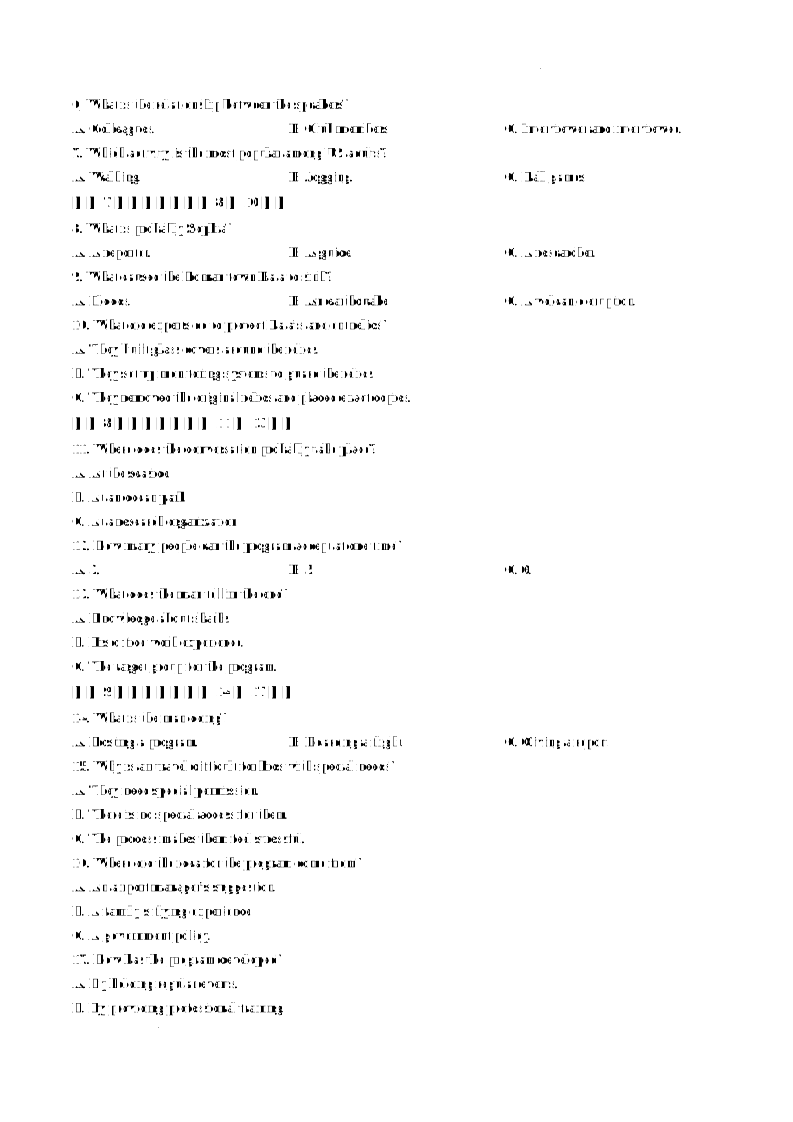
6, What is the relationship between the speakers?
A. Colleagues. B. Club members. C. Interviewer and interviewee.
7. Which activity is the most popular among US adults?
A. Walking. B. Jogging. C. Ball games.
听第7段材料,回答第8至10题。
8. What is probably Sophia?
A. A reporter. B. A guide. C. A researcher.
9. What caused the Roman town Baia to sink?
A. Floods. B. An earthquake. C. A volcanic eruption.
10. What did experts do to protect Baia’s ancient relics?
A. They built glass covers around the relics.
B. They set up monitoring systems to guard the relics.
C. They removed the original relics and placed exact copies.
听第8段材料,回答第11至13题。
11. Where does the conversation probably take place?
A. At the seaside.
B. At an ocean park.
C. At a research organization.
12. How many people can the program accept at one time?
A. 3. B. 5. C. 6.
13. What does the man tell in the end?
A. Knowledge about sharks.
B. His office work experience.
C. The target group for the program.
听第9段材料,回答第14至17题。
14. What is the man doing?
A. Hosting a program. B. Boarding a flight. C. Giving a report.
15. Why is air travel difficult for kids with special needs?
A. They need special permission.
B. There is no special access for them.
C. The process makes them feel stressful.
16. Where did the idea for the program come from?
A. An airport manager’s suggestion.
B. A family’s flying experience.
C. A government policy.
17. How has the program developed?
A. By holding regular events.
B. By providing professional training.
C. By building special airport facilities.
听第10段材料,回答第18至20题。
18. What does the speaker say about the Belgian woman?
A. She likes traveling. B. She is experienced. C. She got hurt.
19. What do volunteers do at the center?
A. Look after the animals.
B. Train injured wild animals.
C. Organize educational classes for visitors.
20. Why does the speaker give the talk?
A. To call for the protection of animals.
B. To ask people to donate money to a zoo.
C. To introduce an animal center and its volunteer program.
第二部分 阅读(共两节,满分50分)
第一节(共15小题;每小题2.5分,满分37.5分)
阅读下列短文,从每题所给的A、B、C和D四个选项中,选出最佳选项,并在答题卡上将该项涂黑。
A
Lucky for us, Greece has many more insanely brilliant islands so if you’re looking for the perfect island vacation, you are in the right place!
Sifnos
Any Greek trip should include island hopping to Sifnos. It’s a quaint and relaxing island with gorgeous white-sand beaches and turquoise waters. The island is known for beautiful pottery made by locals and it’s a perfect island for couples that want just the right amount of nightlife and action.
Antiparos
Tourists love visiting Antiparos only because it has everything you could ever ask for. The climate is calm, the surroundings are peaceful, and the accommodation is perfect. It is an island that is said to have one of the oldest caves in Europe. The cave has been a place of interest for archaeologists since the cave is made of stone formations and the inscriptions present say a lot about medieval times.
Paros
Paros is a small island in the Aegean Sea. It’s known for its traditional villages, and one of the oldest churches in the country. It’s also a great place to have a party.
Getting around the island is easy if you’re using public transportation — you have the bus and water taxis that hop around the beaches, attractions, and ports.
Milos
Beautiful beaches, pretty villages, and even some fascinating historic sites — Milos, in the Cyclades chain, certainly meets the standard Greek island trifecta. Of course, with over 70 different beaches, it is definitely on another level when it comes to sunbathing opportunities.
The island is also lined with terrific hiking trails, although if you want to cover more ground and expend less energy, you can rent one of the ATVs that are a popular choice for getting around the island.
1. Which island is recommended for people interested in handmade products?
A. Paros. B. Antiparos. C. Milos. D. Sifnos.
2. What is Antiparos well-known for according to the text?
A. Its busy nightlife scenes. B. Fascinating party gathering.
C. One of Europe’s oldest caves. D. The largest number of beaches.
23. What do Paros and Milos have in common according to the text?
A. They are both ideal for sunbathing.
B. They both have appealing historic sites.
C. They are both good places for backpacking.
D. They both offer convenient public transportation.
B
In 1985, 20-year-old Yin Yuzhen from Shaanxi Province got married and moved with her husband to the interior of the Maowusu Desert. The living conditions there were extremely tough. Everything around her was either sand or something covered in sand. The wind blew sand into their eyes, mouths, and nostrils, and after each storm, there was only silence. Yin and her husband were the only people living in that lonely, empty land.
On the second day of her arrival, Yin resolved that she would not let the desert control her life. Despite her inability to read or write and being totally green when it came to planting, she chose to learn through practical experience. Over time, she figured out that the best way to fight the desert was by planting trees. Her idea was to first grow grass to hold the sand, then plant bushes, and later trees.
At first, her efforts failed. Desert mice ate all the grass seeds. She tried planting them deeper, but the mice still found them. She racked her brains and came up with a great idea. She took one of their sheep and used its hoofprints (蹄印) to hide the seeds. The smell of the sheep disguised the seeds, and the grass began to grow.
Yin didn’t stop there. She planted strong trees like poplars and Scotch pines along the outer edges to block the wind and sand. In the middle, she planted smaller trees and bushes. Her dream was to create a green “fortress” in the desert and grow fruits and crops in the protected center where they lived.
Yin and her husband worked diligently for many years, showing remarkable perseverance. She once said, “I’d rather die of tiredness from fighting the sand than be challenged by it.” In the end, her hard work paid off. The desert that once seemed hopeless turned into a thriving green land.
24. What’s the purpose of Paragraph 1?
A. To introduce the background of the story.
B. To compare city life and countryside life.
C. To imply the significance of desert control.
D. To show the relationship between the couple.
25. What does the underlined phrase “being totally green” in Paragraph 2 probably mean?
A. Loving green plants. B. Being very young in age.
C. Protecting the environment. D. Having no experience at all.
26. What words can best describe Yin and her husband?
A. Romantic and energetic. B. Determined and creative.
C. Capable and adventurous. D. Knowledgeable and sensitive.
27. What can be a suitable title for the text?
A. Maowusu Desert’s Bright Future B. The Impact of Strong Sandstorms
C. Modern-day Young People’s Dreams D. A Woman’s Struggle Against the Desert
C
The Amazon in the heart of South America and the Atlantic rainforests on the east coast of the continent are separated by hundreds of miles of dry forest and savanna (稀树草原) that are too difficult for most rainforest trees to survive. Despite this gap, the two ecosystems share many different species of tree.
It was previously supposed that the trees bridged this gap during historical periods when the region was much wetter and more forgiving to passing trees.
Off the back of new research, a new theory has sprung up: The forests of the Atlantic rainforest are constantly occupied by trees from the Amazon. They do this by growing and spreading along the river, which acts like a hidden “highway” between the two separated ecosystems.
“Rather than tree species being exchanged during specific wetter periods in the past, we found that they have dispersed consistently over time,” Dr James Nicholls, lead study author, said in a statement. “This probably happens slowly, by generations of trees growing along the ’highways’ provided by rivers that run through Brazil’s dry ecosystems,” added Dr Nicholls.
The researchers came to this conclusion by studying the genetics of 164 species of Inga tree, which are common in Latin American rainforests. Their DNA was used to reconstruct the “family tree” of the plants showing the team when each species split from its numerous ancestors and their pattern of movement across the continent. Researchers identified 16 to 20 instances of species migrating from the Amazon to the Atlantic Forest and successfully taking root.
The study highlights how the natural world does not respect the national borders set by homo sapiens (智人). These ecosystems are deeply connected, frequently spreading between countries with regardless of border checks and passports. This view, the team says, could have huge importance for the conservation of the rainforests in South America and the rest of the world.
28. What can we learn from the old theory of tree migration?
A. It depended on genetic data. B. It stressed slow river spread.
C. It proved species connection. D. It assumed wetter past periods.
29. How do trees from the Amazon reach the Atlantic rainforest according to the new theory?
A. By using wind movement. B. By getting human assistance.
C. By following river highways. D. By relying on animal migration.
30. What does the underlined word “dispersed” in Paragraph 4 mean?
A. Spread. B. Increased. C. Reduced. D. Disappeared.
31. What does the study suggest people do for rainforest conservation?
A. Focus only on the Amazon. B. Cooperate across countries.
C. Protect each forest separately. D. Ignore national borders entirely.
D
It’s early morning, and Murungi is standing next to a towering tree. At its base rests a large yellow plastic jerrycan (油罐). A plastic sheet is pinned to the bark of the tree and then tucked into (塞进) the jerrycan. “At night when the mist comes, water forms on the tree. Then it rolls down the trunk, onto the plastic and into this container,” he explains.
Around the world, climate change is worsening drought conditions and limiting water access, leaving people searching for surprising sources, like fog and dew (露水). And while some of the methods for fog harvesting, like this one in the mountains, have been around for generations, scientists and volunteers have come up with new ways, including technology that can pull water from the air in practically any environment.
Most fog harvesting operations around the world use big mesh nets to trap the fog. “Of course, this is just inspired by nature. The plants that we see in our desert grow little hair, little branches, and when the moist air comes, they trap it,” specialist McDonnell says. “Nature does it best, always. But we’re learning to control and use it for what we humans require.” And McDonnell points out — there’s no energy involved. The carbon footprint is essentially nothing. There is one problem, though: Fog isn’t necessarily a constant. And it, too, is affected by climate change. “It depends on how long the fogs are available for,” she says.
Getting water from fog isn’t the only way to harvest from the air. New technology has made it possible to pull atmospheric water from any environment. It uses fans to suck in hot, moisture-filled air and then cools the air to condense (凝结) the water. The water is then filtered and minerals are added, making it safe for drinking. This technology has been developed in several places around the world. However, the technology is expensive, costing thousands of dollars for even the most basic model. And it uses energy — often solar powered — so it’s not passive in terms of environmental impacts like traditional fog harvesting.
32. The opening paragraph is mainly intended to .
A. present the daily routine of local people
B. describe a common forest scene for readers
C. introduce a traditional fog-harvesting method
D. explain how trees naturally collect water from the air
33. What is the result of climate change according to the passage?
A. Higher sea level. B. Less water access. C. More foggy weather. D. Worse health conditions.
34. What does McDonnell imply about nature-inspired fog nets?
A. They are more eco-friendly. B. They are costly to maintain.
C. They work better than trees. D. They consume much energy.
35. What is the main idea of the text?
A. Traditional fog-harvesting methods are no longer effective today.
B. People are developing various ways to harvest water from the air.
C. Climate change is worsening droughts in many parts of the world.
D. New technologies have completely solved the global water shortage.
第二节(共 5 小题;每小题 2.5 分,满分 12.5 分)
根据短文内容,从短文后的选项中选出能填入空白处的最佳选项, 并在答题卡上将该项涂黑。选项中有两项为多余选项。
OpenClaw: The “Lobster” in Your Computer
36
Recently, “raising lobsters” has become a hot topic on social media. However, these “lobsters” are not for eating. OpenClaw is an open-source AI agent software. Its name comes from “Open” (open-source) and “Claw” (the powerful pincers of a lobster). With its red lobster icon, it has quickly become a favorite among tech fans, who jokingly call the training process “raising lobsters.”
A Powerful Digital Assistant
37 Unlike traditional AI models like ChatGPT that only provide text or voice suggestions, OpenClaw is a “doer”. Once you give it permission to access your device, it acts as a real personal assistant. It can take over your software to perform complex tasks, such as organizing messy files, managing schedules, and sending emails — all through simple voice commands. It’s like hiring a digital employee for free.
Installation and Costs
While models like DeepSeek are easy to use for everyone, OpenClaw requires some technical skills to set up. This has created a new market for installation services. On various platforms, “door-to-door installation” is booming. Prices usually range from 300 to 800 yuan, with 500 yuan being the most common price per session. 38 For those on a budget, remote installation is a cheaper choice, typically costing between 50 and 100 yuan.
A Final Thought
With the “lobster fever” spreading, many people feel anxious about being left behind. 39 However, there is no need to panic. Just as the Internet and smartphones once seemed complex but eventually became part of everyday life, truly revolutionary technology will always find its way to the masses. After all, the goal is not to chase every new trend, but to embrace technology when it truly serves our needs. 40
A. The Rise of a New AI “Lobster”.
B. The Impact of “Raising Lobsters”.
C. It differs from ChatGPT in a special way.
D. It stands out for its ability to carry out actions.
E. Stay calm and let technology serve us, not the other way around.
F. They worry that they might be replaced by these “digital employees”.
G. This may seem expensive, but the professional service ensures success.
第三部分 语言运用(共三节,满分 30 分)
第一节(共 15 小题;每小题 1 分,满分 15 分)
阅读下面短文,从短文后各题所给的 A、B、C 和 D 四个选项中,选出可以填入空白处的最佳选项,并在答题卡上将该项涂黑。
My name is Lorenzo. Born in Mexico City, I’ve been living here in the United States for five years. While in the tenth grade I had an(a) 41 with my ESL teacher, Mrs. Del Signore.
It all began one night when I 42 until midnight doing homework for the next day. The next morning, I woke up late and was in such a 43 to get to school on time that I 44 to take my homework on the dinner table.
In my ESL class, Mrs. Del Signore said, “ 45 your homework to the front of your row.” Today, like every day, she used the homework to take 46 . So, after a few minutes, she asked, “Lorenzo Gonzales is not here?” I answered, “I’m here.”
She called me to her desk to ask me about the homework. When I explained what had happened, she answered, “Quit 47 my leg. I want the truth.”
I felt my face turning red. What she said didn’t make any 48 to me. She was sitting at her desk, and it would have been practically 49 to pull her leg from under the desk. The whole class looked at her because they did not 50 her either. Soon Mrs. Del Signore realized the reason and 51 to me and the rest of the class. She explained what she meant by the idiom “pulling my leg”. She had thought I was 52 her and making up a story.
The next day she discussed 53 . We were eager to learn them, 54 we could clearly see they would be useful sooner or later. As a result of this experience, whenever I hear an idiom I do not understand, I 55 ask Mrs. Del Signore.
41. A. accident B. misunderstanding C. argument D. disagreement
42. A. cheered up B. brought up C. looked up D. stayed up
43. A. mess B. hurry C. distance D. state
44. A. decided B. forgot C. rushed D. managed
45. A. Lend B. Leave C. Launch D. Pass
46. A. attendance B. charge C. measures D. chances
47. A. observing B. pulling C. beating D. discussing
4. A. difference B. change C. sense D. mistake
49. A. horrible B. effortless C. impossible D. convenient
50. A. notice B. answer C. hear D. understand
51 A. apologized B. admitted C. suggested D. reported
52. A. hurting B. pleasing C. avoiding D. kidding
53. A. idioms B. jokes C. plans D. excuses
54. A. although B. if C. since D. unless
55. A. simply B. nearly C. hardly D. roughly
第二节(共10小题;每小题1分,满分10分)
阅读下面短文,在空白处填入1个适当的单词或括号内单词的正确形式,并将答案写在答题卡上相应题号的横线上。
March 22, World Sleep Day, saw a sleep-in-forest competition, 56 the first 50 participants enjoyed fresh air and greenery for a good sleep and a cash prize. It was held at Dongping National Forest Park on Shanghai’s Chongming, 57 (feature) the city’s best air quality, largest green space, and richest biodiversity.
The organizers revealed real-time data on participants’ heart rates, sleep duration and other information would be displayed 58 a large screen. At every 59 (compete) event, the participant with the highest sleep score can win a cash prize of 3,000 yuan, while those who fall asleep the fastest can earn 2,000 yuan.
Throughout the entire event, participants should remain lying down on the 60 (provide) standard mattress (睡垫). They are allowed to turn over, 61 no part of the body should extend beyond one-third of the mattress’ surface area. Significant movements such as sitting up, standing or leaving the bed 62 (visit) a restroom will mean the end of their challenge.
Up to now, the competition 63 (witness) active registration and gained unexpected popularity on social media platforms. The organizers hope to offer participants 64 unique sleep experience at a national forest park, employing the power of nature to offer them physical and mental 65 (relieve).
第三节(共5小题;每小题1分,满分5分)
根据句意,在空白处填入1个适当的单词或括号内单词的正确形式,并将答案写在答题卡上相应题号的横线上。
66. No writer can describe human life if not ▲ (reflect) on his own life and experiences.
67. The beach ▲ (clear) of people rapidly, just before the huge waves crashed into the coast.
68. Home ▲ different kinds of living things, each level of the forest forms its own little world.
69. After the ▲ (confirm) that all were safe and sound, they relaxed, laughing, crying and hugging each other.
70. Over the empty streets — over the forum — far and wide — with many ▲ noisy crash in the stormy sea — fell that awful shower.
第四部分 写作(共两节,满分40分)
第一节(满分15分)
假定你是校英语社团主席李华,你校本周六将组织学生赴周边示范乡村开展为期一天的劳动实践活动(labor practice activity)。请你给外教Mr. Smith写一封邮件,邀请他一同前往参加活动,内容包括:
(1)写信目的;
(2)活动安排。
注意:
1.写作词数80左右;
2.请按如下格式在答题卡的相应位置作答。
Dear Mr. Smith,
I’m Li Hua, chairman of the school English club.
Yours,
Li Hua
第二节(满分25分)
阅读下面材料,根据其内容和所给段落开头语续写两段,使之构成一篇完整的短文。
Several years ago, I traveled to Qucanbeyan to ask a specialist for help about a chronic (慢性的) health condition that had troubled me for years. My trip was coming to an end, and I was scheduled to head home from Queensland early the next morning. To ensure a smooth departure (离开), I had carefully set my alarm to catch a pre-ordered taxi to the airport.
However, when the sun began to come through the curtains and I finally woke up, a wave of cold panic washed over me. I realized with horror that I had forgotten daylight savings (夏令时). I was now running a full hour late, and my original taxi was long gone.
Desperate and confused, I picked up my phone to order another taxi and hurried to the front of the hotel. Standing on the dark footpath under the dim glow of a streetlamp, I called my sister. My voice was trembling as I described my situation. I told her how unwell I felt and how the “brain fog” was making it nearly impossible to think clearly or solve even the simplest problems. I felt small, weak, and completely overwhelmed.
Just then, a pair of bright headlights cut through the morning darkness. A taxi pulled over. Relieved, I rushed forward, but as I opened the door, the driver shook his head firmly. “Sorry, lady, this one is for the gentleman behind you.”
My heart sank. But then, out of the shadows stepped a well-dressed, professional-looking man. He had clearly overheard my distressed phone call and witnessed my moment of despair. Before I could even make an apology, he turned to the driver with a calm, commanding kindness and said, “She’s in such a rush. Let’s share the ride.”
Gratefully, I climbed in, my trembling hands finally beginning to settle. As the car sped toward the city, I found myself explaining my situation in a rush of words. The man listened with genuine empathy (同情), his eyes reflecting a deep understanding that I rarely got from strangers.
注意:
1.续写词数150左右;
2.请按如下格式在答题卡的相应位置作答。
At one point, he whispered something to the driver.
As he was about to leave, I realized I didn’t even know his name.
学科网(北京)股份有限公司
$
高一年级英语测试卷
参考答案与评分标准
听力
1-5 BBCAB 6-10 AABCC 11-15 CACAC 16-20 BABAC
阅读
21-23 DCB 24-27 ADBD 28-31 DCAB 32-35 CBAB
36-40 ADGFE
完形
41-45 BDBBD 46-50 ABCCD 51-55 ADACA
语法填空
56. where 57. featuring 58. on 59. competitive 60. provided
61. but 62. to visit 63. has witnessed 64. a 65. relief
66. reflecting 67. was cleared 68. to 69. confirmation 70. a
应用文写作
Dear Mr. Smith,
I’m Li Hua, chairman of the school English club. I’m writing to invite you to participate in our one-day labor practice activity in a nearby model village to experience rural life.
We will gather at the school gate at 8:00 a.m. this Saturday. In the morning, we will do farm work like picking seasonal fruits to experience hands-on farming. In the afternoon, we will help sort local agricultural products and make short English videos to showcase the village’s scenery, which combines labor education with supporting rural revitalization.
It will be a great opportunity to enjoy the beauty of our countryside. We’d be delighted if you could join us. Looking forward to your reply.
Yours,
Li Hua
读后续写
At one point, he whispered something to the driver. It wasn’t until we bypassed the city center that I realized he had instructed the driver to take me to the airport first, delaying his own appointment. Despite my protests, he simply smiled and insisted. Upon arriving at the terminal, the gentleman refused to let me pay a single cent. He even hopped out of the car, carried my luggage, and accompanied me toward the check-in counter to ensure I wouldn’t get lost in my “foggy” state. I stood there, breathless and overwhelmed, as he prepared to head back to the taxi.
As he was about to leave, I realized I didn’t even know his name. I hurried toward him, stammering out a request for his contact information so that I could properly repay his kindness or at least send a thank-you note. He simply placed a gentle hand on my shoulder and said, “No need for that. Just focus on getting home safely and feeling better.” With a polite tip of his hat, he turned back toward the waiting taxi, disappearing into the morning bustle. I watched the car pull away, holding my boarding pass, feeling a strange sense of warmth that my chronic pain usually stole from me.
录音原文:
Text 1 认为历史是最难的科目
W: What is the hardest subject for you, Tom?
M: Physics and chemistry are difficult, but in history, there are many dates to remember. I think it’s the most challenging.
Text 2 学校生活
M: Hi, Linda. I didn’t see you at the school dining hall. Didn’t you have breakfast?
W: Well, I woke up early this morning so that I could go for a long walk. I was the last person to come out of the dining hall.
Text 3 思南月圆节 推断题——数字类
W: Hey Andy! Did you hear about the new festival at Sinan Mansions?
M: No, what is it?
W: It’s the Sinan Full Moon Festival! It started on September 29th and lasted for 4 days. There are performances by more than 20 original musicians, indoor exhibitions, and so on.
Text 4 去医院看望刚出生的女儿
W: Why are you in such a hurry?
M: I’m rushing to the hospital to see my baby. I just got a phone call from the hospital saying that my wife had given birth to a girl.
W: Congratulations on becoming a father!
Text 5 周末活动
M: How was your weekend? Did you go hiking?
W: No, I went to a museum, bought some books in a used bookstore, and went dancing.
Text 6 美国成年人锻炼人数有所增加 第6题为推断题——身份关系类
W: Alex, we will have a meeting at 3:00 pm. What’s the key finding of your report on adults’ exercise trends?
M: About 80% of US adults exercise regularly. This number equals about 247 million people. The figure has risen lately.
W: Your team analyzed 18,000 interviews — what’s the most popular?
M: Walking tops the list. After that come hiking, free weights, and then jogging.
W: What kind of sport is growing the fastest?
M: Ball games.
W: It’s great to see more people staying active.
Text 7 海洋中的城镇 第8题为推断题——身份关系类
M: Sophia, I want to travel during the holiday. Do you have any recommendations?
W: Yeah. The coastal area near Naples! It is a fascinating 2,000-year-old Roman town called Baia. I led a tour group there last week.
M: I’ve never heard of it. What makes it special?
W: It sank centuries ago. Divers rediscovered it in 1969.
M: Did it sink because of floods or earthquakes?
W: Neither. A Mediterranean volcano made it sink.
M: A sunken town!
W: Yeah. Around 15,000 divers and tourists visit it every year. You can even swim through the town to see ancient relics.
M: Cool! But doesn’t sea life damage the relics?
W: They might. So experts took the real relics out of the water and put exact copies back in place for visitors.
M: Smart! I can’t wait to dive there myself!
Text 8 鲨鱼研究实习项目 第 11 题为推断题——谈话背景类;第 12 题为推断题——数字类
W: Hi! I’m interested in your shark research program. I’m here to get some information. Who is it for and what does it offer?
M: It’s for students and volunteers. You’ll get practical shark research experience with skilled staff and experts.
W: Is there a limit on the number of participants? Like five or six?
M: Yes, we only allow half of six, so everyone gets good experience and growth.
W: I love sharks but I don’t have much knowledge about them. Can I apply?
M: Absolutely! It’s open to anyone — whether you’re a student, volunteer, shark enthusiast, fresh graduate, or just starting out in your career. It’s ideal for anyone who wants to contribute to shark conservation research.
W: Thanks for the information!
M: You’re welcome!
Text 9 帮助特需儿童乘坐飞机 第 14 题为推断题——行为动作类
M: Today we’re discussing a program for families of children with special needs who are struggling with air travel. With us is Kerry Mauger, director of special projects at The Arc. Kerry, could you explain why air travel is hard for them?
W: Airports are busy. Planes are loud, and the travel process is too much for kids with special needs.
M: How did The Arc fix this problem?
W: We founded a program. Working with airports, we let kids practice the air travel process in a low-stress way.
M: Where did the idea for this program come from?
W: In 2011, a family had a child with special needs. The child couldn’t handle airport stress. We realized many other families were facing the same challenge, so we developed this program as a solution.
M: How is the program growing?
W: Now we host 20 to 25 events every year. Over 31,000 people in 34 states have joined.
M: Thanks for what you did, Kerry.
W: It’s my pleasure. We’re proud to support these families.
Text 10 匈牙利 Repzootic 动物中心
W: The Repzootic Animal Center is a safe place and educational charity near Pécs, Hungary. It has a special volunteer activity. Volunteers can work like zookeepers with unusual, rescued animals.
A Belgian woman founded the center. She has worked in this area for many years. The center gives homes to pets that were abandoned or hurt. It also helps Hungarian wild animals get well, so they can return to nature.
Its goal is to teach people in Europe about nature and wild animals. It uses educational classes and events for this. The events are continuing to grow in scale.
Volunteers help care for the animals every day. They can also explore Hungary’s beautiful nature. The center has many types of animals: foxes, wolf-dogs, birds, and more. It lets animal lovers learn by hands-on experience — they find out what the animals need and how to take care of them.
学科网(北京)股份有限公司
$
资源预览图

1
2

3
相关资源
由于学科网是一个信息分享及获取的平台,不确保部分用户上传资料的 来源及知识产权归属。如您发现相关资料侵犯您的合法权益,请联系学科网,我们核实后将及时进行处理。