Unit 7 Space exploration 测验A卷(广州专用)2025-2026学年沪教版八年级英语下册
2026-05-27
|
18页
|
139人阅读
|
11人下载
资源信息
| 学段 | 初中 |
|---|---|
| 学科 | 英语 |
| 教材版本 | 初中英语沪教版八年级下册 |
| 年级 | 八年级 |
| 章节 | Unit 8 Imagine that! |
| 类型 | 试卷 |
| 知识点 | - |
| 使用场景 | 同步教学-单元练习 |
| 学年 | 2026-2027 |
| 地区(省份) | 广东省 |
| 地区(市) | 广州市 |
| 地区(区县) | - |
| 文件格式 | DOCX |
| 文件大小 | 58 KB |
| 发布时间 | 2026-05-27 |
| 更新时间 | 2026-05-27 |
| 作者 | 小学初中原创精品资料库 |
| 品牌系列 | - |
| 审核时间 | 2026-05-27 |
| 下载链接 | https://m.zxxk.com/soft/58068421.html |
| 价格 | 0.50储值(1储值=1元) |
| 来源 | 学科网 |
摘要:
**基本信息**
以中国航天成就为主题,融合语言知识与科技情境,覆盖语法、阅读、写作等模块,适配八年级Unit 7单元复习,强化语言能力与文化意识。
**题型特征**
|题型|题量/分值|知识覆盖|命题特色|
|----|-----------|----------|----------|
|语法选择|10题15分|冠词、不定式等语法点|以天宫空间站为语境,考查语法在真实场景中的应用|
|完形填空|10题10分|北斗系统相关词汇|通过科技成就叙述,渗透词汇辨析与语篇连贯能力|
|阅读理解|15题30分|航天医学、深空测控等|选取真实航天科技素材,设题层次分明,兼顾细节与推理|
|写作|3题30分|航天成就介绍、感悟表达|书面表达要求结合中国航天成就,体现家国情怀与思维品质|
内容正文:
沪教版八年级英语下册 Unit 7 Space exploration 测验A卷(广州专用)含答案
沪教版八年级英语下册 Unit 7 Space exploration 测验A卷(广州专用)
本卷共四大题,13页,满分110分。考试用时100分钟。
注意事项:
1. 答题前,考生务必在答题卡上用黑色字迹的钢笔或签字笔填写自己的考生号、姓名。
2. 选择题每小题选出答案后,用2B铅笔把答题卡上对应题目的答案标号涂黑;如需改动,用橡皮擦干净后,再选涂其他答案标号。答案不能答在试卷上。
3. 非选择题答案必须用黑色字迹的钢笔或签字笔写在答题卡各题目指定区域内的相应位置上;如需改动,先划掉原来的答案,然后再写上新的答案,改动后的答案也不能超出指定的区域;不准使用铅笔、涂改液和修正带。不按以上要求作答的答案无效。
4. 考生必须保持答题卡的整洁,考试结束后,将本试卷和答题卡一并交回。
一、语言知识及运用(共两节;满分 25 分)
第一节 语法选择(共 10 小题;每小题 1.5 分,满分 15 分)
阅读下面短文,按照句子结构的语法性和上下文连贯的要求,从 1~10 各题所给的 A、B、C 和 D 项中选出最佳选项。
Life on 1 Tiangong Space Station is quite special for Chinese astronauts. When they board a spacecraft, it usually takes about 10 minutes 2 into space orbit. At first, the weightless environment brings a big change to 3 daily life, but they can get used to it quickly.
There 4 many types of food for them to choose from, like fruit, chicken and seafood. They can even enjoy tea and juice in space. To stay away from floating around, they have to fix their sleeping bags 5 the wall before sleeping. This way can stop them from 6 floating objects while sleeping.
Working in space is much 7 than on Earth because of zero gravity. When astronauts go out for a spacewalk, they must move carefully. They must avoid 8 small mistakes. I still remember the spacewalk in 2021. At that time, Liu Boming and Tang Hongbo 9 outside the space station for over six hours. Space exploration is never easy, 10 it brings us amazing knowledge about the universe. More Chinese space dreams will come true soon.
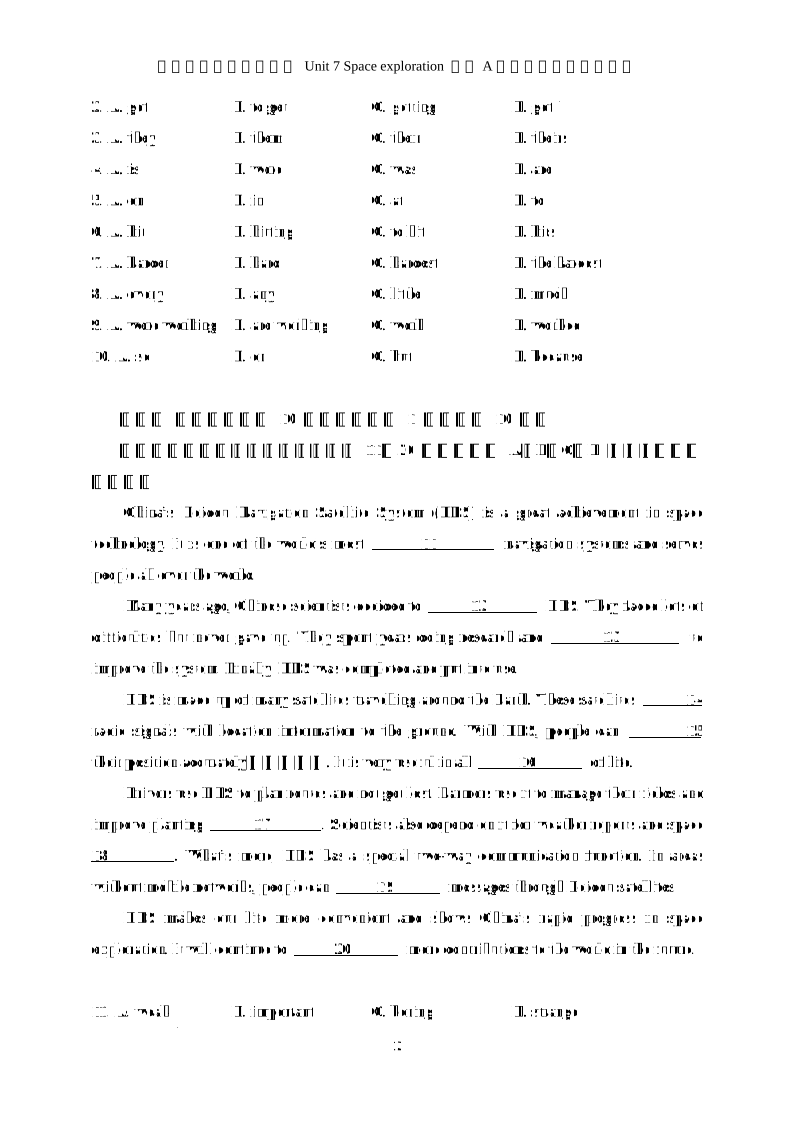
1. A. a B. an C. the D. /
2. A. get B. to get C. getting D. got
3. A. they B. them C. their D. theirs
4. A. is B. were C. was D. are
5. A. on B. in C. at D. to
6. A. hit B. hitting C. to hit D. hits
7. A. harder B. hard C. hardest D. the hardest
8. A. every B. any C. little D. much
9. A. were working B. are working C. work D. worked
10. A. so B. or C. but D. because
第二节 完形填空(共 10 小题;每小题 1 分,满分 10 分)
阅读下面短文,掌握大意,然后从 11~20 各题所给的 A、B、C、D 项中,选出最佳选项。
China’s Beidou Navigation Satellite System (BDS) is a great achievement in space technology. It is one of the world’s most 11 navigation systems and serves people all over the world.
Many years ago, Chinese scientists decided to 12 BDS. They faced lots of difficulties but never gave up. They spent years doing research and 13 to improve the system. Finally, BDS was completed and put into use.
BDS is made up of many satellites travelling around the Earth. These satellites 14 radio signals with location information to the ground. With BDS, people can 15 their position accurately(精确地). It is very useful in all 16 of life.
Drivers use BDS to plan routes and not get lost. Farmers use it to manage their fields and improve planting 17 . Scientists also depend on it for weather reports and space 18 . What’s more, BDS has a special two-way communication function. In areas without mobile networks, people can 19 messages through Beidou satellites.
BDS makes our life more convenient and shows China’s rapid progress in space exploration. It will continue to 20 more contributions to the world in the future.
11. A. weak B. important C. boring D. strange
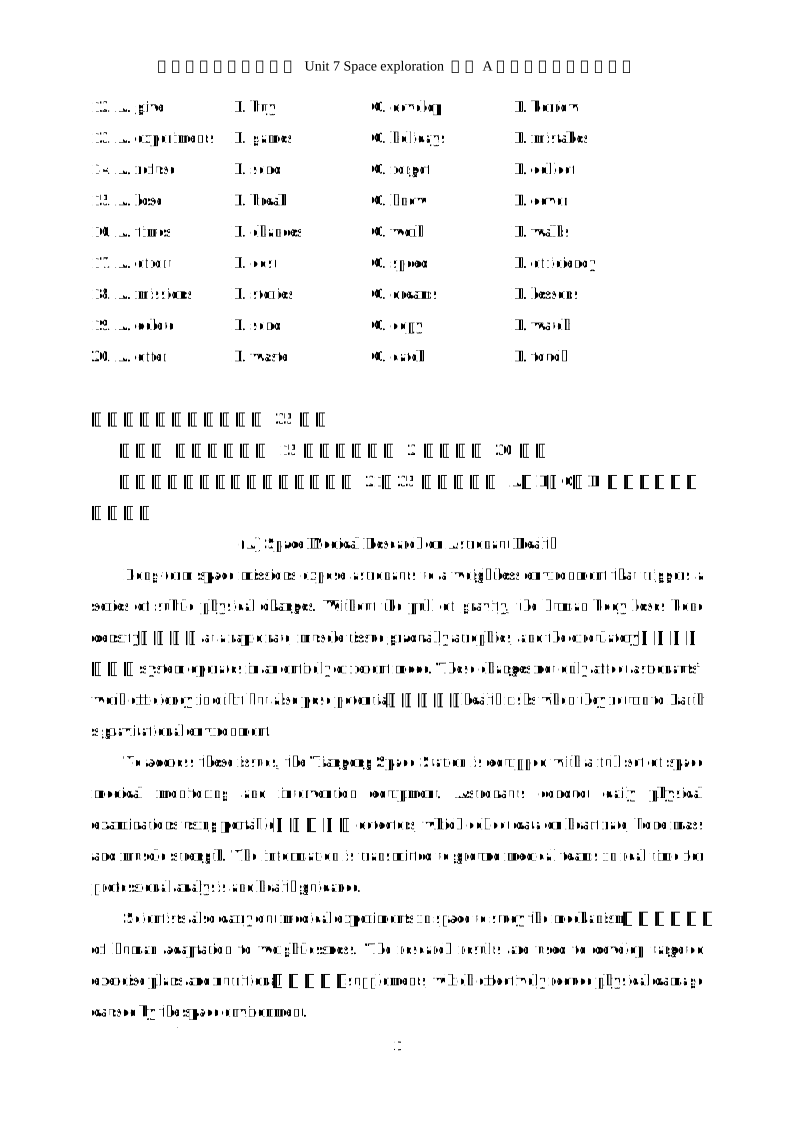
12. A. give B. buy C. develop D. borrow
13. A. experiments B. games C. holidays D. mistakes
14. A. refuse B. send C. forget D. collect
15. A. lose B. break C. know D. cover
16. A. times B. chances C. work D. walks
17. A. effort B. cost C. speed D. efficiency
18. A. missions B. stories C. dreams D. lessons
19. A. delete B. send C. copy D. watch
20. A. offer B. waste C. catch D. touch
二、阅读(共两节;满分 35 分)
第一节 阅读理解(共 15 小题;每小题 2 分,满分 30 分)
阅读下面短文,掌握大意,然后从 21~35 各题所给的 A、B、C、D 项中,选出最佳选项。
(A) Space Medical Research on Astronaut Health
Long-term space missions expose astronauts to a weightless environment that triggers a series of subtle physical changes. Without the pull of gravity, the human body loses bone density(密度)at a rapid rate, muscle tissue gradually atrophies, and the circulatory(血液循环的)system operates in an entirely different mode. These changes not only affect astronauts’ work efficiency in orbit but also pose potential(潜在的)health risks when they return to Earth’s gravitational environment.
To address these issues, the Tiangong Space Station is equipped with a full set of space medical monitoring and intervention equipment. Astronauts conduct daily physical examinations using portable(便携的)detectors, which collect data on heart rate, bone mass and muscle strength. The information is transmitted to ground medical teams in real time for professional analysis and health guidance.
Scientists also carry out medical experiments in space to study the mechanism(运作机制)of human adaptation to weightlessness. The research results are used to develop targeted exercise plans and nutritional(营养的)supplements, which effectively reduce physical damage caused by the space environment.
This space medical research not only protects astronauts’ health but also provides new ideas for treating bone and muscle diseases on Earth. It is a typical example of space technology benefiting global medical development.
21. Why do astronauts have physical changes in space?
A. Because they cannot get enough sleep in the station.
B. Because weightless surroundings affect their bodily functions.
C. Because they have to finish dangerous spacewalks every day.
D. Because the space station lacks basic medical equipment.
22. How do ground doctors know astronauts’ physical condition?
A. By receiving real-time health data from space
B. By flying to the space station for check-ups
C. By asking astronauts to describe their feelings
D. By guessing according to past experience
23. What do space medical experiments help scientists do?
A. Develop faster spacecraft for space travel.
B. Invent new types of space food for astronauts.
C. Build larger space stations for long-term stays.
D. Find ways to reduce harm from weightlessness.
24. What can we infer from the passage?
A. Space medical research helps treat Earth’s diseases.
B. Short space trips have no influence on human body.
C. Astronauts can recover without any medical help.
D. Medical experiments can only be done on Earth.
(B) China’s Deep-Space Tracking & Control System
China’s deep-space tracking and control system is an invisible support for all long-distance space missions. It is composed of large ground antenna(天线)arrays, ocean-going measurement vessels(船只)and mobile control stations, forming a full-coverage monitoring network that tracks spacecraft throughout their flights.
This system can capture weak signals from probes hundreds of millions of kilometers away, calculate precise flight orbits and send operation instructions without delay. When spacecraft move to areas beyond ground antenna coverage, ocean vessels take over the monitoring work to ensure uninterrupted(不间断的)communication and control.
The system played a key role in the Tianwen-1 Mars mission and Chang’e lunar exploration projects. It achieved stable signal transmission during ultra-long-distance flights and ensured the accurate execution of all flight instructions.
China opens part of the system’s functions to the international space community, supporting joint exploration of the universe. This move shows China’s willingness to cooperate with the world and promote the common progress of global space exploration.
25. What makes up China’s deep-space tracking and control system?
A. Space labs, rockets and manned spaceships
B. Antenna arrays, measurement vessels and control stations
C. Medical centers, training bases and research institutes
D. Satellite groups, space stations and planetary rovers
26. When do ocean-going vessels take over monitoring tasks?
A. When new satellites are sent into Earth’s orbit
B. When astronauts finish their daily work in space
C. When spacecraft are out of ground antennas’ reach
D. When the system needs to be repaired and updated
27. Which achievement did the system make in deep-space missions?
A. It sent Chinese astronauts to land on Mars.
B. It kept stable signals during ultra-long flights.
C. It collected planetary samples and brought them back.
D. It built permanent(永久的)bases on the moon and Mars.
28. What’s the main idea of Paragraph 4?
A. China shares control system for global space cooperation.
B. The system only serves China’s own space projects.
C. International cooperation needs more space stations.
D. Other countries refuse to use China’s technology.
(C) Intelligent Space Junk Removal Technology
As more spacecraft and satellites are launched into orbit, space junk has become a major threat to space safety. These abandoned(废弃的)objects, including broken satellites and rocket fragments, travel at ultra-high speeds and can destroy working spacecraft or endanger astronauts’ lives once a collision happens.
Chinese scientists have developed intelligent removal technology to solve this problem. The core device is an autonomous cleaning satellite equipped with a mechanical arm and a capturing net. It can identify and lock small space junk, drag it out of orbit and guide it to burn up in Earth’s atmosphere.
Another innovative technology is degradable(可降解的)satellite materials. Satellites made of these materials can break down naturally after completing tasks, so they will not turn into space junk. Scientists also design a recycling system to reuse useful parts of old satellites, reducing resource waste.
These technologies greatly reduce the risk of space collisions and protect the orbital environment. They demonstrate China’s responsibility in maintaining space safety and provide new solutions for the global space junk problem.
29. What endangers space safety according to the passage?
A. The high speed of working spacecraft B. Extreme weather in outer space
C. The lack of satellite launch technology D. Abandoned objects floating in orbit
30. How does the cleaning satellite deal with space junk?
A. It pulls junk out of orbit and makes it burn up.
B. It fixes junk and turns it into useful equipment.
C. It sends junk back to Earth for storage.
D. It pushes junk to other planets for disposal.
31. Why are degradable satellite materials developed?
A. To make satellites fly faster in orbit
B. To prevent satellites from becoming junk
C. To reduce the cost of satellite production
D. To help satellites carry more equipment
(D) Development of Nutritious Space Food
Space food has evolved(发展)from simple compressed(压缩的)food to a rich variety of nutritious meals. In the early stage of space exploration, astronauts could only eat dry compressed food and canned goods, which could not meet their taste preferences and nutritional needs. Now, the Tiangong Space Station provides more than 120 kinds of space food, covering staple(主食)foods, cooked dishes, fruits and drinks.
Scientists develop space food based on astronauts’ physical needs and dietary preferences. All food is processed with special technology to prevent floating away in the weightless environment, to stay fresh for a long time and to provide enough energy for daily work.
Traditional Chinese cuisines such as braised pork and sweet and sour fish are included in the space menu, allowing astronauts to feel the warmth of home in space. The food preservation technology developed for space has also been applied to Earth’s food industry, extending the shelf life of fresh food.
The continuous improvement of space food makes astronauts’ life in orbit more comfortable and reflects China’s progress in space life support technology.
32. Who decides the types of space food?
A. Astronauts’ physical needs and taste preferences
B. Restaurant chefs on the Earth
C. Foreign space food researchers
D. Ordinary people’s suggestions
33. Where can astronauts enjoy over 120 kinds of space food?
A. On lunar exploration probes B. In ground training centers
C. On the Tiangong Space Station D. In Mars roving vehicles
34. What benefit does space food technology bring to Earth?
A. It produces more kinds of crops. B. It reduces the price of all food.
C. It increases the speed of cooking. D. It makes fresh food last longer.
35. What can we learn about space food from the passage?
A. It is still simple compressed food now.
B. Its improvement makes space life more comfortable.
C. It has no Chinese traditional dishes.
D. It is difficult to eat in weightless environment.
第二节 阅读填空(共 5 小题;每小题 1 分,满分 5 分)
阅读短文及文后选项,选出可以填入空白处的最佳答案。
Nowadays, space knowledge is no longer limited to professional researchers. More and more public science museums across the country have added aerospace exhibition areas to attract visitors of all ages. 36 Many families choose to visit these halls on weekends, turning a simple trip into a fun learning experience.
Most exhibition areas show real spacecraft parts, vivid model rockets and interactive experience devices. 37 Visitors can try to operate simulated equipment and feel what it is like to work in space. These hands-on activities make abstract aerospace knowledge easy to understand.
For teenage students, these museum visits are more meaningful than textbook learning. 38 They can connect theoretical knowledge with real space technology and broaden their horizons greatly.
Apart from exhibitions, museums also hold regular lectures given by retired aerospace workers. 39 Their personal stories and professional explanations leave deep impressions on young listeners.
Popularizing space culture in public museums builds a bridge between ordinary people and the aerospace industry. 40 It will also encourage more young people to devote themselves to scientific research in the future.
A. These activities combine watching with practical operation.
B. People of different ages show great interest in aerospace shows.
C. It helps spread space knowledge widely among the public.
D. These speeches share rich working experience and professional skills.
E. It helps students deepen their understanding of what they learn in class.
三、项目情境(读写综合)(共两节;满分 20 分)
第一节 项目情境(共 5 小题;每小题 2 分,满分 10 分)
阅读以下关于太空知识学习与记忆的方法宣传材料,请根据同学们的学习行动匹配对应的宣传内容,并将宣传内容所对应的 A、B、C、D、E 选项填在相应位置上。选项中有一项为多余选项。
A. Creative mental connection boosts learning efficiency. Linking aerospace vocabulary with authentic cosmic scenarios forms lively visual imagery, which greatly helps learners remember specialized expressions about cosmic exploration.
B. Cognitive-supporting meals enhance memory stability. Dishes with brain-nourishing nutrients like walnuts and ocean fish provide essential support for the brain, helping learners master cosmic facts firmly.
C. Everyday cardio workouts lift memory ability. Activities such as riding and running improve brain circulation, making it easier for learners to retain details about cosmic tasks and tools.
D. Spaced card review strengthens long-term recall. Writing core cosmic information on cards and reviewing them at various moments effectively turns temporary memory into permanent grasp of knowledge.
E. Sufficient rest solidifies knowledge retention. During deep rest, the brain organizes and preserves cosmic-themed learning content, ensuring learners can retrieve(回忆)what they’ve learned precisely.
F. Peer discussion improves knowledge understanding. Sharing cosmic tales with classmates can spark fresh thoughts and make tough cosmic content easier to understand.
41. Zhou Lin frequently connects celestial(天体的)words such as extravehicular(舱外的)activity and orbital outpost with imagined cosmic scenes to memorize them rapidly.
42. Wu Fang’s mother prepares ocean fish and walnuts for her daily to assist her in mastering cosmic facts better.
43. Zheng Wei makes cards about China’s cosmic programs and goes over them every dawn and night.
44. Xu Yan rides a bicycle for thirty minutes each day to keep her mind active for cosmic learning.
45. Han Mei has a nine-hour rest every night to ensure she can retain cosmic-themed learning effectively.
41. 42. 43. 44. 45.
第二节 读写综合(共 5 小题;每小题 2 分,满分 10 分)
阅读短文,掌握大意,并回答以下问题。
Extravehicular Activities in China’s Space Missions
Extravehicular activity (EVA), commonly known as a spacewalk, is one of the most difficult and important tasks in manned spaceflight. It allows astronauts to work outside the spacecraft and the space station to complete repairs, install equipment and collect cosmic data.
China carried out its first spacewalk on September 27, 2008. Astronaut Zhai Zhigang stepped out of the Shenzhou-7 spacecraft and stayed in space for about 20 minutes, waving the national flag and completing basic operations. This made China the third country in the world to master key EVA technologies independently.
As China’s space station developed, longer and more complex spacewalks were carried out. On July 4, 2021, Liu Boming and Tang Hongbo finished the first spacewalk outside the Tiangong space station, which lasted 6 hours and 46 minutes. They installed robotic arms and adjusted equipment on the station’s surface.
To finish a spacewalk safely, astronauts need to wear heavy extravehicular spacesuits. These suits provide oxygen, temperature control and radiation(辐射)protection, as the space environment is full of high risks like extreme(极度的)cold and strong cosmic radiation. Astronauts also practice hundreds of times in water tanks on the ground to get used to the weightless environment before real EVAs.
Spacewalks are vital for building and maintaining the space station. They help astronauts finish tasks that cannot be done inside the cabin and promote space science research. With continuous technological progress, Chinese astronauts will complete more challenging spacewalks in future missions.
46. When did China complete its first spacewalk?
47. Why do astronauts wear extravehicular spacesuits during spacewalks?
48. How do astronauts prepare for real spacewalks on the ground?
49. What tasks did Liu Boming and Tang Hongbo finish in their 2021 spacewalk?
50. Where was China’s first Tiangong space station spacewalk carried out?
四、写作(共三节;满分 30 分)
第一节 语篇填词(共 5 小题;每小题 1 分,满分 5 分)
根据下列语篇以及所给单词的首字母写出所缺单词。(每空只写一词)
Becoming an astronaut is not easy for young people. They need to receive strict training in the g (51) every day to keep healthy and strong. Before a spaceflight, scientists have to s (52) the best candidates(人选)through lots of tests, because they cannot a (53) to make any small mistakes in space tasks.
Sometimes, even a tiny m (54) in operation may cause serious problems. All the workers in the space l (55) work day and night to check everything carefully. They make sure the fuel, supplies and all machines are in good condition before the spacecraft takes off.
第二节 语法填空(共 5 小题;每小题 1 分,满分 5 分)
阅读下面短文,在空白处填入 1 个适当的单词或括号内单词的正确形式。
It was a bright morning in June 2021. Three Chinese astronauts (56) (prepare) for their first spacewalk outside the Tiangong space station when they received the final order from ground control. This special task was one of the most important steps for China’s manned space program that year, attracting millions of people’s attention across the country.
The core module Tianhe (57) (build) to be the central part of the space station in 2019, and it offered a safe and comfortable home for astronauts to live and work in orbit. Many scientists and space fans agreed that this was (58) (exciting) achievement in China’s recent space exploration history.
Lots of young students kept asking how (59) (support) the national space program and realize their own space dreams. (60) the space tasks were full of difficulties and risks, Chinese astronauts never feared challenges and kept moving forward bravely.
第三节 书面表达(共 1 题,满分 20 分)
假设你是李华。为引导全体学生深入了解中国航天发展历程、感悟新时代航天精神、树立科技强国的远大理想,你校八年级英语教研组特举办校级英文主题征文大赛。本次大赛的主题为 My Pride in China’s Space Exploration。请你根据以下提示要点,完成一篇参赛短文。
要点:
1. 简要介绍中国在太空探索领域取得的两项标志性成就。
2. 描述宇航员在空间站的核心工作与日常状态。
3. 表达你对中国航天成就的自豪之情,并说明自身的努力方向。
要求
1. 词数 100 词左右(文章开头已给出,不计入总词数)。
2. 涵盖全部写作要点,可适度拓展,保证行文连贯、逻辑清晰。
3. 文中不得出现真实姓名、校名及任何可识别个人身份的信息。
4. 书写工整,格式规范。
My Pride in China’s Space Exploration
China has made remarkable achievements in space exploration in recent years.
参考答案
一、语言知识及运用
第一节 语法选择
1. C 2. B 3. C 4. D 5. D 6. B 7. A 8. B 9. A 10. C
1. 定冠词用法。the Tiangong Space Station 天宫空间站,是独一无二的专有建筑名称,前面必须加定冠词 the。
2. 固定句型。It takes sb. some time to do sth. 做某事花费某人多长时间,此处用不定式 to get。
3. 形容词性物主代词。修饰名词 daily life 需用形容词性物主代词,their daily life 他们的日常生活;they(主格)、them(宾格)、theirs(名词性物主代词)均不能修饰名词。
4. there be 句型主谓一致 + 时态。后文 many types of food 为复数,且全文为一般现在时,故用 are。
5. 固定搭配。fix sth. to the wall 把某物固定在墙上,为航天场景常用搭配。
6. 固定用法。stop sb./sth. from doing sth. 阻止…… 做某事,介词 from 后接动名词 hitting。
7. 形容词比较级。句中出现标志词 than,要用 hard 的比较级 harder。
8. 限定词辨析。avoid any small mistakes 避免任何小失误;every 后接单数名词,little / much 修饰不可数名词,均不符合。
9. 过去进行时。At that time(在那时)为过去进行时标志,描述过去某一时刻正在进行的动作,主语为复数,故用 were working。
10. 连词辨析。前半句 “太空探索从不容易”,后半句 “它带给我们关于宇宙的奇妙知识”,前后为转折关系,用 but。
第二节 完形填空
11. B 12. C 13. A 14. B 15. C 16. D 17. D 18. A 19. B 20. A
11. 辨析:weak 弱小的;important 重要的;boring 无聊的;strange 奇怪的。北斗是全球重要的导航系统,选 important。
12. 辨析:give 给予;buy 购买;develop 研发;borrow 借用。中国科学家决定研发北斗系统,选 develop。
13. 辨析:experiments 实验;games 游戏;holidays 假期;mistakes 错误。科学家多年来做研究和实验优化系统,选 experiments。
14. 辨析:refuse 拒绝;send 发送;forget 忘记;collect 收集。卫星向地面发送带定位信息的无线电信号,选 send。
15. 辨析:lose 丢失;break 破坏;know 知晓;cover 覆盖。有了北斗,人们能精准知晓位置,选 know。
16. 辨析 all walks of life 各行各业,为固定短语。
17. 辨析:effort 努力;cost 成本;speed 速度;efficiency 效率。农民用北斗提升种植效率,选 efficiency。
18. 辨析:missions 任务;stories 故事;dreams 梦想;lessons 课程。太空任务,固定搭配 space missions。
19. 辨析:delete 删除;send 发送;copy 复制;watch 观看。在无网络地区,人们可通过北斗发送信息,选 send。
20. 辨析 offer contributions to 为…… 做出贡献,是固定表达。
二、阅读
第一节 阅读理解
21. B 22. A 23. D 24. A
21. 原文第一段:失重环境引发身体变化,对应选项 “失重环境影响身体机能”。
22. 原文第二段:数据实时传送给地面医疗团队,医生依靠实时健康数据了解情况。
23. 原文第三段:太空医学实验用来降低太空环境对人体的伤害。
24. 原文最后一段:太空医学研究为地球骨科、肌肉疾病治疗提供新思路,可推断出该结论。
25. B 26. C 27. B 28. A
25. 原文第一段明确说明系统由天线阵列、测量船、移动测控站组成。
26. 原文第二段:航天器超出地面天线覆盖范围时,测量船接管监测工作。
27. 原文第三段:该系统在超远距离飞行中实现了信号稳定传输。
28. 第四段主旨:中国对外开放部分系统功能,助力全球航天合作。
29. D 30. A 31. B
29. 原文第一段:轨道中废弃物体(太空垃圾)威胁太空安全。
30. 原文第二段:清洁卫星将垃圾拖出轨道,使其在大气层燃烧。
31. 原文第三段:可降解材料能让卫星任务结束后自然分解,避免变成太空垃圾。
32. A 33. C 34. D 35. B
32. 原文第二段:科学家根据宇航员身体需求和饮食偏好研发太空食品。
33. 原文第一段:天宫空间站提供 120 多种太空食品。
34. 原文第三段:太空保鲜技术延长了生鲜食品的保质期。
35. 原文最后一段:太空食品的优化让轨道生活更舒适。
第二节 阅读填空
36. B 37. A 38. E 39. D 40. C
36. 前文提到各地科技馆增设航天展区,后文讲全家周末参观,衔接 “不同年龄段的人都对航天展览感兴趣”。
37. 前文介绍展品,后文讲游客操作模拟设备,衔接 “这些活动兼顾观看与实操”。
38. 前文说参观对学生意义重大,衔接 “帮助学生加深课堂知识理解”。
39. 前文提到航天工作者举办讲座,衔接 “讲座分享工作经验与专业技能”。
40. 前文讲博物馆搭建大众与航天行业的桥梁,衔接 “助力航天知识在大众中普及”。
三、项目情境(读写综合)
第一节 项目情境
41. A 42. B 43. D 44. C 45. E
41. 关键词:connect words with imagined cosmic scenes(把词汇和想象的太空场景结合),对应 A 项创意联想记忆。
42. 关键词:ocean fish and walnuts(海鱼、核桃),对应 B 项健脑食物提升记忆力。
43. 关键词:makes cards、goes over them(制作卡片、反复复习),对应 D 项卡片间隔复习。
44. 关键词:rides a bicycle(骑自行车),对应 C 项有氧运动提升记忆力。
45. 关键词:nine-hour rest(九小时休息),对应 E 项充足睡眠巩固知识。
第二节 读写综合
46. China completed its first spacewalk on September 27, 2008.
47. Because the suits can provide oxygen, temperature control and radiation protection in the dangerous space environment.
48. They practice hundreds of times in water tanks to get used to the weightless environment.
49. They installed robotic arms and adjusted equipment on the surface of the Tiangong space station.
50. It was carried out outside the Tiangong space station.
四、写作
第一节 语篇填词
51. gym 52. select 53. afford 54. mistake 55. lab / laboratory
51. gym 单词释义:gym 名词,意为体育馆、健身房,首字母为 g,符合题干要求。 句意:年轻人想成为宇航员并不容易,他们每天需要在健身房接受严格训练,保持健康强健。
52. select 动词,意为 “挑选、选拔”。句意:科学家通过大量测试选拔最优人选。
53. afford 固定搭配 can’t afford to do sth. 承担不起(后果),句意:太空任务中不能出现任何小失误。
54. mistake 名词,a tiny mistake 一个小小的失误,符合语境。
55. lab / laboratory,意为 “实验室”,space lab / space laboratory 太空实验室。
第二节 语法填空
56. were preparing 57. was built 58. the most exciting 59. to support 60. Although / Though
56. 考点:过去进行时。when 引导时间状语从句,描述过去某个动作发生时,主句动作正在进行,主语 three astronauts 为复数,故用 were preparing。
57. 考点:一般过去时被动语态。核心舱 “天和” 是被建造的,时间 2019 为过去,单数主语,用 was built。
58. 考点:形容词最高级。范围 in China’s recent space exploration history 表示大范围比较,用最高级,exciting 最高级为 the most exciting。
59. 考点:固定结构。how to do sth. 如何做某事,疑问词 + 不定式作宾语。
60. 考点:让步状语从句连词。句意:虽然太空任务充满困难与风险,但中国宇航员从不畏惧挑战。
第三节 书面表达
My Pride in China’s Space Exploration
China has made remarkable achievements in space exploration in recent years. We have successfully built the Tiangong Space Station and completed the Tianwen-1 Mars exploration mission, which have won worldwide recognition.
Astronauts live busy and fulfilling lives in the space station. They conduct various scientific experiments, do regular exercise to keep fit and finish challenging spacewalks bravely.
I am extremely proud of China’s outstanding progress in space exploration. The persistent and courageous spirit of astronauts inspires me greatly. I will learn scientific knowledge hard and stick to my space dream. I am determined to make contributions to China’s space industry in the future.
1
1
学科网(北京)股份有限公司
$
资源预览图

1
2
3

相关资源
由于学科网是一个信息分享及获取的平台,不确保部分用户上传资料的 来源及知识产权归属。如您发现相关资料侵犯您的合法权益,请联系学科网,我们核实后将及时进行处理。