七年级英语下学期期末模拟卷(沈阳专用)(新教材沪教版)
2026-05-27
|
6份
|
32页
|
0人阅读
|
0人下载
资源信息
| 学段 | 初中 |
|---|---|
| 学科 | 英语 |
| 教材版本 | 初中英语沪教版七年级下册 |
| 年级 | 七年级 |
| 章节 | - |
| 类型 | 试卷 |
| 知识点 | - |
| 使用场景 | 同步教学-期末 |
| 学年 | 2026-2027 |
| 地区(省份) | 辽宁省 |
| 地区(市) | 沈阳市 |
| 地区(区县) | - |
| 文件格式 | ZIP |
| 文件大小 | 1.10 MB |
| 发布时间 | 2026-05-27 |
| 更新时间 | 2026-05-27 |
| 作者 | 创新初高英语精品馆 |
| 品牌系列 | 上好课·考点大串讲 |
| 审核时间 | 2026-05-27 |
| 下载链接 | https://m.zxxk.com/soft/58066400.html |
| 价格 | 3.00储值(1储值=1元) |
| 来源 | 学科网 |
内容正文:
2025-2026学年七年级下学期期末模拟卷(沈阳专用)
英语·答题卡
姓
名:
条码粘贴处
准考证号:
缺考标记口
注意事项
违纪标记口
1.答题前,考生先将自己的姓名、准考证号码填写清楚。
以上标记由监考
2.请将准考证条码粘贴在右侧的条码粘贴处的方框内。
人员用2B铅笔
3.
选择题必须使用2B铅笔填涂;非选择题必须用0.5mm黑色字迹的签字笔填写,字体工整。
填涂!
4.
请按题号序在各题的答题区内作答,超出范围的答案无效,在草纸、试卷上作答无效。
5.保持卡面清洁,不要折叠、不要弄破、弄皱,不准使用涂改液、刮纸刀。
6.填涂样例正确■错误[-[√][×]
选择题部分(请用2B铅笔填涂)》
1.[A][B][C][D]
6A][B][CID]
11.A[B][C]ID]
16[A][B][CID]
2[AJ[BI[C][D]
7AJBIICIDI
12[AJ[BI[CID]
17AJIBIICIID]IEI
3.[A][BI[C][D]
8[A][B][CID]
13[A][BI[CIID]
18AlBICI[DIEI
4[AJ[B][C][D]
9[A][B][CID]
14[A][B][CID]
19[AJ[B][C][D][E]
5[AJ[B][C]ID]
10.[AJ[B]ICID]
15[A][B][CID]
20AJ[B]ICI[D][E]
21[AJ[BJ[C][D]
26A][B][C][D]
22[AJ[B][C][D]
27[AJ[BJIC][D]
23.[A][B]IC][D]
28[A][B]ICI[D]
24.A1[B1[C1ID1
29[A][B]ICI[D]
25[A][B][C][D]
30.[A][B][C][D]
非选择题(请在各答题区域内作答)
三、语法填空(共10小题,每小题1分,共10分)
31.
32
33
34
35
36
37
38
39.
40
请在各题目的答题区域内作答,超出黑色矩形边框限定区域的答案无效!
1/2
请在各题目的答题区域内作答,超出黑色矩形边框限定区域的答案无效!
四、任务型阅读(第41-43,每小题2分;第34小题4分;满分10分)
41
42.
43
44
四、书面表达(20分)
Hello everyone!I'm Li Hua.
That's all.Thank you for listening.
请在各题目的答题区域内作答,超出黑色矩形边框限定区域的答案无效!
2/2
2025-2026学年七年级下学期期末模拟卷(沈阳专用)
英语
(考试时间:90分钟 试卷满分:90分)
注意事项:
1.本试卷分第Ⅰ卷(选择题)和第Ⅱ卷(非选择题)两部分。答卷前,考生务必将自己的姓名、准考证号填写在答题卡上。
2.回答第Ⅰ卷时,选出每小题答案后,用2B铅笔把答题卡上对应题目的答案标号涂黑。如需改动,用橡皮擦干净后,再选涂其他答案标号。写在本试卷上无效。
3.回答第Ⅱ卷时,将答案写在答题卡上。写在本试卷上无效。
4.考试结束后,将本试卷和答题卡一并交回。
一、阅读理解(共20小题,每小题2分;满分40分)
第一节 阅读下面语言材料,从每题所给的A、B、C、D 选项中选出最佳选项。
A
An Introduction to Shanghai Museum
Shanghai Museum is located in the center of the People’s Square. It covers an area of 4,000 square meters. There are so many ancient books, paintings, bronze wares (青铜器) in it. It’s just like a huge book to tell you the history of China. If you have a chance to go there, you will have a good time.
An Introduction to the Louvre Museum
The Louvre Museum is the largest national museum of France. It is a central landmark of Paris, located on the Right Bank of the Seine in the 1st neighborhood. Nearly 35,000 objects from prehistory (史前) to the 19th century are exhibited over an area of 60,600 square meters.
An Introduction to the British Museum
The British Museum in London New Oxford Street, north of the Great Russell Square, was built in 1753, 15 January 1759 officially open to the public, is one of the world’s oldest and largest museums. At present the museum has a collection of more than 600 million pieces from different times.
1.In which section of the newspaper can we read the news?
A.BUSINESS. B.CULTURE. C.SPORTS. D.EDUCATION.
2.In Shanghai Museum, you can see these works except ________.
A.ancient books B.paintings C.bronze wares D.a huge history book
3.The Louvre Museum ________.
A.is on the Left Bank of the Seine in the 1st neighborhood
B.is the largest natural museum of France
C.has over 35,000 objects
D.covers over an area of 60,600 square meters
4.We can ________ from the three museums.
A.enjoy the natural beauty of the three countries
B.read the different books about the three countries
C.eat all kinds of delicious food from the three countries
D.learn the history of the three countries
【答案】1.B 2.D 3.D 4.D
【导语】本文是三座著名博物馆的介绍。
【详解】1.材料是三座著名博物馆的介绍,博物馆属于文化领域内容,因此会出现在报纸的文化(CULTURE)版块。
2.根据上海博物馆的介绍“There are so many ancient books, paintings, bronze wares (青铜器) in it. It’s just like a huge book to tell you the history of China.”:馆内有古籍(ancient books)、画作(paintings)、青铜器(bronze wares);原文说上海博物馆“就像一本讲述中国历史的大书”,这是比喻,不是说馆内真有一本大历史书。
3.根据“Nearly 35,000 objects from prehistory (史前) to the 19th century are exhibited over an area of 60,600 square meters.”,卢浮宫的展览面积为60600平方米。
4.三个博物馆都收藏了不同时期的文物,人们参观博物馆可以了解三个国家的历史。
B
“I spend my whole life doing one thing,” Gu Fangzhou once said. Known as "the father of sugar pills (糖丸)”, Gu passed away at age 92 on January 2nd, 2019. Eight months later he received a national honor title “The People’s Science” for his polio (骨髓灰质炎) research.
Gu Fangzhou was born in June, 1926. He studied at Peking University as a medical student in 1944. After graduation, Gu made the decision to work to help improve public health.
In 1955, polio broke out in Nantong. Jiangsu Province. It paralyzed (使瘫痪) 1680 people, mostly children aged below seven. It spread to neighboring areas and resulted in 466 deaths. Gu was asked to lead polio research in 1957. “At that time the only way to prevent polio was to invent a vaccine(疫苗),” said Gu.
In 1959 Gu succeeded in developing the first polio live vaccine. Later, he developed the “sugar-coated (糖衣) pill” vaccine in 1962. It not only tasted better but was much easier to keep. In order to test the vaccine, Gu himself tried the vaccine and later his one-month-old son was vaccinated. This inspired his team to vaccinate their kids. They became the first group of people in China to try a polio vaccine. “If we don’t believe in what we produce, how can others believe in it?” said Gu.
Later, the sugar pill was popular in China. It saved millions of people, especially kids. In 2000, the World Health Organization (WHO) announced (宣布) that China was already a polio-free country.“We feel satisfied. I can tell people that I tried my best, and your kids will no longer get polio,” said Gu. “That’s all we hoped for.”
5.How is the text developed by?
A.Character. B.Direction. C.Feeling. D.Timeline.
6.Why did Gu Fangzhou and his team vaccinate their own kids with the polio vaccine?
A.To show their courage and experience.
B.To encourage other experts to do the same.
C.To test the “sugar-coated pill” vaccine’s safety.
D.To protect their families and relatives from polio.
7.What’s the correct order of the following events?
a. China became a polio-free country.
b. The “sugar-coated pill” vaccine was created.
c. Gu received a national honor title.
d. Polio resulted in 466 deaths in Nantong.
A.c→d→a→b B.d→a→b→c
C.b→d→a→c D.d→b→a→c
8.What can we infer from the text?
A.Children can get polio more probably.
B.There will no longer be polio in the world.
C.Gu developed the first polio live vaccine all by himself.
D.Gu dreamed of improving public health when he was a child.
【答案】5.D 6.C 7.D 8.A
【导语】本文是一篇记叙文,讲述了顾方舟的生平事迹及其在脊髓灰质炎疫苗研究方面的贡献。
5.篇章结构题。根据“Gu Fangzhou was born in June, 1926”、“In 1955, polio broke out in Nantong.”、“ In 1959 Gu succeeded in developing the first polio live vaccine.”以及“Later, the sugar pill was popular in China.”可知,文章按照时间顺序介绍了顾方舟的生平事迹及其在脊髓灰质炎疫苗研究方面的贡献。故选D。
6.细节理解题。根据第四段“In order to test the vaccine, Gu himself tried the vaccine and later his one-month-old son was vaccinated. This inspired his team to vaccinate their kids.”可知,顾方舟和他的团队给自己的孩子接种疫苗是为了测试“糖衣丸”疫苗的安全性。故选C。
7.推理判断题。通读全文可知,首先是1955年南通爆发脊髓灰质炎并导致466人死亡;然后是1962年“糖衣丸”疫苗被研制出来;接着是2000年中国成为无脊髓灰质炎国家;最后是2019年顾方舟获得国家荣誉称号。故选D。
8.推理判断题。根据第三段“mostly children aged below seven”可知,脊髓灰质炎主要影响7岁以下的儿童,因此可以推断出儿童更容易患上脊髓灰质炎。故选A。
C
Do you know the kiwi fruit? In Chinese it is called “mihoutao”. Can you guess what “the running kiwi” is? It is a kind of bird that is from New Zealand. Its cry sounds like “kee-wee”, so people name it “kiwi (几维鸟)”. It is as big as a chicken. Its beak (鸟喙) is very long and its eyes are very small. It has two feet and each foot has four toes. It has hair-like feathers (羽毛) on its body, which are quite different from the typical feathers of most birds. So it can’t fly. Don’t you think it’s very special?
A kiwi likes to have a lot of trees around it. It sleeps in the tree holes (树洞) all day because the sunlight hurts its eyes. It always comes out for food at night. It can’t see well but it can smell things with its nose. It is one of the few bird species that can smell things very well. The kiwi’s eggs are very big. The number of kiwis in New Zealand is declining now. People may never see them again so they shouldn’t kill kiwis anymore. New Zealanders want their kiwis to live.
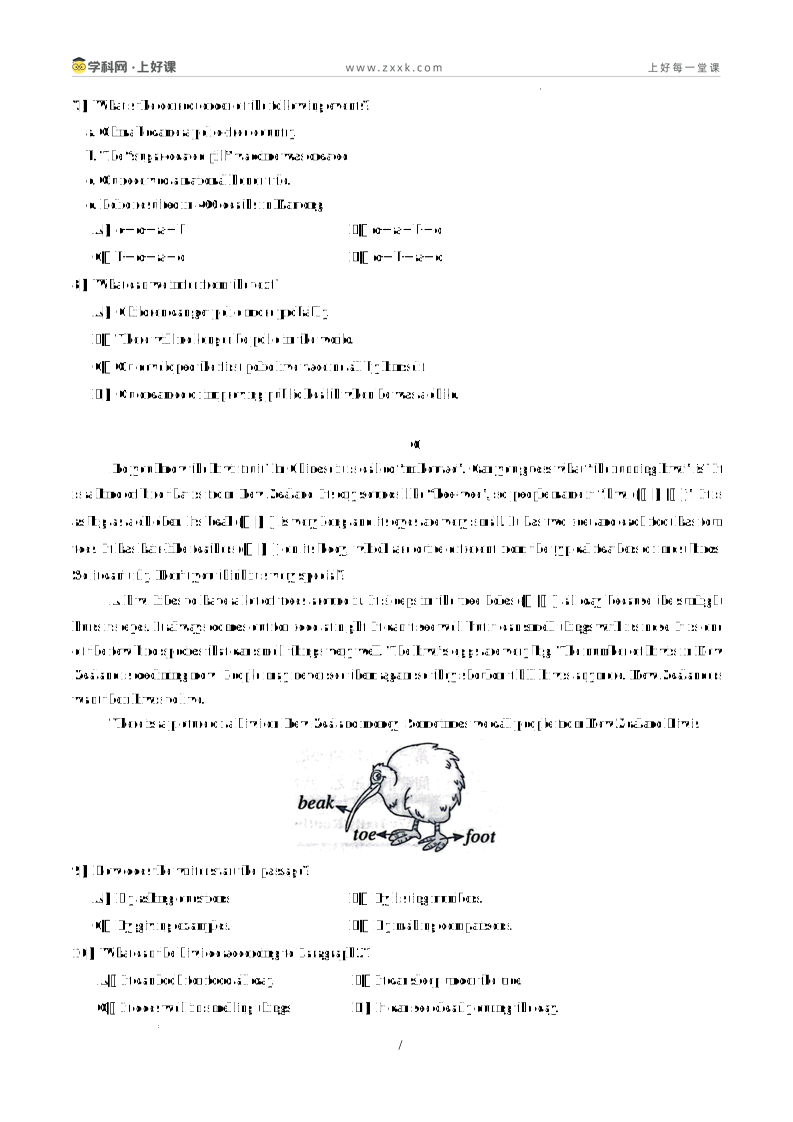
There is a picture of a kiwi on New Zealand money. Sometimes we call people from New Zealand Kiwis.
9.How does the writer start the passage?
A.By asking questions. B.By listing numbers.
C.By giving examples. D.By making comparisons.
10.What can the kiwi do according to Paragraph 2?
A.It can look for food all day. B.It can sleep under the tree.
C.It does well in smelling things. D.It can see clearly during the day.
11.What can a kiwi be according to the passage?
①a bird ②a fruit ③money ④a New Zealander
A.①②③ B.①②④ C.②③④ D.①③④
12.What can be the best title for the passage?
A.The Look of the Kiwi B.The Hometown of the Kiwi
C.The Kiwi—A Special Bird D.The Habits of the Kiwi
【答案】9.A 10.C 11.B 12.C
【导语】本文从基础介绍、生活习性、文化意义方面介绍几维鸟的独特性与文化地位。
【详解】9.第一段“Do you know the kiwi fruit? In Chinese it is called ‘mihoutao’. Can you guess what ‘the running kiwi’ is?”说明作者以两个问题开篇。
10.第二段“It is one of the few bird species that can smell things very well.”说明它很擅长闻气味。
11.第一段“It is a kind of bird that is from New Zealand.”说明它是一种鸟,对应①;第一段“Do you know the kiwi fruit? In Chinese it is called ‘mihoutao’.”说明kiwi可以指水果,对应②;第三段“Sometimes we call people from New Zealand Kiwis.”说明kiwi可以指代新西兰人,对应④。
12.本文从基础介绍、生活习性、文化意义方面介绍几维鸟的独特性与文化地位,因此最佳标题为The Kiwi—A Special Bird。
D
Siene is a firefighter in the USA.It isn’t easy to become a firefighter there. Many people try, but a lot of them fail. Also, in the past firefighting was always a job for men. Now there are women firefighters.
When Siene was five years old, it was her dream to become a firefighter. Forty years later, she was the oldest woman to pass a sixweek course at the WFPA (女子消防预备学院). The WFPA trains (训练) women in the skills they need to be firefighters. In fact, Siene now trains firefighters there herself.
Starting the course doesn’t mean you’ll become a firefighter. The course is very difficult, so not everyone finishes the training. They are trained like being in the army. Can you hold a heavy piece of wood for four minutes? How many exercises can you do? Can you lift a 12-meter ladder (梯子)?
You also need other skills. Can you lead a team? Are you a skillful driver? Can you use technology? There are so many more that are a part of firefighting these days. Of course, no one can do them all, but more skills certainly help.
However, you must wait for a chance to work as a firefighter even before passing your course. It seems that lots of women aren’t ready to do that. In one year, 50 women got trained, but only three of them are now firefighters. Learning the skills is not enough to become a firefighter. Like Siene, you also need to stick to your dream.
13.When did Siene dream of being a firefighter?
A.At the age of five. B.When she was ten years old.
C.Thirty years ago. D.When she was fifteen years old.
14.How is the course at the WFPA?
A.Boring. B.Relaxing. C.Difficult. D.Interesting.
15.The underlined words “stick to” mean “________”.
A.not give up B.change C.give up D.not change
16.What can we learn from the passage?
A.Firefighting is always a job for men now.
B.Everyone can finish the training at the WFPA.
C.You need a lot of skills to become a firefighter.
D.Starting the course at the WFPA means you'll become a firefighter.
【答案】13.A 14.C 15.A 16.C
【导语】本文是一篇记叙文,主要讲述了美国女消防员Siene的故事,以及成为消防员所需的技能和挑战。
13.细节理解题。根据文章第二段“When Siene was five years old, it was her dream to become a firefighter.”可知,Siene在五岁时就梦想成为消防员。故选A。
14.细节理解题。根据文章第三段“The course is very difficult, so not everyone finishes the training.”可知WFPA的课程非常困难。故选C。
15.词句猜测题。根据文章最后一段“Like Siene, you also need to stick to your dream.”可知,你还需要坚持自己的梦想,“stick to”意为“坚持”,即“不放弃”。故选A。
16.主旨大意题。根据文章第四段“You also need other skills. Can you lead a team? Are you a skillful driver? Can you use technology? There are so many more that are a part of firefighting these days.”可知,成为消防员需要很多技能。故选C。
第二节 阅读填空(共4小题,每小题2分,满分8分。)
阅读短文,从选项内所给的选项中选出可以填入空白处的最佳选项,其中有一个多余的选项。
The Magic of Trees
Trees are an important part of our life. They do so many things for us. 17 . They can take in harmful gases and produce oxygen, making the air we breathe cleaner. Also, they provide shelter and food for many animals.
Trees are amazing in many ways. They can sense things around them. For example, tree roots can feel the direction of water. 18 . When it’s dry, they grow towards the sound of running water.
Trees also have a long history with humans. In China, tea, which comes from trees, has a long-standing culture. 19 . According to legend, Shennong discovered tea by accident. And later, Lu Yu’s Cha Jing played a big role in spreading tea culture.
However, trees are facing some problems now. People cut down too many trees for various reasons. 20 . We should plant more trees and protect the existing ones to make sure our planet remains green and healthy.
A.If they sense the sound of water, they will grow in that direction.
B.We need to take action to protect them.
C.They help us in many aspects.
D.People have been growing tea for thousands of years.
E.Trees can communicate with each other through a network underground.
【答案】17.C 18.A 19.D 20.B
【导语】本文是一篇说明文,主要讲述了树木对人类和自然的重要性、树木的感知能力、茶树与人类的历史渊源以及当前树木面临的保护问题。
17.根据“They do so many things for us… They can take in harmful gases and produce oxygen… provide shelter and food for many animals.”可知,树木在多个方面帮助人类和自然。选项C“它们在许多方面帮助我们。”符合语境。故选C。
18.根据“When it’s dry, they grow towards the sound of running water.”可知,树木能感知水流方向并朝其生长。选项A“如果它们感知到水的声音,就会朝那个方向生长。”符合语境。故选A。
19.根据“In China, tea, which comes from trees, has a long-standing culture… According to legend, Shennong discovered tea by accident.”可知,茶树与人类的历史渊源深厚。选项D“人们种植茶树已有数千年。”符合语境。故选D。
20.根据“People cut down too many trees… We should plant more trees and protect the existing ones…”可知,此处表示需要采取行动保护树木。选项B“我们需要采取行动保护它们。”符合语境。故选B。
二、完形填空(共10小题,每小题1分;满分10分)
根据短文内容,从A、B、C、D四个选项中选择一个最佳答案,使短文完整、正确。并将符合题意的选项用2B铅笔涂在答题卡的相应位置上。
In a small town, there lived a little girl named Diana. Every time Diana went home from playing outside, her mother would always make soup for her. The 21 of the soup was like her mother’s love, warm and sweet.
One day, Diana’s mother didn’t feel 22 and couldn’t cook. Looking at her mother sleeping in bed, Diana 23 her mom. She thought, “If I could make soup for my mother, then my mother would 24 be happy and maybe she would be fine soon.”
So Diana wanted to make soup herself for her mother. Diana 25 how her mother made the soup. But Diana had a 26 . No matter how (无论怎么样) Diana tried, her soup was not so delicious as her mother’s. She tried again and again, but ended in failure (失败).
Diana felt very 27 . She sat by the river and cried. At this time, an old man passed by (路过). He asked what happened and said to Diana, “Do you know why your mother’s soup is so delicious? That’s because she put the 28 into it.”
Diana went home and tried to make the soup again. This time she thought about all her mother did for her and was 29 to her mother when making the soup. She imagined (想象) her mother’s smile after drinking the soup. When she 30 making the soup, she found the soup was very delicious, just like her mother’s.
21.A.colour B.look C.taste D.temperature
22.A.well B.busy C.nice D.relaxed
23.A.asked about B.talked about C.worried about D.learned about
24.A.certainly B.quietly C.suddenly D.slowly
25.A.liked B.showed C.helped D.remembered
26.A.way B.wish C.problem D.message
27.A.sad B.surprised C.excited D.interested
28.A.fruit B.candy C.flower D.love
29.A.hard B.thankful C.important D.smart
30.A.finished B.practiced C.enjoyed D.kept
【答案】
21.C 22.A 23.C 24.A 25.D 26.C 27.A 28.D 29.B 30.A
【导语】本文讲述小女孩Diana为生病的母亲学做汤的故事,最终明白母亲做的汤美味是因为注入了爱。
21.句意:汤的味道就像母亲的爱,温暖而甜蜜。
colour颜色;look外表;taste味道;temperature温度。根据“The…of the soup was like her mother’s love”可知,描述汤的“味道”像母爱。故选C。
22.句意:一天,Diana的母亲感到不适,无法做饭。
well健康的;busy忙碌的;nice友好的;relaxed放松的。根据“couldn’t cook”和“sleeping in bed”可知母亲身体不适。feel well为固定搭配,故选A。
23.句意:看到母亲卧床休息,Diana很担心她。
asked about询问;talked about谈论;worried about担心;learned about了解。根据母亲生病卧床的语境可知,Diana应感到“担心”。故选C。
24.句意:“如果我为母亲做汤,她一定会开心,也许很快就能好起来。”
certainly当然;quietly安静地;suddenly突然;slowly缓慢地。根据Diana的愿望可知,此处表达肯定的“当然会开心”。故选A。
25.句意:Diana记得母亲是如何做汤的。
liked喜欢;showed展示;helped帮助;remembered记得。根据“how her mother made the soup.”和后文模仿母亲做汤可知,Diana记得母亲是如何做汤的。故选D。
26.句意:但Diana遇到了问题。
way方法;wish愿望;problem问题;message信息。根据“No matter how (无论怎么样) Diana tried, her soup was not so delicious as her mother’s. She tried again and again, but ended in failure (失败).”可知,她遇到了问题。故选C。
27.句意:Diana感到非常难过。
sad难过的;surprised惊讶的;excited兴奋的;interested感兴趣的。根据“cried”可知她因失败而难过。故选A。
28.句意:那是因为她注入了爱。
fruit水果;candy糖果;flower花;love爱。根据主题“母亲的汤温暖如爱”可知,老人点明秘诀是“爱”。故选D。
29.句意:这次她边做汤边对母亲心存感激。
hard努力的;thankful感激的;important重要的;smart聪明的。根据“thought about all her mother did for her”可知,想到母亲为她做的一切,她心怀感激。故选B。
30.句意:当她完成做汤时,发现汤和母亲做的一样美味。
finished完成;practiced练习;enjoyed享受;kept保持。根据“making the soup”和“found the soup was delicious”可知动作是“完成”。故选A。
三、语法填空(共10小题,每小题1分;满分10分)
阅读下面短文,在空格处填入一个恰当的词或使用括号中的词语的正确形式填空,并将答案写在答题卡规定的位置上。
The Huazhao Festival, or Flower Festival, is a traditional Chinese event. It is on the 15th day of the 31 (two) lunar month, celebrating the birthday of the Flower Goddess.
In ancient times, people held different events to celebrate this festival with 32 (they) family. They 33 (visit) flower god temples and prayed for the good growth of plants and flowers. Young girls often cut colorful paper and tied it to flower branches. Families went outdoors 34 (enjoy) flowers, wrote poems, and had picnics. These customs showed people’s love for nature 35 spring.
However, with time passing by, this festival gradually disappeared. 36 (lucky), with the growing interest in traditional culture, the Huazhao Festival has come back in recent years.
Nowadays, many young Hanfu lovers wear traditional clothes and hold many kinds of cultural 37 (fair) during the Huazhao Festival. Organizing these events needs a lot of work, but the young people never give up. With their hard work, the modern Huazhao celebration turns out to be a great 38 (succeed).
This return shows that young people are playing 39 important role in keeping traditions alive. The festival is now even 40 (big) and more fun than before, attracting visitors from all over China.
【答案】
31.second 32.their 33.visited 34.to enjoy 35.and 36.Luckily 37.fairs 38.success 39.an 40.bigger
【导语】本文主要介绍了花朝节的相关信息,包括其时间、庆祝方式、历史变迁以及在现代的复兴情况。
【详解】31.句意:它在农历二月十五日,庆祝花神的生日。根据“the...lunar month”可知,此处表示“第二个月”,用序数词表示顺序,two的序数词为second。故填second。
32.句意:在古代,人们和家人一起举行不同的活动来庆祝这个节日。修饰名词family,用they的形容词性物主代词their“他们的”。故填their。
33.句意:他们参观花神庙,祈求植物和花卉茁壮成长。根据“prayed”可知,句子用一般过去时,动词用过去式visited“参观”。故填visited。
34.句意:一家人到户外赏花、写诗、野餐。根据“Families went outdoors...flowers”可知,到户外的目的是赏花,用动词不定式作目的状语。故填to enjoy。
35.句意:这些习俗表达了人们对自然和春天的热爱。根据“people’s love for nature...spring”可知,此处表示并列关系,用and连接。故填and。
36.句意:幸运的是,随着人们对传统文化兴趣的增加,花朝节在近年来又回来了。根据“with the growing interest in traditional culture, the Huazhao Festival has come back in recent years.”可知,花朝节又回来了是幸运的,修饰整个句子用副词luckily“幸运地”,句首首字母大写。故填Luckily。
37.句意:如今,许多年轻的汉服爱好者在花朝节期间穿着传统服装,举办各种文化集市。fair“集市”,可数名词,many kinds of修饰可数名词复数。故填fairs。
38.句意:在他们的努力下,现代花朝节的庆祝活动取得了巨大的成功。a后接可数名词单数,succeed的名词形式success“成功”。故填success。
39.句意:这种回归表明年轻人在保持传统方面发挥着重要作用。play an important role in“在……中发挥重要作用”,固定短语,important以元音音素开头,不定冠词用an。故填an。
40.句意:这个节日现在比以前更大、更有趣,吸引了来自中国各地的游客。根据“more fun”可知,此处用big的比较级bigger“更大的”。故填bigger。
四、任务型阅读(第41-43,每小题2分;第44小题4分;满分10分)
When he was nine years old, Felix Finkbeiner gave a class report on climate change. At the end of his talk, he called on the people of his country to help by planting one million trees. Nobody thought much about a nine-year-old boy’s project. However, before he was 20, Felix’s efforts had resulted in the planting of more than 12 billion trees around the world.
Felix and his classmates began the project named “Plant for the Planet” by planting the first tree outside their school. Other schools followed the example, and then the news of the one-million challenge spread. Felix’s project became famous worldwide. He was invited to give a speech at the United Nations conference (联合国大会) in New York. “We young people cannot depend on adults alone to save the earth,” he said. “We have to take responsibilities in protecting the environment.”
Felix is now in his twenties, and “Plant for the Planet” is an organisation with around 70, 000 members. It works to teach people about climate change and to encourage the planting of more trees. Felix’s one millionth tree was planted long ago. The goal now is one trillion (万亿)—150 for every person on Earth.
41.How did Felix begin the project “Plant for the Planet”?
42.In which city did Felix give a speech at the United Nations conference?
43.How many members does “Plant for the Planet” have now?
44.What do you think of Felix and his project? Write 30 words or more.
【答案】
41.He and his classmates began it by planting the first tree outside their school.
42.New York.
43.Around 70, 000.
44.Felix is brave, responsible and has a strong sense of environmental protection. His “Plant for the Planet” project has made a great contribution to fighting climate change, inspiring people of all ages to protect the earth.
【导语】本文是一篇记叙文,讲述了Felix Finkbeiner从小关注气候变化,发起“Plant for the Planet”植树项目,从最初无人关注到如今成为全球性环保组织,激励无数人参与环保行动的故事。
41.根据文章第二段“Felix and his classmates began the project named ‘Plant for the Planet’ by planting the first tree outside their school.”可知,Felix和同学们通过在学校外种下第一棵树,开启了“Plant for the Planet”项目。故填He and his classmates began it by planting the first tree outside their school.
42.根据文章第二段“ He was invited to give a speech at the United Nations conference (联合国大会) in New York.”可知,Felix在纽约的联合国大会上发表了演讲。故填New York.
43.根据文章第三段“Felix is now in his twenties, and ‘Plant for the Planet’ is an organisation with around 70, 000 members.”可知,“Plant for the Planet”组织目前拥有约7万名成员。故填Around 70, 000.
44.本题为开放性试题,答案不唯一。根据文章内容,Felix从小关注气候变化,发起植树项目,并坚持多年将其发展为全球性环保组织,展现出勇敢、责任感和环保意识。他的行动不仅对抗气候变化做出了巨大贡献,更激励了不同年龄段的人参与环保。所以答案需包含对Felix个人品质的评价(如brave, responsible, visionary等)和对项目意义的肯定(如made a great contribution, inspired people等),且字数不少于30词。故填Felix is brave, responsible and has a strong sense of environmental protection. His “Plant for the Planet” project has made a great contribution to fighting climate change, inspiring people of all ages to protect the earth.
五、书面表达(20分)
45.假定你是李华,下周你将参加英语俱乐部举行的“编织兴趣,梦想未来”的主题分享活动,请你根据以下问题提示,写一篇发言稿。
1. What is your hobby?
2. Why do you like it?
3. How do you develop your hobby?
4. Do you want to make your hobby your future career? Why or why not?
要求:
1. 词数80词左右,开头和结尾已给出,不计入总词数;
2. 可适当增加细节,使行文连贯;
3. 文中不得出现真实的人名、校名等信息;
4. 条理清楚,语句通顺,意义连贯,书写规范。
Hello everyone! I’m Li Hua. ____________________________________________________________________________________________________________________________________________________________________________________________________________________________________________________________________________________________________________________________________________________________________________________________________________________________________________________________________________________________________________________________________________________________________________________________________________________________________________________________________________________________________________________________________________________________________________________________________________________________________________________________
That’s all. Thank you for listening.
【答案】例文
Possible version 1:
Hello everyone! I’m Li Hua. I’m excited to share my hobby with you today. My hobby is dancing. When I dance, I feel like a bird flying freely. It makes me forget all my worries!
My love for dancing began when I was young. One day, I watched a ballet show on TV. The dancers’ beautiful moves caught my eyes at once. After that, I joined a dance class. I practise dancing three times a week. Besides taking classes, I also learn new steps on the Internet. It’s so fun!
I hope to become a dancer. Dancing makes me confident and brave. Standing on stage, I forget my fears. I will work hard to achieve my dream!
That’s all. Thank you for listening.
Possible version 2:
Hello everyone! I’m Li Hua. I’m excited to share my hobby—painting. When I paint, I enter a colourful world of my own, leaving all my worries behind.
I started loving painting at the age of seven. My grandma gave me coloured pencils, and I was amazed to discover I could bring animals, flowers and my stories to life on paper. To get better at it, I draw every day. I also learn on the Internet and go to art shows on weekends.
Though I love painting, I don’t want it to be my job. I want to keep it as pure fun. No matter what I do in the future, I’ll always paint as it colours my life.
That’s all. Thank you for listening.
【详解】[总体分析]
①题材:本文是一篇发言稿;
②时态:时态为“一般现在时”和“一般过去时”;
③提示:写作要点已给出,考生应注意不要遗漏信息,可适当发挥。
[写作步骤]
第一步,承接上文,介绍自己的爱好是什么并给出原因;
第二步,描述培养爱好的过程和方法;
第三步,表达是否要将爱好发展成职业的观点,并给出原因;
第四步,感谢聆听。
[亮点词汇]
①share sth. with sb.与某人分享某物
②at once立刻
③practise doing sth.练习做某事
④hope to do sth.希望做某事
⑤achieve my dream实现梦想
[高分句型]
①When I dance, I feel like a bird flying freely.(when引导的时间状语从句)
②Standing on stage, I forget my fears.(现在分词短语作状语)
/
学科网(北京)股份有限公司
学科网(北京)股份有限公司
$………………○………………外………………○………………装………………○………………订………………○………………线………………○………………
………………○………………内………………○………………装………………○………………订………………○………………线………………○………………
此卷只装订不密封
………………○………………内………………○………………装………………○………………订………………○………………线………………○………………
………………○………………外………………○………………装………………○………………订………………○………………线………………○………………
… 学校:______________姓名:_____________班级:_______________考号:______________________
2025-2026学年七年级下学期期末模拟卷(沈阳专用)
英语
(考试时间:90分钟 试卷满分:90分)
注意事项:
1.本试卷分第Ⅰ卷(选择题)和第Ⅱ卷(非选择题)两部分。答卷前,考生务必将自己的姓名、准考证号填写在答题卡上。
2.回答第Ⅰ卷时,选出每小题答案后,用2B铅笔把答题卡上对应题目的答案标号涂黑。如需改动,用橡皮擦干净后,再选涂其他答案标号。写在本试卷上无效。
3.回答第Ⅱ卷时,将答案写在答题卡上。写在本试卷上无效。
4.考试结束后,将本试卷和答题卡一并交回。
一、阅读理解(共20小题,每小题2分;满分40分)
第一节 阅读下面语言材料,从每题所给的A、B、C、D 选项中选出最佳选项。
A
An Introduction to Shanghai Museum
Shanghai Museum is located in the center of the People’s Square. It covers an area of 4,000 square meters. There are so many ancient books, paintings, bronze wares (青铜器) in it. It’s just like a huge book to tell you the history of China. If you have a chance to go there, you will have a good time.
An Introduction to the Louvre Museum
The Louvre Museum is the largest national museum of France. It is a central landmark of Paris, located on the Right Bank of the Seine in the 1st neighborhood. Nearly 35,000 objects from prehistory (史前) to the 19th century are exhibited over an area of 60,600 square meters.
An Introduction to the British Museum
The British Museum in London New Oxford Street, north of the Great Russell Square, was built in 1753, 15 January 1759 officially open to the public, is one of the world’s oldest and largest museums. At present the museum has a collection of more than 600 million pieces from different times.
1.In which section of the newspaper can we read the news?
A.BUSINESS. B.CULTURE. C.SPORTS. D.EDUCATION.
2.In Shanghai Museum, you can see these works except ________.
A.ancient books B.paintings C.bronze wares D.a huge history book
3.The Louvre Museum ________.
A.is on the Left Bank of the Seine in the 1st neighborhood
B.is the largest natural museum of France
C.has over 35,000 objects
D.covers over an area of 60,600 square meters
4.We can ________ from the three museums.
A.enjoy the natural beauty of the three countries
B.read the different books about the three countries
C.eat all kinds of delicious food from the three countries
D.learn the history of the three countries
B
“I spend my whole life doing one thing,” Gu Fangzhou once said. Known as "the father of sugar pills (糖丸)”, Gu passed away at age 92 on January 2nd, 2019. Eight months later he received a national honor title “The People’s Science” for his polio (骨髓灰质炎) research.
Gu Fangzhou was born in June, 1926. He studied at Peking University as a medical student in 1944. After graduation, Gu made the decision to work to help improve public health.
In 1955, polio broke out in Nantong. Jiangsu Province. It paralyzed (使瘫痪) 1680 people, mostly children aged below seven. It spread to neighboring areas and resulted in 466 deaths. Gu was asked to lead polio research in 1957. “At that time the only way to prevent polio was to invent a vaccine(疫苗),” said Gu.
In 1959 Gu succeeded in developing the first polio live vaccine. Later, he developed the “sugar-coated (糖衣) pill” vaccine in 1962. It not only tasted better but was much easier to keep. In order to test the vaccine, Gu himself tried the vaccine and later his one-month-old son was vaccinated. This inspired his team to vaccinate their kids. They became the first group of people in China to try a polio vaccine. “If we don’t believe in what we produce, how can others believe in it?” said Gu.
Later, the sugar pill was popular in China. It saved millions of people, especially kids. In 2000, the World Health Organization (WHO) announced (宣布) that China was already a polio-free country.“We feel satisfied. I can tell people that I tried my best, and your kids will no longer get polio,” said Gu. “That’s all we hoped for.”
5.How is the text developed by?
A.Character. B.Direction. C.Feeling. D.Timeline.
6.Why did Gu Fangzhou and his team vaccinate their own kids with the polio vaccine?
A.To show their courage and experience.
B.To encourage other experts to do the same.
C.To test the “sugar-coated pill” vaccine’s safety.
D.To protect their families and relatives from polio.
7.What’s the correct order of the following events?
a. China became a polio-free country.
b. The “sugar-coated pill” vaccine was created.
c. Gu received a national honor title.
d. Polio resulted in 466 deaths in Nantong.
A.c→d→a→b B.d→a→b→c
C.b→d→a→c D.d→b→a→c
8.What can we infer from the text?
A.Children can get polio more probably.
B.There will no longer be polio in the world.
C.Gu developed the first polio live vaccine all by himself.
D.Gu dreamed of improving public health when he was a child.
C
Do you know the kiwi fruit? In Chinese it is called “mihoutao”. Can you guess what “the running kiwi” is? It is a kind of bird that is from New Zealand. Its cry sounds like “kee-wee”, so people name it “kiwi (几维鸟)”. It is as big as a chicken. Its beak (鸟喙) is very long and its eyes are very small. It has two feet and each foot has four toes. It has hair-like feathers (羽毛) on its body, which are quite different from the typical feathers of most birds. So it can’t fly. Don’t you think it’s very special?
A kiwi likes to have a lot of trees around it. It sleeps in the tree holes (树洞) all day because the sunlight hurts its eyes. It always comes out for food at night. It can’t see well but it can smell things with its nose. It is one of the few bird species that can smell things very well. The kiwi’s eggs are very big. The number of kiwis in New Zealand is declining now. People may never see them again so they shouldn’t kill kiwis anymore. New Zealanders want their kiwis to live.
There is a picture of a kiwi on New Zealand money. Sometimes we call people from New Zealand Kiwis.
9.How does the writer start the passage?
A.By asking questions. B.By listing numbers.
C.By giving examples. D.By making comparisons.
10.What can the kiwi do according to Paragraph 2?
A.It can look for food all day. B.It can sleep under the tree.
C.It does well in smelling things. D.It can see clearly during the day.
11.What can a kiwi be according to the passage?
①a bird ②a fruit ③money ④a New Zealander
A.①②③ B.①②④ C.②③④ D.①③④
12.What can be the best title for the passage?
A.The Look of the Kiwi B.The Hometown of the Kiwi
C.The Kiwi—A Special Bird D.The Habits of the Kiwi
D
Siene is a firefighter in the USA.It isn’t easy to become a firefighter there. Many people try, but a lot of them fail. Also, in the past firefighting was always a job for men. Now there are women firefighters.
When Siene was five years old, it was her dream to become a firefighter. Forty years later, she was the oldest woman to pass a sixweek course at the WFPA (女子消防预备学院). The WFPA trains (训练) women in the skills they need to be firefighters. In fact, Siene now trains firefighters there herself.
Starting the course doesn’t mean you’ll become a firefighter. The course is very difficult, so not everyone finishes the training. They are trained like being in the army. Can you hold a heavy piece of wood for four minutes? How many exercises can you do? Can you lift a 12-meter ladder (梯子)?
You also need other skills. Can you lead a team? Are you a skillful driver? Can you use technology? There are so many more that are a part of firefighting these days. Of course, no one can do them all, but more skills certainly help.
However, you must wait for a chance to work as a firefighter even before passing your course. It seems that lots of women aren’t ready to do that. In one year, 50 women got trained, but only three of them are now firefighters. Learning the skills is not enough to become a firefighter. Like Siene, you also need to stick to your dream.
13.When did Siene dream of being a firefighter?
A.At the age of five. B.When she was ten years old.
C.Thirty years ago. D.When she was fifteen years old.
14.How is the course at the WFPA?
A.Boring. B.Relaxing. C.Difficult. D.Interesting.
15.The underlined words “stick to” mean “________”.
A.not give up B.change C.give up D.not change
16.What can we learn from the passage?
A.Firefighting is always a job for men now.
B.Everyone can finish the training at the WFPA.
C.You need a lot of skills to become a firefighter.
D.Starting the course at the WFPA means you'll become a firefighter.
第二节 阅读填空(共4小题,每小题2分,满分8分。)
阅读短文,从选项内所给的选项中选出可以填入空白处的最佳选项,其中有一个多余的选项。
The Magic of Trees
Trees are an important part of our life. They do so many things for us. 17 . They can take in harmful gases and produce oxygen, making the air we breathe cleaner. Also, they provide shelter and food for many animals.
Trees are amazing in many ways. They can sense things around them. For example, tree roots can feel the direction of water. 18 . When it’s dry, they grow towards the sound of running water.
Trees also have a long history with humans. In China, tea, which comes from trees, has a long-standing culture. 19 . According to legend, Shennong discovered tea by accident. And later, Lu Yu’s Cha Jing played a big role in spreading tea culture.
However, trees are facing some problems now. People cut down too many trees for various reasons. 20 . We should plant more trees and protect the existing ones to make sure our planet remains green and healthy.
A.If they sense the sound of water, they will grow in that direction.
B.We need to take action to protect them.
C.They help us in many aspects.
D.People have been growing tea for thousands of years.
E.Trees can communicate with each other through a network underground.
二、完形填空(共10小题,每小题1分;满分10分)
根据短文内容,从A、B、C、D四个选项中选择一个最佳答案,使短文完整、正确。并将符合题意的选项用2B铅笔涂在答题卡的相应位置上。
In a small town, there lived a little girl named Diana. Every time Diana went home from playing outside, her mother would always make soup for her. The 21 of the soup was like her mother’s love, warm and sweet.
One day, Diana’s mother didn’t feel 22 and couldn’t cook. Looking at her mother sleeping in bed, Diana 23 her mom. She thought, “If I could make soup for my mother, then my mother would 24 be happy and maybe she would be fine soon.”
So Diana wanted to make soup herself for her mother. Diana 25 how her mother made the soup. But Diana had a 26 . No matter how (无论怎么样) Diana tried, her soup was not so delicious as her mother’s. She tried again and again, but ended in failure (失败).
Diana felt very 27 . She sat by the river and cried. At this time, an old man passed by (路过). He asked what happened and said to Diana, “Do you know why your mother’s soup is so delicious? That’s because she put the 28 into it.”
Diana went home and tried to make the soup again. This time she thought about all her mother did for her and was 29 to her mother when making the soup. She imagined (想象) her mother’s smile after drinking the soup. When she 30 making the soup, she found the soup was very delicious, just like her mother’s.
21.A.colour B.look C.taste D.temperature
22.A.well B.busy C.nice D.relaxed
23.A.asked about B.talked about C.worried about D.learned about
24.A.certainly B.quietly C.suddenly D.slowly
25.A.liked B.showed C.helped D.remembered
26.A.way B.wish C.problem D.message
27.A.sad B.surprised C.excited D.interested
28.A.fruit B.candy C.flower D.love
29.A.hard B.thankful C.important D.smart
30.A.finished B.practiced C.enjoyed D.kept
三、语法填空(共10小题,每小题1分;满分10分)
阅读下面短文,在空格处填入一个恰当的词或使用括号中的词语的正确形式填空,并将答案写在答题卡规定的位置上。
The Huazhao Festival, or Flower Festival, is a traditional Chinese event. It is on the 15th day of the 31 (two) lunar month, celebrating the birthday of the Flower Goddess.
In ancient times, people held different events to celebrate this festival with 32 (they) family. They 33 (visit) flower god temples and prayed for the good growth of plants and flowers. Young girls often cut colorful paper and tied it to flower branches. Families went outdoors 34 (enjoy) flowers, wrote poems, and had picnics. These customs showed people’s love for nature 35 spring.
However, with time passing by, this festival gradually disappeared. 36 (lucky), with the growing interest in traditional culture, the Huazhao Festival has come back in recent years.
Nowadays, many young Hanfu lovers wear traditional clothes and hold many kinds of cultural 37 (fair) during the Huazhao Festival. Organizing these events needs a lot of work, but the young people never give up. With their hard work, the modern Huazhao celebration turns out to be a great 38 (succeed).
This return shows that young people are playing 39 important role in keeping traditions alive. The festival is now even 40 (big) and more fun than before, attracting visitors from all over China.
四、任务型阅读(第41-43,每小题2分;第44小题4分;满分10分)
When he was nine years old, Felix Finkbeiner gave a class report on climate change. At the end of his talk, he called on the people of his country to help by planting one million trees. Nobody thought much about a nine-year-old boy’s project. However, before he was 20, Felix’s efforts had resulted in the planting of more than 12 billion trees around the world.
Felix and his classmates began the project named “Plant for the Planet” by planting the first tree outside their school. Other schools followed the example, and then the news of the one-million challenge spread. Felix’s project became famous worldwide. He was invited to give a speech at the United Nations conference (联合国大会) in New York. “We young people cannot depend on adults alone to save the earth,” he said. “We have to take responsibilities in protecting the environment.”
Felix is now in his twenties, and “Plant for the Planet” is an organisation with around 70, 000 members. It works to teach people about climate change and to encourage the planting of more trees. Felix’s one millionth tree was planted long ago. The goal now is one trillion (万亿)—150 for every person on Earth.
41.How did Felix begin the project “Plant for the Planet”?
42.In which city did Felix give a speech at the United Nations conference?
43.How many members does “Plant for the Planet” have now?
44.What do you think of Felix and his project? Write 30 words or more.
五、书面表达(20分)
45.假定你是李华,下周你将参加英语俱乐部举行的“编织兴趣,梦想未来”的主题分享活动,请你根据以下问题提示,写一篇发言稿。
1. What is your hobby?
2. Why do you like it?
3. How do you develop your hobby?
4. Do you want to make your hobby your future career? Why or why not?
要求:
1. 词数80词左右,开头和结尾已给出,不计入总词数;
2. 可适当增加细节,使行文连贯;
3. 文中不得出现真实的人名、校名等信息;
4. 条理清楚,语句通顺,意义连贯,书写规范。
Hello everyone! I’m Li Hua. ____________________________________________________________________________________________________________________________________________________________________________________________________________________________________________________________________________________________________________________________________________________________________________________________________________________________________________________________________________________________________________________________________________________________________________________________________________________________________________________________________________________________________________________________________________________________________________________________________________________________________________________________
That’s all. Thank you for listening.
试题 第3页(共6页) 试题 第4页(共6页)
试题 第1页(共6页) 试题 第2页(共6页)
学科网(北京)股份有限公司
$2025-2026学年七年级下学期期末模拟卷(沈阳专用)
英语·答题卡
姓
名:
条码粘贴处
准考证号:
缺考标记口
注意事项
违纪标记口
1.答题前,考生先将自己的姓名、准考证号码填写清楚。
以上标记由监考
2.
请将准考证条码粘贴在右侧的[条码粘贴处]的方框内。
人员用2B铅笔
3.
选择题必须使用B铅笔填涂;非选择题必须用0.5mm黑色字迹的签字笔填写,字体工整。
填涂!
4.请按题号顺序在各题的答题区内作答,超出范围的答案无效,在草纸、试卷上作答无效。
5.保持卡面清洁,不要折叠、不要弄破、弄皱,不准使用涂改液、刮纸刀。
6.
填涂样例正确[■]错误[-][√][×]
选择题部分(请用2B铅笔填涂)
1-A][B][C][D]
6.[A][BJ[C][D]
11.[AJ[B][CJ[D]
16[A][B][C][D]
2.A][B][C][D]
7[A][B][CI[D]
12.[A][B][CJ[D]
17.[A][BJ[C][D][E]
3.[A][B][C][D]
8.[A][B][CJ[D]
13.[A][B][CJ[D]
18.[A][B][C][D][E]
4.A][B][C][D]
9.[A][B][C][D]
14.[A][B][CJ[D]
19.[A][B][C][D][E]
5.[A][B][C][D]
10.[A][B][C][D]
15.[A][B][CJ[D]
20.[A][B][C][D][E]
21.A][BJ[C][D]
26.[AJ[B][CJ[D]
22.[A][B][C][D]
27.[A][B][C][D]
23.[A][B][C][D]
28.[A][B][C][D]
24.A][B][C][D]
29.[A][B][C][D]
25.[A][B][C][D]
30.[A][B][C][D]
非选择题(请在各答题区域内作答)
三、语法填空(共10小题,每小题1分,共10分)
31
32
33.
34.
35
36.
37
38
39.
40
请在各题目的答题区域内作答,超出黑色矩形边框限定区域的答案无效!
1/2
请在各题目的答题区域内作答,超出黑色矩形边框限定区域的答案无效!
四、任务型阅读(第41-43,每小题2分;第34小题4分,满分10分)
41
42.
43.
44.
四、书面表达(20分)
Hello everyone!I'm Li Hua.
That's all.Thank you for listening.
请在各题目的答题区域内作答,超出黑色矩形边框限定区域的答案无效!
2/2
2025-2026学年七年级下学期期末模拟卷(沈阳专用)
英语·参考答案
(考试时间:90分钟 试卷满分:90分)
一、阅读理解(共20小题,每小题2分;满分40分)
1.B 2.D 3.D 4.D
5.D 6.C 7.D 8.A
9.A 10.C 11.B 12.C
13.A 14.C 15.A 16.C
17.C 18.A 19.D 20.B
二、完形填空(共10小题,每小题1分;满分10分)
21.C 22.A 23.C 24.A 25.D 26.C 27.A 28.D 29.B 30.A
三、语法填空(共10小题,每小题1分;满分10分)
31.second 32.their 33.visited 34.to enjoy 35.and 36.Luckily 37.fairs 38.success 39.an 40.bigger
四、任务型阅读(第41-43,每小题2分;第44小题4分;满分10分)
41.He and his classmates began it by planting the first tree outside their school.
42.New York.
43.Around 70, 000.
44.Felix is brave, responsible and has a strong sense of environmental protection. His “Plant for the Planet” project has made a great contribution to fighting climate change, inspiring people of all ages to protect the earth.
五、书面表达(20分)
Possible version 1:
Hello everyone! I’m Li Hua. I’m excited to share my hobby with you today. My hobby is dancing. When I dance, I feel like a bird flying freely. It makes me forget all my worries!
My love for dancing began when I was young. One day, I watched a ballet show on TV. The dancers’ beautiful moves caught my eyes at once. After that, I joined a dance class. I practise dancing three times a week. Besides taking classes, I also learn new steps on the Internet. It’s so fun!
I hope to become a dancer. Dancing makes me confident and brave. Standing on stage, I forget my fears. I will work hard to achieve my dream!
That’s all. Thank you for listening.
Possible version 2:
Hello everyone! I’m Li Hua. I’m excited to share my hobby—painting. When I paint, I enter a colourful world of my own, leaving all my worries behind.
I started loving painting at the age of seven. My grandma gave me coloured pencils, and I was amazed to discover I could bring animals, flowers and my stories to life on paper. To get better at it, I draw every day. I also learn on the Internet and go to art shows on weekends.
Though I love painting, I don’t want it to be my job. I want to keep it as pure fun. No matter what I do in the future, I’ll always paint as it colours my life.
That’s all. Thank you for listening.
/
学科网(北京)股份有限公司
学科网(北京)股份有限公司
$
2025-2026学年七年级下学期期末模拟卷(沈阳专用)
英语
(考试时间:90分钟 试卷满分:90分)
注意事项:
1.本试卷分第Ⅰ卷(选择题)和第Ⅱ卷(非选择题)两部分。答卷前,考生务必将自己的姓名、准考证号填写在答题卡上。
2.回答第Ⅰ卷时,选出每小题答案后,用2B铅笔把答题卡上对应题目的答案标号涂黑。如需改动,用橡皮擦干净后,再选涂其他答案标号。写在本试卷上无效。
3.回答第Ⅱ卷时,将答案写在答题卡上。写在本试卷上无效。
4.考试结束后,将本试卷和答题卡一并交回。
一、阅读理解(共20小题,每小题2分;满分40分)
第一节 阅读下面语言材料,从每题所给的A、B、C、D 选项中选出最佳选项。
A
An Introduction to Shanghai Museum
Shanghai Museum is located in the center of the People’s Square. It covers an area of 4,000 square meters. There are so many ancient books, paintings, bronze wares (青铜器) in it. It’s just like a huge book to tell you the history of China. If you have a chance to go there, you will have a good time.
An Introduction to the Louvre Museum
The Louvre Museum is the largest national museum of France. It is a central landmark of Paris, located on the Right Bank of the Seine in the 1st neighborhood. Nearly 35,000 objects from prehistory (史前) to the 19th century are exhibited over an area of 60,600 square meters.
An Introduction to the British Museum
The British Museum in London New Oxford Street, north of the Great Russell Square, was built in 1753, 15 January 1759 officially open to the public, is one of the world’s oldest and largest museums. At present the museum has a collection of more than 600 million pieces from different times.
1.In which section of the newspaper can we read the news?
A.BUSINESS. B.CULTURE. C.SPORTS. D.EDUCATION.
2.In Shanghai Museum, you can see these works except ________.
A.ancient books B.paintings C.bronze wares D.a huge history book
3.The Louvre Museum ________.
A.is on the Left Bank of the Seine in the 1st neighborhood
B.is the largest natural museum of France
C.has over 35,000 objects
D.covers over an area of 60,600 square meters
4.We can ________ from the three museums.
A.enjoy the natural beauty of the three countries
B.read the different books about the three countries
C.eat all kinds of delicious food from the three countries
D.learn the history of the three countries
B
“I spend my whole life doing one thing,” Gu Fangzhou once said. Known as "the father of sugar pills (糖丸)”, Gu passed away at age 92 on January 2nd, 2019. Eight months later he received a national honor title “The People’s Science” for his polio (骨髓灰质炎) research.
Gu Fangzhou was born in June, 1926. He studied at Peking University as a medical student in 1944. After graduation, Gu made the decision to work to help improve public health.
In 1955, polio broke out in Nantong. Jiangsu Province. It paralyzed (使瘫痪) 1680 people, mostly children aged below seven. It spread to neighboring areas and resulted in 466 deaths. Gu was asked to lead polio research in 1957. “At that time the only way to prevent polio was to invent a vaccine(疫苗),” said Gu.
In 1959 Gu succeeded in developing the first polio live vaccine. Later, he developed the “sugar-coated (糖衣) pill” vaccine in 1962. It not only tasted better but was much easier to keep. In order to test the vaccine, Gu himself tried the vaccine and later his one-month-old son was vaccinated. This inspired his team to vaccinate their kids. They became the first group of people in China to try a polio vaccine. “If we don’t believe in what we produce, how can others believe in it?” said Gu.
Later, the sugar pill was popular in China. It saved millions of people, especially kids. In 2000, the World Health Organization (WHO) announced (宣布) that China was already a polio-free country.“We feel satisfied. I can tell people that I tried my best, and your kids will no longer get polio,” said Gu. “That’s all we hoped for.”
5.How is the text developed by?
A.Character. B.Direction. C.Feeling. D.Timeline.
6.Why did Gu Fangzhou and his team vaccinate their own kids with the polio vaccine?
A.To show their courage and experience.
B.To encourage other experts to do the same.
C.To test the “sugar-coated pill” vaccine’s safety.
D.To protect their families and relatives from polio.
7.What’s the correct order of the following events?
a. China became a polio-free country.
b. The “sugar-coated pill” vaccine was created.
c. Gu received a national honor title.
d. Polio resulted in 466 deaths in Nantong.
A.c→d→a→b B.d→a→b→c
C.b→d→a→c D.d→b→a→c
8.What can we infer from the text?
A.Children can get polio more probably.
B.There will no longer be polio in the world.
C.Gu developed the first polio live vaccine all by himself.
D.Gu dreamed of improving public health when he was a child.
C
Do you know the kiwi fruit? In Chinese it is called “mihoutao”. Can you guess what “the running kiwi” is? It is a kind of bird that is from New Zealand. Its cry sounds like “kee-wee”, so people name it “kiwi (几维鸟)”. It is as big as a chicken. Its beak (鸟喙) is very long and its eyes are very small. It has two feet and each foot has four toes. It has hair-like feathers (羽毛) on its body, which are quite different from the typical feathers of most birds. So it can’t fly. Don’t you think it’s very special?
A kiwi likes to have a lot of trees around it. It sleeps in the tree holes (树洞) all day because the sunlight hurts its eyes. It always comes out for food at night. It can’t see well but it can smell things with its nose. It is one of the few bird species that can smell things very well. The kiwi’s eggs are very big. The number of kiwis in New Zealand is declining now. People may never see them again so they shouldn’t kill kiwis anymore. New Zealanders want their kiwis to live.
There is a picture of a kiwi on New Zealand money. Sometimes we call people from New Zealand Kiwis.
9.How does the writer start the passage?
A.By asking questions. B.By listing numbers.
C.By giving examples. D.By making comparisons.
10.What can the kiwi do according to Paragraph 2?
A.It can look for food all day. B.It can sleep under the tree.
C.It does well in smelling things. D.It can see clearly during the day.
11.What can a kiwi be according to the passage?
①a bird ②a fruit ③money ④a New Zealander
A.①②③ B.①②④ C.②③④ D.①③④
12.What can be the best title for the passage?
A.The Look of the Kiwi B.The Hometown of the Kiwi
C.The Kiwi—A Special Bird D.The Habits of the Kiwi
D
Siene is a firefighter in the USA.It isn’t easy to become a firefighter there. Many people try, but a lot of them fail. Also, in the past firefighting was always a job for men. Now there are women firefighters.
When Siene was five years old, it was her dream to become a firefighter. Forty years later, she was the oldest woman to pass a sixweek course at the WFPA (女子消防预备学院). The WFPA trains (训练) women in the skills they need to be firefighters. In fact, Siene now trains firefighters there herself.
Starting the course doesn’t mean you’ll become a firefighter. The course is very difficult, so not everyone finishes the training. They are trained like being in the army. Can you hold a heavy piece of wood for four minutes? How many exercises can you do? Can you lift a 12-meter ladder (梯子)?
You also need other skills. Can you lead a team? Are you a skillful driver? Can you use technology? There are so many more that are a part of firefighting these days. Of course, no one can do them all, but more skills certainly help.
However, you must wait for a chance to work as a firefighter even before passing your course. It seems that lots of women aren’t ready to do that. In one year, 50 women got trained, but only three of them are now firefighters. Learning the skills is not enough to become a firefighter. Like Siene, you also need to stick to your dream.
13.When did Siene dream of being a firefighter?
A.At the age of five. B.When she was ten years old.
C.Thirty years ago. D.When she was fifteen years old.
14.How is the course at the WFPA?
A.Boring. B.Relaxing. C.Difficult. D.Interesting.
15.The underlined words “stick to” mean “________”.
A.not give up B.change C.give up D.not change
16.What can we learn from the passage?
A.Firefighting is always a job for men now.
B.Everyone can finish the training at the WFPA.
C.You need a lot of skills to become a firefighter.
D.Starting the course at the WFPA means you'll become a firefighter.
第二节 阅读填空(共4小题,每小题2分,满分8分。)
阅读短文,从选项内所给的选项中选出可以填入空白处的最佳选项,其中有一个多余的选项。
The Magic of Trees
Trees are an important part of our life. They do so many things for us. 17 . They can take in harmful gases and produce oxygen, making the air we breathe cleaner. Also, they provide shelter and food for many animals.
Trees are amazing in many ways. They can sense things around them. For example, tree roots can feel the direction of water. 18 . When it’s dry, they grow towards the sound of running water.
Trees also have a long history with humans. In China, tea, which comes from trees, has a long-standing culture. 19 . According to legend, Shennong discovered tea by accident. And later, Lu Yu’s Cha Jing played a big role in spreading tea culture.
However, trees are facing some problems now. People cut down too many trees for various reasons. 20 . We should plant more trees and protect the existing ones to make sure our planet remains green and healthy.
A.If they sense the sound of water, they will grow in that direction.
B.We need to take action to protect them.
C.They help us in many aspects.
D.People have been growing tea for thousands of years.
E.Trees can communicate with each other through a network underground.
二、完形填空(共10小题,每小题1分;满分10分)
根据短文内容,从A、B、C、D四个选项中选择一个最佳答案,使短文完整、正确。并将符合题意的选项用2B铅笔涂在答题卡的相应位置上。
In a small town, there lived a little girl named Diana. Every time Diana went home from playing outside, her mother would always make soup for her. The 21 of the soup was like her mother’s love, warm and sweet.
One day, Diana’s mother didn’t feel 22 and couldn’t cook. Looking at her mother sleeping in bed, Diana 23 her mom. She thought, “If I could make soup for my mother, then my mother would 24 be happy and maybe she would be fine soon.”
So Diana wanted to make soup herself for her mother. Diana 25 how her mother made the soup. But Diana had a 26 . No matter how (无论怎么样) Diana tried, her soup was not so delicious as her mother’s. She tried again and again, but ended in failure (失败).
Diana felt very 27 . She sat by the river and cried. At this time, an old man passed by (路过). He asked what happened and said to Diana, “Do you know why your mother’s soup is so delicious? That’s because she put the 28 into it.”
Diana went home and tried to make the soup again. This time she thought about all her mother did for her and was 29 to her mother when making the soup. She imagined (想象) her mother’s smile after drinking the soup. When she 30 making the soup, she found the soup was very delicious, just like her mother’s.
21.A.colour B.look C.taste D.temperature
22.A.well B.busy C.nice D.relaxed
23.A.asked about B.talked about C.worried about D.learned about
24.A.certainly B.quietly C.suddenly D.slowly
25.A.liked B.showed C.helped D.remembered
26.A.way B.wish C.problem D.message
27.A.sad B.surprised C.excited D.interested
28.A.fruit B.candy C.flower D.love
29.A.hard B.thankful C.important D.smart
30.A.finished B.practiced C.enjoyed D.kept
三、语法填空(共10小题,每小题1分;满分10分)
阅读下面短文,在空格处填入一个恰当的词或使用括号中的词语的正确形式填空,并将答案写在答题卡规定的位置上。
The Huazhao Festival, or Flower Festival, is a traditional Chinese event. It is on the 15th day of the 31 (two) lunar month, celebrating the birthday of the Flower Goddess.
In ancient times, people held different events to celebrate this festival with 32 (they) family. They 33 (visit) flower god temples and prayed for the good growth of plants and flowers. Young girls often cut colorful paper and tied it to flower branches. Families went outdoors 34 (enjoy) flowers, wrote poems, and had picnics. These customs showed people’s love for nature 35 spring.
However, with time passing by, this festival gradually disappeared. 36 (lucky), with the growing interest in traditional culture, the Huazhao Festival has come back in recent years.
Nowadays, many young Hanfu lovers wear traditional clothes and hold many kinds of cultural 37 (fair) during the Huazhao Festival. Organizing these events needs a lot of work, but the young people never give up. With their hard work, the modern Huazhao celebration turns out to be a great 38 (succeed).
This return shows that young people are playing 39 important role in keeping traditions alive. The festival is now even 40 (big) and more fun than before, attracting visitors from all over China.
四、任务型阅读(第41-43,每小题2分;第44小题4分;满分10分)
When he was nine years old, Felix Finkbeiner gave a class report on climate change. At the end of his talk, he called on the people of his country to help by planting one million trees. Nobody thought much about a nine-year-old boy’s project. However, before he was 20, Felix’s efforts had resulted in the planting of more than 12 billion trees around the world.
Felix and his classmates began the project named “Plant for the Planet” by planting the first tree outside their school. Other schools followed the example, and then the news of the one-million challenge spread. Felix’s project became famous worldwide. He was invited to give a speech at the United Nations conference (联合国大会) in New York. “We young people cannot depend on adults alone to save the earth,” he said. “We have to take responsibilities in protecting the environment.”
Felix is now in his twenties, and “Plant for the Planet” is an organisation with around 70, 000 members. It works to teach people about climate change and to encourage the planting of more trees. Felix’s one millionth tree was planted long ago. The goal now is one trillion (万亿)—150 for every person on Earth.
41.How did Felix begin the project “Plant for the Planet”?
42.In which city did Felix give a speech at the United Nations conference?
43.How many members does “Plant for the Planet” have now?
44.What do you think of Felix and his project? Write 30 words or more.
五、书面表达(20分)
45.假定你是李华,下周你将参加英语俱乐部举行的“编织兴趣,梦想未来”的主题分享活动,请你根据以下问题提示,写一篇发言稿。
1. What is your hobby?
2. Why do you like it?
3. How do you develop your hobby?
4. Do you want to make your hobby your future career? Why or why not?
要求:
1. 词数80词左右,开头和结尾已给出,不计入总词数;
2. 可适当增加细节,使行文连贯;
3. 文中不得出现真实的人名、校名等信息;
4. 条理清楚,语句通顺,意义连贯,书写规范。
Hello everyone! I’m Li Hua. ____________________________________________________________________________________________________________________________________________________________________________________________________________________________________________________________________________________________________________________________________________________________________________________________________________________________________________________________________________________________________________________________________________________________________________________________________________________________________________________________________________________________________________________________________________________________________________________________________________________________________________________________
That’s all. Thank you for listening.
/
学科网(北京)股份有限公司
学科网(北京)股份有限公司
$
资源预览图

1

2
3
相关资源
由于学科网是一个信息分享及获取的平台,不确保部分用户上传资料的 来源及知识产权归属。如您发现相关资料侵犯您的合法权益,请联系学科网,我们核实后将及时进行处理。