江西南昌中学三经路校区2025-2026学年度第二学期考前模测试卷高三英语试题
2026-05-27
|
2份
|
8页
|
18人阅读
|
0人下载
资源信息
| 学段 | 高中 |
|---|---|
| 学科 | 英语 |
| 教材版本 | - |
| 年级 | 高三 |
| 章节 | - |
| 类型 | 试卷 |
| 知识点 | - |
| 使用场景 | 高考复习-三模 |
| 学年 | 2026-2027 |
| 地区(省份) | 江西省 |
| 地区(市) | 南昌市 |
| 地区(区县) | - |
| 文件格式 | ZIP |
| 文件大小 | 19.76 MB |
| 发布时间 | 2026-05-27 |
| 更新时间 | 2026-05-27 |
| 作者 | 匿名 |
| 品牌系列 | - |
| 审核时间 | 2026-05-27 |
| 下载链接 | https://m.zxxk.com/soft/58066133.html |
| 价格 | 2.00储值(1储值=1元) |
| 来源 | 学科网 |
摘要:
**基本信息**
以时代话题为载体,融合语言能力与思维品质考查,如阅读理解聚焦AI与语言保护、超加工食品等热点,写作“AI and Life”引导批判性表达,听力涵盖日常交际与学术场景,实现基础与能力的梯度检测。
**题型特征**
|题型|题量/分值|知识覆盖|命题特色|
|----|-----------|----------|----------|
|听力|20题/30分|日常交际、学术访谈|对话情境真实,如第9段科研项目讨论,考查信息抓取与逻辑分析|
|阅读理解|20题/50分|社会热点(Color Walk)、文化传承(AI与濒危语言)、健康科学(超加工食品)|C篇对比AI技术局限与社区保护作用,培养辩证思维;七选五聚焦批判性思维,强化逻辑衔接|
|语言运用|25题/30分|词汇辨析、语法结构、语篇连贯|完形填空以“写感谢信”叙事,考查情感词汇(如gratitude);语法填空结合北京文创产品,渗透文化意识|
|写作|2题/40分|应用文(AI与校园生活)、读后续写(亲子滑雪)|应用文要求观点平衡,读后续写通过情节发展塑造成长型人格,体现学习能力与共情能力|
内容正文:
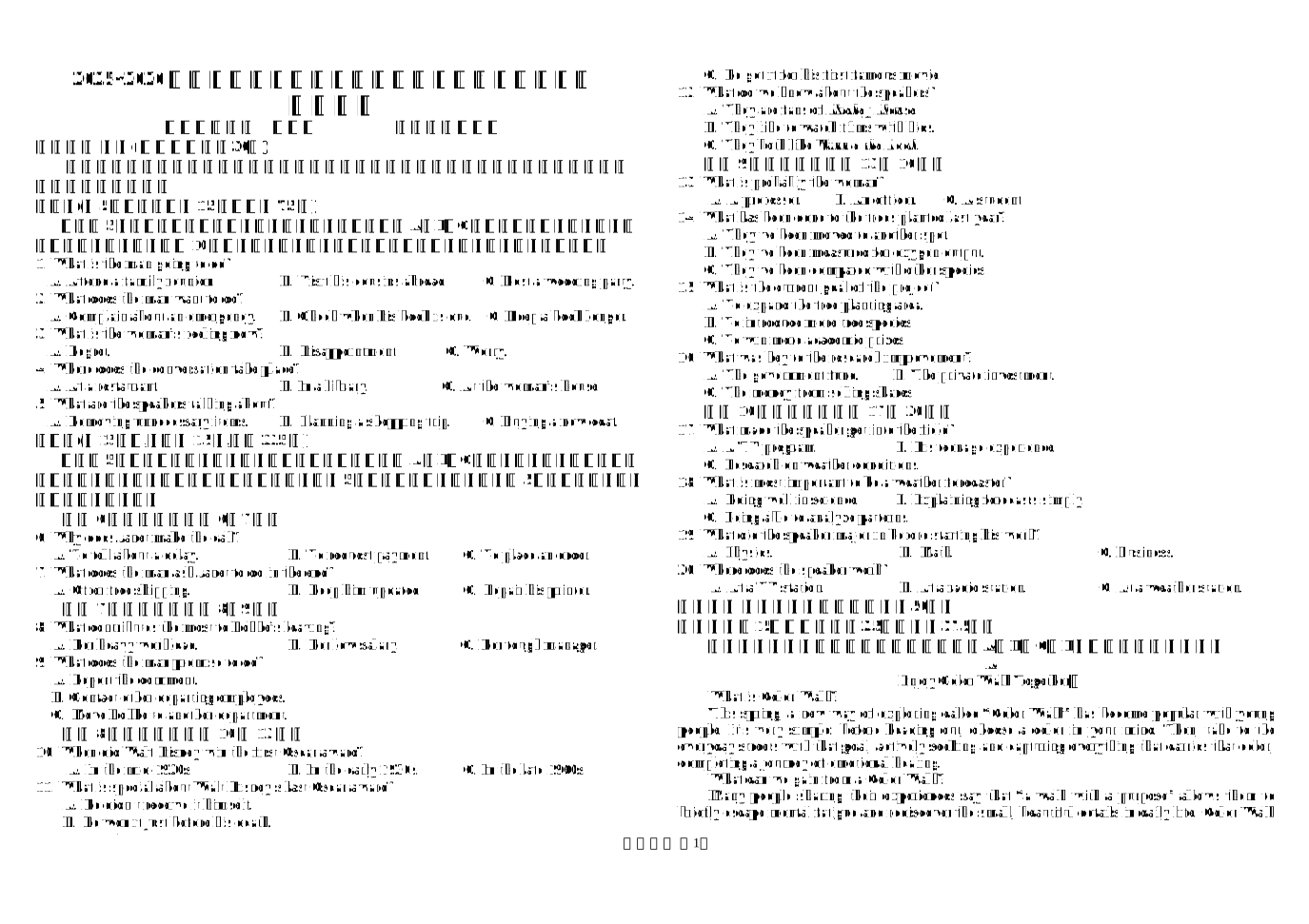
高2026届高三年级质量检测英语试题听力部分,该部分分为第一第二两节。注意回答听力部分时,请先将答案标在试卷上。听力部分结束前,你将有两分钟的时间将你的答案转涂到客观题答题卡上请看听力部分第一节,第一节听下面五段录音,每段录音后有一个小题,从题中所给的A、B、C三个选项中选出最佳选项。听完每段录音后,你都有10秒钟的时间来回答有关小题和阅读下一小题,每段录音播放两遍。现在你有5秒钟的时间阅读第一小题的有关内容。听下面的录音,回答第一小题。You look smart. Where are you going? Today is my grandparents golden wedding anniversary. All the family will be there, even my cousins who live in australia. You look smart. Where are you going? Today is my grandparents golden wedding anniversary. All the family will be there, even my cousins who live in australia. 听下面的录音,回答第二小题。King's Cliff library, can I help you? Yes. my library book is due back, but I had a bit of an emergency and I can't come to return. IT, can I were knew? IT, that's no problem. King's Cliff library, can I help you? Yes. my library book is due back, but I had a bit of an emergency and I can't come to return IT can I were knew IT. that's no problem. 听下面的录音,回答第三小题。Don't tell me you were at the office very late . last night. Yeah, I had to finish that report. Be careful, or you're gonna burn . yourself out. Don't tell me you were at the office very late last night. Yeah, I had to finish that report. Be careful, or you're gonna burn yourself out. 听下面的录音,回答第四小题。Good morning. What can I get you today? Eggs always sound good, but what do you suggest . if you are really hungry? A pancakes or pies . are wonderful. Hm, i'll have a pancake, please, and a cup of milk. Good morning. What can I get you today? And always sounds good, but what do you suggest . if you're really hungry? The pancakes or pies . are wonderful. HMM, i'll have a pancake, please, and a cup of milk. 听下面的录音回答第五小题。Will that be another unnecessary purchase? No, it's something I really need. Why do you need another coat? You already have many coats at home. Will that be another unnecessary purchase? No, it's something I really need. Why do you need another coat? You already have many coat at home. 第一节到此结束,第二节听下面5段录音。每段录音后有几个小题,从题中所给的ABC3个选项中选出最佳选项。听每段录音前,你将有时间阅读各个小题,每小题5秒钟,听完后,每小题都有5秒钟的作答时间,每段录音播放两遍。听下面的录音,回答第六和第七小题。现在你有10秒钟的时间阅读这两个小题。Hi, this is jane t. sayers. With acme supplies, we received your order yesterday. We have everything you requested, except the printer is currently unavailable. I'm sorry to hear that our current machine keeps breaking down. How soon do you think you'll . have IT within a week, I can ship the rest of your order? And when the printer gets here, i'll send IT by express delivery . for no extra charge that OK. Could you also call and let me know when he arrives on your end? Hi, this is jane t. sayers. With acme supplies, we received your order yesterday. We have everything you requested except the printer. It's currently unavailable. I'm sorry to hear that our current machine keeps breaking down. How soon do you think you'll have IT . within a week? I can ship the rest of your order. And when the printer gets here, i'll send IT by express delivery for no extra charge. That's okay. Could you also call and let me know when he arrives on your end? 听下面的录音,回答第八和第九小题。现在你有10秒钟的时间阅读这两个小题。Thanks for coming to this exit interview. Ec, so let's start with the most important question. Why did you decide to leave? Well, I got a Better job at another company. What makes that job more attractive? Well, to be honest, i'll be doing the same work for more pay. Our pay here is below market, right? You know? Yes. we've heard this comment from other departing employees. I'll be sure to pass IT on to management again though. Now please tell me your impression of your manager. Thanks for coming to this exit interview. Ec, so let's start with the most important question. Why did you decide to leave? Well, I got a Better job at another company. What makes that job more attractive? Well, to be honest, i'll be doing the same work for more pay. Our pay here is below market, right? You know, yes, we've heard this comment from other departing employees. I'll be sure to pass this on to management again, though. Now please tell me your impression of your manager. 听下面的录音,回答第十至第十二小题。现在你有15秒钟的时间阅读这三个小题。Do you know that what disney won the most Oscar awards in history? Yes, I do. I read the other day that he actually received a total of twenty six Oscars. His first award was for the creation of Mickey mouse. I think IT was in nineteen thirty two or in nineteen nineteen thirty three and the last one was for winning the pool and the blast three day in nineteen nineteen sixty nine. Second, tony didn't what disney die in nineteen nineteen sixty six. I'm not sure of the exact year he died, but I do know he won his last award after his death. That's amazing. But i'm not really a fan of Mickey mouse, but I watched winning the pool and the blustery day online with my kids last year. And I must say, I really enjoy. I agree of all, vote disney films when the poo is my favorite. Do you know that what disney won the most Oscar awards in history? Yes, I do. I read the other day that he actually received a total of twenty six Oscars. His first award was for the creation of macy mouse. I think IT was in nineteen thirty two or in nineteen thirty three, and the last one was for winning the poo and the blast three day in nineteen nineteen sixty . nine with the second. Tony didn't what disney die in one thousand nine . hundred and sixty six. I'm not sure of the exact year he died, but I do know he won his last award after his death. That's amazing. While i'm not really a fan of Mickey mouse, but I watched winning the pool and the blustery day online with my kids last year, and I must say I really enjoyed IT. I agree of all vote disney films when the poo is my favorite. 听下面的录音,回答第十三至第十六小题。现在你有20秒钟的时间阅读这四个小题。Hello, mister thomson. I'm Alexander Jones. I want to ask you some questions about the project that you offer. Yes, of course, please fire away. Has the project been effective in improving the environment? Yes, absolutely. We have seen great results. Last year. We planted a small field of trees, and we have been measuring their oxygen output to see the benefits that they have provided to the environment. Our current goal is to plant a lot more tree species so that we can compare the benefits of each species. In order to do this, we need to get a lot more students involved in the project. Well, the project sounds fascinating. I would definitely like to be involved. absolutely. Over the years, we have received funding from private investors and from selling shares. But the biggest improvement in our research came from a government fund that we received in the first year. This has greatly improved the organization and we have since one prizes . for our research. Wow, impressive. Hello, mister thomson. I'm Alexander Jones. I want to ask you some questions about the project that you offer. Yes, of course, please fire away. Has the project been effective in improving the environment? Yes, absolutely. We have seen great results. Last year. We planted a small field of trees, and we have been measuring the oxygen output to see the benefits that they have provided to the environment. Our current goal is to plant a lot more tree species so that we can compare the benefits of each species. In order to do this, we need to get a lot more students involved in . the project. Well, the project sounds fascinating. I would definitely like to . be involved absolutely. Over the years, we have received funding from private investors and from selling shares, but the biggest improvement in our research came from a government fund that we received in the first year. This has greatly improved the organization, and we have since one prizes . for our research. Wow, impressive. 听下面的录音,回答第十七至第二十小题。现在你有20秒钟的时间阅读这四个小题。Hi everyone, i'm a weather forecaster, which means I study what happens in the atmosphere and the weather conditions that occur on earth. People are always surprised to learn that forecasters aren't just involved in weather reporting on T. V, but they could also work at a radio station, too. I often get asked how I got interested in weather, believe IT or not. As a teenager, I became nervous of thunderstorms, and i'd often check the forecasts to see if any were coming from there. My interest developed. If you are thinking of going into weather forecasting, there are some important skills you'll need. You have to be good at science. Of course, the essential thing is having the ability to make sense of presence. You won't go too far wrong with that. Another useful scale is being able to translate a forecast into something people at home can understand. Most weather experts study physics and math before going on to do a more specialized course. Forecasting my own way in was somewhat different as I did a business degree before getting into television. As a research, I moved around quite a lot at the T. V station and eventually ended up in the weather department where I did my training. Hi everyone, i'm a weather forecaster, which means I study what happens in the atmosphere and the weather conditions that occur on earth. People are always surprised to learn that forecasters aren't just involved in weather reporting on T. V, but they could also work at a radio station too. I often get asked how I got interested in whether believe IT or not. As a teenager, I became nervous of thunderstorms, and i'd often check the forecasts to see if any were coming from there. My interest developed. If you are thinking of going into weather forecasting, there are some important skills you'll need. You have to be good at science. Of course, the essential thing is having the ability to make sense of patterns. You won't go too far wrong with that. Another useful scale is being able to translate a forecast into something people at home can understand. Most weather experts study physics and math before going on to do a more specialized course in forecasting. My own way in was somewhat different as I did a business degree before getting into television as a researcher. I moved around quite a lot at the T, V station and eventually ended up in the weather department where I did my training. 第二节到此结束,现在你有两分钟的时间将试卷上的答案转图到客观题答题卡上。听力部分到此结束。
2025~2026学年度第二学期南昌中学三经路校区三模测试卷
高三英语
命题人:王静 李文妹 审题人:汪淼毅
第一部分 听力( 共两节,满分30分)
做题时,先将答案标在试卷上。录音内容结束后,你将有两分钟的时间将试卷上的答案转涂到答题卡上。
第一节(共5小题;每小题1.5分,满分7.5分)
听下面5 段录音。每段录音后有一个小题,从题中所给的A、B、C三个选项中选出最佳选项。听完每段录音后,你都有10秒钟的时间来回答有关小题和阅读下一小题。每段录音播放两遍。
1. What is the man going to do?
A. Attend a family reunion. B. Visit his cousins abroad. C. Host a wedding party.
2. What does the man want to do?
A. Complain about an emergency. B. Check when his book is due. C. Keep a book longer.
3. What is the woman’s feeling now?
A. Regret. B. Disappointment. C. Worry.
4. Where does the conversation take place?
A. At a restaurant. B. In a library. C. At the woman’s house.
5. What are the speakers talking about?
A. Removing unnecessary items. B. Planning a shopping trip. C. Buying a new coat.
第二节(共15小题,每小题1.5分,满分22.5分)
听下面 5 段录音。每段录音后有几个小题,从题中所给的A 、B、C 三个选项中选出最佳选项。听每段录音前,你将有时间阅读各个小题,每小题5 秒钟;听完后,各小题都有5 秒钟的作答时间。每段录音播放两遍。
听第6段录音,回答第6、7题。
6. Why does Janet make the call?
A. To tell about a delay. B. To request payment. C. To place an order.
7. What does the man ask Janet to do in the end?
A. Offer free shipping. B. Keep him updated. C. Repair his printer.
听第7段录音,回答第8、9题。
8. What contributes the most to Echke’s leaving?
A. Her heavy workload. B. Her low salary. C. Her tough manager.
9. What does the man promise to do?
A. Report the comment.
B. Contact other departing employees.
C. Move Echke to another department.
听第8段录音,回答第10至12题。
10. When did Walt Disney win the first Oscar award?
A. In the mid-1920s. B. In the early 1930s. C. In the late 1960s.
11. What is special about Walt Disney’s last Oscar award?
A. He didn’t receive it himself.
B. He won it just before his death.
C. He got it for his first famous movie.
12. What do we know about the speakers?
A. They are fans of Mickey Mouse.
B. They like to watch films with kids.
C. They both like Winnie the Pooh.
听第9段录音,回答第13至16题。
13. What is probably the woman?
A. A professor. B. An officer. C. A student.
14. What has been done to the trees planted last year?
A. They’ve been moved to another spot.
B. They’ve been measured for oxygen output.
C. They’ve been compared with other species.
15. What is the current goal of the project?
A. To expand the tree planting area.
B. To introduce more tree species.
C. To win more academic prizes.
16. What was key to the research improvement?
A. The government fund. B. The private investment.
C. The money from selling shares.
听第10段录音,回答第17至20题。
17. What made the speaker get into the field?
A. A TV program. B. His teenage experience.
C. Research on weather conditions.
18. What is most important to be a weather forecaster?
A. Doing well in science. B. Explaining forecasts simply.
C. Being able to analyze patterns.
19. What did the speaker major in before starting his work?
A. Physics. B. Math. C. Business.
20. Where does the speaker work?
A. At a TV station. B. At a radio station. C. At a weather station.
第二部分 阅读理解(共两节;满分50分)
第一节(共15小题;每小题2.5分,满分37.5分)
阅读下列短文,从每题所给的四个选项(A、B、C和D)中,选出最佳选项。
A
Enjoy Color Walk Together!
What is Color Walk?
This spring, a new way of exploring called “Color Walk” has become popular with young people. It’s very simple: before heading out, choose a color in your mind. Then, take to the everyday streets with that goal, actively seeking and capturing everything that carries that color, completing a journey of emotional healing.
What can we gain from a Color Walk?
Many people sharing their experiences say that “a walk with a purpose” allows them to briefly escape mental fatigue and rediscover the small, beautiful details in daily life. Color Walk doesn’t set a specific destination; the aim is simply to search for a certain color, making the wandering range broader and the things worth stopping to appreciate more diverse. Participants often describe it as a healing journey that helps combat life’s anxieties, making the often-overlooked details of everyday life visible again. By focusing on finding a specific color, participants can pull their thoughts back to the present, giving their overactive minds a temporary respite (暂缓). On a deeper level, Color Walk addresses the common modern problem of “loss of proximity”. It playfully forces one’s gaze back to the immediate surroundings, repairing senses worn down by modern life and re-establishing a connection with one’s living environment.
Share your “Color Walk” content for prizes!
Although spring is nearly over, it’s still a great time to ease daily anxieties and regulate our mood through Color Walk. We are now collecting content from you. Participating is simple: visit our website, collect and upload 9 photos of the color theme you choose, along with your thoughts from the walk or the stories behind the photos. You can also browse others’ Color Walk posts in our community and vote for your favorites. The top 10 works with the most votes will receive a Spring-based prize! The activity ends on June 1st.
Come on, take a step outside, and give yourself a healing Color Walk!
21. According to the text, what can be inferred about Color Walk?
A. It needs to choose a color on your phone. B. It allows people to travel to new places.
C. It pays attention to details in life. D. It helps people win prizes more often.
22. What can participants do to receive a Spring-based prize?
A. Collect 9 photos of different colors. B. Vote for your favorite Color Walk contents.
C. Share your photos with your experience. D. Uploading a post on July 1st.
23. Where is this text most likely from?
A. A mental research report. B. An online activity announcement.
C. A daily sports magazine. D. A product advertisement poster.
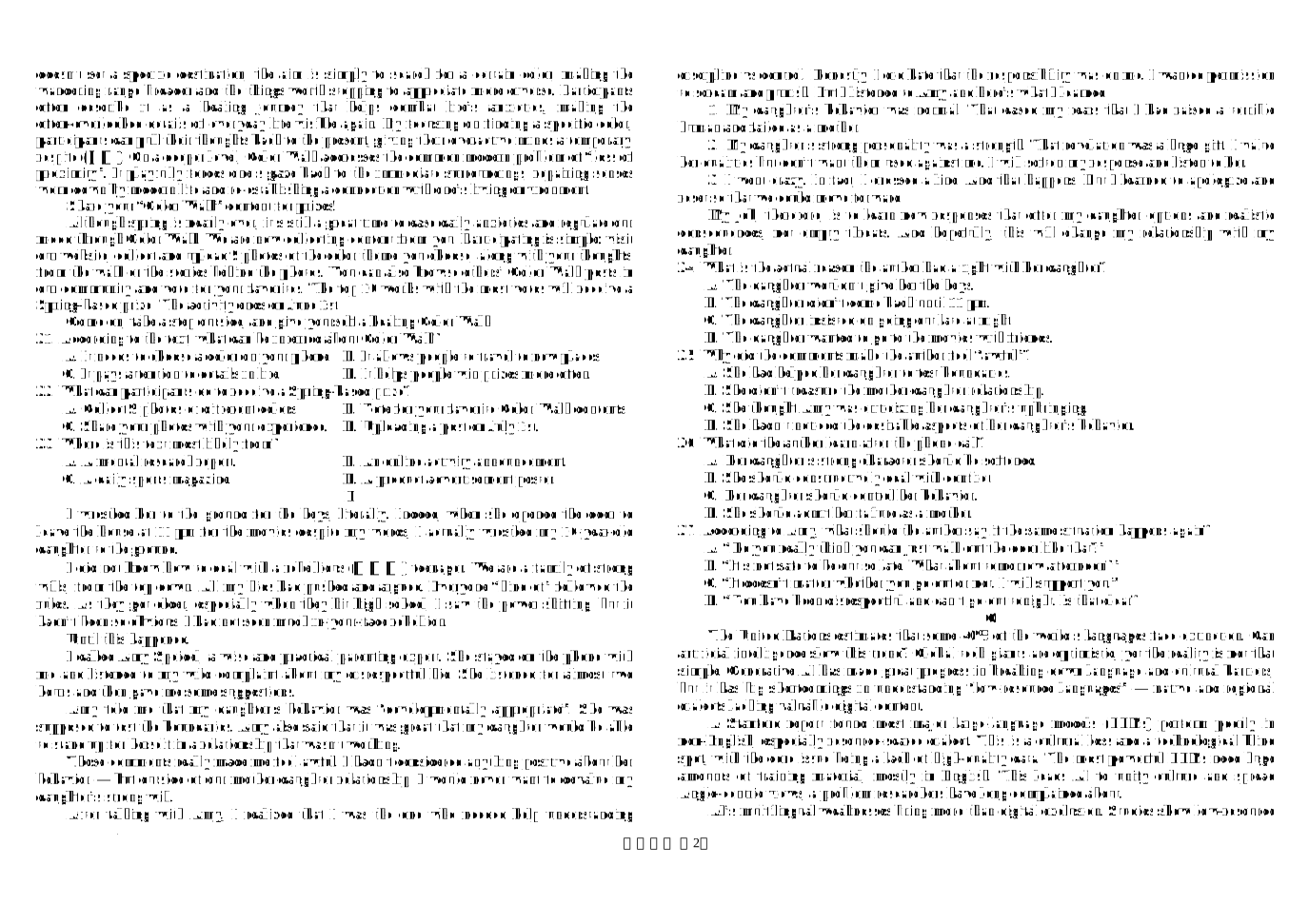
B
I wrestled her to the ground for the keys, literally. Indeed, when she opened the door to leave the house at 11 pm for the movies despite my words, I actually wrestled my 16-year-old daughter to the ground.
I did not know how to deal with a rebellious (叛逆的) teenager. We are a family of strong wills, from the top down. All my kids had pushed and argued. Everyone “kind of” followed the rules. As they got older, especially when they hit high school, I saw the power shifting, but it hadn’t been so obvious. I had not seen much in-your-face rebellion.
Until this happened.
I called Amy Speidel, a wise and practical parenting expert. She stayed on the phone with me and listened to my wild complaint about my disrespectful kid. She listened for almost two hours and then gave me some suggestions.
Amy told me that my daughter’s behavior was “developmentally appropriate”. She was supposed to test the boundaries. Amy also said that it was great that my daughter would be able to stand up for herself in a relationship that wasn’t working.
Those comments really made me feel awful. I hadn’t considered anything positive about her behavior — but outside of our mother-daughter relationship, I would never want to devalue my daughter’s strong will.
After talking with Amy, I realized that I was the one who needed help understanding discipline vs control. Honestly, I did hate that the responsibility was on me. I wanted permission to scream and punish. But I listened to Amy and here’s what I learned.
1. My daughter’s behavior was normal. That eased my fears that I had raised a terrible human and failed as a mother.
2. My daughter’s strong personality was a strength. That revelation was a huge gift. I value her qualities but don’t want them used against me. I will soften my response and listen to her.
3. I went crazy. In fact, I crossed a line. And that happens. But I learned to apologize and reset so that we could move forward.
My job, therefore, is to learn new responses that offer my daughter options and realistic consequences, not empty threats. And hopefully, this will change my relationship with my daughter.
24. What is the actual reason the author had a fight with her daughter?
A. The daughter wouldn’t give her the keys.
B. The daughter didn’t come back until 11 pm.
C. The daughter insisted on going out late at night.
D. The daughter wanted to go to the movies with friends.
25. Why did the comments make the author feel “awful”?
A. She had helped her daughter to test boundaries.
B. She didn’t treasure the mother-daughter relationship.
C. She thought Amy was criticizing her daughter’s upbringing.
D. She hadn’t noticed the desirable aspects of her daughter’s behavior.
26. What did the author learn after the phone call?
A. Her daughter’s strong character should be softened.
B. She should constructively deal with conflict.
C. Her daughter should control her behavior.
D. She should admit her failure as a mother.
27. According to Amy, what should the author say if the same situation happens again?
A. “Do you really think you can just walk out the door like that?”
B. “It’s not safe to be out so late. What about tomorrow afternoon?”
C. “It doesn’t matter whether you go out or not. I will support you.”
D. “You have been disrespectful and can’t go out tonight. Is that clear?
C
The United Nations estimates that some 40% of the world’s languages face extinction. Can artificial intelligence slow this trend? Global tech giants are optimistic, yet the reality is not that simple. Generative AI has made great progress in breaking down language and cultural barriers, but it has big shortcomings in understanding “low-resource languages” — native and regional dialects lacking valuable digital content.
A Stanford report found most major large-language models (LLMs) perform poorly in non-English, especially resource-scarce dialect. This is a cultural loss and a technological blind spot, with the core issue being a lack of high-quality data. The most powerful LLMs need huge amounts of training material, mostly in English. This leads AI to unify culture and spread Anglo-centric views, a problem researchers have long complained about.
AI’s multilingual weaknesses bring more than digital exclusion. Studies show low-resource languages can get past its safety guardrails. Inappropriate questions in Thai or Swahili failed to trigger AI’s safety mechanisms, unlike those in English or Chinese. Worse still, anyone can translate dangerous requests into such languages to exploit AI’s flaws, making this a global safety problem, not just a linguistic one.
A push for independent AI has grown especially in linguistically diverse Asia to preserve cultural distinctions in AI tools: Singapore’s SEA-LION model covers over a dozen local languages, and Malaysia’s ILMU model recognizes regional cues. These efforts have revealed for an AI model to truly represent a group of people, even the smallest details in training material matter.
True language preservation depends on community-led efforts, not just technology. Indonesian researchers tried to save the Orang Rimba language with Meta’s AI but faced limited datasets — only deeper community participation can solve this. New Zealand’s Te Hiku Media set a good example: working with Maori elders, it built a community-owned language database, not one controlled by big tech. This is the only sustainable way — without community involvement, AI will not save dying languages, but help bury them.
28. What is the major problem of AI in protecting dying languages?
A. It makes little progress in breaking cultural barriers.
B. It cannot create any digital content for native dialects.
C. It lacks high-quality training data for low-resource languages.
D. It erases cultural diversity and promotes Anglo-centric ideas.
29. What can we learn about AI’s safety guardrails from the text?
A. They bring more than digital exclusion.
B. They fail to protect English digital users.
C. They work well in handling all linguistic requests.
D. They can be bypassed by low-resource languages.
30. How does the author present Asia’s independent AI efforts?
A. By giving examples. B. By quoting an expert.
C. By providing statistics. D. By making a comparison.
31. What can be a suitable title for the text?
A. AI: A Powerful Tool for Dying Language Preservation
B. Independent AI in Asia: The Key to Solving Language Crisis
C. Low-resource Languages: A Big Challenge to AI Development
D. Dying Languages: AI’s limitations and the vital community role
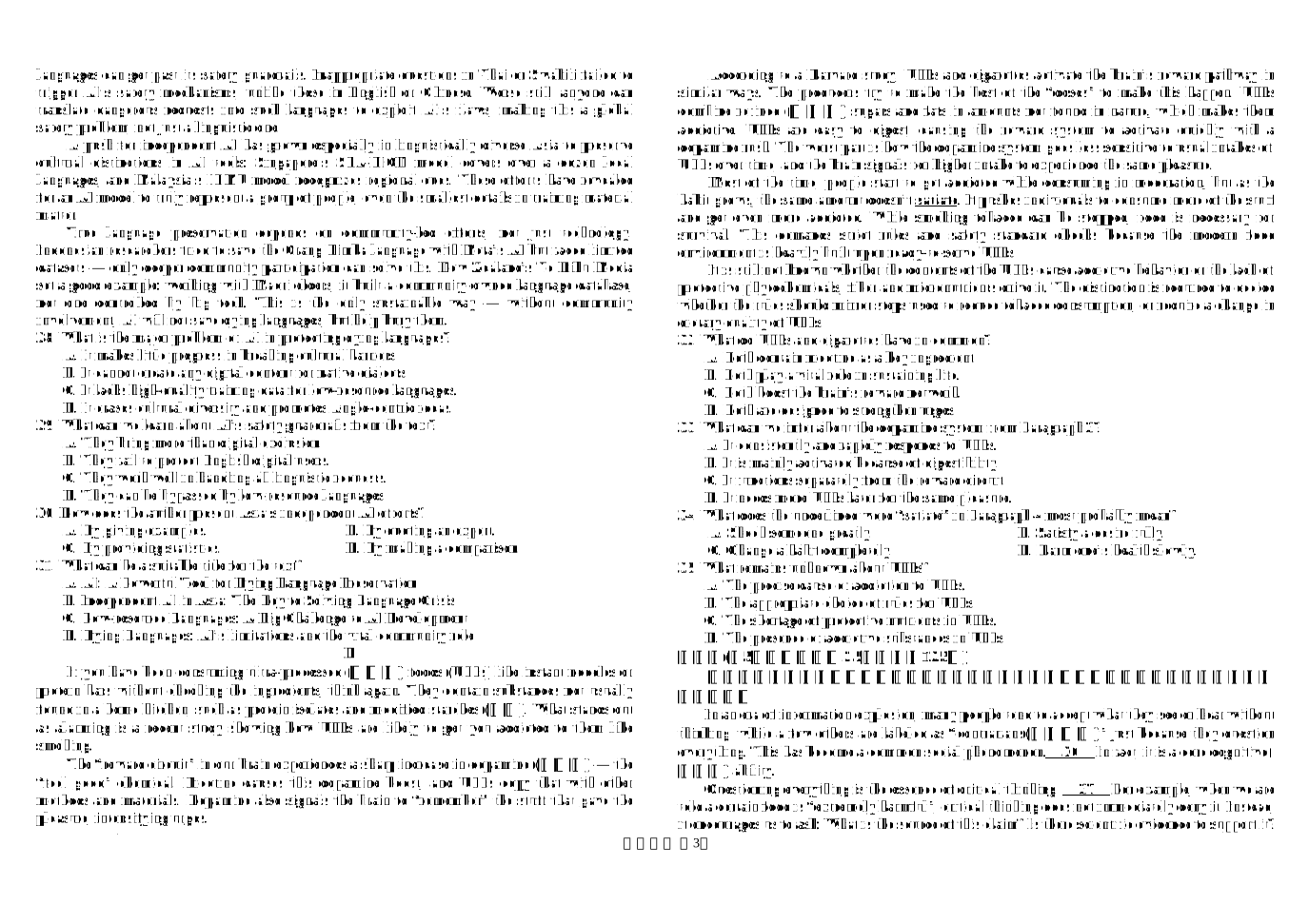
D
If you have been consuming ultra-processed (超加工) foods (UPFs) like instant noodles or protein bars without checking the ingredients, think again. They contain substances not usually found in a home kitchen, such as protein isolates and modified starches (淀粉). What stands out as alarming is a recent study showing how UPFs are likely to get you addicted to them like smoking.
The “reward circuit” in our brain experiences a sharp increase in dopamine (多巴胺) — the “feel good” chemical. Nicotine causes this dopamine boost, and UPFs copy that with other methods and materials. Dopamine also signals the brain to “remember” the stuff that gave the pleasure, intensifying urges.
According to a Harvard study, UPFs and cigarettes activate the brain’s reward pathway in similar ways. The producers try to make the best of the “doses” to make this happen. UPFs combine refined (精炼的) sugars and fats in amounts not found in nature, which makes them addictive. UPFs are easy to digest, causing the reward system to activate quickly with a dopamine rush. The worst part is how the dopamine system goes less sensitive to usual intakes of UPFs over time, and the brain signals for higher intake to experience the same pleasure.
Most of the time, people start to get addicted while consuming in moderation, but as the habit grows, the same amount doesn’t satiate. It pushes individuals to consume more of the stuff and get even more addicted. While smoking tobacco can be stopped, food is necessary for survival. This demands strict rules and safety standard checks because the modern food environment is heavily built upon ready-to-serve UPFs.
It is still not known whether the contents of the UPFs cause addictive behavior or the lack of protective phytochemicals, fiber and micronutrients drive it. The distinction is required to decide whether the rules should mirror steps used to reduce tobacco consumption, or require a change in dietary quality of UPFs.
32. What do UPFs and cigarettes have in common?
A. Both contain nicotine as a key ingredient.
B. Both play a vital role in sustaining life.
C. Both boost the brain’s reward network.
D. Both are designed to strengthen urges.
33. What can we infer about the dopamine system from Paragraph 3?
A. It consistently and rapidly responds to UPFs.
B. It is mainly activated because of digestibility.
C. It functions separately from the reward circuit.
D. It needs more UPFs later for the same pleasure.
34. What does the underlined word “satiate” in Paragraph 4 most probably mean?
A. Shock someone greatly. B. Satisfy a desire fully.
C. Change a habit completely. D. Harm one’s health slowly.
35. What remains unknown about UPFs?
A. The precise cause of addiction to UPFs.
B. The appropriate choice of rules for UPFs.
C. The shortage of protective nutrients in UPFs.
D. The presence of addictive substances in UPFs.
第二节(共5小题;每小题2.5分,满分12.5分)
阅读下面短文,从短文后的选项中选出可以填入空白处的最佳选项。选项中有两项为多余选项。
In an era of information explosion, many people tend to accept what they see or hear without thinking, while a few others are labeled as “contrarians(叛逆的人)” just because they question everything. This has become a common social phenomenon. 36 In fact, it is a core cognitive(认知的) ability.
Questioning everything is the essence of critical thinking. 37 For example, when we are told a certain food is “extremely harmful”, critical thinking does not immediately deny it. Instead, it encourages us to ask: What is the source of this claim? Is there scientific evidence to support it? Are there any conflicting studies? It is not about being negative, but about seeking objective evidence.
38 Some people fall into the trap of cognitive biases without realizing it. They may refuse to accept new information that goes against their existing beliefs. These biases are so common that most people are unaware of their existence, and critical thinking is the key to recognizing and overcoming them.
However, critical thinking is not an inborn talent as many people believe, but a skill that can be trained and improved through daily practice. 39 When having a discussion with others, listen to opposing views carefully instead of interrupting immediately. Every time we actively challenge our own thinking, we are polishing our critical thinking ability. With consistent practice, this ability will become an essential part of our thinking.
In a world where misinformation spreads faster than ever, critical thinking is no longer a “bonus skill” for a few people. 40 It allows us to stand firm in the tide of information, and to live and think as an independent individual.
A. We can start with small things.
B. Cognitive ability also requires logical reasoning.
C. It starts with the willingness to question assumptions.
D. It is a necessary ability for everyone to survive and thrive.
E. Critical thinking also requires us to avoid cognitive biases.
F. This is why many people stick to wrong views unconsciously.
G. Critical thinking is often undervalued in such a social context.
第三部分语言运用(共两节,满分30分)
第一节(共15小题;每小题1分,满分15分)
阅读下面短文,从每题所给的A、B、C、D四个选项中选出可以填入空白处的最佳选项。
In January 2018, I was commuting (通勤) between Brooklyn and New Jersey, and the quiet train rides felt like mini-vacations. Yet, I spent most of the precious time 41 social media.
One afternoon, however, I 42 my phone and started writing thank-you notes to those who had 43 a charity event I had organized. When I got off the train, I was in a noticeably better mood. Something 44 . What if I kept it up? I 45 to write one note daily for the year. Writing the notes demanded full 46 : I couldn't do it while listening to a podcast or switching between articles. That felt refreshing.
What struck me was that this practice was the perfect 47 for my anxiety from social media; instead of longing for others’ lives, I learned to 48 kindness around me - from neighbors to friends, even acquaintances (泛泛之交) with small, unnoted 49 . Above all, this simple act 50 my relationships and reconnected me with people who left a lasting 51 on my life. Many replied that my words cheered them through 52 times.
I admit, I fell behind sometimes. But I completed my goal with hours to 53 - writing my last card before the New Year’s Eve. That night, we hosted a big party, and I looked around at my 54 , to whom I’d written thank-you notes throughout the year. I shot a picture of the scene so I could remember the feeling welling up inside me--- 55 .
41. A. typing B. catching C. checking D. monitoring
42. A. put down B. turned down C. hung up D. backed up
43. A. noticed B. funded C. enjoyed D. conducted
44. A. clicked B. worked C. mattered D. followed
45. A. struggled B. deserved C. resolved D. agreed
46. A. strength B. focus C. potential D. enthusiasm
47. A. reward B. match C. cure D. excuse
48. A. value B. inspire C. expect D. overlook
49. A. charms B. talents C. messages D. favours
50. A. proved B. defined C. identified D. strengthened
51. A. fame B. mark C. relief D. warning
52. A. rough B. old C. precious D. promising
53. A. kill B. wait C. spare D. waste
54. A. families B. patients C. clients D. guests
55. A. trust B. gratitude C. empathy D. forgiveness
第二节(共10小题;每小题1.5分,满分15分)
阅读下面短文,在空白处填入1个适当的单词或括号内单词的正确形式。
Sitting in the dynamic downtown core of China’s capital, a newly launched Beijing Gifts store occupies a special gray stone building. It displays an irresistible charm that naturally attracts the attention of 56 (passer-by).
It is decorated with panda models mounted on the walls, 57 (invite) visitors to step inside. The entire space is animated by the lively conversations and cheerful laughter of youngsters, 58 are drawn to showcases filled with 59 (delicate) designed cultural and creative products.
Ranging from miniatures (缩微模型) of the city’s iconic architectural landmarks to refined refrigerator magnets, each product carries 60 one-of-its-kind story that reflects the essence of the capital city. Among these 61 (remark) items, one is an unarguable favorite: the Rabbit God, a traditional divine figure with a rabbit’s head and a human body, which has firmly established itself as one of the store’s most sought-after souvenirs.
Hu Pengfei, the creative mind behind these decorative Rabbit God figurines (雕塑), is delighted to witness this age-old cultural symbol, once an important clay toy for children during the Mid-Autumn Festival, growing 62 popularity among a younger generation.
63 (regard) initially to be an auspicious mascot (吉祥物) symbolizing peace and well-being, the Rabbit God carries profound cultural significance; in the past, it 64 (see) as a creature that drove away diseases and brought good fortune, often shown on royal clothing.
Through Hu’s innovative design approach, this cultural heritage has been tastefully transformed 65 (suit) contemporary lifestyles as a desktop display piece.
第四部分 写作(40 分)
第一节(满分15分)
假定你是李华,你校英语报正发起主题为 “AI and Life” 的短文征集活动,请你以 “My View on AI in My School Life” 为题写一篇短文投稿,内容包括:
1. AI在学习中的具体应用;
2. 给学习带来的影响;
3. 你的看法。
注意:写作词数应为80左右;可适当增加细节,以使行文连贯;
______________________________________________________________________________
______________________________________________________________________________
第二节(满分25分)
阅读下面材料,根据其内容和所给段落开头语续写两段,使之构成一篇完整的短文。
Last winter, I planned a short ski trip to the mountains with my 9-year-old son, Max. Max is a kind boy, but he is also quite shy and careful. He doesn’t like to try new things, especially if they seem frightening. New foods, tall trees, deep water — he usually says no before he even tries. I wanted this trip to be different. So before we packed our bags, I told him, “This time, we’ll say yes to new things.” He laughed a little, not sure I really meant it.
Our first test came at the airport restaurant. I ordered a bowl of hot noodles I’d never tried before. And Max chose a piece of funny green bread that caught his eye. He looked at it for a while and said, “It looks strange.” But after one small taste, he smiled. “It’s actually good!” he said. It was a small step, but a good start.
When we arrived at our destination, everything looked huge — the mountains, the ski lifts, even the piles of snow. Max looked up at the slopes and said, “They look really high.” I smiled and said, “We’ll learn together.” The next morning, we joined a beginner’s ski class. I was nervous too — I hadn’t skied for years. The coach taught us how to put on our skis, how to use ski poles and how to stop and turn. Max listened carefully but didn’t move much. “I don’t think I can do it,” he said quietly. I could see the fear in his eyes. “Let’s say yes,” I told him. “Watch me first.” My heart was pounding wildly, but I pushed off slowly, and skied down the slope. My turns were awkward and I almost fell, but when I reached the bottom, I laughed. I looked up at Max and waved. “See? It’s not perfect, but it’s fun! Come on, Max!”
注意:
1. 续写词数应为150左右;
2. 请按如下格式在答题卡的相应位置作答。
Max thought for a while and then moved to the top of the slope.
______________________________________________________________________________
______________________________________________________________________________
______________________________________________________________________________
After that trip, Max changed a lot. ______________________________________________________________________________
____________________________________________________________________________________________________________________________________________________________
2026高三英语模拟试卷答案与解析
一、听力
1-5 ACCAC 6-10 ABBAB 11-15 ACCBB 16-20 ABCCA
二、阅读
21-23 CCB 24-27 CDBB 28-31 CDAD 32-35 CDBA 36-40 GCEAD
三、完型
41-45 CABAC 46-50 BCADD 51-55 BACDB
四、语法填空
56. passers-by
57. inviting
58. who
59. delicately
60. a
61. remarkable
62. in
63. Regarded
64. was seen
65. to suit
五、应用文
范文一(侧重思辨与平衡)
My View on AI in My School Life
AI has become a game-changer in my school life. I often turn to intelligent apps for instant grammar checking, personalized math exercises, and even oral English practice.
Undoubtedly, AI boosts learning efficiency and offers tailored support. Nevertheless, over-dependence on it may weaken our problem-solving abilities.
From my perspective, AI should serve as a wise assistant rather than a substitute for active thinking. When used properly, it empowers us to learn smarter without losing our intellectual independence.
范文二(侧重理性态度)
My View on AI in My School Life
From correcting compositions to recommending study plans, AI has quietly transformed my daily learning experience.
The benefits are evident — instant feedback, personalized guidance, and time savings. However, a growing reliance on AI risks making us mentally lazy.
In my view, AI is a powerful tool, but never a replacement for our own effort. We should embrace its convenience while staying critical and self-reliant. Only then can AI truly enhance, not hinder, our growth.
六、读后续写
Max thought for a while and then moved to the top of the slope. His small figure looked fragile against the vast white mountain, and I could see his legs trembling slightly. He looked down at me, his eyes full of doubt and fear. “You can do it, Max! Just like the coach taught you — lean forward and relax!” I shouted, waving my ski pole. Max closed his eyes, took a deep breath, and pushed off. At first, he leaned too far back and nearly lost his balance. My heart stopped. But then he leaned forward, gained speed, and let out a wild scream — part terror, part joy. When he finally reached the bottom, he crashed into a soft snowbank but burst out laughing. “Dad! I did it! I really did it!” he yelled, his face red with excitement and cold. I hugged him tightly, prouder than I had ever been.
After that trip, Max changed a lot. The shy boy who once said “no” to everything new became more willing to step out of his comfort zone. He tried spicy food at restaurants, went down tall waterslides at the pool, and even raised his hand to speak in class. One evening months later, we looked at the photos from that ski trip. Max pointed at the green bread and the snowy slope and smiled. “That was the trip where I learned something important, Dad,” he said quietly. “Sometimes the scariest thing to do is also the most fun. And you can’t know if you don‘t try.” I realized then that a father’s greatest gift to his child is not protection from fear, but the courage to face it together.
解析部分
听力原文
1.【原文】W: You look smart! Where are you going?
M: Today is my grandparents’ golden wedding anniversary. All the family will be there, even my cousins who live in Australia.
2.【原文】W: Kingscliffe Library. Can I help you?
M: Yes. My library book is due back, but I had a bit of an emergency, and I can’t come to return it. Can I renew it?
W: That’s no problem.
3. 【原文】W: Don’t tell me you were at the office very late last night!
M: Yeah, I had to finish that report.
W: Be careful, or you’re gonna burn yourself out.
4. 【原文】W: Good morning. What can I get you today?
M: Eggs always sound good. But what do you suggest?
W: If you’re really hungry, the pancakes or pies are wonderful.
M: Hmm. I’ll have a pancake, please. And a cup of milk.
5. 【原文】M: Will that be another unnecessary purchase?
W: No! It’s something I really need.
M: Why do you need another coat? You already have many coats at home.
6【原文】W: Hi. This is Janet Sayers with Acme Supplies. We received your order yesterday. We have everything you requested except the printer. It’s currently unavailable.
M: I’m sorry to hear that. Our current machine keeps breaking down. How soon do you think you’ll have it?
W: Within a week. I can ship the rest of your order, and when the printer gets here, I’ll send it by express delivery for no extra charge.
M: That’s OK. Could you also call and let me know when it arrives on your end?
7【原文】M: Thanks for coming to this exit interview, Echke. So let’s start with the most important question. Why did you decide to leave?
W: Well, I got a better job at another company.
M: What makes that job more attractive?
W: Well, to be honest, I’ll be doing the same work for more pay. Our pay here is below market rate, you know.
M: Yes. We’ve heard this comment from other departing employees. I’ll be sure to pass it on to management again, though. Now, please tell me your impression of your manager.
8【原文】W: Do you know that Walt Disney won the most Oscar awards in history?
M: Yes, I do. I read the other day that he actually received a total of 26 Oscars. His first award was for the creation of Mickey Mouse. I think it was in 1932 or in 1933. And the last one was for Winnie the Pooh and the Blustery Day in 1969.
W: Wait a second, Tony, didn’t Walt Disney die in 1966?
M: I’m not sure of the exact year he died, but I do know he won his last award after his death.
W: That’s amazing. Well, I’m not really a fan of Mickey Mouse, but I watched Winnie the Pooh and the Blustery Day online with my kids last year, and I must say I really enjoyed it.
M: I agree. Of all Walt Disney films, Winnie the Pooh is my favorite.
9【原文】W: Hello, Mr. Thompson. I’m Alexandra Jones. I want to ask you some questions about the project that you offer.
M: Yes, of course, please fire away.
W: Has the project been effective in improving the environment?
M: Yes, absolutely. We have seen great results. Last year, we planted a small field of trees, and we have been measuring their oxygen output to see the benefits that they have provided to the environment. Our current goal is to plant a lot more tree species so that we can compare the benefits of each species. In order to do this, we need to get a lot more students involved in the project.
W: Well, the project sounds fascinating. I would definitely like to be involved.
M: Absolutely. Over the years, we have received funding from private investors and from selling shares, but the biggest improvement in our research came from a government fund that we received in the first year. This has greatly improved the organization, and we have since won prizes for our research.
W: Wow, how impressive!
10【原文】Hi, everyone. I’m a weather forecaster, which means I study what happens in the atmosphere and the weather conditions that occur on Earth. People are always surprised to learn that forecasters aren’t just involved in weather reporting on TV, but they could also work at a radio station, too. I often get asked how I got interested in weather. Believe it or not, as a teenager, I became nervous of thunderstorms, and I’d often check the forecasts to see if any were coming. From there, my interest developed. If you are thinking of going into weather forecasting, there are some important skills you’ll need. You have to be good at science, of course. The essential thing is having the ability to make sense of patterns. You won’t go too far wrong with that. Another useful skill is being able to translate a forecast into something people at home can understand. Most weather experts study physics and math before going on to do a more specialized course in forecasting. My own way in was somewhat different, as I did a business degree before getting into television as a researcher. I moved around quite a lot at the TV station and eventually ended up in the weather department, where I did my training.
阅读解析
A
无解析
B
【导语】本文是一篇记叙文。文章讲述作者和自己的女儿发生冲突后,和育儿专家通话后改变原来的处理冲突的方式,希望能改善和女儿的关系。
【24题】细节理解题。根据第一段“I wrestled her to the ground for the keys, literally. Indeed, when she opened the door to leave the house at 11 pm for the movies despite my words, I actually wrestled my 16-year-old daughter to the ground. (我因为钥匙把她摔在地上,真的。事实上,当她不顾我的话,在晚上11点开门离开家去看电影时,我把我16岁的女儿摔倒在地)”可知,作者和女儿吵架的真正原因是因为女儿坚持深夜外出。故选C。
【25题】细节理解题。根据第六段“Those comments really made me feel awful. I hadn’t considered anything positive about her behavior — but outside of our mother-daughter relationship, I would never want to devalue my daughter’s strong will. (那些评论真的让我感觉很糟糕。我没有考虑过她的行为有什么积极的方面——但除了我们母女的关系,我从来不想贬低我女儿坚强的意志)”可知,这些评论让作者感到“糟糕”,是因为作者没有注意到女儿行为中积极的方面,也就是令人满意的方面。故选D。
【26题】推理判断题。根据第七段“After talking with Amy, I realized that I was the one who needed help understanding discipline vs control. Honestly, I did hate that the responsibility was on me. I wanted permission to scream and punish. (在和艾米交谈之后,我意识到我才是那个需要帮助来理解纪律和控制的人。老实说,我确实讨厌责任落在我身上。我想要被允许尖叫和惩罚)”可推知,通过电话,作者了解到她应该建设性地处理冲突,故选B。
【27题】推理判断题。根据最后一段“My job, therefore, is to learn new responses that offer my daughter options and realistic consequences, not empty threats. And hopefully, this will change my relationship with my daughter. (因此,我的工作是学习新的回应,为我的女儿提供选择和现实的后果,而不是空洞的威胁。希望这能改变我和女儿的关系)”可推知,在重新处理同样的情况时,作者应该会把深夜离家的后果——不安全告诉女儿,并且让她选择一个其他时间出门。故选B。
C
【导语】这是一篇说明文。文章说明了全球近半数语言濒临消失,AI 因稀缺语种数据不足存在诸多短板与安全隐患,亚洲自研模型作出尝试,而语言保护更离不开本土社区的主导参与。
【28题】细节理解题。根据第二段“This is a cultural loss and a technological blind spot, with the core issue being a lack of high-quality data.(这是一种文化上的缺失,也是技术上的盲点,其核心问题在于缺乏高质量的数据)”可知,人工智能在保护濒危语言方面的主要问题是它缺乏针对低资源语言的高质量训练数据。故选C。
【29题】细节理解题。根据第三段“Studies show low-resource languages can get past its safety guardrails.(研究表明,资源匮乏的语言能够突破其安全防护措施)”可知,人工智能安全防护措施可能会被低资源语言所绕过。故选D。
【30题】推理判断题。根据第四段“A push for independent AI has grown especially in linguistically diverse Asia to preserve cultural distinctions in AI tools: Singapore’s SEA-LION model covers over a dozen local languages, and Malaysia’s ILMU model recognizes regional cues. These efforts have revealed for an AI model to truly represent a group of people, even the smallest details in training material matter.(在语言多样的亚洲地区,推动建立独立自主的人工智能的努力愈发显著,目的是为了在人工智能工具中保留文化差异:新加坡的“SEA-LION”模型涵盖了十几种当地语言,而马来西亚的“ILMU”模型则能识别地域特征。这些努力表明,要使一个人工智能模型真正代表某一人群,训练材料中的哪怕是最细微的细节也至关重要)”可知,作者通过举例说明展现亚洲在人工智能方面的独立努力。故选A。
【31题】主旨大意题。根据第一段“The United Nations estimates that some 40% of the world’s languages face extinction. Can artificial intelligence slow this trend? Global tech giants are optimistic, yet the reality is not that simple. Generative AI has made great progress in breaking down language and cultural barriers, but it has big shortcomings in understanding “low-resource languages” — native and regional dialects lacking valuable digital content.(联合国估算,全球约40%的语言面临消亡危机。人工智能能否延缓这一趋势?全球科技巨头持乐观态度,但现实并非如此简单。生成式人工智能在打破语言与文化壁垒方面成果显著,却难以吃透低资源语言,即缺乏有效数字内容的本土语言与地方方言)”结合文章说明了全球近半数语言濒临消失,AI 因稀缺语种数据不足存在诸多短板与安全隐患,亚洲自研模型作出尝试,而语言保护更离不开本土社区的主导参与。可知,D选项“消亡的语言:人工智能的局限性及至关重要的社区作用”最符合文章标题。故选D。
D
【导语】本文是一篇说明文。文章主要讲述了超加工食品易使人上瘾及其原因和未知问题。
【32题】细节理解题。根据第三段中“According to a Harvard study, UPFs and cigarettes activate the brain’s reward pathway in similar ways.(哈佛大学的一项研究表明,超加工食品与香烟以相似的方式激活大脑的奖赏通路)”可知,超加工食品和香烟的共同点是都会刺激大脑的奖赏系统。故选C。
【33题】推理判断题。根据第三段中“The worst part is how the dopamine system goes less sensitive to usual intakes of UPFs over time, and the brain signals for higher intake to experience the same pleasure.(最糟糕的是,随着时间推移,多巴胺系统对常规摄入量的超加工食品变得不那么敏感,大脑会发出信号要求摄入更多才能获得同样的愉悦感)”可知,之后需要更多的超加工食品才能获得相同的愉悦感。故选D。
【34题】词句猜测题。根据第四段中“Most of the time, people start to get addicted while consuming in moderation, but as the habit grows, the same amount doesn’t satiate. It pushes individuals to consume more of the stuff and get even more addicted.(大多数时候,人们在适量食用时就开始上瘾,但随着习惯养成,同样的量不再能satiate。这会促使人们吃更多,变得更加上瘾)”可知,此处表示同样的量无法再满足欲望,satiate意为“充分满足欲望”。故选B。
【35题】细节理解题。根据最后一段中“It is still not known whether the contents of the UPFs cause addictive behavior or the lack of protective phytochemicals, fiber and micronutrients drive it.(目前尚不清楚是超加工食品中的成分导致了成瘾行为,还是缺乏保护性植物化学物质、纤维和微量营养素导致了这种情况)”可知,关于超加工食品,人们仍不清楚其导致成瘾的确切原因。故选A。
七选五
【导语】本文是一篇议论文,探讨了批判性思维的重要性。文章指出,在信息爆炸的时代,质疑是批判性思维的核心,它能帮助我们克服认知偏差;批判性思维并非天生,而是可以通过日常练习培养的,是每个人生存和发展的必备能力。
【36题】 G 根据空前句“This has become a common social phenomenon.”(这已成为一种普遍的社会现象。)及空后句“In fact, it is a core cognitive ability.”(事实上,它是一种核心的认知能力。)可知,空处需承接前文的社会现象,并引出对批判性思维价值的转折性评价。G选项“Critical thinking is often undervalued in such a social context.”(在这样的社会背景下,批判性思维常常被低估。)中“such a social context”精准指代前文“人们不加思考接受信息,质疑者被贴上叛逆标签”的现象,“undervalued”与空后 “核心认知能力”形成鲜明转折,逻辑衔接紧密。正确选项:G
【37题】 C 根据空前句“Questioning everything is the essence of critical thinking.”(质疑一切是批判性思维的本质。)及空后句“For example, when we are told a certain food is ‘extremely harmful’, critical thinking does not immediately deny it. Instead, it encourages us to ask...”(例如,当我们被告知某种食物 “极其有害”时,批判性思维不会立即否定它。相反,它会鼓励我们提问……)可知,空处需衔接“质疑的本质”与“具体的提问行为”。C选项“It starts with the willingness to question assumptions.”(它始于质疑假设的意愿。)中“It”指代批判性思维,“question assumptions”承接前文的“Questioning everything”,同时为后文的具体提问例子做铺垫,结构连贯。正确选项:C
【38题】 E 根据空后句“Some people fall into the trap of cognitive biases without realizing it.”(有些人在不知不觉中陷入了认知偏差的陷阱。)及“critical thinking is the key to recognizing and overcoming them”(批判性思维是识别和克服它们的关键)可知,本段主题是批判性思维与认知偏差的关系。E 选项“Critical thinking also requires us to avoid cognitive biases.”(批判性思维还要求我们避免认知偏差。)中“also”承接上一段“批判性思维始于质疑”的内容,“cognitive biases”直接引出本段核心话题,是本段的主题句。正确选项:E
【39 题】 A 根据空前句“However, critical thinking is not an inborn talent as many people believe, but a skill that can be trained and improved through daily practice.”(然而,批判性思维并非像许多人认为的那样是天生的才能,而是一种可以通过日常练习训练和提高的技能。)及空后句“When having a discussion with others, listen to opposing views carefully instead of interrupting immediately.”(与他人讨论时,仔细倾听相反的观点,而不是立即打断。)可知,空处需衔接“日常练习”与“具体的练习方法”。A选项“We can start with small things.”(我们可以从小事做起。)承接前文的“daily practice”,引出后文“倾听不同观点”这一具体小事,逻辑通顺。正确选项:A
【40题】 D 根据空前句“In a world where misinformation spreads faster than ever, critical thinking is no longer a ‘bonus skill’ for a few people.”(在一个错误信息传播比以往任何时候都快的世界里,批判性思维不再是少数人的“额外技能”。)及空后句“It allows us to stand firm in the tide of information, and to live and think as an independent individual.”(它使我们能够在信息的浪潮中站稳脚跟,作为一个独立的个体生活和思考。)可知,空处需递进说明批判性思维的必要性。D选项“It is a necessary ability for everyone to survive and thrive.”(它是每个人生存和发展的必备能力。)中“no longer a bonus skill”与 “necessary ability”形成自然递进,同时解释了空后批判性思维的重要作用,衔接紧密。正确选项:D 。
完型
【导语】本文是情感类记叙文,讲述作者每天通勤时沉迷社交媒体,心情焦虑。一次偶然的机会,她放下手机写感谢信,发现心情明显变好。于是决定坚持每天写一封,一年后不仅治愈了焦虑,还加强了人际关系,领悟到感恩的真谛。
41. C checking 她把大部分宝贵时间用来刷社交媒体 A.打字/B.抓住/D.监控:不符合刷手机的常用表达。
42. A put down 然而一天下午,她放下手机,开始写感谢信 B.拒绝/C.挂断/D.备份:不符合语境。
43. B funded 写给那些资助过她组织的慈善活动的人 A.注意到/C.享受/D.实施:符合慈善活动的语境。
44. A clicked 某种东西奏效了 B.起作用/C.重要/D.跟随:"click"在这里表示"突然产生效果,让人豁然开朗" 。
45. C resolved 她决定这一年每天写一封感谢信 A.挣扎/B.值得/D.同意:符合下定决心的语境
46. B focus 写感谢信需要全神贯注 A.力量/C.潜力/D.热情:后文说不能同时听播客或切换文章,对应专注。
47. C cure 这个做法是治愈她社交媒体焦虑的完美良药 A.奖励/B.匹配/D.借口:符合"治愈焦虑"的语境。
48. A value 她学会了重视身边的善意 B.激励/C.期待/D.忽视:与前文"羡慕别人的生活"形成对比
49. D favours 从邻居到朋友,甚至是做过微小、不被注意的好事的泛泛之交 A.魅力/B.才能/C.信息:"small favours"表示"小恩小惠"。
50. D strengthened 最重要的是,这个简单的行为加强了她的人际关系 A.证明/B.定义/C.识别:符合语境。
51. B mark 重新联系上那些在她生命中留下持久印记的人 A.名声/C.解脱/D.警告:固定搭配"leave a mark on sb." 。
52. A rough 很多人回复说,她的话帮助他们度过了艰难时期 B.老的/C.珍贵的/D.有希望的:符合语境 。
53. C spare 她提前几小时完成了目标,还有时间剩余 A.消磨/B.等待/D.浪费:"with hours to spare"表示"还有剩余时间"。
54. D guests 她环顾四周的客人 A.家人/B.病人/C.客户:前文说举办了新年派对,对应客人。
55. B Gratitude 感恩 A.信任/C.共情/D.原谅:全文核心是写感谢信带来的改变,对应感恩 。
语法填空
56. passers-by
命题透析考查名词单复数。思路点拨passer-by为可数名词,其前没有限制词,故用复数形式。
57. inviting
命题透析考查非谓语动词。思路点拨句子已有谓语动词is decorated,此处应用非谓语动词作状语;逻辑主语It(指代北京礼物文创店)与invite之间为主动关系,故用现在分词形式。
58. who
命题透析考查定语从句。思路点拨分析句子结构可知,此处为非限制性定语从句,先行词为youngsters,关系词在从句中作主语,故用关系代词who引导。
59. delicately
命题透析考查词性转换。思路点拨空格处修饰过去分词designed,需用副词形式;delicate的副词形式为delicately,意为“精巧地;精致地”。
60. a
命题透析考查冠词。思路点拨此处泛指“一个独特的故事”,one-of-its-kind的发音以辅音音素开头,需用不定冠词a。
61. remarkable
命题透析考查词性转换。思路点拨空格处修饰名词items,需用形容词作定语;remark的形容词形式为remarkable,意为“非凡的;引人注目的”。
62. in
命题透析考查介词。思路点拨grow in popularity为固定搭配,意为“越来越受欢迎;人气不断提升”。
63. Regarded
命题透析考查非谓语动词。思路点拨句子已有谓语动词caries,此处应用非谓语动词作状语;逻辑主语the Rabbit God 与regard之间为被动关系,故用过去分词形式。
64. was seen
命题透析考查动词时态、语态及主谓一致。思路点拨根据时间状语inthe past 可知,此处应用一般过去时;主语it为单数形式,与see之间为被动关系,故用一般过去时的被动语态was seen。
65. to suit
命题透析考查非谓语动词。思路点拨此处表示“被精心改造以适应当代生活方式”,应用不定式结构表目的,故填to suit。
高三英语 第2页
学科网(北京)股份有限公司
$
资源预览图
1
2
3

相关资源
由于学科网是一个信息分享及获取的平台,不确保部分用户上传资料的 来源及知识产权归属。如您发现相关资料侵犯您的合法权益,请联系学科网,我们核实后将及时进行处理。