2026年普通高等学校招生全国统一考试预测卷:黑龙江·吉林·辽宁·内蒙古专版 英语试题
 切换试卷
切换试卷
2026-05-26
|
12页
|
1人阅读
|
4人下载
资源信息
| 学段 | 高中 |
|---|---|
| 学科 | 英语 |
| 教材版本 | - |
| 年级 | 高三 |
| 章节 | - |
| 类型 | 试卷 |
| 知识点 | - |
| 使用场景 | 高考复习-模拟预测 |
| 学年 | 2026-2027 |
| 地区(省份) | 黑龙江省 |
| 地区(市) | - |
| 地区(区县) | - |
| 文件格式 | DOCX |
| 文件大小 | 114 KB |
| 发布时间 | 2026-05-26 |
| 更新时间 | 2026-05-26 |
| 作者 | 匿名 |
| 品牌系列 | - |
| 审核时间 | 2026-05-26 |
| 下载链接 | https://m.zxxk.com/soft/58060723.html |
| 价格 | 1.00储值(1储值=1元) |
| 来源 | 学科网 |
内容正文:
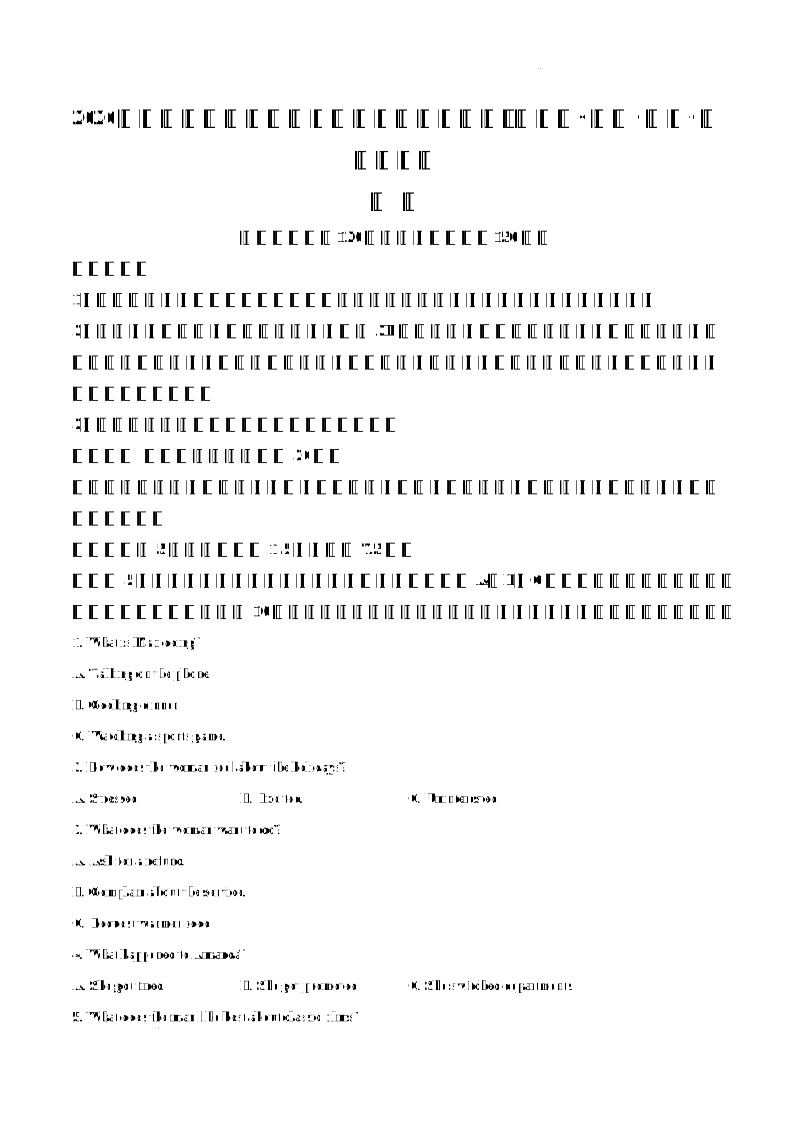
2026年普通高等学校招生全国统一考试预测卷:黑龙江·吉林·辽宁·内蒙古专版
英 语
(考试时间:120分钟;试卷满分:150分)
注意事项:
1.答卷前,考生务必将自己的姓名、准考证号等填写在答题卡和试卷指定位置上。
2.回答选择题时,选出每小题答案后,用2B铅笔把答题卡上对应题目的答案标号涂黑。如需改动,用橡皮擦干净后,再选涂其他答案标号。回答非选择题时,将答案写在答题卡上。写在本试卷上无效。
3.考试结束后,将本试卷和答题卡一并交回。
第一部分 听力(共两节,满分30分)
做题时,先将答案标在试卷上。录音内容结束后,你将有两分钟的时间将试卷上的答案转涂到答题卡上。
第一节(共5小题;每小题1.5分,满分7.5分)
听下面5段录音。每段录音后有一个小题,从题中所给的A、B、C三个选项中选出最佳选项。听完每段录音后,你都有10秒钟的时间来回答有关小题和阅读下一小题。每段录音播放两遍。
1. What is Max doing?
A. Talking on the phone.
B. Cooking dinner.
C. Watching a sports game.
2. How does the woman feel about the holidays?
A. Stressed. B. Excited. C. Uninterested.
3. What does the woman want to do?
A. Ask for a refund.
B. Complain about the service.
C. Request warmer food.
4. What happened to Amanda?
A. She got fired. B. She got promoted. C. She switched departments.
5. What does the man like best about classic films?
A. Their special effects.
B. Their well-developed plots.
C. Their long run-times.
第二节(共15小题;每小题1.5分,满分22.5分)
听下面5段录音。每段录音后有几个小题,从题中所给的A、B、C三个选项中选出最佳选项。听每段录音前,你将有时间阅读各个小题,每小题5秒钟;听完后,每小题都有5秒钟的作答时间。每段录音播放两遍。
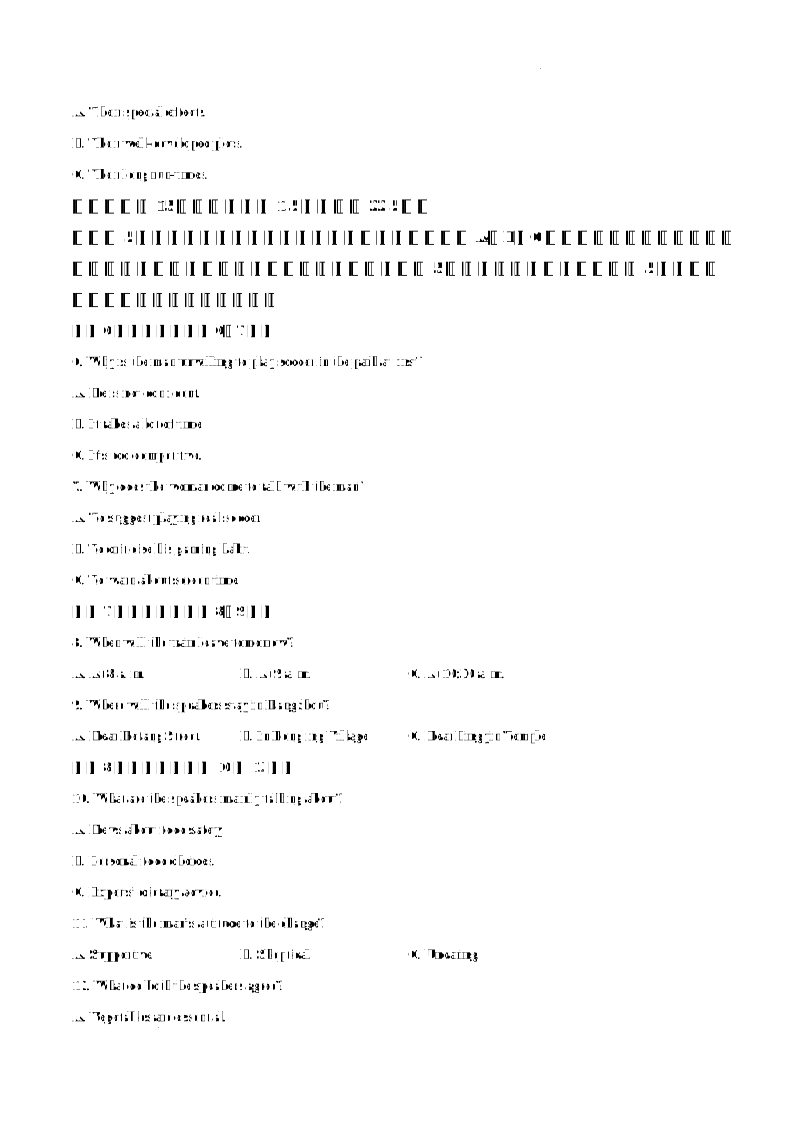
听第6段录音,回答第6、7题。
6. Why is the man unwilling to play soccer in the park at first?
A. He is not confident.
B. It takes a lot of time.
C. It’s too competitive.
7. Why does the woman come to talk with the man?
A. To suggest playing real soccer.
B. To criticise his gaming habit.
C. To warn about screen time.
听第7段录音,回答第8、9题。
8. When will the train leave tomorrow?
A. At 8 a. m. B. At 9 a. m. C. At 10:30 a. m.
9. Where will the speakers stay in Hangzhou?
A. Near Hefang Street. B. In Longjing Village. C. Near Lingyin Temple.
听第8段录音,回答第10至12题。
10. What are the speakers mainly talking about?
A. News about food safety.
B. Personal food choices.
C. Experts’ dietary advice.
11. What is the man’s attitude to the change?
A. Supportive. B. Skeptical. C. Uncaring.
12. What do both the speakers agree?
A. Vegetables are essential.
B. Meat is only a supplement.
C. Whole grains are their favourites.
听第9段录音,回答第13至16题。
13. Where does the conversation probably take place?
A. In a restaurant. B. At a technology fair. C. At a party.
14. What is the probable relationship between the speakers?
A. Husband and wife. B. Former schoolmates. C. Fellow workers.
15. What happened to Joey when he sang the school song?
A. He went off-key. B. He kept laughing. C. He forgot the words.
16. Who is Mr Lee?
A. The party organiser. B. Joey’s headteacher. C. The songwriter.
听第10段录音,回答第17至20题。
17. What inspired Aisha to start the project?
A. Her lack of decent clothes.
B. Her habit of collecting clothes.
C. Her observation of clothing needs.
18. How can people donate their clothes?
A. Request a free pickup.
B. Mail them to a store.
C. Drop them beside dustbins.
19. What happens to the clothes once they are collected?
A. They are cleaned. B. They are sorted. C. They are recycled.
20. What does the project plan to host next?
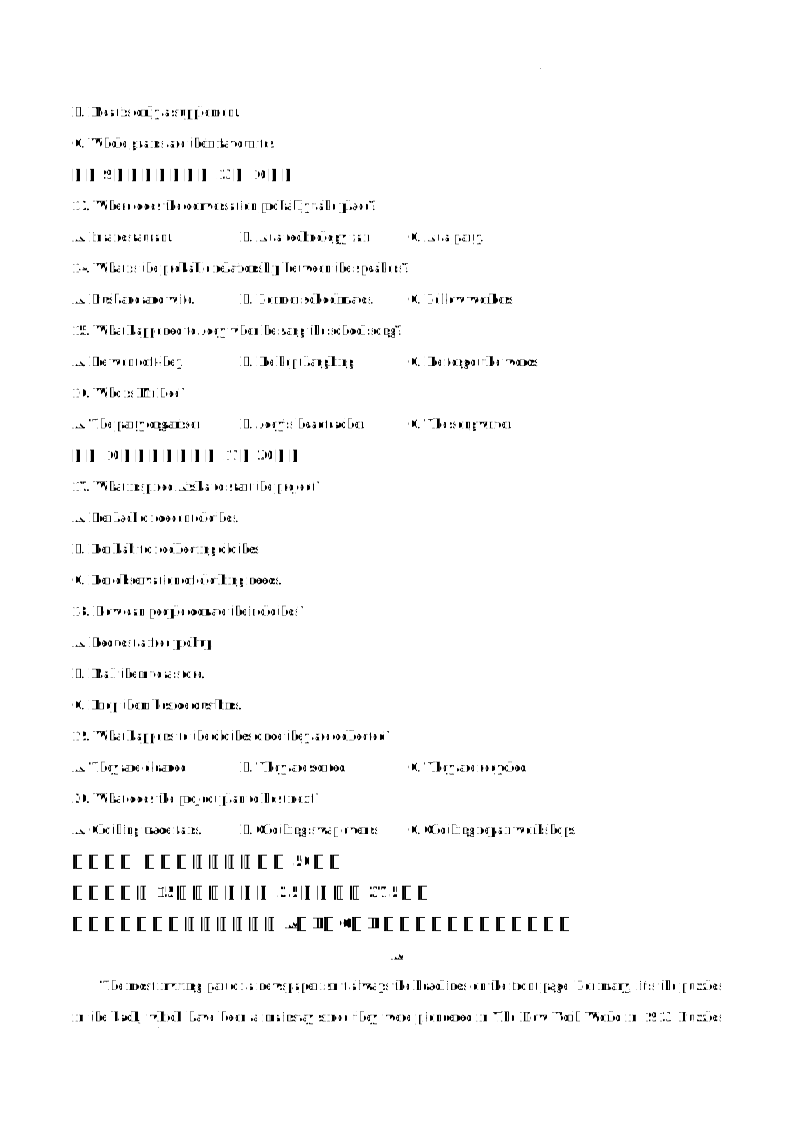
A. Clothing trade fairs. B. Clothing swap events. C. Clothing repair workshops.
第二部分 阅读(共两节,满分50分)
第一节(共15小题;每小题2.5分,满分37.5分)
阅读下列短文,从每题所给的A、B、C、D四个选项中选出最佳选项。
A
The most inviting part of a newspaper isn’t always the headlines on the front page. For many, it’s the puzzles in the back, which have been a mainstay since they were pioneered in The New York World in 1913. Puzzles combine the thrill of an engaging challenge with the relaxation of a mindful exercise. That’s why PressReader has made not just news, but puzzles digital, providing a more convenient and sustainable option for puzzlers. From pen and paper to click and tap, puzzles have found a new home. But one thing’s for certain, they’re as satisfying as ever.
Thousands of newspapers, magazines and books.
Ten puzzle types. One engaging platform.
The PressReader platform faithfully recreates the reading experience of thousands of newspapers and magazines from across the globe in digital form. Now it recreates the experience of tackling the daily newspaper puzzle section, too.
How many puzzles does PressReader offer?
PressReader provides users with 10 puzzle types that can be played directly on PressReader.com (both on desktop and mobile), including codewords, crosswords, pathfinder and more.
How often are new puzzles added?
New puzzles are added daily, just like a daily newspaper! Users can also access puzzles from the previous 28 days.
What are the features of PressReader Puzzles?
Feature
Description
Rules
explain to the user how the game or puzzle works
Hint (提示)
offers hints for current steps, or solves the puzzle entirely
Check
checks whether the user’s current solution is correct
Timer
counts down the time to complete the puzzle (users can pause or continue the timer as desired)
Can users track their puzzle progress?
Yes, completed puzzles will show a check mark. Puzzles in progress will display a pause icon.
Can users play PressReader Puzzles offline?
No, downloading puzzles for offline play is currently not supported.
Can I see how people are using puzzles on my PressReader?
Yes, there is a report showing how many users played the puzzles and which ones they engaged with.
21. What is PressReader?
A. A newspaper. B. A digital news platform.
C. A printing company. D. A new type of puzzle game.
22. How long are previous puzzles available to PressReader users?
A. 1 day. B. 7 days. C. 10 days. D. 28 days.
23. What do PressReader Puzzles offer?
A. Daily rankings. B. Offline downloads.
C. Real-time matches with other users. D. Interactive playing with guidance.
B
Take a closer look at the colourful plants dotted along an initially unassuming Bristol alleyway (小巷) and you’ll see them teeming with insects. “It’s buzzing with pollinators now,” Flora Beverley says.
Just over a year ago, the alleyway was a scary, litter-packed dumping ground. Now, thanks to the Pollinator Pathways Project, it is filled with nectar-rich plants and bee hotels. A neighbour and her son passing by stop to tell Beverley they watered the plants yesterday. The local people who helped to transform the pathways continue to maintain them too.
A trail runner and fitness influencer, Beverley, started the project after an illness left her unable to spend as much time running in the countryside. She wanted to bring more nature into her local community and, at the same time, help to connect important nearby habitats in Bristol including parks and the Northern Slopes Nature Reserve with insect-friendly corridors.
The project took off unexpectedly well and in the space of a year local groups have transformed seven alleyways around the south of the city. Volunteers pile in, and it is funded by small grants that Beverley — who does not get paid — applies for in her own time, street collections and donations from local businesses.
“The things that are good for nature tend to be very good for people too,” she says. “We’re lucky to have so many green spaces in Bristol, but there is a lack of connection between them. Habitat fragmentation is a big issue.”
Beverley is hoping to expand her Pollinator Pathways Project and make it as sustainable as possible. With hotter and drier summers expected, she has made sure to include a variety of drought-resistant plants in the alleyways. Weeds that might block accessibility are removed by hand to prevent the use of herbicide (除草剂). After her videos of the alleyway transformations shared on social media attracted hundreds of thousands of views, she also plans to set an example for people outside Bristol to follow.
24. Which of the following best describes the Bristol alleyway now?
A. It is free of insects. B. It is filled with plants.
C. It is closed to the public. D. It is packed with hotels.
25. Why did Beverley start the project?
A. To find a cure for her disease.
B. To get paid by the council.
C. To provide volunteer positions.
D. To stay connected to nature.
26. What does the underlined word “fragmentation” in Paragraph 5 probably mean?
A. Unity. B. Division. C. Growth. D. Protection.
27. What is Beverley’s goal for the future of her project?
A. To make sure plants survive herbicide.
B. To make it long-lasting and eco-friendly.
C. To launch similar projects in other cities.
D. To increase biodiversity in the alleyways.
C
My friend Amelia and I, both freelance journalists, share a common weakness: procrastination (拖延). Amelia’s are household jobs like investigating her broken dishwasher, while mine are all work-related, particularly a difficult email I’ve been avoiding since last November. On one sunny Thursday morning, we gathered at Amelia’s kitchen table to hold a “forcing party”.
The concept was coined by Tyler Alterman, who posted jokingly on social media about wanting to hire someone to force him to complete tasks he was putting off. When one of his friends responded with an offer of help, they agreed to throw a “force-one-another-to-do-stuff party”. Alterman later reported the results: a completed passport application, a brand new website and a cleared inbox.
Inspired, Amelia and I set aside one hour to complete all the tasks we’re procrastinating, and promised to hold each other to account. Initially, I started with some simpler editing work, still avoiding that email. Amelia finished a task first. “I messaged the bank,” she said proudly. “That’s huge.” But the quiet kitchen didn’t match our celebratory mood. So I opened a new browser, and played an online airhorn (汽笛) sound. The sound functioned as a powerful stimulant; we immediately straightened up, our focus sharpened, and we became newly aware of the potential achievements ahead.
According to neuroscientist Ewa Lombard, such gatherings are effective for two main reasons. First, they combine unpleasant tasks with enjoyable social interaction — a concept known as “reward substitution”. Second, the positive pressure created by time limits helps people enter a productive state more quickly. This approach is similar to “body doubling”, where cooperation and a supportive environment reduce the perceived difficulty of tasks.
By the end of the hour, Amelia had completed several long-delayed chores, and I finally sent that email — a task that took only five minutes and received a positive reply shortly after.
28. What can we learn about Alterman’s “forcing party”?
A. It was a controversial proposal. B. It was a fruitless experiment.
C. It was a casual friend agreement. D. It was a widely publicised event.
29. How did the online airhorn sound motivate the author and Amelia?
A. It created a sense of urgency. B. It helped block outside noises.
C. It provided positive reinforcement. D. It marked their shared progress.
30. What helps make tough tasks feel easier according to Ewa Lombard?
A. Material reward. B. Time pressure.
C. Personal efficiency. D. Motivating interaction.
31. Which of the following is the best title for the text?
A. The Secret to Time Management B. A Journalist’s Guide to Productivity
C. The Importance of Social Interaction in Work D. A Scientific Approach to Fighting Procrastination
D
The best way to appreciate the planet fully is to leave the planet entirely. Ever since Yuri Gagarin became the first human being in space, astronauts have come home to describe what they call the Overview Effect: the change that occurs when they see the world from above, as a place where borders are invisible, where racial, religious and economic setbacks are nowhere to be seen.
In his book Floating in Darkness: A Journey of Evolution, retired astronaut Ron Garan reports a touch of the Overview Effect when he was on the nighttime side of the Earth. Gazing down on Shanghai after dark, he observes, “The whole scene looks somehow biological. The city is lit up all over — bright, unmistakable — stretching out in all directions to connect with other cities. The scene looks like a microscopic photograph of a nerve cell in the brain of the superorganism called humanity. What a dreamy experience!” But those profound feelings can swing the other way, when the Overview Effect reveals the wounds of the world.
In my new novel, Holdout, the lead character, Walli Beckwith, is driven to an extreme act by the power of the Overview Effect. When an emergency forces the evacuation of the space station, she refuses to leave, staying aboard alone. Only later do we learn her reason. “I will come home,” she tells the world, “when we have put an end to the burning of the Amazon that is causing damage so great that it’s visible from space.”
In a 2013 study, researchers administered to two different groups of people a survey designed to measure an individual’s level of spirituality. One group first looked at pictures intended to inspire awe (敬畏): a sunset, a galaxy, mountains, canyons; the other group was shown no such pictures. Repeatedly, those who had seen something of the magnificence of the universe first scored spiritually higher than those who had not.
Spirituality doesn’t have to involve religion. It can simply point to something that goes beyond the ordinary — the feelings that the Overview Effect inspires. Travelling to space may deliver awe directly to our emotional core, but smaller versions of that feeling can be found without leaving the ground.
32. What is the Overview Effect according to Paragraph 1?
A. A change in perception. B. A psychological disorder.
C. A feeling of increased excitement. D. A method of exploring space.
33. What does Ron Garan try to illustrate by mentioning Shanghai?
A. Light pollution is visible from space.
B. Earth seen from space can inspire awe.
C. Astronauts prefer viewing cities at night.
D. Cities need to be more closely connected.
34. Why does Walli Beckwith refuse to leave space in Holdout?
A. To protest the burning of Amazon.
B. To call for environmental protection.
C. To prove she can survive alone in space.
D. To reveal the dangers of space emergencies.
35. What did the 2013 study find about people exposed to awe-inspiring pictures?
A. They desired space travel. B. They became less religious.
C. They were emotionally touched. D. They started to appreciate ordinary things.
第二节(共5小题;每小题2.5分,满分12.5分)
阅读下面短文,从短文后的选项中选出可以填入空白处的最佳选项。选项中有两项为多余选项。
How I Became News-Resilient
Today, we have a 24-hour news cycle that never seems to stop. It can feel overwhelming, with constant updates on everything from global crises to local events. At one point, I found myself consumed by the never-ending stream of information. 36
For a while, I tried to stop reading the news entirely. I thought it would help reduce my anxiety and give me a break from the chaos. But it didn’t work. 37 I’d sit quietly while my friends chatted about headlines I’d never heard of. That’s when I realised I needed a different approach — one that would let me stay informed without stressing me out.
Instead of completely cutting myself off, I decided to take a self-care approach. 38 I set a timer for 30 minutes each morning, and turned off notifications (通知) for the rest of the day. I also avoided news right before bed to protect my sleep.
39 Rather than following countless news outlets and social media accounts, I now choose just a few that are reliable and thoughtful. This has made me more aware of what I consume and how it affects my mood. I’ve unfollowed accounts that spread fear or negativity, and shifted my attention towards content that inspires, informs, or simply leaves me feeling calm and hopeful.
We can’t always control what’s happening around us. 40 Becoming news-resilient doesn’t mean ignoring the world or pretending everything’s fine. It means acknowledging the challenges we face, staying informed in a way that feels manageable.
A. It started affecting my mental health.
B. But we can control how we respond to it.
C. My phone battery lasted much longer after that.
D. I focused on controlling the time spent on news.
E. Sometimes the headlines were surprisingly funny.
F. Disconnection from current events made me feel left out.
G. Over time, I’ve learnt to rely on a handful of trusted sources.
第三部分 语言运用(共两节,满分30分)
第一节(共15小题;每小题1分,满分15分)
阅读下面短文,从每题所给的A、B、C、D四个选项中选出最佳选项。
All my life I’ve been bad at sports. At school I always 41 “fell ill” on the annual sports day and had a standing note from my mother to 42 me from PE classes due to my “bad foot”. Even after I started exercising regularly in my mid-20s, I never 43 in my friends’ social netball or football teams.
“Hating sports” was a key part of my 44 . Then, last year, a friend invited me to her birthday “kickabout” — a 45 game of football, I assumed. I turned up at the park, 46 to stay as far from the ball as possible. However, instead of counting down the time on the sidelines, I soon found myself 47 in the game, cheering for my team to score. None of the other players were sporty or experienced. Yet, we all agreed that we’d had fun and 48 the next game.
A year on, our kickabout has not only 49 , but expanded from a handful of friends to a group of about forty. By any measure, I remain the least skilled player, known for my 50 of using my hands. But I see my own 51 , and to say I hate sports now would be dishonest.
So what draws me back each Sunday? Surprisingly, the 52 lies neither in the socialising nor the workout, but the challenge itself — a (n) 53 free from any pressure, or even desire, to ever 54 the sport. “Amateurish”, the way I see it now, deserves a better 55 .
41. A. apparently B. merely C. successfully D. actually
42. A. prohibit B. excuse C. separate D. protect
43. A. engaged B. believed C. persisted D. invested
44. A. principle B. opinion C. record D. identity
45. A. usual B. casual C. normal D. formal
46. A. convinced B. embarrassed C. astonished D. determined
47. A. swept up B. set up C. turned down D. knocked down
48. A. dismissed B. deserved C. appreciated D. anticipated
49. A. declined B. survived C. changed D. ceased
50. A. habit B. choice C. way D. frequency
51. A. talent B. goal C. progress D. advantage
52. A. appeal B. strength C. reward D. purpose
53. A. selection B. prospect C. pursuit D. opportunity
54. A. maintain B. reject C. improve D. master
55. A. use B. reputation C. chance D. definition
第二节(共10小题;每小题1.5分,满分15分)
阅读下面短文,在空白处填入1个适当的单词或括号内单词的正确形式。
As humanoid robots become increasingly integrated into everyday life, their development now includes a critical stage — training. In Beijing’s Shijingshan district, the Beijing Humanoid Robot Data Training Centre, the largest facility of its kind in China, 56 (function) as a “school” where robots receive specialised training in real-world 57 (produce) and living environments before employment.
At the training centre, robots begin by selecting a “major” from four 58 (category), including smart home applications, elderly care services, industrial manufacturing, and 5G-integrated tasks. There are 110 staff members currently working at the centre, most of 59 were born in the 2000s.
The primary model under training is “Kuafu”, a 1.66-metre-tall humanoid robot. Training is conducted in “small-class” settings, with each robot 60 (assign) two human trainers. In one section of the centre, trainers Shi Xuanyu and Han Weiqi cooperate to teach a robot how to perform protective packaging. 61 (remote) controlled by Han, the robot works with incredible flexibility and accuracy, 62 (wrap) the item in bubble wrap before placing it in a box. Shi monitors and records data throughout the process on a computer. The two trainers switch roles after several hours 63 (ensure) precision and consistency.
“Training robots requires great attention 64 details,” Shi said, “but the work is worth the effort.” There is 65 electronic display at the training centre that shows several “outstanding graduates” already employed in key roles, such as material handlers at factories and service guides at exhibitions.
第四部分 写作(共两节,满分40分)
第一节(满分15分)
假定你是李华,上周你在学校餐厅做志愿服务工作。请你给英国朋友Chris写一封邮件分享这次经历,内容包括:
1.你的服务情况;
2.你的感想。
注意:1.写作词数应为80个左右;
2.请按如下格式在答题卡的相应位置作答。
Dear Chris,
I’m writing to share with you my volunteer experience in the school canteen last week.
Yours,
Li Hua
第二节(满分25分)
阅读下面材料,根据其内容和所给段落开头语续写两段,使之构成一篇完整的短文。
I had been dreaming of cycling through the Atlas Mountains in Africa for years. Last month, with a bike and some camping supplies, I set off, determined to follow the winding river valleys that cut through the mountain ranges. In my bag lay my most treasured companion — a small hand-drawn travel journal filled with sketches of mountains, villages, and the people I had met along the way.
The journey was filled with surprises — snow-capped mountains, palm trees, and the delightful chirping of birds. However, my excitement faded when I reached a section of the valley where the road ahead had been completely flooded by the rising river after a night of heavy rain.
I had a strict principle I never broke — I never walked the same path backwards. To me, this journey was not just about reaching the destination, but also about embracing the unknown and challenging myself. Taking a deep breath, I made up my mind to wade (蹚水) through the river, pushing my bike along with me. The moment my feet touched the water, a sharp, numbing cold shot up my legs, as if thousands of needles were sticking into my skin. After all, the water came straight from the snowmelt.
I gritted my teeth, gripping the bike tightly, and took one slow step after another. Every step felt like a struggle against an invisible force. The water threatened to sweep me off balance at any moment. My feet grew numb, my arms ached, and after nearly an hour of slow struggle, I realised I had moved only about one and a half kilometres.
I was exhausted, both physically and mentally, finally collapsing to my knees in the shallow water, the bike crashing down beside me. On the riverbank, I noticed two local children gathering firewood. Their laughter echoed in the valley until the sound of me slipping and splashing caught their attention.
注意:1.续写词数应为150个左右;
2.请按如下格式在答题卡的相应位置作答。
The two children walked towards me.
I ought to express my gratitude, but I had nothing really valuable.
学科网(北京)股份有限公司
$
资源预览图
1
2
3
相关资源
由于学科网是一个信息分享及获取的平台,不确保部分用户上传资料的 来源及知识产权归属。如您发现相关资料侵犯您的合法权益,请联系学科网,我们核实后将及时进行处理。