命题大赛 河北省石家庄市2025-2026学年高二英语下学期阶段测试(人教版新教材选择性必修四)
2026-05-25
|
2份
|
13页
|
91人阅读
|
0人下载
资源信息
| 学段 | 高中 |
|---|---|
| 学科 | 英语 |
| 教材版本 | 高中英语人教版选择性必修第四册 |
| 年级 | 高二 |
| 章节 | - |
| 类型 | 试卷 |
| 知识点 | - |
| 使用场景 | 同步教学-阶段检测 |
| 学年 | 2026-2027 |
| 地区(省份) | 河北省 |
| 地区(市) | 石家庄市 |
| 地区(区县) | - |
| 文件格式 | ZIP |
| 文件大小 | 170 KB |
| 发布时间 | 2026-05-25 |
| 更新时间 | 2026-05-25 |
| 作者 | Q。Q |
| 品牌系列 | - |
| 审核时间 | 2026-05-25 |
| 下载链接 | https://m.zxxk.com/soft/58022968.html |
| 价格 | 2.00储值(1储值=1元) |
| 来源 | 学科网 |
摘要:
**基本信息**
融合文化传承与社会热点,通过听力日常情境、阅读多元主题及写作实践任务,综合考查语言能力与跨文化思维,适配高二阶段性学情。
**题型特征**
|题型|题量/分值|知识覆盖|命题特色|
|----|-----------|----------|----------|
|听力|20题/30分|日常对话、独白理解|聚焦生活场景,如音乐会讨论、工作面试等,考查信息抓取与推理能力|
|阅读|20题/50分|世界遗产、个人成长、心理学研究、塑料污染|选取跨文化遗产(如埃及阿布辛贝神庙)、环境热点等素材,培养文化意识与批判性思维|
|语言运用|25题/30分|语法填空、完形填空|完形填空以莱特兄弟故事渗透 persistence 主题,语法填空结合敦煌文化,强化语言知识与文化理解|
|写作|2题/40分|邮件写作、故事续写|智慧农场实践邮件考查信息整合,故事续写围绕合作冲突,提升语言表达与逻辑构建能力|
内容正文:
石家庄市高二英语参考
1-5 BCABC 6-10ACBCA 11-15CBABC 16-20CABAC
A: 21-23:BDB B: 24-27:BCAB C: 28-31:ADAC D:32-35: BBCA
七选五:36-40:GADEC
完型:41-45:C CABC 46-50.DDADB 51-55.ACDBA
语法填空:
56.an 57.to 58.has spent 59.deepening 60.which
61.earlier 62.generates 63.but 64.Regarded 65.sharing
应用文
Dear Linda,
Hope you’re having a wonderful week!I’m super excited to tell you about our Smart Farm field trip last Friday.
Upon arrival一到达,the farm workers showed us all kinds of cool high-tech devices:sensors感应器 that track soil moisture水分, automatic自动的 watering systems,and even drones无人机 checking the crops from above.The most impressive part was picking fresh strawberries.One bite and you could taste the sweet juice exploding in your mouth.So amazing to see how tech makes farming smarter!
This activity was a great eye-opener.Not only did I gain a deeper understanding of modern farming but also felt the charm魅力 of cutting-edge尖端的 science.How I wish you could visit our Smart Farm some day.
Yours,
Li Hua
续写范文
I finally gathered my courage and walked up to Suzie after class. I apologized sincerely for my rude words and admitted that Id been too impulsive冲动的 to listen to her explanation. Suzie looked surprised at first, and then smiled gently. “Its okay,” she said. “I know you were under pressure for the exhibition. We should have communicated better too.” She told me shed been looking forward to working with our club again. We quickly agreed on the division of labor: Our club would focus on taking themed photos, while hers would handle the captions and background research.
With Suzies help, we worked smoothly for the competition. Her club not only designed thoughtful深思熟虑的 captions but also suggested creative ways to present the photos. During our cooperation, I learned to listen patiently and appreciate others efforts. Whenever we faced difficulties, we supported each other instead of blaming. Finally, our entry进入、条目、参赛作品 won second prize in the national competition. At the award ceremony颁奖典礼, Suzie and I looked at each other, sharing a smile that held pride. Through the experience, I realized that true cooperation isnt just about splitting work, but about understanding, respecting, and forgiving each other.
听力文本解析
1.B
【原文】W: My television stopped working yesterday. I tried to plug it in somewhere else, but the screen was still black.
M: The television is quite old. It’s not worth repairing. It is probably better to just get it replaced.
2.C
【原文】W: Have you heard the new album by The Yesterdays?
M: Yes, I bought it last week and listened to all the songs on it. It’s amazing. The guitar player wrote all of them.
3.A
【原文】W: Well, tonight we have Professor Brown in the studio to talk about his recent book — Fashion Images. Good evening, Mr. Brown.
M: Good evening, and thank you for inviting me here.
4.B
【原文】M: Mom, is this your handbag?
W: Oh, yes! I was looking for it. I thought it was on the sofa.
M: Shall I put it in your bedroom?
W: OK. On the night table next to my bed would be great.
5.C
【原文】M: Oh, man! What a terrible day I had!
W: What happened?
M: Everything went wrong. I had to meet a big client in the morning but on the way to the appointed place, my car broke down. So I couldn’t make it.
6.A 7.C
【原文】M: Do you sing or play a musical instrument?
W: I’m thinking of taking drum lessons.
M: Really? Why not learn the piano with me?
W: Well, I did study the piano as a child, but I gave it up. It seemed I could never succeed in dealing with the keys.
M: It takes time to become good at any musical instrument, but I found it fairly easy. Now I’m pretty good at it. It’s time to have lessons on something else.
W: You could come to drum lessons with me.
M: My neighbors wouldn’t be pleased if I practiced it at home. I think the guitar would make a better option, so I’m going for that.
8.B 9.C
【原文】M: What a flight! I can’t believe we are back from our holiday. I need a good rest.
W: It felt like a long time till we landed. Those kids didn’t stop laughing out loud.
M: Yeah, I’m sure their parents felt really uncomfortable, especially when the girl moved uneasily in the seat.
W: Well, I am glad to be home. Let’s have something to eat and drink first.
M: OK, I’ll go and see if there’s any food in the kitchen. Well, there’s no bread. Just a little bit of milk. Wow! It smells as if it has gone bad. Let me order some pizza online, and we can enjoy it in 30 minutes.
W: I’m really hungry. I need more than a piece of pizza anyway. Have a look and see what’s in the fridge.
10.A 11.C 12.B
【原文】W: So what are you studying in college?
M: Business. That’s why I’m interested in this job. I’d like to get an MBA after I graduate.
W: I see. How much experience do you have working with computers?
M: Actually, I don’t have any. But I’m willing to learn.
W: Well, we don’t require experience. We’ll be glad to give you some training. Now, this is full-time, and you have to know this is a volunteer position.
M: Oh, I know I won’t get paid. And I understand I’ll work full-time. I just want to get some background in business.
W: Would you be able to start on June 1st?
M: Yes, that’s no problem. I’ll finish my classes in the third week of May.
W: Great. We need someone for June, July, and August.
M: August? Oh, no. I have to be back to school on August 1st.
13.A 14.B 15.C 16.C
【原文】M: Have you started the project for Mr. Lee yet?
W: The one about Australian music? My father loves that. He’ll help me.
M: I think you heard wrong. It’s about African music!
W: Oh my god! I don’t know anything about that! My favorite is American rap!
M: I can help you. I’ve got some information.
W: Have you got a book about it then, Robert?
M: I haven’t read anything, but I listened to something on the radio and made some notes. You can also download some music and search for information from the Internet.
W: Good idea! When do we have to hand in the project?
M: On the last day of this month, just before the holidays start.
W: That means we’ve only got seven days!
M: That’s right!
W: Can we work on the project together after school this afternoon?
M: Tomorrow morning is better. I’ve got other homework tonight.
W: OK. And do we have to write about all the different instruments?
M: No. We can choose which ones to write about. I love the guitar and …
17.A 18.B 19.A 20.C
【原文】
W: And now for some information about an exciting fashion show here in the town this summer. The show will be at the History Center at Peckham Street. I guess most of you know the place. It is behind the town hall, between the Art Gallery and the Crafts Museum. The show is on July 12th … Why? It is July 20th today. Oh, sorry. I’ve got the wrong piece of paper here … I mean the show will be on August 15th and it’s called “Clothes for the Successful Students”. At the start of the show, you’ll see some smart shirts and blouses, just right for those university interviews. And then in the second half of the show, there are a variety of fashionable and comfortable shoes. If you’re studying fashion, tickets are only $6, instead of the normal price of $9. That’s good news for fashion students! The clothes in the fashion show won’t be on sale that day, but you will be able to buy a catalogue of the show to take home with you!
A:21. B 22. D 23. B
【导语】本文是一篇应用文。介绍了埃及阿布辛贝神庙、德国埃尔茨城堡、印度尼西亚婆罗浮屠和中国故宫四处世界著名古代文明建筑遗产,分别说明了它们的历史、建筑特色与文化价值。
【4题详解】
细节理解题。根据Eltz Castle, Wierschem, Germany中“Eltz Castle is one of the few Rhine castles never destroyed. Owned by the same family since records began, it sits on a 70m-high rock spur with eight dramatic towers.(埃尔茨城堡是莱茵河沿岸少数从未被毁的城堡之一。自有记录以来,它就由同一个家族所有,坐落在70米高的岩石支脉上,有八座引人注目的塔楼。)”可知,埃尔茨城堡属于私人所有。故选B。
【5题详解】
细节理解题。根据The Forbidden City, Beijing, China中“Today the palace complex is a UNESCO World Heritage Site and the world’s largest collection of heritage wooden buildings.(如今,这座宫殿群是联合国教科文组织世界遗产,也是世界上规模最大的木质古建筑群。)”可知,故宫建筑的特别之处在于它是世界上最大的木质建筑群。故选D。
【6题详解】
主旨大意题。通读全文可知,文章依次介绍了四处世界著名的历史文化遗产,对其位置、建造背景和建筑特点进行了简要说明,因此本文是一篇对文化遗产地的介绍。故选B。
B答案 BCAB
24. 解析:文中提到孩童时期作者看不清黑板,只能通过抄写同学笔记来遮掩视力问题。
25. 解析:原文明确写明看到视网膜营养不良的诊断结果后,作者内心感到释然。
26. 解析:作者后续试着摒弃多年形成的过度独立的性格,说明这是他长久以来的处事状态。
27. 解析:如今遭遇不便处境时,作者会主动提出诉求,请求做出合理调整来适配自身情况。
C答案28.A 29.D 31.A 31.C
【导语】本文是一篇说明文。文章主要介绍了新的心理学研究指出了为什么我们觉得某些诗歌具有美学吸引力的因素。
5.细节理解题。根据第三段中“To do this, the team had more than 400 participants read and rate poems of two genres — haiku and sonnet — with the aim of understanding the factors that best predicted the aesthetic appeal of the poems.(为了做到这一点,研究小组让400多名参与者阅读并评价两种类型的诗歌——俳句和十四行诗,目的是了解哪些因素最能预测诗歌的美学吸引力)”可知,研究人员要求参与者评价俳句和十四行诗。故选A项。
6.细节理解题。根据第四段中“Their results showed that vividness of mental imagery was the best predictor of aesthetic appeal — poems that evoked greater imagery were more pleasing.(他们的研究结果表明,心理意象的生动性是审美吸引力的最佳预测指标 —— 能唤起更多意象的诗歌更令人愉悦)”可知,心理意象的生动性与美学吸引力有着最强的联系。故选D项。
7.推理判断题。根据最后一段中Starr的话““While limited to poetry,” she adds, “our work sheds light into which facts most influence our aesthetic judgments and paves the way for future research investigating how we make such judgments in other fields.”(“虽然仅限于诗歌,”她补充说,“但我们的工作揭示了哪些事实最影响我们的美学判断,并为未来研究我们在其他领域如何做出这样的判断铺平了道路。”)”可知,从Starr的话中可以推断出,这项研究将有助于探索其他领域的美学判断。故选A项。
8.主旨大意题。通读全文,结合第一段“New psychology research points to the factors that explain why we find particular poems aesthetically pleasing.(新的心理学研究指出了为什么我们觉得某些诗歌具有美学吸引力的因素)”可知,文章开篇指出新的心理学研究指出了人们觉得某些诗歌具有审美吸引力的因素,接着介绍了研究过程和研究发现,最后说明研究的意义,所以文章的主要目的是展示关于审美吸引力的研究发现。故选C项。
D【答案】32. B 33. B 34. C 35. A
【解析】
【导语】本文是一篇说明文。一项研究表明,美国对全球沿海塑料污染的“贡献”比此前认为的高得多,原因包括用塑增加和纳入出口废塑料污染,数据标准缺失致估算范围大。
【1题详解】
细节理解题。根据第二段“According to the research, published in Science Advances, two factors contributed to the sharp increase:Americans are using more plastic than ever and the current study included pollution produced by United States exports of plastic waste, while the earlier one did not.(根据发表在《科学进展》上的研究,有两个因素导致了塑料的急剧增加:美国人使用的塑料比以往任何时候都多,目前的研究包括了美国出口塑料废物产生的污染,而之前的研究没有)”可知,因为现在的研究包含了之前未考虑的数据,所以美国对沿海塑料污染的“贡献”比之前认为的要高。故选B项。
【2题详解】
细节理解题。根据第五段“The study estimates that in 2016, the United States contributed between 1.1 and 2.5 million tons of plastic waste to the oceans through a combination of littering, dumping and mismanaged exports.(该研究估计,2016年,美国通过乱扔垃圾、倾倒和管理不善的出口向海洋排放了110万至250万吨塑料废物)”以及第六段“At a minimum, that’s almost double the total estimated waste in the team’s previous study.(至少,这几乎是该团队之前研究中估计的垃圾总量的两倍)”可计算出之前研究中估计的塑料垃圾总量约为1.1÷2=0.55百万吨。故选B项。
【3题详解】
细节理解题。根据第七段“The ranges are wide partly because ‘there’s no real standard for being able to provide good quality data on collection and disposal of waste in general,’ said Ted Siegler, a resource economist at DSM Environmental Solutions, a consulting firm, and an author of the study.(DSM Environmental Solutions的资源经济学家、该研究的作者泰德·西格勒(Ted Siegler)表示,范围很广,部分原因是‘总体上没有能够提供高质量废物收集和处置数据的真正标准’)”可知,数据范围广是因为没有被广泛认可的数据相关标准。故选C项。
【4题详解】
推理判断题。根据最后一段“Nonetheless, Dr. Walker, who was not involved in the study, said it could offer a more accurate accounting of plastic pollution than the previous study, which likely underestimated the United States’ contribution. ‘They’ve put their best estimate, as accurate as they can be with this data,’ he said, and used ranges, which underscores that the figures are estimates.(然而,没有参与这项研究的沃克博士说,与之前可能低估了美国贡献的研究相比,这项研究能更准确地计算塑料污染。他说:‘他们给出了最好的估计,在这些数据的基础上尽可能准确’,并使用了范围,这强调了这些数字是估计值)”可知,沃克博士认为研究团队的估计是基于现有数据尽可能准确的,但也只是估计,言外之意是他认为这些估计并非绝对准确。故选A项。
七选五答案: GADEC
36. G。根据前文提到的澳大利亚家庭每年浪费大量食物,选项G“While the scale is discouraging, we each can find solutions at home”与之相呼应,指出尽管浪费的规模令人沮丧,但我们每个人都可以在家找到解决方案。
37. A。根据小标题“Stop food waste at the source”以及后文提到的购物习惯,选项A“And that starts at the supermarket”强调了在超市购物时就要开始减少食物浪费。
38. D。根据前文提到的“Growing some food also helps me prevent waste”以及后文提到的特别是绿叶蔬菜,选项D“They’re easy to grow, and I can pick what I need at anytime”解释了为什么种植绿叶蔬菜有助于减少浪费,因为它们易于种植并且可以随时采摘。
39. E。根据前文提到的“check my fridge regularly for items that will soon go off”以及“moving them to the front”,选项E“If a staple is starting to age, I plan a meal to use it up”说明了如何处理即将过期的食物,通过准备一顿饭来消耗掉它们。
40. C。该处小标题应是对下面内容的概括。根据后文提到的“giving scraps a second life”和制作泡菜的例子,选项C“Turn food scraps into something delicious”总结了如何将食物残渣转化为美味的食物,符合该段核心理念。
完型答案41.C 42.C 43.A 44.B 45.C 46.D 47.D 48.A 49.D 50.B 51.A 52.C 53.D 54.B 55.A
【导语】这是一篇记叙文。威尔伯和奥维尔·赖特的父亲在他们小时候送给了他们一架由法国制造的橡皮材质的直升机玩具,这点燃了他们的梦想,在长大后他们成功制造出了世界上第一架有动力的飞机,作者通过这个故事表明唯有坚持不懈和坚定不移才能有所成就。
41.考查名词词义辨析。句意:他们的这一成就绝非一蹴而就的!A.potential潜力;B.accident事故;C.achievement成就;D.change改变。根据前文“We talk about the persistence needed to make our dream come true today. Just think of Wilbur and Orville Wright.(今天我们谈论的是实现梦想所需的坚持不懈的精神。想想威尔伯和奥维尔·赖特吧。)”可知,此处是指威尔伯和奥维尔·赖特的成就不是一蹴而就的。故选C。
42.考查名词词义辨析。句意:这是一架由法国制造的橡皮材质的直升机。A.car汽车;B.bicycle自行车;C.helicopter直升机;D.recording录音。根据后文“having built their first glider(已经制造出了他们的第一架滑翔机)”可知,此处是指这是一架由法国制造的橡皮材质的直升机。故选C。
43.考查动词词义辨析。句意:随即,他们便开始制作复制品了。A.building建造;B.selling售卖;C.interpreting解释;D.drawing画。根据后文“having built their first glider(已经制造出了他们的第一架滑翔机)”可知,此处是指他们开始制作复制品。故选A。
44.考查动词词义辨析。句意:1900 年,当他们还是年轻人的时候,已经制造出了自己的第一架滑翔机,于是他们决定在基蒂霍克的基迪维尔山进行试飞。A.put放置;B.try尝试;C.pick采摘;D.carry携带。根据后文“That first flight was unsuccessful(那第一次飞行没有成功)”可知,此处是指他们决定试飞自己制造的滑翔机。故选B。
45.考查动词词义辨析。句意:它提供了持续强劲的风力,并且还有沙子带来的些许缓冲作用。A.avoided避免;B.prevented阻止;C.provided提供;D.consulted咨询。根据前文“at Kitty Hawk on Kill Devil Hills”可知,此处是指基迪维尔山提供了持续强劲的风力。故选C。
46.考查形容词词义辨析。句意:经过多次尝试之后,在 1903 年 12 月 17 日,他们驾驶着一架经过大幅改进的飞机,在风中冒险试飞。A.flexible灵活的;B.fundamental基础的;C.energized通电的;D.improved改良的。根据“After several more tries”可知,此处是指他们驾驶着一架经过大幅改进的飞机。故选D。
47.考查动词短语辨析。句意:他们最终驾驶着世界上第一架有动力的飞机飞行。A.exposed to暴露于;B.relied on依赖;C.gave up放弃;D.ended up最终成为。根据后文“At 12:00, Wilbur flew it 852 feet in 59 seconds!(在 12 点整,威尔伯驾驶着它飞行了 852 英尺,耗时 59 秒!)”可知,此处是指他们最终驾驶着世界上第一架有动力的飞机飞行。故选D。
48.考查动词词义辨析。句意:当天上午 10 点 35 分开始,奥维尔驾驶着它飞行了约 120 英尺,耗时约 12 秒!A.flew飞行;B.placed放置;C.dragged拖拽;D.pulled拉。根据后文“At 12:00, Wilbur flew it 852 feet in 59 seconds!(在 12 点整,威尔伯驾驶着它飞行了 852 英尺,耗时 59 秒!)”可知,此处是指奥维尔驾驶着飞机飞行了约 120 英尺。故选A。
49.考查动词词义辨析。句意:当天上午协助他们行动的五人之一——约翰尼·摩尔(负责将飞机拖过沙滩以确定其位置),跑到基蒂霍克村时高声喊道。A.expanded扩大;B.assessed评估;C.uploaded上传;D.assisted协助。根据“in charge of dragging the plane across the sand for positioning”可知,此处是指负责协助他们的人。故选D。
50.考查名词词义辨析。句意:这就是航空业的诞生!A.result结果;B.birth诞生;C.target目标;D.development发展。根据前文“They’ve made it!(他们成功了!)”可知,此处是指这次试飞成功代表着航空业的诞生。故选B。
51.考查名词词义辨析。句意:自从他们的父亲送给他们那个玩具以来,已经过去了大约 24 年了!A.toy玩具;B.rank等级;C.promise承诺;D.wisdom智慧。根据前文“Wilbur was 12 years old and Orville 8 when their father brought home a toy.(在威尔伯12 岁、奥维尔 8 岁的时候,他们的父亲把一个玩具带回家了。)”可知,此处是指自从他们的父亲送给他们那个玩具以来。故选A。
52.考查动词词义辨析。句意:如果结果不像预期的那样,那就再试一次!A.urged敦促;B.decided决定;C.expected预期;D.required要求。根据前文“If you have a dream, work at it.(如果你有梦想,就为之努力奋斗。)”可知,此处是指如果结果不像预期的那样。故选C。
53.考查副词词义辨析。句意:坚定不移地坚持你所想要的。A.respectively各自地;B.morally道德上;C.uncritically不加批评地;D.faithfully忠实地。根据后文“Don’t ever give up!(永远不要放弃!)”可知,此处是指坚定不移地坚持你所想要的。故选D。
54.考查代词词义辨析。句意:世界上没有任何东西能够取代坚持不懈的作用。A.Something某物;B.Nothing没有什么;C.Anything任何事物;D.Everything一切。根据后文“Talent will not.(天赋取代不了。)”可知,此处是指没有任何东西能够取代坚持不懈的作用。故选B。
55.考查形容词词义辨析。句意:没有什么比那些有才华却未能成功的人更为常见了。A.common普遍的;B.vivid生动的;C.satisfactory令人满意的;D.painful痛苦的。根据后文“Persistence and determination alone make a difference.(唯有坚持不懈和坚定不移才能有所成就。)”和前文“Talent will not.(天赋取代不了。)”可知,此处是指没有什么比那些有才华却未能成功的人更为常见了。故选A。
语法填空
56. 答案:an - 解析:此处表示“一名大学生”,`undergraduate` 以元音音素 /ʌ/ 开头,因此用不定冠词 an。
57.答案:to- 解析:固定搭配 owe sth to sb/sth意为“把……归功于”,句中表示“他将自己与莫高窟的长久羁绊归功于‘缘分’”。
58.答案:has spent - 解析:`since then`(自那以后)是现在完成时的标志,主语 `he` 为第三人称单数,因此用现在完成时 `has spent`。
59.答案:deepening- 解析:现在分词作伴随/结果状语,表示“每次探访都揭示新发现,从而加深了他的理解”,逻辑主语 `Each visit` 与 deepen是主动关系,因此用现在分词形式 deepening。
60.答案:which - 解析:非限制性定语从句,先行词为 one of Leonardo da Vinci's works(物),关系词在从句中作主语,因此用 which。
61.答案:earlier - 解析:此处表示“(这幅作品)比它早了五个多世纪”,隐含比较含义,因此用副词 early的比较级 earlier。
62.答案:generates - 解析:宾语从句中,主语 cultural exchange为单数,句子描述客观事实,用一般现在时,因此用 generates。
63.答案:but- 解析:固定结构 not just... but (also)...意为“不仅……而且……”,句中表示“使敦煌不仅是一个十字路口,更是一个创新之地”。
64.答案:Regarded - 解析:过去分词作状语,表示“被视为……”,逻辑主语 Schmid与 regard是被动关系(他被视为故事讲述者和跨文化向导),因此用过去分词 `Regarded`(句首首字母大写)。
65.答案:sharing- 解析:固定搭配 commit oneself to doing sth. 意为“致力于做某事”,其中 to是介词,后接动名词,因此用sharin
试卷第1页,共3页
试卷第1页,共3页
学科网(北京)股份有限公司
$ 石家庄市高二英语 你今天的日积月累,终会变成别人的望尘莫及。
高二下学期英语阶段性测试
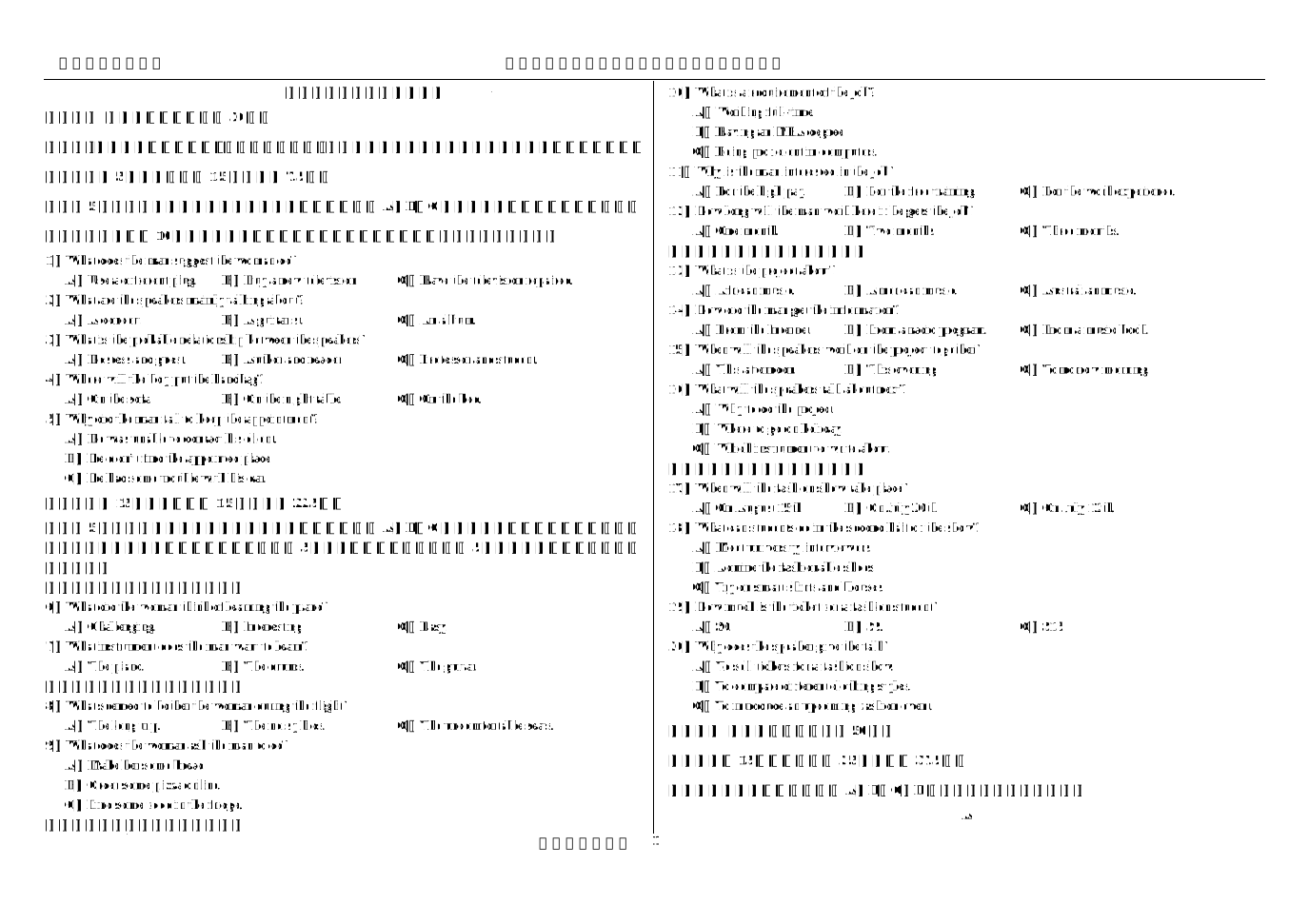
第一部分 听力(共两节,满分30分)
做题时,先将答案标在试卷上。录音内容结束后,你将有两分钟的时间将试卷上的答案转涂到答题卡上。
第一节(共5小题;每小题1.5分,满分7.5分)
听下面5段录音。每段录音后有一个小题,从题中所给的A、B、C三个选项中选出最佳选项。听完每段录音后,你都有10秒钟的时间来回答有关小题和阅读下一小题。每段录音播放两遍。
1.What does the man suggest the woman do?
A.Use a different plug. B.Buy a new television. C.Have the television repaired.
2.What are the speakers mainly talking about?
A.A concert. B.A guitarist. C.An album.
3.What is the probable relationship between the speakers?
A.Hostess and guest. B.Author and reader. C.Professor and student.
4.Where will the boy put the handbag?
A.On the sofa. B.On the night table. C.On the bed.
5.Why did the man fail to keep the appointment?
A.He was unable to contact his client.
B.He didn’t find the appointed place.
C.He had some trouble with his car.
第二节(共15小题;每小题1.5分,满分22.5分)
听下面5段录音。每段录音后有几个小题,从题中所给的A、B、C三个选项中选出最佳选项。听每段录音前,你将有时间阅读各个小题,每小题5秒钟;听完后,每小题都有5秒钟的作答时间。每段录音播放两遍。
听下面一段对话,回答以下小题。
6.What did the woman think of learning the piano?
A.Challenging. B.Interesting. C.Easy.
7.What instrument does the man want to learn?
A.The piano. B.The drums. C.The guitar.
听下面一段对话,回答以下小题。
8.What seemed to bother the woman during the flight?
A.The long trip. B.The noisy kids. C.The uncomfortable seats.
9.What does the woman ask the man to do?
A.Make her some bread.
B.Order some pizza online.
C.Find some food in the fridge.
听下面一段对话,回答以下小题。
10.What is a requirement of the job?
A.Working full-time.
B.Having an MBA degree.
C.Being proficient in computers.
11.Why is the man interested in the job?
A.For the high pay. B.For the free training. C.For the work experience.
12.How long will the man work here if he gets the job?
A.One month. B.Two months. C.Three months.
听下面一段对话,回答以下小题。
13.What is the project about?
A.African music. B.American music. C.Australian music.
14.How did the man get the information?
A.From the Internet. B.From a radio program. C.From a music book.
15.When will the speakers work on the project together?
A.This afternoon. B.This evening. C.Tomorrow morning.
16.What will the speakers talk about next?
A.Why to do the project.
B.Where to go on holiday.
C.Which instrument to write about.
听下面一段独白,回答以下小题。
17.When will the fashion show take place?
A.On August 15th. B.On July 20th. C.On July 12th.
18.What can students do in the second half of the show?
A.Meet university interviewers.
B.Admire the fashionable shoes.
C.Try on smart shirts and blouses.
19.How much is the ticket for a fashion student?
A.$6. B.$9. C.$15.
20.Why does the speaker give the talk?
A.To sell tickets for a fashion show.
B.To compare different clothing styles.
C.To introduce an upcoming fashion event.
第二部分 阅读(共两节,满分50分)
第一节(共15小题;每小题2.5分,满分37.5分)
阅读下列短文,从每题所给的A、B、C、D四个选项中选出最佳选项。
A
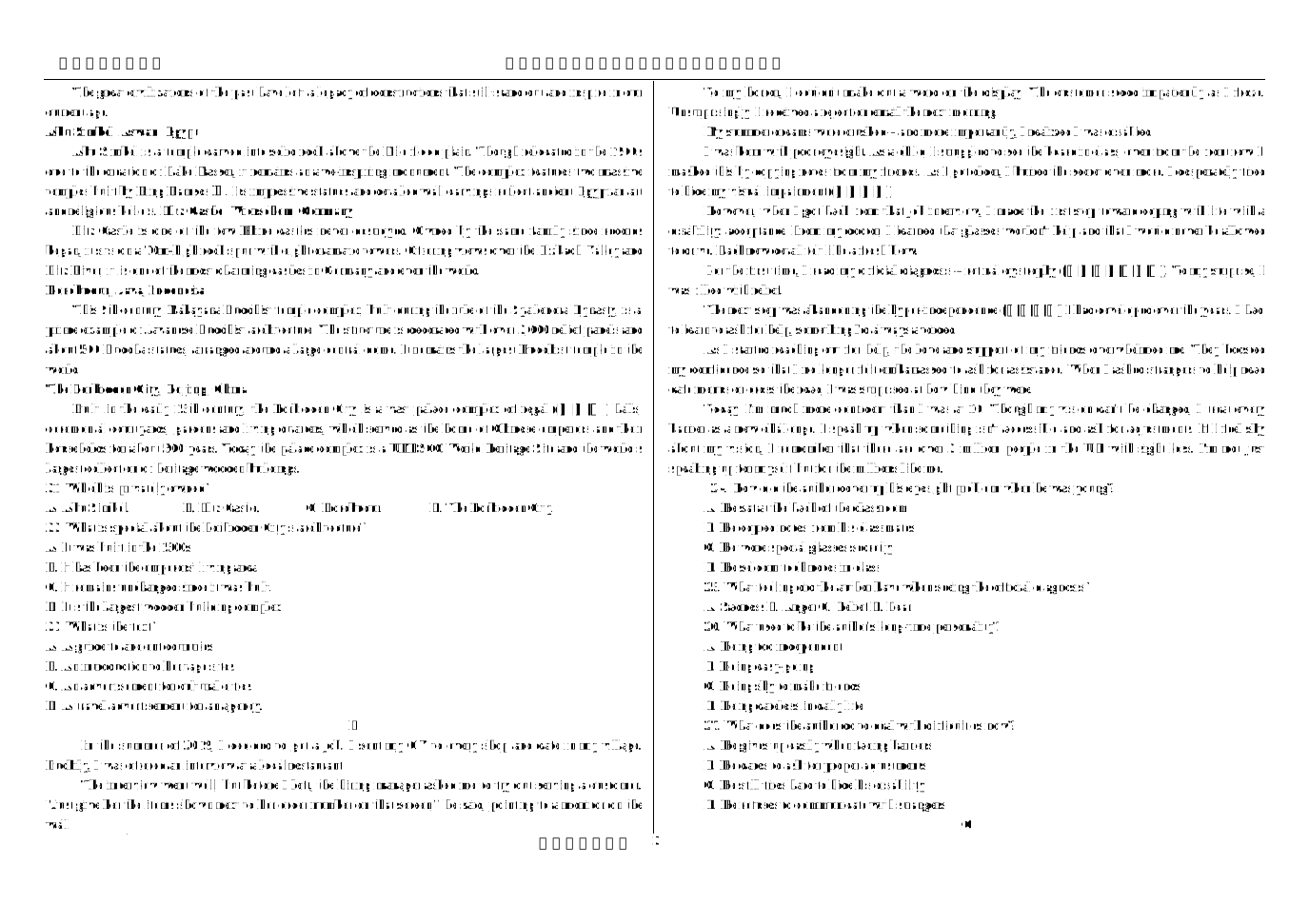
The great civilizations of the past have left a legacy of constructions that still stand out and inspire in our current age.
Abu Simbel, Aswan, Egypt
Abu Simbel is a temple carved into solid rock above the Nile flood plain. Though relocated in the 1960s due to the creation of Lake Nasser, it remains an awe-inspiring monument. The complex features two massive temples built by King Ramses Ⅱ. Its impressive statues and detailed wall carvings reflect ancient Egyptian art and religious beliefs. Eltz Castle, Wierschem, Germany
Eltz Castle is one of the few Rhine castles never destroyed. Owned by the same family since records began, it sits on a 70m-high rock spur with eight dramatic towers. Offering views over the Elzbach Valley and Eltz River, it is one of the most charming castles in Germany and even the world.
Borobudur, Java, Indonesia
This 9th-century Mahayana Buddhist temple complex, built during the rule of the Syailendra Dynasty, is a prime example of Javanese Buddhist architecture. The structure is decorated with over 2,600 relief panels and about 500 Buddha statues, arranged around a large central dome. It remains the largest Buddhist temple in the world.
The Forbidden City, Beijing, China
Built in the early 15th century, the Forbidden City is a vast palace complex of regal (帝王的) halls, ceremonial courtyards, gardens and living quarters, which served as the home of Chinese emperors and their households for about 500 years. Today the palace complex is a UNESCO World Heritage Site and the world’s largest collection of heritage wooden buildings.
21. Which is privately owned?
A. Abu Simbel. B. Eltz Castle. C. Borobudur. D. The Forbidden City.
22. What is special about the Forbidden City’s architecture?
A. It was built in the 1500s.
B. It has been the emperors’ living area.
C. It remains unchanged since it was built.
D. It’s the largest wooden building complex.
23. What is the text?
A. A guide to ancient countries.
B. An introduction to heritage sites.
C. An advertisement for cultural cities.
D. A travel advertisement for an agency.
B
In the summer of 2019, I decided to get a job. I sent my CV to every shop and cafe in my village. Luckily, I was offered an interview at a local restaurant.
The interview went well, but before I left, the hiring manager asked me to try out serving a customer. "Just give her the items shown next to her order number on that screen," he said, pointing to a monitor on the wall.
To my horror, I couldn't make out a word on the display. The customer stood impatiently as I froze. Unsurprisingly, I received a rejection email the next morning.
My summer dreams were crushed – and more importantly, I realized I was disabled.
I was born with poor eyesight. As a child, I struggled to see the board in class, even from the front row. I masked this by copying notes from my friends. As I got older, I buried the secret even more. I desperately tried to hide my visual impairment (视力缺陷).
However, when I got back from that job interview, I made the first step toward coping with life with a disability: acceptance. From my doctor, I learned that glasses wouldn't help and that I would never be allowed to drive. Each new detail felt like a fresh blow.
For the first time, I read my official diagnosis – retinal dystrophy (视网膜营养不良). To my surprise, I was filled with relief.
The next step was abandoning the hyper-independence (过度独立) I had developed over the years. I had to learn to ask for help, something I'd always avoided.
As I started reaching out for help, the love and support of my friends overwhelmed me. They boosted my confidence so that I no longer felt embarrassed to ask for assistance. When I asked strangers to help read cafe menus or cross the road, I was surprised at how kind they were.
Today, I'm much more confident than I was at 16. Though my vision can't be changed, I treat every barrier as a new challenge. I speak up when something isn't accessible and ask for adjustments. If I feel shy about my vision, I remember that there are over 2 million people in the UK with sight loss. I'm not just speaking up for myself but for the millions like me.
24. How did the author cover up his eyesight problem when he was young?
A. He sat at the back of the classroom
B. He copied notes from his classmates
C. He wore special glasses secretly
D. He seldom took notes in class
25. What feeling did the author have when seeing the official diagnosis?
A. Sadness B. Anger C. Relief D. Fear
26. What used to be the author's long-time personality?
A. Being too independent
B. Being easy-going
C. Being shy to make friends
D. Being careless in daily life
27. What does the author do to deal with difficulties now?
A. He gives up easily when facing barriers
B. He dares to ask for proper adjustments
C. He still tries hard to hide his disability
D. He refuses to communicate with strangers
C
New psychology research points to the factors that explain why we find particular poems aesthetically pleasing. “While it may seem obvious that individual taste matters in judgments of poetry, we found certain factors consistently influence how much a poem will be enjoyed.”
Aesthetics (美学), the basis of what we find appealing or not, play an important role in our everyday lives. However, little is known about how we make these judgments. The researchers sought to answer an age-old question — “Why do we like what we like?” — by measuring what we find aesthetically pleasing in poetry.
To do this, the team had more than 400 participants read and rate poems of two genres — haiku and sonnet — with the aim of understanding the factors that best predicted the aesthetic appeal of the poems. After reading each poem, participants answered questions about the poem’s vividness (“How vivid is the imagery evoked from this poem?”), emotional arousal (“How relaxing or stimulating is this poem?”), emotional valence (“How positive or negative is the content of this poem?”), and aesthetic appeal (“How enjoyable or aesthetically appealing did you find this poem?”).
Their results showed that vividness of mental imagery was the best predictor of aesthetic appeal — poems that evoked greater imagery were more pleasing. Emotional valence also predicted aesthetic appeal, though to a lesser extent; specifically, poems that were found to be more positive were generally found to be more appealing. By contrast, emotional arousal did not have a clear relationship to aesthetic appeal.
“The vividness of a poem consistently predicted its aesthetic appeal,” notes Starr, author of Feeling Beauty: The Neuroscience of Aesthetic Experience. “Therefore, it seems that vividness of mental imagery may be a key factor influencing what we like more broadly.” “While limited to poetry,” she adds, “our work sheds light into which facts most influence our aesthetic judgments and paves the way for future research investigating how we make such judgments in other fields.”
28.What did the researchers ask the participants to do?
A.Evaluate poems of haiku and sonnet. B.Write the aesthetic appeal of poems.
C.Explain factors of emotional valence. D.Ask questions about the poem’s vividness.
29.Which of the following is true according to paragraph 4?
A.Poems with more negative content are more appealing.
B.Emotional arousal is negatively related to aesthetic appeal.
C.Emotional valence is the most important predictor of aesthetic appeal.
D.Vividness of mental imagery has the strongest connection with aesthetic appeal.
30.What can be inferred from Starr’s words?
A.The research will help explore aesthetic judgments in other fields.
B.The finding of vividness being a key factor is only applicable to poetry.
C.Emotional valence should be further studied in the context of other art forms.
D.The research has little value for understanding aesthetic judgments in other areas.
31.What is the main purpose of this passage?
A.To introduce different types of poems. B.To discuss the importance of aesthetics.
C.To show the findings of aesthetic appeal. D.To persuade people to admire the poems.
D
The United States contribution to coastal plastic pollution world-wide is significantly larger than previously thought, possibly by as much as five times, according to a study published Friday.
According to the research, published in Science Advances, two factors contributed to the sharp increase: Americans are using more plastic than ever and the current study included pollution produced by United States exports of plastic waste, while the earlier one did not.
The United States, which does not have sufficient infrastructure (基础建设) to handle its recycling demands at home, exports about half of its recyclable waste. Of the total exported, about 88 percent ends up in countries considered to have inadequate waste management.
“When you consider how much of our plastic waste isn’t actually recyclable because it is low-value, polluted or difficult to process, it’s not surprising that a lot of it ends up polluting the environment,” said the study’s lead author, Kara Lavender Law, research professor of oceanography at Sea Education Association, in a statement.
The study estimates that in 2016, the United States contributed between 1.1 and 2.5 million tons of plastic waste to the oceans through a combination of littering, dumping and mismanaged exports.
At a minimum, that’s almost double the total estimated waste in the team’s previous study. At the high end, it would be a fivefold increase over the earlier estimate.
The ranges are wide partly because “there’s no real standard for being able to provide good quality data on collection and disposal of waste in general,” said Ted Siegler, a resource economist at DSM Environmental Solutions, a consulting firm, and an author of the study.
Mr. Siegler said the researchers had evaluated waste-disposal practices in countries around the world and used their “best professional judgment” to determine the lowest and highest amounts of plastic waste likely to escape into the environment. They settled on a range of 25 percent to 75 percent.
Tony Walker, an associate professor at the Dalhousie University School for Resource and Environmental Studies in Halifax, Nova Scotia, said that analyzing waste data can amount to a “data minefield (危机四伏的局面)” because there are no data standards across municipalities. Moreover, once plastic waste is shipped overseas, he said, data is often not recorded at all.
Nonetheless, Dr. Walker, who was not involved in the study, said it could offer a more accurate accounting of plastic pollution than the previous study, which likely underestimated the United States’ contribution. “They’ve put their best estimate, as accurate as they can be with this data,” he said, and used ranges, which underscores that the figures are estimates.
32. According to the research, what has made the US contribution to coastal plastic pollution higher than thought?
A. More unrecyclable plastic waste has been produced.
B. Some once excluded data is now included in the study.
C. Americans have begun to export plastic waste recently.
D. People have no device at home to dispose of plastic waste.
33. The total estimated plastic waste was according to the team’s previous study.
A. about 0.26 million tons B. about 0.55 million tons
C. about 1.1 million tons D. about 2.2 million tons
34. Why is there a wide range in the team’s estimate?
A. Countries around the world vary a lot in the amount of plastic waste.
B. More plastic waste has escaped into the environment than before.
C. No such data-related standard is widely acknowledged.
D. The team hopes to give a possible prospect.
35. It can be inferred from the passage that Tony Walker .
A. doesn’t think the team’s estimates are that accurate
B. underestimates the US contribution to plastic waste
C. doesn’t think that the team should provide such estimates
D. feels regretful that he hasn’t been involved in the study
第二节(共5小题;每小题2.5分,满分12.5分)
阅读下面短文,从短文后的选项中选出可以填入空白处的最佳选项。选项中有两项为多余选项。
We've all been there – reaching into the fridge to find a forgotten cucumber shriveled (干瘪) beyond recognition, or a half-eaten bag of baby spinach quietly collapsing into mush. Australian households throw out almost 2.5m tonnes of food every year – or the equivalent of 7.7m meals a day. 36 .
Over the past decade, I've developed habits that help reduce food waste. Here are some ideas that may work.
Stop food waste at the source
The best way to prevent food waste is to avoid bringing too much into your house. 37 .
I keep a digital shopping list on my phone, adding things as they run out so it's always up to date. I stick to my list, only buying the things I actually need.
Growing some food also helps me prevent waste. I prioritize plants that spoil quickly, especially leafy greens. 38 .
Eat it before you bin it
I check my fridge regularly for items that will soon go off, moving them to the front so they're the first thing I see. The same goes for the pantry (食品储藏室). 39 .
For families, I recommend bright yellow Use It Up tape (or a homemade version), which you can stick on items in the fridge as a simple visual reminder.
____40_____
I always follow the principle “produce no waste” by giving scraps (残羹剩饭) a second life. For example, when dealing with old vegetables, I'll make simple pickles (泡菜) to keep it shelf-stable. I also collect vegetable offcuts in a big freezer bag, and when it's full, I use a slow cooker to make soup.
A. And that starts at the supermarket
B. Limit or switch the items on your list
C. Turn food scraps into something delicious
D. They're easy to grow, and I can pick what I need at anytime
E. If a staple is starting to age, I plan a meal to use it up
F. Donating unwanted food to local charities can also be a choice
G. While the scale is discouraging, we each can find solutions at home
第三部分 语言运用(共两节,满分30分)
第一节(共15小题;每小题1分,满分15分)
阅读下面短文,从每题所给的A、B、C、D四个选项中选出最佳选项。We talk about the persistence needed to make our dream come true today. Just think of Wilbur and Orville Wright. Their 16 definitely didn’t happen overnight!
Wilbur was 12 years old and Orville 8 when their father brought home a toy. It was a rubber 17 made in France. They liked it so much that they played with it until it broke. Immediately, they began 18 copies. They were hooked on aviation! In 1900, as young men, having built their first glider (滑翔机), they decided to 19 it out at Kitty Hawk on Kill Devil Hills. It 20 consistent strong winds and the somewhat cushioning (减震的) effects of sand. That first flight was unsuccessful, but it didn’t stop them. After several more tries, on December 17, 1903, with a much 21 plane, they risked their lives to fly it in the wind. They 22 flying the world’s first powered airplane. Beginning at 10:35 a.m. that day, Orville 23 it 120 feet in about 12 seconds! At 12:00, Wilbur flew it 852 feet in 59 seconds! Johnny Moore, one of the five men who 24 them that morning (in charge of dragging the plane across the sand for positioning), ran to the village of Kitty Hawk crying. “They’ve made it!” This was the 25 of aviation! At this time, Wilbur was 36 and Orville 32. Roughly 24 years had passed since their father gave them that 26 !
If you have a dream, work at it. If it doesn’t turn out as 27 , try again! Stick to what you want 28 . Don’t ever give up! 29 in the world can take the place of persistence. Talent will not. Nothing is more 30 than unsuccessful men with talent. Persistence and determination alone make a difference.
41.A.potential B.accident C.achievement D.change
42.A.car B.bicycle C.helicopter D.recording
43.A.building B.selling C.interpreting D.drawing
44.A.put B.try C.pick D.carry
45.A.avoided B.prevented C.provided D.consulted
46.A.flexible B.fundamental C.energized D.improved
47.A.exposed to B.relied on C.gave up D.ended up
48.A.flew B.placed C.dragged D.pulled
49.A.expanded B.assessed C.uploaded D.assisted
50.A.result B.birth C.target D.development
51.A.toy B.rank C.promise D.wisdom
52.A.urged B.decided C.expected D.required
53.A.respectively B.morally C.uncritically D.faithfully
54.A.Something B.Nothing C.Anything D.Everything
55.A.common B.vivid C.satisfactory D.Painful
第二节(共10小题;每小题1.5分,满分15分)
阅读下面短文,在空白处填入1个适当的单词或括号内单词的正确形式。
In 1987, the Mogao Caves (莫高窟) became a UNESCO World Heritage site. That same year, Neil Schmid, then___56___ undergraduate studying Chinese at Georgetown University, first visited the desert city of Dunhuang. He owes his lasting bond with the caves __57__"yuanfen"—a special fondness.
Over thirty years later, in 2018, Schmid made history as the first full-time foreign researcher at the Dunhuang Academy. Since then, he___58___(spend) thousands of hours examing the caves' murals (壁画) and sculptures (雕塑). Each visit, he says, reveals something new, ____59____(deep) his appreciation of how these sacred spaces were designed to engage body, senses, and mind in acts of devotion and storytelling.
Schmid's current research highlights Dunhuang as a test of cultural integration. In Cave 25, he identified a hand gesture strikingly similar to that in one of Leonardo da Vinci's works, __60___ was painted over five centuries _____61___ (early). These discoveries show what cultural exchange ___62____(generate): new visual languages and devotional forms, making Dunhuang not just a crossroad___63____ a site of innovation.
_____64 ___(regard) as a storyteller and a cross-cultural guide, Schmid commits himself to ___65____(share) Dunhuang with global audiences through lectures and exhibitions. For him, the ancient caves remain a steady source of inspiration—proof that lasting achievements come from openess.
第四部分 写作(共两节,满分40分)
第一节(满分15分)
第四部分 写作(共两节,满分40分)
第一节(满分15分)
假定你是李华,参加了你校组织的智慧农场(Smart Farm)实践活动。请给你的外国笔友Linda写一封邮件,分享这次活动。内容包括:
1.时间与经历;
2.收获与感受。
注意:
1.写作词数应为80个左右;
2.请按如下格式在答题卡的相应位置作答。
Dear Linda,
Yours,
Li Hua
第二节(满分25分)
阅读下面材料,根据其内容和所给段落开头语续写两段,使之构成一篇完整的短文。
As the president of the photography club in our school , Ⅰ was excited to cooperate with the Environmental protection club ona“Green campus”photo exhibition. we agreed to split (分摊) the work : our club would take photos of eco_friendly sceneson campus, while their club , led by my classmate suzie , would design the exhibition boardsand write captions (说明文字) .
The deadline was two weeks away , and everything seemed to be going well. our club spent weekends capturing beautiful shot sof the school garden , therecycling station , and students practicing low_carbon lifestyles. However , three days before the deadline , suzie sent mea message saying their club hadn’t finished the captions yet. Ⅰ felt anxious__without captions, the photos would make little sense. Ⅰ replied angrily , blaming them for being irresponsible and threatening to cancel the cooperation.
suzie didn’t respond immediately. Later that evening , she sent a long message explaining that two of their key members had caught a heavy cold and that they’d been struggling to keep up. But Ⅰ was too upset to read it carefully , so Ⅰ just ignored her. The next day , Ⅰ told my club members we’d finish the captions ourselves, even though it meant extra work.
The photo exhibition turned out to bea success, but Ⅰ hadn’t spoken to suzie since that argument. Every time Ⅰ met her in the hallway , she’d look away quietly. A month later , our teacher announced that the school would select a team to participate in a national environmental photography competition , and that we needed to work with the Environmental protection club again.
Ⅰ hesitated fora long time. Ⅰ knew suzie was the best person to lead the caption team , but Ⅰ was embarrassed about how Ⅰ’d treated her. My club members encouraged me to talk to her , saying that holding a grudge (怨恨) wouldn’t solve anything.
注意:
(1)续写词数应为 150 个左右 ;
(2)请按如下格式在答题卡的相应位置作答。
Ⅰ finally gathered my courage and walked up to suzie after class.
with suzie’s help , we worked smoothly for the competition.
(
1
)高中二年级英语
学科网(北京)股份有限公司
$
资源预览图
1
2

3
相关资源
由于学科网是一个信息分享及获取的平台,不确保部分用户上传资料的 来源及知识产权归属。如您发现相关资料侵犯您的合法权益,请联系学科网,我们核实后将及时进行处理。