上海市2025-2026学年高一第二学期英语期末考试模拟卷A
2026-05-24
|
17页
|
113人阅读
|
3人下载
资源信息
| 学段 | 高中 |
|---|---|
| 学科 | 英语 |
| 教材版本 | - |
| 年级 | 高一 |
| 章节 | - |
| 类型 | 试卷 |
| 知识点 | - |
| 使用场景 | 同步教学-期末 |
| 学年 | 2026-2027 |
| 地区(省份) | 上海市 |
| 地区(市) | - |
| 地区(区县) | - |
| 文件格式 | DOCX |
| 文件大小 | 45 KB |
| 发布时间 | 2026-05-24 |
| 更新时间 | 2026-05-24 |
| 作者 | CuiEnglish |
| 品牌系列 | - |
| 审核时间 | 2026-05-24 |
| 下载链接 | https://m.zxxk.com/soft/58016943.html |
| 价格 | 1.00储值(1储值=1元) |
| 来源 | 学科网 |
摘要:
**基本信息**
聚焦时代主题与语言运用,融合科技(实验室培育咖啡)、环保(无车日)等真实情境,全面考查高一学生语言能力与思维品质。
**题型特征**
|题型|题量/分值|知识覆盖|命题特色|
|----|-----------|----------|----------|
|语法词汇|30分|动词短语(如come up with)、名词辨析(如cooperation)、篇章词汇填空|Section B(A)以手机使用与健康为情境,考查词汇在语境中的运用|
|阅读理解|60分|细节理解、推理判断、主旨归纳|C篇以苏伊士运河堵塞事件考查全球供应链认知,提升思维深度|
|语法填空|20分|时态(如had made)、非谓语(wanting)、从句连接词(which)|(A)篇刺猬花园故事,在叙事中考查语法应用|
|书面表达|15分|应用写作(书信)、环保主题表达|结合“无车日”,要求阐述看法并介绍本地环保措施,体现文化意识|
内容正文:
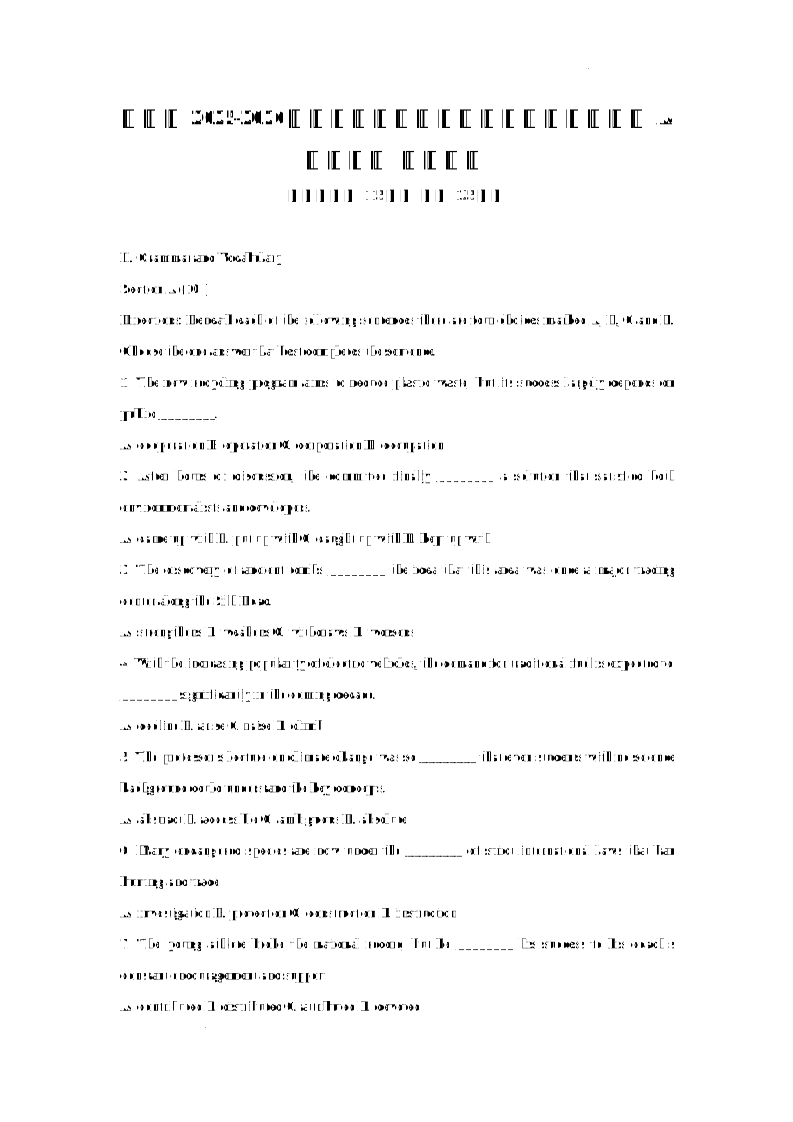
上海市2025-2026学年高一第二学期英语期末考试模拟卷A
高一年级 英语学科
(考试时间115分钟 总分125分)
II. Grammar and Vocabulary
Section A (10’)
Directions: Beneath each of the following sentences there are four choices marked A, B, C and D. Choose the one answer that best completes the sentence.
1. The new recycling program aims to reduce plastic waste, but its success largely depends on public ________.
A. cooperation B. operation C. corporation D. occupation
2. After hours of discussion, the committee finally ________ a solution that satisfied both environmentalists and developers.
A. came up with B. put up with C. caught up with D. kept up with
3. The discovery of ancient tombs ________ the idea that this area was once a major trading center along the Silk Road.
A. strengthens B. weakens C. withdraws D. worsens
4. With the increasing popularity of electric vehicles, the demand for traditional fuel is expected to ________ significantly in the coming decade.
A. decline B. arise C. raise D. climb
5. The professor’s lecture on climate change was so ________ that even students with no science background could understand the key concepts.
A. abstract B. accessible C. ambiguous D. absolute
6. Many endangered species are now under the ________ of strict international laws that ban hunting and trade.
A. investigation B. protection C. construction D. instruction
7. The young athlete broke the national record, but he ________ his success to his coach’s constant encouragement and support.
A. contributed B. distributed C. attributed D. devoted
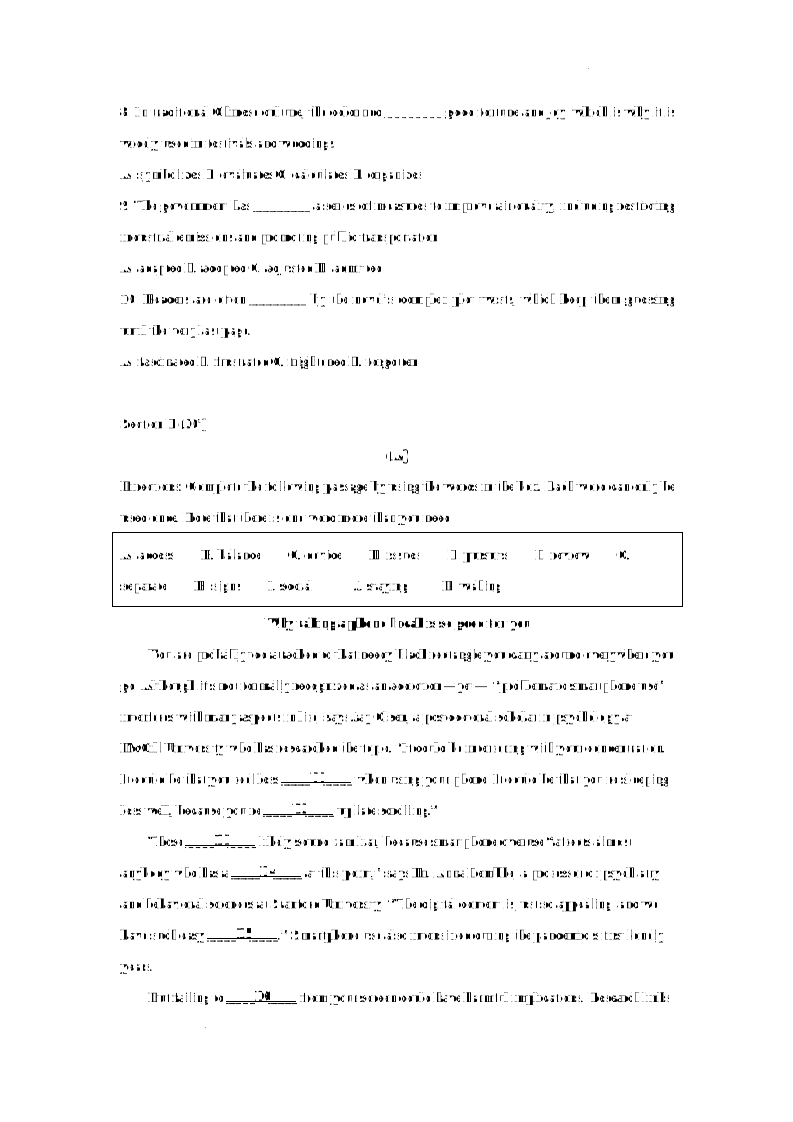
8. In traditional Chinese culture, the color red ________ good fortune and joy, which is why it is widely used in festivals and weddings.
A. symbolizes B. evaluates C. calculates D. organizes
9. The government has ________ a series of measures to improve air quality, including restricting industrial emissions and promoting public transportation.
A. adapted B. adopted C. adjusted D. admitted
10. Readers are often ________ by the novel’s complex plot twists, which keep them guessing until the very last page.
A. fascinated B. frustrated C. frightened D. forgotten
Section B (20’)
(A)
Directions: Complete the following passage by using the words in the box. Each word can only be used once. Note that there is one word more than you need.
A. access B. balance C. device D. issues E. pursuits F. review G. separate H. signs I. social J. staying K. waking
Why taking a phone break is so good for you
You are probably too attached to that needy black rectangle you carry around everywhere you go. Although it’s not formally recognized as an addiction—yet— “problematic smartphone use” interferes with many aspects in life, says Jay Olsen, a postdoctoral scholar in psychology at McGill University who has researched the topic. “It could be interfering with your concentration. It could be that you feel less ____11____ when using your phone. It could be that you’re sleeping less well, because you’re ____12____ up late scrolling.”
Those ____13____ likely sound familiar, because smartphone overuse “affects almost anybody who has a ____14____ at this point,” says Dr. Anna Lembke, a professor of psychiatry and behavioral sciences at Stanford University. “The digital content is just so appealing, and we have such easy ____15____.” Smartphone use also intensified during the pandemic’s first lonely years.
But failing to ____16____ from your screen could have harmful implications. Research links smartphone overuse to a wide variety of physical and mental-health ____17____. People who are glued to their phones tend to get worse sleep and less of it. And according to a ____18____ published in Frontiers in Psychology in August, smartphone overuse can lead to anxiety, stress, and depression. All that scrolling also consumes your time and attention, leaving less to spend on healthy ____19____ like exercise and spending time with loved ones.
Taking some space from your phone—even for short amounts of time—can help restore your _____20_____, attention, and even faith in humanity. “I think disconnecting matters to everyone,” says Adam Alter, a professor of marketing at NYU.
(B)
Directions: Complete the following passage by using the words in the box. Each word can only be used once. Note that there is one word more than you need.
A. address B. challenges C. imaging D. monitor E. navigate F. operations G. respond H. setting I. short J. successive K. worth
Satellites Can Help Us Fight Climate Change
At the beginning of 2021, President Joe Biden exclaimed that “science is back” as we continued our efforts to ____21____ the COVID emergency. That phrase continues to ring true across the federal government. Science and its applications are being used at every agency to deal with public health ____22____, build new transportation infrastructure, inform policy decisions and tackle the climate crisis.
Recently the Interior Department’s U.S. Geological Survey assumed ____23____ of Landsat 9 from NASA, which built and launched it in 2021.This satellite is designed to ____24____ Earth’s land, water and other natural resources. Landsat missions support environmental sustainability and climate resilience. The Landsat program, which launched in July 1972, has helped us understand our planet and the changes that are occurring on it. That partnership has propelled research and observation forward through the launch of ____25____ Landsat satellites, each replacing its predecessors and working in tandem with new capabilities and strengths.
I attended the historic launch of Landsat 9 in California. It was nothing ____26____ of amazing. I toured the mission control center and met a young scientist from the Navajo Nation living far away from home. She uses Landsat ____27____ to see her home from many miles away, and with such data, she enables her community to manage water resources in the face of a changing climate. This is the power and beauty of science at work.
All around the globe, scientists are using Landsat and other imagery to interpret what is happening on Earth today and to compare it with the 50 years’ ____28____ of data the Landsat program has collected.
This science-based program and those like it across federal agencies are powerful tools in our efforts to responsibly manage our resources. Their prioritization helps to demonstrate the Biden-Harris administration’s commitment to lead with science. So, too, the resources provided through the president’s Bipartisan Infrastructure Law and Inflation Reduction Act will be key to the development of longer-term sustainability measures as we ____29____ to climate change, including building more resilient communities and protecting our natural environment.
Landsat NEXT is the upcoming mission we will develop with NASA to power better science and decision-making for the next 50 years. Science is indeed ____30____ us on a path to a brighter future.
III. Reading Comprehension
Section A Cloze (30’)
Directions: For each blank in the following passage there are four words or phrases marked A, B, C and D. Fill in each blank with the word or phrase that best fits the context.
(A)
Coral reefs are often called the rainforests of the sea, supporting about 25% of all marine species. Unfortunately, they are ____31____ a serious threat due to rising ocean temperatures. When water gets too warm, corals expel the algae living in their tissues, turning ____32____ white. This process, known as bleaching, can lead to the coral’s death if conditions do not improve.
Scientists are not standing by idly. In a ____33____ effort to save these vital ecosystems, marine biologists are developing a new technique called “cryopreservation.” This involves freezing and storing coral larvae (幼体) in special containers. The idea is to create a frozen ____34____ of coral genetic material, which can be used years or even decades later to restore damaged reefs.
The process is incredibly ____35____. First, researchers must collect coral spawn during a very short annual event. Then, they carefully freeze the microscopic larvae at temperatures of nearly -200 degrees Celsius. A recent ____36____ in the field came when scientists successfully thawed and grew frozen coral larvae into young corals. “It’s like a dream come true,” said one lead researcher. “We are essentially stopping the biological clock ____37____.”
This breakthrough offers a ray of hope, but it is not a complete ____38____. Cryopreservation is a tool to buy time, not a substitute for stopping climate change. The long-term survival of reefs still depends on ____39____ global carbon emissions.
Nevertheless, the work is a testament to human ingenuity and determination. The ability to bring species back from the ____40____ of extinction is a powerful one. As the research team continues its work, they are not just saving individual corals; they are trying to preserve an entire underwater world for future generations.
31. A. facing B. causing C. preventing D. suffering
32. A. purely B. completely C. slightly D. hardly
33. A. local B. foreign C. global D. private
34. A. surface B. layer C. bottom D. bank
35. A. simple B. common C. delicate D. obvious
36. A. loss B. event C. failure D. breakthrough
37. A. at last B. at least C. at once D. at will
38. A. solution B. problem C. topic D. doubt
39. A. increasing B. reducing C. ignoring D. studying
40. A. edge B. middle C. center D. beginning
(B)
The Quiet Power of Introverts
In many cultures, especially in the West, being outgoing and talkative is often seen as the ideal personality. Classrooms are designed for group work, and offices encourage open-plan collaboration. However, this ____41____ for extroversion may cause us to overlook the quiet power of introverts.
Introverts, who make up one-third to one-half of the population, are people who feel more ____42____ spending time in less stimulating environments. They are not necessarily shy; rather, they gain energy from solitude and can feel drained by too much social ____43____. In a world that often celebrates the “loudest voice in the room,” introverts are sometimes ____44____ as being aloof or unenthusiastic, which is a misunderstanding.
Studies show that introverts bring unique and valuable ____45____ to the table. They tend to be excellent listeners, think before they speak, and are often able to ____46____ deeply on complex problems. A famous study on leadership found that teams led by introverted leaders sometimes performed better than those led by extroverts, especially when the team members were proactive. The introverted leaders were more ____47____ to good ideas and allowed their creative employees to run with them.
This does not mean extroverts are bad leaders; it simply ____48____ that different situations call for different personalities. A balanced team likely needs both: the extrovert to spark energy and the introvert to provide focus and ____49____.
The key takeaway is that we should stop trying to force introverts to act like extroverts. Instead, we should create spaces where both personality types can ____50____. After all, some of the greatest innovators—from Albert Einstein to Rosa Parks—were known for their quiet, thoughtful nature. As one writer put it, “Solitude is a catalyst for innovation.”
41. A. search B. preference C. need D. plan
42. A. energetic B. nervous C. comfortable D. curious
43. A. isolation B. distance C. interaction D. structure
44. A. mistaken B. praised C. hired D. treated
45. A. problems B. strengths C. weaknesses D. styles
46. A. rely B. pass C. insist D. focus
47. A. blind B. open C. used D. close
48. A. doubts B. explains C. highlights D. hides
49. A. luck B. fame C. noise D. thought
50. A. disappear B. compete C. argue D. thrive
Section B (22’)
Directions: Read the following four passages. Each passage is followed by several questions or unfinished statements. For each of them there are four choices marked A, B, C and D. Choose the one that fits best according to the information given in the passage you have just read.
(A)
In a small laboratory in Finland, a team of scientists has achieved something remarkable. They have grown coffee beans in a lab, without using a single coffee plant. This process, known as cellular agriculture, involves taking cells from a real coffee plant and growing them in a nutrient-rich liquid inside a bioreactor (生物反应器). Within a few weeks, these cells multiply and are then harvested, dried, and roasted, just like traditional coffee.
The goal is not to replace your morning espresso from Colombia or Ethiopia, but to offer a more sustainable and ethical alternative. Traditional coffee farming is linked to several environmental issues. It requires large amounts of land, often leading to deforestation in sensitive tropical regions. It is also a water-intensive crop, and the long-distance transportation from farms to consumers around the world adds to its carbon footprint.
Lab-grown coffee, on the other hand, has a much smaller environmental impact. It can be produced in any urban center, drastically cutting down on transport emissions. It requires less water and land, and because the process is contained in a sterile lab, there is no need for pesticides or fungicides. The researchers claim that the taste is “exactly like coffee,” though they admit it is still in the development phase.
However, significant challenges remain. The production cost is currently much higher than traditional farming. Scaling up the process to an industrial level will require massive investment. Furthermore, it faces regulatory hurdles. Is it “coffee”? How should it be labeled? Consumer acceptance is another unknown. Many coffee drinkers are attached to the tradition and “terroir” of beans grown in specific mountains or regions.
Despite these obstacles, the potential is enormous. As climate change threatens traditional coffee-growing regions—with rising temperatures and unpredictable rainfall already reducing yields in countries like Brazil and Vietnam—lab-grown coffee could provide a stable and reliable supply. It represents a fascinating glimpse into the future of food, where what we eat and drink is no longer limited by the boundaries of traditional agriculture.
51. What is the main purpose of the first paragraph?
A. To compare lab-grown coffee with traditional coffee.
B. To introduce a new method of producing coffee.
C. To describe the history of coffee production in Finland.
D. To explain the environmental benefits of lab-grown coffee.
52. Why is traditional coffee farming considered environmentally harmful?
A. It uses too much plastic packaging.
B. It creates air pollution during roasting.
C. It contributes to deforestation and uses a lot of water.
D. It produces a large amount of waste that cannot be recycled.
53. The word “obstacles” in the last paragraph is closest in meaning to ______.
A. advantages B. possibilities C. challenges D. discoveries
54. What can be inferred from the passage about the future of lab-grown coffee?
A. It will completely replace traditional coffee within five years.
B. It is likely to become more important as the climate changes.
C. It will always be too expensive for ordinary consumers.
D. It will be banned by traditional coffee-growing countries.
(B)
For many parents and educators, keeping children constantly engaged in productive activities is a top priority. From piano lessons to math tutoring, a child’s schedule is often packed from morning to night. The enemy is “boredom,” that uncomfortable feeling when there is nothing to do. However, a growing number of psychologists argue that boredom is not the enemy; in fact, it is a crucial ingredient for creativity and mental development.
When a child complains, “I’m bored,” an adult’s first reaction is often to provide a solution, like turning on a tablet or suggesting a game. But by doing so, we may be robbing children of a valuable opportunity. Boredom creates a mental state where the mind, no longer occupied by external input, begins to wander. This wandering is the birthplace of creativity. Without a screen to watch or a structured activity to follow, a child is forced to use their own imagination to invent games, tell stories, or explore their surroundings.
This idea is supported by research. Studies have shown that people who engage in a “boring” task (like copying numbers from a phone book) afterward perform better on creative problem-solving tests than those who did a relaxing task first. The theory is that boredom signals to the brain that the current situation is lacking, which motivates the brain to seek out new and more rewarding mental territory. In other words, boredom is a call to action for the mind.
Of course, not all boredom is equal. Constant, unstructured boredom without any resources or a safe environment can be negative, leading to feelings of frustration or hopelessness. The key is balanced boredom. This means providing children with a rich environment—books, art supplies, a backyard—and then stepping back to let them figure things out for themselves.
So the next time your child says, “I’m bored,” try to resist the urge to solve the problem. Instead, you might say, “That’s great. See what you can come up with.” You might be surprised by the creativity that follows.
55. What is the common belief about boredom that the author challenges?
A. Boredom is a sign of low intelligence.
B. Boredom is something that should be avoided.
C. Boredom only affects children.
D. Boredom is caused by too much screen time.
56. According to the passage, what is a positive effect of boredom?
A. It makes children obey their parents more easily.
B. It encourages children to ask for help.
C. It forces children to rely on digital devices for fun.
D. It pushes children to use their imagination.
57. How did the study mentioned in paragraph 3 support the benefits of boredom?
A. Bored people performed worse on all types of tests.
B. A boring task improved later creative thinking.
C. Relaxing tasks were the best way to boost creativity.
D. Copying numbers is the best way to get bored.
58. What advice does the author give to parents when their child is bored?
A. Immediately provide a fun activity.
B. Turn on an educational TV show.
C. Encourage the child to find their own solution.
D. Send the child to a friend’s house to play.
(C)
On a cloudy morning in March, a large container ship called the Ever Given was making its way north through the Suez Canal in Egypt. The canal is a man-made waterway that connects the Mediterranean Sea to the Red Sea, providing the shortest shipping route between Europe and Asia. Suddenly, a strong gust of wind, combined with a sandstorm that reduced visibility, pushed the massive ship off course. In a matter of minutes, the 400-meter-long vessel turned sideways, completely blocking the canal.
The consequences were almost immediate and global. The Suez Canal is one of the world’s most important trade arteries; about 12% of global trade passes through it. With the canal blocked, over 400 ships were trapped, unable to go forward or backward. This created a massive traffic jam on the water. Since ships couldn’t use the canal, they faced a difficult choice: wait for an unknown period, or take the much longer route around the southern tip of Africa, adding weeks and thousands of miles to their journey.
For six days, the world watched as a small army of engineers and salvage experts worked to free the Ever Given. They used powerful tugboats to try to pull the ship, and giant dredgers (挖泥船) to suck sand and mud from beneath its bow. The operation was tense. Finally, on March 29th, aided by a high tide, the ship was partially refloated and straightened. The canal was open again, and the backlog of ships began to move.
This event was a dramatic demonstration of just how fragile the global supply chain can be. The blockage caused daily losses estimated at billions of dollars. Factories in Europe faced delays in receiving parts from Asia, and some stores saw empty shelves. The Ever Given incident served as a wake-up call for governments and companies around the world, reminding them of the risks of depending too heavily on a single, narrow point of failure. Since then, discussions have increased about investing in alternative trade routes and making supply chains more resilient.
59. What was the direct cause of the Ever Given blocking the Suez Canal?
A. An engine failure on the ship.
B. A collision with another vessel.
C. Bad weather conditions including wind and sandstorm.
D. A mistake by the captain who was unfamiliar with the route.
60. Why was the blockage of the Suez Canal a global issue?
A. Because it prevented tourists from visiting Egypt.
B. Because a large percentage of world trade depends on the canal.
C. Because the ship was carrying medicine for many countries.
D. Because the canal is the only route between Europe and Asia.
61. How was the ship finally freed?
A. The crew unloaded all the cargo to make the ship lighter.
B. A combination of tugboats, dredgers, and a high tide succeeded.
C. Engineers cut the ship into smaller pieces to remove it.
D. The ship waited for the water level to drop naturally.
62. What lesson did the world learn from the Ever Given incident?
A. The Suez Canal is no longer a useful trade route.
B. Sandstorms are becoming more frequent in Egypt.
C. Global supply chains are more fragile than many thought.
D. Container ships are becoming too large to be safe.
Section C (8’)
Directions: Read the passage carefully. Fill in each blank with a proper sentence given in the box. Each sentence can be used only once. Note that there are two more sentences than you need.
A. This often happens in places where there is a large gap between the rich and the poor.
B. Instead, it creates a feeling of belonging and shared responsibility for public property.
C. These are small, non-violent acts that show residents care about their neighborhood.
D. The theory was later applied to crime and policing.
E. Over time, the lack of action signals that no one is in charge.
F. This sends a clear message that anti-social behavior will not be tolerated.
The Broken Windows Theory
The "Broken Windows Theory" is a well-known idea in criminology and urban studies. It was first proposed by social scientists James Wilson and George Kelling in 1982. The theory suggests that visible signs of disorder and neglect, such as a broken window that is not repaired, encourage more serious crime. ____63____
The reasoning behind the theory is simple. A broken window left unrepaired sends a signal that no one cares about the building or the neighborhood. This invites more vandalism. A person who might not normally steal or cause trouble might throw a rock through a second window, just because the first one is already broken. ____64____ People become afraid to go out, businesses close, and the area declines further.
To prevent this, the theory argues that police and communities should focus on maintaining order and fixing small problems before they grow. This means cleaning up graffiti, fixing broken streetlights, and stopping public drinking or fare evasion on subways. ____65____ When a community actively maintains its environment, it discourages potential criminals.
The theory was famously put into practice in New York City during the 1990s. Police Commissioner William Bratton applied the principles of the Broken Windows Theory to the city's subway system and then to the city as a whole. Police began aggressively cracking down on minor offenses like jumping subway turnstiles and washing car windows in traffic without permission. ____66____ Many experts believe this approach was a key factor in the dramatic reduction of serious crime in New York City during that decade.
第II卷
Section A (20’)
(A)
Directions: After reading the passages below, fill in the blanks to make the passage coherent and grammatically correct. For the blanks with a given word, fill in each blank with the proper form of the given word; for the other blanks, use one word that best fits each blank.
A Surprise in the Garden
My grandmother has always loved her garden. Every morning, she would go outside with a cup of tea and check on her roses. Last spring, however, she noticed something strange. A small patch of her lawn had been torn up, and there were tiny footprints in the mud. She had no idea what ____67____ (make) them.
For several nights, she tried to stay awake to solve the mystery, but she kept falling asleep in her chair. Then, one night, she ____68____ (hear) a scratching sound. She looked out the window and could not believe her eyes. A family of hedgehogs (刺猬) was digging for worms in her flower bed! She watched as the mother hedgehog led her three babies across the grass, their little noses twitching. She was so excited ____69____ she almost ran outside to tell them hello, but she stopped herself, not ____70____ (want) to scare them.
The next morning, she told me the news. “We have new neighbors,” she said ____71____ a smile. Instead of fixing the torn-up grass, she decided to make them feel welcome. She placed a shallow dish of water and some cat food near the hedge of the garden, ____72____ they seemed to enjoy very much.
For the rest of the summer, we watched the hedgehogs every evening. ____73____ we learned, hedgehogs are wonderful for a garden because they eat insects and slugs. My grandmother’s problem had turned into a joy. Now, she even built a small wooden house for them ____74____ (keep) them warm in the winter.
“You see,” she told me, “sometimes the best things in life are the ones you don’t plan for. All you have to do is open your eyes and your heart.” I think that was the ____75____ (good) lesson her garden ever taught me.
(B)
Directions: After reading the passages below, fill in the blanks to make the passage coherent and grammatically correct. For the blanks with a given word, fill in each blank with the proper form of the given word; for the other blanks, use one word that best fits each blank.
Once seen as a novelty for the elderly or the lazy, the electric bicycle, or e-bike, ____76____ (become) a mainstream form of transportation in cities around the world. With a small battery-powered motor to assist the rider’s pedaling, e-bikes make ____77____ possible to climb hills and travel longer distances without arriving at work covered in sweat.
The reasons for their popularity are clear. For commuters, e-bikes are often faster than cars in crowded city traffic and cheaper than trains or subways. For the environment, they produce zero emissions, ____78____ (offer) a green alternative to gas-powered vehicles. Cities from Paris to Shanghai are investing in bike lanes and offering subsidies (补贴) to encourage people ____79____ (switch) from cars to e-bikes.
However, this rapid growth has also created new challenges. The most pressing issue is safety. Many cities’ infrastructure was ____80____ (simple) not designed for bicycles moving at speeds of up to 25 or 32 kilometers per hour. Conflicts between e-bikes, traditional bicycles, and pedestrians are becoming common, and accidents are on the rise. Some cities have responded ____81____ setting speed limits and requiring licenses for faster e-bike models.
Another challenge is regulation. Is an e-bike a bicycle or a motorcycle? The answer ____82____ (vary) from country to country. In some places, you can ride one anywhere a regular bike can go; in others, you need insurance and a helmet. These unclear rules can be confusing for users.
Despite these problems, the future of the e-bike looks bright. As battery technology improves, e-bikes ____83____ (become) lighter, cheaper, and more efficient. They represent a practical and realistic solution to the problems of traffic jams and urban air pollution—a solution ____84____ is already here, today. It seems the e-bike is not just a passing trend, ____85____ a lasting part of the future of mobility.
Section B (15’)
书面表达
Directions: Write an English composition of at least 100 words according to the situation given below.
假设你是李华,你的英国笔友Chris来信说,他所在的城市正在推广“无车日”(Car-Free Day)活动,鼓励市民在那一天使用公共交通、骑自行车或步行。他询问你对此类活动的看法,以及你的城市是否有类似环保举措。请给他写一封回信,内容包括:
1. 你对“无车日”活动的看法(至少两个理由);
2. 介绍你所在城市的一项环保措施(如垃圾分类、植树活动等);
3. 表达对共同保护地球的期望。
___________________________________________________________________________________________________________________________________________________________________________________________________________________________________________________________________________________________________________________________________________________________________________________________________________
____________________________________________________________________________________________________________________________________________________________________________________________________________________________________________________________________________________________________________________________
___________________________________________________________________________________________________________________________________________________________________________________________________________________________________________________________________________________________________________________________________________________________________________________________________________
____________________________________________________________________________________________________________________________________________________________________________________________________________________________________________________________________________________________________________________________
___________________________________________________________________________________________________________________________________________________________________________________________________________________________________________________________________________________________________________________________________________________________________________________________________________
____________________________________________________________________________________________________________________________________________________________________________________________________________________________________________________________________________________________________________________________
______________________________________________________________________________________________________________________________________________________________
答案
II. Section A (1-10): 1. A 2. A 3. A 4. A 5. B 6. B 7. C 8. A 9. B 10. A
Section B (A)
【答案】11. I 12. J 13. H 14. C 15. A 16. G 17. D 18. F 19. E 20. B
Section B (B)
【答案】21. E 22. B 23. F 24. D 25. J 26. I 27. C 28. K 29. G 30. H
III. Section A Cloze (A) (31-40): 31. A 32. B 33. C 34. D 35. C 36. D 37. C 38. A 39. B 40. A
Cloze (B) (41-50): 41. B 42. C 43. C 44. A 45. B 46. D 47. B 48. C 49. D 50. D
Section B (A) (51-54): 51. B 52. C 53. C 54. B
(B) (55-58): 55. B 56. D 57. B 58. C
(C) (59-62): 59. C 60. B 61. B 62. C
Section C (63-66): 63. D 64. E 65. C 66. F
第II卷 Section A (A) (67-75): 67. had made 68. heard 69. that 70. wanting 71. with 72. which 73. As 74. to keep 75. best
(B) (76-85): 76. has become 77. it 78. offering 79. to switch 80. simply 81. by 82. varies 83. will become 84. that/which 85. but
书面表达 (One possible version):
Dear Chris,
Thank you for sharing the Car-Free Day initiative in your city. I think it’s a fantastic idea. First, it significantly reduces air pollution on that day, giving our planet a much-needed break. Second, it encourages people to be more active by walking or cycling, which is great for public health.
My city also has a similar measure: a strict garbage sorting (垃圾分类) system. Every household must separate waste into four categories: recyclable, kitchen, hazardous, and other waste. It was challenging at first, but now it has become a habit, and I can see less waste being sent to landfills.
I believe small actions like these can make a big difference. Let’s continue to do our part for the Earth.
Best wishes,
Li Hua
学科网(北京)股份有限公司
$
资源预览图
1
2

3
相关资源
由于学科网是一个信息分享及获取的平台,不确保部分用户上传资料的 来源及知识产权归属。如您发现相关资料侵犯您的合法权益,请联系学科网,我们核实后将及时进行处理。