黑龙江大庆市肇源县薄合台中学2025一2026学年度下学期期中测试初二英语试题
 切换试卷
切换试卷
2026-05-23
|
12页
|
4人阅读
|
0人下载
资源信息
| 学段 | 初中 |
|---|---|
| 学科 | 英语 |
| 教材版本 | - |
| 年级 | 八年级 |
| 章节 | - |
| 类型 | 试卷 |
| 知识点 | - |
| 使用场景 | 同步教学-期中 |
| 学年 | 2026-2027 |
| 地区(省份) | 黑龙江省 |
| 地区(市) | 大庆市 |
| 地区(区县) | 肇源县 |
| 文件格式 | DOCX |
| 文件大小 | 285 KB |
| 发布时间 | 2026-05-23 |
| 更新时间 | 2026-05-23 |
| 作者 | 匿名 |
| 品牌系列 | - |
| 审核时间 | 2026-05-23 |
| 下载链接 | https://m.zxxk.com/soft/58011355.html |
| 价格 | 1.00储值(1储值=1元) |
| 来源 | 学科网 |
内容正文:
2025—2026学年度下学期期中测试
初二英语试题
第一部分 听力(共20分,1--20题,每小题1分)
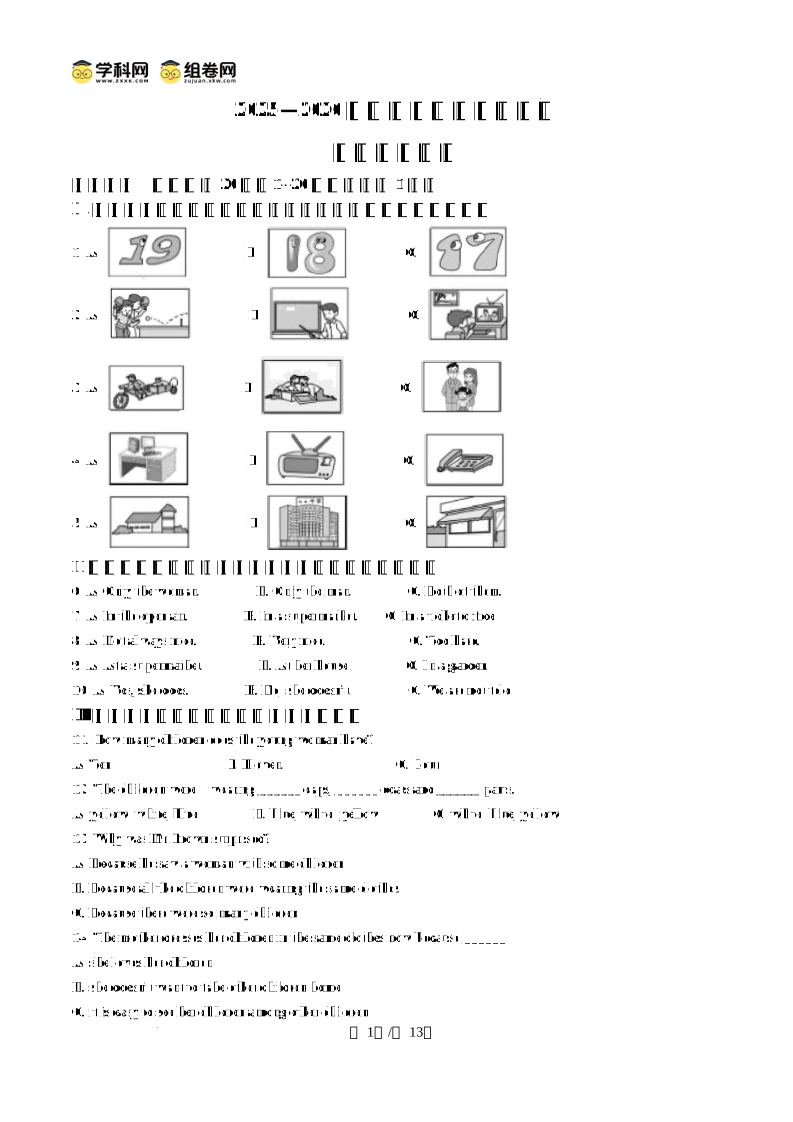
Ⅰ.听句子,选择与所听内容相符的图片。每个句子读一遍。
1. A. B. C.
2. A. B. C.
3. A. B. C.
4. A. B. C.
5. A. B. C.
II.听对话及问题,选择正确答案。每段对话读两遍。
6. A. Only the woman. B. Only the man. C. Both of them.
7. A. In the open air. B. In a supermarket. C. In a ticket office.
8. A. Not always nice. B. Very nice. C. Too hard.
9. A. At a supermarket. B. At her house. C. In a garden.
10. A. Yes, she does. B. No, she doesn’t. C. We are not told.
Ⅲ.听短文,选择正确答案。短文读两遍。
11. How many children does the young woman have?
A. Ten. B. Eleven. C. Four.
12. The children were wearing ______ caps, ______ coats and ______ pants.
A. yellow; white; blue B. blue; white; yellow C. white; blue; yellow
13. Why was Mr Brown surprised?
A. Because he saw a woman with some children.
B. Because all the children were wearing the same clothes.
C. Because there were so many children.
14. The mother dresses her children in the same clothes now because ______.
A. she loves her children
B. she doesn’t want to take other children home
C. it is easy to see her children among other children
15. From the story we know the woman was ______.
A. brave B. clever C. boring
Ⅳ.听短文及问题,选择正确答案。短文读两遍。
16. A. A student. B. The monitor. C. A teacher.
17. A. To have a rest. B. To prepare lessons. C. To look for jobs.
18. A. Seven days. B. Nine days. C. Sixteen days.
19. A. Post letters and borrow books.
B. Use computers and go dancing.
C. Buy school things and have meals.
20. A. The library. B. The post office. C. The computer center.
第二部分 笔试部分(共计90分)
第一节 选择题(共45分)
一.阅读理解(共15小题 每小题2分 共30分)
(A)
In 2017, Lugazo first came to Wuhan from Tanzania. He didn’t know which way to go when he arrived at the Hankou Railway Station. Luckily, a man took him to the university by subway.
Lugazo just arrived in China from Tanzania to study at Central China Normal University. The kind man, he said, was the first “Lei Feng” he met. This thing touched Lugazo. Some months later, he joined the university’s volunteer team.
The next year, he was at the Wuhan Railway Station volunteering. “I couldn’t speak good Chinese at the time. My partner taught me three sentences, ‘Hello! Do you need help? May I carry your luggage for you?’” Lugazo said, “Once, after I helped an elderly woman, her 5-year-old grandson came up to me and said ‘Thank you, Lei Feng!’. That really touched me.” Lugazo always remembers the time when he taught English to children in a village of Yichang in 2021. Many of their parents worked in faraway cities, so the children lived with their grandparents. Lugazo played with the children and became friends with them.
In China, the Lei Feng story is well known. These days, anyone can be named as a “Lei Feng” if they try their best to help others.
1. Which is TRUE about Lugazo in 2017?
①He came to Wuhan for travel.
②He took the subway to the university.
③He came to Wuhan for the first time.
④He went to the university with a policeman.
A. ①② B. ③④ C. ②③ D. ①④
2. What does the underlined word “volunteer” mean in Chinese?
A. 运动员 B. 助教 C. 新生 D. 志愿者
3. Lugazo went to the Wuhan Railway Station ________ the next year.
A. to take a train B. to help people
C. to meet new friends D. to find a 5-year-old boy
(B)
Mei Lanfang (1894—1961) was a great artist of Peking Opera. Mei Lanfang was his stage name. His real name was Mei Lan.
Mei Lanfang was born into a family of Peking Opera performers (演员) in Beijing. Mei began studying Peking Opera at the age of eight and made his first performance on the stage when he was ten years old, playing a girl. Some of his most famous roles were Bai Niangzi, Lin Daiyu, Yuji, and Yang Yuhuan. Mei was one of the greatest singer-actor-dancers in Chinese history.
Mei was the first artist to spread Peking Opera to foreign countries. He toured (在……巡回演出) Japan in 1919, 1924 and 1956, and the United States in 1930. In 1935, Mei toured around Europe. Thanks to his performances, Peking Opera won the hearts of so many foreign people.
In 2000, the story of his life was filmed in a documentary (纪录片). Its name is The World of Mei Lanfang.
4. What might Mei Lanfang’s father do?
A. He might be a teacher. B. He might be a farmer.
C. He might be a worker. D. He might be an opera performer.
5. Mei Lanfang made his first performance on the stage ________.
A. in 1894 B. in 1904 C. in 1919 D. in 1935
6. Which sentence has a similar meaning to the underlined sentence in Paragraph 3?
A. So many foreign people lost interest in Peking Opera.
B. Peking Opera became popular with so many foreign people.
C. Peking Opera won the first prize in a competition which held by many foreign people.
D. A lot of foreign people got crazy for Mei Lanfang.
7. What’s the passage mainly about?
A. A great artist. B. Peking Opera. C. A documentary. D. Mei’s opera tours.
(C)
Different countries have different customs of giving presents.
In China, you must never give a clock to a Chinese person, because the sound of the word “clock” is similar to the sound of the word “death” in Chinese. Also, don’t wrap (包,裹) a present in white, black or blue paper, because they are the colors for funerals (葬礼). Don’t give a knife, because something sharp can cut a friendship.
In Russia, if you give flowers as presents, you have to give an odd number of them (one, three, five, etc.) because even numbers of flowers are for funerals.
In Germany, if you are invited to dinner, flowers are good presents to take to your dinner hostess (女主人), but don’t take her red roses because it means you are in love with her. Don’t take thirteen of anything because it’s an unlucky number. Don’t take an even number of anything, either. Don’t wrap your presents in white, brown, or black paper.
8. According to the passage, ________ must never be given to Chinese people as presents.
A. flowers B. clothes C. food D. clocks
9. People don’t wrap presents in black or white paper in ________.
A. Germany B. China C. both China and Germany D. both China and Russia
10. What presents can you take to your dinner hostess in Germany?
A. Thirteen of something. B. Flowers except red roses.
C. An even number of something. D. Something wrapped in brown paper.
11. Which is the best title of the passage?
A. Foreigners’ presents
B. Giving flowers as presents
C. Different customs of giving presents
D. Don’t give thirteen of anything as presents
(D)
The latest smart phone
The latest smart phone from Huawei, the Mate 60 Pro, does not have 5G written on it. However, some people bought the phone after it came out on Wednesday, and they found its download speed (下载速度) is 500Mbp a second. It is really 5G speed.
A bad drought (旱灾) report
A report showed that 43,000 people lost their lives because of Somalia’s longest dry and hot weather. After three very dry years, many people had to leave their homes and millions of farm animals also lost their lives. This means that people couldn’t get enough food.
Fight against letting nuclear-contaminated water (核污水) run into the sea
Japan planned to let nuclear-contaminated water run into the sea. On Tuesday, many Japanese people went to a meeting. They thought the plan was bad for the environment. “The mountains and rivers will never return to the past, and the radiation (辐射) will not go away easily,” they shouted.
The first snowfall in Johannesburg in 11 years
Children make snowmen and enjoy snowball fights as it snows in the country’s biggest city for the first time since 2012. South Africa is in the southern hemisphere (半球). It is winter there at the moment. Parts of the country do get snow sometimes, but it rarely falls in Johannesburg.
12. Which is TRUE about the Mate 60 Pro?
①It is too expensive. ②It works at 5G speed.
③It sells well in the world. ④Huawei makes the Mate 60 Pro.
A. ①② B. ③④ C. ①③ D. ②④
13. Where did people spend three dry years?
A. In China. B. In Somalia. C. In Japan. D. In South Africa.
14. What does the underlined part in the third news imply (暗示)?
A. There won’t be fish in the sea.
B. There won’t be trees on mountains.
C. The radiation is bad for the environment.
D. The radiation will go away quickly.
15. Both the second news story and the fourth news story have something to do with ________.
A. weather B. science C. history D. school
二.根据短文内容,从短文后的选项中选出能填入空白处的最佳选项。选项中有两项为多余选项。(每小题1分,共5分)
Once upon a time, before Longmen was dug open, the Yi River was blocked by Longmen Mountain, and a large lake was in the other side of the mountain.
The carp (鲤鱼) who lived in the Yellow River wanted to have a visit after knowing that Longmen was beautiful. ____16____, but there was no waterway, so they had to gather together to discuss what to do next. “I have an idea. How about jumping over this Longmen Mountain?” ____17____. “It’s so high. How can you jump?” other car p asked
The big red carp volunteered and said, “I’ll jump first, and give it a try.”
Like a speedy arrow (箭) from a bow, the carp used all its power, swimming from half a mile away, and then jumped high into the sky, trying to get away from the clouds of fire chasing (追赶) from behind. ____18____. To others’ surprise, it finally crossed the Longmen Mountain, fell into the lake in the other side of the mountain.
The other carp in the river were so frightened that they were afraid to take this risk (风险) again.
At this time, a giant dragon suddenly came from the sky and said, “____19____, because I jumped over the mountain successfully, I became a dragon. So you can also jump bravely!”
Hearing these words, the carp were encouraged and began to jump over Longmen Mountain one by one. ____20____. To this day, this black scar still grows on the forehead of the Yellow River carp.
阅读短文,从方框中选出合适的句子补全短文。
A. His tail was burned
B. A big red carp said to others
C. Don’t be afraid! I was your friend, the big red carp
D. They tried their best to reach the foot of Longmen Mountain
E. Those who fell to the ground would have a black scar (疤痕) on their foreheads
F. Don’t do the same thing as me!
G. They only wanted to stay in the river and enjoyed the rest of their lives.
三、完形填空(每小题1分,共10分)
Last summer, I joined an English summer camp in Australia with some of my classmates. It was a ____21____ experience (经历) for me. I not only improved my spoken English, but also made some Australian friends.
We visited McKinnon Primary School. We had some ____22____ and played together with the local students. I learned a lot in class. I ____23____ with them in English. I made some progress (进步) in my spoken English. After lunch, we went outside to play ____24____ like Australian football and basketball.
I ____25____ some Australian friends. They were ____26____ to me. They helped me a lot with my English. They said that they would send emails ____27____ me. They also told me that they were ____28____ China and asked me some____29____ about China. I also asked them some questions about Australia. We had a good time!
My experience in Australia was so great. I’m ____30____ going there again. I’m going to study in Sydney University after graduating (毕业) from my high school.
21. A. boring B. tiring C. difficult D. special
22. A. lessons B. classrooms C. buildings D. schools
23. A. told B. spoke C. said D. wrote
24. A. food B. clothes C. sports D. books
25. A. gave B. used C. made D. put
26. A. strict B. friendly C. noisy D. bad
27. A. on B. in C. for D. to
28. A. careful with B. full of C. busy with D. interested in
29. A. answers B. questions C. problems D. words
30. A. looking forward to B. taking care of C. looking out of D. keeping away from
第二节:非选择题部分(共45分)
一、阅读下面短文,在空白处填入1个适当的单词或括号内单词的正确形式。(每题2分,共20分)
Mr Wu is having a class in Class Five. He is asking students ___31___ (think) about their future life. Different students have different ____32____ (idea).
Zhang Wei thinks people will live in the sea ___33___ fish. Because ___34___ the future, people ___35___ (use) organic silicon (有机硅) to breathe (呼吸) in the sea. And people will build cinemas and schools in the sea a____36____ well. Then they can see doctors and go to school. He thinks life in the sea will be very ____37____ (interest) and comfortable.
Luo Li thinks every family will have a car. And these cars will fly in the sky. People will drive cars to ____38____ (they) offices.
Wang Kai thinks machines like robots will do work for people, ____39____ people will have more free time to enjoy life. He thinks people will have short winter holidays ____40____ long summer holidays, because the summer will be very long.
二、根据短文内容,用符合语意及语法规则的词填空。(每空1分,共10分)
In Chinese culture, people believe that lucky numbers can bring them good luck. So, it is important for Chinese people to use a good number for important things.
The numbers 6, 8, and 9 are the favorite lucky numbers of most Chinese people. Combinations(结合) of the above are thought of as lucky numbers too, such as 66,88, 168. However, of all the individual numbers, 8 is believed to be the luckiest number in China.
There are many phrases or idioms with “8” in Chinese. They have “Bafang laicai”, meaning (意思) “wealth (财富) comes in from all corners of the world”. They have “Bamian laifeng”, meaning “the wind comes from eight sides”. They use those words to show the wish that they get good luck wherever they go, or whatever they are working on.
Chinese people would like to choose “8” as the time and date of important events. For example, the opening celebration of the 2008 Beijing Olympic Games started exactly at 8 minutes and 8 seconds past 8 pm on the 8th of August 2008.
Chinese people’s love for 8 can be seen in many other cases (情况), such as house numbers, phone numbers, number plates, wedding dates, and the date for opening a store. 8 is popular with Chinese people because it has meaning in both traditional and modern cultures.
阅读以上信息,用恰当的单词完成下面的表格,每空一词。
Lucky numbers
Chinese culture
Chinese people think lucky numbers can ____41____ them good luck.
Chinese people ____42____ good numbers for their important things.
6, 8 and 9 are ____43____ with most Chinese people.
Of all the numbers, Chinese people like “8” ____44____.
Words with luck number(s)
There ____45____ some Chinese words with “8”.
“Bafang laicai” means “making ____46____ from eight sides”.
“Bamian laifeng” means “the wind ____47____ from eight directions”
When to use lucky numbers
Chinese people use “8” for important events like the opening date of the ____48____ meeting in 2008.
Chinese people hope there is “8” ____49____ their phone numbers.
“8” has an important meaning in their culture, so Chinese people ____50____ it very much.
三、书面表达(满分15分)
51. Tony今年18岁,爱好旅游。今年五一,他和朋友打算一起去海南游玩两天。根据表格中提供的信息,再适当增加想象,加以拓展,使 Tony的这次海南之行更生动。
Tony的海南之行
May 1st
游览三亚(Sanya),拍照……
May 2nd
上午
去海边,在海滩上打排球……
下午
去海里游泳……
晚上
去吃海鲜,购物,10:00 pm坐飞机回家
要求:
意思连贯,符合逻辑,注意时态。
可在方框内信息基础上有所扩展。
不少于90个词。
开头已给出,不计入总数。
提示词: play volleyball, seafood
Tony is 18 years old this year. He likes travelling very much. May Day is coming...
____________________________________________________________________________________________________________________________________________________________________________________________________________________________________________________________________________________________________________________________________________________________________________________________________________________________________________________________________________________________________________________________________________________________________________
2025—2026学年度下学期期中测试
初二英语试题
第一部分 听力(共20分,1--20题,每小题1分)
Ⅰ.听句子,选择与所听内容相符的图片。每个句子读一遍。
1. A. B. C.
2. A. B. C.
3. A. B. C.
4. A. B. C.
5. A. B. C.
II.听对话及问题,选择正确答案。每段对话读两遍。
6. A. Only the woman. B. Only the man. C. Both of them.
7. A. In the open air. B. In a supermarket. C. In a ticket office.
8. A. Not always nice. B. Very nice. C. Too hard.
9. A. At a supermarket. B. At her house. C. In a garden.
10. A. Yes, she does. B. No, she doesn’t. C. We are not told.
Ⅲ.听短文,选择正确答案。短文读两遍。
11. How many children does the young woman have?
A. Ten. B. Eleven. C. Four.
12. The children were wearing ______ caps, ______ coats and ______ pants.
A. yellow; white; blue B. blue; white; yellow C. white; blue; yellow
13. Why was Mr Brown surprised?
A. Because he saw a woman with some children.
B. Because all the children were wearing the same clothes.
C. Because there were so many children.
14. The mother dresses her children in the same clothes now because ______.
A. she loves her children
B. she doesn’t want to take other children home
C. it is easy to see her children among other children
15. From the story we know the woman was ______.
A. brave B. clever C. boring
Ⅳ.听短文及问题,选择正确答案。短文读两遍。
16. A. A student. B. The monitor. C. A teacher.
17. A. To have a rest. B. To prepare lessons. C. To look for jobs.
18. A. Seven days. B. Nine days. C. Sixteen days.
19. A. Post letters and borrow books.
B. Use computers and go dancing.
C. Buy school things and have meals.
20. A. The library. B. The post office. C. The computer center.
第二部分 笔试部分(共计90分)
第一节 选择题(共45分)
一.阅读理解(共15小题 每小题2分 共30分)
(A)
【1~3题答案】
【答案】1. C 2. D 3. B
(B)
【4~7题答案】
【答案】4. D 5. B 6. B 7. A
(C)
【8~11题答案】
【答案】8. D 9. C 10. B 11. C
(D)
【12~15题答案】
【答案】12. D 13. B 14. C 15. A
二.根据短文内容,从短文后的选项中选出能填入空白处的最佳选项。选项中有两项为多余选项。(每小题1分,共5分)
【16~20题答案】
【答案】16. D 17. B 18. A 19. C 20. E
三、完形填空(每小题1分,共10分)
【21~30题答案】
【答案】21. D 22. A 23. B 24. C 25. C 26. B 27. D 28. D 29. B 30. A
第二节:非选择题部分(共45分)
一、阅读下面短文,在空白处填入1个适当的单词或括号内单词的正确形式。(每题2分,共20分)
【31~40题答案】
【答案】31. to think
32. ideas 33. like
34. in 35. will use
36. as##s 37. interesting
38. their 39. so
40. but
二、根据短文内容,用符合语意及语法规则的词填空。(每空1分,共10分)
【41~50题答案】
【答案】41. bring
42. use 43. popular
44. best 45. are
46. money 47. comes
48. Olympic
49. in 50. like##love
三、书面表达(满分15分)
【51题答案】
【答案】
Tony is 18 years old this year. He likes travelling very much. May Day is coming, he and his friends are planning a two-day trip to Hainan. On May 1st, they will visit Sanya and take many photos of the beautiful beaches and blue sky. They will also enjoy the warm sunshine there. On May 2nd, in the morning, they will go to the beach and play volleyball happily on the sand. In the afternoon, they will swim in the clear sea to cool off. In the evening, they will try fresh seafood and buy some souvenirs. Finally, at 10:00 pm, they will take a plane back home. Tony thinks this journey will be exciting and unforgettable.
第1页/共1页
学科网(北京)股份有限公司
$
资源预览图
1
2
3
相关资源
由于学科网是一个信息分享及获取的平台,不确保部分用户上传资料的 来源及知识产权归属。如您发现相关资料侵犯您的合法权益,请联系学科网,我们核实后将及时进行处理。