2026年重庆一中初2026届初三下期第二次模拟测试英语试题卷
 切换试卷
切换试卷
2026-05-23
|
15页
|
88人阅读
|
0人下载
资源信息
| 学段 | 初中 |
|---|---|
| 学科 | 英语 |
| 教材版本 | - |
| 年级 | 九年级 |
| 章节 | - |
| 类型 | 试卷 |
| 知识点 | - |
| 使用场景 | 中考复习-二模 |
| 学年 | 2026-2027 |
| 地区(省份) | 重庆市 |
| 地区(市) | - |
| 地区(区县) | - |
| 文件格式 | DOCX |
| 文件大小 | 1.79 MB |
| 发布时间 | 2026-05-23 |
| 更新时间 | 2026-05-23 |
| 作者 | 匿名 |
| 品牌系列 | - |
| 审核时间 | 2026-05-23 |
| 下载链接 | https://m.zxxk.com/soft/58008313.html |
| 价格 | 1.00储值(1储值=1元) |
| 来源 | 学科网 |
内容正文:
【机密】2026年5月23日11:00前
2026年重庆一中初2026届初三下期第二次模拟测试
英语试题卷
(全卷共九个大题,满分:150分,考试时间:120分钟)
第Ⅰ卷(共100分)
Ⅰ.听力测试。(共35分)
第一节(每小题1分,共6分)
听两遍。根据你所听到的句子,从A、B、C三个选项中选出最恰当的答语,并把答题卡上对应题目的答案标号涂黑。
1. A. Pretty good. B. Not at all. C. You, too.
2. A. Sorry, I won’t. B. OK, I will. C. Here you are.
3. A. Of course not. B. Yes, I do. C. That sounds great.
4. A. Saturday. B. May, 23rd. C. Sunny.
5. A. What a pity! B. Have a good time. C. Good luck.
6. A. I don’t think so. B. It’s cool. C. They’re perfect.
第二节(每小题1. 5分,共9分)
听两遍。根据你所听到的对话和问题,从A、B、C三个选项中选出正确答案,并把答题卡上对应题目的答案标号涂黑。
7. A. /ə'bʌv/. B. /ə'brɔ:d/. C. /ə'raɪv/.
8. A. Go to the school concert.
B. Stay at home and review.
C. Go out with friends.
9. A. A comedy. B. A war film. C. A scary movie.
10. A. Teacher and student. B. Brother and sister. C. Mother and son.
11. A. B. C.
12. A. 35. B. 65. C. 100.
第三节(每小题1. 5分,共6分)
听两遍。根据你所听到的长对话,从A、B、C三个选项中选出正确答案,并把答题卡上对应题目的答案标号涂黑。
听第一段材料,回答第13和14小题。
13. What is wrong with the boy’s earphones?
A. They don’t work. B. They are too old. C. They are too expensive.
14. What will the boy probably do next?
A. Get the earphones repaired.
B. Buy a new pair.
C. Ask his friend for help.
听第二段材料,回答第15和16小题。
15. What time will the bus leave?
A. At 7:30. B. At 7:50. C. At 8:00.
16. Who will probably be late for the school trip?
A. Tom. B. Ben. C. Peter.
第四节(每小题1.5分,共6分)
听两遍。根据你所听到的短文内容,从A、B、C三个选项中选出正确答案,并把答题卡上对应题目的答案标号涂黑。
17. What did the driver do again and again?
A. He gave speeches. B. He listened to the speech. C. He wrote speeches.
18. Where did Einstein sit during the speech?
A. On the stage. B. At home. C. In the crowd.
19. How did people feel after Einstein answered the question?
A. Shocked. B. Happy. C. Angry.
20. Why didn’t the driver answer the question himself?
A. Because the question was too difficult for him.
B. Because he didn’t hear the question clearly.
C. Because he thought the student was impolite.
第五节(每小题2分,共8分)
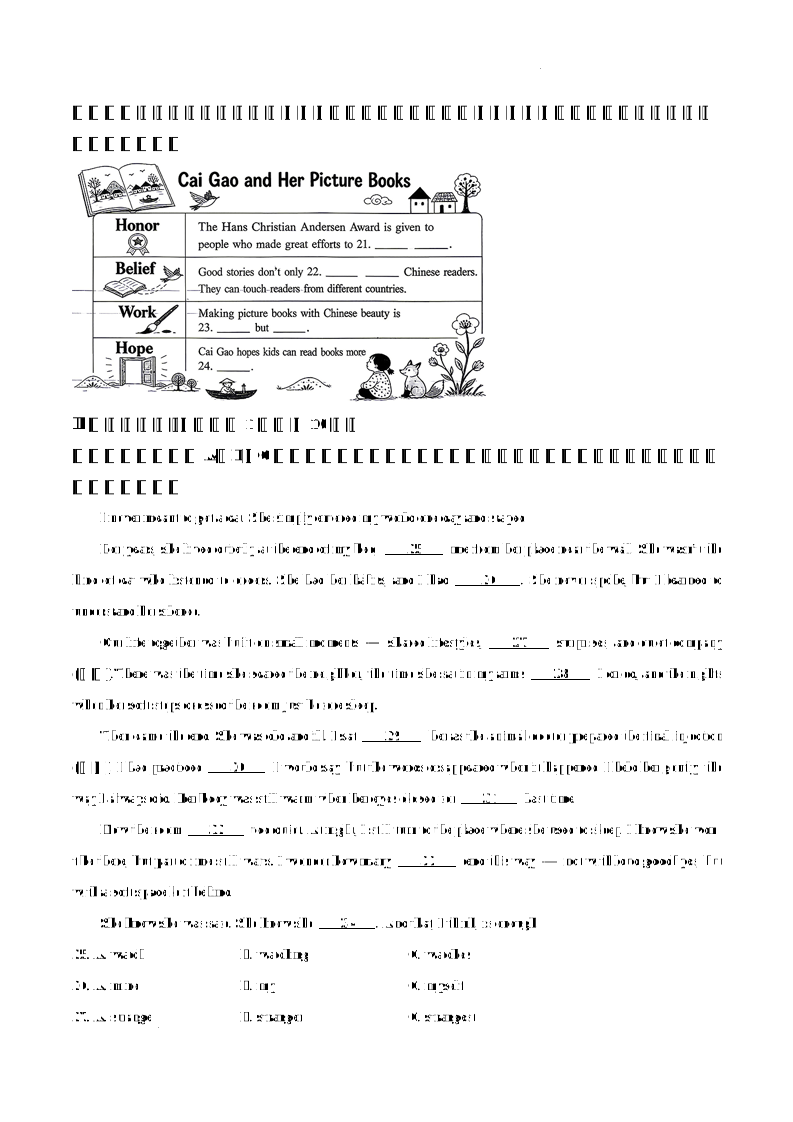
听两遍。根据你所听到的广播内容,在横线处补全笔记,每空一词,并把答案填写在答题卡上对应的位置。
Ⅱ.语法选择。(每小题1分,共10分)
根据短文内容,从A、B、C三个选项中选出一个语法正确的答案,并把答题卡上对应题目的答案标号涂黑。
I never meant to get a cat. She simply entered my world one day and stayed.
For years, she lived quietly at the end of my bed, 25 me from her place near the wall. She wasn’t the kind of cat who listened to orders. She had her habits, and I had 26 . She never spoke, but I learned to understand her silence.
Our life together was built on small moments — shared lifestyles, 27 surprises, and quiet company (陪伴).There was the time she scared the neighbor, the time she sat in my arms 28 I cried, and the nights when her soft steps crossed the room just before sleep.
Then came the end. She was old and ill. I sat 29 her as the animal doctor prepared the final injection (注射). I had practiced 30 I would say, but the words disappeared when it happened. I held her gently, the way I always did. Her body was still warm when her eyes closed for 31 last time.
Now the room 32 too quiet. At night, I still turn to the place where she used to sleep. I know she won’t be there, but part of me still waits. I wonder how many 33 end this way — not with loud goodbyes, but with a soft space left behind.
She knew she was safe. She knew she 34 . And that, I think, is enough.
25. A. watch B. watching C. watches
26. A. mine B. my C. myself
27. A. strange B. stranger C. strangest
28. A. as B. so C. though
29. A. through B. beside C. on
30. A. which B. what C. whether
31. A. an B. a C. the
32. A. felt B. feel C. feels
33. A. story B. stories C. story’s
34. A. loves B. is loved C. was loved
Ⅲ.完形填空。(每小题1.5分,共15分)
根据短文内容,从A、B、C、D四个选项中选出一个能填入相应空格的最佳答案,并把答题卡上对应题目的答案标号涂黑。
The elevator was broken. So even though it was a cool autumn afternoon, I was sweating (出汗) all over after I climbed up to my seventh-floor apartment. As soon as I got inside, I headed straight for the fridge and took out a bottle of iced 35 .
Just then, Mom came out of the bedroom. “It’s not that hot today!” she said. “Don’t drink something too cold. Let me pour you some hot water.”
“But I’m sweating all over!” I argued.
“You 36 sweat! I’m afraid your liver (肝) fire is too high.”
Mom’s opinion — “high liver fire” — reminded me of a popular video. The mother in the video always pushed her son to drink sponge gourd (丝瓜) soup 37 she thought it was good for his health. When the son refused, she complained that his-liver fire-must be too high. She finally asked her son to have some sponge gourd soup to help 38 the heat.
Unsurprisingly, the video quickly drew much attention. After all, who hasn’t 39 these “for your own good” lines such as “Drink more hot water”, “Wear your warm coats”, and “Use your phone 40 ”?
But as other people point out, these words stand for our parents’ love for us. Many of them hope to take good care of us, but often find 41 unable to understand our daily habits. My mom, for example, once 42 my weight-loss diet for eating almost nothing.
Perhaps we should try to be 43 for our parents’ “liver-fire” love. But when my “liver fire” runs high, I’d still rather drink some iced juice. Next time, though, I’ll make sure to enjoy it 44 .
35. A. soup B. milk C. juice D. tea
36. A. never B. always C. hardly D. sometimes
37. A. if B. though C. unless D. because
38. A. reduce B. increase C. win D. leave
39. A. heard from B. looked after C. heard of D. looked through
40. A. less B. more C. harder D. faster
41. A. ourselves B. themselves C. herself D. yourself
42. A. changed B. called C. decided D. mistook
43. A. ready B. thankful C. fit D. sorry
44. A. in excitement B. in surprise C. in secret D. in public
Ⅳ.阅读理解。(每小题2分,共30分)
阅读下列材料,从A、B、C、D四个选项中选出最佳答案,并把答题卡上对应题目的答案标号涂黑。
A
Before flying a drone, read these instructions carefully. Follow each step and choose a safe place. This will help you use it correctly and avoid danger.
Follow these steps before flying:
① Turn on the controller.
② Connect the controller to the drone.
③ Check the battery level. Make sure it is full.
④ Choose an open place.
⑤ Press the button to take off.
⑥ Use the control sticks carefully to move the drone.
Page 1
√ in a park with few people
√ in an open field
√ in the countryside
√ on a big playground
√ …
× near people or crowds
× on busy streets
× near tall buildings
× in windy areas
× in rainy areas
× …
Always check the place and the weather before flying. Use your drone carefully and put safety first.
Page 2
45. Which of the following is the third step before flying a drone?
A. Turn on the controller. B. Connect the controller to the drone.
C. Check the battery level. D. Choose an open place.
46. Where can people fly a drone safely?
A. B. C. D.
47. What is the writer’s main purpose of writing the passage?
A. To introduce different kinds of drones. B. To tell people how to use drones safely.
C. To invite people to join a drone club. D. To explain why people like flying drones.
B
Have you ever seen this? The rotating (旋转的) lantern, known as Zou Ma Deng, is a traditional Chinese invention. It gets the name from the moving shadows (影子) of the horses on it. But how can they move? Some interesting physical rules lie behind this.
However, this simple but clever design is not just a lantern: it pushes technology forward. Gas turbines (涡轮机), for example, work in the same way: heat drives air, and then it produces electricity to power modern machines. Just like this, the wisdom of the ancient people has traveled through time and space, and quietly changed the modern world.
From Zou Ma Deng to gas turbines, from fireworks to space rockets, and from compasses to e-maps…, these folk inventions have grown into forces to drive our world. And human creativity, like Zou Ma Deng, is a light that will never go out.
48. What is the correct order of how the rotating lantern works?
① The candle warms the air. ② The paper cut-outs move around.
③ The central axis turns around. ④ Hot air pushes the fan wheel.
A. ① → ④ → ③ → ② B. ② → ① → ④ → ③
C. ① → ③ → ② → ④ D. ④ → ① → ③ → ②
49. Which sentence uses “mount” the same meaning as the underlined word?
mount /maʊnt/ v. ①骑上 ②组织;发起 ③安装;固定 ④增加;上升
A. ▶ The noise outside kept mounting as more people arrived.
B. ▶ A show was mounted for the Ancient Chinese Art Festival.
C. ▶ The girl mounted her horse and rode away before sunrise.
D. ▶ Wendy’s family photo was mounted on the bedroom wall.
50. What do the rotating lantern and the gas turbine have in common?
A. They were both invented in ancient China. B. They both depend on the moving air.
C. They are both used to drive modern machines. D. They both use candles to create heat.
51. What is the best title for the passage?
A. Modern Science: The Development of Gas Turbines
B. Physical Rules: The Secret Behind Hot Air and Lantern
C. Human Wisdom: From Old Inventions to Modern Technology
D. A Great Invention: Special Ways to Make a Zou Ma Deng
C
(Victor, a young scientist with a big dream, was crazy about creating life. His hope was exciting, but soon led to regret and a sad ending...)
Chapter One
At university, I shut my door against the world. Letters from home lay unanswered. Friends knocked and finally stopped. Days became nights.
To make a living creature (生物), I had chosen body parts that I thought beautiful, and I imagined life would rise like sunshine: clean, golden, and bright. . In this way I began my dream work that would finally shape my painful life.
Then, on a dark and stormy night, its breath started. A hand lifted,fingers moving as if testing the air. Its eyes opened, ugly and yellow, the lips dark, and the parts I had chosen for beauty turned out to be awful.
My blood froze. I stepped back, unable to breathe.
It was a monster(怪物), made from death! Without any hesitation (犹豫), I left it in darkness. But what I didn’t expect was that I left myself in an even darker place.
(…)
Chapter Nine
I do not remember much about the beginning of my life. I saw, felt, heard and smelt all at the same time. But I do remember the moment Victor flee (逃离) from me, leaving me with my first lesson: I was alone.
I got out of that university and just walked through the forest. The cold cut through my skin, and hunger clawed (抓) at my stomach. I tried to go near humans like a lost child, but only to get cries and hatred (厌恶).
“Go away! Ugly monster!”
“I will kill you if you dare to come closer!”
“…”
I tried to give a hand to the people in need. I tried to be kind and gentle.
But stones and sticks met me before a hand of welcome ever did. Even when I did help a child once, ▲
Day after day, I stopped trying to be understood and chose to make my pain seen. In time, I killed, and each death made my sadness deeper and my hatred harder. Something good and clean inside me disappeared, and I had learned the final lesson: when the world only sees you as a monster, it makes you one.
— Adapted from Frankenstein
Here is the information form of the two chapters. Which can be put in No.52 and No.53?
Chapter One
Chapter Nine
The Narrative (叙事角度)
Victor
52
Details & Emotions
① Letters from ... became nights. → Focused
② I imagined life… bright. → Hopeful
③ I stepped back, unable to breathe. → 53
① But I do remember … alone. → Lone
② I tried to go near ... hatred. → Hurt
③ I killed ... my hatred deeper. → Hate
52. A. Victor B. The child C. The creature D. A friend
53. A. Angry B. Excited C. Scared D. Proud
54. Which of the following is the best to put in ▲ ?
A. I killed the child because he strongly refused my help.
B. he smiled at me and invited me to have dinner together.
C. his parents looked at me and thanked me with flowers.
D. thankfulness disappeared the moment he saw my face.
55. What can we learn from the two chapters?
A. Humans shouldn’t get too close to monsters. B. People’s coldness may change one’s nature.
C. We can never depend too much on science. D. Monsters or bad people are born, not made.
D
① Sitting through a family dinner, your uncle suddenly starts talking about different topics like an expert. But everything he knows is from TikTok. After exams, one classmate is sure to do well. But he ends up with far lower marks than expected. Sounds familiar? This kind of behavior is called the Dunning Kruger effect.
② In 1995, a man named Wheeler robbed a bank with lemon juice on his body. He believed it would make him not be seen. This story inspired two psychologists (心理学家) David Dunning and Justin Kruger to take some experiments. They asked people to tell how well they did in certain tasks. The results showed people with poor skills often thought they did much better than they actually did. They failed to see their own shortcomings, which made them too confident.
③ Later, people used a simple graph (图表) to show this effect. It clearly tells us the link between our actual knowledge and our self-confidence. When we know very little about something, our confidence gets to a quite high point. We may even believe we know everything. Digging deeper, we begin to realize how difficult the topic truly is, and our confidence drops. At this point, we start questioning ourselves. Only when we keep learning can our ability and confidence rise in a healthy way.
④ This is not just a psychological phenomenon (现象) for strangers or uncles at dinner — it is a mistake that everyone may easily fall into. Have you ever laughed at your classmates’ mistakes without realizing your own? Have you ever turned a deaf ear to others’ advice because you thought you knew better? Have you ever felt fully prepared, only to be shocked by the final result? If so, you are having it too.
⑤ Dear graduates of 2026, as you are stepping into senior high and then a wider world, remember that real growth lies in the courage to be modest (谦虚). Always remember to learn, feel, and listen, and you will surely shine brighter in the years ahead.
56. Which sentence might be said by the uncle in Paragraph ①?
A. “I’m not sure. You’d better go and ask a teacher about this.”
B. “Oranges are good for skin? Let’s check more articles.”
C. “This accident has many causes. I may not know the truth.”
D. “This war would end fast if they just listened to me.”
57. What do the experiments by Dunning and Kruger show?
A. Most people can see their shortcomings, more or less.
B. Less skilled people often think highly of themselves.
C. A person can tell how well he or she finishes a task.
D. Lemon juice doesn’t work for hiding people’s bodies.
58. Who is most likely to be at Point D in the graph?
A. A student who is beating self-doubt step by step with hard work.
B. A person who feels super confident after taking the first driving lesson.
C. A math teacher who feels very lost in the beginning of his teaching.
D. An experienced doctor who keeps learning for many years at work.
59. Which of the following can be put in the third box of the structure?
A. Listing more results B. Sharing scientific facts
C. Connecting with readers D. Discussing different ideas
Ⅴ.口语运用。(每小题2分,共10分)
阅读下面对话,从方框内7个选项中选择5个恰当的句子完成此对话,并把答题卡上对应题目的答案标号涂黑。
(A reporter is interviewing a student about the law on the return of cultural relics《文物归还法案》.)
R: Hello. I’m from the school newspaper. We’re doing a report on cultural relics. 60
S: Yes. France has made a new rule about returning them.
R: 61
S: Because many cultural relics were taken away during wars.
R: I see. But returning them may not be easy.
S: You’re right. 62
R: So, it may take a long time.
S: Yes. And it is not only about bringing things home.
R: 63
S: I mean, each relic carries history and culture.
R: I agree. 64
S: We can learn to respect history and protect cultural things.
A. It sounds interesting.
B. What do you mean by that?
C. Have you heard about the new rule in France?
D. When did the rule start?
E. It may be hard to find out where they came from.
F. What do you think we can learn from this?
G. Why does France want to do that?
第Ⅱ卷(共50分)
Ⅵ.任务型阅读。(65-66小题,每小题2分,67-68小题,每小题3分,共10分)
阅读下文并回答问题。
When AI brings unprecedented (前所未有的) convenience, what makes humanity valuable? A Chinese teacher collected 54 answers from her students, posing a single question in class: “Prove (证明) you’re not an AI with one word. What would you choose?” .The following are three of their responses.
Lacey: My dad had been ill for weeks. Some of those days I was overcome with fear, and some with worrying thoughts. Yet I still held his hand and kept believing that tomorrow might be better because the love of family never gives up easily. Experiences like this make me understand: AI can offer answers to almost everything, but everything I felt in my hope stays only in humans like me.
Winslet: Since primary school, I always considered my classmates smarter than me. I remember the slow and painful progress. But those experiences taught me to accept my “stupidity” and turn it into a push to try harder. AI can work quickly, but it will never understand the struggle (挣扎), the joy, the upset and the quiet pride of growing from my own “stupidity”.
Chris: On my walk home, I always slow down for sunsets, flowers, and stray (流浪) cats. I still remember the nervousness while waiting for the exam result, and the feeling of being excited and worried when waiting for the girl I care about. AI can have all the data (数据) on earth but not those real moments of life. And all the ups and downs I had in my heart always remind me of the beauty of being a human.
Soon, this class went popular online and received many different answers, each of which was surprising and heartfelt. And those answers together show us the differences between humans and AI.
65. Did Lacey’s family members give up on his dad easily?
__________________________________________________________________________________________
66. How does Chris feel about waiting for the girl he cares about?
__________________________________________________________________________________________
67. According to the answers, what are the differences between humans and AI?
__________________________________________________________________________________________
68. Which word would you choose to prove you are not AI? Share your answer like the three above.(about 30 words)
____________________________________________________________________________________________________________________________________________________________________________________________________________________________________________________________________________________
Ⅶ.完成句子。(69-71小题,73小题每空1分,72小题2分,共10分)阅读短文,根据方框中的内容和各小题的提示,完成句子。
▶ The road is smooth.
▶ The rider will often meet many problems on the way.
▶ 即使你摔下车,你也要爬起来继续前行。
▶ make, hard, strong, you, confident, roads, and
▶ You should face the challenges bravely.
Check out the two pictures above. Many people think their “plan” is a smooth road to success. However, the road 69. ______ ______. (否定句) In fact, “God’s plan” is full of ups and downs.70. ______ ______ the rider often meet on the way? (对划线部分提问) Many problems, of course. It’s because life is filled with unexpected changes. So remember, even though you 71. ______ ______ the bike, you should get back up and keep going. (完成译句) Because you will find out that 72. ____________. (连词成句) 73. ______ ______ face the challenges bravely? (一般疑问句) I think you have the answer now.
Ⅷ.概要补全。(74和76小题,每小题2分;75和77小题,每小题3分,共10分)
阅读文章,用恰当的短语或句子补全概要。补全部分总词数不超过30词,不能照抄原文连续超过3个词。
When you read comic (漫画) books, have you noticed that villains (反派) often share two clear things in common? For one thing, they hurt others or break laws to get what they want. For another, they are painted green or purple by comic artists, like the classic bad characters Joker and Loki. These colors help readers tell heroes and villains apart right away. So what influenced the choice of the two colors?
Let’s look into the history and culture first. In Shakespeare’s play Othello, envy (嫉妒) is famously described as a “green-eyed monster”, and this is where the common expression “green with envy” comes from. Even earlier, people connected green with sickness. Ancient Greeks believed too much bile (胆汁) could make a sick person look green. This idea makes green perfect for a villain who is sick in mind. We can also find green used in many other similar situations to show villains’ bad personalities. Gradually, it has developed deeper meanings more than just a simple color.
Purple sends a different message. For centuries, purple coloring was very hard to produce, which makes it unusual and expensive. Only powerful people could afford it. In ancient Rome, purple was worn by rulers. In England, Queen Elizabeth I only let close relatives wear purple. So when villains wear purple, it suggests that they want to be powerful and respected.
Next, let’s look at color theory (理论). Red, yellow and blue are primary colors. When two of them are mixed, they make secondary colors like green and purple. Most superheroes wear bright primary colors. Comic artists use green and purple for villains, making these characters seem “secondary”. This way, readers can easily tell heroes from villains just by their colors.
In short, the use of green and purple for comic book villains is not by accident. These colors help show villains’ bad personalities and power, making characters clearer and the stories easier to read.
Different colors separate comic characters. Comic artists 74 . These two colors help readers tell the difference between heroes and them. Green 75 which are often seen in villains. Villains wear purple to show their wish for 76 . Primary and secondary colors create clear differences for easier reading. In short, the choice of the two colors is influenced by 77 .
Ⅸ.书面表达。(满分20分)
下个月,来自加拿大的访学团将来到我校。他们将了解中国学生的校园生活,近距离感受中国传统文化的魅力。作为学生代表,你将在交流活动中进行发言。请你从以下三种中国传统手工艺品中选择一种来制作,并写一篇英文演讲稿。
写作要点:
①阐述该工艺品的制作过程;
②描述该工艺品的设计(形状、图案等)和寓意;
③表达对访学团同学的欢迎或祝福。
要求:
1.80-120词,开头已给出,不计入总词数;
2.文中不能出现自己的姓名和所在学校的名称。
Hello everyone! I’m really glad to introduce this traditional Chinese handcraft to you. __________________
____________________________________________________________________________________________________________________________________________________________________________________________________________________________________________________________________________________
Thank you for listening. I sincerely hope we will be good friends from now on.
学科网(北京)股份有限公司
$
资源预览图

1
2
3
相关资源
由于学科网是一个信息分享及获取的平台,不确保部分用户上传资料的 来源及知识产权归属。如您发现相关资料侵犯您的合法权益,请联系学科网,我们核实后将及时进行处理。