河南省周口市郸城县第二实验中学2025-2026学年八年级下学期英语综合素养调研
 切换试卷
切换试卷
2026-05-23
|
14页
|
6人阅读
|
0人下载
资源信息
| 学段 | 初中 |
|---|---|
| 学科 | 英语 |
| 教材版本 | - |
| 年级 | 八年级 |
| 章节 | - |
| 类型 | 试卷 |
| 知识点 | - |
| 使用场景 | 同步教学-阶段检测 |
| 学年 | 2026-2027 |
| 地区(省份) | 河南省 |
| 地区(市) | 周口市 |
| 地区(区县) | 郸城县 |
| 文件格式 | DOCX |
| 文件大小 | 1.26 MB |
| 发布时间 | 2026-05-23 |
| 更新时间 | 2026-05-23 |
| 作者 | 匿名 |
| 品牌系列 | - |
| 审核时间 | 2026-05-23 |
| 下载链接 | https://m.zxxk.com/soft/58004653.html |
| 价格 | 1.00储值(1储值=1元) |
| 来源 | 学科网 |
内容正文:
郸城县第二实验中学八年级英语综合素养调研
出题人:王思宇 审核人:王雪莲
注意事项:
1.本试卷共6页,六个大题,满分120分,考试时间100分钟。
2.请按要求把答案填写在试卷或答题卡上。
一、听力理解(20小题,每小题1分,共20分)
第一节 听下面5段对话。每段对话后有一个小题,从题中所给的A、B、C三个选项中选出最佳答案。每段对话读两遍。
1.When will they get home?
A. At 12:05. B. At 12:10. C. At 12:15.
2. What may the woman be doing?
A. Talking with her mouth full.
B. Putting food into the boy’s bowl.
C. Hitting the bowl with chopsticks.
3. Whose model car is this?
A. Jim’s. B. Jessica’s. C. The boy’s.
4. What did the lady just talk about?
A. The weather. B. The time. C. The rules.
5. What did Dale do today?
A. He ate snacks in class. B. He made noises in class. C. He was late for class.
第二节 听下面几段对话或独白。每段对话或独白后有几个小题,从题中所给的A、B、C三个选项中选出最佳答案。每段对话或独白读两遍。
听下面一段对话,回答第6至第7两个小题。
6. How does Carolyn like the party last night?
A. Boring. B. Interesting. C. Wonderful
7. What did Carolyn and her new friends share with one another?
A. Their eating habits. B. Their table manners. C. Their languages
听下面一段对话,回答第8至第9两个小题。
8. How does Jack advise the girl to greet others in Canada?
A. By hugging them. B. By shaking hands with them. C. By saying hello and smiling.
9. What question should the girl avoid asking?
A. Her classmates’ age. B. Her classmates’ hobbies. C. Her classmates’ favourite food.
听下面一段独白,回答第10至第12三个小题。
10. Why did Daniel feel sorry?
A. He made some mistakes. B. He didn’t like the food. C. He got lost.
11.When did Daniel arrive at Li Hua’s home?
A. At 5:40pm. B. At 6:00 pm. C. At 6:20pm.
12. What does Daniel mean in the end?
A. The early bird catches the worm.
B. When in Rome, do as the Romans do.
C. Don’t put all your eggs in one basket.
听下面一段对话,回答第13至第15三个小题。
13.Where does Amy come from?
A. The UK. B. The US. C. Canada.
14.What is Amy interested in?
A. Chinese food. B. Chinese culture. C. Chinese history.
15.What does Amy think of her host family?
A. Kind. B. Polite. C. Hospitable.
第三节 你将听到一则活动通知。请用你所听到的内容填写表格中所缺单词,每空限填一词。短文读两遍。
The dinner at Mrs Brown’s house
Greeting
I 16. ________ her when I arrived at her house.
Before dinner
She put beautiful bowls and 17. ________ on the table.
At dinner
She shared her travelling experiences in China and we had a(n) 18. ________ about manners in different countries.
After dinner
◆She played the violin and I really enjoyed the music.
◆We sang 19. ________ songs together.
My feeling
I was 20. ________ to be invited and had a wonderful time.
二、阅读理解(20小题,每小题2分,共40分)
阅读下面四篇语言材料,然后按文后要求做题。
A
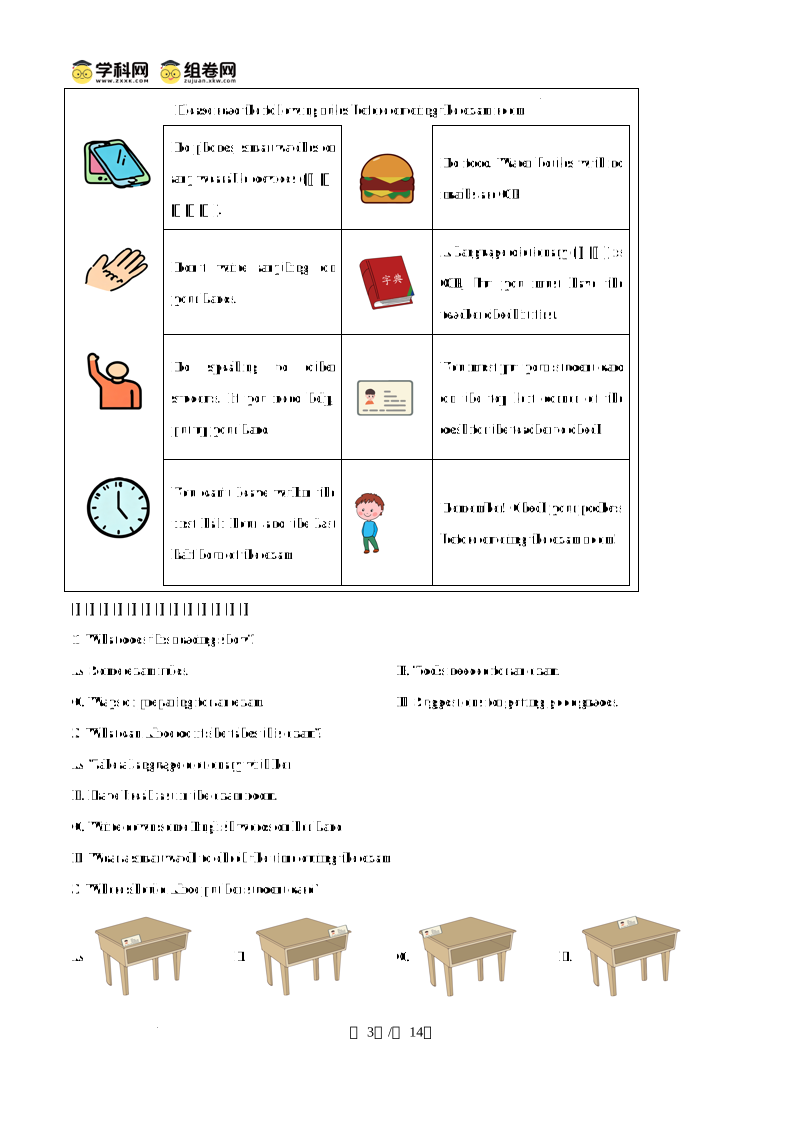
Please read the following rules before entering the exam room.
No phones, smartwatches or any wearable devices (可穿戴设备).
No food. Water bottles with no marks are OK.
Don’t write anything on your hands.
A language dictionary (字典) is OK, but you must have the teacher check it first.
No speaking to other students. If you need help, put up your hand.
You must put your student card on the top left corner of the desk for the teacher to check.
You can’t leave within the first half hour and the last half hour of the exam.
Remember! Check your pockets before entering the exam room!
根据材料内容选择最佳答案。
1. What does this reading show?
A. Some exam rules. B. Tools needed for an exam.
C. Ways of preparing for an exam. D. Suggestions for getting good grades.
2. What can Alice do if she takes this exam?
A. Take a language dictionary with her.
B. Have breakfast in the exam room.
C. Write down some English words on her hand.
D. Wear a smartwatch to check the time during the exam.
3. Where should Alice put her student card?
A. B. C. D.
4. When can Alice leave in an 8:00-10:00 exam?
A. At 8:25. B. At 9:05. C. At 9:35. D. At 9:55.
5. Where can we find this reading?
A. In a storybook. B. In the test paper. C. In the exam guide. D. In a science magazine.
B
①It was my first day as an English teacher at a Chinese school. The hot weather was very different from that in the UK.I asked a teacher where I could get water. She kindly led me to a machine. As I pressed the button, I felt the warm water fill my bottle. Confused(困惑的), I looked at her and said, “Sorry, I meant the cold water.” She smiled and said, “We only have hot water here.” This was my first experience of culture shock(冲击).
②Culture shock happens when you move to a new country. However, no one talked about the “reverse(反向的)culture shock” to me.
③I stayed in China for three years. During my time in China, I got used to the life there. When travelling around China, I would always choose to travel by train. The trains always arrived and left on time, and the QR code systems made sure the journey would be easy and efficient.
④However, when I returned to my hometown, ________, when I arrived in the UK, I tried to take a train, but there were many delays(延误). When eating out in restaurants in the UK, I was surprised to find myself missing Chinese dishes. That’s when I started to feel “reverse culture shock”.
⑤Living in China taught me that every culture is special. Now, although I’m in the UK, I often drink warm water.
根据材料内容选择最佳答案。
6. What made the writer confused at the Chinese school?
A. The hot weather. B. The hot water. C. The big machine. D. The kind teacher.
7. What can we put in ________?
A. everything was similar B. everything seemed different
C. the weather was still pleasant D. life there was easy and comfortable
8. What do we know about reverse culture shock?
A. Feeling excited back in your home country.
B. Feeling worried about leaving your home country.
C. Feeling surprised when getting used to a new culture.
D. Feeling like a stranger when returning to your own country.
9. What is the right structure of the passage?
A. ①/②③④⑤ B. ①/②③/④⑤ C. ①/②③④/⑤ D. ①②③/④/⑤
10. What is the passage mainly about?
A. The writer’s life in China. B. Differences between the UK and China.
C. The development of China’s railways. D. Culture shock and reverse culture shock.
C
We all make mistakes in our daily lives. For example, we may break a classmate’s favourite cup by accident. Or we may say something impolite when arguing with a friend. In such situations, it’s important to know how to say sorry and repair the relationship in time. But how do you make sure your apology (道歉) sounds sincere? Well, a recent finding shows that people are more willing to accept apologies, including more words.
Not long ago, Shiri Lev-Ari, a professor from the University of London, did two studies about making apologies. In the first one, she searched for 50 apologetic posts online. Then she compared (比较) these posts to normal posts written by the same people. She found that their apologetic posts were far longer than the normal ones. However, the words used in apologies were as common as those in the other posts. They weren’t unusual or difficult to understand,
In the second study, Lev-Ari asked 49 volunteers to read three different versions (说法) of the same apologetic sentence. The three versions conveyed the same meaning, but they differed in length (长度). The volunteers all agreed the longest sentence sounded the most apologetic.
“An apology seems to be more sincere if it takes more effort to say it. When you use more words, it looks like you’ve put more thought into the apology,” said Lev-Ari.
In future studies, Lev-Ari hopes to find if using big words will help. She also wonders whether saying sorry face-to-face is better than sending an apologetic message. For now, a sincere apology with enough words is a good way to say sorry.
根据材料内容选择最佳答案。
11. How does the writer start the passage?
A. By asking questions. B. By using sayings.
C. By giving examples. D. By offering numbers.
12. What do we know about the two studies?
A. A professor from a British university did them.
B. They are about people’s opinions on apologies.
C. Fifty volunteers took part in the second study.
D. The first study shows making apologies online is useless.
13. The underlined word “conveyed” probably means “________”.
A. changed B. expressed C. avoided D. doubted
14. Which of the following apologies is the best according to the two studies?
A. “I’m really sorry.”
B. “I didn’t mean to do it.”
C. “I know I did something wrong.”
D. “I’m sorry to hurt you. Please accept my apology.”
15. What is the best title for the passage?
A. The power of simple words B. The importance of saying sorry
C. Making apologies—the sooner, the better D. More words, more sincerity in “sorry”
D
Deserts are natural wonders on the earth. ____16____ Besides their size, let’s learn more surprising facts about deserts.
Types of deserts
The main types are hot and dry, cold, coastal (海岸线的), and semi-arid (半干旱的) deserts. The Sahara is a hot and dry desert. ____17____ Coastal deserts are usually near the sea.
Life in deserts
Deserts seem to have no life, but they are alive. ____18____ Also, people living in deserts depend on them for food and other things.
____19____
Unfortunately, global warming causes droughts (干旱) and more wildfires (野火). ____20____ Human activities like farming also cause problems. These can turn not-so-dry areas into very dry deserts.
We have to work out good ways to protect deserts. It’s not only important to them but also to us humans.
根据材料内容,从下面五个选项中选出能填入文中空缺处的最佳选项,使文章意思通顺、内容完整。
A. Problems with deserts
B. Cold deserts are in very cold places.
C. For example, there are lots of plants and animals.
D. They cover about 20% of the earth’s land surface.
E. It can change deserts by taking away plants and water there.
三、完形填空(15小题,每小题1分,共15分)
先通读短文,掌握其大意,然后从A、B、C、D四个选项中选出一个可以填入相应空白处的最佳答案。
Leo was a clever boy. In class, he was always the first to put his hand up. During group projects, he always made the plan ____21____ anyone could speak. In his ____22____, being quick was very important.
The school science festival was coming. Leo ____23____ to build a model volcano (火山) with Sam, but he didn’t ask for Sam’s opinion. “Sam, let’s make a successful model volcano. You also think it’s a(n) ____24____ idea, right?” said Leo. Sam just ____25____ and said nothing.
For days, they worked on the model volcano ____26____. Sometimes Sam wanted to ____27____ Leo about the model. However, every time he spoke, Leo would cut in on (打断) him.
The day of the festival ____28____. Their model volcano looked tall and perfect. But when Leo ____29____, he felt worried. Three other teams also built model volcanoes! Later, it was their ____30____ to show their volcano. Leo was so ____31____ that he added too much vinegar (醋) in a hurry. As a result, their volcano didn’t “erupt (喷发)” as beautifully as they thought.
Leo turned around and said to Sam, “I am sorry. This was my ____32____. You tried to give me suggestions, but I didn’t listen.”
Sam smiled, “It’s OK. We can ____33____ next year. Don’t lose heart!”
At that time, Leo realized that Sam was not only a quiet helper, but a wonderful ____34____. From then on, Leo still came up with many ideas, but he never forgot to ____35____ first.
Great things begin not only by speaking, but by listening.
21. A. because B. before C. unless D. so
22. A. opinion B. title C. report D. notice
23. A. agreed B. failed C. managed D. decided
24. A. excellent B. traditional C. terrible D. impossible
25. A. cried B. replied C. nodded D. guessed
26. A. finally B. suddenly C. carefully D. clearly
27. A. scare B. trust C. advise D. admire
28. A. arrived B. passed C. ended D. lasted
29. A. gave up B. looked around C. took action D. fell behind
30. A. wish B. record C. theme D. turn
31. A. calm B. honest C. polite D. nervous
32. A. doubt B. mistake C. rule D. ticket
33. A. try B. pay C. leave D. relax
34. A. guest B. soldier C. partner D. guard
35. A. think B. listen C. check D. understand
四、语篇填空(15小题,每小题1分,共15分)
第一节
阅读短文,从方框中选择适当的词并用其正确形式填空,使短文通顺、意思完整。每空限填一词,每词限用一次。
they normally reply discuss how avoid manner behave polite realize
Social media (社交媒体) has become an important part of daily life. But do you know how to ____36____ politely on the internet? Do you show good manners while talking with people online? Here are some tips on ____37____ to be a good internet user.
Treat others online as you would like to be treated yourself. As the old saying goes, “Courtesy demands reciprocity (礼尚往来)”. lf you are ____38____ to others, it’s impossible for them to treat you well. ____39____, you won’t agree with everyone online. It is important for you to be polite when ____40____ to others. Therefore, you should ____41____ using bad words.
Express yourself with some emoticons (表情符号). Messages like a “Hello:-D” can add warmth to your expression when you are having a ____42____ with others online. Many people have ____43____ that emoticons can make them much closer to each other. Therefore, you should use more emoticons to make communication smoother and more enjoyable!
Take the time to understand and respect different cultures and communities online. When you make mistakes online,you should say sorry to others and then make sure not to repeat ____44____
By practising good internet ____45____, you can have a happy time online.
第二节
阅读短文,根据语篇要求填空,使短文通顺、意思完整。每空限填一词
Chen Li is a football lover and he started practising it at six. Chen is used ____46____ playing football in his free time. And he has good playground manners.
Playground manners are the ways players should act in the playground. For example, they should always follow sports rules and ____47____ nice to others. However, some players care too much about winning to focus on improving their skills or making friends ____48____ others.
Chen doesn’t understand why some players play in a rude(无礼的) style. “In order to win, they push and pull with all their energy,” Chen said. “We should respect others in the playground.”
Chen is right. There is only one winner in most games. But it doesn’t matter whether you win ____49____ lose. The important thing is what you have learned ____50____ the game.
五、补全对话(5小题,每小题2分,共10分)
根据下面的对话情景,在每个空白处填上一个适当的句子,使对话的意思连贯、完整。
A: Dad. I’m so happy today. I have a piece of good news to tell you.
B: What is it? Did you make new friends at school?
A: ______51______. In fact, I’ve been chosen by a student exchange program in China.
B: That’s great. ______52______?
A: For about two months.
B: I see. This will certainly be a great experience for you.
A: That’s for sure. ______53______.
B: What are you worried about?
A: My Chinese is not very good. ______54______.
B: Take it easy. I believe it will be easy for you to talk with them soon. By the way, ______55______?
A: Oh. I just know a little about them. What should I do?
B: Let’s search for Chinese manners online and learn about them.
A: OK. Thanks, Dad.
六、书面表达(20分)
56. 生活中规则无处不在,它们不仅规范我们的行为,更在无形中促进我们成长,假如你校英语俱乐部正在举办以“Rules in our lives”为主题的征文活动。请你根据以下提示,选择或自定一个具体场景,写一篇英语短文,探讨该场景中应遵守的规则,参加该征文活动。
提示:
In different places:
●at home
●at school
●in a library
●……
About rules:
What rules should you follow?
Why?
What benefits(益处) can you get from rules?
要求:1.文中须包含所有要点,可适当拓展;
2.条理清晰,语句通顺,语法正确,书写规范;
3.词数:不少于80词(开头已给出,不计入总词数)。
Rules are very important in our daily lives.
____________________________________________________________________________________________________________________________________________________________________________________________________________________________________________________________________________________________________________________________________________________________________________________________________________________________________________________________________________
郸城县第二实验中学八年级英语综合素养调研
出题人:王思宇 审核人:王雪莲
注意事项:
1.本试卷共6页,六个大题,满分120分,考试时间100分钟。
2.请按要求把答案填写在试卷或答题卡上。
一、听力理解(20小题,每小题1分,共20分)
第一节 听下面5段对话。每段对话后有一个小题,从题中所给的A、B、C三个选项中选出最佳答案。每段对话读两遍。
1.When will they get home?
A. At 12:05. B. At 12:10. C. At 12:15.
2. What may the woman be doing?
A. Talking with her mouth full.
B. Putting food into the boy’s bowl.
C. Hitting the bowl with chopsticks.
3. Whose model car is this?
A. Jim’s. B. Jessica’s. C. The boy’s.
4. What did the lady just talk about?
A. The weather. B. The time. C. The rules.
5. What did Dale do today?
A. He ate snacks in class. B. He made noises in class. C. He was late for class.
第二节 听下面几段对话或独白。每段对话或独白后有几个小题,从题中所给的A、B、C三个选项中选出最佳答案。每段对话或独白读两遍。
听下面一段对话,回答第6至第7两个小题。
6. How does Carolyn like the party last night?
A. Boring. B. Interesting. C. Wonderful
7. What did Carolyn and her new friends share with one another?
A. Their eating habits. B. Their table manners. C. Their languages
听下面一段对话,回答第8至第9两个小题。
8. How does Jack advise the girl to greet others in Canada?
A. By hugging them. B. By shaking hands with them. C. By saying hello and smiling.
9. What question should the girl avoid asking?
A. Her classmates’ age. B. Her classmates’ hobbies. C. Her classmates’ favourite food.
听下面一段独白,回答第10至第12三个小题。
10. Why did Daniel feel sorry?
A. He made some mistakes. B. He didn’t like the food. C. He got lost.
11.When did Daniel arrive at Li Hua’s home?
A. At 5:40pm. B. At 6:00 pm. C. At 6:20pm.
12. What does Daniel mean in the end?
A. The early bird catches the worm.
B. When in Rome, do as the Romans do.
C. Don’t put all your eggs in one basket.
听下面一段对话,回答第13至第15三个小题。
13.Where does Amy come from?
A. The UK. B. The US. C. Canada.
14.What is Amy interested in?
A. Chinese food. B. Chinese culture. C. Chinese history.
15.What does Amy think of her host family?
A. Kind. B. Polite. C. Hospitable.
第三节 你将听到一则活动通知。请用你所听到的内容填写表格中所缺单词,每空限填一词。短文读两遍。
The dinner at Mrs Brown’s house
Greeting
I 16. ________ her when I arrived at her house.
Before dinner
She put beautiful bowls and 17. ________ on the table.
At dinner
She shared her travelling experiences in China and we had a(n) 18. ________ about manners in different countries.
After dinner
◆She played the violin and I really enjoyed the music.
◆We sang 19. ________ songs together.
My feeling
I was 20. ________ to be invited and had a wonderful time.
二、阅读理解(20小题,每小题2分,共40分)
阅读下面四篇语言材料,然后按文后要求做题。
A
【1~5题答案】
【答案】1. A 2. A 3. C 4. B 5. C
B
【6~10题答案】
【答案】6. B 7. B 8. D 9. C 10. D
C
【11~15题答案】
【答案】11. C 12. A 13. B 14. D 15. D
D
【16~20题答案】
【答案】16. D 17. B 18. C 19. A 20. E
三、完形填空(15小题,每小题1分,共15分)
【21~35题答案】
【答案】21. B 22. A 23. D 24. A 25. C 26. C 27. C 28. A 29. B 30. D 31. D 32. B 33. A 34. C 35. B
四、语篇填空(15小题,每小题1分,共15分)
第一节
【36~45题答案】
【答案】36. behave
37. how 38. impolite
39. Normally
40. replying
41. avoid 42. discussion
43. realized
44. them 45. manners
第二节
【46~50题答案】
【答案】46. to 47. be
48. with 49. or
50. from
五、补全对话(5小题,每小题2分,共10分)
【51~55题答案】
【答案】51. No, I didn’t
52. How long are you going to stay there
53. But I’m a little worried
54. I may have difficulty talking with people there
55. how much do you know about Chinese manners
六、书面表达(20分)
【56题答案】
【答案】范文
Rules are very important in our daily lives. Without rules, everything would be in a mess.
As a student, I have the duty to follow school rules. For example, I must arrive at school on time to show respect for teachers. I also keep the classroom clean, because a tidy environment helps me focus on my studies. Besides, I should be kind and polite to my classmates.
In short, rules guide us like bright lights. They make our school life better and teach us to be responsible. We should always follow them.
第1页/共1页
学科网(北京)股份有限公司
$
资源预览图
1
2
3
相关资源
由于学科网是一个信息分享及获取的平台,不确保部分用户上传资料的 来源及知识产权归属。如您发现相关资料侵犯您的合法权益,请联系学科网,我们核实后将及时进行处理。