Unit 7 Section A(2a-2e)课件 2025-2026学年人教版英语七年级下册
2026-05-23
|
62页
|
883人阅读
|
6人下载
普通
资源信息
| 学段 | 初中 |
|---|---|
| 学科 | 英语 |
| 教材版本 | 初中英语人教版七年级下册 |
| 年级 | 七年级 |
| 章节 | Section A,2a-2e,Unit 7 A Day to Remember |
| 类型 | 课件 |
| 知识点 | - |
| 使用场景 | 同步教学-新授课 |
| 学年 | 2026-2027 |
| 地区(省份) | 全国 |
| 地区(市) | - |
| 地区(区县) | - |
| 文件格式 | PPTX |
| 文件大小 | 123.43 MB |
| 发布时间 | 2026-05-23 |
| 更新时间 | 2026-05-23 |
| 作者 | 匿名 |
| 品牌系列 | - |
| 审核时间 | 2026-05-23 |
| 下载链接 | https://m.zxxk.com/soft/58003953.html |
| 价格 | 2.00储值(1储值=1元) |
| 来源 | 学科网 |
摘要:
该初中英语课件围绕一般过去时及“学校旅行”主题展开,通过Review环节复习上周末活动动词短语,Pre-listening以龙猫角色提问结合图片引导学生回忆旅行经历,预测听力内容,搭建新旧知识联系的学习支架。
其亮点在于融合语言能力、思维品质和学习能力培养,通过听力填空、句子匹配训练信息抓取与表达(语言能力),流程图解污水处理过程培养逻辑分析(思维品质),Predict环节和角色扮演引导主动探究(学习能力)。例如2a听力填空巩固动词运用,Post-listening角色扮演提升对话表达,助力学生提升综合语言运用能力,教师可借助结构化活动高效开展教学。
内容正文:
Unit 7 A Day to Remember
Section A (2a-2e)
1
01
02
03
04
05
06
07
08
Review
Pre-listening
While-listening
Post-listening
Summary
Exercise
Homework
Language points
Contents
Review
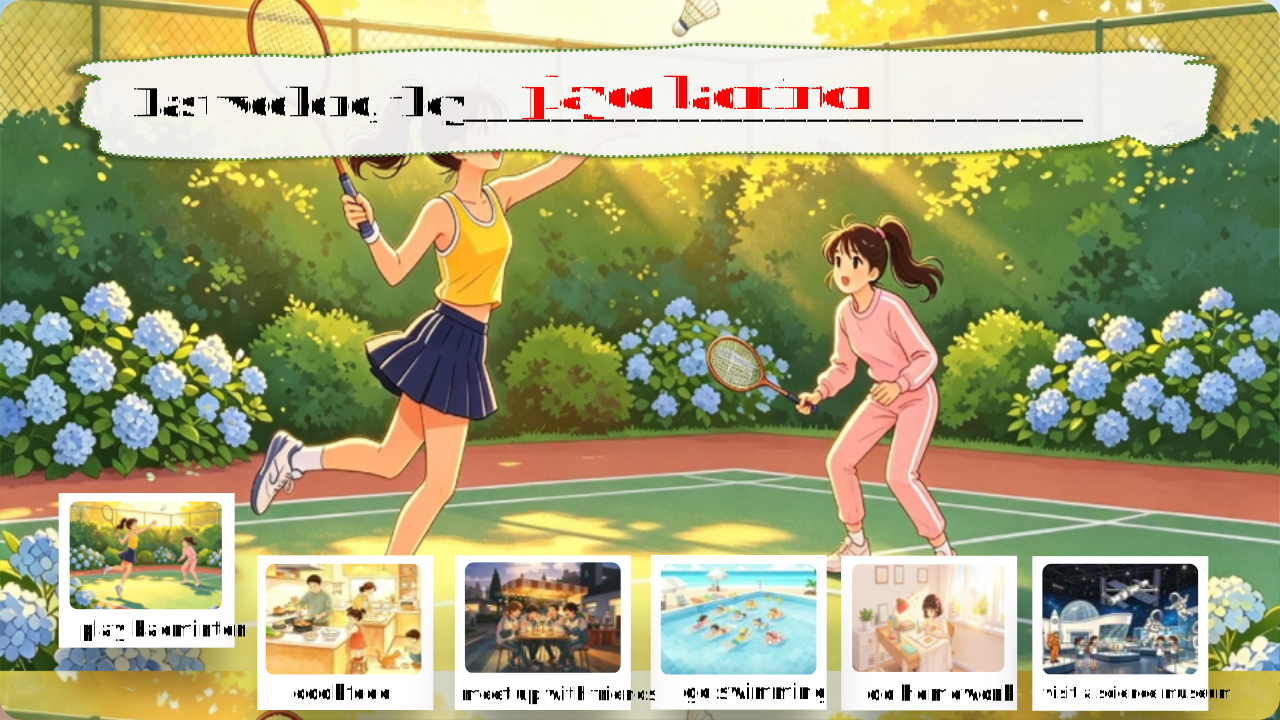
play badminton
do homework
go swimming
visit a science museum
cook food
meet up with friends
Last weekend, they_____________________________
played badminton
play badminton
do homework
go swimming
visit a science museum
cook food
meet up with friends
Last weekend, they_____________________________
cooked food
play badminton
do homework
go swimming
visit a science museum
cook food
meet up with friends
Last weekend, they_____________________________
met up with friends
play badminton
do homework
go swimming
visit a science museum
cook food
meet up with friends
Last weekend, they_____________________________
went swimming
play badminton
do homework
go swimming
visit a science museum
cook food
meet up with friends
Last weekend, she_____________________________
did her homework
play badminton
do homework
go swimming
visit a science museum
cook food
meet up with friends
Last weekend, they_______________________________
visited a science museum
Pre-listening
What did you do there?
Where did you go?
Do you think it was a great trip? Why?
Do you remember your last school trip?
--Where did they go?
--What did they do?
--They went to a park.
--They flew kites.
--Where did she go?
--What did she do?
--She went to a farm.
--She fed the animals.
--Where did they go?
--What did they do?
--They went to a museum.
--They visited the exhibition.
--Where did they go?
--What did they do?
--They went to a theatre.
--They watched a play.
Where did Fuxing go?
What did she do?
1. Where did Fu Xing go on his school trip?
A. To a park B. To a wastewater plant C. To a museum
2. What does Fu Xing think of the trip?
A. Boring B. Interesting C. Terrible
Predict and choose the right answer.
People make a lot of wastewater every day.
Do you know where the wastewater goes? Now let’s follow Fu Xing.
Fu Xing went to the wastewater plant. But what is a wastewater plant?
废水处理厂
plant
n.
植物
工厂
/ˈweɪstwɔːtə/ n. 废水
While-listening
Helen: Hi, Fu Xing. How was your school trip to the wastewater plant?
Was it boring?
Fu Xing: No, it wasn’t at all. It was really interesting!
Helen: Wow! What did you see?
Fu Xing: We saw the plant make dirty water _________ again.
Helen: Really? How?
Fu Xing: Well, first, _________ water from our homes goes into the plant. Then,
special screens remove large pieces of waste from the water.
Helen: What happens next?
Fu Xing: Well, _________ machines remove germs and other things from the water.
These things are usually too ________ to see. It takes a few more steps after
that before the water becomes clean again.
Helen: Wow! I used to think it was _______ to get clean water.
Fu Xing: Me too! I didn’t realize it was so _________.
Listen to the conversation and fill in the blanks with correct adjectives.
2a
clean
dirty
large
small
easy
hard
clean
dirty
large
small
easy
hard
Antonyms(反义词)
Fu Xing: We saw the plant make dirty water clean again.
Helen: Really? How?
Fu Xing: Well, first, dirty water from our homes goes into the plant. Then,
special screens remove large pieces of waste from the water.
Helen: What happens next?
Fu Xing: Well, large machines remove germs and other things from the water.
These things are usually too small to see.
It takes a few more steps after that before the
water becomes clean again.
Helen: Wow! I used to think it was easy to get clean water.
Fu Xing: Me too! I didn’t realize it was so hard.
How many steps are memtioned does it take before the water becomes clean again?
Learn More: How does the wastewater plant work
Listen to the conversation again and match the sentence parts.
2b
1. The plant makes
2. Dirty water goes
3. Machines inside the plant
4. Screens inside the plant
5. Helen used to think
A. remove small things from
the water.
B. it was easy to get clean water.
C. dirty water clean again.
D. remove large pieces of
waste from the water.
E. into the plant.
Put the sentences in right order and draw a diagram of the cleaning process of wastewater plant.
/ˈdaɪəɡræm/
/ˈprəʊses/
Cleaning process
First, _______________________________________.
dirty water from our homes goes into the plant
Talk about the cleaning process of wastewater plant .
Then, _________________________________________________.
special screens remove large pieces of waste from the water
Next, __ ________________________________________________.
large machines remove germs and other things from the water
It ___________________ after that before __________________________.
the water becomes clean again
takes a few more steps
Retell the process:
Dirty water ...goes into ...
First
Special screens remove ... from the water.
then
Machines ...
remove ... from ...
next
The plant makes ... again.
after, before
Think and answer:
What does Helen think of getting clean water?
She used to think it was easy to get clean water, but now she knows it is hard.
I used to think it was __________ to get clean water, but now I knows it is ______.
How about you?
Helen: Wow! I used to think it was easy to get clean water.
Fu Xing: Me too! I didn’t realize it was so hard. __________
_________________________________________
_________________________________________
_________.
What may Fu Xing say next?
We should
really save water. Knowing how hard it is to treat wastewater makes me realize the importance of not wasting it
reuse the water
save the water
Helen: Hi, Fu Xing. How was your school trip to the wastewater plant? Was it boring?
Fu Xing: No, it wasn’t at all. It was really interesting!
Helen: Wow! What did you see?
Fu Xing: We saw the plant make dirty water clean again.
Helen: Really? How?
Fu Xing: Well, first, dirty water from our homes goes into the plant. Then, special screens remove large
pieces of waste from the water.
Helen: What happens next?
Fu Xing: Well, large machines remove germs and other things from the water. These things are usually
too small to see. It takes a few more steps after that before the water becomes clean again.
Helen: Wow! I used to think it was easy to get clean water.
Fu Xing: Me too! I didn’t realize it was so hard.
Listen to the conversation again and pay attention to the pronunciation of was, wasn’t, did and didn’t.
wasn’t/ˈwɒznt/
was/wɒz/
unstressed
stressed
did/dɪd/
didn’t/ˈdɪd(ə)nt/
unstressed
stressed
朗读停顿
Then, I special screens remove large pieces of waste from the water. It takes a few more steps after that before the water becomes clean again.
朗读比较长的句子时,需要在意群过渡处________。
区分意群意味着把句子中的内容按意义进行划分,这一策略不仅适用于阅读,也同样适用于口语朗读。
停顿
Post-listening
Complete the summary of the conversation in 2a.
2c
Last week, Fu Xing’s class went on a school trip to a
___________ plant. The plant turned dirty water into
clean water. Fu Xing learnt about the cleaning process:
First, dirty water goes from people’s ___________ to
the plant. Then the plant uses screens to remove large
pieces of ________from the dirty water. Next, large
__________clean the water. They remove _______and other small things. It takes a few more ___________before the water becomes clean again.
wastewater
homes
waste
machines
germs
steps
Helen: Hi, Fu Xing. How was your school trip to the wastewater plant? Was it boring?
Fu Xing: No, it wasn’t at all. It was really interesting!
Helen: Wow! What did you see?
Fu Xing: We saw the plant make dirty water clean again.
Helen: Really? How?
Fu Xing: Well, first, dirty water from our homes goes into the plant. Then, special screens remove large
pieces of waste from the water.
Helen: What happens next?
Fu Xing: Well, large machines remove germs and other things from the water. These things are usually
too small to see. It takes a few more steps after that before the water becomes clean again.
Helen: Wow! I used to think it was easy to get clean water.
Fu Xing: Me too! I didn’t realize it was so hard.
Analyze the structure
First,
Then,
Next,
Finally
What did you see?
How did you feel?
What did you learn?
Where did you go?
Where did you go?
How did you feel?
What did you see?
What did you learn?
First,
Then,
Next,
After that before,
Analyze the conversation
a wastewater plant
interesting
…from…into
…remove…
…remove…
…become…
Role play the conversation
What did you see?
How did you feel?
What did you learn?
Where did you go?
Helen: Hi, Fu Xing. How was …
Fu Xing: No, it . It …!
Helen: Wow! What did you see?
Fu Xing: We saw …
Helen: Really? How?
Fu Xing: Well, first, ... Then, …
Helen: What happens next?
Fu Xing: Well, ... It …again.
Helen: Wow! I used to …
Fu Xing: Me too! I didn’t …
I went to…
It was interesting/boring…
We saw…
First/ Then/ Next/After that…
I used to think…
I didn’t realize…
Place: ____________
Activities:
___________________________________________________
see old things
learn history
look at ...
museum
What other special places did you go on a school trip?
What did you do there?
Place: ____________
Activities:
___________________________________________________
see animals
take photos
learn about wildlife
zoo
What other special places did you go on a school trip?
What did you do there?
Place: ____________
Activities:
___________________________________________________
go hiking
watch birds
collect leaves
forest
What other special places did you go on a school trip?
What did you do there?
Place: ____________
Activities:
____________________________________________________________
see machines
learn how workers work
learn how things are made
factory
What other special places did you go on a school trip?
What did you do there?
Place: ____________
Activities:
___________________________________________________
see animals/flowers
feed animals
milk cows
farm
What other special places did you go on a school trip?
What did you do there?
Place: ____________
Activities:
___________________________________________________
watch plays
listen to music
see a performance
theater
What other special places did you go on a school trip?
What did you do there?
Place: ____________
Activities:
_________________________________________________________
buy food
talk to sellers
learn how to sell things
market
What other special places did you go on a school trip?
What did you do there?
Place: ____________
Activities:
___________________________________________________
draw pictures
play games
have a picnic
park
What other special places did you go on a school trip?
What did you do there?
Where did you go?
How was your school trip?
It was great.
We went to the theatre to watch a show.
theatre factory zoo museum
farm forest market park
剧院
农场
工厂
森林
动物园
市场
博物馆
公园
Talk about a school trip you took to a special place.
2e
Now it’s your turn to share your school trip with us.
Talk about a school trip
How was it? First,
Where did you go? Then,
What did you see and do? Next,
How did you feel? Finally,
What did you learn? ...
… ...
Show time
A special day makes our life interesting!
Language points
trip
词
讲
练
trip〔可数名词〕旅行;通常指近距离的旅行,并且往往要回到出发点(即双程)。课文中指的是郊游。
Have a good trip!
例
她经常在假期和家人一起去短途旅行。
She often goes on ______ with her family during holidays.
trips
看句子填空。
祝旅途愉快!
拓展
常见的与trip相关的短语:
a day trip 一日游
business trip 出差
go on a trip 去旅行
3. My uncle works in a big car ______.
Don’t forget to water the _______.
We _______ trees in spring.
plant
词
讲
练
①〔可数名词〕工厂;植物
My father works in a _______.
1. There are many green _______ in the park.
plant
plant
看句子填空。
我爸爸在一家工厂工作。
②〔及物动词〕种植;栽种;播种
别忘了给植物浇水。
我们在春天种树。
plant
公园里有许多绿色的植物。
2. She likes _______ vegetables on the farm.
她喜欢在农场种蔬菜。
plant
plants
planting
例
讲
例
我叔叔在一家大型汽车工厂工作。
①interesting令人感兴趣的;有趣的;常表示某物具有令人感兴趣的特征,常说明事物;可作表语或定语。
interesting与interested
辨析
讲
The game is ___________.
例
练
用 interesting 或 interested 填空
The trip to the wastewater plant was ____________.
I am ___________ in the water cleaning process.
The story is very _____________.
interesting
1. 这个游戏有趣。
2. 这是一次有趣的旅行。
②interested感兴趣的;常表示某人对某物感兴趣,常说明人;常作表语。
3. 这个男孩对美术感兴趣。
This is an ____________ trip.
The boy is ____________ in art.
interesting
interested
interesting
interested
interesting
①see sb do sth看见某人做某事;强调看到了动作的全过程或动作经常发生。
see sb do sth 与 see sb doing sth
辨析
We saw the plant make dirty water clean again.
我们看到工厂使得脏水又变干净了。
I saw her __________ the flowers.
讲
练
②see sb doing sth看见某人正在做某事;强调看到的动作正在进行。
1. 我经常看到他在操场上打篮球。
I often see him ____ basketball on the play-ground.
play
2. 我看到她正在浇花。
watering
①〔不可数名词〕废弃物
waste
词
讲
②〔及物动词〕浪费
People put their ______ into the dustbin.
人们把他们的废弃物放到垃圾桶里。
Don't _______ water.
不要浪费水。
例
waste
waste
We mustn’t ________ food.
A. waste B. wastes C. wasted
2. There is much ________ here.
A. wastes B. waste C. wasted
练
A
B
be used to doing sth习惯于做某事
used to
词
讲
used to do sth常常做某事;强调过去和现在的对比,暗指现在已经不存在的动作或状态。
【注意】used to do sth 中的 used 没有人称和时态的变化。
例
他曾经在这儿住过。
He ________ live here.
拓展
used to
He ___________ getting up early.
他习惯于早起。
is used to
练
1. He ______ live in Paris, but now he lives in London.
A. used to B. is used to C. gets used to
2. She ______ eating spicy food now.
A. used to B. is used to C. got used
A
B
realize〔及物动词〕认识到;实现;其后常接名词或 that从句。
realize one's dream实现某人的梦想
realize
词
讲
The woman _____________ that she was wrong.
那个妇女没有意识到她错了。
他尽力实现了他的梦想。
He tried __________ his dream.
练
例
didn't realize
to realize
我意识到我错了。
他终于实现了他的梦想。
I ____________ I was wrong.
She finally ____________ her dream.
realized
realized
use sth. to do sth.
词
讲
use sth to do sth做事,可与 use sth for doing sth 互换使用。
I _____ some chicken and vegetables _________ hamburgers.
=I ____ some chicken and vegetables for ________ hamburgers.
我用一些鸡肉和蔬菜制作汉堡。
例
use
to make
use
making
练
人们用电脑工作。
People ____computers __________.
=People _____ computers for ________.
use
to work
use
working
__________ early, he went to bed at nine last night.
他来这儿是为了买他最喜欢的书。
动词不定式(短语)作目的状语
to watch a show在本句中作目的状语。动词不定式(短语)作目的状语时可位于句末,也可位于句首。位于句首时,常用逗号与后面的句子隔开,意为“为了做某事”。
We went to the theatre to watch a show.我们去戏院看演出了。
讲
例
练
He came here _______ his favourite books.
为了早起,他昨天晚上9点就上床睡觉了。
to buy
To get up
Exercise
单项选择
1.The cake is so big. I want to cut it into ________.
A.bags B.cups C.pieces D.bowls
2.Playing computer games is a ________ of time and energy.
A.step B.waste C.plant D.process
3.I ________ afraid of dogs. But now I like them very much.
A.am used to B.used to C.used to be D.use to be
4.Sally fell ill and had to stay in hospital. At that time, she ________ the
importance of health.
A.realized B.hoped C.created D.removed
C
B
C
A
按要求写出正确的单词、词组或句子。
旅行 (名词) __________ 2. 废水工厂 (短语) ___________
3. 移走(动词) __________ 4. 一片(短语) __________
5. 废弃物(名词) __________ 6. 机器 (名词) __________
7. 微生物(名词)__________ 8. 步骤(名词)___________
9. 过去常常做某事(短语) ___________________________
10. 将大块废弃物从水中分离。 _______________________
11. 这要花费更多几步。___________________
12. 东西太小以至于看不见。
________________________________________
trip
wastewater plant
remove
a piece of
waste
machine
germ
step
used to do sth
remove large pieces of waste from the water
It takes a few more steps.
These things are usually too tiny to see.
I went to a history museum last Sunday. It 1. ____ (be) a sunny day, and it's easy to 2.______ (find) the museum because it's near the bus stop. When I got inside, I was 3._________ (real) excited. There were so many ancient 4. _________(thing) on display. One of the statues was 5.________ (heavy) to move by myself. I spent a long time looking at it.
It took me about two hours 6.__________ (learn) about the history of the local area from the exhibits. There was also a special room where they showed short videos about historical events. It's easy to 7.______________ (understand) the stories through these videos.
语法填空。
too heavy
find
to learn
understand
was
really
things
60
Homework
Thank you!
null
69066.68
Lavf59.10.100
null
75571.805
$
资源预览图

1

2
3
4

5

6
相关资源
由于学科网是一个信息分享及获取的平台,不确保部分用户上传资料的 来源及知识产权归属。如您发现相关资料侵犯您的合法权益,请联系学科网,我们核实后将及时进行处理。