精品解析:福建省龙岩市实验学校2025-2026学年下学期七年级期中联考英语试卷
 切换试卷
切换试卷
2026-05-20
|
2份
|
35页
|
6人阅读
|
0人下载
资源信息
| 学段 | 初中 |
|---|---|
| 学科 | 英语 |
| 教材版本 | 初中英语仁爱科普版七年级下册 |
| 年级 | 七年级 |
| 章节 | - |
| 类型 | 试卷 |
| 知识点 | - |
| 使用场景 | 同步教学-期中 |
| 学年 | 2026-2027 |
| 地区(省份) | 福建省 |
| 地区(市) | 龙岩市 |
| 地区(区县) | - |
| 文件格式 | ZIP |
| 文件大小 | 2.66 MB |
| 发布时间 | 2026-05-20 |
| 更新时间 | 2026-05-20 |
| 作者 | 匿名 |
| 品牌系列 | - |
| 审核时间 | 2026-05-20 |
| 下载链接 | https://m.zxxk.com/soft/57953182.html |
| 价格 | 4.00储值(1储值=1元) |
| 来源 | 学科网 |
内容正文:
2025-2026学年第二学期龙岩市实验学校和龙岩市高级中学
七年级期中联考英语试卷
考试时间:120分钟;命题人:阙舒琦;审题人:张永明、卢昕洁、罗兰
注意事项:1. 答题前填写好自己的姓名、班级、考号等信息;
2. 请将答案正确填写在答题卡上
一、听力部分(30分)
Ⅰ. 听力(共三节,20小题,每小题1.5分,满分30分)
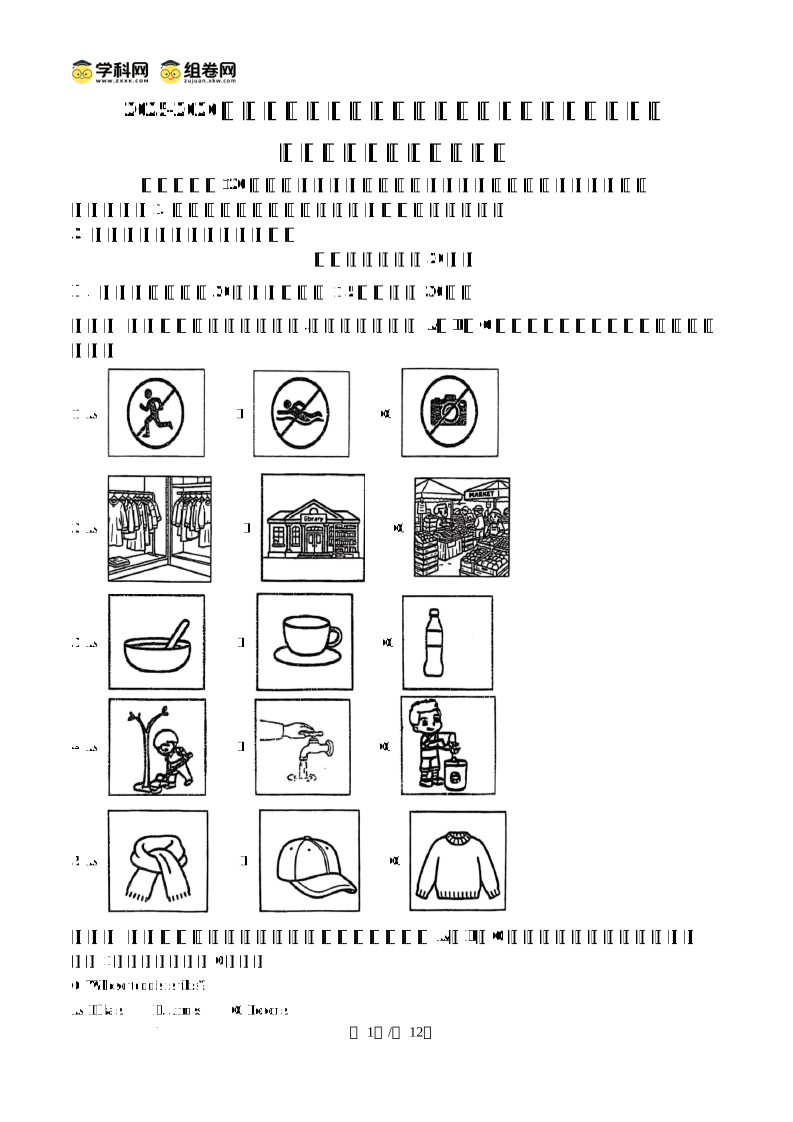
第一节 听句子。听下面五个句子.从每小题所给的A、B、C三幅图中选出与句子内容相符的选项。
1. A. B. C.
2. A. B. C.
3. A. B. C.
4. A. B. C.
5. A. B. C.
第二节 听对话。听下面七段对话。从每小题所给的A、B、C三个选项中选出正确答案。
听第1段对话,回答第6小题。
6. Whose tennis is this?
A. Ella’s. B. Jim’s. C. Peter’s.
听第2段对话,回答第7小题。
7. When does the movie start?
At 7:00. B. At 8:00. C. At 9:00.
听第3段对话,回答第8小题。
8. Where does Timmy volunteer?
A. In a children’s hospital. B. In an old people’s home. C. In the community center.
听第4段对话,回答第9小题。
9. What does Andy do to save water?
A. Collect rainwater. B. Take shorter showers. C. Reuse water.
听第5段对话,回答第 10、11小题。
10. When did Tom watch the TV show?
A. Last night. B. This morning. C. This afternoon.
11. How many ideas do they give about saving water?
A. 2. B. 3. C. 4.
听第6段对话,回答第12、13小题。
12. How far is it from here to Sun Park?
A. About 3 kilometers. B. About 5 kilometers. C. About 9 kilometers.
13. How does the woman go to the park?
A. By bus. B. By bike. C. By underground.
听第7段对话,回答第14、15小题。
14. Who did John go to Hainan with on holiday?
A. His family. B. His friends. C. His classmates.
15. How long did John stay in Hainan?
A. For 10 days. B. For 14 days. C. For 21 days.
第三节 听下面短文,根据你所听到的内容,完成以下表格,每空填一词。
A sale in the community
Time
Last 16
Sale
Lisa sold some old books for 17 yuan each.
Sarah sold strawberry 18 for 2 yuan each.
Tom sold clothes for 10 yuan each. All the clothes were almost 19 .
Reason (原因)
They wanted to collect 20 to help children in need.
Feeling
It was great.
二、笔试部分(120分)
Ⅱ. 选择填空(共10小题;每小题1分,满分10分)
从每小题所给的A、B、C三个选项中,选出可以填入空白处的正确选项。
1. My mother often goes to that market because the things there are always ________ good prices.
A. at B. in C. on
2. —There are two ________ bikes in our town, and it’s easy to ride to work.
A. thousand B. thousands C. thousand of
3. We have to stay at home ________ the bad weather.
A. such as B. far from C. because of
4. —________ milk do you need?
—Two bottles.
A. How much B. How many C. How far
5. If we have some problems, we can ask Mr. Li for ________.
A. orders B. help C. steps
6. Last Sunday, he ________ himself at the party.
A. is enjoying B. enjoyed C. enjoys
7. The supermarket is ________ a library and a bank.
A. between B. across C. on
8. —What would you like to drink?
—________ coffee, please.
A. One cup B. One cup of C. One
9. —Did you go to the supermarket yesterday?
—________. I watched TV at home.
A. No, I don’t B. Yes, I did C. No, I didn’t
10. — What a cute toy! Is it ________?
— Yes. I got it from my grandmother.
A. hers B. yours C. his
Ⅲ. 完形填空(共10小题;每小题1.5分,满分15分)
从每小题所给的A、B、C三个选项中,选出可以填入空白处的最佳选项。
Last Saturday, Mrs. Green went shopping with her son Tom. She wanted to be a ____11____ shopper.
They went to a supermarket near their home. Mrs. Green first looked at the ____12____ of the food. She didn’t want to ____13____ too much money. She only bought things they ____14____. Tom wanted a toy car, but it was a little expensive. He didn’t ask for it again.
On their way home, Tom saw some rubbish on the ground. He said, “Mom, our earth is a blue planet. We must keep it ____15____.” Then he ____16____ the rubbish and put it into the bin. Mrs. Green was very happy. She said, “You are a good boy. We should love our ____17____
When they got home, Tom helped his mom clean the room. He didn’t forget to ____18____ the lights when he left the room.
In the evening, Tom told his dad, “I want to ____19____ our planet. I will not litter and I will save water.” His dad smiled and said, “Let’ s work ____20____ to make our home beautiful.”
11. A. smart B. lazy C. funny
12. A. colors B. prices C. time
13. A. save B. make C. spend
14. A. need B. sell C. borrow
15. A. clean B. quiet C. fun
16. A. threw away B. picked up C. looked for
17. A. supermarket B. house C. planet
18. A. turn on B. turn up C. turn off
19. A. plan B. protect C. draw
20. A. together B. only C. just
Ⅳ. 阅读理解(共三节,25小题;满分45分)
第一节 阅读下面A、B、C三篇短文,根据短文内容,从题中所给的A、B、C、D四个选项中,选出最佳答案。(共15小题,每小题2分,满分30分)
(A)
Money plays an important part in our life. We use it to buy what we need and want. That’s why we should spend our money wisely when we go shopping. Here is a survey about the monthly spending of two students, Wang Yang and Zhang Xin.
Both students know how to spend and save money. This tells us that making a plan before shopping is very important. By thinking about where our money goes, we can all become wise shoppers.
根据材料内容选择最佳答案。
21. Wang Yang spends _________ of his money on food.
A. 50%. B. 14%. C. 20%. D. 16%.
22. Wang Yang and Zhang Xin spend the same percentage (百分比) of money on _________.
A. others B. books C. savings D. food
23. Zhang Xin puts 40% of her money into _________.
A. savings B. food C. books D. others
24. What can we learn from the survey?
A. Wang Yang saves more money than Zhang Xin.
B. Zhang Xin spends more money on food than Wang Yang.
C. Both students spend most of their money on books.
D. We should spend all of our money.
25. Where is the passage probably from?
A. A story book. B. A food poster.
C. A school newspaper. D. A city map.
(B)
My name is Julia. I live on a big street. On the left of my house is a big park. The police station is across from my house. There is a hotel on the left of the park. Between the hotel and a Chinese restaurant there is a small bank. A big supermarket is across from the Chinese restaurant. The food in the restaurant is really delicious. We all like it and often eat out there.
On weekends, my family often play sports in the park. My mother often shops in the supermarket.
I’m Amy. I live on a small street. My house is in the middle of the street. In front of my house there is a small supermarket. On the left of the supermarket is a library and on the right of the supermarket is a post office. Behind my house there is a small park with a few trees and a small garden. At the end of the street there is a hill with lots of trees.
On weekends, my family often climb the hill. It takes us about 15 minutes to walk there from our house.
26. Julia’s house is across from ________.
A. the post office B. the police station C. the supermarket D. the bank
27. What do Julia’s family do in the park on weekends?
A. Read books. B. Eat lunch. C. Play sports. D. Take photos.
28. Where is the library in Amy’s neighborhood?
A. In front of her house. B. Behind her house.
C. On the left of the supermarket. D. On the right of the supermarket.
29. Where is Amy’s house?
A. Across from the park. B. In front of the park. C. Next to the park. D. Behind the park.
30. We can know from the two letters that ________.
A. both Julia and Amy live on a small street
B. Julia’s mother shops in the supermarket every day
C. it’s fifteen minutes’ ride from Amy’s house to the hill
D. Julia and Amy are talking about their neighborhood
(C)
Hello, I am water. I am free and I can travel around in nature Do you know how I travel? Now come and travel with me.
Now I am a drop of water in the lake. I play with the fish. The sun keeps shining (照耀). I feel hot. Slowly I go up into the sky. It’s a little cold in the sky, then I become the cloud.
I meet more and more friends. When it gets cold, we become heavy and we drop from the sky as raindrops. We fall on the ground. We go into the soil. We go back to the river, too. Sometimes, I can even change into snow. Do you think it’s fun?
I am everywhere. I can change into different kinds of forms. The most important thing is I am your good friend, and you need to use me in your daily life.
31. What is the text about?
A. Traveling. B. Animals. C. Water cycle. D. Sports.
32. What does the water become in the sky?
A. River. B. Raindrops. C. Clouds. D. Snow.
33. What is Paragraph 3 mainly about?
A. How many forms of water there are. B. Why water cycle is important.
C. How we can use water. D. How raindrops form.
34. What would the writer probably talk about after Paragraph 4?
A. The use of water. B. The ways to protect water.
C. The world’s water problems. D. The tips on reusing water.
35. What’s the structure of this text? (Para1=①, Para2=②…)
A. B. C. D.
第二节(共5小题,每小题1分,满分5分)
(D)
阅读下面短文,从短文后面所给的五个选项中选出填入短文空白处的最佳选项,使短文通顺、连贯、意思完整。
What Can You Do If You Are Lost in a Forest?
When you go into a forest, it is always a good idea to be well prepared. What if you get lost in a forest? ____36____
Stay in one place.
If you are lost and don’t have anything to direct (指引) your way, stay in one place. It will be much easier for people to find you. Mark (做标记) the place with branches or rocks. ____37____
Check your phone.
If you are lost in a forest, it may be difficult to get a signal (信号) on your phone. Make an emergency call (紧急电话) if it still works well. Put the phone on battery (电池) saver mode or turn it off when you are not using it. ____38____
Find or make a shelter (庇护所).
If you are lost, look for a shelter. It keeps off the sun and rain. ____39____ Be sure to keep your clothes dry and keep yourself warm.
Find water.
____40____ If you are able to make a fire in a clear spot, boil (煮沸) water from a stream or river. However, if you are unable to start a fire, drink the dew (露水)from leaves.
A. You can’t live without water.
B. This can keep the battery power for as long as possible.
C. Then people will find them and know you are lost.
D. Here are some ideas for you.
E. If there is no place to stay, make one by yourself.
第三节 (共5小题,每小题2分,满分10分)
阅读下面短文,根据短文内容回答下列问题。
In the south of China, there is a special activity in Fujian —Nanyin. It is an old kind of music. People call it “the music from the Tang Dynasty (唐朝)”. We can learn about the history and culture of Minnan from it.
Nanyin uses many old instruments (乐器), like the pipa and the xiao. Players sit together and play the music slowly. The songs are short and beautiful. They often talk about life, love and the beauty of nature. Old people like to listen to it in the teahouse. Young people also learn to play it in schools.
Nanyin is a symbol of Minnan culture. It is a way to remember old stories. It tells us how people lived in the past. Now, it is on the list of World Intangible Cultural Heritage (非遗).
Today, many people still love Nanyin. Some artists go to schools to teach students. There are also big shows for visitors. We need to protect this special art. When we listen to Nanyin, we feel the warm heart of Minnan people.
41. What do people call Nanyin?
_____________________________________________
42. What instruments does Nanyin use?
_____________________________________________
43. Where do old people like to enjoy Nanyin?
_____________________________________________
44. 请把划线的句子翻译成中文
_____________________________________________
45. Do you like Nanyin? Why or why not?
_____________________________________________
Ⅴ.综合运用.(满分10分)
A.根据汉语意思,完成下列句子。(每空限填一词,每空0.5分,满分5分)
46. 你可以在中山公园站下车。
You can ________ ________ at Zhongshan Park Station.
47. 书店在酒店的对面。
The bookstore is ________ ________ the hotel.
48. 我妹妹做志愿者捡垃圾。
My sister worked as a volunteer to ________ ________ the litter.
49. 超市里的苹果在特价出售。
The apples in the supermarket are ________ ________.
50. reuse, after, shower, water, a, taking (连词成句)
________________________________________________________________
B.句型转换.(每小题1分,满分5分)
51. We need three kilos of meat. (就划线部分提问)
________ ________ kilos of meat do you need?
52. They can share books with me. (改为一般疑问句)
________ ________ share books with me?
53. He collected paper last year. (改为否定句)
He ________ ________paper last year.
54. Did the girl enjoy singing?(做出否定回答)
No, ________ ________.
55. We must keep quiet in the library. (改为祈使句)
________ ________ in the library.
Ⅵ.情景交际(共5小题,每小题2分,满分10分)
根据情景提示,用得体的英语完成下列对话。
56. — Let me take the heavy bag for you.
—________________________
57. —________________________________________________________ the bank?
—Go along the road, and you can see it on your right.
58. A: _________________________ go to the supermarket with me?
B: Sure, I’d like to.
59. —________________________ last weekend?
—I went hiking with my parents.
60. —__________________________ the Changjiang River?
—It’s about 6,300 kilometers long.
Ⅶ.看图写话(共5小题;每小题2分,满分10分)
根据每小题所提供的图画情景和提示词,写出一个与图画情景相符的句子。
61. across from
________________________________
62. Don’t
________________________________
63. spend
________________________________
64. knock, now
________________________________
65. go camping, last week
________________________________
Ⅷ.短文填空(共10小题;每小题1分,满分10分)
阅读下面短文,根据语境或所给单词的提示,在每个空格内填入一个恰当的词,要求所填的词意义准确,形式正确,使短文意思完整,行文连贯。
“Traveling like a special forces soldier (特种兵)” is a new way of traveling in China. An office worker just had ____66____ trip like this. After the work on Friday, he took the train from Shenzhen to Beijing ____67____ he had a good time. He ____68____ (arrive) in Beijing at 5:00 a. m. on Saturday. Then he began to visit some famous ____69____ (place) of interest (景点) there. On Sunday evening, he ____70____ (return) to Shenzhen by train. After ____71____ (get) off the train, he went straight back to work. No one knows what happened to ____72____ (he) during the weekend. But ____73____ a matter of fact, he traveled across more than 1,300 kilometers in 30 hours.
Summer holiday is coming soon. Do you want to try this kind of ____74____ (excite) trip? Decide a place to go. Plan your trip ____75____ (careful). Keep a strong body. Then let’s go!
Ⅸ.书面表达(满分10分)
76. 俭,德之共也。近几年,我国提倡构建“节约型社会”。假如你是李华,准备参加学校举办的“我是节约小能手”英语征文活动。请根据下方思维导图,写一篇英语短文。
注意事项:
1.必须包含所有内容提示信息,行文连贯,可适当发挥。
2.书写工整规范,字数70词左右(开头给出,不计入词数)。
Hello, my name is Li Hua. Saving is important to us. As students, we should ____________________________________________________________________________________________________________________________________________________________________________________________________________________________________________________________________________________________________________________________________________________________________________________________________________________________________________________________________________________________________________________________________________________________________________________________________________________________________________________________________
第1页/共1页
学科网(北京)股份有限公司
$
2025-2026学年第二学期龙岩市实验学校和龙岩市高级中学
七年级期中联考英语试卷
考试时间:120分钟;命题人:阙舒琦;审题人:张永明、卢昕洁、罗兰
注意事项:1. 答题前填写好自己的姓名、班级、考号等信息;
2. 请将答案正确填写在答题卡上
一、听力部分(30分)
Ⅰ. 听力(共三节,20小题,每小题1.5分,满分30分)
第一节 听句子。听下面五个句子.从每小题所给的A、B、C三幅图中选出与句子内容相符的选项。
1. A. B. C.
2. A. B. C.
3. A. B. C.
4. A. B. C.
5. A. B. C.
第二节 听对话。听下面七段对话。从每小题所给的A、B、C三个选项中选出正确答案。
听第1段对话,回答第6小题。
6. Whose tennis is this?
A. Ella’s. B. Jim’s. C. Peter’s.
听第2段对话,回答第7小题。
7. When does the movie start?
At 7:00. B. At 8:00. C. At 9:00.
听第3段对话,回答第8小题。
8. Where does Timmy volunteer?
A. In a children’s hospital. B. In an old people’s home. C. In the community center.
听第4段对话,回答第9小题。
9. What does Andy do to save water?
A. Collect rainwater. B. Take shorter showers. C. Reuse water.
听第5段对话,回答第 10、11小题。
10. When did Tom watch the TV show?
A. Last night. B. This morning. C. This afternoon.
11. How many ideas do they give about saving water?
A. 2. B. 3. C. 4.
听第6段对话,回答第12、13小题。
12. How far is it from here to Sun Park?
A. About 3 kilometers. B. About 5 kilometers. C. About 9 kilometers.
13. How does the woman go to the park?
A. By bus. B. By bike. C. By underground.
听第7段对话,回答第14、15小题。
14. Who did John go to Hainan with on holiday?
A. His family. B. His friends. C. His classmates.
15. How long did John stay in Hainan?
A. For 10 days. B. For 14 days. C. For 21 days.
第三节 听下面短文,根据你所听到的内容,完成以下表格,每空填一词。
A sale in the community
Time
Last 16
Sale
Lisa sold some old books for 17 yuan each.
Sarah sold strawberry 18 for 2 yuan each.
Tom sold clothes for 10 yuan each. All the clothes were almost 19 .
Reason (原因)
They wanted to collect 20 to help children in need.
Feeling
It was great.
二、笔试部分(120分)
Ⅱ. 选择填空(共10小题;每小题1分,满分10分)
从每小题所给的A、B、C三个选项中,选出可以填入空白处的正确选项。
1. My mother often goes to that market because the things there are always ________ good prices.
A. at B. in C. on
【答案】A
【解析】
【详解】句意:我妈妈经常去那个市场,因为那里的东西总是以优惠的价格。
at在;in在……里面;on在……上面。根据“the things there are always...good prices”可知,此处考查固定短语at good prices,意为“价格优惠”,符合语境。
2. —There are two ________ bikes in our town, and it’s easy to ride to work.
A. thousand B. thousands C. thousand of
【答案】A
【解析】
【详解】句意:我们镇上有两千辆自行车,骑车上班很容易。
当“thousand”前有具体数字(本句中的“two”)修饰时,“thousand”需用单数形式,且不与“of”连用。
3. We have to stay at home ________ the bad weather.
A. such as B. far from C. because of
【答案】C
【解析】
【详解】句意:因为天气不好,我们不得不待在家里。
such as例如;far from远离;because of因为。根据“the bad weather”是“待在家里”的原因,because of用于引出原因,符合语境。
4. —________ milk do you need?
—Two bottles.
A. How much B. How many C. How far
【答案】A
【解析】
【详解】句意:——你需要多少牛奶?——两瓶。
考查不可数名词的量。How much“多少”,询问价格或不可数名词的数量;How many“多少”,询问可数名词的数量;How far“多远”,询问距离。milk为不可数名词,且根据答句“Two bottles”可知询问数量,需用How much提问。故选A。
5. If we have some problems, we can ask Mr. Li for ________.
A. orders B. help C. steps
【答案】B
【解析】
【详解】句意:如果我们遇到一些问题,可以向李老师求助。
orders命令;help帮助;steps步骤。根据“If we have some problems, we can ask Mr.Li for….”可知,遇到问题应该向别人“求助”,应填help。
6. Last Sunday, he ________ himself at the party.
A. is enjoying B. enjoyed C. enjoys
【答案】B
【解析】
【详解】上周日,他在聚会上玩得开心。
时间状语“Last Sunday”表明句子时态是一般过去时,谓语动词要用过去式,应填enjoyed。
7. The supermarket is ________ a library and a bank.
A. between B. across C. on
【答案】A
【解析】
【详解】句意:超市在图书馆和银行之间。
between在……之间(两者);across穿过;on在……上面。根据“a library and a bank”可知,此处表示在两者之间,应填between。
8. —What would you like to drink?
—________ coffee, please.
A. One cup B. One cup of C. One
【答案】B
【解析】
【详解】句意:——你想喝点什么?——请给我一杯咖啡。
coffee是不可数名词,不能直接用数词修饰,表示具体数量时需借助量词,结构为“数词+量词+of”。此处表示“一杯咖啡”,应用“one cup of coffee”。
9. —Did you go to the supermarket yesterday?
—________. I watched TV at home.
A. No, I don’t B. Yes, I did C. No, I didn’t
【答案】C
【解析】
【详解】句意:——昨天你去超市了吗?——不,我没有。我在家看电视了。
考查一般过去时和一般疑问句的回答。由“Did you go to the supermarket yesterday?”可知,时态是一般过去时,排除选项A。根据回答“I watched TV at home.”可知,在家看电视了,没有去超市,所以应用否定回答。故选C。
10. — What a cute toy! Is it ________?
— Yes. I got it from my grandmother.
A. hers B. yours C. his
【答案】B
【解析】
【详解】句意:——多么可爱的玩具啊!它是你的吗?——是的。我从祖母那里得到的。
hers她的;yours你的;his他的。根据答语“Yes.”及“I got it from my grandmother.”可知,玩具属于回答者,问句是询问对方“它是你的吗”,应用yours。
Ⅲ. 完形填空(共10小题;每小题1.5分,满分15分)
从每小题所给的A、B、C三个选项中,选出可以填入空白处的最佳选项。
Last Saturday, Mrs. Green went shopping with her son Tom. She wanted to be a ____11____ shopper.
They went to a supermarket near their home. Mrs. Green first looked at the ____12____ of the food. She didn’t want to ____13____ too much money. She only bought things they ____14____. Tom wanted a toy car, but it was a little expensive. He didn’t ask for it again.
On their way home, Tom saw some rubbish on the ground. He said, “Mom, our earth is a blue planet. We must keep it ____15____.” Then he ____16____ the rubbish and put it into the bin. Mrs. Green was very happy. She said, “You are a good boy. We should love our ____17____
When they got home, Tom helped his mom clean the room. He didn’t forget to ____18____ the lights when he left the room.
In the evening, Tom told his dad, “I want to ____19____ our planet. I will not litter and I will save water.” His dad smiled and said, “Let’ s work ____20____ to make our home beautiful.”
11. A. smart B. lazy C. funny
12. A. colors B. prices C. time
13. A. save B. make C. spend
14. A. need B. sell C. borrow
15. A. clean B. quiet C. fun
16. A. threw away B. picked up C. looked for
17. A. supermarket B. house C. planet
18. A. turn on B. turn up C. turn off
19. A. plan B. protect C. draw
20. A. together B. only C. just
【答案】11. A 12. B 13. C 14. A 15. A 16. B 17. C 18. C 19. B 20. A
【解析】
【导语】本文讲述周六格林夫人带着儿子汤姆去超市购物,汤姆懂事体贴不乱要贵重玩具,路上主动捡拾垃圾爱护环境,回家还节约用电,立志守护地球家园的故事。
【11题详解】
句意:她想做一名精明的购物者。
后文写她购物精打细算、不愿多花钱,smart表示精明的,lazy懒惰的、funny有趣的,均不符合购物省钱的语境。
【12题详解】
句意:格林夫人先查看食物的价格。
根据后文不想花费太多钱财可知是看商品价格,prices价格,colors颜色、time时间,都和省钱购物无关。
【13题详解】
句意:她不想花太多钱。
此处表达花费钱财,spend有花费之意,save节省、make赚取钱财,都不符合句子表达含义。
【14题详解】
句意:她只买他们需要的东西。
结合省钱购物的情节,只购买日常必需品,need需要,sell售卖、borrow借入,均不符合文意。
【15题详解】
句意:我们必须保持它干净。
汤姆看见地面垃圾,想要维护地球环境整洁,clean干净的,quiet安静的、fun有趣的,和保护环境无关。
【16题详解】
句意:然后他捡起垃圾扔进垃圾桶。
此处描写爱护环境的动作,pick up意为捡起,threw away扔掉、looked for寻找,不符合语境动作。
【17题详解】
句意:我们应该爱护我们的星球。
前文提及蓝色地球星球,planet星球,supermarket超市、house房子,和前文内容不呼应。
【18题详解】
句意:离开房间时他不忘关灯。
日常出门要关掉电灯节约用电,turn off意为关掉,turn on打开、turn up调大音量,不符合生活常识。
【19题详解】
句意:我想要保护我们的星球。
不乱扔垃圾、节约用水都是保护地球的行为,protect保护,plan计划、draw画画,均不符合句意。
【20题详解】
句意:让我们一起努力让我们的家园变得美丽。
此处表达共同携手努力,together一起,only仅仅、just只是,无法贴合句子情感与含义。
Ⅳ. 阅读理解(共三节,25小题;满分45分)
第一节 阅读下面A、B、C三篇短文,根据短文内容,从题中所给的A、B、C、D四个选项中,选出最佳答案。(共15小题,每小题2分,满分30分)
(A)
Money plays an important part in our life. We use it to buy what we need and want. That’s why we should spend our money wisely when we go shopping. Here is a survey about the monthly spending of two students, Wang Yang and Zhang Xin.
Both students know how to spend and save money. This tells us that making a plan before shopping is very important. By thinking about where our money goes, we can all become wise shoppers.
根据材料内容选择最佳答案。
21. Wang Yang spends _________ of his money on food.
A. 50%. B. 14%. C. 20%. D. 16%.
22. Wang Yang and Zhang Xin spend the same percentage (百分比) of money on _________.
A. others B. books C. savings D. food
23. Zhang Xin puts 40% of her money into _________.
A. savings B. food C. books D. others
24. What can we learn from the survey?
A. Wang Yang saves more money than Zhang Xin.
B. Zhang Xin spends more money on food than Wang Yang.
C. Both students spend most of their money on books.
D. We should spend all of our money.
25. Where is the passage probably from?
A. A story book. B. A food poster.
C. A school newspaper. D. A city map.
【答案】21. C 22. B 23. A 24. A 25. C
【解析】
【导语】本文介绍了两名学生的月度消费情况调查,通过柱状图展示了他们在储蓄、书籍、食物等方面的支出占比,并倡导理性消费。
【21题详解】
根据图表,Wang Yang “Food”上的支出占比为20%。
【22题详解】
两人在“Books”上的支出占比均为14%,是唯一相同的项目。
【23题详解】
根据图表,Zhang Xin在“Savings”上的支出占比为40%。
【24题详解】
根据柱状图Savings显示:Wang Yang的储蓄占比是50%高于 Zhang Xin的40%,选项A正确。
【25题详解】
文章介绍了学生的消费调查,内容贴近校园生活,最可能出自校报。
(B)
My name is Julia. I live on a big street. On the left of my house is a big park. The police station is across from my house. There is a hotel on the left of the park. Between the hotel and a Chinese restaurant there is a small bank. A big supermarket is across from the Chinese restaurant. The food in the restaurant is really delicious. We all like it and often eat out there.
On weekends, my family often play sports in the park. My mother often shops in the supermarket.
I’m Amy. I live on a small street. My house is in the middle of the street. In front of my house there is a small supermarket. On the left of the supermarket is a library and on the right of the supermarket is a post office. Behind my house there is a small park with a few trees and a small garden. At the end of the street there is a hill with lots of trees.
On weekends, my family often climb the hill. It takes us about 15 minutes to walk there from our house.
26. Julia’s house is across from ________.
A. the post office B. the police station C. the supermarket D. the bank
27. What do Julia’s family do in the park on weekends?
A. Read books. B. Eat lunch. C. Play sports. D. Take photos.
28. Where is the library in Amy’s neighborhood?
A. In front of her house. B. Behind her house.
C. On the left of the supermarket. D. On the right of the supermarket.
29. Where is Amy’s house?
A. Across from the park. B. In front of the park. C. Next to the park. D. Behind the park.
30. We can know from the two letters that ________.
A. both Julia and Amy live on a small street
B. Julia’s mother shops in the supermarket every day
C. it’s fifteen minutes’ ride from Amy’s house to the hill
D. Julia and Amy are talking about their neighborhood
【答案】26. B 27. C 28. C 29. B 30. D
【解析】
【导语】本文是一篇记叙文,分别介绍了Julia和Amy两人各自居住街区的周边环境以及一家人周末的日常活动。
【26题详解】
第一段指出位置信息:“The police station is across from my house.”,说明朱莉娅家在警察局对面。
【27题详解】
第二段写明活动内容:“my family often play sports in the park.”,可知周末朱莉娅一家人在公园里做运动。
【28题详解】
第三段标明方位:“On the left of the supermarket is a library...”,说明图书馆在超市的左边。
【29题详解】
第三段交代方位:“Behind my house there is a small park”,表明埃米的家在公园前面,也就是公园在她家后面。
【30题详解】
通读全文可知两篇短文分别介绍朱莉娅和埃米各自居住街区的场所与日常活动,由此得出二人都在谈论自己的街区环境。
(C)
Hello, I am water. I am free and I can travel around in nature Do you know how I travel? Now come and travel with me.
Now I am a drop of water in the lake. I play with the fish. The sun keeps shining (照耀). I feel hot. Slowly I go up into the sky. It’s a little cold in the sky, then I become the cloud.
I meet more and more friends. When it gets cold, we become heavy and we drop from the sky as raindrops. We fall on the ground. We go into the soil. We go back to the river, too. Sometimes, I can even change into snow. Do you think it’s fun?
I am everywhere. I can change into different kinds of forms. The most important thing is I am your good friend, and you need to use me in your daily life.
31. What is the text about?
A. Traveling. B. Animals. C. Water cycle. D. Sports.
32. What does the water become in the sky?
A. River. B. Raindrops. C. Clouds. D. Snow.
33. What is Paragraph 3 mainly about?
A. How many forms of water there are. B. Why water cycle is important.
C. How we can use water. D. How raindrops form.
34. What would the writer probably talk about after Paragraph 4?
A. The use of water. B. The ways to protect water.
C. The world’s water problems. D. The tips on reusing water.
35. What’s the structure of this text? (Para1=①, Para2=②…)
A. B. C. D.
【答案】31. C 32. C 33. D 34. A 35. C
【解析】
【导语】本文是一篇拟人化科普,以第一人称“我是一滴水”的口吻,生动讲述了水从湖中受热蒸发变成水蒸气、在空中遇冷变成云、云变重后变成雨滴落回地面、渗入土壤或流回河流,有时还能变成雪的自然循环过程。
【31题详解】
全文以第一人称讲述了水在自然界中的循环过程 (蒸发→成云→降雨/雪→回归河流/土壤),所以选项C“Water cycle.” (水循环) 正确。
【32题详解】
第二段中提到“Slowly I go up into the sky. It‘s a little cold in the sky, then I become the cloud.”,说明水在天空中变成了云,所以选项C“Cloud.”正确。
【33题详解】
第三段讲述了水 (云) 遇冷变重后变成雨滴落下,进入土壤或河流,有时还能变成雪,主要讲雨滴是如何形成的,所以选项D“How raindrops form.”正确。
【34题详解】
第四段提到“The most important thing is I am your good friend, and you need to use me in your daily life.”,由此推断接下来可能会讲水的用途,所以选项A“The use of water.”正确。
【35题详解】
文章结构:第①段引出话题 (水在自然界中旅行);第②段讲水蒸发成云;第③段讲云变成雨/雪落回地面;第④段总结水与人类的关系。整体为“引入→过程描述→总结”的线性结构。故选项C正确。
第二节(共5小题,每小题1分,满分5分)
(D)
阅读下面短文,从短文后面所给的五个选项中选出填入短文空白处的最佳选项,使短文通顺、连贯、意思完整。
What Can You Do If You Are Lost in a Forest?
When you go into a forest, it is always a good idea to be well prepared. What if you get lost in a forest? ____36____
Stay in one place.
If you are lost and don’t have anything to direct (指引) your way, stay in one place. It will be much easier for people to find you. Mark (做标记) the place with branches or rocks. ____37____
Check your phone.
If you are lost in a forest, it may be difficult to get a signal (信号) on your phone. Make an emergency call (紧急电话) if it still works well. Put the phone on battery (电池) saver mode or turn it off when you are not using it. ____38____
Find or make a shelter (庇护所).
If you are lost, look for a shelter. It keeps off the sun and rain. ____39____ Be sure to keep your clothes dry and keep yourself warm.
Find water.
____40____ If you are able to make a fire in a clear spot, boil (煮沸) water from a stream or river. However, if you are unable to start a fire, drink the dew (露水)from leaves.
A. You can’t live without water.
B. This can keep the battery power for as long as possible.
C. Then people will find them and know you are lost.
D. Here are some ideas for you.
E. If there is no place to stay, make one by yourself.
【答案】36. D 37. C 38. B 39. E 40. A
【解析】
【导语】本文是一篇说明文,主要讲述了在森林里迷路时可以采取的一些自救措施。
【36题详解】
根据文章第1段“What if you get lost in a forest?”可推知,空后应介绍具体应对方法,D选项“Here are some ideas for you.”引出下文,符合语境。
【37题详解】
根据文章第3段“Mark the place with branches or rocks.”可推知,这样做的目的是让别人发现标记并知道你迷路了,C选项“Then people will find them and know you are lost.”顺承上文,符合语境。
【38题详解】
根据文章第5段“Put the phone on battery saver mode or turn it off when you are not using it.”可推知,这样做的目的是尽可能长时间地保持电池电量,B选项“This can keep the battery power for as long as possible.”说明这么做的目的,对应上文,符合语境。
【39题详解】
根据文章第6段“Find or make a shelter (庇护所).”可知,此处提到了庇护所,E选项“If there is no place to stay, make one by yourself.”对应标题“Find or make a shelter”,顺承上文,符合语境。
【40题详解】
根据文章第8段“Find water.”可知。此处提到寻找水源,A选项“You can’t live without water.”点明水的重要性,引出下文对获取水的方法的介绍,符合语境。
第三节 (共5小题,每小题2分,满分10分)
阅读下面短文,根据短文内容回答下列问题。
In the south of China, there is a special activity in Fujian —Nanyin. It is an old kind of music. People call it “the music from the Tang Dynasty (唐朝)”. We can learn about the history and culture of Minnan from it.
Nanyin uses many old instruments (乐器), like the pipa and the xiao. Players sit together and play the music slowly. The songs are short and beautiful. They often talk about life, love and the beauty of nature. Old people like to listen to it in the teahouse. Young people also learn to play it in schools.
Nanyin is a symbol of Minnan culture. It is a way to remember old stories. It tells us how people lived in the past. Now, it is on the list of World Intangible Cultural Heritage (非遗).
Today, many people still love Nanyin. Some artists go to schools to teach students. There are also big shows for visitors. We need to protect this special art. When we listen to Nanyin, we feel the warm heart of Minnan people.
41. What do people call Nanyin?
_____________________________________________
42. What instruments does Nanyin use?
_____________________________________________
43. Where do old people like to enjoy Nanyin?
_____________________________________________
44. 请把划线的句子翻译成中文
_____________________________________________
45. Do you like Nanyin? Why or why not?
_____________________________________________
【答案】41.
“The music from the Tang Dynasty”.
42.
Many old instruments, like the pipa and the xiao.
43.
In the teahouse.
44.
它是铭记古老故事的一种方式。
45.
Yes, I do. Because we can learn about the history and culture of Minnan from it.(答案不唯一,言之有理即可)
【解析】
【导语】本文是一篇说明文,主要介绍了福建的一种古老音乐——南音的历史、演奏乐器、文化意义以及现状。
【41题详解】
由文中第一段“People call it ‘the music from the Tang Dynasty’.”可知,人们称它为“来自唐朝的音乐”。
【42题详解】
由文中第二段“Nanyin uses many old instruments, like the pipa and the xiao.”可知,南音使用许多古老的乐器,比如琵琶和箫。
【43题详解】
由文中第二段“Old people like to listen to it in the teahouse.”可知,老年人喜欢在茶馆里欣赏南音。
【44题详解】
“It is a way to remember old stories”译为这是一种铭记古老故事的方式。句子的核心是用“It is a way to do sth.”结构表示“这是做某事的一种方式”,“一种方式”译为a way,“铭记古老故事”译为to remember old stories;结合语法规则组合句子,用不定式to remember old stories作后置定语修饰a way,符合英语表达习惯。
【45题详解】
本题为开放性问题,表达自己的观点并给出合理原因即可。
Ⅴ.综合运用.(满分10分)
A.根据汉语意思,完成下列句子。(每空限填一词,每空0.5分,满分5分)
46. 你可以在中山公园站下车。
You can ________ ________ at Zhongshan Park Station.
【答案】 ①. get ②. off
【解析】
【详解】原句中“下车”为关键词,对应固定短语get off,意为“下车”,情态动词can后接动词原形。
47. 书店在酒店的对面。
The bookstore is ________ ________ the hotel.
【答案】 ①. across ②. from
【解析】
【详解】原句中“在……的对面”是关键词,表示“在……的对面”的介词短语是across from。
48. 我妹妹做志愿者捡垃圾。
My sister worked as a volunteer to ________ ________ the litter.
【答案】 ①. pick ②. up
【解析】
【详解】原句中“捡”是关键词,表示“捡”的短语是pick up,pick up the litter“捡垃圾”,用原形,和前面的to一起构成动词不定式结构 。
49. 超市里的苹果在特价出售。
The apples in the supermarket are ________ ________.
【答案】 ①. on ②. sale
【解析】
【详解】原句中“特价出售”是关键词,对应的短语是on sale。
50. reuse, after, shower, water, a, taking (连词成句)
________________________________________________________________
【答案】Reuse water after taking a shower.
【解析】
【详解】分析所给词,本句是祈使句。Reuse是谓语动词,位于句首且大写,water作宾语,after taking a shower是介词短语作时间状语,其中taking a shower为动名词短语作介词after的宾语。
B.句型转换.(每小题1分,满分5分)
51. We need three kilos of meat. (就划线部分提问)
________ ________ kilos of meat do you need?
【答案】 ①. How ②. many
【解析】
【详解】句意:我们需要三公斤的肉。原句中划线部分“three”表示数量,询问数量多少应使用疑问词how many提问,how位于句首,首字母应大写。故填How;many。
52. They can share books with me. (改为一般疑问句)
________ ________ share books with me?
【答案】 ①.
Can ②.
they
【解析】
【详解】句意:他们可以和我分享书籍。句子含有情态动词can,改为一般疑问句时,需将can提到句首,主语they放在其后。注意单词位于句首首字母需大写。
53. He collected paper last year. (改为否定句)
He ________ ________paper last year.
【答案】 ①.
didn’t ②.
collect
【解析】
【详解】句意:去年,他没有收集纸。根据原句是一个含有实义动词的过去式的句子。变为否定句时,要借助助动词didn’t,因为didn’t 已经代表是过去发生的事情,其后要跟动词原形,要用collected的原形collect。
54. Did the girl enjoy singing?(做出否定回答)
No, ________ ________.
【答案】 ①. she ②. didn’t
【解析】
【详解】句意:这个女孩喜欢唱歌吗?
原句为一般过去时的一般疑问句,否定回答用“No, 主语 + did + not”,主语“the girl”变代词“she”,故填she;didn’t。
55. We must keep quiet in the library. (改为祈使句)
________ ________ in the library.
【答案】 ①. Keep ②. quiet
【解析】
【详解】句意:我们必须在图书馆保持安静。原句核心信息是must keep quiet(必须保持安静),祈使句需要表达“命令/要求”的含义,保留核心动词和形容词keep quiet;原句中的“We must”表示 “我们必须”,转化为祈使句时,去掉主语We和情态动词must,用动词原形开头。故填Keep;quiet。
Ⅵ.情景交际(共5小题,每小题2分,满分10分)
根据情景提示,用得体的英语完成下列对话。
56. — Let me take the heavy bag for you.
—________________________
【答案】
It’s very kind of you./Thank you.
【解析】
【详解】上句是说话人主动提供帮助的表达。在英语交际中,当别人主动提出帮助时,应答者通常应表示感谢或赞扬对方的好意,故It’s very kind of you.或者Thank you.均符合语境。
57. —________________________________________________________ the bank?
—Go along the road, and you can see it on your right.
【答案】Where is/How can I get to
【解析】
【详解】答句介绍的是沿着这条路走,你可以在你的右边看到它,提供的是前往某地的具体路线指引。因此,问句应当是询问“去某地的路怎么走”或“某地在哪里”。故“Where is”或者“How can I get to”两种问法均符合语境。
58. A: _________________________ go to the supermarket with me?
B: Sure, I’d like to.
【答案】Would you like to
【解析】
【详解】A的句子是在向B发出邀请,根据B的回答“Sure, I’d like to.(当然,我很乐意。)”可知,这是一个表示邀请的一般疑问句,所以A的句子中应该使用“Would you like to”,表示“你愿意和我一起去超市吗?”。故填Would you like to。
59. —________________________ last weekend?
—I went hiking with my parents.
【答案】
What did you do
【解析】
【详解】答句介绍的是上周末的活动内容。因此,问句可以是询问具体的“做了什么事”,也可以是询问宽泛的“周末安排”,故What did you do符合语境。
60. —__________________________ the Changjiang River?
—It’s about 6,300 kilometers long.
【答案】How long is
【解析】
【详解】答句介绍的是长江的长度。因此,问句应当是询问“长江有多长”。故“How long is”是符合语境的问法。
Ⅶ.看图写话(共5小题;每小题2分,满分10分)
根据每小题所提供的图画情景和提示词,写出一个与图画情景相符的句子。
61. across from
________________________________
62. Don’t
________________________________
63. spend
________________________________
64. knock, now
________________________________
65. go camping, last week
________________________________
【答案】61.
The hotel is across from the hospital.
62.
Don’t litter.
63.
I spent 300 yuan on the shoes.
64.
He is knocking at the door now.
65.
They went camping last week.
【解析】
【61题详解】
根据图片和“across from”,可知本句应表达为“酒店在医院的对面。”,时态为一般现在时,主语The hotel;谓语is;表语across from the hospital。
【62题详解】
根据图片和“Don’t”,可知本句应表达为“不要乱扔垃圾。”,用祈使句表示,助动词Don’t;谓语litter。
【63题详解】
根据图片和“spend”,可知本句应表达为“我花了300元买这双鞋。”,时态为一般过去时,主语I;谓语spent;宾语300 yuan;状语on the shoes。
【64题详解】
根据图片和“knock, now”,可知本句应表达为“他现在正在敲门。”,时态为现在进行时,主语He;谓语is knocking at;宾语the door;时间状语now。
【65题详解】
根据图片和“go camping, last week”,可知本句应表达为“他们上周去露营了。”,时态为一般过去时,主语They;谓语went camping;时间状语last week。
Ⅷ.短文填空(共10小题;每小题1分,满分10分)
阅读下面短文,根据语境或所给单词的提示,在每个空格内填入一个恰当的词,要求所填的词意义准确,形式正确,使短文意思完整,行文连贯。
“Traveling like a special forces soldier (特种兵)” is a new way of traveling in China. An office worker just had ____66____ trip like this. After the work on Friday, he took the train from Shenzhen to Beijing ____67____ he had a good time. He ____68____ (arrive) in Beijing at 5:00 a. m. on Saturday. Then he began to visit some famous ____69____ (place) of interest (景点) there. On Sunday evening, he ____70____ (return) to Shenzhen by train. After ____71____ (get) off the train, he went straight back to work. No one knows what happened to ____72____ (he) during the weekend. But ____73____ a matter of fact, he traveled across more than 1,300 kilometers in 30 hours.
Summer holiday is coming soon. Do you want to try this kind of ____74____ (excite) trip? Decide a place to go. Plan your trip ____75____ (careful). Keep a strong body. Then let’s go!
【答案】66. a 67. and
68. arrived
69. places 70. returned
71. getting
72. him 73. as
74. exciting
75. carefully
【解析】
【导语】本文介绍了中国新兴的“特种兵式旅游”,以一位上班族为例,讲述了他利用周末完成深圳到北京的超紧凑旅行经历,并鼓励读者尝试这类旅行。
【66题详解】
句意:一位上班族就进行了一次这样的旅行。此处泛指一次这样的旅行,trip以辅音音素开头,用不定冠词a。
【67题详解】
句意:周五下班后,他从深圳坐火车去北京,而且他玩得很开心。两句之间并列关系,用并列连词and“和、而且”连接。
【68题详解】
句意:周六早上5点,他抵达北京。描述过去的旅行经历,用一般过去时,动词用过去式形式arrived。
【69题详解】
句意:随后他开始参观那里的一些名胜。some后接可数名词复数,place of interest“名胜”,是固定搭配,复数形式为places of interest。
【70题详解】
句意:周日晚上,他乘火车返回深圳。时态为一般过去时,描述过去的旅行经历,动词过去式形式returned。
【71题详解】
句意:下车后,他就直接去上班了。 介词“after”后接动名词形式,作宾语,get的动名词形式是getting。
【72题详解】
句意:没人知道他周末的经历。介词“to”后接人称代词宾格形式,作宾语,he的宾格形式是him。
【73题详解】
句意:但事实上,他在30小时内穿越了1300多公里。as a matter of fact“事实上”,是固定搭配,作状语。
【74题详解】
句意:你想试试这种令人兴奋的旅行吗?此空修饰名词trip,用excite的形容词形式exciting“令人兴奋的”,作定语。
【75题详解】
句意:认真规划你的行程。此处修饰动词plan,用careful的副词形式carefully“认真地”,作状语。
Ⅸ.书面表达(满分10分)
76. 俭,德之共也。近几年,我国提倡构建“节约型社会”。假如你是李华,准备参加学校举办的“我是节约小能手”英语征文活动。请根据下方思维导图,写一篇英语短文。
注意事项:
1.必须包含所有内容提示信息,行文连贯,可适当发挥。
2.书写工整规范,字数70词左右(开头给出,不计入词数)。
Hello, my name is Li Hua. Saving is important to us. As students, we should ____________________________________________________________________________________________________________________________________________________________________________________________________________________________________________________________________________________________________________________________________________________________________________________________________________________________________________________________________________________________________________________________________________________________________________________________________________________________________________________________________
【答案】例文
Hello, my name is Li Hua. Saving is important to us. As students, we should help save time and money. To save money, we can make a shopping list before buying things to avoid wasting money. We can wait for big sales and compare prices. Group-buying is also a good way. Try to spend less.
Water is valuable. Turn off the tap in time and reuse water, like using rice water to water flowers. Collect rainwater for cleaning. Don’t take long showers. Every drop counts!
Join me and let’s make a difference together.
【解析】
【详解】写作步骤
[第一步:审题立意]
确定文体:说明文,用一般现在时为主
明确要点:省钱(购物清单、大促、补充细节)、节水(及时关水龙头、重复利用、补充细节)
确定人称:第一人称(we/my)
注意事项:必须包含所有提示信息,词数70词左右,不得透露真实信息
[第二步:构思布局]
三段式结构:
开头段:总起句,点明节约的重要性(题干已给出)
主体段:分别介绍省钱和节水的具体做法
结尾段:发出倡议,升华主题
[第三步:要点展开]
要点一:省钱(save money)
具体做法:make a shopping list/wait for big sales/avoid buying unnecessary things
作用效果:help us save money and avoid waste
要点二:节水(save water)
具体做法:turn off the tap in time/reuse water/take shorter showers
作用效果:protect valuable water resources
第1页/共1页
学科网(北京)股份有限公司
$
资源预览图
1
2
3
相关资源
由于学科网是一个信息分享及获取的平台,不确保部分用户上传资料的 来源及知识产权归属。如您发现相关资料侵犯您的合法权益,请联系学科网,我们核实后将及时进行处理。