2026年辽宁营口市初中学业水平考试第二次模拟考试英语试卷
 切换试卷
切换试卷
2026-05-20
|
2份
|
12页
|
92人阅读
|
3人下载
资源信息
| 学段 | 初中 |
|---|---|
| 学科 | 英语 |
| 教材版本 | - |
| 年级 | 九年级 |
| 章节 | - |
| 类型 | 试卷 |
| 知识点 | - |
| 使用场景 | 中考复习-二模 |
| 学年 | 2026-2027 |
| 地区(省份) | 辽宁省 |
| 地区(市) | 营口市 |
| 地区(区县) | - |
| 文件格式 | ZIP |
| 文件大小 | 361 KB |
| 发布时间 | 2026-05-20 |
| 更新时间 | 2026-05-20 |
| 作者 | 匿名 |
| 品牌系列 | - |
| 审核时间 | 2026-05-20 |
| 下载链接 | https://m.zxxk.com/soft/57951634.html |
| 价格 | 3.00储值(1储值=1元) |
| 来源 | 学科网 |
内容正文:
2026年学业水平考试第二次模考
英语参考答案及评分标准
一、阅读理解(每小题2分,共40分)
1~4:CADB
5~8:ADCA
9~12:DBCD
13~16:CCBB
17~20:BDCE
二、完形填空(每小题1分,共10分)
21~25:AACBD
26~30:CDBBC
三、词语运用(每小题1分,共10分)
31.In
32.took
33.national
34.importance
35.an
36.and
37.greatly
38.was honoured
39.to teach
40.him
四、任务型阅读(41~43每小题2分,44题4分,共10分)
41.They should start as early as possible.
42.By trying saving some of the pocket money every week.
43.Focus on what they really want./Spend money on the things they really like.(意思对就给
分)
44.
(1)Parents act as guides and helpers.They can help children open a bank account for long-
term goals like driving lessons.They can also answer money-related questions and work with
kids to find solutions,building good saving habits from an early age.
英语试题参考答案及评分标准
(2)Parents play a supportive role by teaching kids to save pocket money regularly.They
help children create money journals,set saving goals,and open bank accounts.Most
importantly,they encourage open talks about money and never make children feel shy.
(3)Parents serve as educators and partners.They show children how to record income and
spending in a journal.They also help open accounts.By discussing money openly,they build
children's confidence.
(4)Parents are advisors and teachers.They teach kids to focus on what truly makes them
happy instead of following the crowd.They help set up bank accounts for bigger goals and
always encourage kids to ask questions without shame.They work together to find out
answers.
(5)Parents provide practical help and support.They can open a bank account for a child's
long-term savings.They listen to children's money questions and if unsure,they research
together.This cooperation builds responsibility and smart saving habits.
(6)Parents are instructors and safety guides.They explain the benefits of bank accounts and
interest.They warn against sharing passwords even with best friends.By talking about money
freely and answering all questions,they help children avoid wasteful spending and stay
focused on true goals.
(7)Parents play a key role.They help open accounts for long-term objectives,teach the
value of regular saving,and encourage kids to ask about money openly.When parents don't
know an answer,they find it out together.It builds strong trust.
(此题为开放性试题,答案不唯一,请酌情赋分。)
五、书面表达(共20分)
本大题满分为20分,按五个档次赋分。
英语试题参考答案及评分标准
档次(分数)
评分标准
很好地完成了规定的写作任务。包含所有内容要点,结构
第一档(18~20分)
完整,语句流畅,意思清楚、连贯。使用较为丰富的语法结构
和词汇,语法和词汇错误极少,格式正确,书写规范。
较好地完成了规定的写作任务。基本上包含所有内容要
第二档(14~17分)
点,结构较为完整,语句完整,意思清楚。语法结构和词汇错
误较少,格式基本正确,书写较为规范。
基本上完成了规定的写作任务。包含主要内容要点,结构
第三档(10~13分)
欠完整,少数语句不通顺,意思基本清楚。语法结构和词汇错
误较多,格式基本正确,书写基本规范。
未能按要求完成规定的写作任务。只包含少数内容要点,
第四档(6~9分)
结构不完整,多数语句欠完整,意思不够清楚。语法结构和词
汇错误较多,影响理解,格式不够正确,书写欠规范。
未能按要求完成规定的写作任务。只写出个别要点,结构
第五档(0-5分)
不完整,多数语句不完整或意思不明,语法和词汇错误很多,
书写不规范。
英语试题参考答案及评分标准
2026年营口市初中学业水平考试第二次模拟考试
英语试卷
(本试卷共45小题 满分90分 考试时长90分钟)
注意事项:
1.答卷前,考生务必将自己的姓名、准考证号填写在答题卡上。
2.答选择题时,选出每小题答案后,用2B铅笔把答题卡对应题目的答案标号涂黑。如需改动,用橡皮擦干净后,再选涂其他答案标号。答非选择题时,将答案写在答题卡上。写在本试卷上无效。
3.考试结束后,将本试卷和答题卡一并交回。
第一部分 选择题(共50分)
一、阅读理解(共20小题,每小题2分;满分40分)
第一节 阅读下面语言材料,从每题所给的A、B、C、D四个选项中选出最佳选项。
A
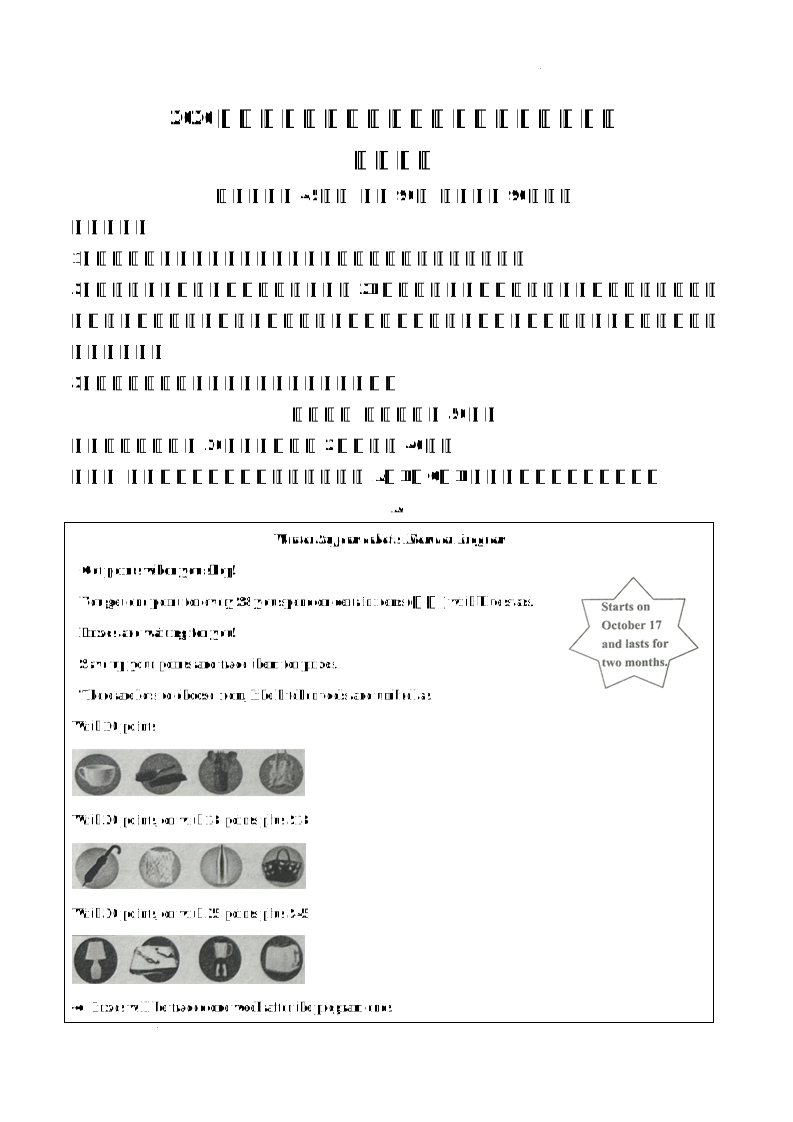
Winter Supermarket’s Member Program
Get points when you shop!
You get one point for every $8 you spend on certain items (商品) with blue stars.
Prizes are waiting for you!
Save up your points and trade them for prizes.
There are lots to choose from, like kitchen tools and umbrellas.
With 10 points
With 20 points, or with 18 points plus $18
With 30 points, or with 25 points plus $45
◆ Prizes will be traded one week after the program ends.
◆ The program is only open to members of our physical stores. There is no online prize exchange!
◆ Members are not allowed to give their points to each other.
1. How many points can you get if you spend $48 in Winter Supermarket?
A. 4 B. 5 C. 6 D. 8
2. How can you join in the program according to the text?
A. By saving up your points. B. By buying items at low prices.
C. By giving points to each other. D. By only becoming an online member.
3. When can customers start to trade their points for prizes?
A. October 17. B. October 24. C. December 17. D. December 24.
4. Where do you most probably find the text?
A. On a shopping list. B. On a market board.
C. In a music website. D. In a fashion magazine.
B
There were tubes (试管) all over my lab desk. Once again, my experiment (实验) failed. I felt hopeless. A few months earlier, I had just started the project full of confidence, believing I could make it through hard work. I spent long hours in the lab every day. When the experiment failed, I simply worked harder.
But while I was working harder than ever, I was not getting anywhere. I didn’t know what to do.
It was late in the evening. One partner was still in the lab. He noticed my worried look, came over and asked how I was doing. I told him about my problems. After we talked through the experiment, he said, “I think it’s time to go home and get some sleep.” “Taking a break is also hard work, you know,” he added with a smile.
Those words opened my eyes. I no longer overworked myself in the lab. I felt less stressed and my research started to progress.
A few years later, my professor (教授) and I were discussing an age-old problem at a café. As he finished his coffee, he said, “We need to work smarter, not harder.” I was surprised. I had never heard my professor say anything like this.
Our conversation that day helped me understand that exciting ideas seldom come from a mind under pressure. My best ideas almost always come after I have allowed my mind to relax — whether that’s cooking or going on hikes with my brother. Part of working smarter, I realised, can be taking a break.
Today, I try to pass this idea on to my own students. Work-life balance is not a barrier (障碍) to excellent research. It is an important part of it.
5. What did the writer do when his experiment failed at first?
A. He spent more time working in the lab. B. He went home early and got some sleep.
C. He felt hopeless and gave up the project. D. He asked his professor for advice politely.
6. How did the writer feel after his partner told him to take a break?
A. Proud. B. Nervous. C. Hopeless. D. Encouraged.
7. Why did the writer mention “cooking or going on hikes with my brother”?
A. To remind readers not to work hard. B. To explain he develops a lot of interests.
C. To show what activities help relax his mind. D. To tell readers how to do experiments properly.
8. What is the main idea of the passage?
A. Work-life balance is part of working smarter.
B. It is very necessary to do experiments in a lab.
C. A lab partner can help keep safe in experiments.
D. It is important to work hard if we want to succeed.
C
On a quiet street in old Shanghai, a candy shop window once shone with rows of golden sweets. Their soft shine and sweet pear smell caught people’s attention from far away. These were pear-syrup candies (梨膏糖), small snacks that carried both sweetness and health benefits, and their gentle taste is still loved today.
Pear-syrup candy was first made more than a thousand years ago in China. Long before it became a snack, it was a traditional medicine believed to stop coughs and comfort the throat. Its recipe (食谱) was simple but magical: pear juice, honey, and a mix of herbs (草药).
The story began in the Tang Dynasty. An official named Wei Zheng was known for his deep love and care for his mother. One day, his mother caught a bad cough, and he worried about her. Doctors offered medicine, but it tasted so terrible that she refused to take it. So Wei Zheng tried something new. He mixed sweet pear syrup with herbs, and heated the mixture carefully over the fire until it became thick and smooth. When his mother tasted it, her eyes lit up — it was sweet! She loved the taste and quickly got better. Word spread quickly. People everywhere began making this “sweet medicine” for their families.
By the Song Dynasty, pear-syrup candy had become popular. Later, many skilled candy makers moved south and lived in Hangzhou. From there, the candy soon spread to nearby cities.
In 1855, the first pear-syrup candy shop, Zhupinzhai, opened in Shanghai. Two others soon followed, and together they made the candy famous across China. Later, they started the Shanghai Pear-Syrup Candy Factory, which still produces the classic snack today.
Today, doctors no longer use pear-syrup candy as medicine, but it still stands for care and love in China. Its making process is listed as a national intangible cultural heritage (国家级非物质文化遗产).
9. What does the underlined word “it” refer to (指代) in Paragraph 2?
A. The snack. B. The recipe. C. The medicine. D. Pear-syrup candy.
10. How does the writer organise Paragraph 3?
A. By giving reasons. B. By telling a story. C. By listing numbers. D. By showing opinions.
11. According to the passage, you can learn ________.
A. pear-syrup candy was first made less than 1000 years ago.
B. pear-syrup candy is still used as medicine by doctors today.
C. the first pear-syrup candy shop opened in Shanghai in 1855.
D. Wei Zheng made the candy for his mother in the Song Dynasty.
12. What is the writer’s purpose in writing this passage?
A. To ask people to eat more pear-syrup candy.
B. To teach people how to make pear-syrup candy.
C. To advise people to visit old Shanghai’s candy shops.
D. To introduce the history and value of pear-syrup candy.
D
You are in a quiet room, trying to focus on your homework. But a short piece of a song keeps playing in your mind. Why does this happen?
Scientists call this an “earworm (耳虫现象)”. It may happen because our brains miss music. When we want to hear music but cannot, our brains may create the song themselves.
Earworms are more likely to happen with songs we hear often or not long ago. In one study, researchers played a new song to two groups. One group heard it twice, while the other heard it six times. Then, over the next three days, the researchers called them at different times to ask if the song was stuck in their heads. About one in three people said yes. Those who heard the song six times got more earworms, especially on the first day after hearing it.
An earworm not only makes you unhappy but also takes up space in your working memory — the part of your brain that holds information for a short time. Studies show that when a song is stuck in your head, you do worse at remembering other things. The better you know the song, the more it gets in the way of your recall.
So how can you stop an earworm? Chewing gum (嚼口香糖) might help. Your working memory uses your “inner voice,” which moves your throat a little when you “say” things in your mind. Chewing gum uses the same throat muscles (肌肉). This may break the loop (循环) of the song and make it go away. Next time a song gets stuck, try some gum. It’s worth a shot!
13. What can we know from the study in Paragraph 3?
A. Earworms usually last less than a whole day.
B. People dislike hearing the same song many times.
C. Hearing a song more often causes more earworms.
D. All the people get earworms after listening to old songs.
14. The underlined word “recall” probably means ________ in the passage?
A. to forget something slowly. B. to hear another song.
C. to bring back the memory. D. to write down new ideas.
15. What can we infer (推断) from the text?
A. People with good memories seldom have earworms.
B. Earworms may weaken our short-term memory ability.
C. Chewing gum can completely solve the earworm problem.
D. A quiet room can make students do the homework carefully.
16. What is the best title for this passage?
A. The History of Music and Memory B. Why Songs Get Stuck and What Helps
C. The Benefit of Chewing Gum Every Day D. How to Stop Songs from Sticking in Your Head
第二节 阅读短文,从方框内所给的选项中选出可以填入空白处的最佳选项,其中有一个多余的选项。
Do you feel sad, tired or worried? Do you find yourself forcing a smile and lying when people ask how you’re doing? Sometimes, you don’t feel like you’re okay. It can be stressful when you’re going through a hard time. Luckily, things can get better in time, and you don’t have to face this alone. 17 .
Direct ways to feel better.
Let your emotions (情感) out. You can cry, shout, or call a friend to talk about your trouble. 18 You can listen to light music, look at lovely pictures or touch something soft. Make a small plan for the next hour — do something you enjoy, like drawing or watching a movie.
Facing life problems.
19 Are there any things that you fear when you know they’re going to happen? Or people that leave you feeling upset, or bad about yourself? Noticing what’s happening is the first step towards improving it. Then, solve big things one small step at a time. If you fail sometimes, don’t lose heart. It’s just part of life. Learn to forgive (原谅) yourself and keep going.
Being Okay Long-Term
You can start with a thank-you note. 20 Every night, write down two things you are thankful for about today, and you will feel yourself slowly becoming a happier person. Also, you can spend time outdoors and balance your life.
A. Give yourself some time to accept who you are.
B. Here are some tips proven to help you to be okay.
C. Try to find out what makes you feel worried inside.
D. Then take deep breaths to help yourself calm down.
E. People who are thankful are more likely to be happy.
二、完形填空(共10小题,每小题1分;满分10分)
阅读短文,理解其大意,从A、B、C、D四个选项中选出可以填入空白处的最佳选项。
For centuries, fishermen on the Li River worked with cormorants (鸬鹚). They are large black birds that can 21 fish. These fishermen made a living with the help of the birds. Today, the old tradition is almost gone. It’s now mostly shown for visitors.
I went to see this ancient art last summer. It was a quiet evening after a storm. I 22 with a boatman named Huang. He rowed his small boat along the river 23 . The water was still and the mountains far away looked dark. I felt 24 to be there, waiting for something special to happen.
As we talked, two other boats suddenly appeared. Four cormorants sat quietly at the front. Two men in big hats smiled at us, then lit their 25 . “The light brings fish up to the top of the water,” Huang explained. “That’s why they fish at night. The birds are 26 than any net (网). They can stay under water for a long time and never fail to get the fish.”
The men whistled (吹口哨) and the birds dove (俯冲) into the river. We watched them swim down and move with the waves. Their heads moved fast from side to side, 27 for fish in the dark water. After some time, the birds came back up. One bird had a large fish! A man 28 the fish out of the bird’s mouth. Then the bird gave him two more fish. Its partner also 29 some fish. The fishermen laughed and patted (轻拍) the birds. I could see they were old friends, not just working partners.
That night, I ate the 30 at my hotel. “This is what you saw this evening,” the cook said. I tasted it and loved it at once. It was simply delicious! As I ate, I thought about the fishermen and their birds. This old way of life may not last much longer, but I was lucky to see it with my own eyes.
21. A. catch B. buy C. feed D. draw
22. A. set out B. came back C. gave away D. stay up
23. A. heavily B. loudly C. slowly D. nervously
24. A. sorry B. lucky C. afraid D. surprised
25. A. hats B. ropes C. sticks D. lanterns
26. A. safer B. bigger C. better D. stronger
27. A. hoping B. waiting C. asking D. searching
28. A. touched B. pulled C. cut D. hid
29. A. sold B. brought C. knew D. found
30. A. bird B. candy C. fish D. tomato
第二部分 非选择题(共40分)
三、语篇填空(共10小题,每小题1分;满分10分)
阅读短文,在空白处填入一个适当的单词或用括号内所给词的正确形式填空,使短文通顺、连贯。
Nie Weiping passed away in Beijing on January 14th, 2026. 31 the 1980s, he became well-known in Weiqi after he led the Chinese team to victories in the China-Japan Go Challenge Series (中日围棋擂台赛).
One of his most unforgettable series 32 (take) place in 1985 against Japan’s famous Go player Koichi Kobayashi. Instead of wearing a suit as usual, 33-year-old Nie wore a red sports shirt that was borrowed from China’s 33 (nation) table tennis team. He later said that seeing the word “China” on the shirt filled him with fighting spirit. Nie beat Kobayashi, a victory of historic 34 (important).
In the first three China-Japan Go Challenge Series, Nie achieved 35 amazing record of winning 9 games without a loss. It helped the Chinese team win three championships. This was seen as a turning point in the history of Weiqi competition between China 36 Japan. The result increased the confidence of the Chinese nation 37 (great). As a result, Weiqi became popular all over China. For his great achievements, Nie 38 (honour) as “Weiqi Sage (圣人)” in 1988.
Nie also played an important role in bringing Weiqi to the public in China. “I’m ready to devote (奉献) myself to anything that helps spread Weiqi,” Nie often said. In 1999, he founded the Nie Weiping Dao Chang, 39 (teach) the game to young people. Nie’s daughter said, “I’m proud of 40 (he). My father’s life was like a legend (传奇), and above all, it was a life devoted to his deep love for Weiqi.”
四、阅读与表达(共4小题,41~43小题,每小题2分,44小题4分;满分10分)
阅读短文,然后根据内容回答问题。
Many children wonder when they should start saving money. My advice is simple: Start as soon as you can. Having goals is good for you, and saving helps you work toward them step by step. It can give you a sense of responsibility. As you get older, you can set your sights on bigger goals.
Try saving some of your pocket money every week. After a while, saving will become a habit, and you won’t even notice that the money is gone. You could also create your own money journal (日记) with a notebook and colored pens. Write down how much money you get, where you spend it and how much you’ve saved. Stick pictures of the things you’re saving up for in the journal to keep yourself motivated (有动力的).
It’s nice to put your savings in a piggy bank, if you still receive pocket money in the form of coins. Because you can see your money every day. But a bank account can help your money grow more. Banks reward (给以报酬) you for saving money with something called "interest". If you have a long-term goal like saving up for driving lessons, ask your parents to help you open a bank account. Remember never to share your passwords with anyone, not even your best friend.
When you want to buy something simply because your friend has it, stop and ask yourself if there’s something else that would make you truly happy. Focus on what you really want. Following the crowd can lead you away from your own goals.
Finally, don’t be shy about talking about money. Ask your parents or teachers if you have questions. If they can’t give you a clear answer, try to work it out together.
41. When is the best time to start saving?
42. How can children make saving a habit?
43. What can children do to stop spending money too much?
44. What role do parents play in teaching kids how to save money? Write 30 words or more.
五、书面表达(满分20分)
45.假定你是李辉。初中毕业在即,你的英国笔友Eric对你校即将举办的毕业典礼(graduation ceremony)很感兴趣,请你给他写一封电子邮件,内容包括:
(1)毕业典礼的地点和时间安排;
(2)毕业典礼上最期待的一个环节;
(3)询问英国毕业典礼的活动形式。
注意:
(1)词数80~100,开头和结尾已给出,不计入总词数;
(2)可适当增加细节,以使行文连贯;
(3)文中不能出现真实姓名及学校名称。
Dear Eric,
How is everything going? _____________________________________________________________________________________________________________________________________________________________
Looking forward to your reply.
Yours,
Li Hui
学科网(北京)股份有限公司
$
资源预览图
1
2
3
相关资源
由于学科网是一个信息分享及获取的平台,不确保部分用户上传资料的 来源及知识产权归属。如您发现相关资料侵犯您的合法权益,请联系学科网,我们核实后将及时进行处理。