湖北省省直辖县级行政单位潜江市联考协作体13校联考2025-2026学年八年级下学期5月阶段检测英语试题
2026-05-20
|
2份
|
5页
|
24人阅读
|
0人下载
资源信息
| 学段 | 初中 |
|---|---|
| 学科 | 英语 |
| 教材版本 | - |
| 年级 | 八年级 |
| 章节 | - |
| 类型 | 试卷 |
| 知识点 | - |
| 使用场景 | 同步教学-阶段检测 |
| 学年 | 2026-2027 |
| 地区(省份) | 湖北省 |
| 地区(市) | 省直辖县级行政单位 |
| 地区(区县) | 潜江市 |
| 文件格式 | ZIP |
| 文件大小 | 153 KB |
| 发布时间 | 2026-05-20 |
| 更新时间 | 2026-05-20 |
| 作者 | 匿名 |
| 品牌系列 | - |
| 审核时间 | 2026-05-20 |
| 下载链接 | https://m.zxxk.com/soft/57950538.html |
| 价格 | 2.00储值(1储值=1元) |
| 来源 | 学科网 |
摘要:
**基本信息**
八年级下学期五月月考英语试卷,以成长故事、社会热点及文化传承为情境载体,融合语言能力与核心素养考查,题型覆盖全面且贴近学生生活实际。
**题型特征**
|题型|题量/分值|知识覆盖|命题特色|
|----|-----------|----------|----------|
|完形填空|15题/15分|动词短语(give up)、连词(so that)等|通过个人跑步经历考查语境理解,渗透成长思维与情感态度|
|阅读理解|20题/40分|细节理解、词义猜测(rare)、主旨归纳|含心理健康课程通知、九寨沟自然保护、情绪管理等素材,贴近社会热点与文化传承|
|短文填空|10题/10分|副词(surprisingly)、动词(express)等词形变化|以学生周末放松方式调查为情境,考查词汇运用与逻辑分析|
|读写结合|2题/25分|信息提取(徐霞客旅行)、应用文写作(感谢信)|任务型阅读结合历史人物,书面表达关联个人经历,培养语言输出与思维品质|
内容正文:
完形
1-5 CBCDB 6-10 CADBA 11-15 BCAAB
阅读理解
16-20 BACDB 21-25 BBABC 26-30 BABCD
31-35 ECDAF
短文填空 36-45
myself about joy Surprisingly reduce
express Although skiing meaningful less
任务型阅读
46. Chinese mountains and rivers
47. about 20 (years old)
48. the Yangtze River
49. (sometimes) Fell into rivers
50. We should be brave to face difficulties and stick to our dreams.
/ We should love nature and enjoy exploring its beauty. (言之有理即可)
书面表达
略
学科网(北京)股份有限公司
$
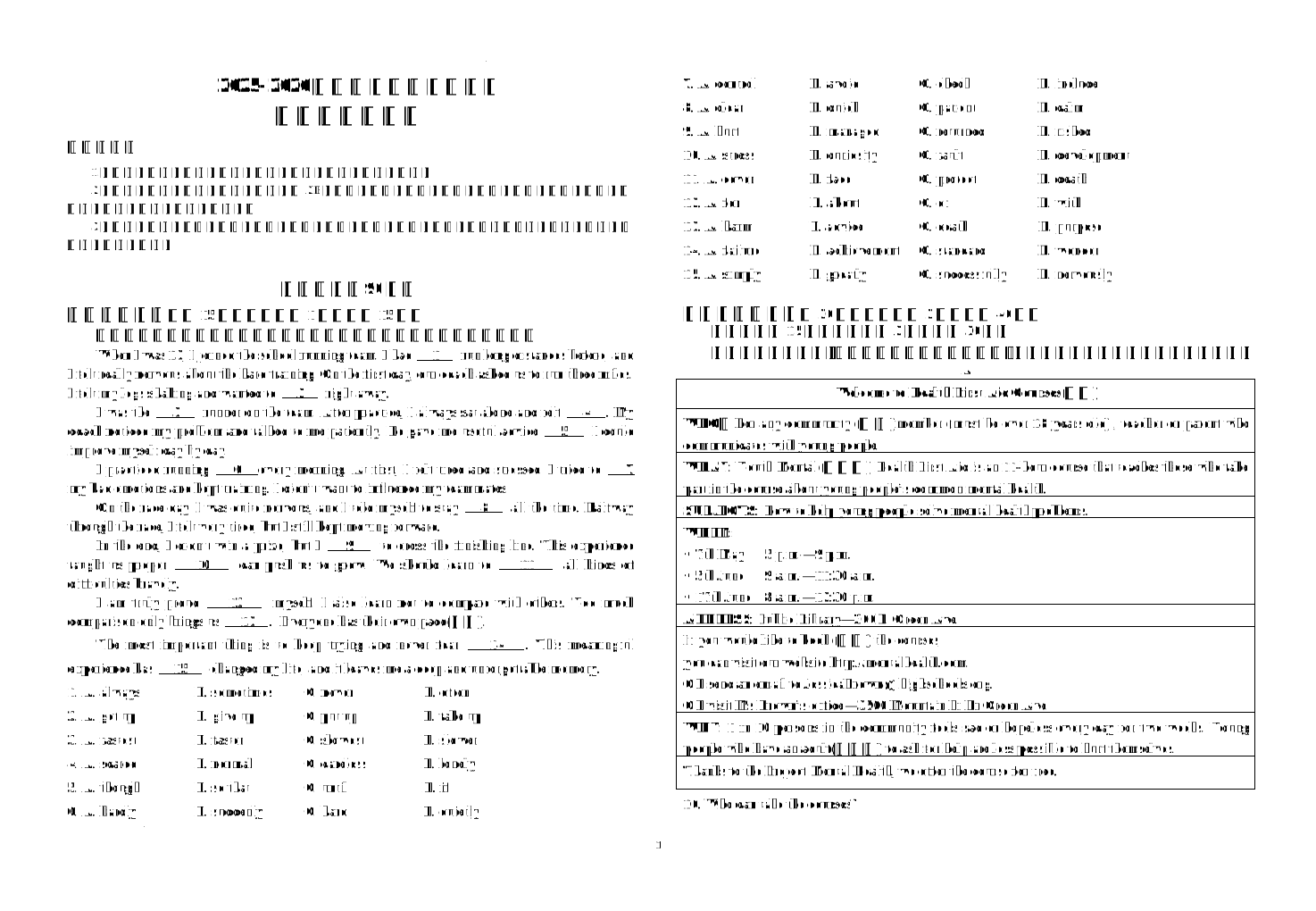
2025-2026学年度下学期五月月考
八年级英语试卷
注意事项:
1.答卷前,考生务必将自己的姓名、班级填写在试卷和答题卡上。
2.选择题的作答:每小题选出答案后,用2B铅笔把答题卡上对应题目的答案标号涂黑。写在试卷、草稿纸和答题卡上的非答题区域均无效。
3.非选择题的作答:用黑色签字笔直接答在答题卡上对应的答题区域内,写在试卷、草稿纸和答题卡上的非答题区域均无效。
笔试部分(90分)
一、完形填空(共15小题,每小题1分,满分15分)
阅读短文,从每小题所给的四个选项中,选出最佳选项,填入空白处。
When I was 13, I joined the school running team. I had 1 run long distances before, and I felt really nervous about the hard training. On the first day, our coach asked us to run three miles. I felt my legs shaking and wanted to 2 right away.
I was the 3 runner on the team. After practice, I always sat alone and felt 4 . My coach noticed my problem and talked to me patiently. He gave me useful advice 5 I could improve myself day by day.
I practiced running 6 every morning. At first, I felt tired and stressed. I tried to 7 my bad emotions and kept training. I didn’t want to influence my teammates.
On the race day, I was quite nervous, and I told myself to stay 8 all the time. Halfway through the race, I felt very tired, but I still kept moving forward.
In the end, I didn’t win a prize, but I 9 to cross the finishing line. This experience taught us proper 10 can push us to grow. We should learn to 11 all kinds of difficulties bravely.
I am truly proud 12 myself. I also learn not to compare with others. Too much comparison only brings us 13 . Everyone has their own pace(节奏).
The most important thing is to keep trying and never fear 14 . This meaningful experience has 15 changed my life, and it leaves me a deep and unforgettable memory.
1. A. always B. sometimes C. never D. often
2. A. get up B. give up C. put up D. take up
3. A. fastest B. faster C. slowest D. slower
4. A. scared B. normal C. careless D. lonely
5. A. though B. so that C. until D. if
6. A. hardly B. suddenly C. hard D. quietly
7. A. control B. avoid C. check D. include
8. A. clear B. quick C. patient D. calm
9. A. hurt B. managed C. returned D. risked
10. A. stress B. curiosity C. fault D. development
11. A. cover B. face C. protect D. death
12. A. for B. about C. of D. with
13. A. harm B. advice C. death D. purpose
14. A. failure B. achievement C. standard D. wonder
15. A. simply B. greatly C. successfully D. nervously
二、阅读理解(共20小题,每小题2分,满分40分)
第一节(共15小题,每小题2分,满分30分)
阅读以下三篇短文,从每小题所给的四个选项中,选出一个与短文内容相符的最佳选项。
A
Welcome to Health First Aid Courses(课程)
WHO:For any community (社区)member (must be over 18 years old) , teacher or parent who communicates with young people.
WHAT: Youth Mental (心理的) Health First Aid is an 11-hour course that teaches those who take part in the course about young people’s common mental health.
SUBJECTS: How to help young people solve mental health problems.
WHEN:
• 7th May 5 p.m.—9 p.m.
• 5th June 9 a.m.—11:30 a.m.
• 17th June 8 a.m.—12:30 p.m.
ADDRESS: Public Library—300N. Green Ave.
If you would like to book (预定) the courses,
you can visit our website http://mentalhealth.com.
OR send an email to JessicaBrown@ highschools.org.
OR visit Ms Brown’s office—3500 Mountain Li Dr Green Ave.
WHY: 1 in 10 persons in the community feels sad or hopeless every day for two weeks. Young people who have an adult(成年人) to ask for help are less possible to hurt themselves.
Thanks to the Project Mental Health, we offer the course for free.
16. Who can take the courses?
A. All community members.
B. Adults like parents and teachers.
C. Primary school students.
D. Young children.
17. How long is the course on 5th June?
A. For 2.5 hours.
B. For 4 hours.
C. For 4.5 hours.
D. For 5 hours.
18. How many ways are there to book the course?
A. One
B. Two
C. Three
D. Four
19. What can can we learn from the text?
A. The courses can’t help parents and their children.
B. 90% of people feel sad every day for two weeks.
C. There are 3 courses in June.
D. You don’t need to pay for the courses.
20. Where is this text most probably from?
A. A science magazine.
B. A community notice.
C. A travel guide.
D. An invitation.
B
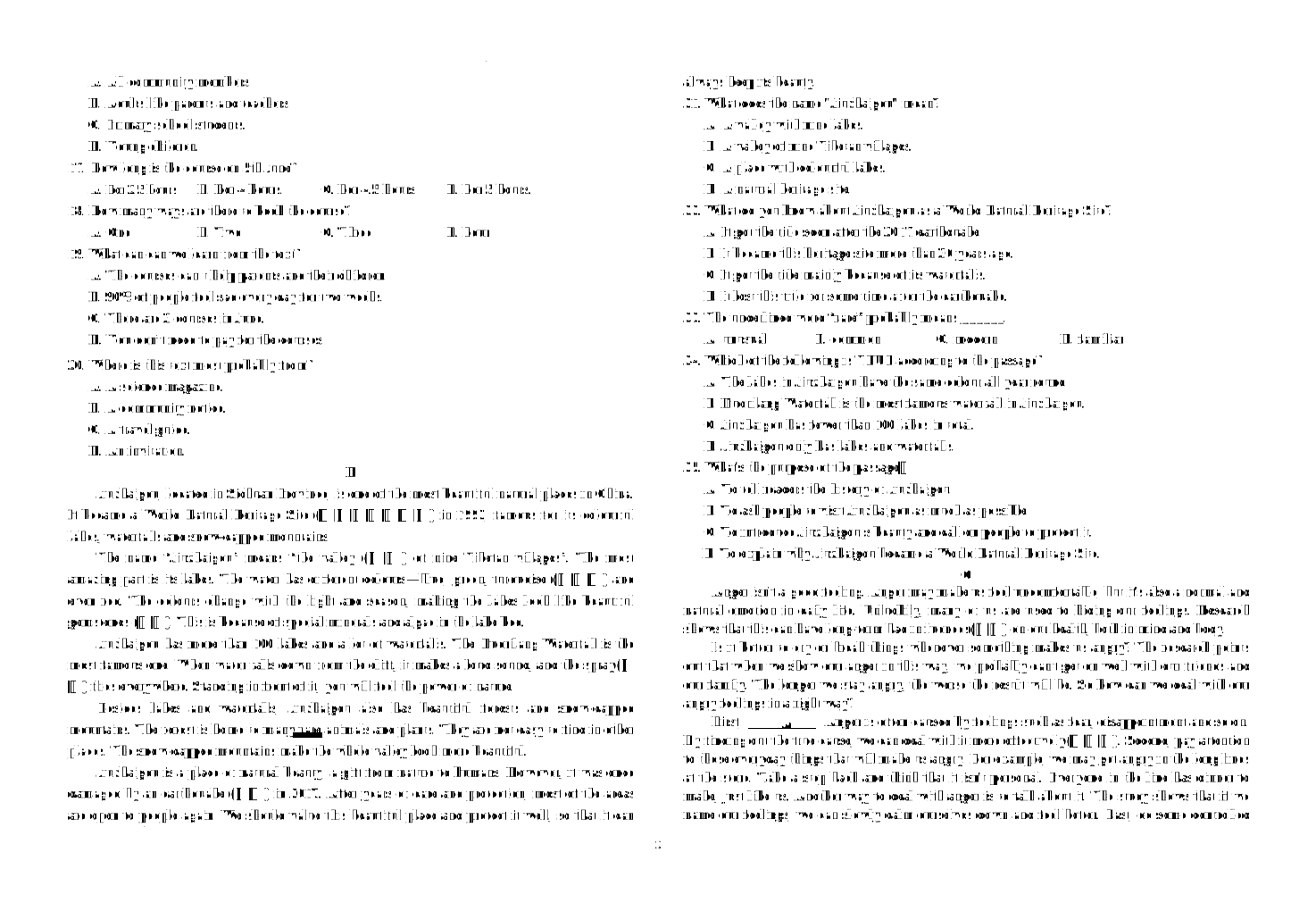
Jiuzhaigou, located in Sichuan Province, is one of the most beautiful natural places in China. It became a World Natural Heritage Site (世界自然遗产地) in 1992, famous for its colourful lakes, waterfalls and snow-capped mountains.
The name “Jiuzhaigou” means “the valley (山谷) of nine Tibetan villages”. The most amazing part is its lakes. The water has different colours—blue, green, turquoise (青绿色) and even red. The colours change with the light and season, making the lakes look like beautiful gemstones (宝石). This is because of special minerals and algae in the lake bed.
Jiuzhaigou has more than 100 lakes and a lot of waterfalls. The Nuorilang Waterfall is the most famous one. When water falls down from the cliff, it makes a loud sound, and the spray(水花) flies everywhere. Standing in front of it, you will feel the power of nature.
Besides lakes and waterfalls, Jiuzhaigou also has beautiful forests and snow-capped mountains. The forest is home to many rare animals and plants. They are not easy to find in other places. The snow-capped mountains make the whole valley look more beautiful.
Jiuzhaigou is a place of natural beauty, a gift from nature to humans. However, it was once damaged by an earthquake (地震) in 2017. After years of care and protection, most of the areas are open to people again. We should value this beautiful place and protect it well, so that it can always keep its beauty.
21. What does the name "Jiuzhaigou" mean?
A. A valley with nine lakes.
B. A valley of nine Tibetan villages.
C. A place with colourful lakes.
D. A natural heritage site.
22. What do you know about Jiuzhaigou as a World Natural Heritage Site?
A. It got the title soon after the 2017 earthquake.
B. It became this heritage site more than 30 years ago.
C. It got the title mainly because of its waterfalls.
D. It lost this title for some time after the earthquake.
23. The underlined word “rare” probably means ______.
A. unusual
B. common
C. modern
D. familiar
24. Which of the following is TRUE according to the passage?
A. The lakes in Jiuzhaigou have the same colour all year round.
B. Nuorilang Waterfall is the most famous waterfall in Jiuzhaigou.
C. Jiuzhaigou has fewer than 100 lakes in total.
D. Jiuzhaigou only has lakes and waterfalls.
25. What's the purpose of the passage?
A. To tell readers the history of Jiuzhaigou.
B. To ask people to visit Jiuzhaigou as much as possible.
C. To introduce Jiuzhaigou’s beauty and call on people to protect it.
D. To explain why Jiuzhaigou became a World Natural Heritage Site.
C
Anger isn't a good feeling. Anger may make us feel uncomfortable, but it's also a normal and natural emotion in daily life. Unluckily, many of us are used to hiding our feelings. Research shows that this can have long-term bad influences(影响) on our health, both in mind and body.
Is it better to cry or break things whenever something makes us angry? The research points out that when we show our anger in this way, we probably can't get on well with our friends and our family. The longer we stay angry, the worse the result will be. So how can we deal with our angry feelings in a right way?
First, ▲ Anger is often caused by feelings such as fear, disappointment and so on. By finding out the true cause, we can deal with it more effectively(有效的). Second, pay attention to those everyday things that will make us angry. For example, we may get angry in the long lines at the store. Take a step back and think that it isn't personal. Everyone in the line has dinner to make, just like us. Another way to deal with anger is to talk about it. The study shows that if we name our feelings, we can slowly calm ourselves down and feel better. Last, do some controlled breathing or find some helpful exercise to do. Exercise helps with feelings of anger.
If we learn to deal with anger properly, we will feel calmer, get on better with others and live a happier life.
26. How does the writer lead into the topic in Paragraph 2?
A. By telling a story.
B. By asking a question.
C. By giving an example.
D. By listing numbers.
27. Which of the following is right?
(X means how long we stay angry; Y means the bad influence it will have.)
A. B. C. D.
28. Which of the following can be put in“ ▲ ”in Paragraph 3?
A. learn to control our anger.
B. know what makes us angry.
C. hide our bad feeling quietly.
D. try not to be angry.
29. Which can help deal with feelings of anger according to the passage?
① Taking some exercise.
② Eating delicious food.
③ Talking about the feelings.
④ Doing some controlled breathing.
A. ①②③ B. ②③④ C. ①③④ D. ①②④
30. Which of the following can be the best title for the passage?
A. What makes you angry?
B. Why are you angry?
C. When to deal with anger
D. How to deal with anger
第二节(共5小题,每小题2分,满分10分)
阅读短文,从方框内所给的选项中,选出能填入空白处的最佳选项,使短文通顺、连贯。(选项中有一项为多余选项)
Every year thousands of people get hurt or die when they are crossing the road. 31 Old people often get hurt or die because they can't see or hear very well. Children usually meet with accidents because of their carelessness. 32
How can we avoid traffic accidents? 33 For the drivers, they shouldn't drive too fast. If they drive too fast, it will be very difficult for the cars to stop in a very short time. For the pedestrians(行人), it's very important to be careful when they are walking on the road. 34 We must stop and look around before crossing the road. Look left first, next look right, and then look left again. Only when we are sure that the road is safe can we cross it. 35 It's not safe to run. If people run across the road, they may fall. As teenagers, we should try to help little children, old people or blind people to cross the road, and never play in the street.
(
A. So, when we walk across the road, we must try to walk along the pavements
(人行道)
.
B. As a result, more and more traffic accidents have happened.
C. They forget to look and listen before they cross the road.
D. All of us must
follow
the traffic rules.
E. Most of these people are old people and children.
F. The right way to cross the road is to walk quickly.
)
三、短文填空(共10小题,每小题1分,满分10分)
阅读短文,从方框中选出恰当的单词并用其适当形式填空,使短文通顺、意思完整。
每空仅填一词,每词仅用一次。
(
about
joy
reduce
I meaning
although
surprisingly
little
ski
express
help
)
What do students actually do for fun? Last week, I did a survey by 36 to learn about how Grade 8 students relax on weekends. I asked 500 students 37 their favourite ways to relax. After getting the answers, I sorted out the results.
The results show that 50% of the students choose to use their phones or computers to relax. Another 20% prefer reading books, such as storybooks, and they get great 38 from wonderful stories. 39 , some have a special interest in reading poems. Another 20% enjoy listening to music because it can 40 stress. Some like to sing to 41 their feelings, while others prefer playing instruments. Finally, only 10% of the students enjoy sports. 42 they have a lot of schoolwork to do, they still like to go climbing or play ball games outdoors with friends. Some even try going 43 in winter.
We all know that TV shows, phones and computers are popular. But too much screen time can cause eye problems. Let’s do something 44 to help ourselves grow! From now on, try to spend 45 time on phones and more time reading or doing sport with friends.
四、读写结合(共两节,满分25分)
第一节 任务型阅读(共5小题,每小题2分,满分10分)
阅读短文,用英文填空或回答问题(注意每小题的词数要求)。
He was a traveler over 500 years ago. He spent about 30 years traveling across China. His name is Xu Xiake. He is from Jiangsu Province. When he was a child, Xu enjoyed reading books about Chinese mountains and rivers. He made a wish then. He wanted to see them one day.
At that time, many children studied hard to become officials(官员). Xu's father never made him take exams. He let his son go out and discover(探索) the world. Xu started to travel when he was about 20 years old.
Xu traveled to 21 provinces and over 100 cities in China. He climbed lots of mountains and discovered over 350 caves(洞穴). And he discovered the Yangtze River's headwaters(河流源头).
Xu usually traveled on foot. He slept and ate in the wild. Sometimes he fell into rivers or ran into dangerous animals. But Xu still enjoyed traveling. He kept a diary when traveling and the book The Travels of Xu Xiake is still popular today!
46. What did Xu Xiake dream of seeing when he was a child? (不超过10词)
47-49. Fill in the blanks according to the passage.
Xu Xiake’s travelling experiences
Age
When he was 47 , he started to travel.
(不超过5词)
Achievements
· Visited 21 provinces and over 100 cities
· Climbed lots of mountains and discovered over 350 caves
· Discovered the headwaters of 48
(不超过5词)
Difficulties
• Traveled on foot
· Slept and ate in the wild
· 49 or ran into dangerous animals
(不超过5词)
50. What can you learn from Xu Xiake?
(结合自身实际,不超过20词)
第二节 书面表达(共1题,满分15分)
在你成长的过程中,一定有人(如父母、老师、朋友等)在你学习、生活上,给予过你帮助、鼓励或启发。学校英语网站正在开展以 The Person I Want to Thank Most 为主题的征文活动。假如你是李华,请写一封英语书信,向他/她表达感谢。
要点:
1. Who do you want to thank most?
2. How did he/she help you (in study, life )?
3. What changes did you have because of his/her help?
4. Your thanks and wishes to him/her.
参考词汇&短语
lonely, upset, afraid, confident, patient, encourage
do badly in,be kind to, with sb’s help ,make progress
注意:
1. 词数80词左右,开头和结尾已给出,不计入总词数。
2. 文中不得出现真实姓名、校名及其他个人相关信息。
3. 语句通顺,逻辑连贯,表达清晰,书写规范。
Dear ,
I’m writing this letter to express my sincere thanks to you.
__________________________________________________________________________________________
__________________________________________________________________________________________
__________________________________________________________________________________________
__________________________________________________________________________________________
__________________________________________________________________________________________
__________________________________________________________________________________________
__________________________________________________________________________________________
__________________________________________________________________________________________
__________________________________________________________________________________________
__________________________________________________________________________________________
Best wishes,
Li Hua
(
2
)
学科网(北京)股份有限公司
$
资源预览图
1
2

相关资源
由于学科网是一个信息分享及获取的平台,不确保部分用户上传资料的 来源及知识产权归属。如您发现相关资料侵犯您的合法权益,请联系学科网,我们核实后将及时进行处理。