广东广州市黄埔区广州市玉岩中学2025-2026学年第二学期期中教学质量监测高一英语试卷
 切换试卷
切换试卷
2026-05-19
|
10页
|
27人阅读
|
1人下载
资源信息
| 学段 | 高中 |
|---|---|
| 学科 | 英语 |
| 教材版本 | - |
| 年级 | 高一 |
| 章节 | - |
| 类型 | 试卷 |
| 知识点 | - |
| 使用场景 | 同步教学-期中 |
| 学年 | 2026-2027 |
| 地区(省份) | 广东省 |
| 地区(市) | 广州市 |
| 地区(区县) | 黄埔区 |
| 文件格式 | DOCX |
| 文件大小 | 39 KB |
| 发布时间 | 2026-05-19 |
| 更新时间 | 2026-05-19 |
| 作者 | 匿名 |
| 品牌系列 | - |
| 审核时间 | 2026-05-19 |
| 下载链接 | https://m.zxxk.com/soft/57942413.html |
| 价格 | 3.00储值(1储值=1元) |
| 来源 | 学科网 |
摘要:
**基本信息**
本试卷以时代性情境与分层设计为特色,涵盖科技(太空“合唱波”)、文化(清明节)、社会热点(睡眠拖延症)等主题,融合语言能力、文化意识与思维品质考查,适配高一学情。
**题型特征**
|题型|题量/分值|知识覆盖|命题特色|
|----|-----------|----------|----------|
|阅读理解|15题37.5分|细节理解、推理判断|素材含《了不起的盖茨比》音乐剧、情感智能双面性等,兼具人文与思辨|
|应用文写作|1题25分|语言表达、文化意识|以“The Person I Admire most”为主题,结合袁隆平事迹,考查价值表达与逻辑组织|
内容正文:
广州市玉岩中学 2025 学年第二学期期中教学质量监测
高一英语
说明:本试卷分第I卷和第II卷。第I卷为选择题,共 35 题共 65 分,第II卷为非选择题,共 65 分,全卷共 130 分。考试时间为 120 分钟
第I卷(选择题)
注意事项:
1.答第I卷前,考生务必用 2B 铅笔将姓名、准考证号填写在答题卡上,并用 2B 铅笔在答题卡上规定位置涂黑自己的试卷类型、考试证号和考试科目。
2.每小题选出答案后,用铅笔涂黑答题卡上对应题目的答案标号。如需改动,用橡皮擦干净后,再选涂其他答案。(答案写在试题卷上无效)
第一部分 阅读(共两节,满分 50 分)
第一节 阅读理解(共 15 小题;每小题 2.5 分,满分 37.5 分)
阅读下列短文,从每题所给的 A、B、C、D 四个选项中选出最佳选项。
A
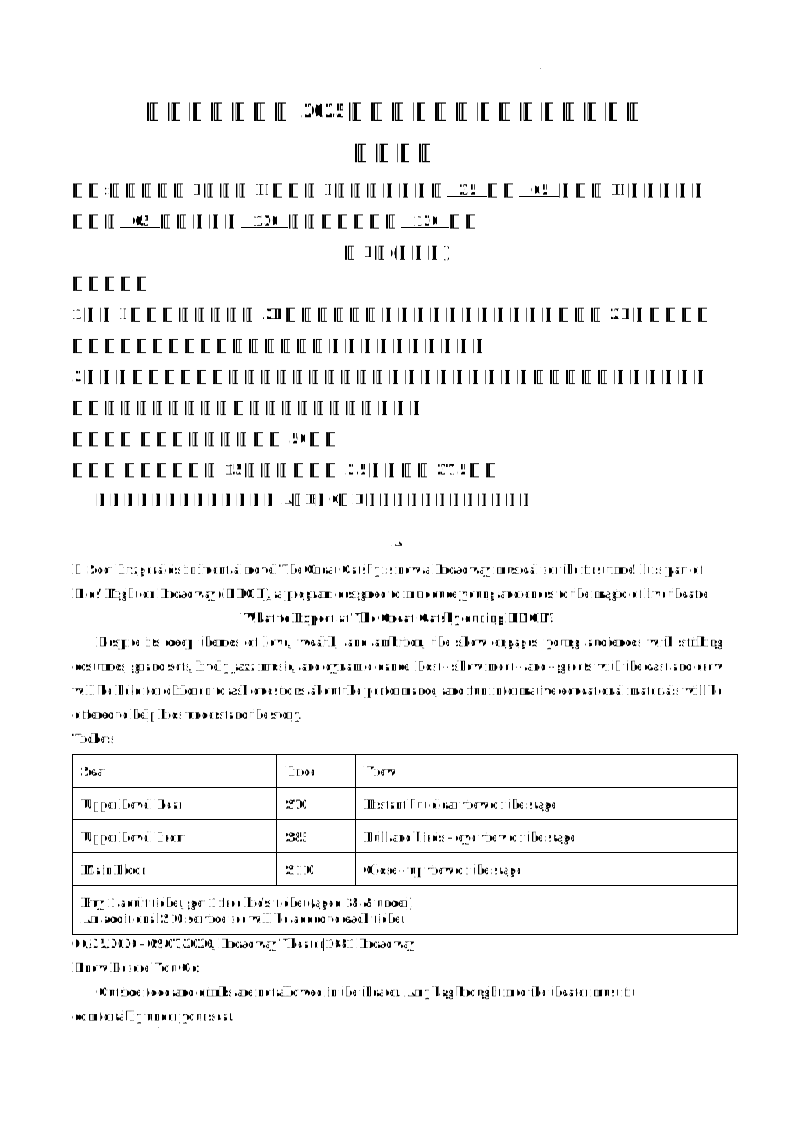
F. Scot Fitzgerald's influential novel The Great Gatsby is now a Broadway musical for the first time! It is part of Kids' Night on Broadway (KNOB), a program designed to introduce young audiences to the magic of live theatre.
What to Expect at The Great Gatsby during KNOB?
Despite its deep themes of love, wealth, and ambition, the show engages young audiences with striking costumes, grand sets, lively jazz music, and dynamic dance. Post - show meet - and - greets with the cast and crew will be held for children to ask questions about the performance, and fun informative educational materials will be offered to help kids understand the story.
Tickets
Seat
Price
View
Upper Level Rear
$70
Distant but clear view of the stage
Upper Level Front
$85
Full and bird's - eye view of the stage
Main Floor
$110
Close - up view of the stage
Buy 1 adult ticket, get 1 free kid's ticket (aged 18 & under).
An additional $10 service fee will be added to each ticket.
06/25/2026 - 09/07/2026, Broadway Theater|1681 Broadway
Know Before You Go:
Outside food and drinks are not allowed in the theater. Any bag brought into the theater must fit
comfortably under your seat.
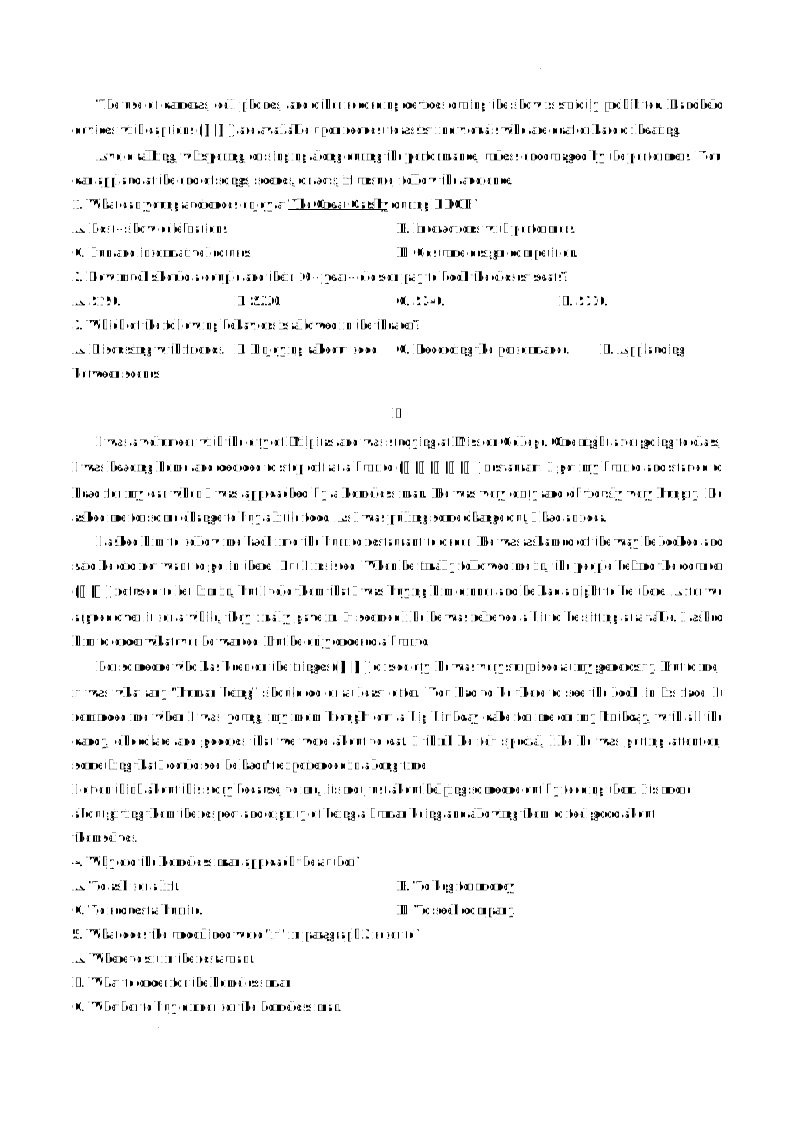
The use of cameras, cell phones, and other recording devices during the show is strictly prohibited. Handheld devices with captions (字幕) are available upon request to assist individuals who are deaf or hard of hearing.
Avoid talking, whispering, or singing along during the performance, unless encouraged by the performers. You can applaud at the end of songs, scenes, or acts; if unsure, follow the audience.
1. What can young audiences enjoy at The Great Gatsby during KNOB?
A. Post - show celebrations. B. Interactions with performers.
C. Fun and informative lectures. D. Costume design competition.
2. How much should a couple and their 16 - year - old son pay to book the closest seats?
A. $190. B. $220. C. $240. D. $330.
3. Which of the following behaviors is allowed in the theater?
A. Discussing with friends. B. Enjoying takeout food. C. Recording the performance. D. Applauding between scenes.
B
I was a volunteer with the city of Milpitas and was studying at Mission College. One night after going to class, I was heading home and decided to stop off at a burrito (墨西哥卷饼) restaurant. I got my burrito and started to head for my car when I was approached by a homeless man. He was very dirty and obviously very hungry. He asked me for some change to buy a little food. As I was pulling some change out, I had an idea.
I asked him to follow me back into the burrito restaurant to order. He was ashamed of the way he looked and said he did not want to go in there. But I insisted. When he finally followed me in, the people behind the counter (柜台) refused to let him in, but I told them that I was buying him dinner and he had a right to be there. After we argued over it for a while, they finally gave in. It seemed like he was relieved a bit to be sitting at a table. I asked him to order whatever he wanted. But he only ordered a burrito.
For someone who has been on the fringes (边缘) of society, he was very surprised at my generosity. But to me, it was what any "human being" should do or at least offer. You had to be there to see the look in his face. It reminded me when I was young, my mom brought out a big birthday cake for me on my birthday, with all the candy, chocolate and goodies that we were about to eat. I think he felt special, like he was getting attention, something that I could see he hadn't experienced in a long time.
I often think about this story because, to me, it's not just about helping someone out by feeding them. It's more about giving them the respect and dignity of being a human being and allowing them to feel good about themselves.
4. Why did the homeless man approach the author?
A. To ask for a lift. B. To beg for money.
C. To request a burrito. D. To seek company.
5. What does the underlined word "it" in paragraph 2 refer to?
A. Where to sit in the restaurant.
B. What to order for the homeless man.
C. Whether to buy dinner for the homeless man.
D. Whether to allow the homeless man to enter the restaurant.
6. Why does the author mention his birthday in paragraph 3?
A. To demonstrate his wonderful childhood.
B. To stress the importance of enjoying a feast.
C. To contrast his life with that of the homeless man.
D. To describe the happy feelings of the homeless man.
7. What does the author suggest doing in the last paragraph?
A. Treating others with respect. B. Fighting against the world of hunger.
C. Encouraging acts of bravery. D. Paying attention to the homeless.
C
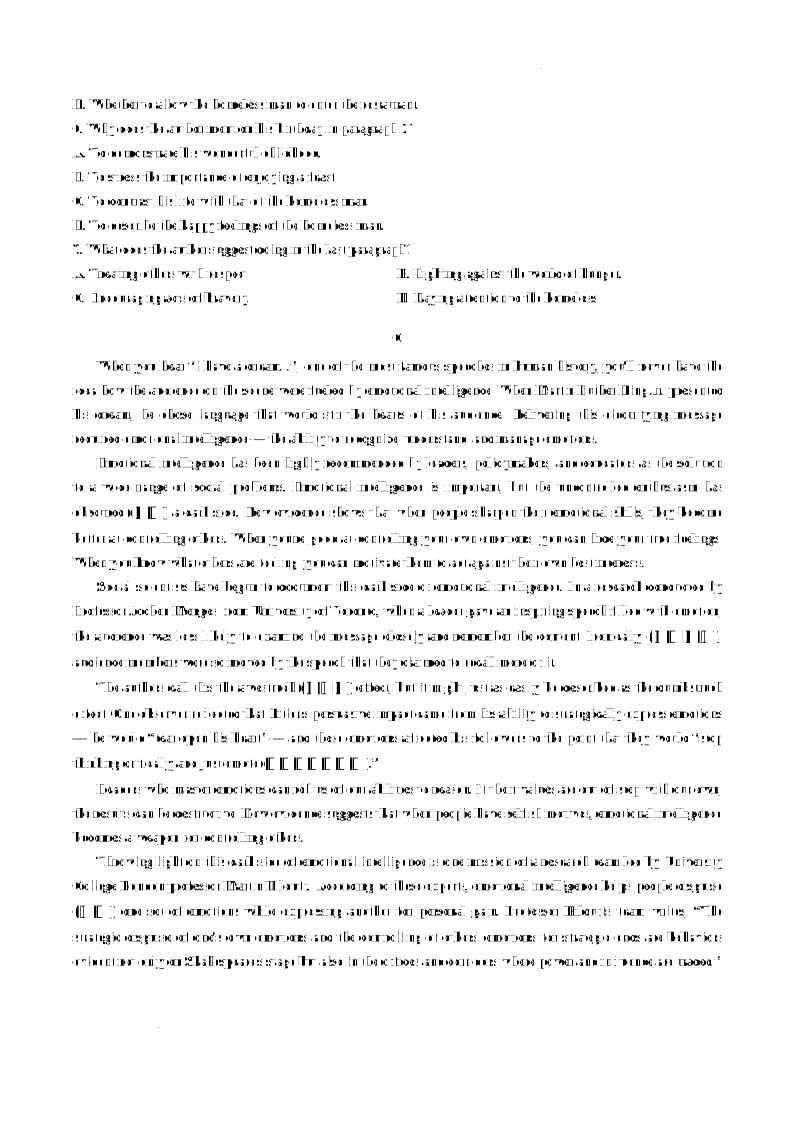
When you hear “I have a dream...”, one of the most famous speeches in human history, you'll never have the idea how the audience on the scene were fueled by emotional intelligence. When Martin Luther King Jr. presented his dream, he chose language that would stir the hearts of his audience. Delivering this electrifying message required emotional intelligence — the ability to recognize, understand, and manage emotions.
Emotional intelligence has been highly recommended by leaders, policymakers, and educators as the solution to a wide range of social problems. Emotional intelligence is important, but the uncontrolled enthusiasm has obscured (掩盖) a dark side. New evidence shows that when people sharpen their emotional skills, they become better at controlling others. When you're good at controlling your own emotions, you can hide your true feelings. When you know what others are feeling, you can motivate them to act against their own best interests.
Social scientists have begun to document this dark side of emotional intelligence. In a research conducted by Professor Jochen Menges from University of Toronto, when a leader gave an inspiring speech filled with emotion, the audience was less likely to examine the message closely and remember the content. Ironically (讽刺的是), audience members were so moved by the speech that they claimed to recall more of it.
The authors call this the awestruck (敬畏的) effect, but it might just as easily be described as the dumbstruck effect. One observer reflected that Hitler's persuasive impact came from his ability to strategically express emotions — he would “tear open his heart” — and these emotions affected his followers to the point that they would “stop thinking critically and just emote (夸张地表达感情).”
Leaders who master emotions can rob us of our abilities to reason. If their values are out of step with our own, the results can be destructive. New evidence suggests that when people have selfish motives, emotional intelligence becomes a weapon for controlling others.
Throwing light on this dark side of emotional intelligence is one mission of a research team led by University College London professor Martin Kilduff. According to these experts, emotional intelligence helps people disguise (伪装) one set of emotions while expressing another for personal gain. Professor Kilduffs team writes, “The strategic disguise of one's own emotions and the controlling of others' emotions for strategic ends are behaviors evident not only on Shakespeare's stage but also in the offices and corridors where power and influence are traded.”
Of course, people aren't always using emotional intelligence for evil ends. More often than not, high EQ is helpful in most aspects of our life. Emotional intelligence — like any skill — can be used for good or evil. So whether it is a gift or a curse lies in your hand.
8. Why does the author mention Martin Luther King, Jr?
A. To advocate a society with fewer problems.
B. To recommend his speech to other leaders.
C. To honor the great leader for his courage.
D. To introduce the major topic to readers.
9. What is the dumbstruck effect of Hitler's emotional intelligence?
A. His followers would tear open their hearts to him.
B. His followers would express emotions strategically.
C. His followers would develop the self - serving motives.
D. His followers would lose the ability to reason properly.
10. How do people use their emotional intelligence for personal gain?
A. They disguise their true emotions and show another one.
B. They present their strategic behaviors on the stage.
C. They help their colleagues to build up confidence.
D. They lower their own dignity to gain popularity.
11. What would be the suitable title for the passage?
A. The benefits of emotional intelligence. B. The reasons for using emotional skills.
C. The dark side of emotional intelligence. D. The advantages and disadvantages of emotions.
D
On January 22, international researchers shared a significant finding in the scientific journal Nature. They discovered bursts of energy in an unexpected part of space, which they named "chorus waves". These waves got their name because they vibrate (震动) at the same rates as the sounds we can hear. When changed into hearable signals, they sound just like birds chirping (鸣叫) cheerfully.
Scientists have been aware of chorus waves in space for years. However, the latest study brought a big surprise. The researchers found that these waves exist as far as 100,000 kilometers away from Earth. This is the greatest distance at which chorus waves have ever been detected from a planet.
Chengming Liu, a study writer from Beihang University, stated in an email, "Chorus waves are one of the strongest and most significant waves in space." Allison Jaynes, a space physicist not participating in this study, commented, "This opens up a lot of new questions about the physics that could be possible in this area."
The newfound chorus waves were detected in an area where Earth's magnetic (磁的) field extends. Scientists didn't expect to find them there. Now, they're eager to figure out how these unique waves form. Jaynes added, "We surely need to find more of these events."
Scientists still are not sure how chorus waves develop, but they believe Earth's magnetic field is related to it. In the past, radio antennas (天线) detected chorus waves. For example, in the 1960s, an Antarctic research station picked them up. NASA's Van Allen Probes also heard the chirping sounds, but from a closer distance. The most recent chorus waves were detected by NASA's Magnetospheric Multiscale satellites, which were sent into space in 2015 to study Earth and the sun's magnetic fields.
Chorus waves have also been found near other planets including Jupiter and Saturn. The waves can
produce high - energy electrons. That means they can be a danger to satellite communications. The researchers said their findings suggest that chorus waves might be found everywhere in the magnetic fields of planets.
12. What makes chorus waves get their name?
A. The place where they are first discovered.
B. Their vibration rates like hearable sounds.
C. The way they affect satellite signals.
D. Their movement speed in space.
13. What can be inferred from the scientists' comments?
A. Further research is crucial. B. Wave creation is clear.
C. Discoveries lack importance. D. Waves pose satellite risks.
14. Which detected the chorus waves at the greatest distance from Earth?
A. NASA's Van Allen Probes.
B. Scientists from Beihang University.
C. An Antarctic research station in the 1960s.
D. NASA's Magnetospheric Multiscale satellites.
15. Which is the best title for the text?
A. The Naming Story of Chorus Waves
B. Chorus Waves: A New Threat to Satellites
C. Revealing the Mysteries of Chorus Waves
D. Scientists' Great Debate on Chorus Waves
第二节 七选五(共 5 小题;每小题 2.5 分,满分 12.5 分)
根据下面短文,从短文后的选项中选出可以填入空白处的最佳选项。选项中有两项为多余选项。
Film has seen great progress over the years. While actors and directors often receive most of the praise, the heroes behind the screen are the musicians who make a film unforgettable. 16 This is the kind of music we call a film score (配乐). It has developed through several stages.
In the silent film era, music was used to fill the silence. 17 They had to respond in real time to the changing scenes, adjusting their music to match the mood. This was the early form of film scoring.
The shift from live performance to written scores began in the early 1900s. French composer (作家) Camille Saint - Saens was the first to write original music specially for film. This marked a new stage of film scoring. 18 . They worked closely with directors. As sound technology advanced, film scoring became an important part of the film - making process.
19 By the mid - 20th century, they grew to include rock, pop, hip - hop, and electronic music. Films like Saturday Night Fever used popular music to define both character and culture. In science fiction films, electronic sounds were used to create a sense of the unknown.
Today, film musicians continue to shape the way we experience films. Masters like Hans Zimmer have moved us deeply with the beautiful score in Interstellar. Combining traditional instruments with digital production in innovative ways, he has brought us new sounds. 20
A. The film industry gained big success.
B. From then on, more composers joined in.
C. Musicians would play live music in theaters.
D. As a new kind of music, it faced many challenges.
E. His music takes us on a whole new journey of the senses.
F. Through the years, film scores took on various musical styles.
G. Their music deepens emotion and connects the audience to the story.
第二部分 语言运用 (共两节,满分 30 分)
第一节 完形填空 (共 15 小题;每小题 1 分,满分 15 分)
阅读下面短文,从每题所给的 A、B、C、D 四个选项中选出可以填入空白处的最佳选项。
Have you ever told yourself, “Just five more minutes” before bed, only to find yourself still awake an hour later? If so, you're not 21 . Sleep procrastination (拖延症) — delaying bedtime despite knowing the consequences — isn't unusual.
Some might 22 a lack of self - discipline. But the truth is, sleep procrastination is more complex than just poor time management. Both psychological and emotional factors make it difficult to 23 go to bed earlier.
During the day, we are busy with 24 : school, homework, chores and endless tasks. By the time night rolls around, we finally feel 25 our time, so we stay up late as a form of rebellion (反抗). It's not just bedtime procrastination; it's revenge (报复) procrastination. Instead of resting, we seek out distractions: scrolling through social media, binge - watching or playing games. These activities might 26 stress, but here's the kicker: Staying up late doesn't actually make you feel better. Instead, it leaves you looking and feeling 27 , squinting (眯着眼看) at the classroom whiteboard, wondering if it's a secret code that you're too tired to crack.
The problem is that most of these activities are designed to keep us 28 . Social media apps, video platforms and even games trigger dopamine releases, making it hard to stop. Our brains want the next small hit of pleasure five minutes after another, even though our bodies are begging for sleep. It's an unfavorable 29 . But it's one that we can break.
We need to redefine relaxation by creating moments of pleasure during the day, so we don't feel the need to steal “me - time” at night. We should form a 30 routine: dim the lights, 31 and wind down with a book or a calming activity. Overstimulating activities, like action movies, intense gaming or heated debates on social media right before bed, should be avoided. 32 , we ought to treat sleep like a luxury instead of just a way to 33 for the next day. Start regarding it as an all - expenses - paid vacation to Dreamland. Cozy blankets? Check. Fluffy pillows? Check. Waking up feeling like an actual human? Priceless. Revenge bedtime procrastination might seem like a small victory, but the real win is waking up feeling 34 . So tonight, when that “five more minutes” voice starts whispering, tell it: “nice try, but I choose self - care and functioning brain cells instead.” Believe me, your 35 self will thank you for it.
21.A. unique B. alone C. anxious D. guilty
22.A. name it after B. attribute it to C. blame it for D. assign it to
23.A. simply B. directly C. reluctantly D. timely
24.A. adventures B. opportunities C. responsibilities D. challenges
25.A. in place of B. in need of C. in favor of D. in control of
26.A. calm B. relieve C. ignore D. worsen
27.A. relaxed B. confused C. exhausted D. energized
28.A. bored B. attentive C. addicted D. satisfied
29.A. system B. rhythm C. cycle D. hobby
30.A. sleep - friendly B. health - focused C. time - saving D. energy - consuming
31.A. check messages B. lower volume C. avoid screens D. take notes
32.A. For example B. In addition C. In comparison D. Most importantly
33.A. recharge B. refill C. reshape D. replace
34.A. frustrated B. annoyed C. amused D. refreshed
35.A. future B. present C. past D. former
第II卷(非选择题)
第二节 语法填空(共10小题;每小题1.5分,满分15分)
阅读下面短文,在空白处填入1个适当的单词或括号内单词的正确形式。
Qingming Festival is a traditional Chinese holiday 36 (observe) to remember ancestors and honour the dead. Falling around early April, Qingming has great 37 (culture) importance in Chinese society.
The 38 (tradition) of Qingming Festival were not formed overnight; instead, they came from the Cold Food Festival and a sad story about Jie Zitui, a follower of Duke Wen from the state of Jin during the Spring and Autumn Period.
When Duke Wen was in exile (流放), Jie Zitui helped him survive. Wen was so moved that he promised 39 (reward) Jie one day. However, Jie was not the type of person 40 sought rewards.
Later, Wen became the ruler and rewarded his followers. However, Jie Zitui refused any reward and moved to a mountain. When Wen 41 (final) discovered Jie's whereabouts. he ordered his army to set the forest on fire, forcing Jie out. When the fire stopped, Jie 42 (find) dead under a burnt willow tree. In memory 43 Jie, Wen announced that no fires should be lit on the day of Jie's death and people should eat cold food, 44 (give) rise to the Cold Food Festival.
At first, only the state of Jin followed this custom, but later, 45 festival spread across China.
第三部分 写作(共三节,满分50分)
第一节 单词拼写(共10小题,每小题1分,满分10分)
请根据句子的意思和汉语提示完成下列句子,每空只填一个单词。
46. A timely heavy snow promises a good (收成) for farmers this year.
47. Every time he finds new evidence, he (接近) the truth more closely.
48. The old castle, which is (包围) by ancient trees, looks mysterious and fascinating in the moonlight.
49. There stand many stone sculptures of famous historical (人物)
50. She was more interested in (发表) medical research on care for women and children.
51. I saw her (悄声说) something into his ear, obviously not wanting to be heard.
52. I (选择) a Cantonese restaurant that served its food on beautiful china plates.
53. ______ (装饰) with brightly colored lights, the room looks even more beautiful and charming.
54. The UK is a ______ (吸引人的,迷人的) mix of history and modern culture, with both new and old traditions.
55. To their ______ (满意), their son made great achievements in his field.
第二节 句子翻译(共5小题,每小题3分,满分15分)
请根据中文及括号内的提示翻译下列句子。将每一题的答案写在答题卷相应的横线上。
56.英国的历史文化引人入胜,可学之处比比皆是。(There is so much more to...)
_______________________________________________________________________
57. 未曾踏足中国的游客可以在唐人街近距离感受中国传统文化。(allow^ 定语从句)
_______________________________________________________________________
58.他被这段音乐打动了,他说:“那种(兴奋)的感觉就如同第一次看见色彩一样。”(v.-ed 做原因状语)
_______________________________________________________________________
59. 该节日于每年农历六月初四开始的,通常为期3天。(fall on)
_______________________________________________________________________
60. 过了一会儿,一群妇女走了过来,每个人头上都顶着一罐水。(独立主格结构)
_______________________________________________________________________
第三节 应用文(共1题,满分25分)
假如你是李华,学校即将举办以“The Person I Admire most”为主题的英语演讲比赛,请你写一篇演讲稿,介绍一位你最敬佩的人,内容包括:
1. 人物的身份和事迹;
2. 你敬佩他/她的原因;
3. 他/她对你的影响和启示。
注意:
1. 写作词数应为100左右;
2. 演讲稿的开头和结尾已给出,不计入词数;
Ladies and gentlemen,
_______________________________________________________________________
_______________________________________________________________________
_______________________________________________________________________
_______________________________________________________________________
_______________________________________________________________________
_______________________________________________________________________
_______________________________________________________________________
_______________________________________________________________________
Thanks for your listening.
试卷答案
第一部分 阅读
第一节 阅读理解(每小题2.5分,共37.5分)
1
2
3
4
5
6
7
8
9
10
B
C
D
B
D
D
A
D
D
A
11
12
13
14
15
C
B
A
D
C
第二节 七选五(每小题2.5分,共12.5分)
16. G 17. C 18. B 19. F 20. E
第二部分 语言运用
第一节 完形填空(每小题1分,共15分)
21
22
23
24
25
26
27
28
29
30
B
B
A
C
D
B
C
C
C
A
31
32
33
34
35
C
D
A
D
A
第二节 语法填空(每小题1.5分,共15分)
36. observed
37. cultural
38. traditions
39. to reward
40. who/that
41. finally
42. was found
43. of
44. giving
45. the
第三部分 写作
第一节 单词拼写(每小题1分,共10分)
46. harvest
47. approaches
48. surrounded
49. figures
50. conducting
51. whispering
52. selected
53. Decorated
54. attractive
55. satisfaction
第二节 句子翻译(每小题3分,共15分)
56. The history and culture of the UK are fascinating, and there is so much more to learn.
57. Tourists who have never set foot in China can get up close to experience traditional Chinese culture near Chinatown.
58. Moved by the music, he said, "The excited feeling is just like seeing colors for the first time."
59. The festival falls on the fourth day of the sixth month of the lunar calendar every year and usually lasts three days.
60. After a while, a group of women came over, each with a pot of water on her head.
第三节 应用文(25分)
参考范文:
Ladies and gentlemen,
The person I admire most is Yuan Longping, the father of hybrid rice. As a great agricultural scientist, he devoted his whole life to developing higher - yield rice to help solve the problem of hunger in China and even around the world.
I admire him most because of his dedication to his career and his deep care for people's wellbeing. Even when he was already world - famous, he still worked in the fields every day, focusing on his research without any thought of fame or wealth.
His spirit inspires me to study hard and make contributions to the people and the country when I grow up. Whenever I face difficulties in my studies, his example reminds me to keep moving forward.
Thanks for your listening.
要点说明:
身份事迹介绍(8分):点明人物身份,说明其核心贡献
敬佩原因(8分):点明奉献精神、淡泊名利等品质
影响启示(6分):结合自身说明激励作用
语言表达流畅、字数符合要求(3分)
学科网(北京)股份有限公司
$
资源预览图
1
2
3
相关资源
由于学科网是一个信息分享及获取的平台,不确保部分用户上传资料的 来源及知识产权归属。如您发现相关资料侵犯您的合法权益,请联系学科网,我们核实后将及时进行处理。