2026年浙江省温州市龙湾区二模英语试卷
 切换试卷
切换试卷
2026-05-17
|
3份
|
14页
|
268人阅读
|
22人下载
资源信息
| 学段 | 初中 |
|---|---|
| 学科 | 英语 |
| 教材版本 | - |
| 年级 | 九年级 |
| 章节 | - |
| 类型 | 试卷 |
| 知识点 | - |
| 使用场景 | 中考复习-二模 |
| 学年 | 2026-2027 |
| 地区(省份) | 浙江省 |
| 地区(市) | 温州市 |
| 地区(区县) | 龙湾区 |
| 文件格式 | ZIP |
| 文件大小 | 15.84 MB |
| 发布时间 | 2026-05-17 |
| 更新时间 | 2026-05-17 |
| 作者 | 匿名 |
| 品牌系列 | - |
| 审核时间 | 2026-05-17 |
| 下载链接 | https://m.zxxk.com/soft/57899566.html |
| 价格 | 3.00储值(1储值=1元) |
| 来源 | 学科网 |
内容正文:
2026年九年级学生学科素养检测
英语试题
2026.05
考生注意:
1.本试题卷包括四部分,共10页,满分120分,考试时间100分钟。
2.答题前,请务必将自己的姓名、准考证号用黑色字迹的签字笔或钢笔分别填写在试题卷和答题卷规定的位置上。
3.答题时,请按照答题纸上“注意事项”的要求,在答题纸相应的位置上规范作答,在本试题卷上的作答一律无效。
第一部分 听力理解(共三节,满分20分)
第一节(共5小题,每小题1分,满分5分)
听下面5段对话,每段对话后有一个小题,从题中所给的A、B、C三个选项中选出最佳选项,并标在试卷的相应位置。听完每段对话后,你都有10秒钟的时间来回答有关小题和阅读下一小题。每段对话仅读一遍。
1. What will the boy wear?
A. A coat. B. A sweater. C. A jacket.
2. How was the weather yesterday?
A. Rainy. B. Sunny. C. Cloudy.
3. How often does the woman clean the flat?
A. Once a week. B. Twice a week. C. Three times a week.
4. What is Mary going to do?
A. Make party cards. B. Buy some fruits. C. Visit old friends.
5. Where are the speakers now?
A. In the science lab. B. In the dining hall. C. In the music room.
第二节(共5小题,每小题1.5分,满分7.5分)
听下面2段较长对话,每段对话后有几个小题,从题中所给的A、B、C三个选项中选出最佳选项,并标在试卷的相应位置。听每段对话前,你将有时间阅读各个小题,每小题5秒钟;听完后,各小题将给出5秒钟的作答时间。每段对话读两遍。
听下面一段较长对话,回答第6至第7两个小题。
6. When did Daisy leave her hometown?
A. Last June. B. Last July. C. Last August.
7. Who might be talking with Daisy?
A. Her teacher. B. Her friend. C. Her neighbour.
听下面一段较长对话,回答第8至第10三个小题。
8. What does Tom want to buy?
A. A mountain bike. B. A digital camera. C. A sports watch.
9. How much does it cost?
A. 120 dollars. B. 200 dollars. C. 220 dollars.
10. What will Tom do next?
A. Wash his father’s car. B. Sell his old toys. C. Collect used bottles.
第三节(共5小题,每小题1.5分,满分7.5分)
听下面一段独白,独白后有5个小题,从题中所给的A、B、C三个选项中选出最佳选项,并标在试卷的相应位置。听独白前,你将有时间阅读各个小题,每小题5秒钟;听完后,各小题将给出5秒钟的作答时间。独白读两遍。
听下面一段独白,回答第11至第15五个小题。
11. Which place did the speaker visit last Sunday?
A. A zoo. B A park. C. A farm.
12. Why did the speaker go there?
A. To do a project. B. To have a picnic. C. To go on a school trip.
13. What rule did the boy break?
A. Don’t drop litter. B. Don’t climb the tree. C. Don’t step on the grass.
14. What did the boy do after the speaker talked to him?
A. He ran away. B. He said sorry. C. He phoned his mum.
15. How did the speaker feel at last?
A. Upset. B. Warm. C. Proud.
第二部分 阅读理解(共两节,满分40分)
第一节 阅读理解(共15小题,每小题2分,满分30分)
阅读下面短文,从每题所给A、B、C、D四个选项中选出最佳选项。
A
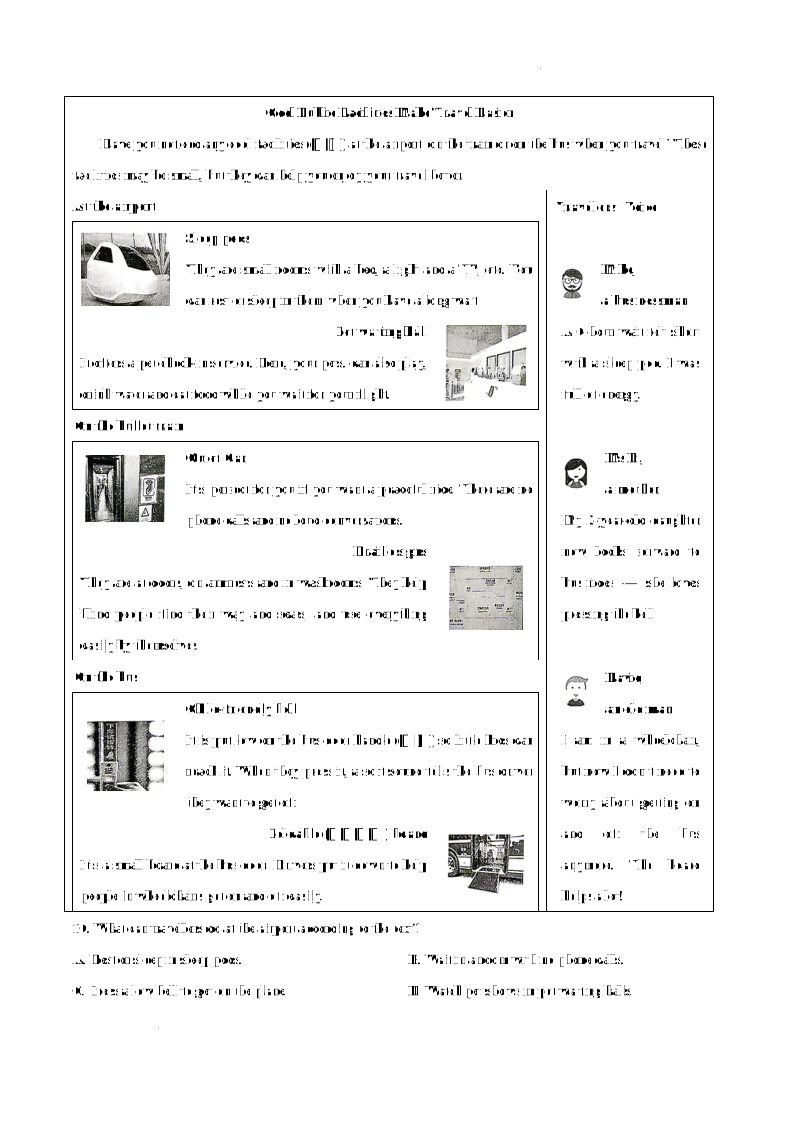
Cool Public Facilities Make Travel Easier
Have you noticed any cool facilities (设施) at the airport, on the train or on the bus when you travel? These facilities may be small, but they can help you enjoy your travel better.
At the airport
Sleep pods
They are small rooms with a bed, a light and a TV, etc. You can rest or sleep in them when you have a long wait.
Pet waiting hall
It offers a pet check-in service. Here, your pets. can also play, drink water and eat food while you wait for your flight.
Travellers’ Voice
Mike,
a businessman
A 6-hour wait felt short with a sleep pod. I was full of energy.
On the bullet train
Quiet Car
It’s perfect for you if you want a peaceful ride. There are no phone calls and no loud conversations.
Braille signs
They are at doors, on armrests and in washrooms. They help blind people find their way and seats, and use everything easily by themselves.
Ms Li,
a mother
My 2-year-old daughter now looks forward to bus rides — she loves pressing the bell.
On the bus
Child-friendly bell
It is put low on the bus door handle (把手) so little kids can reach it. When they press it, a soft sound tells the bus driver they want to get off.
Foldable (可折叠的) board
It’s a small board at the bus door. Drivers put it down to help people in wheelchairs get on and off easily.
David,
an old man
I am in a wheelchair, but now I don’t need to worry about getting on and off the bus anymore. The board helps a lot!
16. What can travellers do at the airport according to the text?
A. Rest or sleep in sleep pods. B. Wait in a room with no phone calls.
C. Press a low bell to get on the plane. D. Watch pet shows in pet waiting halls.
17. Which facility does David think is useful?
A. The braille signs. B. The Quiet Car. C. The child-friendly bell. D. The foldable board.
18. Why do these public places offer facilities according to the text?
A. To make more money. B. To make cities popular.
C. To make travel enjoyable. D. To make travellers safer.
B
Luo Shiyue, a 42-year-old sanitation (环境卫生) worker in Guangzhou, has become famous for his amazing street art. He starts his work at 6 a.m., collecting waste and carrying over 100 heavy rubbish bins of waste to the disposal (处理) station every day. But after work, instead of staying at home, he goes to the streets and turns common utility (设备) boxes into works of art.
Luo’s love for drawing began in primary school after he watched an exciting cartoon. He taught himself to draw, using the books that his father bought him. However, after finishing middle school, he had to work and gave up drawing for nearly 20 years. In 2022, a video of an artist’s work online got him to start drawing again.
At first, Luo painted on old wooden boards in his small room. In February 2026, encouraged by his workmates, he painted in public for the first time. He painted a red kapok flower, the city flower of Guangzhou, on a wall near a subway entrance. People were amazed and stopped to take photos.
Later, Luo joined a community project to make utility boxes more beautiful. In about two months, he has created more than 20 artworks in the streets like flowers, pandas, and lion dance. He shared his street artworks online and they won many people’s hearts. “With a broom, he works as a city beautician; with a paintbrush, he becomes a street artist,” someone praised him online.
“I’m really glad to do my part for the city,” Luo said. “My life has become so wonderful because of my love for painting. I hope everyone finds something they love and makes usual days more colourful.”
19. Where does Luo create his amazing artworks?
A. At home. B. In the streets. C. At school. D. In the disposal station.
20. What made Luo start drawing again in 2022?
A. An exciting cartoon. B. A video of an artwork.
C. The books from his father. D. The support from an artist.
21. Which is the right order of the following?
① Luo shared his street artworks online.
② Luo joined a community painting project.
③ Luo practiced painting on old wooden boards.
④ Luo painted a red kapok flower near a subway entrance.
A. ③④②① B. ②③①④ C. ③②④① D. ④③②①
22. What can we know about Luo according to the text?
A. He is an honest worker. B. He prefers painting with others.
C. His hobby brings joy to his life. D. He hopes to change his job through art.
C
Some people need to take medicine every day. However, it’s not always easy to remember to take the right pills at the right time. This can be especially hard for older people or for patients who take many kinds of medicine. Now a small machine called PillBot can help.
PillBot was invented by Gregory Shechter, a middle school student in California. Gregory saw his grandfather take nearly 30 pills a day. Even with careful notes, his grandpa still couldn’t remember when to take different pills. That’s how Gregory got the idea of inventing PillBot.
PillBot is a smart pill box. It has a 3D-printed shell (外壳). Inside the box, there is a special part with a tiny computer and small motors (马达). When it is time to take medicine, this part pushes out pills. It also makes sound and lights up to remind users to take the pills.
Many smart pill boxes on the market are expensive. Some cost hundreds or even thousands of dollars. Gregory wanted his machine to be cheaper, so he used 3D-printed parts. The main material for the shell costs only about ten dollars per kilogram. So more people can afford PillBot. The open-source (源代码开放的) design is also an advantage of PillBot. That allows users to make their own pill boxes according to their personal needs, such as different pill shapes and different times to take medicine.
Gregory won a Lemelson Early Inventor Prize for PillBot. This prize is for young people who find problems and come up with creative ways to solve them. Gregory’s grandfather’s problem is actually very common. According to the National Institutes of Health, 75% of Americans have trouble taking their medicine on time. This leads to about 125,000 deaths each year. PillBot works well in tests. That means it offers a possible solution to this big problem.
23. How did Gregory get the idea of inventing PillBot?
A. He talked to many patients. B. He had trouble taking pills.
C. He noticed his grandpa’s problem. D. He read his grandpa’s notes.
24. What can PillBot do?
A. It can produce different pills. B. It can treat difficult illnesses.
C. It can remind patients to take pills. D. It can offer a timetable to patients.
25. What does “That” in Paragraph 4 refer to?
A. A small shell. B. The low cost of PillBot.
C. A 3D-printed part. D. The special design of PillBot.
26. What is the main purpose of the last paragraph?
A. To list ways to improve PillBot. B. To show the importance of PillBot.
C. To give advice on inventing PillBot. D. To prove PillBot is popular in America.
D
Compared with animals, plants seem a little boring. They don’t move, feel, or think. But in fact, plants have a superpower — they can live almost everywhere in nature. Let’s find out how they do it.
Plants can grow well in difficult growing conditions. They cannot choose where to live. So they may live in hot deserts, ice fields, salty coasts, or high mountains. In hot deserts, cacti store water in their thick stems, and their roots take in rainwater quickly. In ice fields, some plants grow close to the ground to stay out of the cold wind. Inside their bodies, they also make something special to stop themselves from freezing. These ways help plants survive in bad conditions.
▲ They have no brains, ears, or eyes, but they can still keep insects away. For example, when insects eat bean plants, the plants give off a special smell. This smell brings the enemies of the insects. With the enemies around, the insects are soon gone. Some plants also make their leaves taste bad when animals try to eat them. These different ways help plants save themselves from harm.
Plants also have useful ways to spread. They cannot walk or fly, but their seeds (种子) can travel far. Take
dandelions for example. When the wind blows, their light seeds with soft hairs fly high and land in new places.
That’s why dandelions can be found in so many places. Other plants, like burdock, have seeds with tiny hooks. They help the seeds stick to animal fur or people’s clothes, and then disperse. These clever ways make plants some of the “greatest travellers” on Earth.
So next time you see a plant, don’t just treat it as a green background. Remember — it is really good at surviving in nature. It is quietly living an amazing life.
27. How do plants in ice fields grow well?
A. Stay away from ice. B. Store water in the stems.
C. Take in salt quickly. D. Grow close to the ground.
28. Which sentence can be put in “ ▲ ”?
A. Plants can produce different smells. B. Plants can improve the environment.
C. Plants can change the taste of their leaves. D. Plants can protect themselves in smart ways.
29. What does the underlined word “disperse” probably mean?
A. Wait for care. B. Disappear in the air. C. Travel to other places. D. Discover new things.
30. What is the best title of the text?
A. Great Survivors in Nature B. Why Plants Live Quietly
C. Green Helpers in the World D. What Environments Plants Like
第二节 任务型阅读(共5小题,每小题2分,满分10分)
阅读下面材料,从方框中所给的A-E五个选项中选出正确选项(其中一项是多余选项),将其序号填入第31-34小题,并回答第35小题。注意:请将第35小题的答案写在答题纸上非选择题部分的相应位置。
Learning Time Speak clearly
originality May 15,2026 8:30 18 people ☆Star signs
You raise your hand in class, but when you speak, the words won’t come out perfectly. Or you tell a story to your friends but someone asks, “So… what’s the point?”. Don’t worry. Here are some ways to help you speak clearly.
So, what does it mean to speak clearly?
It’s not about big words or talking non-stop. It means your idea is clear. your words are easy to understand, and your listeners don’t get tired. 31
But how can I improve my speaking skills?
Just try these three small tips in daily life.
·Say the key point first
Start with one sentence that gives your main idea. 32 For example, when suggesting a weekend plan, you can say, “Let’s go to the beach because it’s close and we can play volleyball.”
·Share only three points at a time
33 Whether it’s an opinion or a suggestion, stick to three key points - it helps others understand you easily.
·Retell like you’re explaining to a friend
After learning something new, close the book and say it in your own words, as if your best friend knows nothing about it. This turns “what I know” into “what others can understand.”
34
Record your voice or talk to an AI. Listen and try again. You can also write down your key points before you speak. Daily practice helps you a lot.
A. People can’t remember many ideas.
B. How can I practice with my friends?
C. What can I do if I often forget what to say?
D. So the key is clear thinking and simple language.
E. This way, your listeners can know your point from the start.
35. Do you think these ways are useful? How do you improve your speaking skills? (不超过15词)
____________________________________________________________________________________________
第三部分 语言运用(共三节,满分40分)
第一节 完形填空(共15小题,每小题1分,满分15分)
阅读下面短文,从短文后各题所给的A、B、C、D四个选项中选出最佳选项。
Gabby was on the school polo (马球) team. She often argued with her teammates because she got angry easily. So Coach John didn’t let 36 play in matches.
“Polo is a team sport. Teammates need to be 37 with each other.” he said, and then asked Gabby to 38 a horse named Courage. It was hard to control, so Gabby had to try her best to calm it down.
One day, while Gabby was feeding Courage at the barn (马厩), Anna and other 39 walked in, laughing and talking about their match. Gabby felt unhappy. When Anna asked Gabby to pass her a halter (缰绳), Gabby got 40 and threw it rudely to her. Coach John saw it and called Gabby into his office.
“ 41 did you get angry with Anna?” he asked.
Gabby answered. “She has played in the matches already but I haven’t. I’ve been on the team longer!”
“Unlike you, Anna 42 gets angry with teammates.” he said. “These days, you can stay calm with Courage. Why not be the same with your teammates? 43 your anger. That’s how you’ll get what you want.”
After leaving, Gabby went to Courage with a heavy heart and told it about her 44 . It slowly swung(摆动)its tail — She felt Courage understood her! 45 Courage, her bad feelings seemed to go away.
One afternoon, Anna knocked into Gabby by accident at the barn.
Anna said, “Sorry…”
Gabby was about to shout, 46 she calmed down when she saw Anna’s ponytail swinging. It reminded her of Courage’s 47 . Gabby took a deep breath and said, “It’s okay.” Anna was 48 . Anna never thought Gabby could change.
Soon Coach John learned about it. He found Gabby, “You 49 arguing with your teammates. I’m proud of you,” said Coach John, handing her a halter. “Get Courage and 50 them. You’re in the next match with them.”
36. A. it B. them C. him D. her
37. A. friendly B. honest C. strict D. familiar
38. A. cheer up B. point at C. look after D. talk about
39. A. fans B. players C. coaches D. volunteers
40. A. afraid B. mad C. sad D. worried
41. A. How B. When C. Where D. Why
42. A. hardly B. sometimes C. often D. always
43. A. Control B. Record C. Find D. Understand
44. A. doubt B. accident C. illness D. trouble
45. A. Like B. About C. With D. For
46. A. and B. but C. so D. or
47. A. head B. tail C. neck D. ear
48. A. hopeful B. excited C. surprised D. confident
49. A. avoided B. finished C. missed D. imagined
50. A. choose B. teach C. join D. thank
第二节 词汇运用(共15小题,每小题1分,满分15分)
A.将方框中所给词语的适当形式填入短文中,每词仅用一次。
tradition taste curious during story in the end
Monday 2 May 2026
This morning, while cleaning the kitchen, I found an old notebook. I opened it 51 . It was filled with recipes (食谱), some notes and small 52 .
“What’s this?” I asked Mum.
“That’s my secret recipe book.” she replied, “It has recipes from my mother and grandmother. They are about 53 dishes. Some of them are family favourites.”
I decided to try one of the recipes — Grandma’ s famous cornbread. We often ate it 54 important festivals.
I carefully followed the steps. When the bread was ready, Mum tried it. “It 55 just like your grandma’s recipe,” she said.
56 , I understood that the recipes carried our family’s love and memories.
B.阅读以下短文,根据括号内所给汉语注释写出单词的正确形式(每空一词)。
Short introduction
A Chinese American girl, Sherry Zhu, made a video about healthy Chinese lifestyle. The video soon became popular online. 57 (百万) of foreigners try the lifestyle and they are “becoming Chinese” in their way of living.
Real-time discussion
Taylor From New York
As a new Chinese member, I’m 58 (认真严肃的) about my new way of living. I always wear a pair of soft house shoes at home to keep warm. I have hardly stayed up late 59 (自从) I became Chinese.
Mark From London
My lifestyle may be the most Chinese. I learn to do Baduanjin and practise it 60 (在外面; 在户外) every day. Doing the exercise slowly helps me reduce stress. I also soak (浸泡) my 61 (脚) in hot water before bed at night. It makes me feel healthier and more 62 (放松).
Jennie From Sydney
I start to brush teeth with warm water. 63 (另一; 又一) habit I try is drinking a glass of warm water after getting up. Chinese people 64 (相信; 认为) it protects the stomach and keeps them healthy. Instead of cold salad or 65 (咖啡), I have warm food like porridge for breakfast.
第三节 语法填空(共10小题,每小题1分,满分10分)
阅读下面短文,在空白处填入一个适当的词,或填入括号中所给单词的正确形式。
Last week, Henry’s science teacher asked the class to do a task — make a water rocket.
This task was not easy. It needed knowledge from different 66 (subject), like science, maths and art. However, Henry’s team couldn’t wait to have a try.
First, they learned how to make a good water rocket 67 the teacher. Then they used a plastic bottle to build a rocket. They painted blue lines and stars on 68 bottle. And they added three cardboard wings of proper size 69 the wings could help the water rocket fly straight.
Next, they filled the bottle with some water and covered it. They tried to push air inside the bottle to make 70 (they) water rocket fly. For the first time, the rocket didn’t fly high. They tried again, but it still didn’t go high enough. For the 71 (three) time, they pushed more air in, and the rocket shot high into the sky.
When the show time came, their water rocket flew 72 (high) among all the rockets. Everyone cheered, “ 73 a great water rocket it is!”
After the show, Henry’s team wrote a nice report. They 74 (give) a prize — a rocket model. “We really enjoy learning by doing,” they said. The teacher 75 (nod), “You learn better when you try things yourself.”
第四部分 书面表达(共1小题,满分20分)
76.学校英语社正在开展“Sharing”主题活动。请你根据以下相关信息,选择或自定一项分享内容,结合一次自身体验,撰写一篇英语短文,谈谈你在分享中的收获。
◆What did you share?
□ food □ way of learning □ time □ …
◆What did you do to share?
who, when, where, why…
◆What did sharing bring you?
□ happiness □ friendship □ …
注意:(1)请先补全标题;提供的信息仅供参考使用;
(2)文中不得出现真实姓名、学校等信息;
(3)词数80左右。
Sharing brings me __________
____________________________________________________________________________________________
学科网(北京)股份有限公司
$这是2026年九年级学生学科素养检测英语科听力部分。该部分分为第一、第二第三三节。注意回答听力部分时,请先将答案标在试卷上。听力部分结束前,你将有一分钟的时间将你的答案转涂到。答题卡上。现在是听力试音时间。Hello, my name is Jennifer. I'll be taking you on your tool today. Nice to meet you both. So do you have any questions before we start? Yes, are we the only people on this trip? Actually, you are. Yesterday there were seventeen people, so you're getting a private tour today. great. So what are we going to do? Well, in a few minutes, we are going to start our woke up to the mountain, and we hope to get before the sun rises. Then we'll come back down for a short breakfast, and after that the car will pick us up. So what do we need to bring? We both have our toes, hiking shoes and swimming suits. Well, do you have swimming . glasses? Yes. good. And for our lunch, our driver will prepare sandwich es for us. After the quick lunch, the car will take us to a national park, and then we will go to the seaside. In the late afternoon, we have prepared all that you need to swim. 试音到此结束。听力考试正式开始,请看听力部分第一节。第一节听下面5段对话,每段对话后有一个小题,从题中所给的ABC3个选项中选出最佳选项,并标在试卷的相应位置。听完每段对话后,你都有10秒钟的时间来回答有关小题和阅读下一小题,每段对话仅读一遍。Mum, do you think this sweater will look nice in photos? Of course, you look really cool in this yellow sweater. Just wear this one. Jason, how was your trip to the beach yesterday? Terrible had rained heavily, so we had to leave early. What bad weather? Well, your flat is so clean and tidy, you must clean IT very often. Yeah, I usually clean IT three times a week. Oh, no, my friends are coming, but I haven't got any fruits for the party. Don't worry, mary, i'll drive you to the supermarket . and buy some. Okay, thanks. Lets go. Nancy, I can't sing this song well. Can you play IT on the piano for me? Sure, listen first, then you try. Okay, i'll listen to the song carefully. 第一节到此结束。第二节听下面两段较长对话,每段对话后有几个小题,从题中所给的ABC3个选项中选出最佳选项,并标在试卷的相应位置。听每段对话前,你将有时间阅读各个小题题,每小题5秒钟。听完后各小题将给出5秒钟的作答时间,每段对话读两遍。听下面一段较长对话,回答第六和第7两个小题。现在你有10秒钟的时间阅读这两个小题。Daisy, what are you drawing? I drawing my hometown. IT looks really beautiful. Do you often go back to your hometown? No, I haven't been back since I moved away last july. I miss you so, so much. Now. what do you miss most. my old friends, and also the nice views and quiet life? I had so many happy times there. Wow. that's lovely. Would you like to share something about your hometown in class next week? sure. mr. White, i'd love to . Daisy. What are you drawing? I drawing my hometown. IT looks really beautiful. Do you often go back to your hometown? No, I haven't been back since I moved away last july. I miss you so much. Now. what do you miss most. my old friends, and also the nice views and quiet live. I had so many happy times there. Wow. that's lovely. Would you like to share something about your in clouds . next week? Sure, mr. White. I'd love to. 听下面一段较长对话,回答第八至第13个小题。现在你有15秒钟的时间阅读这三个小题。Hey, tom, you've been looking at the sports watch online for many days. Yeah, I really like IT. IT can record sleep time and count steps. Sounds cool. Have you saved enough money for IT? Not yet. I've only got twenty dollars, but IT costs two hundred dollars. How will you get the rest of the money? Are you going to ask your parents to pay for the watch? No, I want to pay for IT myself. I decide to save my pocket money. That's going to take a long time. isn't IT? yes. So I will also help my father wash the car, that way I can get enough money in several months. Good for you. That's a smart plan. Hey, tom, you've been looking at the sports watch online for many days. Yeah, I really like IT IT can record sleep time and count steps. Sounds cool. Have you saved enough money for IT? Not yet. I've only got twenty dollars, but IT costs two hundred dollars. How will you get the rest of the money? Are you going to ask your parents to pay for the watch? No, I want to pay for IT myself. I decide to save my pocket money. That's going to take a long time. isn't IT? yes. So I will also help my father wash the car. That way I can get enough money in several months. Good for you. That's a smart plan. 第二节到此结束,第三节听下面一段独白。独白后有五个小题,从题中所给的ABC3个选项中选出最佳选项,并标在试卷的相应位置。听独白前你将有时间阅读各个小题,每小题5秒钟。听完后,各小题将给出5秒钟的作答时间。读白读两遍。听下面一段独白,回答第11至第15 5个小题。现在你有25秒钟的时间阅读这五个小题。Hello everyone, today I want to share a story about following rules in public. Last sunday, I visited sunshine farm with my cousins. We found a nice place and had a picnic. Everything was wonderful. Until I saw a little boy. He ates some snacks, drank some cola and dropped later on the grass. I felt a bit upset, so I walked to him and said politely, hi boy, look at the sign. No littering. Let's help the letter find its home. His face turned read, and he ran away a few moments later when my cousins and die were picking up the letter, the boy came back with his mother. The mother and the boy tanked us, and they joined us. The girls became clean again. I felt happy and proud because I had done the right thing. So my friends, next time you see someone break, girls, don't just walk away. A few kind words might make a difference. Thank you. Hello, everyone. Today I want to share a story about following rules in public. Last sunday, I visited sunshine farm with my cousins. We found a nice place and had a picnic. Everything was wonderful until I saw a little boy, he ates some snacks, drank some cola and dropped later on the grass. I felt a bit upset, so I walked to him and said politely, hi boy, look at the sign. No littering. Let's help the litter find its home. His face turned read, and he ran away a few moments later when my cousins and die were picking up. The later the boy came back with his mother. The mother and the boy tanked us, and they joined us. The girls became clean again. I felt happy and proud because I had done the right thing. So my friends, next time you see someone break, girls, don't just walk away. A few kind words might make a difference. Thank you. 第三节到此结束,现在你有一分钟的时间将试卷上的答案转涂到答题纸上。听力部分到此结束。
2026年区九年级学生学科素养检测
英语试卷参考答案
第一部分 听力理解(共三节,满分20分)
第一节(共5小题,每小题1分,满分5分)
1-5. BACBC
第二节(共5小题,每小题1.5分,满分7.5分)
6-10. BACBA
第三节(共5小题,每小题1.5分,满分7.5分)
11-15. CBAAC
第二部分 阅读理解(共两节,满分40分)
第一节 阅读理解(共15小题,每小题2分,满分30分)
16-18. ADC 19-22. BBAC 23-26. CCDB 27-30. DDCA
第二节 任务型阅读(共5小题,每小题2分,满分10分)
31-34. DEAC
35. 参考答案:
①Yes. I often listen to the radio and learn from the host. (12词)
②Yes. I often say the key points first to help others understand me better. (14词)
③Yes. I always practise with AI or friends to improve my speaking skills. (13词)
④No. I usually read books and write down good ideas. (10词)
第三部分 语言运用(共三节,满分40分)
第一节 完形填空(共15小题,每小题1分,满分15分)
36-40. DACBB 41-45. DAADC 46-50. BBCAC
第二节 词汇运用(共15小题,每小题1分,满分15分)
A. 将方框中所给词语的适当形式填入短文中,每词仅用一次。
51. curiously 52. stories 53. traditional 54. during 55. tastes 56. In the end
B. 阅读下面短文,根据括号内所给汉语注释写出单词的正确形式(每空一词)。
57. Millions 58. serious 59. since 60. outside 61. feet
62. relaxed 63. Another 64. believe 65. coffee
第三节 语法填空(共10小题,每小题1分,满分10分)
66. subjects 67. from 68. the 69. because 70. their
71. third 72. (the) highest 73. What 74. were given 75. nodded
第四部分 书面表达(共1小题,满分20分)
76. 参考例文:
Sharing brings me friendship
Sharing ways of learning helps me make friends.
Last year, I shared how to learn English with my new classmate. He was weak in English vocabulary. I told him he could write several words a day on small cards, read them aloud and try to use them. After practising for weeks, he could remember more words and became confident in learning English. Since then, we have been study partners.
When I share my ways of learning, I can help others make progress and form friendship as well. (87词)
学科网(北京)股份有限公司
$
资源预览图
1
2
3
相关资源
由于学科网是一个信息分享及获取的平台,不确保部分用户上传资料的 来源及知识产权归属。如您发现相关资料侵犯您的合法权益,请联系学科网,我们核实后将及时进行处理。