浙江台州市玉环市2026年九年级学业水平模拟测试英语卷
 切换试卷
切换试卷
2026-05-16
|
11页
|
107人阅读
|
6人下载
资源信息
| 学段 | 初中 |
|---|---|
| 学科 | 英语 |
| 教材版本 | - |
| 年级 | 九年级 |
| 章节 | - |
| 类型 | 试卷 |
| 知识点 | - |
| 使用场景 | 中考复习-二模 |
| 学年 | 2026-2027 |
| 地区(省份) | 浙江省 |
| 地区(市) | 台州市 |
| 地区(区县) | 玉环市 |
| 文件格式 | DOCX |
| 文件大小 | 1.04 MB |
| 发布时间 | 2026-05-16 |
| 更新时间 | 2026-05-16 |
| 作者 | 匿名 |
| 品牌系列 | - |
| 审核时间 | 2026-05-16 |
| 下载链接 | https://m.zxxk.com/soft/57895079.html |
| 价格 | 1.00储值(1储值=1元) |
| 来源 | 学科网 |
内容正文:
2026年九年级学业水平模拟测试
英语卷
亲爱的考生:
欢迎参加考试!请你认真审题,仔细答题,发挥最佳水平。答题时,请注意以下几点:
1.全卷共8页,满分120分。考试时间100分钟。
2.答案必须写在答题纸的相应位置上,写在试题卷、草稿纸上无效。
3.答题前,请认真阅读答题纸上的“注意事项”,按规定答题。
第一部分 听力(共3节,满分20分)
第一节(共5小题,每小题1分,满分5分)
听小对话,从A、B、C三个选项中选出正确的选项,回答问题。
1. How does Tom usually go to school?
A. By bus. B. By car. C. By bike.
2. What does Bob plan to do this weekend?
A. Have a picnic. B. Visit his grandparents. C. Go to the park.
3. When will the concert begin?
A. At 7:00. B. At 8:00. C. At 9:00.
4. How long has Peter learned to play the piano?
A. For 6 years. B. For 7 years. C. For 8 years.
5. What’s the relationship between the two speakers?
A. Teacher and student. B. Mother and son. C. Customer and waiter.
第二节(共5小题,每小题1.5分,满分7.5分)
听较长对话,从A、B、C三个选项中选出正确的选项,回答问题。
听下面一段较长对话,回答6~7两个小题。
6. Where is Jane now?
A. In Guangzhou. B. In Shanghai. C. In Beijing.
7. What is Jane’s dad doing?
A. Making zongzi. B. Shopping. C. Washing the car.
听下面一段较长对话,回答第8~10三个小题。
8. Which class won the game?
A. Class One. B. Class Two. C. Class Three.
9. What happened to Jack?
A. He hurt his knee. B. He hurt his leg. C. He broke his arm.
10. What are the two speakers going to do this weekend?
A. To watch a basketball game. B. To buy some gifts. C. To visit Jack.
第三节(共5小题,每小题1.5分,满分7.5分)
听独白,从题中所给的A、B、C三个选项中选出最佳选项,回答问题。
11. Who is the speaker?
A. A student. B. A parent. C. A teacher.
12. Where will the festival be held?
A. In the school hall. B. In the classroom. C. On the playground.
13. How many activities can students join in?
A. Two. B. Three. C. Four.
14. What will winners get?
A. A nice classic book. B. A small gift. C. An old book.
15. When should students tell the speaker if they want to join the festival?
A. Before Wednesday. B. Before Thursday. C. Before Friday.
第二部分 阅读理解(共2节,满分40分)
第一节 阅读理解(共15小题,每小题2分,满分30分)
阅读下面短文,从每题所给的A、B、C、D四个选项中选出最佳选项。
A
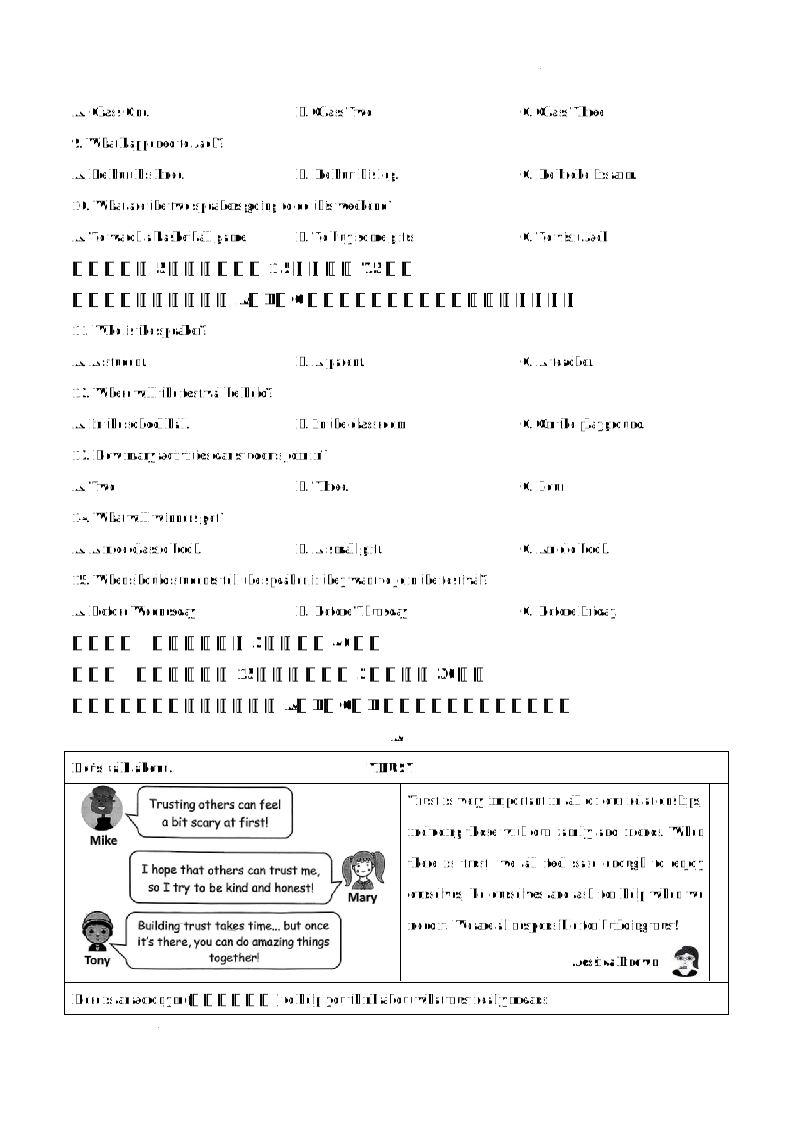
Let’s talk about... TRUST
Trust is very important in all of our relationships, including those with our family and friends. When there is trust, we all feel safe enough to enjoy ourselves, be ourselves and ask for help when we need it. We are all responsible for building trust!
Jessica Brown
Here is an acronym (首字母缩略词) to help you think about what trust really means:
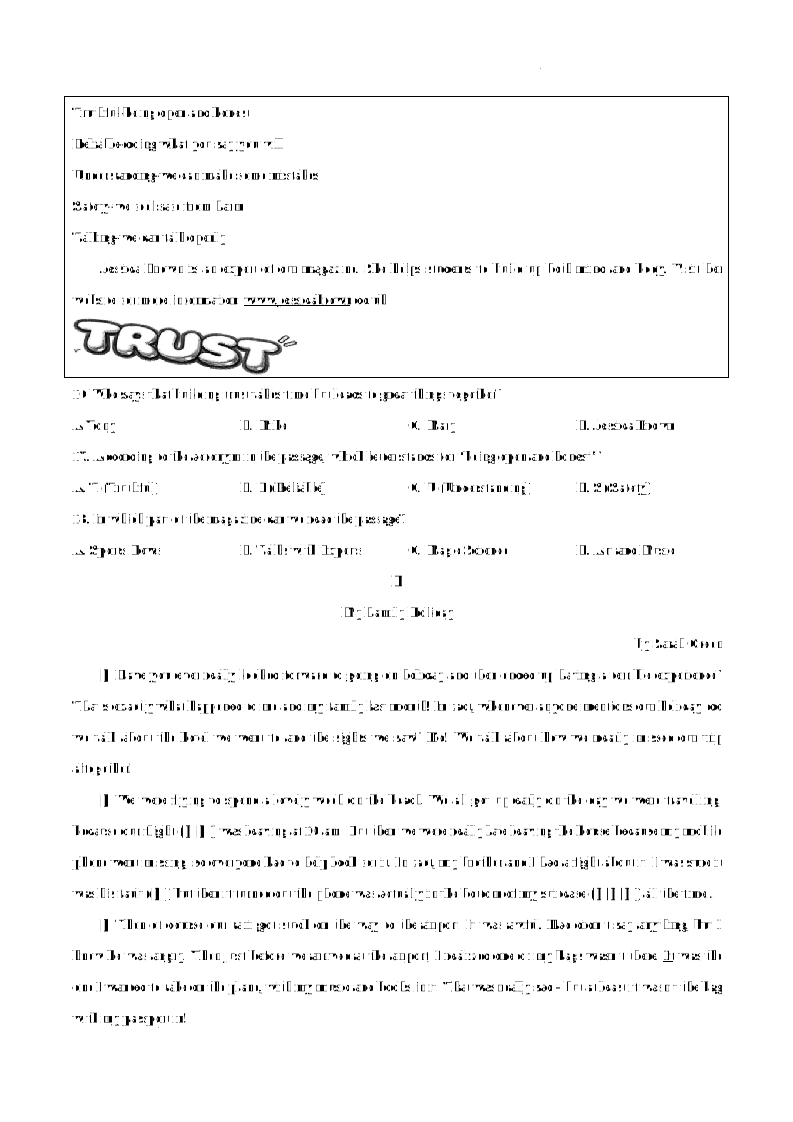
Truthful-being open and honest
Reliable-doing what you say you will
Understanding-we can make some mistakes
Safety-we feel safe from harm
Talking-we can talk openly
Jessica Brown is an expert of our magazine. She helps students to build up both mind and body. Visit her website for more information: www.jessicabrown.co.uk
16 Who says that building trust takes time but leads to great things together?
A Tony B. Mike C. Mary D. Jessica Brown
17. According to the acronym in the passage, which letter stands for “being open and honest”?
A. T (Truthful) B. R (Reliable) C. U (Understanding) D. S (Safety)
18. In which part of the magazine can we read the passage?
A. Sports News B. Talks with Experts C. Magic Science D. Art and Music
B
My Family Holiday
by Sarah Green
①Have you ever really looked forward to going on holiday and then ended up having a terrible experience? That’s exactly what happened to me and my family last month! In fact, whenever anyone mentions our holiday, do we talk about the hotel we went to and the sights we saw? No! We talk about how we nearly missed our trip altogether!
②We were flying to spend a lovely week on the beach. We all got up early on the day we were travelling, because our flight (航班) was leaving at 10 am. But then we were really late leaving the house because my mobile phone went missing, so everyone had to help look for it. In fact, my brother and I had a fight about it. I was sure it was his fault (错) but then it turned out the phone was actually in the bottom of my suitcase (行李箱) all the time...
③Then of course our taxi got stuck on the way to the airport. It was awful. Dad didn’t say anything, but I knew he was angry. Then just before we arrived at the airport, I realized one of my bags wasn’t there. It was the one I wanted to take on the plane, with my music and books in it. That was really sad - but at least it wasn’t the bag with my passport in!
④Then we went to check our bags in. My brother had a backpack that weighed a lot, so he had to take some clothes out and wear them. I think by now, Mum was just eager for Dad to take the bags to the check-in desk, then go through security (安检) and passport control and finally sit down and have a nice cool drink! But there was worse to come. The man at check-in asked for our tickets and Dad handed them over. “Flight GE 186,” said Dad. The man took one look at the tickets and made a face. “I’m really very sorry sir,” he said to Dad. “Your flight is indeed GE186 and your flight is at 10 am - but it’s tomorrow morning...”
19. Why does the writer ask the question at the beginning of Paragraph 1?
A. To lead into the story of her terrible holiday experience.
B. To show how much she loves going on holiday with her family.
C. To tell readers to look forward to their traveling plans.
D. To introduce a perfect place for traveling to readers.
20. What does the underlined word “It” refer to in Paragraph 3?
A. The mobile phone B. The suitcase C. One of the bags D. The passport
21. What is the right order of the following events according to the text?
①The family took a taxi to the airport.
②Dad showed the tickets to the clerk.
③The writer couldn’t find her mobile phone.
④The brother took some clothes out of the backpack.
⑤The writer found that one of her bags was left at home.
A. ①→④→③→⑤→② B. ④→⑤→②→①→③
C. ③→①→⑤→④→② D. ②→⑤→④→①→③
22. What is the most possible ending of the story?
A. They went back home and gave up the holiday. B. They had to catch the flight the next morning.
C. They got on the plane and started their trip. D. They changed their flight to another place.
C
In Shanghai, 78-year-old Master Zhang carefully folds a red piece of paper. With just one pair of scissors, he creates a beautiful pattern of peonies and butterflies-symbols of wealth and joy in Chinese culture. These beautiful artworks used to be shown only at folk festivals or in exhibitions (展览) on paper, enjoyed by a small group of people.
______. Thanks to a new project called “Intangible Heritage (非物质文化遗产) Goes Digital (数字),” started by the Ministry of Culture in late 2025, Master Zhang’s paper-cutting art is now being turned into 3D works, AR products, and even NFTs.
“Many young people think traditional crafts are ‘old-fashioned’,” says Li Wei, a 15-year-old student from Shanghai Experimental School who joined the project. “But when I saw a paper-cutting tiger come alive through my phone screen using AR, I was amazed! It made me want to learn how to cut one myself.”
The project has already worked with over 20 schools in Shanghai. Students not only learn the history and meaning behind patterns like the ruyi (a traditional symbol of good luck) or double happiness, but also use simple apps to design their own digital works.
“This isn’t about taking the place of tradition,” explains cultural expert Dr. Lin. “It’s about connecting the old and the young. Modern technology gives ancient art a new voice that the young can understand and share.”
As Master Zhang puts it with a smile: “My hands may age, but as long as young hearts care, this art will never die.”
23. What can we learn about Master Zhang according to Paragraph 1?
A. He is over 80 years old and works in a museum.
B. He is a master of paper-cutting in Shanghai.
C. He teaches students paper-cutting in a middle school.
D. He has turned his paper-cuts into 3D works.
24. Which of the following can be put in ______.
A. But this time, his works won’t stay only on paper.
B. So he keeps creating more paper-cuts every day.
C. He hopes to have more exhibitions in the future.
D. However, he decides to give up making paper-cuts.
25. Which of the following is true about the project?
A. It was started by the Ministry of Culture in early 2026.
B. It shows students how to use modern technology well.
C. It only teaches students the history and meaning of paper-cutting.
D. It helps the young better understand paper-cutting and keeps it alive.
26. What is the best title of the text?
A. Chinese Paper-Cutting Finds New Life in Digital Age
B. Paper-Cutting: A Gradually Disappearing Traditional Art
C. Master Zhang Makes Paper-Cutting Popular
D. AR Is Taking the Place of Traditional Art
D
①From February 13-16, people around the world will take part in an event called the Great Backyard Bird Count (GBBC) which is held every year. Anyone can join by counting and identifying (识别) birds, then sharing their findings on a website or app.
②During the four-day event, bird lovers are asked to collect data (数据) as volunteers for scientific research. They need to spend at least 15 minutes counting the birds they see outdoors, such as a local park or the yard outside their home.
③For beginning bird lovers, they can use the Merlin Bird ID app to identify birds. More experienced birdwatchers can also show their observations (观察结果) on eBird, a website and mobile app.
④The data helps researchers learn more about where the birds are, whether their populations are changing, and how to protect them. “It is used in many different ways to better understand the condition of our planet and our natural resources (资源),” said Becca Rodomsky-Bish, a project leader at Cornell. “Without this data, we would have less understanding about what is working, what isn’t working, and what areas need to be focused on for bird protection.”
⑤Last year, more than 800,000 people took part in the GBBC. About 8,078 bird species (种类) were found all over the world. Birdwatchers in the US and Canada found the tufted duck, which usually lives in Africa, Europe, and Asia. Some lucky birdwatchers in Australia noticed the Lewin’s rail, a hard-to-see bird with a special call. People in the UK saw the largest group of birds, with 500,000 European starlings in the sky.
⑥The team is excited to see what happens this year. “We believe there will always be some new surprises,” added Rodomsky-Bish.
27. What is the Great Backyard Bird Count (GBBC) according to the passage?
A. A four-day bird counting event for science. B. A summer camp for bird lovers.
C. An online game about bird identification. D. A competition to find beautiful birds.
28. Why is bird observation data important?
A. It makes bird watching more popular.
B. It teaches people how to use bird ID apps.
C. It helps people learn more about bird protection.
D. It tells researchers how many people take part in the event.
29. What is Paragraph 5 mainly about?
A. The special birds in the US. B. The ways to help birds in different countries.
C. The meaning of protecting birds. D. The findings around the world last year.
30. What’s Rodomsky-Bish’s attitude toward the future of GBBC?
A. Hopeful. B. Doubtful. C. Worrying. D. Boring.
第二节 任务型阅读(共5小题,每小题2分,满分10分)
阅读下面短文,从方框中A-E给31-34选择合适的小标题,有一个多余选项,并回答35小题。
Spring break is here! It’s a great time to have fun and try new things. Here are some great ideas for you.
31
Go to a park near your home. Bring a picnic blanket and some drinks and snacks. You can play games or just enjoy the sun. It’s a great way to spend time with family and enjoy the fresh air.
32
If you like excitement, try an amusement park. Ride roller coasters and play fun games. The excitement and laughter will make it a day to remember. Don’t forget to take pictures with your family!
33
Many museums have fun, hands-on activities for kids. You might see dinosaur bones, old paintings, or even try a cool science experiment. It’s a great way to explore something new indoors.
34
If your family enjoys the outdoors, take advantage of the spring weather with a family hike. Find a trail near you and walk in nature. You can look for birds, flowers, or just enjoy the quiet. You can even bring your dog!
No matter what you do, make sure you enjoy your spring break!
A. Go hiking
B. Have a picnic
C. Visit an amusement park
D. Go on a road trip
E. Plan a museum day
35. What’s your favorite spring break activity? Why? (不超过20词)
____________________________________________________________________________________________
第三部分 语言运用(共3节,满分40分)
第一节 完形填空(共15小题,每小题1分,满分15分)
Every day after school, eleven-year-old Maya walked past a music shop. In the window stood an old-brown 36 . She would stop and stare at it, imagining her fingers 37 on the keys (键盘).
Maya’s family could not 38 a piano. They could not afford lessons either. But Maya did not 39 . She found a piece of hard 40 and drew black and white keys on it. Every evening, she sat on the floor and 41 on her paper piano. Her younger sister sometimes 42 her. “You are playing on paper!” she said. Maya just smiled and kept practicing.
One day, the music teacher, Mrs. Li, heard Maya humming (哼唱) a beautiful tune in the hallway. “Where did you learn that?” Mrs. Li asked. “I 43 made it up,” Maya said quietly. Mrs. Li was 44 . She asked Maya to play something on the real piano in the 45 room.
Maya’s hands were shaking. She had 46 touched a real piano before. She sat down, closed her eyes, and placed her fingers on the keys. 47 , she began to play. The music that came out was not perfect, 48 it was full of feeling. The notes danced like little birds flying into the sky.
Mrs. Li listened with her eyes wide open. “You have a gift,” she said. “I will 49 you for free.”
Tears filled Maya’s eyes. She looked at her paper piano at home and then at the real one under her fingers. All those 50 of practice had not been wasted.
From that day on, Maya played not because she had to, but because she loved to. And that made all the difference.
36. A. guitar B piano C. violin D. drum
37. A. dancing B. drawing C. swimming D. riding
38. A. find B. sell C. afford D. play
39. A. come out B. lie down C. give up D. hold on
40. A. paper B. box C. pencil D. schoolbag
41. A. practiced B. sang C. drew D. wrote
42. A. looked after B. waited for C. talked with D. laughed at
43. A. still B. even C. just D. also
44. A. bored B. worried C. tired D. surprised
45. A. music B. science C. computer D. reading
46. A. always B. usually C. often D. never
47. A. Slowly B. Loudly C. Quickly D. Luckily
48. A. but B. so C. and D. or
49. A. tell B. teach C. serve D. encourage
50. A. evenings B. mornings C. afternoons D. mid-nights
第二节 词汇运用(共15小题,每小题1分,满分15分)
A. 将方框中所给词语的适当形式填入短文中,每词仅用一次
suddenly, scary, again, get up, strange, hug
It was a beautiful day. I was riding my bike. 51 , I rode over a hole in the road and fell down on the ground. I tried to 52 , but I couldn’t. Then I saw blood on my shoes. My hand and knee were bleeding. As I lay there, I took off my helmet (头盔). There was a sharp rock sticking out of it. It was so 53 to look at. Thank goodness I wore my helmet!
I shouted for help. A 54 stopped his truck and came to help me. He drove me to the hospital right away. When my mother got to the hospital, she gave me a big 55 . “I’m so glad you were wearing your helmet,” she said. She knew I was careless and did not always wear my helmet.
But I’ll never be careless 56 ! My bike helmet saved my life!
B. 阅读下面短文,根据括号内所给汉语注释写出单词的正确形式(每空一词)。
Summer is hot, and many people enjoy playing in the water to cool-off. They like to play in pools, 57 (河流), lakes, and beaches. It 58 (提供) a lot of fun. But there is also a 59 (风险). In order to stay safe, try to follow a few basic safety tips.
First, do not go very far away by yourself. Always swim with an 60 (成年人) or stay where she or he can see you 61 (清楚). If you get into trouble, people nearby can help. 62 (第二), do not run nearby the water. You could slip and fall down. You could get hurt or fall into deep water. If you fall into deep water, it could be 63 (危险). If you don’t know how to swim well, you might feel scared and drown, which makes a person sink in water. Third, learn how to float on your 64 (背). This is a good way to survive if you get into deep water.
Even if you feel unsafe, you should stay calm. Take slow breaths and keep your body relaxed. Wait for 65 (某人) to help you and don’t panic. Following these simple tips will help you stay safe and have fun around water.
第三节 语法填空(共10小题,每小题1分,满分10分)
阅读下面短文,在空白处填入一个恰当的词,或填入括号中所给词的正确形式。
Harbin is a town in northeast China. In winter, it is very cold. The average temperature is about -18°C. Some people call Harbin the “Ice City.”
During the Qing Dynasty, the people in Harbin 66 (make) ice lanterns. The ice lanterns were 67 (real) beautiful.
Years later, the people of Harbin decided to have 68 ice and snow festival. These days, artists from all over the world go to Harbin 69 (create) their beautiful works. First, the artists collect ice from the countryside. Then they turn the ice into 70 (building), gardens and other things.
There are a lot of 71 (excite) activities during the festival such as ice hockey and winter swimming. There are also skiing (滑雪) races. 72 you are interested, you can see people doing folk dances and singing folk songs.
There is something 73 everyone at the festival. And Harbin becomes one of the 74 (good) places to visit in China. People from all over the world can admire the ice works, enjoy the fun activities, 75 learn about products made in Harbin.
第四部分 书面表达(共1小题,满分20分)
76. 假如你是张华,你的英国好友Alice暑期将来中国研学。她对浙江台州非常感兴趣。请根据以下相关信息,写一封邮件,向她推荐一个合适的研学目的地。
要求:1.邮件必须包含所选目的地的所有要点,可适当发挥;
2.文中不得出现真实姓名、学校等信息;
3.词数80左右;邮件开头和结尾已给出,不计入总词数。
Dear Alice,
I’m glad to know that you are interested in Taizhou. ______________________________________________
____________________________________________________________________________________________
____________________________________________________________________________________________
____________________________________________________________________________________________
____________________________________________________________________________________________
____________________________________________________________________________________________
Looking forward to meeting you in Taizhou!
Yours,
Zhang Hua
学科网(北京)股份有限公司
$
资源预览图
1
2
3
相关资源
由于学科网是一个信息分享及获取的平台,不确保部分用户上传资料的 来源及知识产权归属。如您发现相关资料侵犯您的合法权益,请联系学科网,我们核实后将及时进行处理。