云南2025-2026学年下学期4月联考高二英语试卷
 切换试卷
切换试卷
2026-05-16
|
2份
|
14页
|
50人阅读
|
0人下载
资源信息
| 学段 | 高中 |
|---|---|
| 学科 | 英语 |
| 教材版本 | 高中英语人教版选择性必修第三册 |
| 年级 | 高二 |
| 章节 | - |
| 类型 | 试卷 |
| 知识点 | - |
| 使用场景 | 同步教学-阶段检测 |
| 学年 | 2026-2027 |
| 地区(省份) | 云南省 |
| 地区(市) | - |
| 地区(区县) | - |
| 文件格式 | ZIP |
| 文件大小 | 72 KB |
| 发布时间 | 2026-05-16 |
| 更新时间 | 2026-05-16 |
| 作者 | 匿名 |
| 品牌系列 | - |
| 审核时间 | 2026-05-16 |
| 下载链接 | https://m.zxxk.com/soft/57896602.html |
| 价格 | 3.00储值(1储值=1元) |
| 来源 | 学科网 |
内容正文:
高二英语
注意事项:
1.答题前,考生务必将自己的姓名、考生号、考场号、座位号填写在答题卡上。
2.回答选择题时,选出每小题答案后,用铅笔把答题卡上对应题目的答案标号涂黑。如需改动,用橡皮擦干净后,再选涂其他答案标号。回答非选择题时,将答案写在答题卡上。写在本试卷上无效。
3.考试结束后,将本试卷和答题卡一并交回。
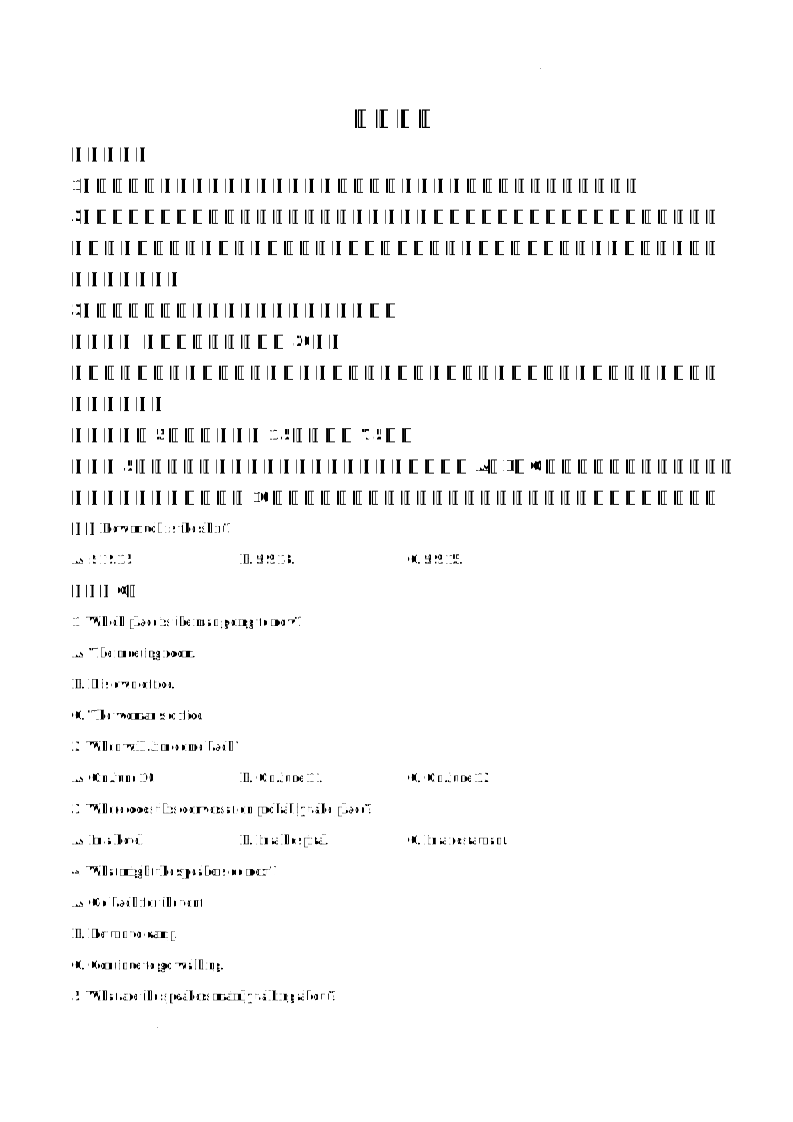
第一部分 听力(共两节,满分30分)
做题时,先将答案标在试卷上。录音内容结束后,你将有两分钟的时间将试卷上的答案转涂到答题卡上。
第一节(共5小题;每小题1.5分,满分7.5分)
听下面5段对话。每段对话后有一个小题。从题中所给的A、B、C三个选项中选出最佳选项。听完每段对话后,你都有10秒钟的时间来回答有关小题和阅读下一小题。每段对话读两遍。
例:How much is the shirt?
A. £ 19.15. B. £ 9.18. C. £ 9.15.
答案是C。
1. Which place is the man going to now?
A. The meeting room.
B. His own office.
C. The woman’s office.
2. When will Jim come back?
A. On June 10. B. On June 11. C. On June 12.
3. Where does this conversation probably take place?
A. In a hotel. B. In a hospital. C. In a restaurant.
4. What might the speakers do next?
A. Go back for the tent.
B. Return to camp.
C. Continue to go walking.
5. What are the speakers mainly talking about?
A. The feeling of fish.
B. The color of fish.
C. The protection for fish.
第二节(共15小题;每小题1.5分,满分22.5分)
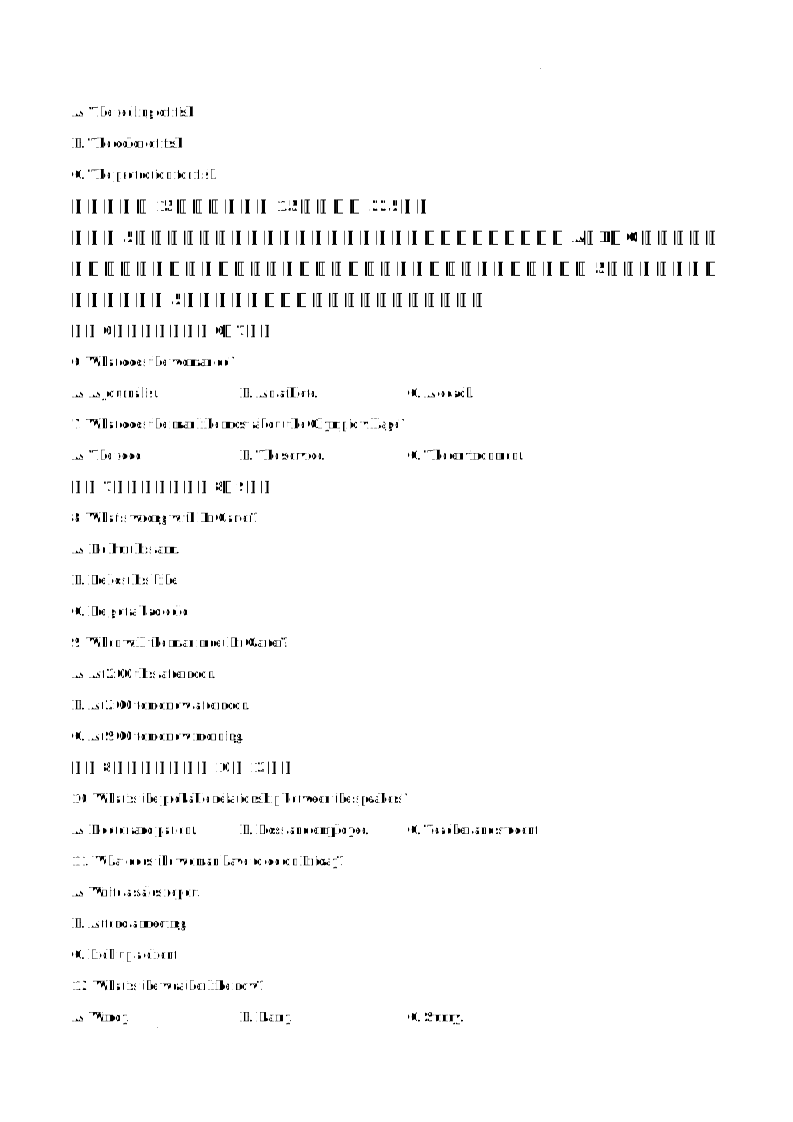
听下面5段对话或独白。每段对话或独白后有几个小题,从题中所给的A、B、C三个选项中选出最佳选项。听每段对话或独白前,你将有时间阅读各个小题,每小题5秒钟;听完后,各小题将给出5秒钟的作答时间。每段对话或独白读两遍。
听第6段材料,回答第6、7题。
6. What does the woman do?
A. A journalist. B. An athlete. C. A coach.
7. What does the man like most about the Olympic village?
A. The food. B. The service. C. The environment.
听第7段材料,回答第8、9题。
8. What’s wrong with Dr Carter?
A. He hurt his arm.
B. He lost his bike.
C. He got a bad cold.
9. When will the man meet Dr Carter?
A. At 2:00 this afternoon.
B. At 2:00 tomorrow afternoon.
C. At 9:00 tomorrow morning.
听第8段材料,回答第10至12题。
10. What is the probable relationship between the speakers?
A. Doctor and patient. B. Boss and employee. C. Teacher and student.
11. What does the woman have to do on Friday?
A. Write a sales report.
B. Attend a meeting.
C. Pick up a client.
12. What is the weather like now?
A. Windy. B. Rainy. C. Sunny.
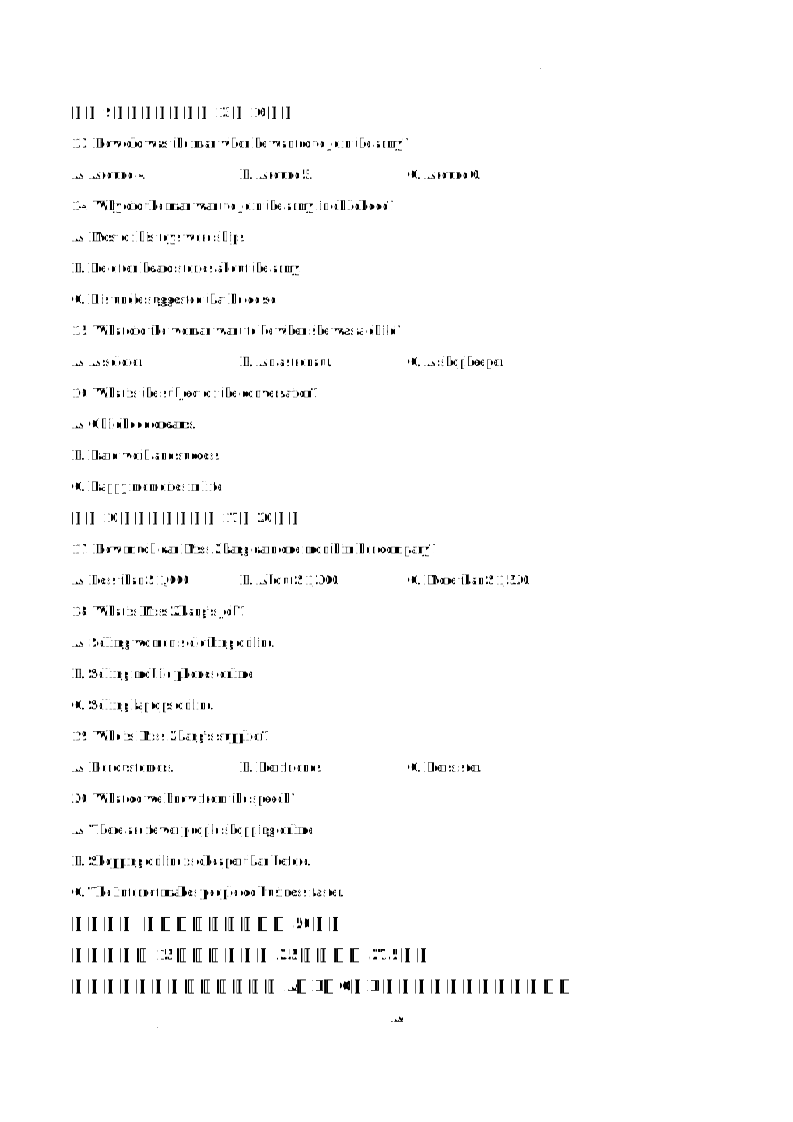
听第9段材料,回答第13至16题。
13. How old was the man when he wanted to join the army?
A. Around 4. B. Around 5. C. Around 6.
14. Why did the man want to join the army in childhood?
A. Most of his toys were ships.
B. He often heard stories about the army.
C. His uncle suggested that he do so.
15. What did the woman want to be when she was a child?
A. A soldier. B. An astronaut. C. A shopkeeper.
16. What is the subject of the conversation?
A. Childhood dreams.
B. Hard work and success.
C. Happy memories in life.
听第10段材料,回答第17至20题。
17. How much can Miss Zhang earn one month in her company?
A. Less than $ 1,000. B. About $ 1,300. C. More than $ 1,520.
18. What is Miss Zhang’s job?
A. Selling women’s clothing online.
B. Selling mobile phones online.
C. Selling laptops online.
19. Who is Miss Zhang’s supplier?
A. Her customers. B. Her friends. C. Her sister.
20. What do we know from the speech?
A. There are fewer people shopping online.
B. Shopping online is cheaper than before.
C. The Internet makes people do business faster.
第二部分 阅读(共两节,满分50分)
第一节(共15小题;每小题2.5分,满分37.5分)
阅读下列短文,从每题所给的A、B、C、D四个选项中选出最佳选项。
A
Young Artists Exhibition Coming to Katonah Museum of Art
Dates:
May 3-May 24, 2026
Location:
Katonah Museum of Art, New York
Detail:
The exhibition shows artworks created by high school students from over 40 schools in the area. Nearly 400 senior students will take part in this event. Their works include paintings, figures, digital art, and mixed-media pieces. The exhibition offers a rich mix of styles and ideas, giving visitors a chance to see the world through young artists’ eyes.
What makes this exhibition different is that students do more than just create art. They also help organize, publicize, and install (安装) the exhibition themselves. Working with museum professionals, students take on real-world roles such as curators (馆长) and exhibition designers. They learn how to select pieces, design gallery spaces, and promote the show to the public. This hands-on experience is rare for high school students.
“We want to provide hands-on museum experiences for young artists,” said the staff of the museum. By the end of the program, students gain practical skills beyond making art — they learn how to bring art to the world.
This is the 43rd year of the exhibition. It is part of the museum’s long-standing effort to support young artists and give them a platform to share their voices. For visitors, it is a great chance to see fresh, bold, and creative works from the next generation.
The museum’s opening times:
Wednesday-Friday, 12 pm-5 pm; Saturday, 10 am-5 pm; Sunday, 12 pm-5 pm. The museum is closed on Monday, Tuesday and some festivals. You can visit our website for detailed information.
Admission:
$ 15 for adults, $ 9 for students, $6 for children aged between 2 and 12, and free for children under 2.
21. Which is a special feature of this exhibition?
A. Beautiful paintings are shown.
B. Professionals help create the works.
C. Students assist to run the exhibition.
D. It is held in a museum and high schools.
22. What does the museum mainly want to do through the event?
A. Support high schools in youth education.
B. Discover talented high school art students.
C. Raise public awareness of modern art styles.
D. Offer students real experience in presenting art.
23. How much will a mother with a kid aged two pay for the admission?
A. $ 30. B. $ 24. C. $ 21. D. $ 15.
B
When a powerful snowstorm buried parts of the Wildwood Zoo under more than two feet of snow, a dedicated staff member refused to leave his post. Kyle Kirk, the zoo’s manager in Marshfield, Wisconsin, spent three straight nights at the facility, making sure every animal — across all 27 species — was safe and cared for during the extreme weather.
“This is the most snow I think I’ve ever seen in my whole life,” said Kirk, describing the intensity of the storm. At one point, conditions were so severe that he was completely trapped inside the staff building. “There was a solid hour that I really couldn’t help anybody because I was completely trapped by snow.”
But as soon as he was able to get outside, Kirk got to work. He began digging out smaller animals that had been buried under the snow, including quail, prairie dogs, and skunks (臭鼬). “I was able to dig them out. Our skunks were completely snowed in,” he said. Despite the serious situation, there was even a moment of humor. “It was hilarious because I think our skunks thought that I brought the snow. They were stomping (跺脚) angrily as if to say, ‘Oh, you can take away the snow now.’”
Kirk carved pathways through enclosures (围场) so animals like porcupines and skunks could move around again, and he made sure foxes — who had already shed their winter coats — were warm enough to handle the sudden freeze. Meanwhile, some of the zoo’s larger residents took the storm calmly. The Kodiak bears hung around comfortably, and the lynx seemed right at home in the deep snow.
For Kirk, staying through the storm wasn’t a question — it was part of the job. “A lot of other people can call in sick or get snowed in, but simply, I can’t,” he said. “There’s really no reason to have these animals if we’re not going to care for them in the best possible way.”
24. Why did Kirk spend three nights continuously in the zoo?
A. To wait for the rescue team.
B. To ensure the safety of the animals.
C. To repair the damaged staff building.
D. To study the behavior of the animals.
25. What does the underlined word “hilarious” in paragraph 3 probably mean?
A. Amusing. B. Confusing. C. Frightening. D. Embarrassing.
26. What kind of picture does paragraph 4 describe?
A. Animals’ fear and Kirk’s worry.
B. Kirk’s efforts and animals’ reaction.
C. Kirk’s loneliness and animals’ anger.
D. The storm’s damage and animals’ suffering.
27. What do Kirk’s words in the last paragraph highlight?
A. Harmony. B. Confidence. C. Reputation. D. Responsibility.
C
Beavers (海狸) may play an unexpected role in tackling climate change by transforming rivers into effective carbon dioxide (CO2) sinks, according to a new international study led by researchers at the University of Birmingham (UB). The study is the first to measure the CO2 released or captured (捕获) as a result of beavers’ activities in wetland environments. Researchers conducted the work in a stream corridor in northern Switzerland, where beavers have been active for more than a decade.
The results show that wetlands shaped by beavers can store carbon at rates up to ten times higher than similar areas without their presence. Over 13 years, the site collected and stored about 1,194 tons of carbon, which equals 10.1 tons of CO2 per hectare each year.
Dr Joshua Larsen, the lead author of the study, said, “Our findings show that beavers don’t just change landscapes — they fundamentally shift how CO2 moves through them. By slowing water, trapping sediments (沉淀物), and expanding wetlands, they turn streams into powerful carbon sinks. This first-of-its-kind study represents an important opportunity and breakthrough for future nature-based climate solutions across Europe.”
Beavers are returning to rivers and natural habitats across Europe after years of conservation efforts. This comeback is revealing how strongly they influence carbon movement, especially in headwater streams, which are the small upper sections where rivers begin. As beavers build dams, they flood nearby land, form wetlands, redirect groundwater flow, and capture both organic and inorganic materials, including CO2. Because of these changes, the way carbon is stored and circulated in these ecosystems is greatly changed.
The findings suggest that expanding beaver populations in suitable wetland regions could provide substantial climate benefits by increasing the amount of carbon captured and stored, while limiting its release back into the atmosphere.
28. What do the statistics in paragraph 2 suggest about beavers?
A. They store 10.1 tons of CO2 per year. B. They help wetlands store more carbon.
C. They release carbon into the atmosphere. D. They’ve lived in Switzerland for 13 years.
29. What would Dr Joshua Larsen most probably agree with?
A. Beavers offer a solution to climate problems.
B. Beavers reduce human emissions of carbon.
C. Beavers mainly store up carbon in their dams.
D. Beavers have solved Europe’s climate problem.
30. What is a result of beavers’ building dams?
A. Groundwater shifts direction. B. The river flow speed increases.
C. The upper rivers become drier. D. Organic materials are removed.
31. Which can be the best title for the text?
A. Beavers Timely Return to Europe B. A New Method of CO2 Measurement
C. Great Urgency of Wetland Conservation D. Beavers Act as Unexpected Climate Helpers
D
Artificial intelligence (AI) is often seen as a tool that replaces human labor. However, a new study from Swansea University offers a different view. It suggests that AI can act as a creative partner, encouraging exploration and inspiration.
Researchers carried out one of the largest studies on how people work with AI during creative tasks. More than 800 participants joined an online experiment. They used an AI system to design virtual cars. Instead of simply finding the best design quickly, the system used a method called MAP-Elites. It created visual galleries filled with many different design possibilities. These galleries showed a wide range of car concepts, including highly effective designs, unusual ideas, and even some intentionally poor ones.
Dr Walton, the lead author of the study, explained, “People often think AI speeds up tasks or improves efficiency, but our findings show something more interesting. When people were shown AI-generated design suggestions, they spent more time on the task, produced better designs, and felt more involved. It was not just about efficiency, it was about creativity and cooperation.”
The study also points out a problem with how AI design tools are usually assessed. Standard measurements often focus on simple behaviors, such as how often users click on or copy AI suggestions. According to the researchers, these measures miss important aspects of the experience, such as how AI influences people’s thoughts, emotions, and willingness to explore new ideas.
Dr Walton emphasized that variety in AI-generated output played a key role. “Participants responded most positively to galleries that included a wide variety of ideas, including bad ones. These helped them move beyond their first thoughts and explore a wider range of designs. This structured diversity prevented early fixation and encouraged creative risk-taking.”
As AI becomes more common in creative fields, from engineering to music and game design, understanding how humans and AI work together is essential. The question is not only what AI can do, but how it can help us think, create, and collaborate more effectively.
32. What do the findings of the study mainly disapprove of AI?
A. It pushes users to try new ideas.
B. It takes over jobs done by people.
C. It supports deeper involvement in tasks.
D. It serves as an inspiring creative partner.
33. How did the AI system in the experiment differ from conventional ones?
A. It was used to improve work speed.
B. It optimized designs automatically.
C. It presented diverse visual options.
D. It was designed to reduce human effort.
34. What is the major limitation of current AI assessment methods?
A. They ignore AI’s mental impact.
B. They miss the process of creation.
C. They fail to track users’ behaviors.
D. They focus on the quality of a task.
35. What is Dr Walton’s attitude towards AI in creative tasks?
A. Doubtful. B. Fearful. C. Supportive. D. Unconcerned.
第二节(共5小题;每小题2.5分,满分12.5分)
阅读下面短文,从短文后的选项中选出可以填入空白处的最佳选项。选项中有两项为多余选项。
Sometimes improving your health seems difficult. You think you must make big changes. But the road to better health can also consist of many small steps. Here are several simple ways to improve your well-being.
36 Experts advise regular exercise to reduce stress. Besides, even something as simple as listening to soft music, reading a good book, or playing with your pet can help you relax. Spending just 10 minutes doing something you enjoy can make you feel calmer and more energetic.
Put away the salt and eat breakfast. A saltshaker (盐瓶) on the dining table makes it easy to take in too much salt, which can lead to high blood pressure. So put the shaker in a cupboard and use lemon juice or herbs instead. 37 Eating a healthy morning meal has been connected to better memory and a healthier weight.
Get to bed earlier and challenge your brain. 38 Over time, not getting enough sleep can increase your risk of health problems. Going to bed just 15 minutes earlier could help. At the same time, mentally challenging activities like crossword puzzles or chess may protect your brain and lower the risk of memory loss.
Take the stairs and stretch regularly. The next time you’re going to a higher floor, take the stairs instead of the lift. 39 Also, stretching your muscles helps you avoid injuries and stay flexible. Take a few minutes to stretch before and after exercise, or even right before bed.
Drink water and help others. Drinking enough water is good for your heart, skin, and memory. It also improves your mood. Finally, studies show that volunteering can lower blood pressure, reduce stress, and even help you live longer. 40
A. Stop anxiety.
B. Reduce stress.
C. Also, don’t skip breakfast.
D. Most adults don’t get seven hours or more of sleep they need.
E. This not only benefits others but also improves your own health.
F. You’ll get your blood pumping and work your lower body muscles.
G. If you don’t get enough sleep, you will have many health problems.
第三部分 语言运用(共两节,满分30分)
第一节(共15小题;每小题1分,满分15分)
阅读下面短文,从每题所给的A、B、C、D四个选项中选出可以填入空白处的最佳选项。
I believe that action is the most honest form of belief. My understanding of action 41 somewhere ordinary, the kitchen. For my mom and me, baking together, mostly chocolate, was a (n) 42 , almost like three meals a day. But in 2020, I realized that 43 could be a tool for change. I started 44 over 600 hot chocolate bombs in my community, raising more than $4,000 and reaching over 80 families. I didn’t do it to 45 recognition, but in response to what I saw around me: needs that could be met, even in small ways.
The project worked not because of 46 , but because it was accessible. Participation didn’t require 47 experience, complicated forms, or large commitments. Anyone could 48 in a meaningful way. It was easy to understand, easy to 49 , and immediately relevant to the people it aimed to serve. What mattered most was how the money was used afterward. Instead of deciding what organizations might need, I directly 50 them. In this way, I knew what they really need. Listening 51 my understanding of service: Meaningful help begins with attention, not assumption.
Action began in a kitchen for me, with melted chocolate and a 52 I could not ignore: What will I do with what I see? That question has 53 every choice I’ve made since that first chocolate, and the moments when I have chosen to speak, listen, and act.
I 54 believe taking action is a choice, and the choice is available to us every day. That’s where responsibility begins, and that’s where 55 becomes real!
41. A. stayed B. popped C. left D. began
42. A. routine B. dream C. strategy D. emission
43. A. fortune B. definition C. familiarity D. tension
44. A. collecting B. selling C. melting D. making
45. A. seek B. value C. know D. restore
46. A. expansion B. abuse C. innovation D. gravity
47. A. pleasant B. key C. memorable D. prior
48. A. contribute B. interrupt C. judge D. slip
49. A. live off B. engage in C. appeal to D. break down
50. A. picked B. gave C. asked D. pushed
51. A. researched B. reviewed C. recovered D. reshaped
52. A. request B. question C. chapter D. vision
53. A. guided B. witnessed C. met D. lifted
54. A. immediately B. rarely C. truly D. mistakenly
55. A. gift B. trace C. frame D. belief
第二节(共10小题;每小题1.5分,满分15分)
阅读下面短文,在空白处填入1个适当的单词或括号内单词的正确形式。
Age has never been a barrier to learning. These senior citizens prove that the courage 56 (start) is always there, no matter how late it seems.
On a winter afternoon by the West Lake in Hangzhou, a white-haired grandfather, Zhou, chatted 57 (confident) with an English-speaking visitor, warmly 58 (introduce) the city’s famous English corners.
The 98-year-old recalls the encounter fondly. The foreign visitor 59 (watch) others practice calligraphy when Zhou approached him and broke the ice with a simple question: “Do you speak English?” For Zhou, it was an ordinary moment. Nearing 100, Zhou still keeps 60 (he) mind sharp with daily habits: reading English books at home and browsing English-language news online.
English corners by the West Lake have a long history. Near the lakeside, a group of bronze 61 (sculpture) stand as silent witness to decades of park life, 62 are a young man and a woman leaning over an open book, their fingers gently tracing the lines of text.
Retirees make up the core of the regular participants. For many of the aged attendees, these weekly conversations are more than just a pastime — they are a 63 (significance) connection to the wider world.
Compared with 64 1980s or 1990s, the crowds are smaller now. Online learning platforms, language apps and the wider availability of English education have given younger learners many new options. 65 the lakeside gatherings still attract a devoted group of participants.
第四部分 写作(共两节,满分40分)
第一节(满分15分)
假定你是李华,你班上周五上了一节诗词分享课。请给你的外国好友Nick写一封邮件,分享此事,内容包括:
(1)介绍诗词分享课的时间、形式与氛围;
(2)分享你最喜欢的诗词及个人感受。
注意:
(1)写作词数应为80个左右;
(2)请按如下格式在答题卡的相应位置作答。
Dear Nick,
Yours,
Li Hua
第二节(满分25分)
阅读下面材料,根据其内容和所给段落开头语续写两段,使之构成一篇完整的短文。
Born to Nigerian parents and holding dual US-Nigerian citizenship, I always felt a deep care for others. As a little girl, I often visited Nigeria, and those trips stayed in my heart. One cold night during a visit, the power went out — as it often did. The only light came from a weak kerosene lamp (煤油灯). I sat on the floor trying to finish my homework, but the smoke made me cough. My mother covered me with a blanket and told me to sleep, because there was no oil left. In the dark, when I listened to the wind, a small thought crossed my mind: There must be a better way to bring light to people without reliable electricity.
Years later, as a high school student, I still remembered those dark nights in Nigeria. When I went back for a family wedding, the power went out again. People used diesel generators (柴油发电机), but they were loud and gave off bad smoke. Watching children play soccer outside, I noticed that many of them later had to study by dim kerosene lamps, just like I once did. A strong desire to help filled my heart. Suddenly, an idea struck me: What if their play could create light? That was the moment when a soccer ball that stores energy was born.
At that time, I knew nothing about engineering. I was just a high school student with a kind heart and a firm dream. But I didn’t let that stop me. I read books on energy, watched online lectures, and asked my science teachers for help. I also invited my classmate Julia to join me. Together, we faced many challenges: The ball was too heavy, or it didn’t store enough energy. Sometimes we wanted to give up. But every time I thought of the children studying in the dark, I found the courage to keep going.
注意:
(1)续写词数应为150个左右;
(2)请按如下格式在答题卡的相应位置作答。
After months of hard work, our first soccer was finally born.
My dream didn’t stop there.
学科网(北京)股份有限公司
$
高二英语参考答案
听力(共20小题;每小题1.5分,满分30分)
1—5 BCAAB 6—10 ABCBB 11—15 BACBC 16—20 ACACC
阅读(共20小题;每小题2.5分,满分50分)
21—23 CDC 24—27 BABD 28—31 BAAD 32—35 BCAC 36—40 BCDFE
语言运用 第一节(共15小题;每小题1分,满分15分)
41—45 DACBA 46—50 CDABC 51—55 DBACD
第二节(共10小题;每小题1.5分,满分15分)
56. to start 57. confidently 58. introducing 59. was watching 60. his
61. sculptures 62. which 63. significant 64. the 65. Yet/But
写作:
第一节(满分15分)
参考范文:
Dear Nick,
Hope you re doing well!Last Friday, our class held a wonderful poetry sharing session.It took place in the afternoon and lasted about forty minutes.Instead of attending a regular lecture, each student stood up to introduce a poem they loved.The classroom was filled with a warm,relaxed atmosphere,and everyone listened attentively and applauded warmly after each sharing.
The poem I liked most is Quiet Night Thoughts by Li Bai.The poem touched me deeply.Though simple in language,the poem expresses such a strong feeling of missing home.It reminded me of the times when I stay far from my family and how much I cherish them.
Does your school have similar activities?I d love to hear about it!
Yours,
Li Hua
第二节(满分25分)
参考范文:
After months of hard work, our first soccer was finally born. It looked like a normal soccer ball, but inside was a device that captured energy from kicks. To our joy, just 30 minutes of play could power an LED light for three hours. When I brought the soccer to children in Nigeria, their faces lit up with excitement. They kicked the ball happily, knowing each kick would help them get light to study at night. Seeing their smiles, I felt all my hard work was worth it.
My dream didn’t stop there. After college, I started a company to improve the soccer ball and help more people without electricity. The first batch had quality problems, but I didn’t give up. I moved production to my own facilities and kept improving. Later, I invented a jump rope that stores energy — 15 minutes of jumping could power an LED light for three hours or charge a phone halfway. I even created a system, bringing the same technology to other everyday objects and turning daily activities into clean energy.
学科网(北京)股份有限公司
$
资源预览图
1
2
3
相关资源
由于学科网是一个信息分享及获取的平台,不确保部分用户上传资料的 来源及知识产权归属。如您发现相关资料侵犯您的合法权益,请联系学科网,我们核实后将及时进行处理。