2026年天津市滨海新区普通高中学业水平等级考试模拟检测卷英语学科试卷
 切换试卷
切换试卷
2026-05-16
|
2份
|
15页
|
223人阅读
|
8人下载
资源信息
| 学段 | 高中 |
|---|---|
| 学科 | 英语 |
| 教材版本 | - |
| 年级 | 高三 |
| 章节 | - |
| 类型 | 试卷 |
| 知识点 | - |
| 使用场景 | 高考复习-三模 |
| 学年 | 2026-2027 |
| 地区(省份) | 天津市 |
| 地区(市) | 天津市 |
| 地区(区县) | 滨海新区 |
| 文件格式 | ZIP |
| 文件大小 | 81 KB |
| 发布时间 | 2026-05-16 |
| 更新时间 | 2026-05-16 |
| 作者 | 匿名 |
| 品牌系列 | - |
| 审核时间 | 2026-05-16 |
| 下载链接 | https://m.zxxk.com/soft/57896404.html |
| 价格 | 3.00储值(1储值=1元) |
| 来源 | 学科网 |
内容正文:
2026年滨海新区普通高考模拟检测卷
英语 参考答案及评分标准
第Ⅰ卷 选择题(共95分)
第一部分:英语知识运用(共两节,满分45分)
第一节:单项填空(共15小题;每小题1分,满分15分)
1-5 DCBBA 6-10 CBCBB 11-15 BBCBA
第二节:完形填空(共20小题;每小题1.5分,满分30分)
16-20 CADBB 21-25 ABABC 26-30 ABDBB 31-35 CCBCA
第二部分:阅读理解(共20小题;每小题2.5分,满分50分)
36-40 BCDAD 41-45 DCCBA 46-50 CBCCB 51-55 BABBA
第Ⅱ卷 非选择题(共35分)
第三部分:写作(共两节;满分35分)
第一节:阅读表达(共5小题;每小题2分,满分10分)
56. Puzzled 或 Confused. (Bothered, Astonished 或 Questioned 不给分)
(如有其他合理答案可给分,形式错误扣0.5分)
57. They dig at old sites, collect ancient Egyptians’ objects and make their best guess.
(三点答出一点或两点得1分;语法错误含时态错误、拼写错误扣0.5分)
Or They dig at sites, collect objects and come up with their “best theory”.
Or By digging at old sites, collecting ancient Egyptian people’s objects and inferring the masters’ wisdom.
58. It was constructed / built around 2600 BC containing many heavy stones.
Or The construction time and the use of stones.
(答出建筑时间给1分;答出多、大或重的石头,其中之一给1分;时态、拼写、形式错误扣0.5分)
59. It is difficult to enter the Great Pyramid.
Or How difficult it is to go into the Great Pyramid.
Or The anti-theft designs of the Great Pyramid.
(时态、形式、拼写错误扣0.5分)
60. (Open) Possible answers:
They are smart / intelligent / clever / wise. (Because) the anti-theft design is so successful that we cannot solve the mystery or answer the questions now.
Or They are creative. (Because) they built such a unique and complex building at ancient times.
Or They are determined. (Because) they have successfully designed and built the Great Pyramid without advanced modern equipment.
(解释内容要与选择的形容词逻辑一致)(每道题目超出字数扣0.5分)
第二节:书面表达(满分25分)
61.参考范文: Nature
Serving as the cradle of life, nature surrounds us, nourishes us, and provides us with abundant resources. Consequently, we should live in harmony with nature, which lays a foundation for the progress of human society.
From my perspective, we can explore nature with sincere curiosity. Only when we venture into the wilderness and witness the transitions of the seasons can we truly embrace nature, feeling the gentle breezes and appreciating the rolling hills. As we constantly benefit from and delight in the precious gifts from nature, it falls upon us to safeguard our living environment. For instance, we can care for our planet through community tree-planting activities on weekends. It is these small acts that remind us of our responsibility to take care of the Earth.
Small acts can make a big difference. As the proverb goes, many hands make light work. Only if we make joint efforts to cherish and guard nature can we guarantee the sustainable development and well-being of our future generations.
学科网(北京)股份有限公司
$
2026年滨海新区普通高考模拟检测卷
英语
本试卷共分为第Ⅰ卷(选择题)和第Ⅱ卷(非选择题)两部分,满分130分;考试用时为100分钟。本试卷共14页。
第Ⅰ卷 选择题(共95分)
注意事项:
1.答第Ⅰ卷前,考生务必将自己的姓名、准考证号用铅笔涂写在答题卡上。
2.选出答案后,用铅笔把答题卡上对应的题目的答案标号涂黑,如需改动,用橡皮擦干净后,再填涂其它答案,不能答在试卷上。
第一部分:英语知识运用(共两节;满分45分)
第一节:单项填空(共15小题;每小题1分,满分15分)
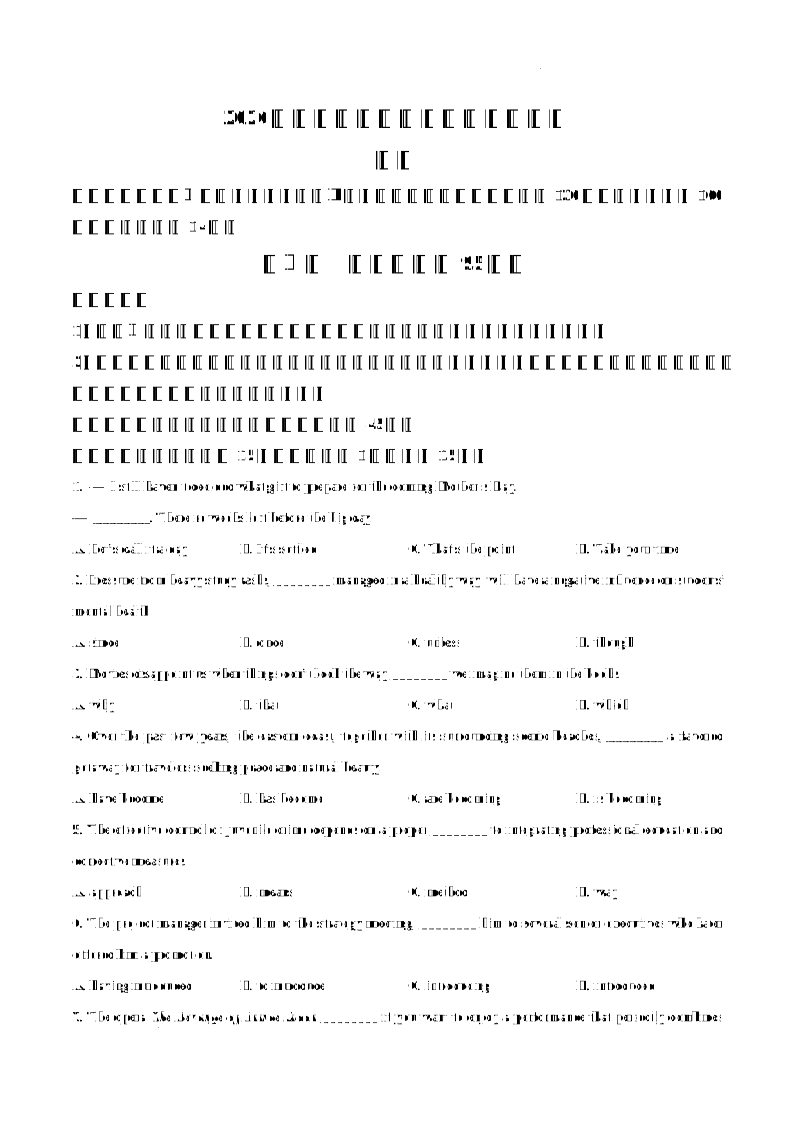
1. — I still haven’t decided what gift to prepare for the coming Mother’s Day.
— ________. There’re weeks left before the big day.
A. Let’s call it a day B. It’s settled C. That’s the point D. Take your time
2. Pressure from heavy study tasks, ________ managed in a healthy way, will have a negative influence on students’ mental health.
A. since B. once C. unless D. though
3. Movies disappoint us when things don’t look the way ________ we imagine them in the books.
A. why B. that C. what D. which
4. Over the past few years, the eastern coast, together with its surrounding scenic beaches, ________ a favored getaway for travelers seeking peace and natural beauty.
A. have become B. has become C. are becoming D. is becoming
5. The effective control of juvenile crime depends on a proper ________ to integrating professional education and corrective measures.
A. approach B. means C. method D. way
6. The project manager invited him to the strategy meeting, ________ him to several senior executives who later offered him a promotion.
A. having introduced B. to introduce C. introducing D. introduced
7. The opera The Revenge of Prince Zidan ________ if you want to enjoy a performance that perfectly combines music, drama, poetry and costume design with explosive effect.
A. braves the elements B. ticks all the right boxes
C. turns over a new leaf D. paves the way
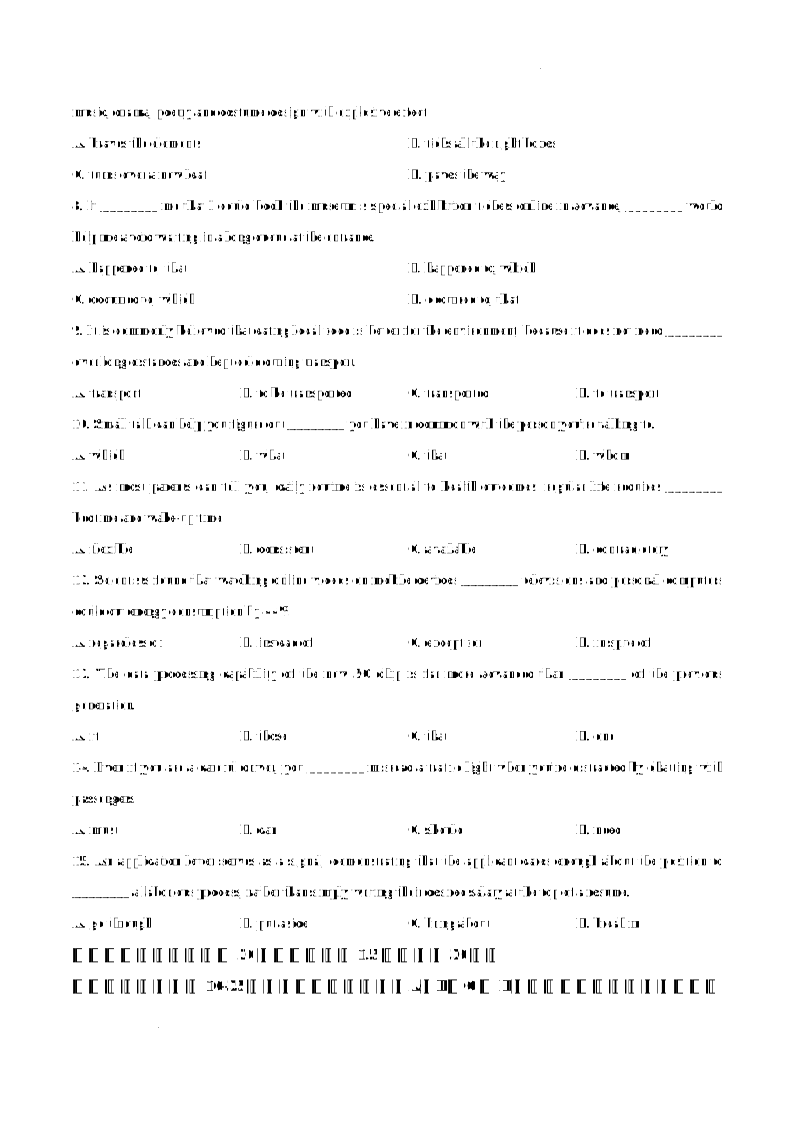
8. It ________ me that I could book the museum’s special exhibition tickets online in advance, ________ would help me avoid waiting in a long queue at the entrance.
A. happened to; that B. happened to; which
C. occurred to; which D. occurred to; that
9. It is commonly believed that eating local food is better for the environment, because it does not need ________ over long distances and kept cold during transport.
A. transport B. to be transported C. transported D. to transport
10. Small talk can help you figure out ________ you have in common with the person you’re talking to.
A. which B. what C. that D. whom
11. As most parents can tell you, daily routine is essential to health outcomes: regular life requires ________ bedtime and wake-up time.
A. flexible B. consistent C. available D. contradictory
12. Scientists found that watching online videos on mobile devices ________ televisions and personal computers could cut energy consumption by 44%.
A. regardless of B. instead of C. except for D. in spite of
13. The data processing capability of the new 5G chip is far more advanced than ________ of the previous generation.
A. it B. those C. that D. one
14. Even if you are a careful driver, you ________ misread a traffic light when you’re distracted by chatting with passengers.
A. must B. can C. should D. need
15. An application letter serves as a signal, demonstrating that the applicant cares enough about the position to ________ a laborious process, rather than simply writing their desired salary at the top of a resume.
A. go through B. put aside C. bring about D. break in
第二节:完形填空(共20小题;每小题1.5分,满分30分)
阅读下面短文,从16-35各题所给的四个选项(A、B、C和D)中,选出可以填入空白处的最佳选项并在答题卡上将其涂黑。
All my life I’ve been bad at sports. At school I was always successfully “sick” on the annual sports day and had a standing note from my equally 16 mother to excuse me from physical education classes due to my “bad foot”. Even after I started exercising regularly in my mid-20s, I never 17 my friends’ social netball or football teams. “Hating sports” was 18 of my identity. Then, last year, a friend invited me to her birthday “kickabout” — a casual game of football, I guessed.
Had we been less close, I might have made my 19 . Instead, I turned up to the park, 20 to keep as far away from the ball as possible. 21 , to my great surprise, I enjoyed myself. Instead of running down the clock on the sidelines, I got 22 in the game, cheering for my team to score. A year later, the kickabout is not only still going, but it’s 23 from five or six friends to a changing group of about 40. Every other Sunday, we play on a proper 24 at our local sports complex.
What 25 me turning up every Sunday? Unexpectedly, it is not the socializing or the exercise. I love the slightly intoxicating sense of 26 myself, with zero expectation — or even hope — of ever being actually 27 . Why does it feel so good to be bad at something? “Amateurish” (业余的) hasn’t always been a 28 term, explains the author and activist Karen Walrond. “It comes from the Latin, meaning ‘one who loves’.” Her new book In Defense of Dabbling explains “intentional amateurism”: finding an activity we’re 29 to but not necessarily naturally good at, and sticking with it anyway.
There are two reasons to 30 intentional amateurism. First, it goes against “hustle culture” and the expectation that we should always be 31 or focus on self-improvement. Teaching yourself to arrange flowers, for instance, is something you might do simply for 32 . Second, even though you might never improve, you’ll inevitably experience benefits, which can flow into your daily life. As Walrond says, she has always thought meditation difficult, but finds mindfulness when 33 fully in activities she enjoys.
Mindfulness is among seven 34 by which Walrond defines intentional amateurism, along with curiosity, self-compassion, patience, kindness, honesty, and creativity. Focusing on these helped her “let go of perfectionism” and 35 the experience.
16. A. energetic B. curious C. unwilling D. patient
17. A. joined B. left C. visited D. found
18. A. opposite B. useful C. simple D. typical
19. A. decisions B. excuses C. plans D. notes
20. A. forced B. determined C. advised D. warned
21. A. However B. Therefore C. Besides D. Additionally
22. A. put up B. caught up C. held up D. brought up
23. A. grown B. moved C. run D. separated
24. A. pool B. field C. street D. hall
25. A. prevents B. stops C. keeps D. avoids
26. A. challenging B. controlling C. blaming D. reflecting
27. A. elegant B. skillful C. polite D. popular
28. A. positive B. traditional C. reasonable D. negative
29. A. forced B. drawn C. adapted D. opposed
30. A. abandon B. pursue C. consider D. refuse
31. A. calm B. adventurous C. productive D. cautious
32. A. success B. future C. enjoyment D. health
33. A. trapped B. engaged C. restricted D. exposed
34. A. problems B. attitudes C. qualities D. steps
35. A. appreciate B. tolerate C. admire D. compare
第二部分:阅读理解(共20小题;每小题2.5分,满分50分)
阅读下列短文,从每题所给的A、B、C、D四个选项中,选出最佳选项。
A
Are you a student planning to visit London? The International Student Identity Card (ISIC) allows you to get huge savings on attractions, transport, and dining. Here is what you need to know.
What is ISIC?
ISIC is the only globally recognized student ID card. It proves your student status worldwide and gives you access to over 150,000 discounts in more than 130 countries. In London alone, more than 200 venues offer special deals for ISIC holders. This includes famous museums, historic royal palaces, and even some guided walking tours.
Top Discounts in London.
With your ISIC card, you can save up to 50% on popular attractions. Here are some examples:
Attraction
Regular Price
ISIC Price
Saving
Tower of London
£ 29.90
£ 19.50
35%
London Eye
£ 32.00
£ 22.40
30%
The Shard
£ 32.95
£ 21.95
33%
You also get one third off on most London underground and bus fares with an ISIC-linked Oyster card. Many restaurants near major universities offer 10% to 20% off meals when you show your ISIC. For instance, eateries around Bloomsbury or South Kensington often welcome student diners with these discounts. A simple flash of your card could turn a £ 15 lunch into a £ 12 one.
How to Get an ISIC Card.
You can apply online at isic.org. The card costs just £ 12, and it remains valid for a full 15 months. You will need to provide a recent digital photo of yourself and clear proof of your current student status. Acceptable documents include a school photo ID or an official enrollment letter from your institution. Make sure your document clearly shows the current academic year to avoid any delay. If you are in a hurry, a digital version of the card will arrive in your email inbox within 48 hours. If you prefer a physical card to carry, please allow 7 to 10 working days for delivery.
Is It Worth It?
If you plan to visit at least two major ticketed attractions, the card easily pays for itself. One satisfied student traveler said: “I saved £ 28 on my very first day — more than the card cost!”
Start Saving Today.
Visit isic.org to order your card before your trip. And do not forget to download the free ISIC mobile app. The app provides real-time updates on nearby discounts and special offers just for cardholders. Your London adventure will be both memorable and affordable.
36. If Li Jin uses an ISIC card to visit both Tower of London and The Shard, how much will he pay for the tickets?
A. £ 19.50
B. £ 41.45
C. £ 53.45
D. £ 62.85
37. What can be learned about the ISIC digital card?
A. It costs more than the physical card.
B. It is only valid when the physical card arrives.
C. It can be received within two days.
D. It requires a separate application fee.
38. What advice does the author give about the application documents?
A. Submit them at least 15 months in advance.
B. Send original paper copies by registered mail.
C. Provide a school photo taken within 7 to 10 days.
D. Ensure they display the present academic year.
39. Which of the following statements is TRUE according to the passage?
A. ISIC is the only internationally recognized student ID card accepted worldwide.
B. ISIC card holders can get a 70% discount on London transportation.
C. ISIC holders are guaranteed discounts at all restaurants in London.
D. A student can recover the cost of the ISIC card by visiting just one major attraction.
40. Where is this passage most probably taken from?
A. A news report.
B. A fashion magazine.
C. An academic journal.
D. A travel website.
B
“It’s as easy as learning to ride a bike.” I heard that phrase growing up. My parents said it when teaching me to swim, and again at eighteen when I learned to drive. They knew the saying held no truth for me. Now, at twenty, I swim and drive like anyone else. Yet I still cannot ride a bike.
In my graduating year of college, I grew determined to cross this off my bucket list. I knew exactly who to ask — the same man who had tried to teach me when I was nine.
“Well, it’s about time.” my father said, amused. On the drive home, we made a simple plan: practice on the grass at the weekend.
At home, my mother joked, “I’m sure this will turn out better than your last attempt.” I laughed, but later, standing in the shower, the memory flooded back.
I was nine. My dad decided I would learn to ride. He pulled my mother’s old bicycle from the garage. I sat on it, small hands gripping the handlebars. He placed his palm against my back, and I made him promise not to let go until I gave permission. Soon we were moving. “There you go!” he shouted from behind — he had released his hold. I tumbled into stinging nettles (荨麻草), my skin breaking out in burning rashes. Lying in the bathtub afterward, I begged him tearfully never to make me get on a bike again. He promised.
Now, eleven years later, standing in that same bathtub, my skin itched at the recollection. Doubt emerged, but eventually my nerves settled.
My dad uncovered my mother’s bicycle again — her 18th birthday gift from 1988. Twenty-seven years later, it was destined to teach me what I had failed to learn. We tried the grass first, but the soft ground and under-inflated (胎压不足的) tires defeated us. We moved to the street. I mounted again. My dad placed his hand on my back. I pushed off and leaned sharply left. I tried repeatedly, each failure deepening my frustration. A fear of falling now weighed on me, a fear so strong I hadn’t felt before.
“It’s all in your head,” my father said. “You’re always trapped inside your thoughts. Let’s do this.”
He pushed me forward. I began to pedal, his hand steadying me. He ran alongside, refusing to let go.
“I’m ready for you to let go,” I announced.
His hand lifted. I swung, then surged ahead. I felt weightless, almost free. It was dark, and I was alone on a fragile piece of metal, surrounded by asphalt (柏油路) that would tear my skin apart should I fall. My heart pounded. Yet I did not care about falling. I felt totally alive. And I kept pedaling forward.
41. What happened to the author during the first bike- riding attempt at the age of nine?
A. He refused to get on the bike at the very beginning.
B. His mother’s old bicycle broke down during the practice.
C. He persuaded his father to let him have another try after falling off.
D. His father let go of the bike before the author was ready.
42. What does the father mean by saying “It’s all in your head” in Paragraph 8?
A. The author was physically too weak to ride.
B. The author needed a better bicycle to succeed.
C. The author’s inner fear was the real obstacle.
D. The author was thinking about the past too much.
43. How did the author feel when she finally rode the bike alone on the street?
A. Terrified of the asphalt and desperate to stop.
B. Frustrated and unable to balance well.
C. Relived and unconcerned about the possibility of falling.
D. Excited and relaxed with his father still running behind her.
44. Which of the following words can best describe the author’s father?
A. He was impatient and short- tempered.
B. He was caring and supportive.
C. He was strict and serious.
D. He was stubborn and inflexible.
45. What message does the author convey through this passage?
A. It takes courage and determination to overcome deep- rooted fears.
B. Parents should never push their children beyond their limits.
C. Childhood nightmare can never be fully healed over time.
D. Riding a bicycle is an essential skill that everyone must acquire.
C
THE MEN who robbed Joseph Haydn’s grave hoped that his genius would be written on his skull. A scan of the Austrian composer’s decomposing brain might have been more enlightening. Musical talent does not, as those 19th-century scientists believed, leave bumps on the cranium (颅骨). It does, however, seem to make a healthy impression on the brain.
Making music is a mental workout. The brain must simultaneously coordinate sound and vision, as well as fine motor control, focus and imagination. Over time this stretches the brain like a muscle. Several studies have found that professional musicians have more grey matter (the neural tissue involved in thinking, movement and memory) in some regions than non-musicians. Existing research hints that other benefits may accrue. One study from 2020 suggests that musicians may also have better executive function and a sharper memory. And a study from last year also suggested they may even be less sensitive to pain.
Might musically precocious (早慧) children have a head start? A paper from 2010 found that musicians who begin training before the age of seven have a larger corpus callosum, the neural bridge between the brain’s two hemispheres, than later starters. Research from 2014 suggests that learning an instrument also improves children’s second-language acquisition and non-verbal reasoning.
Musical training later in life has been linked to slower age-related decline. A small study on older adults showed that continuing to learn an instrument was associated with less deterioration in verbal working memory and grey-matter volume. A meta-analysis from 2021 also found an association between music practice and reduced risk of developing dementia (痴呆).
The instrument you play could make a difference. A study from 2024 of 1,100 older Britons found that pianists and brass players tended, on average, to have better working memory. Woodwind players had superior executive function. Singers excelled in verbal reasoning. Show-offs who played several instruments enjoyed no extra neural benefit.
In addition, the brain’s limbic (边缘的) system, which processes pleasure and reward, lights up when you play an instrument. Endorphins (内啡肽), feel-good hormones which relieve pain, flow when you are in the zone. Performing in a band, orchestra or choir eases stress and encourages social bonding. And if an instrument is out of reach, simply listening may also be worth a try.
The good news is that you don’t have to be a musical genius to feel the benefits of deliberate and regular practice. Studies have found that consistent training correlated with brain reorganisation in amateurs as well as professionals. But if you are a second Haydn, consider hiring a guard at your tombstone.
46. The underlined word “accrue” in Paragraph 2 is closest in meaning to ________.
A. distribute fairly
B. decline sharply
C. accumulate gradually
D. compensate fully
47. We can infer from Paragraphs 3 and 4 that ________.
A. The meta-analysis confirms that music gift can reduce the risk of dementia.
B. Musical training may bring long-term positive effects on people’s cognitive health.
C. People who start music after seven have no structural advantage in the brain.
D. Musical ability is the key factor in improving second-language learning efficiency.
48. The examples of “instrument” in Paragraph 5 are used to illustrate that ________.
A. Playing multiple instruments brings greater neural benefits than focusing on one.
B. Piano playing improves working memory more effectively than other instruments.
C. Various musical practices correspond with distinct advantages in brain functions.
D. Singing benefits verbal reasoning more significantly than playing woodwind.
49. How is the passage generally developed?
A. By listing examples and explaining causes.
B. By comparing different opinions and giving data.
C. By introducing a point of view and presenting supporting findings.
D. By describing a process and analyzing results.
50. What is the main idea of the text?
A. The story of Joseph Haydn and his musical achievements.
B. How musical training benefits the brain physically and mentally.
C. The differences between professional and amateur musicians.
D. Why musical geniuses are rare in the world.
D
Is there anything more frustrating than other people? Despite our best efforts to persuade them to do, say and be what we want, they persist in overturn our plans by making their own decisions, being their own people and thinking their own thoughts.
One can waste hours spiraling (纠结) about others’ behavior. Why weren’t we included in that meeting at work? Why did that stranger cut us off in traffic? Every time you are about to start obsessing over someone else’s actions, remember: let them!
The concept was recently popularized by motivational speaker Mel Robbins. “I just heard about this thing called the Let Them theory,” she told her millions of followers in an Instagram post in May 2023. “I love it.” The video quickly went viral. People got “Let Them” tattoos. In December 2024, Robbins released a book, The Let Them Theory. It became a New York Times bestseller. CNN and the New York Times interviewed Robbins. Even Oprah talked about it on her podcast (播客), saying: “This book is a game-changer. It’s a life-changer.”
There are some important caveats to the theory, according to Robbins. She argues, “let them” only works if it is followed by “let me”. In other words, it is not an excuse for inaction. Accepting that we can’t control other people’s actions is a reminder that we are entirely responsible for our own. You are not responsible for someone cutting you off in traffic, but you are responsible for responding with patience and courtesy, rather than with anger and harsh words.
Also, there are certain situations in which you should not, under any circumstance, “let them”. Robbins explained in a podcast episode that the theory does not apply if someone wants to do something dangerous or if you see someone being discriminated against. In those cases, she says, you must speak up. Second, you must always advocate for yourself and what you need — negotiate a higher salary, for example, or insist on getting the medical care you need. Finally, if someone continually violates your boundaries, you should not “let them” do that, Robbins says.
The “let them” concept is not without its critics. People have argued that the theory is Stoicism repackaged. Others have criticized Robbins for not crediting poet Cassie BPhillips, whose poem Let Them went viral in 2022. Robbins herself acknowledges this. As an author, podcaster and former lawyer, she is not a mental health professional. But experts agree that giving up on trying to control the behaviors and actions of others can be hugely beneficial — not only for yourself, but for the people around you as well.
The phrase is not a panacea (万能药). It still takes time for whatever emotion people are feeling to pass. But saying “let them” prevents us from being reactive. It gives us space to pause and remind ourselves that our own actions are all we can control. Annoying! But also liberating. It’s a reminder that it’s OK to step back, let people be who they are, and stop carrying things that aren’t ours to carry.
51. What can we learn from Mel Robbins’ book The Let Them Theory?
A. It was published in the year 2023.
B. It received wide media and public recognition.
C. It was written in the form of a podcast.
D. It was based on Oprah’s personal experience.
52. The underlined word “caveats” in Paragraph 4 can be explained as ________.
A. restrictions and boundaries of application
B. remarkable benefits and positive effects
C. detailed interpretations and further analyses
D. typical instances and practical illustrations
53. Which of the following is against The Let Them theory according to Robbins?
A. Mind your own behavior when annoyed by strangers.
B. Stay silent when witnessing unfair discrimination.
C. Fight for your deserved salary and medical care.
D. Refuse to tolerate others’ repeated boundary violations.
54. What can we conclude from the last paragraph?
A. It takes little time to get rid of negative emotions.
B. The Let Them theory is not perfect but meaningful.
C. We can control both our own actions and others’.
D. The phrase “let them” can solve all life problems
55. What is the author’s purpose of writing the passage?
A. To introduce and comment on a popular life philosophy.
B. To persuade readers to accept others’ mistakes.
C. To criticize Mel Robbins’ new book.
D. To explain how to control one’s emotions.
第II卷 非选择题(共35分)
第三部分:写作(共两节;满分35分)
第一节:阅读表达(共5小题;每小题2分,满分10分)
Who built the Great Pyramid? How was it built? What is its significance? These questions have bewildered people for a long time. Finding definite answers to them is not as straightforward as you might think. Long ago, the history of human beings was not recorded. As ancient societies died out, their histories died with them. Now, most of this information is buried. Some of it, like the ancient Great Egypt, sits above ground — unexplained and mysterious.
Archaeologists (考古学家) help us to explain things. They dig at old sites and collect objects that were used by ancient cultures. Using their imagination, they come up with their “best theory” about what these objects tell us about the people who used them.
We know for sure that the Great Pyramid was constructed around 2600 BC. It contains nearly two and a half million blocks of stone. Some of these stones weigh nearly 70 tons. How were these blocks moved? How did the workers move them up the tall structure to heights of 146 meters? There are numerous measurements contained in the Great Pyramid that point to a knowledge of mathematics, science, astronomy and world geography that we would not have expected from the Egyptians.
The builders of the Great Pyramid were determined to keep their secrets to themselves. When the first modern visitor discovered the pyramid in the 19th century, he wasn’t even able to find the entrance because it had been so carefully disguised by the builders.
After tunneling aimlessly for weeks, he accidentally discovered the entrance passage, only to find that the builders had blocked it with a massive stone plug. His men tunnel ed around this obstacle and arrived at the entrance. It was blocked by another huge stone. When they finally cut it away, another stone immediately fell into its place, blocking the passage again. An intruder would have to remove each successive block of stone to enter the Great Pyramid.
Why did the Egyptians make it so difficult to gain entry? Was it only the gold and treasure of the king’s burial they wished to conceal? These questions, as with most things from the ancient past, are easier to ask than to answer.
56. What does the underlined word in Paragraph 1 probably mean? (1 word)
57. How do archaeologists help us solve the mysteries of the ancient Great Egypt? (no more than 15 words)
58. According to the passage, what do we know for sure about the Great Pyramid? (no more than 10 words)
59. What’s the main idea of Paragraph 5? (no more than 10 words)
60. How do you find the Egyptian builders of the Great Pyramid? Please explain in your own words. (no more than 25 words)
第二节:书面表达(满分25分)
61.阅读下面材料,根据要求写作。
Nature is essential to our existence. As a result, we need to explore nature — know more about the world around us; embrace nature — get close to and appreciate its beauty; nurture nature — protect and care for the environment.
你校英语俱乐部即将举办以“Nature”为主题的征文活动,请你根据以上材料写一篇英语短文,内容包括:
(1)简述人与自然的关系;
(2)谈谈你对explore nature、embrace nature和nurture nature的理解(至少选择一点);
(3)列举自己或身边的具体事例。
注意:
(1)词数不少于120;
(2)可适当加入细节,使内容充实,行文连贯;
(3)开头和结尾已给出,不计入总词数,文中不能体现学生真实学校及姓名。
Nature
____________________________________________________________________________________________
____________________________________________________________________________________________
____________________________________________________________________________________________
学科网(北京)股份有限公司
$
资源预览图
1
2

3
相关资源
由于学科网是一个信息分享及获取的平台,不确保部分用户上传资料的 来源及知识产权归属。如您发现相关资料侵犯您的合法权益,请联系学科网,我们核实后将及时进行处理。