Unit 6 Crossing Cultures 第4课时 Section A Grammar Focus同步练习题 2025-2026学年人教版八年级英语下册
2026-05-13
|
2页
|
532人阅读
|
24人下载
资源信息
| 学段 | 初中 |
|---|---|
| 学科 | 英语 |
| 教材版本 | 初中英语人教版八年级下册 |
| 年级 | 八年级 |
| 章节 | Grammar Focus |
| 类型 | 作业-同步练 |
| 知识点 | - |
| 使用场景 | 同步教学-新授课 |
| 学年 | 2026-2027 |
| 地区(省份) | 全国 |
| 地区(市) | - |
| 地区(区县) | - |
| 文件格式 | DOCX |
| 文件大小 | 54 KB |
| 发布时间 | 2026-05-13 |
| 更新时间 | 2026-05-13 |
| 作者 | 匿名 |
| 品牌系列 | - |
| 审核时间 | 2026-05-13 |
| 下载链接 | https://m.zxxk.com/soft/57833141.html |
| 价格 | 0.50储值(1储值=1元) |
| 来源 | 学科网 |
摘要:
**基本信息**
本练习以“语法巩固+文化浸润”为特色,通过三级梯度设计实现从单一语法点到跨文化语篇应用的进阶,兼顾语言能力培养与文化意识渗透。
**分层设计**
|层次|知识覆盖|设计特色|
|----|----------|----------|
|基础层|连词(unless/as soon as)、ed/ing形容词后缀|单项选择直接考查语法规则,词形转换题强化基础辨识|
|进阶层|句型(so...that/as soon as/unless)应用|句子翻译结合例句引导迁移,五选五训练语篇逻辑衔接|
|综合层|跨文化情境理解与表达|阅读理解分析筷子文化,短文填词融入日本餐桌礼仪,提升文化意识与语篇综合运用能力|
内容正文:
Unit 6 Crossing Cultures
第4课时 Section A Grammar Focus
I.阅读理解
Chopsticks have been used in Asia for over 3,000 years. The earliest chopsticks were discovered in Henan China about 1200 BCE. Over the next 2,000 years, they spread throughout East and Southeast Asia.
The three most well-known types are Chinese,Japanese,and Korean.Chinese chopsticks are longer with wide, rounded points at the end, mostly made of plastic or bamboo. While Japanese chopsticks are shorter and more pointed. Korean ones are flat rather than round and made of metal rather than wood. It's said that ancient Royalty (皇室) used silver chopsticks to see if their food was poisoned(有毒的). In Southeast Asia,
Vietnamese chopsticks are similar to Chinese ones.
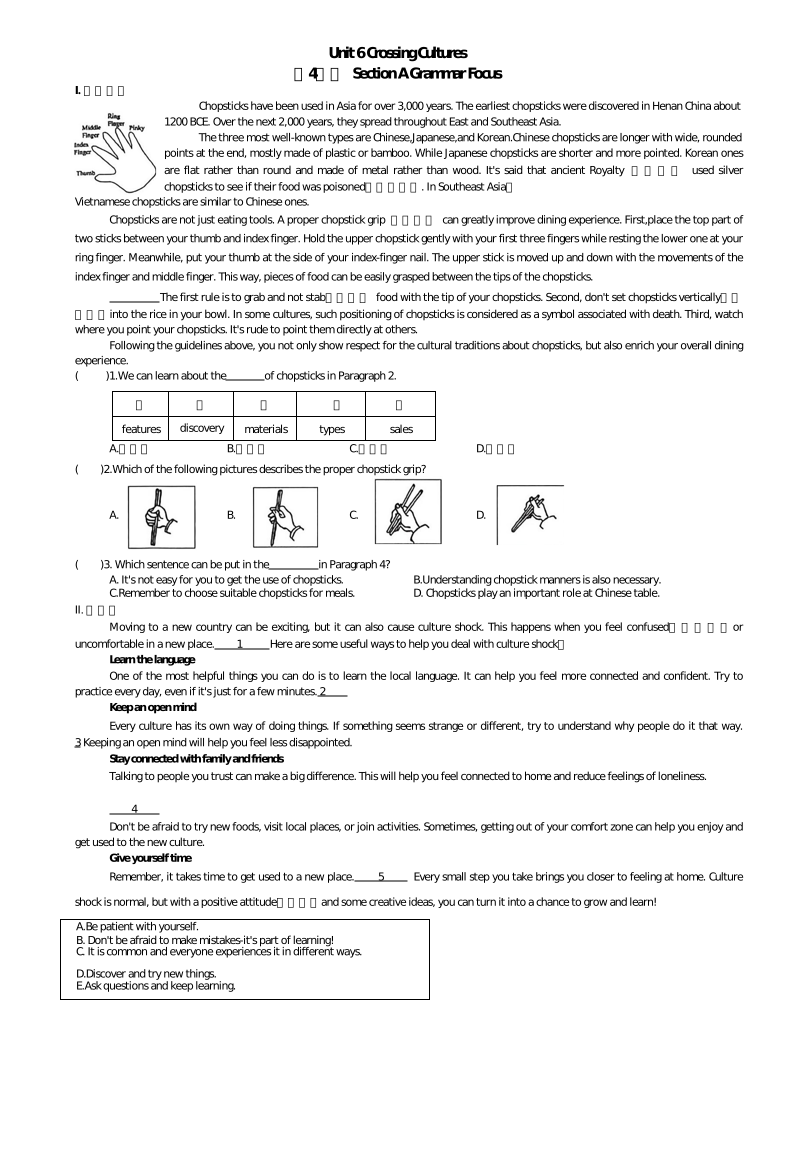
Chopsticks are not just eating tools. A proper chopstick grip (握法) can greatly improve dining experience. First,place the top part of two sticks between your thumb and index finger. Hold the upper chopstick gently with your first three fingers while resting the lower one at your ring finger. Meanwhile, put your thumb at the side of your index-finger nail. The upper stick is moved up and down with the movements of the index finger and middle finger. This way, pieces of food can be easily grasped between the tips of the chopsticks.
The first rule is to grab and not stab(刺入) food with the tip of your chopsticks. Second, don't set chopsticks vertically(垂直的)into the rice in your bowl. In some cultures, such positioning of chopsticks is considered as a symbol associated with death. Third, watch where you point your chopsticks. It's rude to point them directly at others.
Following the guidelines above, you not only show respect for the cultural traditions about chopsticks, but also enrich your overall dining experience.
( )1.We can learn about the of chopsticks in Paragraph 2.
①
②
③
④
⑤
features
discovery
materials
types
sales
A.①②③ B.③④⑤ C.①③④ D.①②⑤
( )2.Which of the following pictures describes the proper chopstick grip?
A. B. C. D.
( )3. Which sentence can be put in the in Paragraph 4?
A. It's not easy for you to get the use of chopsticks. B.Understanding chopstick manners is also necessary.
C.Remember to choose suitable chopsticks for meals. D. Chopsticks play an important role at Chinese table.
II.五选五
Moving to a new country can be exciting, but it can also cause culture shock. This happens when you feel confused(困惑的)or uncomfortable in a new place. 1 Here are some useful ways to help you deal with culture shock.
Learn the language
One of the most helpful things you can do is to learn the local language. It can help you feel more connected and confident. Try to practice every day, even if it's just for a few minutes. 2
Keep an open mind
Every culture has its own way of doing things. If something seems strange or different, try to understand why people do it that way. 3 Keeping an open mind will help you feel less disappointed.
Stay connected with family and friends
Talking to people you trust can make a big difference. This will help you feel connected to home and reduce feelings of loneliness.
4
Don't be afraid to try new foods, visit local places, or join activities. Sometimes, getting out of your comfort zone can help you enjoy and get used to the new culture.
Give yourself time
Remember, it takes time to get used to a new place. 5 Every small step you take brings you closer to feeling at home. Culture shock is normal, but with a positive attitude(态度)and some creative ideas, you can turn it into a chance to grow and learn!
A.Be patient with yourself.
B. Don't be afraid to make mistakes-it's part of learning!
C. It is common and everyone experiences it in different ways.
D.Discover and try new things.
E.Ask questions and keep learning.
III.单项选择
( )1.-Alice lost her wallet she reached Thailand and couldn't find it anywhere. --What a pity!
A.as well as B.as long as C.as soon as
( )2.Most people don't know the value of health_they lose it.
A.until B.because C.Though
( )3. You won't pass the exam unless you start studying now.
A.until B.so C.unless
IV.根据提示,完成下列句子,每空一词。
1.形容词后缀-ing意为“ ”,通常用来描述 的属性或特性。例如:surprising,interesting,exciting.
2.形容词后缀-ed意为“ ”,一般用来描述 的感受或情绪。例如:surprised,interested,excited,embarrassed.
形容词专练(ed与ing结尾):
1.The movie was so (excite) that I watched it twice.
2.Everyone was (surprise) when he suddenly stood up and sang.
3.He made a mistake in front of the whole class. It was so (embarrass)!
4.It was a (tire) day.I want to go to bed now.
5.The news about the earthquake was really (move).
6.After a hot bath, I feel very (relax).
7.My math teacher is a bit (bore). He speaks in the same tone all the time.
V.句子翻译
1.so...that...太...以至于
例句:Bowing is so formal that we don't do it.鞠躬太正式了,以至于我们不这么做。
翻译:我太紧张了,以至于我没能享受晚餐。
2.as soon as -...就...
例句:In Japan,we bow as soon as we meet a teacher.在日本,我们一见到老师就鞠躬。
翻译:你一到家后打电话给我。
3.unless 除非
例句:We don't stand close to someone unless we know them.我们不会站得离某人很近,除非我们非常了解他们。
翻译:除非雨停了,我将不会去公园。
VI.短文填词
Dear Rose,
In your last letter, you told me that you would come to Japan for vacation in July. But you were very worried. Because you don't know 1. you can or can't do in Japanese restaurants. Now, I 2. (write) to tell you the table manners there and how to behave in a restaurant,
Some restaurants in Japan have tatami(榻榻米) floors. When you step into a restaurant, you must take off your shoes. When you sit at the table,you will receive 3. small wet cloth at most Japanese restaurants. Use this to wash your hands before eating,then 4. (care) fold it and set it aside on the table. Don't use it as a napkin(餐巾纸),or 5. (touch) any part of your face.
Before and after a meal, it is important to say 6. (tradition) thank-you words. You can make a little noise when you're eating. For example, it is common to make some slurping(咂嘴)noises while 7. (eat) noodles. That's 8. in Japan if you slurp, it means the food tastes good. It is polite to lift small bowls of rice or soup when you eat.After finishing your meal, it is good manners to restore all your dishes to the way they were at the 9. (begin) of the meal. For example, you can put chopsticks back on the chopsticks shelf.
Write to me if you have other questions. Hope you can enjoy 10. (you) in Japan.
Yours,
Jack
学科网(北京)股份有限公司
$
资源预览图
1
相关资源
由于学科网是一个信息分享及获取的平台,不确保部分用户上传资料的 来源及知识产权归属。如您发现相关资料侵犯您的合法权益,请联系学科网,我们核实后将及时进行处理。