Unit5 Lesson 1-3 教学设计 2025-2026学年冀教版八年级英语下册
2026-04-14
|
6页
|
767人阅读
|
4人下载
普通
内容正文:
初 二 年级下 (英语)教学案 备课时间: 使用者
Unit 5 Great inventions
Lesson 1: Inventions are great!
主备教师
卢学林
参与教师
八年级全体英语教师
缺课学生
审核人
卢学林
课 时
授课时间
核心
素养目标
Key Competencies Objectives
Language Competence:Master core vocabulary such as invention, telephone, bulb, computer, internet, creative, creativity and key sentence patterns like “Which invention do you think is the most important?”, “It connects people around the world and provides us with...”. Be able to understand dialogues about the importance of inventions, listen for key information, and discuss inventions in simple English.
Cultural Awareness:Understand the great influence of important inventions from different countries on human civilization, recognize the role of creativity in promoting social progress, and cultivate a sense of respect for inventors and their creations.
Thinking Quality:By guessing inventions, discussing their importance and imagining new inventions, cultivate logical thinking, divergent thinking and creative thinking abilities, and learn to analyze the value of inventions objectively.
Learning Ability:improve listening and speaking skills through interactive activities, and develop the habit of active thinking and cooperative communication in English learning.
教学重难点
Key and Difficult Points
Key Points:Master core vocabulary (invention, telephone, bulb, computer, internet, creativity, etc.) and key sentence patterns (“Which invention do you think is the most important?”, “provide sb. with sth.”, “connect... around the world”); Understand the main content of the dialogue about the importance of inventions; Be able to talk about favorite inventions and their functions.
Difficult Points:Flexibly use the sentence pattern “疑问词 + do you think + 陈述语序” in daily communication; Distinguish and correctly use the verbs “invent” and “discover”; Express the importance of inventions in fluent English and put forward original ideas about new inventions.
教学准备Preparation
textbook, exercise book, notebook, recorder, ppt
教学过程 Teaching Process
注重构建“情景导入—任务驱动—问题引领—教师主导—学生主体—思政渗透”的“和美课堂”范式
教学环节Teaching Segments
集体备课设计
Collaborative Lesson Planning Design
教学评一体化
个人备课设计
Individual Lesson Planning Design
情景导入
Situational Lead-in
Play a short video about great inventions (showing the process of paper making, the first telephone call, the lighting of the light bulb, etc.) and ask students: “What do you see in the video? What inventions have changed our lives?”
活动设计
Activity Design
Listening
1. “Look, read and guess”: Present descriptions of inventions (e.g., “It gives light. People use it to see in the dark.”) and ask students to guess the inventions. Check answers together and consolidate new words.
2. Ask students to tick the most important inventions in the PPT list (paper, internet, plane, etc.) and discuss with partners: “Why do you think it’s important?”
Activity 1: Play the dialogue recording for the first time. Ask students to circle the inventions mentioned in the pictures (paper, telephone, light bulb, computer, internet, washing machines, cars). Check answers in groups.
Reading & Speaking
1: Language points explanation. Focus on “疑问词 + do you think + 陈述语序”, “provide sb. with sth.”, “invent vs. discover”. Give examples and let students make sentences (e.g., “Which book do you think is the most interesting?”).
Summary & Language points
Pair work. Use the pattern “A: Which invention do you think is the most important? B: I think... is very important. A: That’s true! It...”. Students practice talking about inventions. Invite 3-4 pairs to show their dialogues.: Creative thinking. Ask: “If you could invent something, what would it be? Why?” Students share their ideas in groups.
思政渗透与学科育人有机融合点Subject-based Character Education
Guide students to recognize that great inventions are the crystallization of human wisdom and hard work, and cultivate respect for inventors and their creations.2. Emphasize that “Inventions come from imagination and creativity”, encourage students to keep dreaming, dare to innovate, and cultivate a spirit of exploration.
板书设计
Blackboard Design
教学反思Teaching Reflection
签 字: 年 月 日
Unit 5 Great inventions
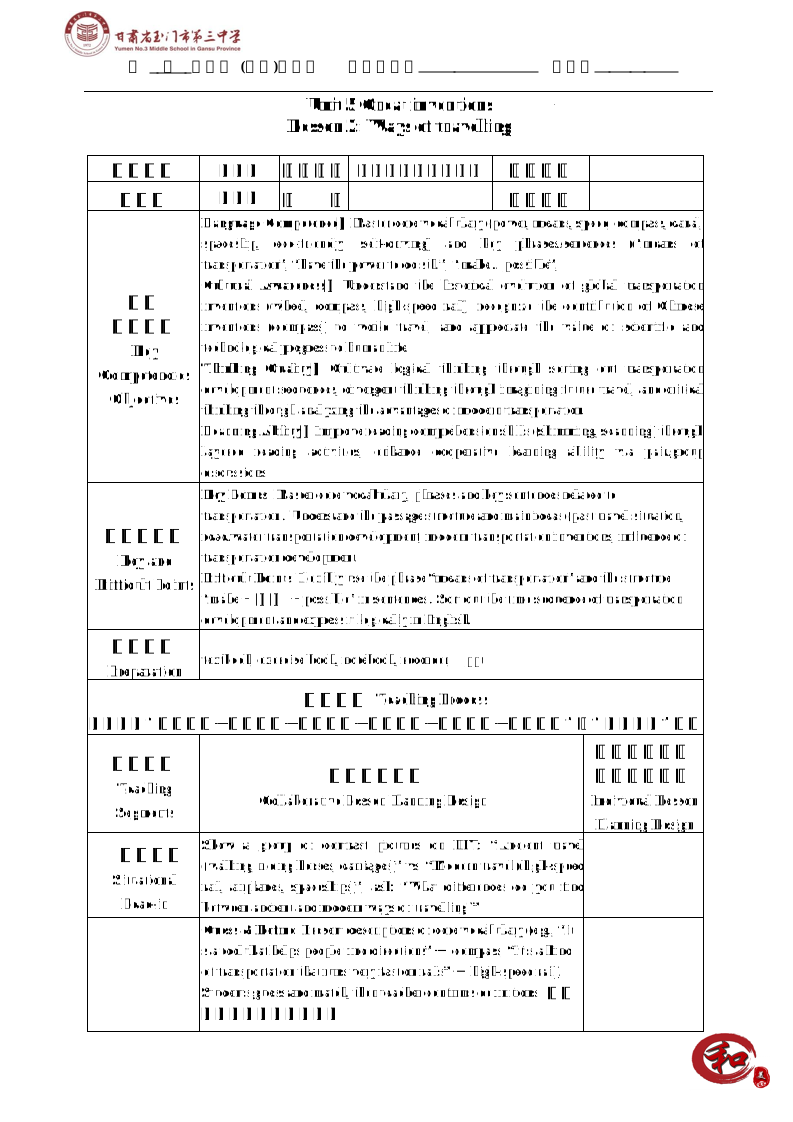
Lesson 2: Ways of travelling
主备教师
卢学林
参与教师
八年级全体英语教师
缺课学生
审核人
卢学林
课 时
授课时间
核心
素养目标
Key Competencies Objectives
Language Competence:Master core vocabulary (power, means, speed, compass, canal, spaceship, eco-friendly, self-driving) and key phrases/sentences (“means of transportation”, “have the power to do sth.”, “make... possible”,
Cultural Awareness:Understand the historical evolution of global transportation inventions (wheel, compass, high-speed rail), recognize the contribution of Chinese inventions (compass) to world travel, and appreciate the value of scientific and technological progress to human life.
Thinking Quality:Cultivate logical thinking through sorting out transportation development sequences, divergent thinking through imagining future travel, and critical thinking through analyzing the advantages of modern transportation.
Learning Ability:Improve reading comprehension skills (skimming, scanning) through layered reading activities, enhance cooperative learning ability via pair/group discussions.
教学重难点
Key and Difficult Points
Key Points: Master core vocabulary, phrases and key sentences related to transportation.. Understand the passage structure and main ideas (past travel situation, road/water transportation development, modern transportation inventions, influence of transportation development.
Difficult Points:Flexibly use the phrase “means of transportation” and the structure “make + 宾语 + possible” in sentences.. Sort out the time sequence of transportation development and express it logically in English.
教学准备Preparation
textbook, exercise book, notebook, recorder, ppt
教学过程 Teaching Process
注重构建“情景导入—任务驱动—问题引领—教师主导—学生主体—思政渗透”的“和美课堂”范式
教学环节Teaching Segments
集体备课设计
Collaborative Lesson Planning Design
教学评一体化
个人备课设计
Individual Lesson Planning Design
情景导入
Situational Lead-in
Show a group of contrast pictures on PPT: “Ancient travel (walking, riding horses, carriages)” vs. “Modern travel (high-speed rail, airplanes, spaceships)”, ask: “What differences do you find between ancient and modern ways of travelling?”
活动设计
Activity Design
Guess & Define: Present descriptions of core vocabulary (e.g., “It’s a tool that helps people find directions” → compass; “It’s a kind of transportation that runs very fast on rails” → high-speed rail). Students guess and match, then teacher confirms definitions. 巩固词汇,建立概念联结。
Brainstorm & Sort: Ask students to list all ways of travelling they know on sticky notes, stick them on the blackboard, and sort into “Ancient Transportation” and “Modern Transportation” together. 培养分类思维,激活已有知识。
First Reading (Skimming):
Ask students to read the passage silently, divide it into 4 parts according to the logical structure, and write down the key sentence of each paragraph. → Check answers in groups, teacher summarizes the passage structure (Past situation → Road/water transportation development → Modern inventions → Influence). 训练篇章结构分析能力。
Second Reading (Scanning):
Play the passage recording, students complete the “Main Idea Matching” task: Match each part with its main idea (e.g., Part 1 → Situation of travel in the past; Part 2 → Road and water transportation development). → Invite students to share answers, explain the logic of matching. 提升主旨捕捉能力。
Third Reading (Detail Mining):
Students read the passage again, fill in the detailed table (as in PPT) with partners. The table is designed with gradient difficulty: Basic level: Fill in simple facts (e.g., “In the early days, a person might live their whole life in ______” → one village); - Intermediate level: Fill in key inventions (e.g., “The first important invention in land travel was ______” → the wheel);
思政渗透与学科育人有机融合点Subject-based Character Education
Strengthen team awareness through pair/group activities (table filling, retelling, discussion), as the development of transportation is also the result of collective wisdom and cooperation. awareness through pair/group activities (table filling, retelling, discussion), as the development of transportation is also the result of collective wisdom and cooperation.
板书设计
Blackboard Design
教学反思Teaching Reflection
签 字: 年 月 日
Unit 5 Great inventions
Lesson 3 Computers and the Internet
主备教师
卢学林
参与教师
八年级全体英语教师
缺课学生
审核人
卢学林
课 时
授课时间
核心
素养目标
Key Competencies Objectives
Language Competence:Master core vocabulary (widely, tool, spell, print, dictionary, simply, AI, definition, application) and key phrases/sentences ("be connected to", "look up", "search for", "be widely used").
Cultural Awareness:Understand the changes brought by computers and the Internet to people's study and life, recognize the impact of scientific and technological progress on society, and establish a rational attitude towards the use of network technology. Thinking Quality:Cultivate analytical thinking through comparing the past and present ways of doing homework, logical thinking through summarizing the structure of the passive voice, and critical thinking through discussing the advantages and disadvantages of the Internet.
Learning Ability:enhance cooperative learning ability via pair discussions and dialogue completion, and develop the ability to analyze and apply grammatical structures independently.
教学重难点
Key and Difficult Points
Key Points: Master core vocabulary and key phrases related to computers and the Internet (widely, tool, spell, look up, be connected to, etc.).
Difficult Points:Flexibly use the passive voice in the simple past tense to describe past events in daily life. use key phrases such as "look up" and "be connected to" in specific contexts. Conduct in-depth discussions on the advantages and disadvantages of the Internet and express personal views clearly.
教学准备Preparation
textbook, exercise book, notebook, recorder, ppt
教学过程 Teaching Process
注重构建“情景导入—任务驱动—问题引领—教师主导—学生主体—思政渗透”的“和美课堂”范式
教学环节Teaching Segments
集体备课设计
Collaborative Lesson Planning Design
教学评一体化
个人备课设计
Individual Lesson Planning Design
情景导入
Situational Lead-in
Ask students questions closely related to their life: “What do you usually do on the computer?” “How do you look up new words when you do homework?” Guide students to answer with simple English (e.g., “Chat with friends”, “Search online”
活动设计
Activity Design
Word Matching:
Distribute vocabulary worksheets, let students match core words with their definitions (e.g., “widely” → “in many places or by many people”; “application” → “a computer program”). Check answers together to consolidate vocabulary.
Prediction Discussion: Ask students to predict the content of the conversation based on the title “Computers and the Internet” and the preview pictures: “What do you think Jenny and her mum will talk about?” Guide students to guess topics such as homework methods, computer usage, etc., to activate relevant background knowledge.
Play the recorder again
Students complete the blank-filling task on the worksheet (e.g., “As it's connected to the internet, it has made study and research much ______.” “Everything was ______ by hand on paper.”). Check answers and explain key points briefly.Third Listening (Grammar Perception)
Key Phrases: Explain core phrases with examples from the conversation:“be connected to”: Analyze the sentence “As it's connected to the internet...” → Explain the meaning “be linked to” → Students make sentences (e.g., “My phone is connected to the Wi-Fi.”). “be widely used”: Analyze the word formation “wide + -ly = widely” → Explain the meaning “be used by many people” → Examples: “English is widely used in the world.”
Grammar Focus: Use the inductive method to teach the passive voice in the simple past tense: - Present the underlined sentences from the conversation, guide students to summarize the structure: “was/were + past participle” (e.g., “was used”, “were written”).
思政渗透与学科育人有机融合点Subject-based Character Education
Through discussing the advantages and disadvantages of the Internet, guide students to recognize that science and technology is a double-edged sword, and cultivate the awareness of rational use of computers and the Internet, avoiding addiction to online games or bad information.
板书设计
Blackboard Design
教学反思Teaching Reflection
签 字: 年 月 日
学科网(北京)股份有限公司
$
资源预览图

1

2
3
相关资源
示范课
由于学科网是一个信息分享及获取的平台,不确保部分用户上传资料的 来源及知识产权归属。如您发现相关资料侵犯您的合法权益,请联系学科网,我们核实后将及时进行处理。