Unit 4 A good read 整单元教学设计2025-2026学年译林版英语八年级下册
2026-04-09
|
13页
|
1151人阅读
|
9人下载
普通
资源信息
| 学段 | 初中 |
|---|---|
| 学科 | 英语 |
| 教材版本 | 初中英语译林版八年级下册 |
| 年级 | 八年级 |
| 章节 | Unit 4 A good read |
| 类型 | 教案-教学设计 |
| 知识点 | - |
| 使用场景 | 同步教学-新授课 |
| 学年 | 2026-2027 |
| 地区(省份) | 江苏省 |
| 地区(市) | - |
| 地区(区县) | - |
| 文件格式 | DOCX |
| 文件大小 | 474 KB |
| 发布时间 | 2026-04-09 |
| 更新时间 | 2026-05-03 |
| 作者 | 匿名 |
| 品牌系列 | - |
| 审核时间 | 2026-04-09 |
| 下载链接 | https://m.zxxk.com/soft/57259117.html |
| 价格 | 1.00储值(1储值=1元) |
| 来源 | 学科网 |
摘要:
该教案围绕“阅读”主题,涵盖书籍类型区分、经典文学理解、语法结构(疑问词+不定式、must/have to)及阅读策略。课堂导入通过图片讨论、文本预测等方式,以对话模型、故事山等支架衔接前后知识,如用对话模型讨论阅读偏好,借故事山梳理《格列佛游记》情节。
资料亮点在于融合语言能力与思维品质,如分析《格列佛游记》讽刺意义引导联系现实挑战,通过版权讨论和鲁迅作品学习提升文化意识。多元活动如角色扮演、听力提取细节、写作工作坊,助力学生语言运用与批判性思维发展,为教师提供结构化教学流程和素养导向的活动范例。
内容正文:
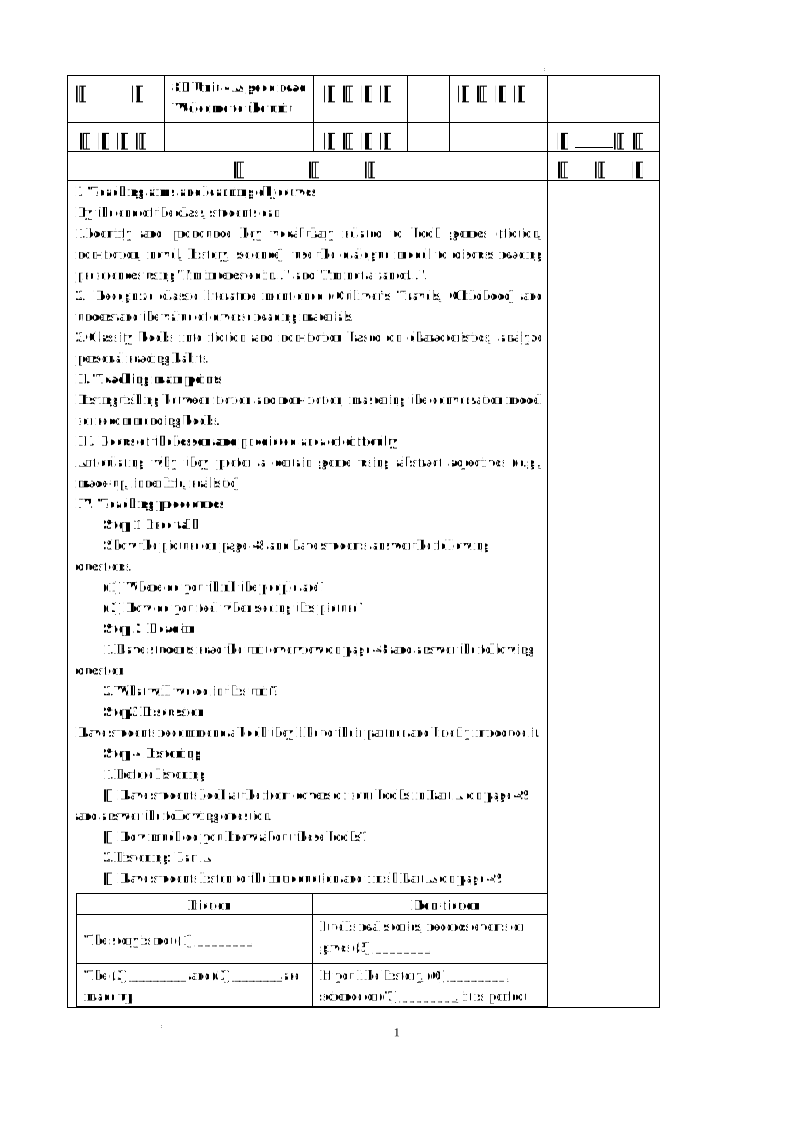
课 题
8B Unit 4 A good read Welcome to the unit
备课时间
上课时间
主备教师
复备教师
第 课时
主 备 栏
复 备 栏
I. Teaching aims and learning objectives
By the end of the class, students can
1.Identify and pronounce key vocabulary related to book genres (fiction, non-fiction, novel, history, science); use the dialogue model to discuss reading preferences using "I'm interested in..." and "I'm not a fan of...".
2. Recognize classic literature mentioned (Gulliver’s Travels, Childhood) and understand the value of diverse reading materials.
3.Classify books into fiction and non-fiction based on characteristics; analyze personal reading habits.
II. Teaching main points
Distinguishing between fiction and non-fiction; mastering the conversation model for recommending books.
III. Focus of the lesson and predicted area of difficulty
Articulating why they prefer a certain genre using abstract adjectives (e.g., made-up, inner life, realistic)
IV. Teaching procedures
Step 1 Free talk
Show the picture on page 48 and have students answer the following questions.
(1) Where do you think the people are?
(2) How do you feel when seeing this picture?
Step 2. Lead-in
1.Have students read the unit overview on page 48 and answer the following question.
2.What will we do in this unit?
Step3 Discussion
Have students recommend a book they like to their partner and briefly introduce it.
Step 4 Listening
1.Before listening
①Have students look at the front covers of four books in Part A on page 49 and answer the following question.
②How much do you know about these books?
2.Listening: Part A
①Have students listen to the introduction and finish Part A on page 49.
Fiction
Non-fiction
The story is not (1) ________.
It tells real stories, records events or gives (5) ________.
The (2) ________ and (3) _______are made up.
If you like history, (6) ________ , science or (7) ________, it is perfect for you.
People read it for (4) ________.
People read it to (8) ________ about different things.
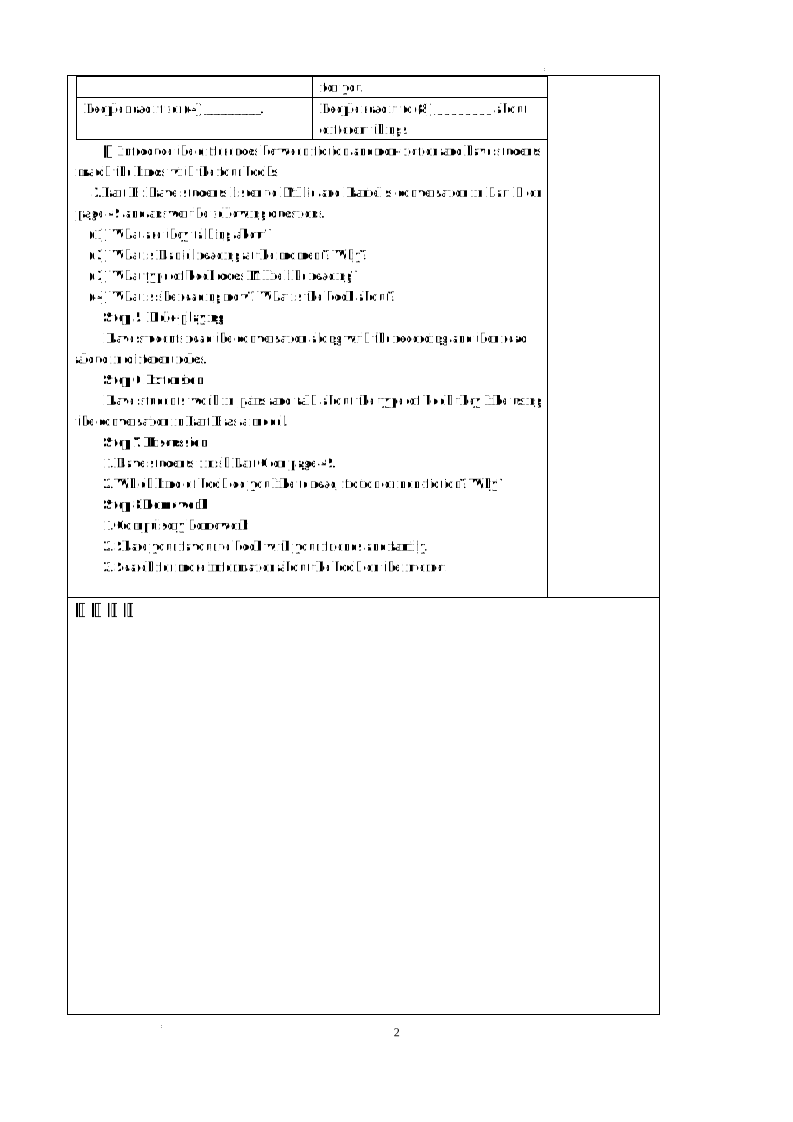
②Introduce the differences between fiction and non-fiction and have students match the kinds with the four books.
3.Part B :Have students listen to Millie and Daniel’s conversation in Part B on page 49 and answer the following questions.
(1) What are they talking about?
(2) What is Daniel reading at the moment? Why?
(3) What type of book does Millie like reading?
(4) What is she reading now? What is the book about?
Step 5. Role-playing
Have students read the conversation along with the recording and then read aloud in different roles.
Step 6 Extension
Have students work in pairs and talk about the type of book they like using the conversation in Part B as a model.
Step 7 Discussion
1.Have students finish Part C on page 49.
2.Which kind of book do you like to read, fiction or non-fiction? Why?
Step 8Homework
1.Compulsory homework:
2.Share your favourite book with your friends and family.
3.Search for more information about the book on the internet.
教后记:
课 题
8B Unit 4 A good read Reading1
备课时间
上课时间
主备教师
复备教师
第 课时
主 备 栏
复 备 栏
I. Teaching aims and learning objectives
By the end of this class,students will be able to
1. Skim and scan the adapted excerpt to grasp the plot; understand key phrases (tired out, break free, huge army); retell the story using a timeline.
2.Appreciate the classic Gulliver’s Travels as a satire; understand the universal theme of facing the unknown.
II. Teaching main points
Understanding the plot sequence; analyzing character feelings.
III. Focus of the lesson and predicted area of difficulty
Grasping the satirical nature of the text (implicit); reflecting on "impossible challenges" in real life.
IV. Teaching procedures
Step 1. Lead-in
1.Introduce the novel called Gulliver’s Travels, by Jonathan Swift.
Step 2. Pre-reading
1.Have students look at the picture on page 51 and answer the two questions on page 50 before reading.
①. What do you think the story is about from the picture?
②Do you like to read this kind of story? Why or why not?
Step 3. While-reading
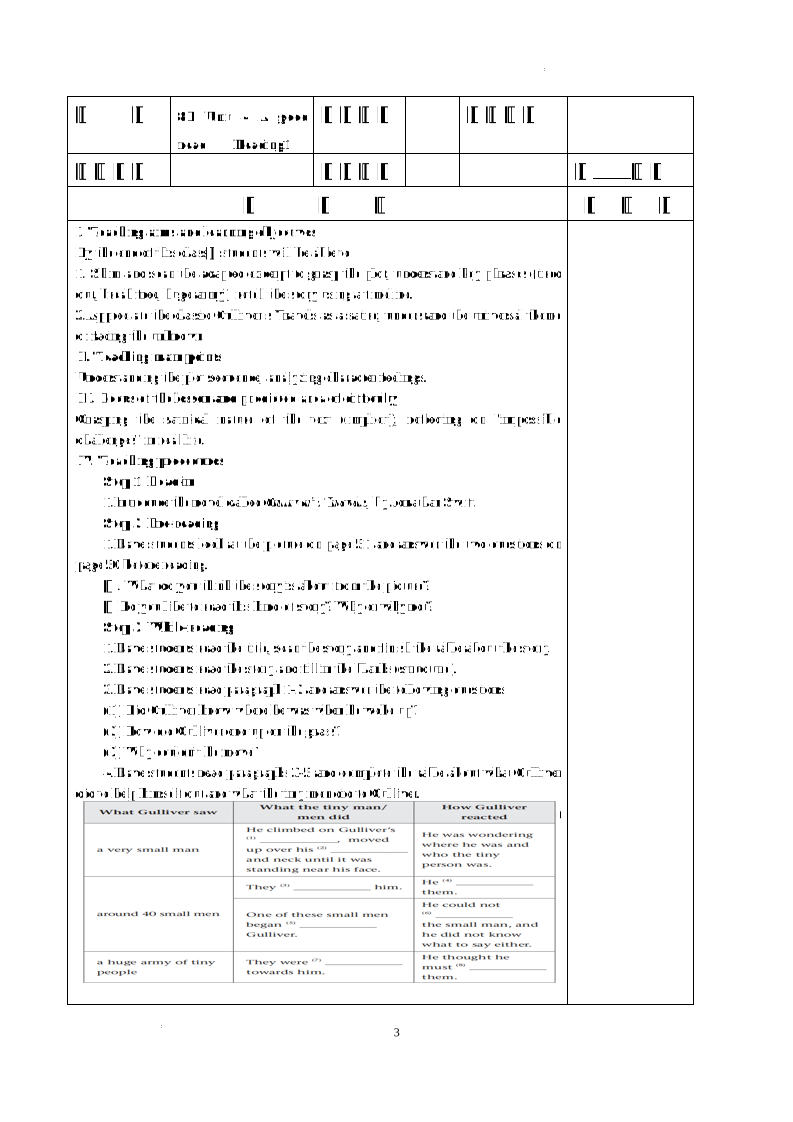
1.Have students read the title, scan the story and finish the table about the story.
2.Have students read the story and fill in the blanks (structure).
3.Have students read paragraph 1-2 and answer the following questions.
(1) Did Gulliver know where he was when he woke up?
(2) How did Gulliver end up on the grass?
(3) Why couldn’t he move?
4.Have students read paragraphs 3-5 and complete the table about what Gulliver did to help himself out and what the tiny men did to Gulliver.
5.Have students read the story again and put sentences in the correct order (Part A on page 52).
6.Have students read the story again and answer the following questions (Part B on page 52).
(1) When did Gulliver wake up?
(2) Which parts of Gulliver’s body were tied to the ground?
(3) Gulliver saw a small man. Where was the man? How big was he?
(4) How do you think Gulliver felt when he saw the small man?
(5) Why did the small men begin to shout?
(6) What do you think of Gulliver?
7. Have students retell the story of “Gulliver in Lilliput” according to the following chart.
Step 4.Post-reading
1.Have students finish Part C on page 53.
Step 5. Further thinking
1.Have students answer questions in Part D on page 53.
(1) Do you think Gulliver could get away from the tiny men? Why or why not?
(2) Suppose the same thing happened to you. What would you do?
(3) How would you feel in this situation: surprised, scared or curious? Give your reasons.
Step 6. Homework
1.Write a brief summary of the story.
2.Retell the story with the help of a mind map
教后记:
课 题
8B Unit 4 A good read Reading2
备课时间
上课时间
主备教师
复备教师
第 课时
主 备 栏
复 备 栏
I. Teaching aims and learning objectives
By the end of this class,students will be able to
1. Infer Gulliver’s emotions from his actions; evaluate the symbolism of the "tiny men"; connect the story to real-life challenges.
2.Use graphic organizers (story mountain) to structure narrative information.
II. Teaching main points
Understanding the plot sequence; analyzing character feelings.
III. Focus of the lesson and predicted area of difficulty
Grasping the satirical nature of the text (implicit); reflecting on "impossible challenges" in real life.
IV. Teaching procedures
Step 1. Lead-in
Have students know about the learning objectives of this lesson.
Step 2. Review
Have students review the development of the story and fill the blanks.
Step 3. Analysis
1. Story mountain
Have students think about the order of the story and match paragraphs with the elements in a story mountain.
2. Language features
Make a visible chart showing how verbs are used to show what Gulliver did/felt/saw/heard.
3. Emotions
Have students think about what emotions the sentences show in each paragraph.
Step 4. Language points
Explain the important expressions and have students practice the usages.
Step 5. Further thinking
1.Have students think about the following questions.
①Why does the novel attract readers?
② What is the major theme of it?
③ What reflections does it bring to young/adult readers?
2. How to read a novel?
Pay attention to the basic elements, which are setting, conflict, characters, plot and theme.
Step 6. Homework
1.Enjoy a video of the film and rewrite the story as A huge man in Lilliput from the tiny men’s eyes.
2.Continue reading Gulliver’s Travels online.
教后记:
课 题
8B Unit 4 A good read Grammar
备课时间
上课时间
主备教师
复备教师
第 课时
主 备 栏
复 备 栏
I. Teaching aims and learning objectives
By the end of the lesson, students should be able to:
1. Master the structure "Question Word + To-Infinitive" as objects; distinguish between must/have to (necessity) and must not/don't have to (prohibition/lack of necessity).
2.Deduce grammar rules from examples; analyze context to choose the correct modal verb (subjective vs. objective necessity).
3.Summarize grammar rules in a chart; self-correct errors in sentence construction.
II. Teaching main points
Structure: Verb/Adj + Wh-word + to do; Usage of must vs. have to.
III. Focus of the lesson and predicted area of difficulty
Understanding why why cannot be used with to-infinitive; distinguishing mustn't (forbidden) from don't have to (not necessary).
IV. Teaching procedures
A Question words + to-infinitives
Step 1. Presentation
1. Have students find out the sentences with “Question words + to-infinitives” in “Gulliver in Lilliput” on pages 50-51.
2. Summarize the sentence structure.
3. Have students read the table next to the tip on page 54 and find out the other three structures concerning to-infinitives.
4. Have students read the different groups of sentences on page 54 and choose the correct structure for each group.
5.Have students finish “Work out the rule!” on page 54.
Step 2. Practice
1. Have students rewrite the following sentences using question words + to-infinitives.
2. Have students finish Part A1 on page 55.
3. Have students finish Part A2 on page 55.
Step 3. Production
1.Write five sentences about a book you have read recently, using question words + to-infinitives.
e.g. Before reading How the Steel Was Tempered, I didn't know I could learn so much from a book. Pavel’s story made me think about how to live a meaningful life, not just for myself but for others. It showed me what to care about most. Now, I am thinking about how to help my school and what to do to make the world better. This book is like a friend that teaches me how to be a better person.
B Using must and have to
Step 4. Presentation
1.Have students read the text at the bottom of page 55 and answer the following questions.
①What are the negative forms of must and have to?
②What tense is used in the sentence with “must, mustn’t, have to, or don’t have to”?
③What is used after must, mustn’t, have to, or don’t have to?
2. Have students read the explanations of using must, mustn’t, have to, and don’t have to and the sentences related to them on page 56 and complete the table with them.
3.Have students read the tips on page 56 and summarize the forms and uses of have to in different tenses. The following tables are for reference.
Step 5. Practice
1.Have students finish Part B1 on page 56.
2. Have students complete the conversation with the words in the box without adding any other words.
Step 6. Production
1.Have students finish Part B2 on page 56.
e.g. To keep your books in good condition for a long time, you must take care of them. You have to keep books away from sunlight and store them in a dry place. Make sure there is some space between books for air. You mustn’t store books in attics or basements. You must wash your hands before reading and mustn’t eat while reading. Remember to clean your shelves lightly. Taking care of books doesn't have to be difficult or expensive.
Step7. Homework
1.Polish the two writing practices and share with your deskmate.
2.Work out some class rules using must (not) and (do not) have to..
教后记:
课 题
8B Unit 4 A good read IntegrationA-C
备课时间
上课时间
主备教师
复备教师
第 课时
主 备 栏
复 备 栏
I. Teaching aims and learning objectives
By the end of the lesson, students should be able to:
1.Identify intonation patterns in polite requests and exclamations; extract specific details from listening texts about book choices and authors; role-play borrowing books.
2. Understand the importance of copyright and respecting authors' hard work; recognize global literary figures (J.K. Rowling, Mark Twain).
3.Synthesize listening information to complete notes; evaluate arguments about pirated books.
4. Use note-taking strategies (keywords, symbols) during listening tasks..
II.Focus of the lesson and predicted area of difficulty
Listening for specific names, dates, and book titles; using polite expressions (Excuse me, Could you tell me...)
III. Focus of the lesson and predicted area of difficulty
Understanding the ethical implications of piracy; fluently integrating listening info into a spoken recommendation.
IV. Teaching procedures
Step 1: Pronunciation
1.Activity: Listen to sentences from the unit.
2."Could you tell me where to find...?" (Falling tone for wh-questions).
3."No way!" (Falling tone for strong surprise).
4.Drill: Mimic the emotion. Practice saying "Excuse me" with a polite, rising-falling contour to attract attention without being rude.
Step 2: Listening (Part A & B)
1.Pre-listening: Look at the book covers in Part A1. Predict which student likes which genre.
2.While-listening (Part A2 - J.K. Rowling):
Task: Complete the notes. (Year of birth, idea origin, number of books, sales).
Q1: "What helped Harry Potter become successful despite initial rejection?" (Persistence, small publisher).
3.While-listening (Part B - Copyright):
Listen to the article about pirated books.
Q2: "What are the two main problems for writers mentioned?" (Difficulty publishing, losing money to pirates).
Q3: "Why is buying pirated books harmful to us (readers) in the long run?" (Harms the industry, fewer good books produced).
Step 3: Speaking (Part C & D)
1.Role-Play (Library Scenario):
①Model: Millie & Mrs. Li.
②Focus: Polite requests (Could you tell me...), asking about limits (How many...?), and rules (Must return within...).
③Activity: Pairs create a dialogue borrowing a specific book from the list in Part A.
2.Discussion:
Q4: "Some people say 'Information should be free'. Do you agree? Where is the line between sharing and stealing?"
Step 4: Integration (Part D1 - Preparation)
1.Task: Complete the questionnaire for a book you have read.
2.Title, Writer, Type, Characters, Summary, Opinion.
3.Scaffolding: Provide sentence starters: The book describes..., The main character is..., I think it is... because...
Step 5. Homework
1.Practice the library dialogue with a partner and record it.
2.Finish the questionnaire in D1 for a book of your choice..
教后记:
课 题
8B Unit 4 A good read IntegrationD
备课时间
上课时间
主备教师
复备教师
第 课时
主 备 栏
复 备 栏
I. Teaching aims and learning objectives
By the end of the lesson, students should be able to:
1 Write a structured reading journal including summary and personal opinion; use target expressions (tell us to..., face the results).
2.Connect reading to cultural identity (Lu Xun, Diary of a Madman); appreciate how literature reflects society.
3.Critically evaluate a book’s theme; synthesize the unit’s concept of "opening minds" through reading.
4. Self-edit writing using a checklist; conduct independent research on an author..
II.Focus of the lesson and predicted area of difficulty
Structuring the journal (Title, Info, Summary, Opinion); using linking words for coherence
III. Focus of the lesson and predicted area of difficulty
Moving from simple plot summary to deep thematic reflection (What does the story teach us?)..
IV. Teaching procedures
Step 1: Further Study Exploration
1.Topic: Lu Xun and Diary of a Madman.
2.Activity: Brief presentation (teacher or student-led) on Lu Xun.
Q1: "Why is Lu Xun considered one of the greatest writers? How did his work 'open minds' in China?"
3.Connection: Link to the unit theme: Reading is a good way to open our minds. Reading isn't just entertainment; it's social reflection.
Step 2: Model Analysis
1.Read: Amy’s journal on The Adventures of Tom Sawyer.
2/.Deconstruct:
1 Basic Info: Title, Writer, Type.
2 Summary: "From talking friends... to finding treasure..." (Action-oriented).
3 Opinion: "I enjoy... because..." + "The story tells us to..." (Thematic depth).
4 Highlight Expressions: face the results, fight for what is right, fun-loving and brave.
Step 3: Writing Workshop
1.Task: Write your own Reading Journal based on D1 preparation.
2.Requirements:
①Include all basic info.
②Summary: 3-4 sentences covering main plot points.
③Opinion: Must include why you liked it and what lesson the story teaches.
④Integrate "Further Study" spirit: Mention how the book broadens horizons or protects culture (if applicable).
⑤Drafting: Students write individually. Teacher circulates to assist with vocabulary.
Step 4: Peer Review & Polish
1.Checklist:
①Did I use must/have to or wh-to structures correctly?
②Is my opinion clear?
③Did I include a "lesson learned"?
2.Sharing: Select 2-3 students to read their "Lesson Learned" section.
Step5. Homework
1.Polish the reading journal based on peer feedback and submit.
2.Project: Choose one Chinese classic (e.g., Journey to the West) and find one English excerpt or summary to share next week, connecting it to the "Further Study" theme of cultural export..
教后记:
13
学科网(北京)股份有限公司
学科网(北京)股份有限公司
$
资源预览图
1
2
3
相关资源
由于学科网是一个信息分享及获取的平台,不确保部分用户上传资料的 来源及知识产权归属。如您发现相关资料侵犯您的合法权益,请联系学科网,我们核实后将及时进行处理。