Unit 2 Legends and Tales-Reading and Thinking 教案-2025-2026学年高中英语人教版选修第二册
2026-03-22
|
6页
|
22人阅读
|
0人下载
普通
资源信息
| 学段 | 高中 |
|---|---|
| 学科 | 英语 |
| 教材版本 | 高中英语人教版选修第二册 |
| 年级 | 高三 |
| 章节 | Reading and Thinking |
| 类型 | 教案 |
| 知识点 | - |
| 使用场景 | 同步教学-新授课 |
| 学年 | 2025-2026 |
| 地区(省份) | 全国 |
| 地区(市) | - |
| 地区(区县) | - |
| 文件格式 | DOCX |
| 文件大小 | 91 KB |
| 发布时间 | 2026-03-22 |
| 更新时间 | 2026-03-22 |
| 作者 | 匿名 |
| 品牌系列 | - |
| 审核时间 | 2026-03-22 |
| 下载链接 | https://m.zxxk.com/soft/56948912.html |
| 价格 | 1.00储值(1储值=1元) |
| 来源 | 学科网 |
内容正文:
Unit 2 Legends and Tales-Reading and Thinking
内容导航
This section focuses on classic legends and tales from different cultures, presenting well-structured narrative texts that tell vivid stories with distinct characters, clear plotlines (exposition, development, climax and resolution) and profound moral implications. It guides students to grasp the main content, analyze character traits, explore the cultural connotations behind the stories, and master basic reading strategies such as skimming, scanning and inferring, laying a solid foundation for further language learning and cultural exploration. The texts not only carry the cultural essence of different regions but also reflect the common spiritual pursuits of human beings, such as courage, kindness and justice.
教学目标和重难点
1. 教学目标
Language Ability: Students can understand and use new words, phrases and complex sentences related to legends and tales, grasp the narrative structure of the text, and express their views on the stories in simple English. Cultural Awareness: They can understand the cultural background and values contained in different legends and tales, respect cultural diversity, and enhance their own cultural confidence. Thinking Quality: They can analyze character traits and plot logic, conduct simple reasoning and evaluation, and develop logical thinking and critical thinking abilities. Learning Ability: They can master effective reading strategies, form good reading habits, and learn to cooperate with peers to complete learning tasks and improve their independent learning ability.
2. 教学重难点
Key Points: Mastering the core vocabulary and phrases related to legends and tales (such as "legend", "tale", "brave", "overcome", "moral") and complex sentence structures; grasping the main content and narrative structure of the reading text; learning and applying reading strategies such as skimming, scanning and inferring. Difficult Points: Understanding the implied meanings and cultural connotations in the text; analyzing the causes of character behaviors and the deep moral implications of the stories; using the learned language knowledge and reading strategies to express personal views and feelings about the legends and tales accurately and fluently.
教学过程
Step 1: Lead-in (Warm-up and Activation)
Activity 1: Brainstorming and Discussion. The teacher writes the topic "Legends and Tales" on the blackboard and asks students the following questions: "What is a legend? What is a tale? Can you think of any legends or tales you have heard before, either from Chinese culture or foreign cultures?" Then, the teacher invites 3-4 students to share their answers in English. For example, students may mention "Journey to the West" from Chinese legends, "The Little Mermaid" from foreign tales, etc. After students’ sharing, the teacher briefly comments and summarizes: "Legends are usually stories about heroes, gods or historical events, which are passed down from generation to generation and have a certain historical color; tales are more about ordinary people or animals, with strong imagination and often convey moral truths."
Activity 2: Visual Aids Presentation. The teacher shows pictures or short video clips related to classic legends and tales (such as the scene of "King Arthur and the Sword in the Stone", the image of "Cinderella") on the screen. While showing, the teacher asks simple questions: "Do you know this story? What is the main character in this story? What happened in the story?" This stimulates students’ interest and helps them recall relevant background knowledge.
Design Intention: The lead-in link combines brainstorming, discussion and visual aids to activate students’ prior knowledge and experience of legends and tales. By asking questions and showing visual materials, it can effectively arouse students’ learning interest, create a relaxed and active classroom atmosphere, and lay a good emotional and cognitive foundation for the subsequent reading teaching. At the same time, it can help students initially distinguish the differences between legends and tales, and pave the way for understanding the theme of the reading text.
Step 2: Pre-reading (Vocabulary Preview and Prediction)
Activity 1: Vocabulary Preview. The teacher presents the core vocabulary and phrases of the reading text on the screen, including nouns (legend, tale, hero, adventure, moral), verbs (overcome, challenge, defeat, save, devote), adjectives (brave, wise, kind, cruel, determined) and phrases (in search of, in danger, come to one’s rescue, be famous for). For each word and phrase, the teacher provides simple English explanations and example sentences related to legends and tales, so that students can understand their meanings and usage in context. For example, for the word "legend", the teacher explains: "A legend is a traditional story that is believed to be true by many people, often about heroes or magical events." And gives an example sentence: "King Arthur is a famous figure in British legends." Then, the teacher asks students to read the words and phrases aloud twice, and invites several students to read them individually to correct their pronunciation and intonation.
Activity 2: Text Prediction. The teacher shows the title of the reading text (e.g., "The Legend of Hua Mulan" or "A Tale of Courage") and the first paragraph on the screen. Then, asks students to work in pairs to discuss and predict: "What do you think the story will be about? Who is the main character? What difficulties will the main character face? What will happen in the end?" After 5 minutes of discussion, each pair sends a representative to share their predictions. The teacher writes down the key points of students’ predictions on the blackboard and encourages students to keep their predictions in mind and verify them in the process of reading.
Design Intention: The pre-reading link focuses on vocabulary preview and text prediction. Vocabulary is the foundation of reading comprehension. By previewing core vocabulary and phrases in advance, students can reduce the difficulty of reading and improve reading efficiency. Text prediction can stimulate students’ reading motivation, make students read with purpose, and cultivate their ability to infer and predict based on limited information. At the same time, pair discussion can enhance students’ cooperative learning ability and make them more actively participate in classroom activities.
Step 3: While-reading (Comprehension and Analysis)
This step is divided into three parts: skimming, scanning and careful reading, which helps students understand the text from shallow to deep.
Activity 1: Skimming for Main Idea. The teacher asks students to read the entire text quickly, without paying too much attention to details, and answer the following questions: "What is the main idea of the text? Who is the main character? What is the main event of the story?" After students finish reading, the teacher invites several students to share their answers, and then summarizes the main idea of the text: "This text tells a legend/tale about [main character], who [main event], showing the character’s [personality traits] and conveying the moral truth of [moral implication]."
Design Intention: Skimming is a basic reading strategy that helps students quickly grasp the core content of the text and form an overall understanding of the text. By asking simple and direct questions, it can guide students to focus on the key information of the text, avoid getting lost in details, and lay a foundation for further in-depth reading.
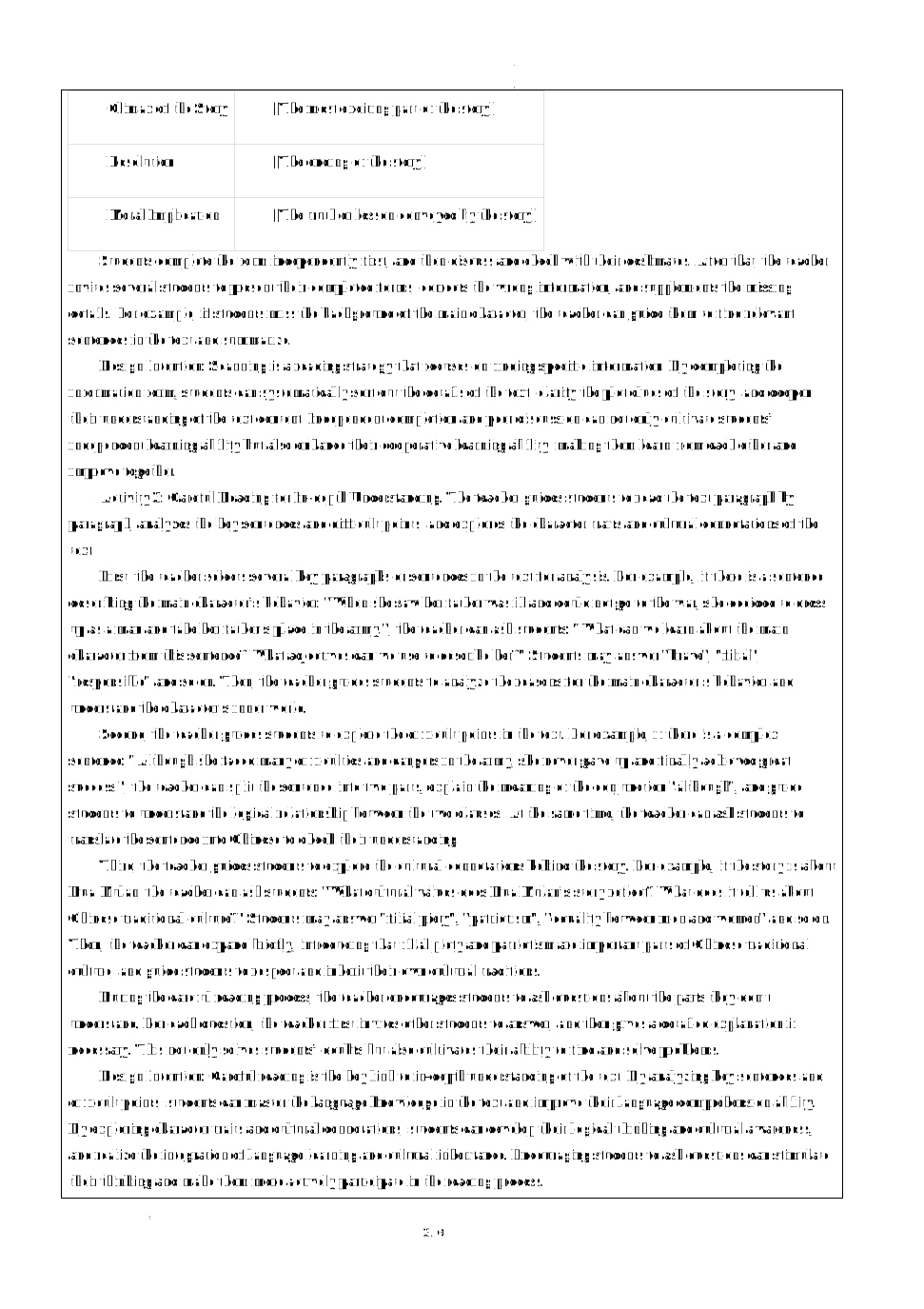
Activity 2: Scanning for Specific Information. The teacher asks students to read the text again, this time focusing on specific details, and complete the following information form (the form is projected on the screen):
Items
Details
Main Character
[Name, Personality Traits, Background]
Setting of the Story
[Time, Place]
Key Events
[Event 1, Event 2, Event 3]
Climax of the Story
[The most exciting part of the story]
Resolution
[The ending of the story]
Moral Implication
[The truth or lesson conveyed by the story]
Students complete the form independently first, and then discuss and check with their deskmates. After that, the teacher invites several students to present their completed forms, corrects the wrong information, and supplements the missing details. For example, if students miss the background of the main character, the teacher can guide them to find relevant sentences in the text and summarize.
Design Intention: Scanning is a reading strategy that focuses on finding specific information. By completing the information form, students can systematically sort out the details of the text, clarify the plot clues of the story, and deepen their understanding of the text content. Independent completion and peer discussion can not only cultivate students’ independent learning ability but also enhance their cooperative learning ability, making them learn from each other and improve together.
Activity 3: Careful Reading for In-depth Understanding. The teacher guides students to read the text paragraph by paragraph, analyzes the key sentences and difficult points, and explores the character traits and cultural connotations of the text.
First, the teacher selects several key paragraphs or sentences in the text for analysis. For example, if there is a sentence describing the main character’s behavior: "When she saw her father was ill and could not go to the war, she decided to dress up as a man and take her father’s place in the army.", the teacher can ask students: "What can we learn about the main character from this sentence? What adjectives can we use to describe her?" Students may answer "brave", "filial", "responsible" and so on. Then, the teacher guides students to analyze the reasons for the main character’s behavior and understand the character’s inner world.
Second, the teacher guides students to explore the difficult points in the text. For example, if there is a complex sentence: "Although she faced many difficulties and dangers in the army, she never gave up and finally achieved great success.", the teacher can split the sentence into two parts, explain the meaning of the conjunction "although", and guide students to understand the logical relationship between the two clauses. At the same time, the teacher can ask students to translate the sentence into Chinese to check their understanding.
Third, the teacher guides students to explore the cultural connotations behind the story. For example, if the story is about Hua Mulan, the teacher can ask students: "What cultural values does Hua Mulan’s story reflect? What does it tell us about Chinese traditional culture?" Students may answer "filial piety", "patriotism", "equality between men and women" and so on. Then, the teacher can expand briefly, introducing that filial piety and patriotism are important parts of Chinese traditional culture, and guide students to respect and inherit their own cultural traditions.
During the careful reading process, the teacher encourages students to ask questions about the parts they don’t understand. For each question, the teacher first invites other students to answer, and then gives a detailed explanation if necessary. This not only solves students’ doubts but also cultivates their ability to find and solve problems.
Design Intention: Careful reading is the key link to in-depth understanding of the text. By analyzing key sentences and difficult points, students can master the language knowledge in the text and improve their language comprehension ability. By exploring character traits and cultural connotations, students can develop their logical thinking and cultural awareness, and realize the integration of language learning and cultural inheritance. Encouraging students to ask questions can stimulate their thinking and make them more actively participate in the reading process.
Step 4: While-reading Extension (Strategy Application and Practice)
Activity 1: Reading Strategy Summary. The teacher summarizes the reading strategies used in the while-reading link with students, including skimming (for main idea), scanning (for specific information) and careful reading (for in-depth understanding). Then, the teacher explains the usage of these strategies in detail: "Skimming requires us to read quickly, focus on the beginning and end of the text and the topic sentence of each paragraph; scanning requires us to find specific information according to the question, such as names, time, places, etc.; careful reading requires us to read slowly and carefully, analyze the key sentences and logical relationships, and understand the implied meanings of the text."
Activity 2: Strategy Practice. The teacher provides a short legend or tale (about 200 words) that is similar to the reading text in theme and structure. Ask students to apply the skimming, scanning and careful reading strategies they have just learned to read the short text and complete the following tasks: 1. Skim the text and write down the main idea. 2. Scan the text and find the specific information (main character, key events). 3. Read carefully and analyze the character traits of the main character. Students complete the tasks independently, and then the teacher checks the results and comments.
Design Intention: The extension link of while-reading focuses on the summary and application of reading strategies. Summarizing the strategies can help students sort out the knowledge they have learned and form a systematic understanding of reading strategies. Strategy practice can help students consolidate the learned strategies, improve their reading ability, and realize the transfer and application of knowledge. The short text selected is similar to the reading text, which can reduce the difficulty of practice and enhance students’ confidence in learning.
Step 5: Post-reading (Consolidation, Application and Reflection)
This step is divided into three parts: language consolidation, theme discussion and reflection summary, which helps students consolidate the knowledge they have learned, apply it flexibly and reflect on their learning process.
Activity 1: Language Consolidation. The teacher designs the following exercises to help students consolidate the core vocabulary, phrases and sentence structures learned in the text:
1. Fill in the blanks with the correct form of the given words. (The words include the core verbs and adjectives in the text, such as overcome, brave, determine, etc.)
Example: She is a ______ (brave) girl who never fears difficulties.
2. Translate the following sentences into English. (The sentences are related to the theme of legends and tales, and need to use the core phrases and sentence structures in the text.)
Example: 他为了寻找宝藏,经历了许多冒险。(in search of, adventure)
3. Rewrite the key sentences in the text with other expressions. (Help students master the flexible use of language.)
Students complete the exercises independently, and then the teacher checks the answers, corrects the mistakes, and explains the key and difficult points. For example, if students make mistakes in the tense of verbs, the teacher can review the relevant tense knowledge and guide students to use the correct tense according to the context.
Design Intention: Language consolidation is an important link to deepen students’ understanding and mastery of language knowledge. By designing different types of exercises, students can consolidate the core vocabulary, phrases and sentence structures in the text, improve their language application ability, and lay a solid foundation for subsequent oral and written expression.
Activity 2: Theme Discussion. The teacher divides students into groups of 4-5, and asks them to discuss the following topics: 1. What do you think of the main character in the story? Do you admire him/her? Why or why not? 2. What moral truth does the story convey? How can we apply this truth to our daily life? 3. Are there any similar legends or tales in your own culture? Share them with your group members and compare the similarities and differences between them and the story in the text. Each group is assigned a recorder and a presenter. After 10 minutes of discussion, each group sends a presenter to share their group’s views. The teacher listens carefully, comments on students’ views, and guides students to think deeply.
For example, when students discuss the moral truth of the story, the teacher can guide them to combine their own life experience and talk about how to practice the moral truth in daily life. When students share similar legends or tales in their own culture, the teacher can guide them to find the common points and differences between different cultures, and cultivate their cultural awareness and cross-cultural communication ability.
Design Intention: Theme discussion can help students deepen their understanding of the theme and moral implication of the text, and express their own views and feelings in English. Group discussion can enhance students’ cooperative learning ability and oral expression ability, make students learn from each other and expand their thinking. By comparing different cultures, students can respect cultural diversity and enhance their own cultural confidence.
Activity 3: Reflection and Summary. The teacher asks students to reflect on their learning process in this class and answer the following questions: 1. What have you learned in this class? (Including language knowledge, reading strategies, cultural knowledge, etc.) 2. What difficulties did you encounter in the learning process? How did you solve them? 3. What aspects do you need to improve in the future? Students think independently for 3 minutes, and then share their reflections with their deskmates. Finally, the teacher makes a summary of the whole class, affirms the achievements of students, points out the problems that need to be improved, and puts forward expectations for students’ future learning.
Design Intention: Reflection and summary can help students sort out the knowledge and skills they have learned in this class, find their own problems and deficiencies, and clarify the direction of future learning. It can also cultivate students’ self-reflection ability and learning ability, make students become the masters of their own learning, and lay a foundation for their lifelong learning.
Step 6: Homework Arrangement
The homework is divided into three levels: basic homework, improved homework and expanded homework, to meet the needs of different students:
1. Basic Homework: Read the reading text aloud for 15 minutes every day, recite the core vocabulary and key sentences; finish the language consolidation exercises in the class again to ensure that you master the relevant language knowledge.
2. Improved Homework: Write a short passage (about 150 words) to introduce the legend or tale in the text, including the main character, key events and moral implication. Try to use the core vocabulary and sentence structures learned in the class.
3. Expanded Homework: Collect a legend or tale from your own culture or foreign cultures, write a short introduction (about 200 words) and prepare to share it in the next class. At the same time, think about the cultural connotations contained in the story.
Design Intention: The hierarchical homework arrangement adheres to the principle of "teaching students in accordance with their aptitude", which can meet the learning needs of different levels of students. Basic homework helps students consolidate the knowledge they have learned; improved homework helps students improve their written expression ability; expanded homework helps students expand their knowledge, enhance their cultural awareness and independent learning ability. At the same time, the homework is closely related to the content of the class, which can realize the connection between classroom learning and after-class practice.
Step 7: Teaching Evaluation
Teaching evaluation runs through the whole teaching process, including formative evaluation and summative evaluation:
1. Formative Evaluation: In the process of lead-in, pre-reading, while-reading and post-reading, the teacher observes students’ participation in classroom activities, such as whether they actively answer questions, participate in discussions, and complete tasks independently. The teacher gives timely praise and encouragement to students with good performance, and guides and helps students with poor performance. For example, when students actively share their views in the theme discussion, the teacher can say: "Your view is very unique and insightful. Well done!" When students have difficulties in completing the exercises, the teacher can give appropriate hints and guidance.
2. Summative Evaluation: Evaluate students’ learning effect through homework completion, classroom performance and small tests. For example, check students’ homework completion, evaluate the quality of their written passages, and test students’ mastery of core vocabulary and reading strategies through small tests. The evaluation results are used to adjust the teaching plan and teaching methods, so as to better meet the learning needs of students.
Design Intention: Teaching evaluation is an important part of teaching. Formative evaluation can timely feedback students’ learning status, help students find their own problems and deficiencies, and stimulate their learning motivation. Summative evaluation can comprehensively understand students’ learning effect, provide a basis for adjusting teaching strategies, and ensure the quality of teaching. The combination of formative evaluation and summative evaluation can make the evaluation more comprehensive and scientific, and promote the all-round development of students.
In the whole teaching process, the teacher adheres to the student-centered teaching concept, focuses on the cultivation of students’ four-dimensional key competencies, designs rich and diverse teaching activities, and guides students to learn actively, independently and cooperatively. Through the combination of reading, discussion, practice and reflection, students can not only master the relevant language knowledge and reading strategies but also enhance their cultural awareness, develop their thinking quality and improve their learning ability, so as to achieve the teaching goal of this section.
1 / 1
学科网(北京)股份有限公司
学科网(北京)股份有限公司
学科网(北京)股份有限公司
$
资源预览图

1

2
3
相关资源
由于学科网是一个信息分享及获取的平台,不确保部分用户上传资料的 来源及知识产权归属。如您发现相关资料侵犯您的合法权益,请联系学科网,我们核实后将及时进行处理。