Unit 2 Legends and Tales-Language Focus 1 教案-2025-2026学年高中英语人教版选修第二册
2026-03-22
|
6页
|
20人阅读
|
0人下载
普通
资源信息
| 学段 | 高中 |
|---|---|
| 学科 | 英语 |
| 教材版本 | 高中英语人教版选修第二册 |
| 年级 | 高三 |
| 章节 | Language Focus 1 |
| 类型 | 教案 |
| 知识点 | - |
| 使用场景 | 同步教学-新授课 |
| 学年 | 2025-2026 |
| 地区(省份) | 全国 |
| 地区(市) | - |
| 地区(区县) | - |
| 文件格式 | DOCX |
| 文件大小 | 109 KB |
| 发布时间 | 2026-03-22 |
| 更新时间 | 2026-03-22 |
| 作者 | 匿名 |
| 品牌系列 | - |
| 审核时间 | 2026-03-22 |
| 下载链接 | https://m.zxxk.com/soft/56948918.html |
| 价格 | 1.00储值(1储值=1元) |
| 来源 | 学科网 |
内容正文:
Unit 2 Legends and Tales-Language Focus 1
内容导航
This section focuses on key vocabulary, phrases and basic sentence structures related to legends and tales. It guides students to master word usage and sentence patterns in the context of legendary stories, laying a foundation for listening, speaking, reading and writing about the unit theme.
教学目标和重难点
1. 教学目标
Language Competence: Students will master core vocabulary and sentence structures of legends and tales, and improve their ability to use language accurately in relevant contexts. Cultural Awareness: They will understand the cultural connotations behind different legends and cultivate respect for diverse cultures. Thinking Quality: They will develop logical thinking through analyzing language structures and critical thinking through exploring the connotation of legendary texts. Learning Ability: They will master effective vocabulary and grammar learning strategies, and enhance their ability of independent learning and cooperative inquiry.
2. 教学重难点
Key Points: Master the usage of core vocabulary (e.g., legend, tale, magical, adventure, hero) and key phrases (e.g., set out, in search of, come across, turn out). Grasp the basic sentence structures used in describing legends and tales, such as narrative sentences and simple complex sentences. Difficult Points: Flexibly use the learned vocabulary and sentence structures to describe legendary plots or characters. Distinguish the subtle differences between similar words (e.g., legend and tale) and use them appropriately in different contexts.
教学过程
Step 1: Lead-in (Warm-up & Activation)
Activity 1: Legend and Tale Sharing
The teacher starts the class by asking two open-ended questions: “Have you ever heard any Chinese or foreign legends or tales? What is the most impressive one in your memory?” Then, invite 3-4 students to share their favorite legends or tales briefly, such as “Journey to the West” or “The Legend of King Arthur”. After each share, the teacher responds positively, e.g., “That’s a wonderful story! It’s a classic Chinese legend full of magical elements.”
Activity 2: Vocabulary Preview
Show some pictures related to legends and tales on the screen, including a hero fighting a monster, a magician casting a spell, a traveler setting out on a journey, etc. Below each picture, mark the corresponding English words (legend, tale, hero, magical, adventure, set out, in search of). Guide students to guess the meanings of these words according to the pictures and their existing knowledge. Then, the teacher reads the words aloud, and students follow, paying attention to the pronunciation and stress. Finally, ask students to match the words with their simple definitions provided on the handout.
Design Intention: The lead-in part aims to activate students’ prior knowledge about legends and tales, arouse their learning interest, and create a relaxed and pleasant learning atmosphere. By asking questions and sharing stories, students can quickly enter the unit theme. The picture-based vocabulary preview helps students understand new words in a visual way, reducing the difficulty of vocabulary learning and laying a foundation for the subsequent learning of Language Focus 1. At the same time, it trains students’ ability to guess word meanings according to context, which is an important learning strategy in English learning.
Step 2: Presentation (Key Vocabulary & Phrases)
Activity 1: Core Vocabulary Explanation
Focus on explaining 6 core vocabulary words: legend, tale, hero, magical, adventure, creature. For each word, the teacher follows the “pronunciation - definition - example sentence - collocation” sequence to explain, combining the context of legends and tales.
1. Legend: Pronunciation /ˈledʒənd/; Definition: A traditional story that is believed to be true, usually about brave people, magical events, or ancient times; Example Sentence: “The Legend of Mulan” is a famous Chinese legend about a brave girl who takes her father’s place in the army. Collocation: a legend about..., a famous legend, pass down a legend.
2. Tale: Pronunciation /teɪl/; Definition: A story, especially one that is imaginative or not based on fact; Example Sentence: She told her children a tale about a magical fox that could talk. Collocation: a fairy tale, a tale of adventure, tell a tale.
3. Hero: Pronunciation /ˈhɪərəʊ/; Definition: A person who is brave, kind, and admired by others, especially someone who does something brave or important; Example Sentence: In many legends, the hero fights against evil and protects the weak. Collocation: a national hero, a hero of the story, brave hero.
4. Magical: Pronunciation /ˈmædʒɪkl/; Definition: Having magic, or seeming to be caused by magic; Example Sentence: The forest is a magical place where all kinds of magical creatures live. Collocation: magical power, magical world, magical experience.
5. Adventure: Pronunciation /ədˈventʃə(r)/; Definition: An exciting and dangerous journey or experience; Example Sentence: The young man set off on an adventure to find the hidden treasure. Collocation: an adventure in..., go on an adventure, exciting adventure.
6. Creature: Pronunciation /ˈkriːtʃə(r)/; Definition: A living thing, especially an animal; Example Sentence: The legend tells of a strange creature with a human head and a lion’s body. Collocation: magical creature, sea creature, mysterious creature.
After explaining each word, ask students to make one sentence with the word, and invite them to share their sentences with the class. The teacher corrects mistakes in usage or grammar in time and affirms good sentences.
Activity 2: Key Phrases Explanation
Introduce 4 key phrases: set out, in search of, come across, turn out. For each phrase, explain its meaning, usage, and provide example sentences related to legends and tales, then guide students to practice.
1. set out: Meaning: to start a journey or a task; Example Sentence: The hero set out at dawn to save the princess from the evil wizard. Usage: set out to do sth. (start to do sth.), set out for a place (start a journey to a place). Practice: Ask students to complete the sentence: “The traveler set out ________ (寻找宝藏) early in the morning.” (in search of treasure)
2. in search of: Meaning: looking for something or someone; Example Sentence: Many people traveled to the mountains in search of the magical stone. Usage: usually used as an adverbial, can be placed at the beginning or the end of a sentence. Practice: Translate the sentence: “他们出发去寻找那个失踪的孩子。” (They set out in search of the missing child.)
3. come across: Meaning: to find or meet someone or something by chance; Example Sentence: While walking in the forest, the hero came across a small cabin where an old man lived. Usage: come across sb./sth. Practice: Ask students to make a sentence with “come across” related to a legend.
4. turn out: Meaning: to happen in a particular way, or to be true after all; Example Sentence: The strange creature turned out to be a friend of the hero, not an enemy. Usage: turn out + (to be) + adj./n. Practice: Complete the sentence: “The story turned out ________ (比我们想象的更精彩).” (to be more wonderful than we thought)
Design Intention: This step focuses on the key vocabulary and phrases of Language Focus 1, which are the basis for students to understand and express legends and tales. By explaining pronunciation, definition, example sentences and collocations, students can master the usage of words and phrases in a systematic way. The immediate practice (making sentences, completing sentences, translating) helps students consolidate what they have learned in time, and transforms the passive acceptance of knowledge into active application. At the same time, combining the example sentences with the unit theme of legends and tales ensures that the language learning is closely connected with the theme, laying a foundation for the subsequent learning of sentence structures and comprehensive application.
Step 3: Presentation (Key Sentence Structures)
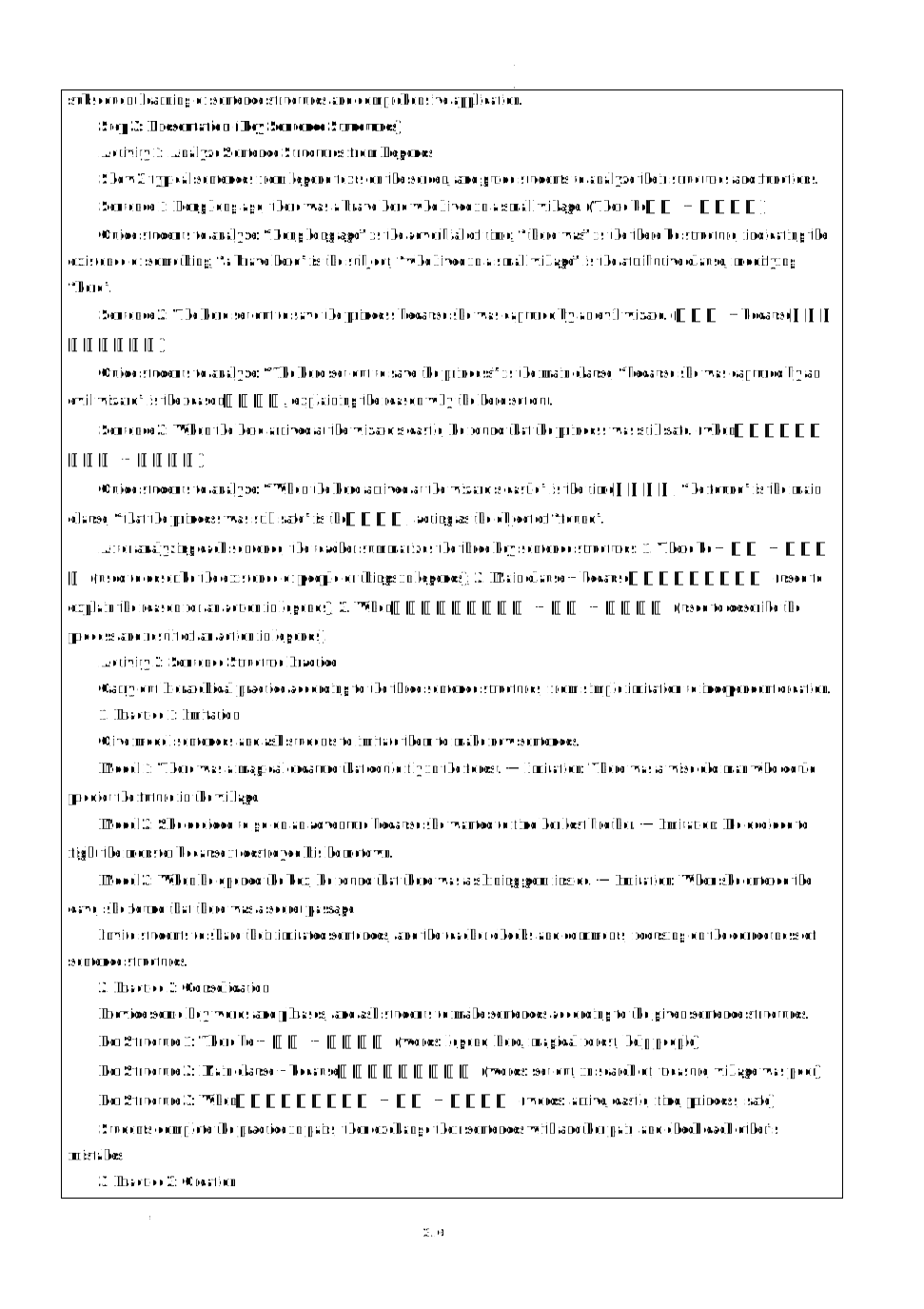
Activity 1: Analyze Sentence Structures from Legends
Show 3 typical sentences from legend texts on the screen, and guide students to analyze their structures and functions.
Sentence 1: Long long ago, there was a brave hero who lived in a small village. (There be句型 + 定语从句)
Guide students to analyze: “Long long ago” is the adverbial of time; “there was” is the there be structure, indicating the existence of something; “a brave hero” is the subject; “who lived in a small village” is the attributive clause, modifying “hero”.
Sentence 2: The hero set out to save the princess because she was captured by an evil wizard. (简单句 + because引导的原因状语从句)
Guide students to analyze: “The hero set out to save the princess” is the main clause; “because she was captured by an evil wizard” is the reason状语从句, explaining the reason why the hero set out.
Sentence 3: When the hero arrived at the wizard’s castle, he found that the princess was still safe. (when引导的时间状语从句 + 宾语从句)
Guide students to analyze: “When the hero arrived at the wizard’s castle” is the time状语从句; “he found” is the main clause; “that the princess was still safe” is the宾语从句, acting as the object of “found”.
After analyzing each sentence, the teacher summarizes the three key sentence structures: 1. There be + 名词 + 定语从句 (used to describe the existence of people or things in legends); 2. Main clause + because引导的原因状语从句 (used to explain the reason for an action in legends); 3. When引导的时间状语从句 + 主句 + 宾语从句 (used to describe the process and result of an action in legends).
Activity 2: Sentence Structure Practice
Carry out hierarchical practice according to the three sentence structures, from simple imitation to independent creation.
1. Practice 1: Imitation
Give model sentences and ask students to imitate them to make new sentences.
Model 1: There was a magical creature that could fly in the forest. → Imitation: There was a wise old man who could predict the future in the village.
Model 2: She decided to go on an adventure because she wanted to find her lost brother. → Imitation: He decided to fight the monster because it destroyed his hometown.
Model 3: When he opened the box, he found that there was a shining gem inside. → Imitation: When she entered the cave, she found that there was a secret passage.
Invite students to share their imitated sentences, and the teacher checks and comments, focusing on the correctness of sentence structures.
2. Practice 2: Consolidation
Provide some key words and phrases, and ask students to make sentences according to the given sentence structures.
For Structure 1: There be + 名词 + 定语从句 (words: legend, hero, magical forest, help people)
For Structure 2: Main clause + because引导的原因状语从句 (words: set out, in search of, treasure, village was poor)
For Structure 3: When引导的时间状语从句 + 主句 + 宾语从句 (words: arrive, castle, find, princess, safe)
Students complete the practice in pairs, then exchange their sentences with another pair, and check each other’s mistakes.
3. Practice 3: Creation
Ask students to create 1-2 sentences with the three sentence structures respectively, combining the content of legends or tales they know. Encourage students to use the vocabulary and phrases learned earlier, such as “magical”, “adventure”, “set out”, etc.
Design Intention: Sentence structure is the core of Language Focus 1, which helps students improve their ability to express complex meanings in English. By analyzing typical sentences from legend texts, students can understand the structure and function of sentences in a real context, rather than mechanically memorizing grammar rules. The hierarchical practice (imitation - consolidation - creation) conforms to the law of students’ language learning, from simple to complex, from passive imitation to active creation, which helps students gradually master the use of sentence structures. Pair work and mutual checking also enhance students’ cooperative learning ability and sense of participation.
Step 4: Consolidation (Comprehensive Practice)
Activity 1: Vocabulary and Phrase Matching
Prepare a matching exercise on the handout, with two columns: Column A is the vocabulary/phrases learned (legend, tale, hero, magical, set out, in search of, come across, turn out), and Column B is their definitions or corresponding Chinese meanings. Ask students to complete the matching individually within a certain time. After completion, the teacher checks the answers together with the students, and explains the wrong matching items in detail, especially the subtle differences between similar words (e.g., legend and tale). For example, “legend” usually refers to a traditional story believed to be true, while “tale” refers to an imaginative story not based on fact.
Activity 2: Sentence Correction
Show 5 incorrect sentences on the screen, which are common mistakes made by students when using the learned vocabulary, phrases and sentence structures. Ask students to find the mistakes and correct them.
Sentence 1: He set out in search for the lost treasure. (Mistake: in search for → in search of)
Sentence 2: There was a hero which fought against the monster. (Mistake: which → who)
Sentence 3: The story turned out be very interesting. (Mistake: turned out be → turned out to be)
Sentence 4: She came across a friend when she walked in the street. (Mistake: walked → was walking)
Sentence 5: He was a hero because he is brave. (Mistake: is → was)
Invite students to correct the sentences one by one, and explain the reasons for the mistakes. The teacher summarizes the common mistakes and reminds students to pay attention to them in future use.
Activity 3: Short Paragraph Completion
Provide a short paragraph about a simple legend, with some blanks. The blanks need to be filled with the learned vocabulary, phrases or sentence structures. The paragraph is as follows:
Long long ago, there was a ________ (hero/magical) young man who lived in a small village. One day, his sister was captured by an evil wizard, so he ________ (set out/in search of) ________ (in search of/turn out) her. On his way, he ________ (came across/set out) a wise old man who gave him a ________ (magical/adventure) ring. When he arrived at the wizard’s castle, he found that his sister was still safe. In the end, the young man defeated the wizard and saved his sister. The story ________ (turned out/came across) to be a famous ________ (legend/tale) in the village.
Students complete the paragraph individually, then check the answers in groups of four. The teacher walks around the classroom to provide guidance for students who have difficulties. After the group check, the teacher invites a group to share their answers and explains the key points in the paragraph, such as the choice of words and the use of sentence structures.
Activity 4: Group Story Creation
Divide students into groups of 4-5. Ask each group to create a short legend (about 50-80 words) using the learned vocabulary, phrases and sentence structures. The legend should include basic elements: characters (hero, magical creature, etc.), plot (set out, in search of, come across, etc.), and ending (turn out to be...). Each group assigns roles: a writer (responsible for writing the story), a speaker (responsible for sharing the story), and two reviewers (responsible for checking the use of vocabulary, phrases and sentence structures). After 15 minutes of group discussion and creation, each group sends a speaker to share their legend with the class. The teacher comments on each group’s work, focusing on the correct use of language, the completeness of the plot, and the connection with the unit theme. Affirm the advantages of each group and put forward suggestions for improvement.
Design Intention: The comprehensive practice step aims to integrate the learned vocabulary, phrases and sentence structures, allowing students to apply what they have learned in a real and comprehensive context. The matching exercise and sentence correction help students consolidate the basic knowledge and avoid common mistakes. The short paragraph completion connects the language points with the theme context, enabling students to understand the application of language in the text. The group story creation is a higher-level comprehensive application, which not only trains students’ language expression ability, but also cultivates their cooperative learning ability, creative thinking and logical thinking. At the same time, sharing stories enhances students’ confidence in using English and increases their interest in learning.
Step 5: Summary & Reflection
Activity 1: Class Summary
The teacher leads students to summarize the key content of this class: 1. Core vocabulary: legend, tale, hero, magical, adventure, creature; 2. Key phrases: set out, in search of, come across, turn out; 3. Key sentence structures: There be + 名词 + 定语从句, main clause + because引导的原因状语从句, when引导的时间状语从句 + 主句 + 宾语从句. The teacher emphasizes that these language points are very important for describing legends and tales, and encourages students to use them more in daily English learning.
Activity 2: Student Reflection
Ask students to reflect on their learning in this class by answering the following questions: 1. What have I learned in this class? 2. Which part do I master well? 3. Which part do I find difficult? 4. What should I do to improve my weak points? Students can write down their reflections on the handout, and then invite 2-3 students to share their reflections with the class. The teacher listens carefully and gives targeted guidance and encouragement, such as “You have mastered the use of key phrases well. For the difficult sentence structures, you can practice more by making sentences after class.”
Design Intention: The summary helps students sort out the knowledge learned in the class, form a systematic knowledge framework, and deepen their memory of key points. Student reflection encourages students to think about their own learning process, find their own advantages and disadvantages, and cultivate their self-reflection ability and independent learning ability. The teacher’s guidance and encouragement can help students establish confidence in learning and clarify the direction of future efforts.
Step 6: Homework Arrangement
1. Basic Homework: Copy the core vocabulary and phrases learned in this class, and make 2 sentences for each word and 1 sentence for each phrase. 2. Consolidation Homework: Complete the exercise sheet about vocabulary, phrases and sentence structures (provided by the teacher). 3. Expansion Homework: Write a short legend (about 80-100 words) using the learned language points, and draw a picture related to the legend. 4. Preview Homework: Preview Language Focus 2 of Unit 2, and find out the new vocabulary and sentence structures in it.
Design Intention: The homework is designed hierarchically, including basic, consolidation, expansion and preview homework, which meets the needs of different students. Basic homework helps students consolidate the basic knowledge; consolidation homework further strengthens the application of language points; expansion homework encourages students to use language creatively and combines language learning with art; preview homework lays a foundation for the next class, forming a good learning cycle.
Step 7: Blackboard Design
Unit 2 Legends and Tales - Language Focus 1
1. Core Vocabulary
legend (n.) 传说; tale (n.) 故事; hero (n.) 英雄; magical (adj.) 神奇的; adventure (n.) 冒险; creature (n.) 生物
2. Key Phrases
set out 出发; in search of 寻找; come across 偶然遇见; turn out 结果是,证明是
3. Key Sentence Structures
① There be + 名词 + who/which... (定语从句)
e.g., There was a brave hero who lived in a small village.
② Main clause + because... (原因状语从句)
e.g., He set out to save the princess because she was captured.
③ When..., sb. found that... (时间状语从句 + 宾语从句)
e.g., When he arrived, he found that the princess was safe.
4. Homework
Basic / Consolidation / Expansion / Preview
1 / 1
学科网(北京)股份有限公司
学科网(北京)股份有限公司
学科网(北京)股份有限公司
$
资源预览图

1

2
3
相关资源
由于学科网是一个信息分享及获取的平台,不确保部分用户上传资料的 来源及知识产权归属。如您发现相关资料侵犯您的合法权益,请联系学科网,我们核实后将及时进行处理。