Unit 2 Healthy Lifestyle-Assessing Your Progress 教案-2025-2026学年高中英语人教版选择性必修第三册
2026-03-18
|
6页
|
436人阅读
|
1人下载
普通
资源信息
| 学段 | 高中 |
|---|---|
| 学科 | 英语 |
| 教材版本 | 高中英语人教版选择性必修第三册 |
| 年级 | 高二 |
| 章节 | Assessing Your Progress |
| 类型 | 教案 |
| 知识点 | - |
| 使用场景 | 同步教学-新授课 |
| 学年 | 2026-2027 |
| 地区(省份) | 全国 |
| 地区(市) | - |
| 地区(区县) | - |
| 文件格式 | DOCX |
| 文件大小 | 87 KB |
| 发布时间 | 2026-03-18 |
| 更新时间 | 2026-03-18 |
| 作者 | 匿名 |
| 品牌系列 | - |
| 审核时间 | 2026-03-18 |
| 下载链接 | https://m.zxxk.com/soft/56873883.html |
| 价格 | 1.00储值(1储值=1元) |
| 来源 | 学科网 |
内容正文:
Unit 2 Healthy Lifestyle-Assessing Your Progress
内容导航
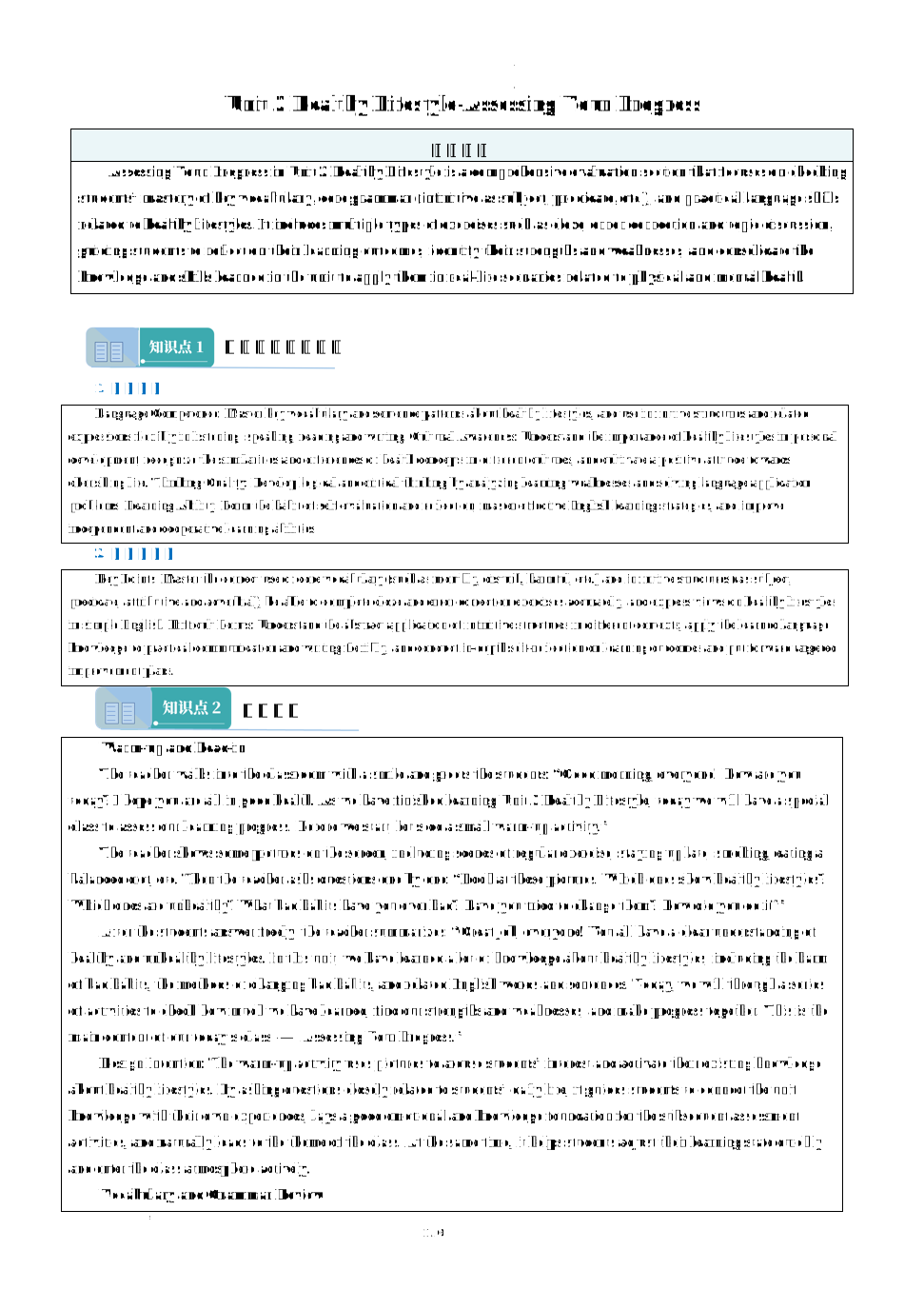
Assessing Your Progress in Unit 2 Healthy Lifestyle is a comprehensive evaluation section that focuses on checking students’ mastery of key vocabulary, core grammar (infinitive as subject, predicate, etc.), and practical language skills related to healthy lifestyles. It includes multiple types of exercises such as cloze, error correction and topic discussion, guiding students to reflect on their learning outcomes, identify their strengths and weaknesses, and consolidate the knowledge and skills learned in the unit to apply them in real-life scenarios related to physical and mental health.
教学目标和重难点
1. 教学目标
Language Competence: Master key vocabulary and sentence patterns about healthy lifestyles, and use infinitive structures and related expressions flexibly in listening, speaking, reading and writing. Cultural Awareness: Understand the importance of healthy lifestyles in personal development, recognize the similarities and differences of health concepts in different cultures, and cultivate a positive attitude towards cherishing life. Thinking Quality: Develop logical and critical thinking by analyzing learning weaknesses and solving language application problems. Learning Ability: Form the habit of self-evaluation and reflection, master effective English learning strategies, and improve independent and cooperative learning abilities.
2. 教学重难点
Key Points: Master the correct use of core vocabulary (such as monthly, disturb, harmful, etc.) and infinitive structures (as subject, predicate, attributive and adverbial); be able to complete cloze and error correction exercises accurately; and express views on healthy lifestyles in simple English. Difficult Points: Understand the abstract application of infinitive structures in different contexts; apply the learned language knowledge to practical communication and writing flexibly; and conduct in-depth self-reflection on learning outcomes and put forward targeted improvement plans.
教学过程
Warm-up and Lead-in
The teacher walks into the classroom with a smile and greets the students: “Good morning, everyone! How are you today? I hope you are all in good health. As we have finished learning Unit 2 Healthy Lifestyle, today we will have a special class to assess our learning progress. Before we start, let’s do a small warm-up activity.”
The teacher shows some pictures on the screen, including scenes of regular exercise, staying up late, smoking, eating a balanced diet, etc. Then the teacher asks questions one by one: “Look at these pictures. Which ones show healthy lifestyles? Which ones are unhealthy? What bad habits have you ever had? Have you tried to change them? How did you do it?”
After the students answer freely, the teacher summarizes: “Great job, everyone! You all have a clear understanding of healthy and unhealthy lifestyles. In this unit, we have learned a lot of knowledge about healthy lifestyles, including the harm of bad habits, the methods of changing bad habits, and related English words and sentences. Today, we will through a series of activities to check how much we have learned, find our strengths and weaknesses, and make progress together. This is the main content of our today’s class — Assessing Your Progress.”
Design Intention: The warm-up activity uses pictures to arouse students’ interest and activate their existing knowledge about healthy lifestyles. By asking questions closely related to students’ daily life, it guides students to connect the unit knowledge with their own experiences, lays a good emotional and knowledge foundation for the subsequent assessment activities, and naturally leads to the theme of the class. At the same time, it helps students adjust their learning state quickly and enter the class atmosphere actively.
Vocabulary and Grammar Review
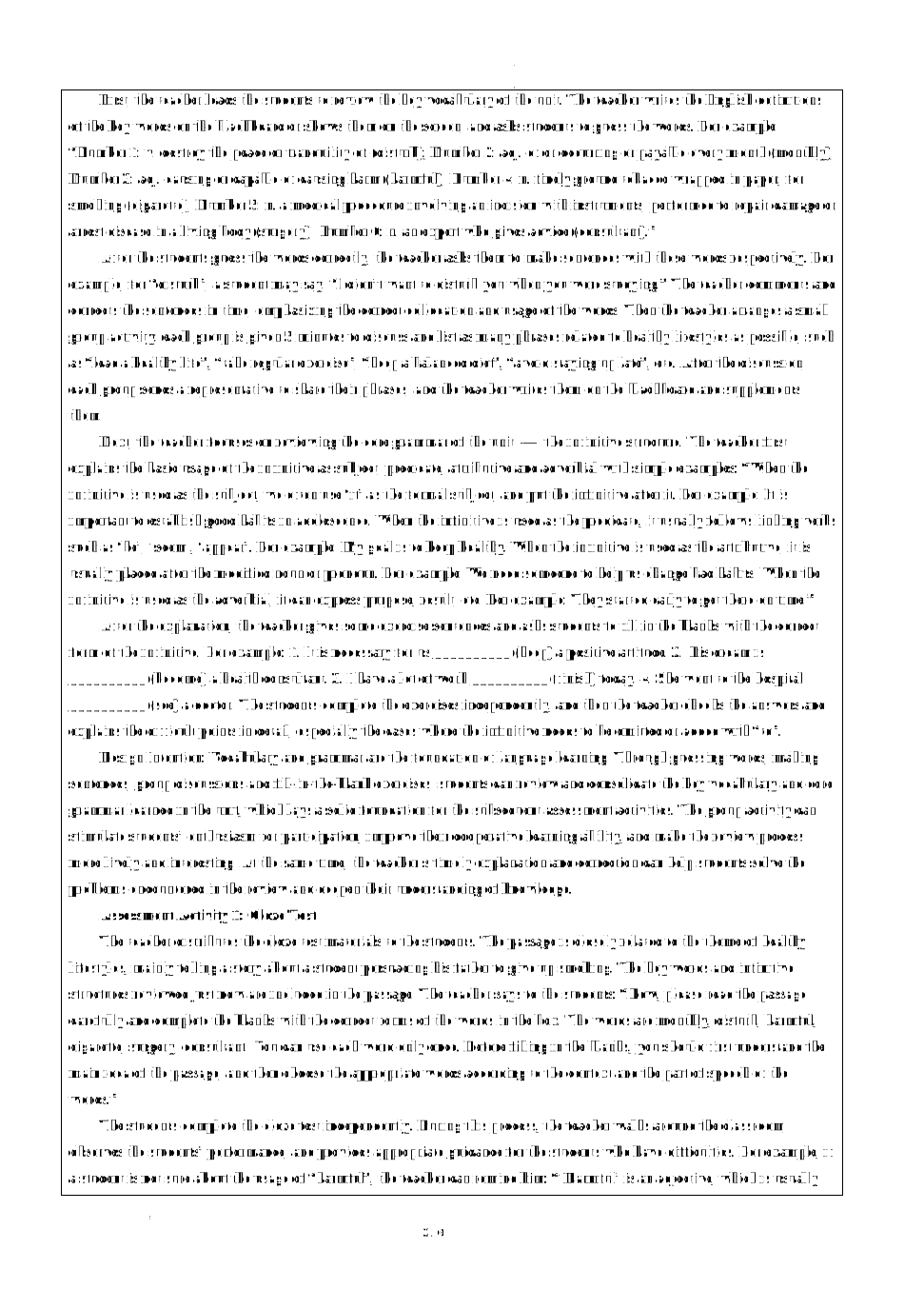
First, the teacher leads the students to review the key vocabulary of the unit. The teacher writes the English definitions of the key words on the blackboard or shows them on the screen, and asks students to guess the words. For example: “Number 1: v. destroy the peace or tranquility of (disturb); Number 2: adj. of or occurring or payable every month (monthly); Number 3: adj. causing or capable of causing harm (harmful); Number 4: n. finely ground tobacco wrapped in paper; for smoking (cigarette); Number 5: n. a medical procedure involving an incision with instruments; performed to repair damage or arrest disease in a living body (surgery); Number 6: n. an expert who gives advice (consultant).”
After the students guess the words correctly, the teacher asks them to make sentences with these words respectively. For example, for “disturb”, a student may say: “I didn’t want to disturb you when you were studying.” The teacher comments and corrects the sentences in time, emphasizing the correct collocation and usage of the words. Then the teacher arranges a small group activity: each group is given 5 minutes to discuss and list as many phrases related to healthy lifestyles as possible, such as “lead a healthy life”, “take regular exercise”, “keep a balanced diet”, “avoid staying up late”, etc. After the discussion, each group sends a representative to share their phrases, and the teacher writes them on the blackboard and supplements them.
Next, the teacher focuses on reviewing the core grammar of the unit — the infinitive structure. The teacher first explains the basic usage of the infinitive as subject, predicate, attributive and adverbial with simple examples: “When the infinitive is used as the subject, we often use ‘it’ as the formal subject, and put the infinitive after it. For example: It is important to establish good habits in adolescence. When the infinitive is used as the predicate, it usually follows linking verbs such as ‘be’, ‘seem’, ‘appear’. For example: My goal is to keep healthy. When the infinitive is used as the attributive, it is usually placed after the modified noun or pronoun. For example: We need someone to help us change bad habits. When the infinitive is used as the adverbial, it can express purpose, result, etc. For example: They started early to get there on time.”
After the explanation, the teacher gives some exercise sentences and asks students to fill in the blanks with the correct form of the infinitive. For example: 1. It is necessary for us __________ (keep) a positive attitude. 2. His dream is __________ (become) a health consultant. 3. I have a lot of work __________ (finish) today. 4. She went to the hospital __________ (see) a doctor. The students complete the exercises independently, and then the teacher checks the answers and explains the difficult points in detail, especially the cases where the infinitive needs to be omitted or added with “to”.
Design Intention: Vocabulary and grammar are the foundation of language learning. Through guessing words, making sentences, group discussions and fill-in-the-blank exercises, students can review and consolidate the key vocabulary and core grammar learned in the unit, which lays a solid foundation for the subsequent assessment activities. The group activity can stimulate students’ enthusiasm for participation, improve their cooperative learning ability, and make the review process more lively and interesting. At the same time, the teacher’s timely explanation and correction can help students solve the problems encountered in the review and deepen their understanding of knowledge.
Assessment Activity 1: Cloze Test
The teacher distributes the cloze test materials to the students. The passage is closely related to the theme of healthy lifestyles, mainly telling a story about a student persuading his father to give up smoking. The key words and infinitive structures reviewed just now are included in the passage. The teacher says to the students: “Now, please read the passage carefully and complete the blanks with the correct forms of the words in the box. The words are monthly, disturb, harmful, cigarette, surgery, consultant. You can use each word only once. Before filling in the blanks, you should first understand the main idea of the passage, and then choose the appropriate words according to the context and the part of speech of the words.”
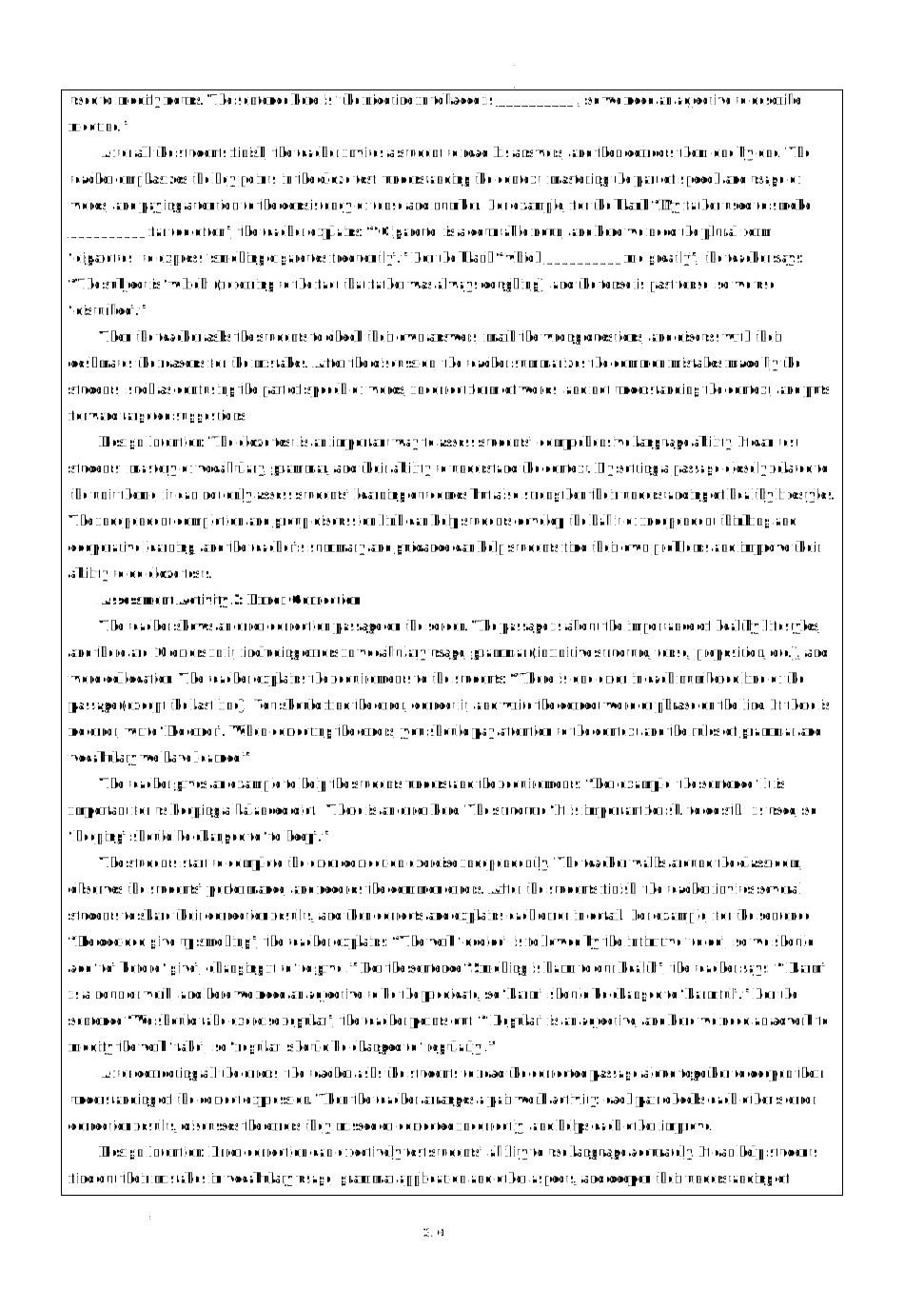
The students complete the cloze test independently. During this process, the teacher walks around the classroom, observes the students’ performance, and provides appropriate guidance for the students who have difficulties. For example, if a student is not sure about the usage of “harmful”, the teacher can remind him: “‘Harmful’ is an adjective, which is usually used to modify nouns. The sentence here is ‘the nicotine in tobacco is __________’, so we need an adjective to describe nicotine.”
After all the students finish, the teacher invites a student to read his answers, and then corrects them one by one. The teacher emphasizes the key points in the cloze test: understanding the context, mastering the part of speech and usage of words, and paying attention to the consistency of tense and number. For example, for the blank “My father used to smoke __________ far too often”, the teacher explains: “‘Cigarette’ is a countable noun, and here we need the plural form ‘cigarettes’ to express ‘smoking cigarettes frequently’.” For the blank “which __________ me greatly”, the teacher says: “The subject is ‘which’ (referring to the fact that father was always coughing), and the tense is past tense, so we use ‘disturbed’.”
Then the teacher asks the students to check their own answers, mark the wrong questions, and discuss with their deskmates the reasons for the mistakes. After the discussion, the teacher summarizes the common mistakes made by the students, such as confusing the part of speech of words, incorrect form of words, and not understanding the context, and puts forward targeted suggestions.
Design Intention: The cloze test is an important way to assess students’ comprehensive language ability. It can test students’ mastery of vocabulary, grammar, and their ability to understand the context. By setting a passage closely related to the unit theme, it can not only assess students’ learning outcomes but also strengthen their understanding of healthy lifestyles. The independent completion and group discussion link can help students develop the habit of independent thinking and cooperative learning, and the teacher’s summary and guidance can help students find their own problems and improve their ability to do cloze tests.
Assessment Activity 2: Error Correction
The teacher shows an error correction passage on the screen. The passage is about the importance of healthy lifestyles, and there are 10 errors in it, including errors in vocabulary usage, grammar (infinitive structure, tense, preposition, etc.), and word collocation. The teacher explains the requirements to the students: “There is one error in each numbered line of the passage (except the last line). You should find the error, correct it, and write the correct word or phrase on the line. If there is no error, write ‘No error’. When correcting the errors, you should pay attention to the context and the rules of grammar and vocabulary we have learned.”
The teacher gives an example to help the students understand the requirements: “For example, the sentence ‘It is important for us keeping a balanced diet.’ There is an error here. The structure ‘It is important for sb. to do sth.’ is used, so ‘keeping’ should be changed to ‘to keep’.”
The students start to complete the error correction exercise independently. The teacher walks around the classroom, observes the students’ performance, and records the common errors. After the students finish, the teacher invites several students to share their correction results, and then corrects and explains each error in detail. For example, for the sentence “He decided give up smoking”, the teacher explains: “The verb ‘decide’ is followed by the infinitive ‘to do’, so we should add ‘to’ before ‘give’, changing it to ‘to give’.” For the sentence “Smoking is harm to our health”, the teacher says: “‘Harm’ is a noun or verb, and here we need an adjective to be the predicate, so ‘harm’ should be changed to ‘harmful’.” For the sentence “We should take exercise regular”, the teacher points out: “‘Regular’ is an adjective, and here we need an adverb to modify the verb ‘take’, so ‘regular’ should be changed to ‘regularly’.”
After correcting all the errors, the teacher asks the students to read the corrected passage aloud together to deepen their understanding of the correct expression. Then the teacher arranges a pair work activity: each pair checks each other’s error correction results, discusses the errors they missed or corrected incorrectly, and helps each other improve.
Design Intention: Error correction can effectively test students’ ability to use language accurately. It can help students find out their mistakes in vocabulary usage, grammar application and other aspects, and deepen their understanding of language rules. By setting errors related to the core knowledge of the unit, it can focus on assessing students’ mastery of key points and difficult points. The pair work activity can enhance students’ communication and cooperation ability, and make students learn from each other and make progress together.
Assessment Activity 3: Topic Discussion and Oral Expression
The teacher divides the students into groups of 4-5, and assigns the discussion topic: “What are the common bad habits among senior high school students? What are the harms of these bad habits? How can we change these bad habits? Please discuss these questions in your groups, and prepare a short report to share with the whole class. You should use the words, phrases and sentence patterns we have learned in this unit, especially the infinitive structure.”
The teacher provides some sentence patterns for the students to refer to: 1. I think the common bad habits among senior high school students are... 2. Staying up late is harmful because it can... 3. To change the bad habit of..., we should... 4. It is important for us to... 5. We can ask our teachers and parents to help us...
The students start the group discussion. During the discussion, the teacher walks around each group, listens to their discussion, and provides appropriate guidance. For example, if a group is not sure how to express “changing the bad habit of playing mobile phones too much”, the teacher can remind them: “We can say ‘To change the bad habit of playing mobile phones too much, we should make a plan and stick to it.’” If a student uses the infinitive structure incorrectly, the teacher corrects it in time.
After 10 minutes of discussion, each group sends a representative to share their report. The representative of each group speaks for 2-3 minutes, introducing the common bad habits, their harms and the methods to change them. Other students listen carefully and can ask questions or put forward supplementary opinions after the representative finishes speaking. For example, if a group talks about the bad habit of skipping breakfast, another student can supplement: “Skipping breakfast can also affect our study efficiency, because we will feel hungry and can’t concentrate in class.”
After all groups finish sharing, the teacher makes a summary and evaluation. The teacher affirms the advantages of each group, such as rich content, correct use of language, and clear expression, and also points out the areas that need improvement, such as the lack of specific examples, incorrect use of some sentence patterns, etc. The teacher also emphasizes that when expressing views, we should pay attention to the logic and fluency of language, and try to use the knowledge we have learned flexibly.
Design Intention: Oral expression is an important part of language ability. Through group discussion and class report, students can practice their oral expression ability, and apply the learned vocabulary, phrases and sentence patterns to practical communication. The discussion topic is closely related to students’ daily life, which can stimulate students’ enthusiasm for participation and make them have more to say. The teacher’s guidance and evaluation can help students improve their oral expression ability and logical thinking ability, and at the same time, let students have a deeper understanding of the harms of bad habits and the methods of changing them.
Assessment Activity 4: Writing Practice
The teacher says to the students: “Now, we will do a writing practice. The topic is ‘My Plan to Keep a Healthy Lifestyle’. You should write a short passage of about 100 words, introducing your own bad habits, the harms of these bad habits, and your specific plan to keep a healthy lifestyle. You should use the words, phrases and infinitive structures we have learned in this unit. Before writing, you can first list an outline, including the main points you want to write.”
The teacher provides an outline for the students to refer to: 1. Introduction: Briefly introduce your current lifestyle and your bad habits. 2. Body: Explain the harms of your bad habits. 3. Conclusion: Put forward your specific plan to keep a healthy lifestyle.
The students start to write independently. During the writing process, the teacher walks around the classroom, provides guidance for the students who have difficulties, and checks the students’ writing. For example, if a student doesn’t know how to express “my plan to keep a healthy lifestyle”, the teacher can remind him: “You can write ‘My plan to keep a healthy lifestyle includes the following points: first, I will... second, I will...’” If a student uses the infinitive structure incorrectly, the teacher corrects it in time.
After the students finish writing, the teacher collects some students’ works (including good works and works with common mistakes) and shows them on the screen. The teacher first comments on the good works, affirming their advantages, such as correct use of language, clear logic, and specific content, and asks the students to learn from them. Then the teacher comments on the works with mistakes, points out the errors and the reasons for the errors, and guides the students to correct them. For example, a student writes: “I plan exercise every morning.” The teacher points out: “‘Plan’ is followed by the infinitive ‘to do’, so we should add ‘to’ before ‘exercise’, changing it to ‘to exercise’.”
Then the teacher asks the students to exchange their works with their deskmates, check each other’s writing, and help each other correct the errors. After that, the students revise their own works according to the comments and suggestions.
Design Intention: Writing practice is an important way to assess students’ comprehensive language ability. It can test students’ ability to use vocabulary, grammar and sentence patterns flexibly, and their ability to organize language and express views. The writing topic is closely related to students’ own life, which can stimulate students’ writing enthusiasm and make them have more real feelings. By showing and commenting on students’ works, and arranging the desk mate mutual check link, it can help students find their own problems in writing, learn from each other, and improve their writing ability.
Self-Evaluation and Reflection
The teacher distributes the self-evaluation form to the students. The self-evaluation form includes the following items: 1. I have mastered the key vocabulary of the unit (such as monthly, disturb, harmful, etc.). (□ Very well □ Generally □ Not well) 2. I can use the infinitive structure flexibly (as subject, predicate, attributive, adverbial). (□ Very well □ Generally □ Not well) 3. I can complete the cloze test and error correction exercise accurately. (□ Very well □ Generally □ Not well) 4. I can express my views on healthy lifestyles in English fluently. (□ Very well □ Generally □ Not well) 5. I can write a short passage about healthy lifestyles correctly. (□ Very well □ Generally □ Not well) 6. What are my strengths in this unit? 7. What are my weaknesses in this unit? 8. What are my improvement plans?
The teacher asks the students to fill in the self-evaluation form carefully according to their own performance in this class and their learning situation in the unit. After filling in, the students can share their self-evaluation results with their deskmates, exchange their learning experience and improvement plans, and learn from each other.
Then the teacher invites several students to share their self-evaluation results with the whole class. For example, a student says: “My strength is that I have mastered the key vocabulary of the unit, and I can complete the cloze test well. My weakness is that I can’t use the infinitive structure flexibly in writing. My improvement plan is to do more writing exercises and pay attention to the use of infinitive structure.”
After the students share, the teacher makes a summary: “I am very glad that you can correctly recognize your strengths and weaknesses. Everyone has made progress in this unit, and there are also some areas that need improvement. I hope you can strictly implement your improvement plans after class, review the knowledge we have learned in time, and make greater progress in English learning. At the same time, I hope you can apply the knowledge about healthy lifestyles to your daily life, develop good living habits, and keep healthy.”
Design Intention: Self-evaluation and reflection are important parts of learning ability. By filling in the self-evaluation form, students can clearly recognize their own strengths and weaknesses, and form the habit of self-reflection. The sharing link can help students learn from each other’s experience, and the teacher’s summary and encouragement can enhance students’ confidence in learning, and guide them to make targeted improvement plans, so as to improve their learning ability and learning effect.
Summary and Homework Arrangement
The teacher summarizes the whole class: “Today, we have carried out a series of assessment activities, including cloze test, error correction, topic discussion, writing practice and self-evaluation. Through these activities, we have checked our learning progress in this unit, found our strengths and weaknesses, and consolidated the knowledge and skills we have learned. I hope you can remember the key points and difficult points we have reviewed today, and apply them flexibly in future English learning and daily life.”
Then the teacher arranges the homework: 1. Revise the cloze test, error correction and writing practice done in class, and sort out the wrong questions into the error book. 2. Write a revised version of the writing “My Plan to Keep a Healthy Lifestyle” according to the comments and suggestions. 3. Review the key vocabulary and grammar of the unit, and make a vocabulary and grammar mind map. 4. Talk with your family in English about healthy lifestyles, and record the conversation (if possible).
Design Intention: The summary link can help students sort out the knowledge and activities of the whole class, deepen their understanding and memory of the key points. The homework arrangement is closely related to the content of the class, which can help students consolidate the knowledge and skills learned in class, make up for their weaknesses, and extend the learning content to daily life, so as to achieve the goal of applying what they have learned.
1 / 1
学科网(北京)股份有限公司
学科网(北京)股份有限公司
学科网(北京)股份有限公司
$
资源预览图
1
2
3
相关资源
由于学科网是一个信息分享及获取的平台,不确保部分用户上传资料的 来源及知识产权归属。如您发现相关资料侵犯您的合法权益,请联系学科网,我们核实后将及时进行处理。