Unit 1 Science and Scientists Reading and Thinking 教案-2025-2026学年高中英语人教版选择性必修第二册
2026-03-16
|
5页
|
274人阅读
|
1人下载
普通
资源信息
| 学段 | 高中 |
|---|---|
| 学科 | 英语 |
| 教材版本 | 高中英语人教版选择性必修第二册 |
| 年级 | 高二 |
| 章节 | Reading and Thinking |
| 类型 | 教案 |
| 知识点 | - |
| 使用场景 | 同步教学-新授课 |
| 学年 | 2025-2026 |
| 地区(省份) | 全国 |
| 地区(市) | - |
| 地区(区县) | - |
| 文件格式 | DOCX |
| 文件大小 | 96 KB |
| 发布时间 | 2026-03-16 |
| 更新时间 | 2026-03-16 |
| 作者 | 匿名 |
| 品牌系列 | - |
| 审核时间 | 2026-03-16 |
| 下载链接 | https://m.zxxk.com/soft/56838866.html |
| 价格 | 1.00储值(1储值=1元) |
| 来源 | 学科网 |
内容正文:
Unit 1 Science and Scientists-Reading and Thinking
内容导航
This part takes "John Snow Defeats 'King Cholera'" as the text, showing the whole process of John Snow's investigation, reasoning and verification to defeat cholera, highlighting the spirit of scientific exploration and the importance of scientific methods, and laying a foundation for students to understand science and scientists.
教学目标和重难点
1. 教学目标
Language Competence: Enable students to master science-related vocabulary and complex sentences, and improve their ability to understand and analyze argumentative and narrative texts. Cultural Awareness: Help students understand the value of scientific exploration in promoting social progress and cultivate respect for scientific spirits of different countries. Thinking Quality: Guide students to analyze John Snow's research logic, develop critical thinking and logical reasoning ability. Learning Ability: Let students master reading strategies such as skimming and scanning, and cultivate the awareness of independent learning and cooperative exploration.
2. 教学重难点
Key Points: Master core vocabulary (e.g., cholera, defeat, investigate, suspect) and key sentence patterns; understand the main idea and structure of the text; grasp John Snow's research process and scientific methods. Difficult Points: Analyze the logical relationship in the text and understand the causal connection between John Snow's investigation steps and conclusions; accurately use relevant vocabulary and sentence patterns to describe scientific research processes; comprehend the connotation of scientific spirit reflected in the text.
教学过程
Step 1: Lead-in (Lead-in and Motivation)
The lead-in link is designed to arouse students' interest in the topic, activate their existing knowledge reserve, and naturally lead to the core content of the reading text. At the beginning of the class, the teacher can start with a question-and-answer interaction to guide students to think about the topic of science and scientists. The teacher asks: "What do you know about scientists? What qualities do you think a great scientist should have?" Let students speak freely. Some students may mention qualities such as carefulness, perseverance, and courage to explore, while others may talk about famous scientists they know, such as Einstein, Madame Curie, etc.
After the students' free speech, the teacher makes a brief summary: "Scientists are people who devote themselves to exploring the unknown world. They use scientific methods to solve difficult problems and promote the progress of human society. Today, we will learn about a great British doctor, John Snow, who used scientific methods to defeat a terrible disease - cholera, which was called 'King Cholera' at that time." Then, the teacher shows pictures related to cholera and John Snow with the help of multimedia, briefly introduces the background of cholera in the 19th century: "In the early 19th century, cholera was a fatal disease that spread rapidly in Europe, killing millions of people. No one knew how it spread or how to treat it until John Snow stepped forward."
Through such lead-in, students can quickly enter the topic, understand the urgency and importance of John Snow's research, and lay a emotional and cognitive foundation for the subsequent reading. At the same time, the interaction link can mobilize the enthusiasm of students and make the class atmosphere active.
Step 2: Pre-reading (Vocabulary Preview and Prediction)
Pre-reading is an important link to help students eliminate reading obstacles and improve reading efficiency. In this link, the teacher mainly focuses on core vocabulary teaching and text content prediction.
First, the teacher presents the core vocabulary of the text, including nouns (cholera, diarrhoea, dehydration, pump, germ, waste), verbs (defeat, investigate, suspect, blame, remove, deliver), adjectives (severe, frustrated, contradictory), and phrases (subscribe to, be to blame, in time, once and for all). For each vocabulary, the teacher explains its meaning, pronunciation and usage in combination with the context of the text, and guides students to make sentences to deepen their understanding. For example, when explaining "cholera", the teacher can combine the background introduced earlier and say: "Cholera is a serious disease that causes severe diarrhoea and even death. It was a great threat to people's lives in the 19th century." When explaining "investigate", the teacher can connect it with John Snow's behavior: "John Snow investigated the spread of cholera to find out its cause."
After the vocabulary preview, the teacher guides students to predict the content of the text according to the title "John Snow Defeats 'King Cholera'". The teacher asks: "According to the title, what do you think the text will talk about? What steps do you think John Snow will take to defeat cholera?" Let students discuss in groups of 4-5, and then invite several groups to share their predictions. Some students may predict that the text will introduce the process of John Snow's investigation, some may think that it will talk about the difficulties John Snow encountered, and others may guess the method of defeating cholera.
The teacher affirms the reasonable predictions of the students and says: "Your predictions are very meaningful. Next, let's read the text to find out whether your predictions are correct and understand the specific process of John Snow defeating cholera." This link not only helps students preview vocabulary and eliminate reading obstacles, but also cultivates their ability of prediction and reasoning, laying a foundation for in-depth reading.
Step 3: While-reading (In-depth Reading and Comprehension)
While-reading is the core link of this class, aiming to help students understand the main content, structure and key information of the text, and master reading strategies such as skimming, scanning and careful reading. This link is divided into three stages: skimming, scanning and careful reading.
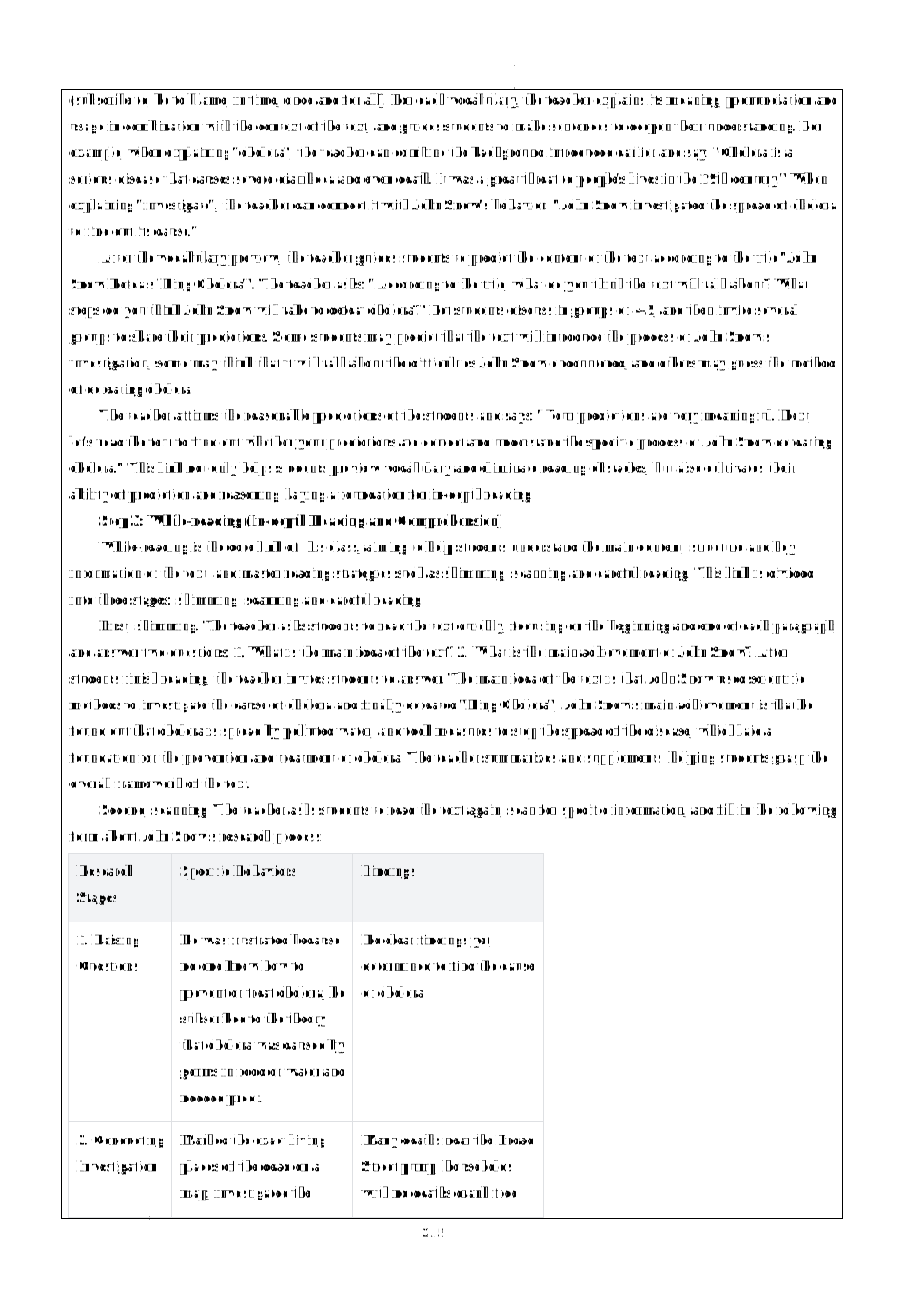
First, skimming. The teacher asks students to read the text quickly, focusing on the beginning and end of each paragraph, and answer two questions: 1. What is the main idea of the text? 2. What is the main achievement of John Snow? After students finish reading, the teacher invites students to answer. The main idea of the text is that John Snow used scientific methods to investigate the cause of cholera and finally defeated "King Cholera"; John Snow's main achievement is that he found out that cholera is spread by polluted water, and took measures to stop the spread of the disease, which laid a foundation for the prevention and treatment of cholera. The teacher summarizes and supplements, helping students grasp the overall framework of the text.
Second, scanning. The teacher asks students to read the text again, scan for specific information, and fill in the following form about John Snow's research process:
Research Stages
Specific Behaviors
Findings
1. Raising Questions
He was frustrated because no one knew how to prevent or treat cholera; he subscribed to the theory that cholera was caused by germs in food or water and needed proof.
No clear findings yet; determined to find the cause of cholera.
2. Conducting Investigation
Marked the exact living places of the dead on a map; investigated the households with no deaths; inquired about the woman who moved away but still died of cholera.
Many deaths near the Broad Street pump; households with no deaths drank free beer instead of pump water; the woman who moved away still drank water from the Broad Street pump.
3. Drawing Conclusions
Analyzed the investigation results; connected the pump water with cholera germs.
The pump water carried cholera germs; the polluted water from the River Thames was the main cause of cholera.
4. Taking Measures
Had the handle of the Broad Street pump removed; persuaded water companies to sell clean water.
The spread of cholera was stopped; the threat of cholera decreased substantially.
Students fill in the form independently, and then discuss and correct with their group members. The teacher walks around the classroom to guide students who have difficulties, and finally presents the standard answers on the multimedia to help students clarify John Snow's research process and understand the logic of scientific research.
Third, careful reading. The teacher guides students to read the key paragraphs carefully, analyze the sentence structure and logical relationship, and deepen their understanding of the text. The key paragraphs include Paragraph 3 (the process of John Snow's investigation) and Paragraph 4 (the conclusion of the investigation and the solution).
For Paragraph 3, the teacher asks: "What methods did John Snow use in his investigation? What do these methods show us?" Students can find that John Snow used the method of marking maps and investigating specific cases. The teacher explains: "Marking maps can help John Snow intuitively find the connection between the distribution of the dead and the water pump; investigating specific cases (such as households with no deaths and the woman who moved away) can help him verify his hypothesis and avoid one-sidedness. These methods reflect John Snow's rigorous and scientific attitude."
For Paragraph 4, the teacher asks: "Why did John Snow think the pump water was the cause of cholera? What evidence did he have?" Students sort out the evidence: 1. Many deaths occurred near the Broad Street pump; 2. Households that did not drink the pump water had no deaths; 3. The woman who moved away still drank the pump water and died of cholera. The teacher summarizes: "These evidences are closely linked, forming a complete logical chain, which proves John Snow's hypothesis is correct. This tells us that scientific conclusions must be based on sufficient evidence."
At the same time, the teacher focuses on analyzing some complex sentences in the text, helping students break through the difficulties of sentence understanding. For example, "It was correct, but he still needed proof. Consequently, when an outbreak of cholera hit London in 1854, Snow began to investigate." The teacher explains the logical relationship between the two sentences (consequence), and guides students to master the usage of "consequently". Another example, "Snow suspected that the water pump was to blame. What is more, in another part of London, a woman and her daughter had died of cholera after moving away from Broad Street." The teacher explains the usage of "what is more" (adding information) and the attributive clause "who had died of cholera after moving away from Broad Street".
In this stage, students not only understand the content of the text, but also master reading strategies and key language points, which effectively improves their language ability and thinking quality.
Step 4: Post-reading (Consolidation and Expansion)
Post-reading is designed to help students consolidate the knowledge learned, expand their thinking, and realize the transfer and application of knowledge. This link includes three parts: text retelling, group discussion and language practice.
First, text retelling. The teacher asks students to retell the process of John Snow defeating cholera with the help of the form filled in during scanning. Students can retell independently first, then retell in pairs, and finally invite 2-3 students to retell in front of the whole class. The teacher evaluates the students' retelling from the aspects of content completeness, language fluency and vocabulary accuracy, and puts forward suggestions for improvement. For example, if a student forgets to mention the measures John Snow took, the teacher can remind him: "Don't forget that John Snow removed the pump handle to stop the spread of cholera." This link not only helps students consolidate the text content, but also improves their oral expression ability.
Second, group discussion. The teacher puts forward two discussion topics, and students discuss in groups: 1. What qualities did John Snow show in the process of defeating cholera? Give examples from the text. 2. What can we learn from John Snow's story? How can we apply the scientific spirit to our study and life?
During the discussion, the teacher walks around the classroom, participates in the discussion of each group, guides students to combine the text content to express their views, and encourages students to think boldly. After the discussion, each group selects a representative to share the group's views. For the first topic, students may mention qualities such as perseverance (he never lost his desire to destroy cholera once and for all), rigor (he used scientific methods to investigate and collect evidence), and courage (he dared to put forward different views from other doctors). For the second topic, students may say that they should be rigorous in study, dare to explore, and not give up when encountering difficulties.
The teacher makes a summary after the students' sharing: "John Snow's story tells us that the scientific spirit is not only the rigorous attitude and scientific methods, but also the perseverance and sense of responsibility to pursue the truth. In our study and life, we should learn from John Snow, use scientific methods to solve problems, and keep the enthusiasm for exploring the unknown." This link helps students deeply understand the connotation of scientific spirit, cultivate their cultural awareness and thinking quality.
Third, language practice. The teacher designs two types of exercises to help students consolidate the core vocabulary and sentence patterns learned.
Exercise 1: Fill in the blanks with the correct form of the given words. (cholera, investigate, suspect, blame, remove, severe) 1. A new outbreak of ______ has occurred in some areas. 2. The police are ______ the cause of the accident. 3. I ______ that he is hiding something from us. 4. Don't ______ him for the mistake; it's not his fault. 5. The workers ______ the old machine and replaced it with a new one. 6. The storm caused ______ damage to the village.
Exercise 2: Translate the following sentences into English. 1. 霍乱曾经是世界上最令人恐惧的疾病之一。 2. 约翰·斯诺决心彻底消灭霍乱。 3. 他怀疑水泵是霍乱传播的罪魁祸首。 4. 通过他的努力,霍乱的威胁大大降低了。
Students complete the exercises independently, and then the teacher checks the answers and explains the key points. For Exercise 1, the teacher emphasizes the correct form of verbs (such as the present continuous tense of "investigate"). For Exercise 2, the teacher guides students to use the key sentence patterns in the text, such as "Cholera used to be one of the most feared diseases in the world." and "He suspected that the water pump was to blame." This link helps students consolidate the language knowledge learned and improve their ability of language application.
Step 5: Summary and Homework
First, summary. The teacher leads students to review the content of this class: "Today, we learned about John Snow's story of defeating 'King Cholera'. We understood his scientific research process, mastered the core vocabulary and key sentence patterns, and felt the scientific spirit contained in the story. We also discussed the qualities of scientists and the significance of scientific spirit to us." The teacher emphasizes again: "The key to this class is to understand John Snow's research process and the connotation of scientific spirit, and master the relevant language knowledge. I hope you can apply what you have learned to your study and life."
Second, homework. The teacher assigns three levels of homework to meet the needs of different students:
Level 1 (Basic): 1. Recite the core vocabulary and key sentences of the text. 2. Retell the story of John Snow in your own words (about 100 words).
Level 2 (Improvement): 1. Write a short passage about "A Scientist I Admire" (about 150 words), introducing the scientist's achievements and the qualities you admire. 2. Finish the after-class exercises in the textbook.
Level 3 (Expansion): 1. Search for more stories about scientists and their scientific research processes, and share them in the next class. 2. Think about how to use scientific methods to solve a small problem in your life, and write a short report (about 200 words).
The teacher explains: "Level 1 homework is to help you consolidate the basic knowledge; Level 2 homework is to improve your writing ability; Level 3 homework is to expand your vision and cultivate your ability of applying scientific methods. You can choose the homework according to your own level, and you can also try to complete the higher-level homework."
Finally, the teacher ends the class with a sentence: "Science is the light of human progress. I hope you can keep the enthusiasm for science, learn from scientists, and pursue the truth bravely."
1 / 1
学科网(北京)股份有限公司
学科网(北京)股份有限公司
学科网(北京)股份有限公司
$
资源预览图

1
2
相关资源
由于学科网是一个信息分享及获取的平台,不确保部分用户上传资料的 来源及知识产权归属。如您发现相关资料侵犯您的合法权益,请联系学科网,我们核实后将及时进行处理。