Unit 1单元基础知识检测 2025-2026学年人教版英语八年级下册
2026-03-10
|
3页
|
592人阅读
|
5人下载
资源信息
| 学段 | 初中 |
|---|---|
| 学科 | 英语 |
| 教材版本 | 初中英语人教版八年级下册 |
| 年级 | 八年级 |
| 章节 | Unit 1 Time to Relax |
| 类型 | 题集-专项训练 |
| 知识点 | - |
| 使用场景 | 同步教学-单元练习 |
| 学年 | 2026-2027 |
| 地区(省份) | 全国 |
| 地区(市) | - |
| 地区(区县) | - |
| 文件格式 | DOCX |
| 文件大小 | 31 KB |
| 发布时间 | 2026-03-10 |
| 更新时间 | 2026-03-10 |
| 作者 | 772765118 |
| 品牌系列 | - |
| 审核时间 | 2026-03-10 |
| 下载链接 | https://m.zxxk.com/soft/56746247.html |
| 价格 | 0.50储值(1储值=1元) |
| 来源 | 学科网 |
内容正文:
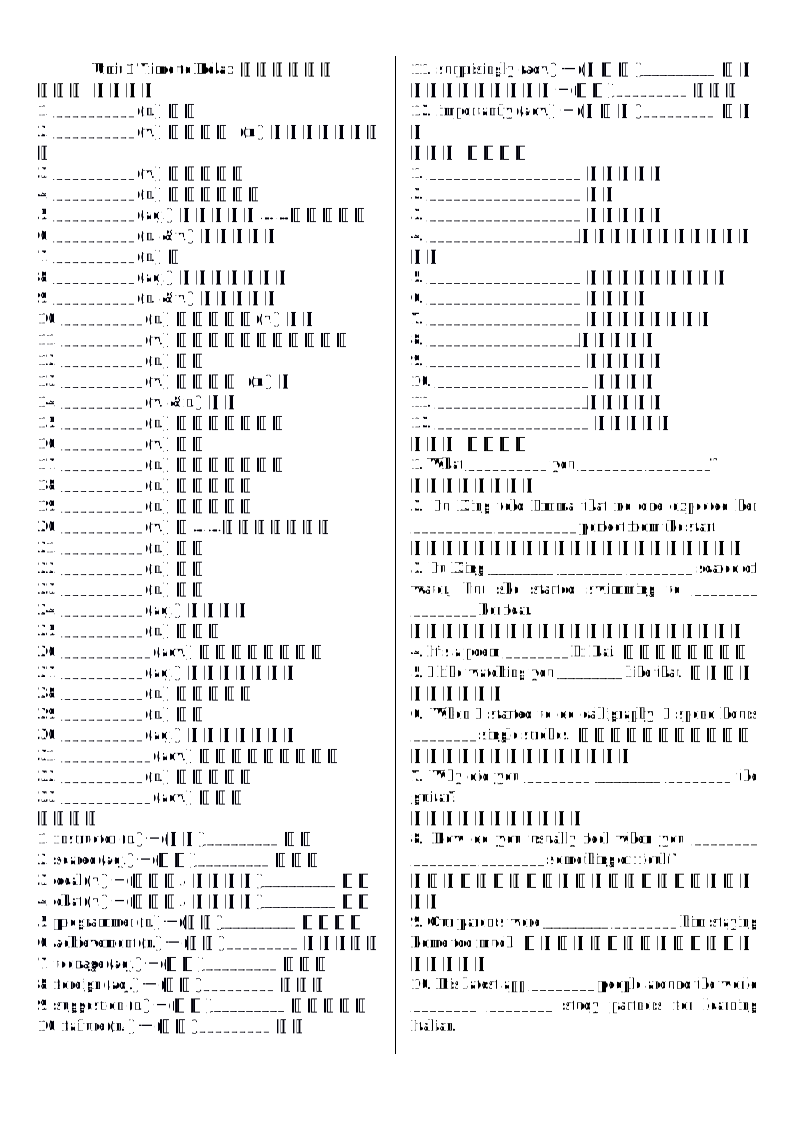
Unit 1 Time to Relax 单元基础知识
考点一 重点单词
1. __________ (n.) 滑雪
2. __________ (v.) 编写程序 (n.) 程序;节目;项目
3. __________ (v.) 表达;表示
4. __________ (n.) 教练;指导者
5. __________ (adj.) 害怕的;对……感到惊慌的
6. __________ (n. & v.) 害怕;担忧
7. __________ (n.) 诗
8. __________ (adj.) 单个的;单身的
9. __________ (n. & v.) 回来;归还
10. __________ (n.) 交易;协议(v.) 对付
11. __________ (v.) 完成(困难的事);管理
12. __________ (n.) 功夫
13. __________ (v.) 鞭策;推 (n.) 推
14. __________ (v. & n.) 闲聊
15. __________ (n.) 出外游玩;远足
16. __________ (v.) 减少
17. __________ (n.) 精神压力;紧张
18. __________ (n.) 物品;宾语
19. __________ (n.) 程序设计员
20. __________ (v.) 使……成为可能;允许
21. __________ (n.) 成就
22. __________ (n.) 硬币
23. __________ (n.) 邮票
24. __________ (adj.) 青少年的
25. __________ (n.) 明信片
26. ___________ (adv.) 相当;更准确地说
27. __________ (adj.) 外国的;国外的
28. __________ (n.) 建议;提议
29. __________ (n.) 失败
30. __________ (adj.) 严厉的;严格的
31. ___________ (adv.) 出人意料地;惊人地
32. __________ (n.) 舞台;阶段
33. ___________ (adv.) 重要地
词汇拓展
1. instructor (n.) →(动词)_________ 指导
2. scared (adj.) →(动词)_________ 使害怕
3. deal (v.) →(过去式/ 过去分词)_________ 对付
4. chat (v.) →(过去式/ 过去分词)_________ 闲聊
5. programmer (n.) →(动词)_________ 编写程序
6. achievement (n.) →(动词)_________ 实现;完成
7. teenage (adj.) →(名词)_________ 青少年
8. foreign (adj.) →(名词)_________ 外国人
9. suggestion (n.) →(动词)_________ 建议;提议
10. failure (n. ) →(动词)_________ 失败
11. surprisingly (adv.) →(形容词)_________ 令人惊讶的;出人意料的→(动词)_________ 使惊奇
12. importantly (adv.) →(形容词)_________ 重要的
考点二 重点短语
1. ___________________ 滑冰;溜冰
2. ___________________ 放弃
3. ___________________ 害怕;恐惧
4. ___________________克服(困难);解决(问题)
5. ___________________ 正在做;由某人决定
6. ___________________ 作为回报
7. ___________________ 开始做某事;进入
8. ___________________试一试某事
9. ___________________ 偶尔;间或
10. ___________________ 出外游玩
11. ___________________梦想;希望
12. ___________________ 到目前为止
考点三 重点句式
1. What __________ you ________ ________?
你正在做什么呢?
2. Fu Xing told Emma that no one expected her __________ __________ perfect from the start.
付兴告诉艾玛,没人期待她从一开始就很完美。
3. Fu Xing ________ ________ ________ scared of water, but she started swimming to ________ ________ her fear.
付兴过去怕水,但她开始游泳来克服她的恐惧。
4. It’s a poem ________ Li Bai. 是李白的一首诗。
5. I like watching you ________ like that. 我喜欢看你这样写字。
6. When I started to do calligraphy, I spend hours ________ single strokes. 我刚开始练书法的时候,花好几个小时练习单个的笔画。
7. Why did you ________ ________ ________ the guitar?
你为什么选择弹吉他呢?
8. How do you usually feel when you ________ ________ ________ something difficult?
当你成功完成一件困难的事时,你通常有什么感受?
9. Our parents were ________ ________ him staying home too much. 我们的父母担心他待在家里的时间太长了。
10. His latest app ________ people around the world ________ ________ study partners for learning Italian.
他最新的应用程序让世界各地的人找到学习意大利语的伙伴。
考点四 语法——动词不定式
练习
1. My parents let my sister and me __________ (watch) a movie tonight.
2. Miss Gao advised us ________ (plant) some tomatoes in our class garden.
3. Could you help me ________ (put) up the pictures on the wall?
4. She’s happy ________ (see) her old friends again.
5. My father gets some exercise every day _________ (keep) fit.
考点五 写作
本单元写作核心:“Introduce your favorite free-time activity”(介绍你最喜欢的休闲活动),需涵盖:活动名称、开始时间、具体做法、喜欢的原因(如放松身心、提升能力、结交朋友等),并灵活运用 动词不定式(表目的) 和单元重点短语(如take up, spend...doing..., keep in mind等)。
写作框架(三段式结构)
第一段:引出爱好(开门见山+基本信息)
核心内容:点明最喜欢的休闲活动、开始时间/契机。
1. My favorite free-time activity is ______, which I have been doing for ______ years.
2. I first took up ______ when I was ______ years old, and it has become an important part of my life.
3. When I feel stressed, ______ is always my go-to way to relax.
第二段:描述爱好(具体做法+细节)
核心内容:如何进行该活动、花费的时间、参与的形式(如独自/和朋友、线上/线下)。
1. Every weekend, I spend about two hours ______ (doing sth.). For example, I often ______ or ______.
2. To do it well, I usually ______ (e.g., read related books, watch tutorial videos, practice with my classmates).
3. Sometimes I join a club to ______ (表目的,如learn from others, make new friends who share the same hobby).
第三段:阐述意义(喜欢的原因+带来的收获)
核心内容:活动带来的好处(放松、提升自我、丰富生活等),总结对自己的影响。
1. I love ______ because it not only helps me relax after a long week of study but also teaches me ______ (e.g., patience, creativity, how to solve problems).
2. Through this activity, I have become more ______ (e.g., confident, calm, outgoing) and learned to balance study and relaxation.
课文改编题:短文填空。
Section A 3a
Peter: Hey, Yaming! What are you up to?
Yaming: Hi, Peter. I’m doing calligraphy.
Peter: It’s beautiful! What are you writing?
Yaming: It’s a poem by Li Bai. My grandmother taught me how 1 (write) it.
Peter: What’s this character?
Yaming: It’s yue. It means “moon”.
Peter: It’s nice! I like watching you write like that. But it looks difficult.
Yaming: Well, the first step is always the hardest. When I started 2 (do) calligraphy, I spent hours practising single strokes.
Peter: I know how that feels! My dad’s teaching me 3 (play) the guitar. It’s difficult, but he always encourages me not 4 (give up).
Yaming: Exactly. Now I do calligraphy 5 (relax). I even like how the ink smells! Why did you choose 6 (play) the guitar?
Peter: I think playing the guitar is cool. Will you teach me 7 (write) a simple poem? I can teach you 8 (play) a short song in return.
Yaming: It’s a deal!
Section B 1b
When work or school is over, what do you do to pass the time? Reading or listening to music can help us to calm down after 1. ________ busy day. Physical hobbies, such as playing tennis or doing yoga, can help 2. ________ (we) to keep fit. And some hobbies are creative. For example, people sometimes paint pictures to remember a beautiful landscape or feel 3. ________ (relax).
Luca Bruno likes to be creative in his spare time. 4. ________ he doesn’t make art or write stories. Instead, he finds it fun to make mobile phone apps. He thinks that apps are able 5. ________ (help) people. He 6. ________ (start) programming at the age of ten, after he read about famous businessmen. His latest app allows people to find some study 7. ________ (partner). They can both learn Italian and make friends!
Some people prefer not to make things. They prefer to collect them! In India, Maya Badal 8. ________ (collect) postcards! She knows some people think they are 9. ________ (real) old-fashioned, but she thinks they’re a good way to learn about different places. Her dad sent her the first postcard when she was five, and she liked it so much. Now there are over one hundred postcards 10. ________ thirty-two countries on Maya’s walls. She hopes to travel to these places in the future!
参考答案:
考点一、重点单词
1. ski 2. program 3. express 4. instructor 5. scared 6. fear 7. poem 8. single 9. return 10. deal 11. manage 12. kung fu 13. push 14. chat 15. outing 16. reduce 17. stress 18. object 19. programmer 20. allow 21. achievement 22. coin 23. stamp 24. teenage 25. postcard 26. rather 27. foreign 28. suggestion 29. failure 30. strict 31. surprisingly 32. stage 33. importantly
词汇拓展
1. instruct 2. scare 3. dealt 4. chatted 5. program 6. achieve 7. teenager 8. foreigner 9. suggest 10. fail 11. surprising, surprise 12. important
考点二 重点短语
1. ice skating 2. give up 3. scared of 4. get over 5. up to 6. in return 7. get into 8. give it a go 9. once in a while 10. go on an outing 11. dream of 12. so far
考点三 重点句式
1. are, up to 2. to be 3. used to be, get over 4. by 5. writing 6. practicing 7. choose to play 8. finish to do 9. worried about 10. allows, to find
考点四
1. watch 2. to plant 3. put 4. to see 5. to keep
课文改编题
Section A 3a
1. to write 2. to do 3. to play 4. to give up 5. to relax 6. to play 7. to write 8. to play
Section B 1b
1. a 2. us 3. relaxed 4. But 5. to help 6. started 7. partners 8. collects 9. really 10. from
学科网(北京)股份有限公司
$
资源预览图
1
相关资源
由于学科网是一个信息分享及获取的平台,不确保部分用户上传资料的 来源及知识产权归属。如您发现相关资料侵犯您的合法权益,请联系学科网,我们核实后将及时进行处理。