Unit2 Travelling Around Reading and Thinking 教学设计-2025-2026学年高中英语人教版必修第一册
2026-03-10
|
5页
|
1032人阅读
|
2人下载
普通
内容正文:
Unit 2 Travelling Around-Reading and Thinking
内容导航
This part mainly introduces Peru’s geographical features, historical background and typical travel routes, including the Amazon Rainforest Tour and Machu Picchu Tour, helping students grasp key information about travel and lay a foundation for language application and cross-cultural understanding. It is closely linked to the unit theme of "Travelling Around" and reflects the concept of integrating language learning with real life.
教学目标和重难点
1. 教学目标
Linguistic Competence: Master travel-related vocabulary and sentence patterns, improve reading ability to obtain, sort out and summarize key information. Cultural Awareness: Understand Peru’s history, geography and cultural characteristics, recognize the diversity of world cultures, and cultivate respect for different cultures. Thinking Quality: Develop logical thinking through analyzing travel routes and geographical features, and form critical thinking by comparing different travel experiences. Learning Ability: Cultivate autonomous reading and cooperative learning habits, master effective reading strategies and lay a foundation for lifelong learning.
2. 教学重难点
Key Points: Master core vocabulary such as "destination, accommodation, explore, unique" and phrases related to travel arrangements; understand the main idea and structural characteristics of the text; learn to extract key information from the text about travel routes and precautions. Difficult Points: Accurately understand and use complex sentences in the text; distinguish and use different future tense expressions in travel contexts; combine text information to analyze the cultural connotation behind travel routes and improve cross-cultural communication ability.
教学过程
Step 1: Lead-in
The lead-in link is designed to activate students’ prior knowledge, arouse their learning interest, and naturally lead to the theme of the text. First, the teacher shows pictures of famous scenic spots around the world on the multimedia, including the Great Wall of China, the Eiffel Tower in France, Machu Picchu in Peru, and the Amazon Rainforest. Then, the teacher asks students questions to guide them to discuss: “Have you ever travelled to other places? Which scenic spot impresses you the most? What do you usually do when you plan a trip?”
After students have a short discussion in pairs, the teacher invites 2-3 students to share their opinions. During the sharing process, the teacher guides students to use English to express, and properly prompts words related to travel, such as “travel plan, destination, transportation, accommodation”. Then, the teacher says: “Today, we will learn about a beautiful country in South America — Peru, and explore its unique travel routes and cultural connotations together. Let’s start our reading journey.”
This lead-in method combines visual materials and interactive discussions, which not only stimulates students’ interest in travel, but also activates their existing vocabulary and expression ability related to travel, laying a good foundation for the subsequent reading link. At the same time, by introducing Peru’s scenic spots in advance, students can have a preliminary understanding of the text content and reduce the difficulty of reading.
Step 2: Pre-reading
The pre-reading link mainly helps students solve the obstacles in vocabulary and background knowledge, and guide them to predict the text content, so as to improve the efficiency of reading. First, the teacher arranges students to read the new words and phrases in the text independently, including “Peru, Pacific, coast, Andes, Amazon, rainforest, emperor, site, control, official, flight, accommodation, explore, unique, path, destination, amazing, method, exact, fit”. For the words that are difficult to understand, the teacher explains them in combination with pictures, examples and context.
For example, when explaining “Machu Picchu”, the teacher shows the picture of Machu Picchu and introduces: “Machu Picchu is an ancient city of the Inca Empire in Peru, which is one of the world’s cultural heritage sites and attracts thousands of tourists every year.” When explaining “explore”, the teacher gives an example: “We will explore the Amazon rainforest with a local guide.” Through these ways, students can understand the meaning and usage of new words in context.
Then, the teacher guides students to predict the text content. The teacher asks: “Look at the title of the text ‘Travel Peru’ and the subheadings ‘Amazon Rainforest Tour’ and ‘Machu Picchu Tour’. What do you think the text will talk about?” Students are encouraged to express their predictions freely. Some students may say: “It will talk about the travel routes in Peru.” Some students may say: “It will introduce the scenic spots in the Amazon Rainforest and Machu Picchu.”
After students finish their predictions, the teacher summarizes: “Your predictions are very reasonable. This text mainly introduces two classic travel routes in Peru, including the specific arrangements and characteristics of each route. Now, let’s read the text to verify your predictions and learn more details.”
The pre-reading link focuses on solving vocabulary obstacles and guiding students to predict, which can help students quickly enter the reading state, improve reading efficiency, and cultivate their ability to predict text content based on title and subheadings.
Step 3: While-reading
The while-reading link is the core part of the teaching process, which aims to guide students to read the text in layers, grasp the main idea and key information, and improve their reading ability. This link is divided into three parts: fast reading, careful reading and intensive reading.
3.1 Fast Reading
The teacher asks students to read the text quickly, and complete two tasks: first, find out the main idea of the text; second, list the two travel routes introduced in the text. Students are required to read quickly without paying too much attention to new words and difficult sentences, and mark the key information with a pen.
After reading, the teacher invites students to share their answers. For the main idea of the text, students can summarize: “The text mainly introduces Peru’s geographical features, historical background and two classic travel routes — Amazon Rainforest Tour and Machu Picchu Tour.” For the two travel routes, students can clearly list them according to the subheadings.
The teacher summarizes and affirms students’ answers: “You read very quickly and accurately grasped the main idea and key information of the text. This fast reading method can help us quickly understand the core content of the text, which is very useful in daily reading.”
3.2 Careful Reading
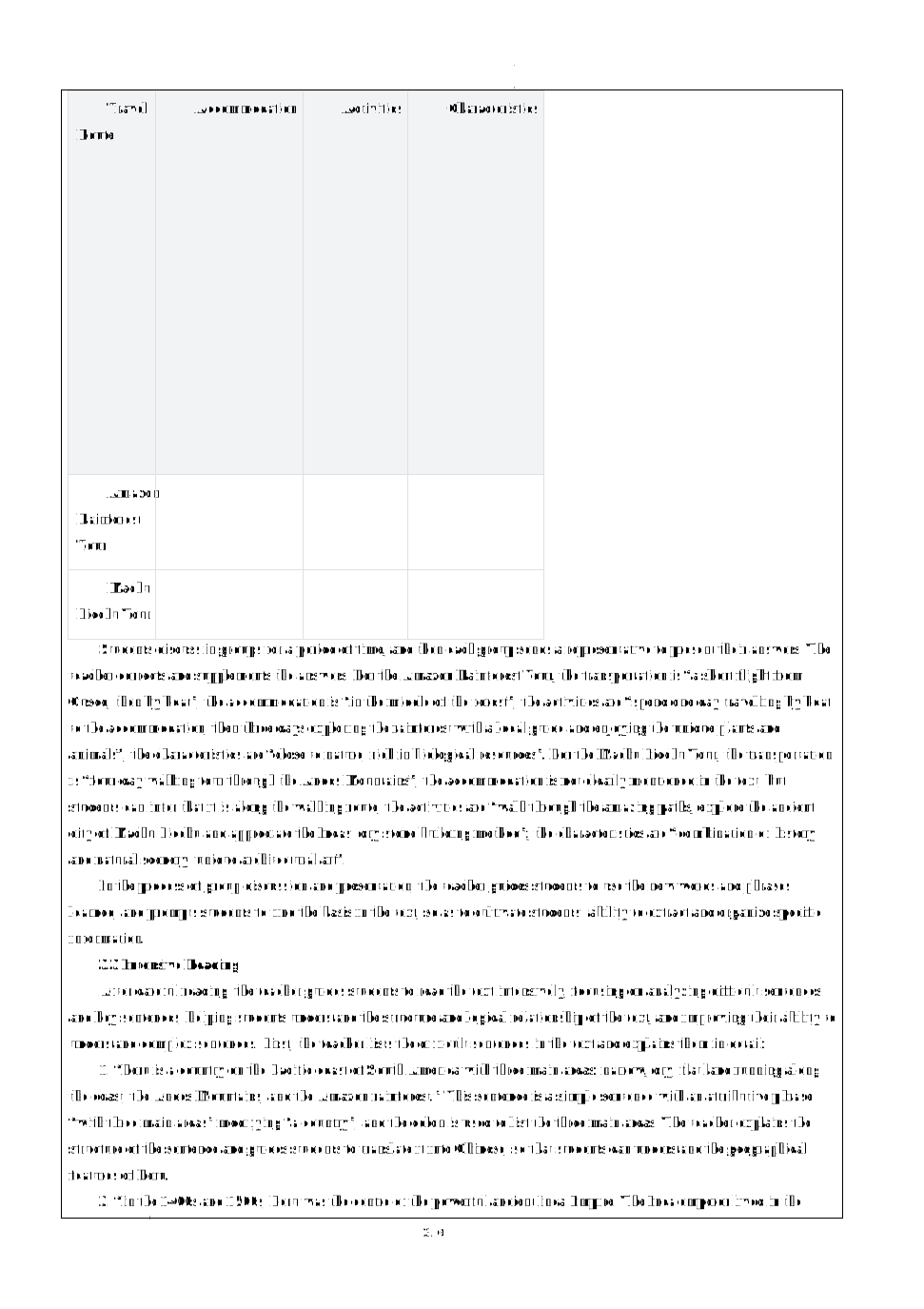
On the basis of fast reading, the teacher guides students to read the text carefully, and complete the following detailed tasks to help students grasp the specific information of each travel route. The teacher divides the class into two groups, Group A is responsible for analyzing the “Amazon Rainforest Tour”, and Group B is responsible for analyzing the “Machu Picchu Tour”. Each group needs to discuss and complete the following table:
Travel Route
Transportation
Accommodation
Activities
Characteristics
Amazon Rainforest Tour
Machu Picchu Tour
Students discuss in groups for a period of time, and then each group sends a representative to present their answers. The teacher corrects and supplements the answers. For the Amazon Rainforest Tour, the transportation is “a short flight from Cusco, then by boat”; the accommodation is “in the middle of the forest”; the activities are “spend one day travelling by boat to the accommodation, then three days exploring the rainforest with a local guide and enjoying the unique plants and animals”; the characteristics are “close to nature, rich in biological resources”. For the Machu Picchu Tour, the transportation is “four-day walking tour through the Andes Mountains”; the accommodation is not clearly mentioned in the text, but students can infer that it is along the walking route; the activities are “walk through the amazing paths, explore the ancient city of Machu Picchu and appreciate the Incas’ dry stone building method”; the characteristics are “combination of history and natural scenery, unique architectural art”.
In the process of group discussion and presentation, the teacher guides students to use the new words and phrases learned, and prompts students to find the basis in the text, so as to cultivate students’ ability to extract and organize specific information.
3.3 Intensive Reading
After careful reading, the teacher guides students to read the text intensively, focusing on analyzing difficult sentences and key sentences, helping students understand the structure and logical relationship of the text, and improving their ability to understand complex sentences. First, the teacher lists the difficult sentences in the text and explains them in detail:
1. “Peru is a country on the Pacific coast of South America with three main areas: narrow, dry, flat land running along the coast, the Andes Mountains, and the Amazon rainforest.” This sentence is a simple sentence with an attributive phrase “with three main areas” modifying “a country”, and the colon is used to list the three main areas. The teacher explains the structure of the sentence and guides students to translate it into Chinese, so that students can understand the geographical features of Peru.
2. “In the 1400s and 1500s, Peru was the centre of the powerful ancient Inca Empire. The Inca emperor lived in the now-famous site Machu Picchu.” These two sentences introduce the historical background of Peru. The teacher explains the time expression “in the 1400s and 1500s” and the phrase “now-famous site”, and guides students to understand the historical status of Peru and the origin of Machu Picchu.
3. “Especially amazing is the Incas’ dry stone method of building. Inca builders cut stones to exact sizes so that nothing was needed to hold walls together other than the perfect fit of the stones.” These two sentences introduce the Incas’ building method. The teacher explains the inverted sentence structure “Especially amazing is...”, the phrase “dry stone method of building” and the conjunction “so that”, and guides students to appreciate the wisdom of the ancient Incas.
Then, the teacher guides students to analyze the structure of the text. The text is divided into three parts: the first part (Paragraph 1-2) introduces Peru’s geographical features and historical background; the second part (Paragraph 3) introduces the Amazon Rainforest Tour; the third part (Paragraph 4) introduces the Machu Picchu Tour. The text adopts the structure of “general introduction + specific introduction”, which is clear and logical.
In the intensive reading link, by analyzing difficult sentences and text structure, students can deeply understand the text content, master the usage of complex sentences and text structure, and lay a foundation for the subsequent language application.
Step 4: Post-reading
The post-reading link aims to consolidate the reading results, guide students to apply the learned language knowledge and reading skills, and expand their thinking, so as to achieve the goal of improving comprehensive language ability. This link includes three activities: discussion, language practice and expansion.
4.1 Discussion
The teacher puts forward the following discussion questions to guide students to think deeply and communicate in English: “1. Which travel route do you prefer, the Amazon Rainforest Tour or the Machu Picchu Tour? Why? 2. What should we pay attention to when travelling to a foreign country? 3. What can we learn from the travel routes introduced in the text?”
Students discuss in groups of 4-5, and each student is required to express their own opinions. During the discussion, the teacher walks around the classroom, guides students to use the new words and phrases learned in the text, and helps students solve the problems encountered in expression. For example, if a student does not know how to express “pay attention to”, the teacher can prompt: “We can use ‘pay attention to’ or ‘be careful with’.”
After the discussion, the teacher invites several groups to share their discussion results. For the first question, students may have different preferences: some students prefer the Amazon Rainforest Tour because they like nature and want to see unique plants and animals; some students prefer the Machu Picchu Tour because they are interested in history and ancient architecture. The teacher affirms students’ different opinions and encourages them to express their ideas boldly.
For the second question, students can put forward some suggestions, such as “learn about the local culture and customs”, “obey the local rules”, “take necessary items”. For the third question, students can summarize: “We can learn how to introduce a travel route clearly, and understand the importance of combining natural scenery and cultural heritage in travel.”
4.2 Language Practice
In order to help students consolidate the new words and sentence patterns learned, the teacher designs the following language practice activities:
1. Fill in the blanks with the correct form of the given words: (destination, explore, unique, amazing, exact)
① Our ________ for this trip is the ancient city of Machu Picchu. ② We will ________ the Amazon rainforest with a local guide. ③ The rainforest has many ________ plants and animals. ④ The Incas’ dry stone building method is ________. ⑤ The builders cut the stones to ________ sizes.
Students complete the exercises independently, and then the teacher checks the answers and explains the usage of the words again. This activity can help students master the usage of core vocabulary.
2. Rewrite the following sentences according to the example: Example: Peru has three main areas. It is a country on the Pacific coast of South America. → Peru is a country on the Pacific coast of South America with three main areas.
① The Amazon rainforest has many unique plants and animals. It is a beautiful place. ② Machu Picchu has a long history. It is a famous tourist site.
This activity helps students master the sentence structure “noun + with + attributive phrase”, which is often used in introducing places.
4.3 Expansion
In order to expand students’ horizons and connect the text content with real life, the teacher guides students to introduce their own dream travel routes. The teacher says: “We have learned about the travel routes in Peru. Now, please introduce your own dream travel route, including the destination, transportation, accommodation, activities and reasons why you choose it. You can use the words and sentence patterns we learned today.”
Students prepare independently for a few minutes, and then invite 2-3 students to share their dream travel routes. For example, a student may say: “My dream travel route is to go to Japan. I will take a plane to Tokyo. I will stay in a hotel near the subway station. I will visit the Tokyo Tower, taste local food and go shopping. I choose this route because I am interested in Japanese culture and want to experience the local life.”
The teacher comments on students’ sharing, affirms their advantages in expression, and puts forward suggestions for improvement. This activity not only consolidates the learned language knowledge, but also cultivates students’ ability of oral expression and logical thinking.
Step 5: Summary and Homework
5.1 Summary
The teacher summarizes the content of this class: “Today, we learned the Reading and Thinking part of Unit 2. We understood the main idea and key information of the text, which introduces Peru’s geographical features, historical background and two classic travel routes. We also mastered some core vocabulary and sentence patterns related to travel, and improved our reading ability and oral expression ability. At the same time, we learned about the culture of Peru and realized the diversity of world cultures.”
Then, the teacher emphasizes the key and difficult points of this class again: “The key points of this class are mastering travel-related vocabulary and extracting key information from the text; the difficult points are understanding and using complex sentences and improving cross-cultural communication ability. I hope you can review these contents after class.”
5.2 Homework
In order to consolidate the learning results and extend the learning content, the teacher assigns the following homework:
1. Read the text aloud for 15 minutes every day, and recite the key sentences and paragraphs to consolidate the pronunciation and intonation and memorize the new words and phrases.
2. Complete the exercises in the workbook related to this reading part, so as to consolidate the language knowledge and reading skills learned.
3. Write a short passage about your dream travel route, about 100 words. You should include the destination, transportation, accommodation, activities and reasons, and use the words and sentence patterns learned in this class.
4. Surf the Internet to find more information about Peru’s culture and scenic spots, and share it in the next class. This homework can help students expand their knowledge and cultivate their autonomous learning ability.
Step 6: Blackboard Design
The blackboard design is concise and clear, highlighting the key points of the class, which helps students review and consolidate the learning content. The blackboard is divided into three parts:
Left Part: Unit 2 Travelling Around — Reading and Thinking
Core Vocabulary: Peru, Amazon, rainforest, Machu Picchu, destination, accommodation, explore, unique, amazing, exact
Key Phrases: travel around, take a flight, by boat, explore the rainforest, dry stone method of building, perfect fit
Middle Part: Main Content
1. Peru’s geographical features: three main areas (coast, Andes Mountains, Amazon rainforest)
2. Peru’s historical background: Inca Empire, Spanish control
3. Travel Routes: Amazon Rainforest Tour, Machu Picchu Tour (transportation, accommodation, activities, characteristics)
Right Part: Key Sentences
1. Peru is a country on the Pacific coast of South America with three main areas.
2. Especially amazing is the Incas’ dry stone method of building.
3. Inca builders cut stones to exact sizes so that nothing was needed to hold walls together other than the perfect fit of the stones.
1 / 1
学科网(北京)股份有限公司
学科网(北京)股份有限公司
学科网(北京)股份有限公司
$
资源预览图

1

2
3
相关资源
示范课
由于学科网是一个信息分享及获取的平台,不确保部分用户上传资料的 来源及知识产权归属。如您发现相关资料侵犯您的合法权益,请联系学科网,我们核实后将及时进行处理。