黑龙江哈尔滨第六中学校2025-2026学年高三下学期2月阶段性测试英语试卷
 切换试卷
切换试卷
2026-03-01
|
2份
|
10页
|
511人阅读
|
7人下载
内容正文:
1~5 BACBB 6~10 CABAC 11~15 ACBBC 16~20 ACBAA
21-23ADB 24-27 BACC 28-31 ABCB 32-35 BCDC 36-40 GDACF
41-45 BACAB 46-50 CDDBA 51-55CBACD
56.what 57. covering 58. to 59. scheduled 60. to fight 61.a 62. and
63.which 64. completion 65. is caged
小作文
Step Outside and Breathe Nature
Dear fellow students,
Have you imagined learning English surrounded by nature’s beauty? That’s what exactly Mr. Johnson’s “The Touch of Nature” outdoor lesson offered us last week.
During the class, we explored the campus woods, observed various plants and insects, described our findings in English, sharing our feelings and thoughts freely and even composed short poems inspired by the scenery. It was more than a lesson — it was a healing experience.
This experience proves how nature sharpens our senses and spark our creativity. I sincerely appeal to you to step outside and embrace nature, walking among trees, feeling the breeze, listening to the birds singing and breathing deeply . These moments will surely refresh your spirit and inspire new perspectives.
读后续写
Paragraph 1
Tom was already in the backyard when I arrived. I approached quietly, holding out the gloves and seedlings. “Sorry I messed up earlier, I shouldn’t have been rude to you.” I murmured. Tom turned around, with a faint surprise crossing his face. He took them readily and grinned, “That’s all right. Let’s get started.” Together, we planted the seedlings, him digging neat holes and me arranging them according to the layout. Sweat dripped down our faces, but laughter replaced our earlier misunderstanding as we helped each other. We waited, hopeful for a little miracle to take root.
Paragraph 2
Finally, the big day came—Mom’s birthday. We led her to the garden, where ripe tomatoes hung thick and heavy on the branches. Mom hugged us tightly, tears blurring(使视线模糊) her vision, “This is the best birthday present — seeing you two work together.” Dad, together with us, picked some fresh tomatoes to make sauce. We enjoyed it, chatting and laughing joyfully. Teamwork and understanding didn’t just grow plants, they bonded our hearts closer and wove our family closer. Family love is a gift far sweeter than any sauce, a memory we would cherish forever.
听力原文
Text 1
M:Oh dear,I’m late. I have to be in the office by 8:00 a. m. There is an important meeting with a new client.
W:OK. Wait a minute. I can give you a lift.
Text 2
W:Kevin,I think it’s time we talked about you taking more financial responsibility.
M:Like,for my college fee?I don’t think my part-time job covers that.
W:I see,but you can cover some smaller expenses,like your phone bills.
Text 3
M:Remember Mike next door when we lived in the countryside?
W:Yes. I heard he’s running his own bookstore now,and he’s doing pretty well.
M:Good for him. He must be doing what he loves. After all,he used to be such a book lover.
Text 4
W:Good morning. Can I see your passport?
M:Certainly. Here it is.
W:Yes,that’s all right. Have you got anything to declare?
M:Yes,I have. I’ve got some whisky and some cigarettes.
Text 5
W:I’m going to try out some new recipes tonight.
M:Well,remember that the Jacks are coming over for dinner. You know how much I like your cooking,dear,but maybe you shouldn’t pick tonight of all nights to experiment.
Text 6
M:Mom,can we go to the zoo?There’s a sea lion show. It’s said to be very exciting.
W:How do you know it?Did someone in school tell you?
M:No,I saw a commercial on TV.
W:I’m sorry that we can’t go,dear. People might think the show is entertaining,but the animals have gone through some tough training. They would never suffer that if they lived in the wild.
M:But Mom,all of my classmates will probably go to see it.
W:Sorry,honey. What if we go to a wildlife zoo in San Diego?There will be no shows,but you can see plenty of animals.
Text 7
M:I’m sorry,but I am trapped in a traffic jam now. I’m going to be 30 minutes late.
W:What time did you leave this morning?
M:I started my car at 7:30 a.m. Normally,it takes me about an hour to get to the office. But today’s trip was a nightmare. In the future,I’ll take the subway. It only takes 45 minutes in total.
W:Sounds like a good plan. Since you live far from our company,the subway is more reliable than driving or riding a bike. Maybe you could also try leaving earlier to avoid the rush hour.
Text 8
M:Mrs. Day,I don’t feel so good.
W:What’s bothering you,Thomas?Is it the same problem from this morning?I can’t give you any more medicine for that until tomorrow.
M:No. It’s not my head. Now my stomach hurts.
W:I don’t have any other patients right now,so why don’t we sit and talk?Do you realize that you’ve come to visit me here at the health office every day since camp began?
M:Yes,but I’m not pretending to be sick. I really feel bad and want to go home.
W:Well,I don’t think it’s the food. None of the other children have this problem. I think you’re just missing your home and parents. There is nothing wrong with that.
M:Then can I go home now?
W:No. Your parents are coming in three days. So relax until then.
Text 9
M:So,Grace,what was the biggest difficulty that you had in managing your time at university?
W:Well,when I started college,I couldn’t believe how much free time I had. Compared with high school,I only had to go to a couple of classes a day in college!It was wonderful! But then halfway through the first term,I realized I was supposed to be studying the rest of the time!
M:So,what advice would you give to new college students?
W:Well,professors expect you to work a lot outside of class. So use a planner. It’s also important to know what the best time for you to study is. Like,after two years,I finally realized that I don’t do my best work late in the evening!So now I try to schedule my classes for the afternoon and the evening,and study the rest of the day on my own. Oh,and one more thing. Take breaks! Don’t think you can study effectively for six hours straight!
Text 10
W:A new museum of laughter in Croatia is helping people deal with the negativity of modern life. Visitors to the HaHaHouse in Zagreb,the capital of Croatia,walk into a little cloud of white smoke when they step inside. Its purpose is to blow away their worries before they climb into a “giant washing machine”. Then they move down a twisting slide into a space filled with little white balls,where their trip to a happier place starts. 43-year-old Andrea Golubic is the museum’s creator. Golubic said she got the idea during the pandemic. At that time,many people were feeling down,so she wanted to heal people with laughter. Golubic said a picture of herself when she was 7 inspired her.“I was constantly joking as a kid,”she added. The museum has eight interactive zones or areas. One has rubber chickens singing cheerfully. They sing songs like ABBA’s “Dancing Queen”. There is a room where people wrestle in large clothes. There is also a rich history of humor from ancient to modern times told through theaters,films or the Internet. Singer Zorica said the museum was just right for this era and clearly a hit.“Entering here is like entering childhood,bringing both happiness and joy,”She added.
学科网(北京)股份有限公司
$
哈尔滨市第六中学校2023级二月阶段性测试
高三英语试卷
考试时间:120分钟 满分:150分
注意事项:
1.答题前,考生须将自己的姓名、班级、考场/座位号填写在答题卡指定位置上,并粘贴条形码。
2.回答选择题时,选出每小题答案后,用2B铅笔把答题卡上对应题目的答案标号涂黑。如需改动,用橡皮擦干净后,再选涂其它答案标号。
3.回答非选择题时,请使用0.5毫米黑色字迹签字笔将答案写在答题卡各题目的答题区域内,超出答题区域或在草稿纸、本试题卷上书写的答案无效。
4.保持卡面清洁,不要折叠、不要弄皱、弄破,不准使用涂改液、修正带、刮纸刀。
第一部分 听力(共两节,满分 30 分)
做题时,先将答案标在试卷上。录音内容结束后,你将有两分钟的时间将试卷上的答案转涂到答题卡上。
第一节(共5小题;每小题1.5分,满分7.5分)
听下面5段对话。每段对话后有一个小题,从题中所给的A、B、C三个选项中选出最佳选项。听完每段对话后,你都有10秒钟的时间来回答有关小题和阅读下一小题。每段对话读两遍。
1. What will the woman do for the man?
A. Pick up his client. B. Drive him to work. C. Wait for him.
2. What will Kevin be responsible for?
A. His phone charges. B. His college fees. C. His family expenses.
3. What are the speakers mainly talking about?
A. A hobby. B. A bookshop. C. A former neighbor.
4. Where does the conversation probably take place?
A. At a bar. B. At an airport. C. At a grocery store.
5. What does the man suggest the woman do?
A. Invite Jack to dinner. B. Use old recipes tonight. C. Do a cooking experiment.
第二节(共15小题;每小题1.5分,满分22.5分)
听下面5段对话或独白。每段对话或独白后有几个小题,从题中所给的A、B、C三个选项中选出最佳选项。听每段对话或独白前,你将有时间阅读各个小题,每小题5秒钟;听完后,各小题将给出5秒钟的作答时间。每段对话或独白读两遍。
听下面一段对话,回答第6和第7两个小题。
6. Where did the boy get information about the show?
A. From the woman. B. From his classmate. C. From a TV advertisement.
7. What is the woman's attitude toward the show?
A. Critical. B. Understanding. C. Unclear.
听下面一段对话,回答第8和第9两个小题。
8. How long will it take the man to arrive at work today?
A. Almost 45 minutes. B. About 90 minutes. C. Around 60 minutes.
9. What does the man plan to do in the future?
A. Take the subway. B. Leave earlier. C. Ride a bike.
听下面一段对话,回答第10至第12三个小题。
10. What problem does Thomas have?
A. A headache. B. A toothache. C. A stomachache.
11. What does the woman mean about Thomas?
A. He is homesick.
B. He eats the wrong food.
C. He should take medicine.
12. What will Thomas do next?
A. Visit his parents. B. Go home directly. C. Stay in the camp.
听下面一段对话,回答第13至第16四个小题。
13. How did Grace feel when she first entered university?
A. Stressed. B. Pleased. C. Confused.
14. What might Grace do halfway through the first term?
A. She decided to join more clubs.
B. She began to spend more time studying.
C. She managed time as she did in high school.
15. When does Grace study alone now?
A. In the evening. B. In the afternoon. C. In the morning.
16. What is Grace's final suggestion?
A. Balance learning and rest. B. Set clear study goals. C. Use a planner.
听下面一段独白,回答第17至第20四个小题。
17. What do visitors experience first when entering the museum?
A. The ball pool. B. The washing machine. C. The white smoke.
18. What inspired Golubic to create the museum?
A. Her visit to museums. B. Her childhood photo. C. Her negative feelings.
19. What can the interactive places offer?
A. History of humor. B. Singing contests. C. Wrestling courses.
20. What do Zorica's words indicate?
A. The HaHaHouse is a success.
B. Mental problems will be solved.
C. The museum is designed for children.
第二部分:阅读理解(共两节,满分40分)
第1节 (共15小题;每小题2.5分,满分37.5分)
阅读下列短文,从每题所给的四个选项中(A、B、C和D)中,选出最佳选项
A
The Secrets of Public Engagement
Are you passionate about sharing your work in STEM (Science, Technology, Engineering and Mathematics)? Do you want to excite the imagination when explaining your love of science? Join the team behind New Scientist Live to discover the secrets behind the UK’s biggest science show.
In this free virtual event, host Martin Davies will welcome science communicator and engagement consultant Dr Jamie Gallagher, as he is to reveal how to prepare memorable talks and interactive stands that leave a lasting impression. Jamie Gallagher is an award-winning professional with ten years’ experience in the delivery and evaluation of quality engagement projects. Martin will also explore what organizers look for when inviting speakers and selecting exhibitors for New Scientist Live.
Who should watch?
science communication professionals
public engagement officers
researchers involved with public engagement
science speakers and demonstrators
anyone else interested in communicating STEM topics to a public audience
Benefits of watching
Learn about how New Scientist Live communicates complicated ideas to a general audience. Discover how to have the greatest impact when exhibiting. Learn how to extend your message to a wider, underrepresented audience.
Booking information
Ring Central will email your ticket confirmation to you immediately after registering. You will also receive a separate email from Ring Central with a link to access the event within a week of the event start date. Each link is unique and should not be shared.
Tickets are non-transferable to any other New Scientist event.
Access to a recording of the event will be exclusively available to registrants for the 12 months following the live event.
21. What will Dr Jamie Gallagher mainly share in the event?
A. Ways to create impressive talks.
B. Advice on applying for research funding.
C. Skills for carrying out scientific experiments.
D. Methods for managing large science exhibitions.
22. Who is the virtual event mainly intended for?
A. Visitors who enjoy science museums.
B. Students preparing for science-related exams.
C. Business professionals working in technology.
D. People interested in communicating STEM topics.
23. In which section of a website can you find the text?
A. Educational resources. B. Science events.
C. Professional guidance. D. Career opportunities.
B
In a world flooded with fast-paced digital entertainment, a group of young literature lovers has been quietly reviving the charm of words through community reading programs. Among them is 18-year-old Leo, a high school senior who first joined the "Page Turners" literary volunteer project out of his love for classic novels, but soon discovered it to be a journey of cultural inheritance, emotional resonance(共鸣), and social connection.
Leo's first assignment was to organize weekly reading sessions for children in a low-income community. Initially, he faced great challenges—many kids were distracted by mobile games and had little interest in sitting down with a book. Some of his fellow volunteers felt frustrated, complaining that their efforts to promote reading were falling on deaf ears. But Leo refused to give up. He observed experienced organizers: they selected engaging stories, added interactive discussions, and even acted out key scenes with simple props. Following their example, Leo started choosing adventure stories full of imagination and designing fun quizzes related to the plots. He spent hours helping the kids understand difficult passages and encouraging them to share their own ideas about the characters. Slowly, the children began to look forward to the weekly sessions, and Leo realized that genuine enthusiasm for literature is the key to inspiring others' interest.
Later, Leo participated in a community literary festival project. The task was ambitious: to showcase local writers' works, hold book exchanges, and invite authors to give lectures. The team of volunteers came from different backgrounds—some were passionate about poetry, others specialized in modern fiction, and a few had experience in event planning. Conflicts emerged quickly—some wanted to focus on promoting classic literature, while others insisted on giving more space to emerging local writers. Instead of taking sides, Leo suggested holding a brainstorming session to listen to everyone's opinions. He proposed dividing the festival into themed zones: a classic literature exhibition area, a local author interaction zone, and a youth reading sharing corner. His ability to integrate diverse ideas impressed his teammates, and the literary festival attracted hundreds of participants, exceeding everyone's expectations.
Through these experiences, Leo has grown into a thoughtful and culturally conscious young person. He has learned that literary promotion is not just about sharing books, but also about building bridges between people and cultures. As the project director noted, "Literature teaches us that every story carries the voice of a community, and that empathy and open-mindedness turn reading into a force for social cohesion(凝聚力)." Today, Leo continues to devote himself to literary volunteer work, inspiring more peers to discover the beauty of words and proving that the power of literature can create a lasting impact on individuals and society alike.
24.What can we infer about the kids in the low-income community after Leo’s efforts?
A.They still preferred mobile games over reading.
B.They became interested in weekly reading sessions.
C.They thought the reading activities were boring.
D.They refused to share ideas about the stories.
25. How did Leo solve the festival conflict?
A.Recommended brainstorming & themed zones.
B.Supported classic literature.
C.Invited more local writers.
D.Let planners decide.
26. Which best describes Leo?
A.tolerant & independent
B.critical & aggressive
C.competent & unbiased
D.cautious &modest
27. What can we infer from the director’s words?
A. Literature reflects one community only.
B. Empathy alone builds social cohesion.
C. Reading unites people with empathy and acceptance.
D. Social cohesion is literary promotion’s main goal.
C
Whether it’s enemy tanks in battle, animals in the wild or cutlery(餐具) in a busy canteen, it is difficult to count objects that are moving around. Luckily, there is a technique that can estimate how many there are of something without requiring you to count every single one.
The capture-recapture method involves getting a sample — waiting for some animals to wander by, for instance, then collecting some — marking the individuals distinctively, then releasing them back into the population. After some time has passed, you repeat the process to pick another group of animals and count how many of them are already marked.
If you captured, say, 50 animals initially and marked them all, then on your recapture step you found half the animals you saw were marked, this tells you something about the whole population. Since half the sample is marked, this implies that half of the whole population is marked — so there must be about 100 individuals. This can give a reasonably accurate estimate of a population, without having to find and count every single member of it.
During the second world war, some statisticians wanted to determine how many tanks the German army was producing. Captured tanks couldn’t be re-released, but, as tank components are marked with serial numbers(序列号), another approach allowed them to make an estimate. They logged(记录) the serial numbers of all captured tanks, working on the assumption that they were numbered in a fixed order and randomly distributed. If the largest serial number in your data is L and the number of captured tanks is n, one estimate for the total number of tanks is given by L+L/n. This is known as the German tank problem in statistics.
One of my favourite population estimation stories was told to me by a teacher friend, who tasked her students with estimating the number of forks in the school canteen — impossible to count as, at any given time, a number will be in use and others will be in the wash.
Her class “captured” a set of forks and marked each one with a drop of nail polish, then released them back into the population. A week later, they recaptured another sample population and used it to make an estimate of the total number of forks.
Researchers performed a similar experiment 20 years ago to shame people into returning lab property. A worrying number of teaspoons were going missing in their lab, so they marked a set of spoons before releasing them, studying their movements and publishing the results. It turns out science is effective thanks to the publication of the paper.
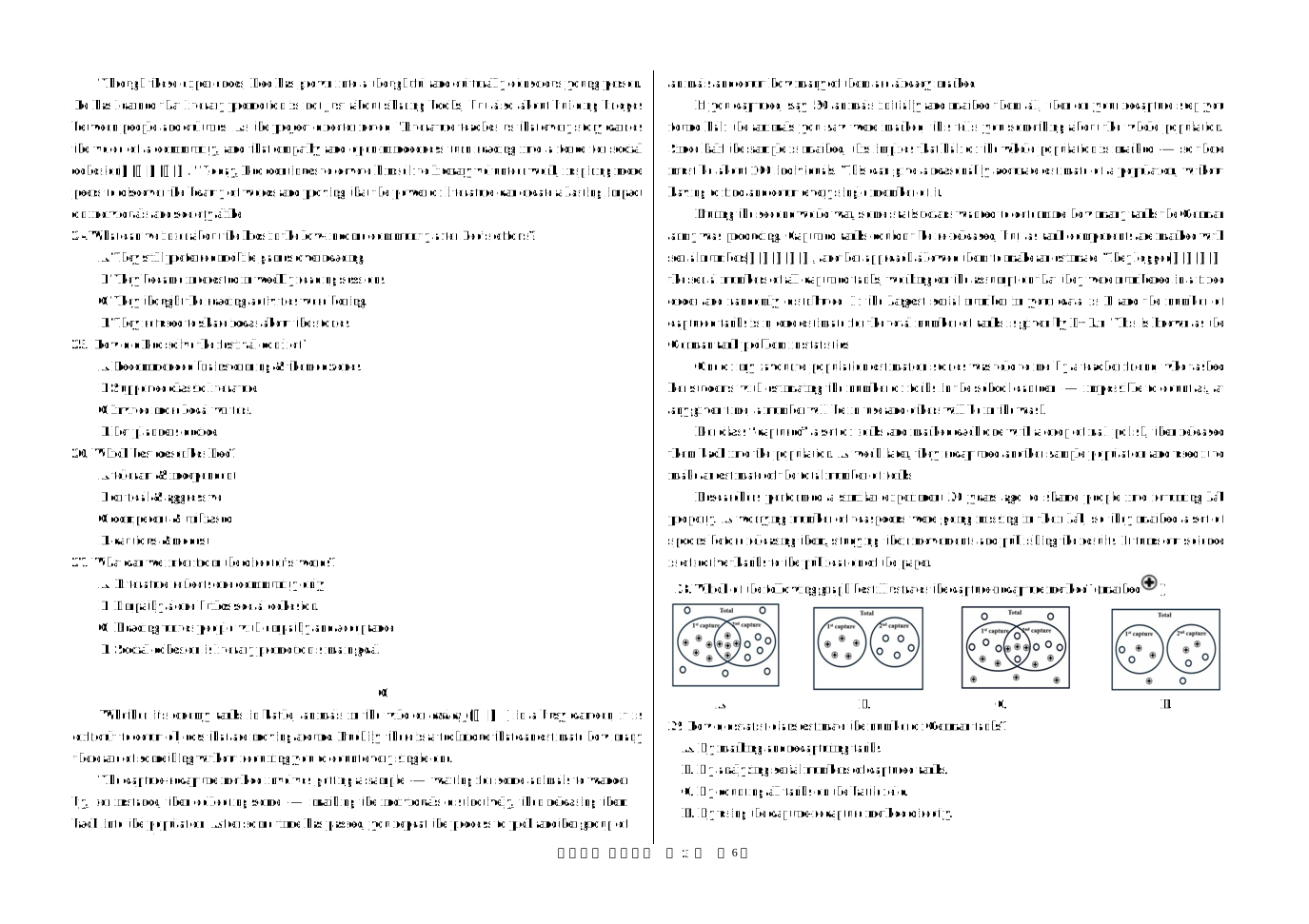
28.Which of the following graph best illustrates the capture-recapture method? (marked)
A. B. C. D.
29.How did statisticians estimate the number of German tanks?
A. By marking and recapturing tanks.
B. By analyzing serial numbers of captured tanks.
C. By counting all tanks on the battlefield.
D. By using the capture-recapture method directly.
30.What is the author’s attitude towards the mark-recapture method?
A.Skeptical B. Critical C. Supportive D. Neutral
31.What is the main idea of the text?
A. The history of the capture-recapture method.
B. Different ways to estimate population sizes.
C. How to count moving objects accurately.
D. The use of statistics in World War II.
D
Until recently, when scientists studied cells from people and animals, they often had to examine large samples, producing an average of results from many kinds of cells. The process was like trying to learn about bananas by studying a smoothie — a drink made from different types of fruit.
In recent years, scientists have developed methods that let them directly study the activity of cells and the genetic structure of individual cells. Single-cell analysis is the term for a group of techniques that scientists have developed for segregating or separating cells from living organisms. Scientists can study genetic material in each cell and learn about the relationships between cells. The result, notes the journal Science, is that researchers can follow the development of people and other organisms in incredible detail.
Francis Collins, who is the former director of the National Institutes of Health, recently noted the importance of such techniques for understanding human beings. “Single-cell analysis is crucial for a comprehensive understanding of our biology and health,” he said.
Jonathan Weissman is a stem cell biologist at the University of California San Francisco. He notes that single-cell analysis lets scientists ask much more detailed, exacting questions than they could in the past. “It’s like a flight recorder, where you are watching what went wrong and not just looking at a snapshot at the end,” he said. “We can ask questions at a resolution that was just not possible before.”
Nicholas Navin is a professor from the MD Anderson Cancer Center. He uses single-cell DNA studies to discover patterns of mutations in cells of a cancerous tumor. These studies let Navin recreate when and where those mutations appeared as the tumor developed. That information helps him identify cells that contain combinations of mutations that make them the deadliest. “In the future, such research could be used to help identify what treatments to use for certain patients,” Navin said. The research might also help doctors follow how well their treatments are working against a cancer over time.
32. What was the shortcoming of the previous way to study cells?
A. Generating a set of identical results.
B. Failing to research individual cells accurately.
C. Requiring scientists to study bananas directly.
D. Focusing on separating cells from living organisms.
33. The underlined words in paragraph 4 is closest in meaning to ______.
A. loosely B. timely C. precisely D. randomly
34. What do the accounts in the last three paragraphs imply?
A. Doctors will find a treatment for cancers soon.
B. Many scientists began to focus on studying cells.
C. There are many challenges of the new techniques.
D. The new techniques have great application potential.
35. Which can be the best title for the text?
A. The Previous Research into Human Cells.
B. A Major Breakthrough in Cancer Research.
C. Single-Cell Analysis: A Biological Revolution.
D. Genetic Material: A Global Research Project.
第二节 (共5小题;每小题2.5分,满分12.5分)
阅读下面短文,从短文后的选项中选出可以填入空白处的最佳选项。选项中有两项为多余选项。
How to Use AI to Boost Your Learning
AI tools are reshaping how students absorb knowledge, yet a large number of learners fail to use these tools in a way that truly enhances their academic growth. 36 .Instead of treating AI as a quick fix for homework, we can turn it into a tailored learning companion with intentional strategies.
● Use AI for active learning, not passive copying.
Many students rely on AI to write essays or solve math problems directly, missing the chance to process information independently. This approach helps you avoid over-reliance and develop independent problem-solving skills. For instance, ask ChatGPT to break down a complex physics formula into plain language, then ask it to create follow-up questions to test whether you grasp the logic behind the formula. 37
● 38 .
AI’s one-size-fits-all responses often fail to meet individual needs.If you’re a beginner in chemistry, request that the tool avoid technical terms and include real-life examples; if you’re advanced, ask for extended analyses of experimental data. AI’s value lies in adapting to your learning pace, not forcing you to keep up with its default settings(出厂设置).
● Cross-check AI answers to build critical thinking.
AI is not always right. 39 .Compare its explanations of historical events with textbook accounts, or check its coding solutions with reliable programming resources. This habit not only ensures accuracy but also trains you to evaluate information independently.
● Use AI to track and better your learning progress.
Staying organized amid busy study schedules is a common challenge. Tools like Notion AI can keep track of your daily study hours, prioritize topics you struggle with (e.g., grammar rules you repeatedly get wrong), and suggest targeted practice tasks. 40 .Over time, this data-driven feedback helps you focus on weak points and make steady progress.
AI is a powerful aid, but it cannot replace the effort of active learning and critical thinking. By combining AI’s strengths with intentional practice, you’ll see meaningful improvements in your learning efficiency.
A.Customize AI outputs to match your current level.
B.Use AI smartly to improve your academic performances.
C.It can mix up facts, misinterpret context, or overlook details in complex tasks.
D.This transforms AI from a “doer” into a tutor that deepens your understanding.
E.You can also share your progress with teachers to get personalized advice on your studies.
F. It can automatically sort your study materials into categories like “to review” and “mastered”.
G.Many learners only use AI to complete assignments quickly, without engaging with the content.
第三部分:英语知识运用(共两节,满分30分)
第一节:完型填空(共15小题;每小题1分,满分15分)
Motivation is delicate. When you notice your motivation fading, you have to make a small adjustment, which can make all the difference between ____41____ something or not.
I learned this lesson from a drive to a picturesque mountain range that lies just an hour from my city. However, the road there is dangerously ____42____, with sharp turns every few seconds. Driving through it was once a(an) ____43____. My child often got carsick, while ____44____ local drivers followed closely on my tail. The short journey always left me exhausted, and my motivation to visit ____45____.
One day, I tried a new approach: I drove really ____46____. It helped my child, but the line of cars in my mirror still ____47____ me out. Feeling pressured, I would speed up again. So then I made one small adjustment: I tilted(倾斜) the rearview mirror up, ___48____ the view behind me.
That simple method ____49____ everything. I could finally enjoy the drive at my own ____50____, appreciating the scenery. While cars occasionally pulled ahead whenever they could, they were no longer my main ____51____. Each crossing of the mountains has now become a journey of peace.
I’ve reflected a lot since then. I’ve realized that we are often demotivated by ___52____ pressures — whether they are social media, distracting environments, or ____53____ voices, much like those cars filling up my mirror. Learning to occasionally “tilt the mirror” — to consciously ignore the ____54____ of others — is essential to protecting our drive and ____55____ at our own pace.
41. A. interrupting B. achieving C. eliminating D. acknowledging
42. A. winding B. smooth C. steep D. arched
43. A. adventure B. routine C. struggle D. blessing
44. A. impatient B. seasoned C. cautious D. sympathetic
45. A. set in B. slipped away C. showed up D. moved out
46. A. swiftly B. efficiently C. slowly D. skillfully
47. A. helped B. urged C. cheered D. stressed
48. A. reflecting B. expanding C. maximizing D. avoiding
49. A. worsened B. changed C. increased D. removed
50. A.rhythm B. cost C. expense D. leisure
51. A. offense B. mission C. concern D. passion
52. A. internal B. external C. mental D. physical
53 A. discouraging B.encouraging C. reassuring D. shocking
54. A. response B. request C. noise D. compliment
55. A. accelerating B. navigating C. inching D. advancing
第二节 语法填空(共10小题;每小题1.5分,满分15分)
阅读下面材料,在空白处填入适当的内容(只填1个单词)或括号内单词的正确形式。
When it comes to deserts, a scene of sandstorms and rolling dunes will pop into our mind. But if you come to the Taklimakan Desert, you will find it is a very breathtaking place different from 56_________you have imagined.
Located in Xinjiang, the Taklimakan Desert is the one 57_________ (cover) 337,000 square kilometers. In the past, the desert expanded outward about 150 meters annually, which posed a serious threat 58 ________the survival of the local people.
In 1979, a groundbreaking super project began as 59__________(schedule), aiming to build large-scale protective forests to reduce disturbing sandstorms and soil erosion dramatically. The project involved over 600,000 participants from various regions, who employed a variety of methods 60__________(fight) against the desert. By the end of 2023, a green barrier of about 2,761 kilometers had been established around the desert. On November 28th, 2024, a significant milestone was achieved as 61_________ 285-kilometer gap was successfully "locked", marking a great victory in the battle against desertification. With the effort of half a century, the project has not only locked the edges of the desert but also protected the surrounding oases(绿洲), safeguarding the livelihoods of local communities 62________ supporting the region' s economic development.
Nowadays, the desert is dotted with countless oases, many of 63________ have become tourist attractions. The 64_________(complete) of the project is not just an environmental victory but also a symbol of perseverance and romance of the Chinese people.
In the foreseeable future, with the continuous efforts of the Chinese people, this desert will continue to shrink until it 65 _________(cage) by the Chinese people completely.
第四部分 写作(共两节,满分40分)
第一节(满分15分)
假定你是李华,校英文报的编辑。上周外教Mr. Johnson组织的主题为“The Touch of Nature”的户外英语课,让你颇受启发。现请你据此为校英文报写一篇倡议书,呼吁同学们走进自然。
内容包括:
1.课堂经历;
2.感受与呼吁。
注意:
1.词数80左右;2.可以适当增加细节,以使行文连贯。
Step Outside and Breathe Nature
Dear fellow students, _____________________________________________________________________________________
_____________________________________________________________________________________
_____________________________________________________________________________________
_____________________________________________________________________________________
_____________________________________________________________________________________
第二节 读后续写(满分25分)
阅读下列文章,根据其内容和所给段落开头语续写两段,使之构成一篇完整的短文。
The Garden Project That Bonded Us
When Dad announced we would transform the overgrown backyard into a vegetable garden, I rolled my eyes while Tom, my 12-year-old little brother, cheered. “It’s a waste of time.” I complained, scrolling through my phone. “We could just buy vegetables from the supermarket.” Tom, however, had always dreamed of growing his own tomatoes—especially since Mom’s birthday was only three months away, and he’d been talking about picking fresh tomatoes to make her favorite pasta sauce. Dad smiled, handing us a list. “Lily, you’ll handle planning the layout and buying seedlings (幼苗). Tom, you’ re in charge of clearing the weeds and digging the soil. Teamwork makes the dream work.” He paused, glancing at the calendar on the wall where Mom’s birthday was circled in red. “Three months is quite enough for those potato seedlings to bear fruit—perfect timing if we get started now.”
The first weekend, conflict erupted. I spent hours researching online but forgot to buy the seedlings, comforting myself “too busy with homework.” Tom was pulling weeds for hours, sweating profusely. Several days later, he marched into the garden expecting to find rows of seedlings, only to be met with empty yard, and then exploded with anger, shouting “You didn’t even do your basic job. I’m doing all the hard work while you’re sitting on the couch. Look! My gloves are worn out.” I fired back, “Digging is easy. My part requires intelligence, not just brute force(蛮力).” We refused to speak to each other, leaving the half-cleared yard in chaos. Dad didn’t intervene immediately; instead, he left a note on the kitchen table, reading “Labor teaches us responsibility, and teamwork means supporting each other, not blaming.”
That night, I couldn’t sleep, remembering how Tom had helped me fix my bike last year, even though he’d had a fever. Meanwhile, Tom lay in his room staring at the layout paper I threw to him earlier that week, recalling the way I’d lingered over(仔细打量) the layout drawings many times, saying, “Mom will definitely love it.”
The next morning, I woke up at dawn, grabbed my wallet, and raced to the store. I came back with not just tomato seedlings but also a new pair of gardening gloves for Tom.
注意:(1)续写词数应为150个左右;
(2)请按如下格式在答题卡的相应位置作答。
Para. 1: Tom was already in the backyard when I arrived.__________________________________
_____________________________________________________________________________________
_____________________________________________________________________________________
_____________________________________________________________________________________
_____________________________________________________________________________________
_____________________________________________________________________________________
_____________________________________________________________________________________
Para. 2: Finally, the big day came—Mom’s birthday._______________________________________
__________________________________________________________________________________________________________________________________________________________________________
_____________________________________________________________________________________
_____________________________________________________________________________________
_____________________________________________________________________________________
_____________________________________________________________________________________
(
1
)高三测试 英语试题 第 页 共6页
学科网(北京)股份有限公司
$
资源预览图

1

2
3
相关资源
示范课
由于学科网是一个信息分享及获取的平台,不确保部分用户上传资料的 来源及知识产权归属。如您发现相关资料侵犯您的合法权益,请联系学科网,我们核实后将及时进行处理。