Unit 5 Summer Fun-2025-2026学年六年级下册英语易错词汇精讲(教科版)
2026-02-10
|
8页
|
13人阅读
|
0人下载
教辅

资源信息
| 学段 | 初中 |
|---|---|
| 学科 | 英语 |
| 教材版本 | 初中英语教科版(五四学制)六年级下册 |
| 年级 | 六年级 |
| 章节 | Unit 5 Summer fun |
| 类型 | 学案 |
| 知识点 | 词汇 |
| 使用场景 | 同步教学-新授课 |
| 学年 | 2026-2027 |
| 地区(省份) | 全国 |
| 地区(市) | - |
| 地区(区县) | - |
| 文件格式 | |
| 文件大小 | 148 KB |
| 发布时间 | 2026-02-10 |
| 更新时间 | 2026-02-10 |
| 作者 | 北京菁榕教育咨询有限公司 |
| 品牌系列 | - |
| 审核时间 | 2026-02-10 |
| 下载链接 | https://m.zxxk.com/soft/56422108.html |
| 价格 | 3.00储值(1储值=1元) |
| 来源 | 学科网 |
内容正文:
初中·教科版·6下
下册专版
B版易错词汇精讲
【下册专版】
初中·教科版·6下Unit5 Summer Fun
单元词汇总览
campfire/'kaempfar()/n.箐火:分词)
硕士V.掌握;精通
营火
contraction /kan'traek(n/n.缩写;beginner /br'gmar)/n.初学者;
recognize/'rekagnaIz/y.认出:识收缩:缩写形式
新手
别:承认
accord /a'ko:dn.协议:条约v.basics/'beisiks/n.基础:基本原
useful'ju:sfl/adj.有用的:有益给予:授予;符合
理;基本知识
的:实用的
unbelievable/,Anbr'li:vabl/ad.birthplace/b3:0 plers/n.出生地:
invention/m'venn/n.发明:创难以置信的:惊人的
发源地
造:发明物
spend /spend/v.(spent,spent)understanding Ands'staendn/n.
dynasty/dinasti/n.王朝:朝代费:度过:消耗
理解;领会;谅解adj.善解人意
survival/sa'val/n.生存:幸存;root seeking /ru:t'sikn/短语寻的
残存物
根
thinking/'k/n.思考:想法:
challenge'taelmd3/n.挑战:艰instead/m'sted/adv.代替;反而:思维v.思考;认为(think的现
巨任务V.挑战:质疑
却
在分词)
winner/wm(c)/n.获胜者;赢training/'tremnr/n.训练;培训workshop/'w3kDp/n.车间;作
家
talent/'taelant/n.天赋;才能:天坊;研讨会
organize/':ganaiz/v.组织:筹才
drinking/'dr四k/n.喝:饮酒v.
备:整理
skilled/skld/ad.熟练的;有技喝:饮酒(drink的现在分词)
camping/'kenp四/n.露营;野能的:有经验的
营v.露营;宿营(camp的现在master/ma:star)/n.主人;大师;
易错词汇精讲
1.recognize/rekagnaIz/v.认出;识别;承认
易错点:易混淆'recognize'”(认出)与"realize”(意识到)的含义;过去式和过去分词易误写
为”recogniced'(正确形式为recognized)。
·精讲:表示“认出某人W某物”时用recognize,.而realize侧重“经过思考后意识到”。词尾-ize
是英式拼写,美式拼写为-ise,但初中阶段统一要求掌握-ize形式。
·例句:I didn't recognize you with your new haircut..(你换了新发型,我没认出你。)
·真题链接:(教科版六年级下册同步练习):She
(认出)her old friend in the crowd
yesterday.(答案:recognized)
2.useful/ju:sfl/adj.有用的:有益的
初中·教科版·6下
下册专版
·易错点:易误写为'useable'”(正确形容词形式为useful);固定搭配be useful for'”与'be useful
to”混淆。
·精讲:use的形容词形式是useful(不是useable),'be useful for+名词/动名词”表示“对…
有用”,'be useful to sb.”表示“对某人有用”。
·例句:This dictionary is useful for learning English.(这本词典对学英语有用。)
·真题链接:(教科版六年级下册单元测试):This tool is
(有用的)to farmers..
(答
案:useful)
3.spend/spend/v.(spent,spent)花费;度过;消耗
·易错点:易混淆'spend,(人作主语)、”take”(it作形式主语)、”cost”(物作主语)的用法:过
去式易误写为”spended”(正确为spent)。
·精讲:spend的主语必须是人,结构为'spend time/money on sth.”或”spend time/money(in)doing
sth.”:take常用'It takes sb.time to do sth.”;cost主语为物,结构为”sth.costs sb.money”。
·例句:She spends two hours reading every day.(她每天花两小时读书。)
·真题链接:(教科版六年级下册期末真题):He
(花费)50 yuan on the book last week.
(答案:spent)
4.instead/m'sted/adv.代替:反而;却
·易错点:易误与”instead of'混淆,”instead'单独使用(句末或句首),”instead of'后接名词/动
名词。
·精讲:instead是副词,意为“代替”,常位于句末;instead of是介词短语,意为“代替…”,
后接被替代的内容。
·例句:I didn't go to the park.I stayed at home instead.(我没去公园,反而待在了家里。)
·真题链接:
(教科版六年级下册同步练习):He drank milk instead
coffee.(答案:
of)
5.master/'ma:sta)/n.主人;大师;硕士v.掌握;精通
·易错点:易混淆名词“主人”与动词“掌握”的含义:作动词时易误接todo(正确搭配为"master
sth.”或'master doing sth.”)。
·精讲:作动词“掌握”时,直接接宾语,如"master English'”(掌握英语),不可说'master to learn
English”。
·例句:She has mastered the basic skills of painting.(她已掌握绘画的基本技能。)
·真题链接:(教科版六年级下册单元测试):It takes years to
(掌握)a foreign language.
(答案:master)
6.beginner /bI'gnar)/n.初学者;新手
初中·教科版·6下
下册专版
·易错点:易误写为beginer'(漏写双写n,正确为beginner):易与beginning”(名词,开始)
混淆。
·精讲:begin的名词“初学者”是beginner(begin+ner),双写n加-er;beginning”表示“开
始”,如”at the beginning'”。
·例句:As a beginner,,you should start with the basics.(作为初学者,你应该从基础开始。)
·真题链接:(教科版六年级下册课时练):He is a
(初学者)in cooking,so he often
makes mistakes.(答案:beginner)
7.understanding/,nda'staendu/n.理解;领会adj.善解人意的
·易错点:易混淆名词“理解”与形容词“善解人意的”用法:名词不可数,易误加复数s。
·精讲:作名词时是不可数名词,如'have a good understanding of,(对…有很好的理解):作
形容词时,意为“体谅人的”,如'an understanding teacher'”。
·例句:We need to improve our understanding of Chinese history.(我们需要提高对中国历史的理
解。)
·真题链接:(教科版六年级下册期末真题):She is an
(善解人意的)girl and always
helps others.(答案:understanding)
8.organize/':ganaIz/v.组织;筹备;整理
·易错点:易误写为'orgnize'”(漏写a,正确为organize);美式拼写为”organize'”,英式拼写
为'organise”,初中阶段统一要求掌握-ize形式。
·精讲:动词原形词尾为-ize,名词形式为"organization'”(组织)。
·例句:They will organize a party for the new students.(他们将为新生组织一场派对。)
·真题链接:(教科版六年级下册同步练习):Lt's
(组织)a trip to the museum next
week.(答案:organize)
9.challenge/'t∫elmd3/n.挑战:艰巨任务v.挑战;质疑
·易错点:易混淆名词“挑战”与动词“质疑”的含义:作动词时易误接todo(正确搭配为”challenge
sb.to sth.”或'challenge sb.to do sth.”)。
·精讲:作动词“挑战某人做某事”时,用challenge sb.to do sth.”:作名词时,常用face a challenge'”
(面对挑战)。
·例句:He challenged me to a game of chess..(他向我挑战下棋。)
·真题链接:(教科版六年级下册单元测试):Learning English is a big
(挑战)for me.
(答案:challenge)
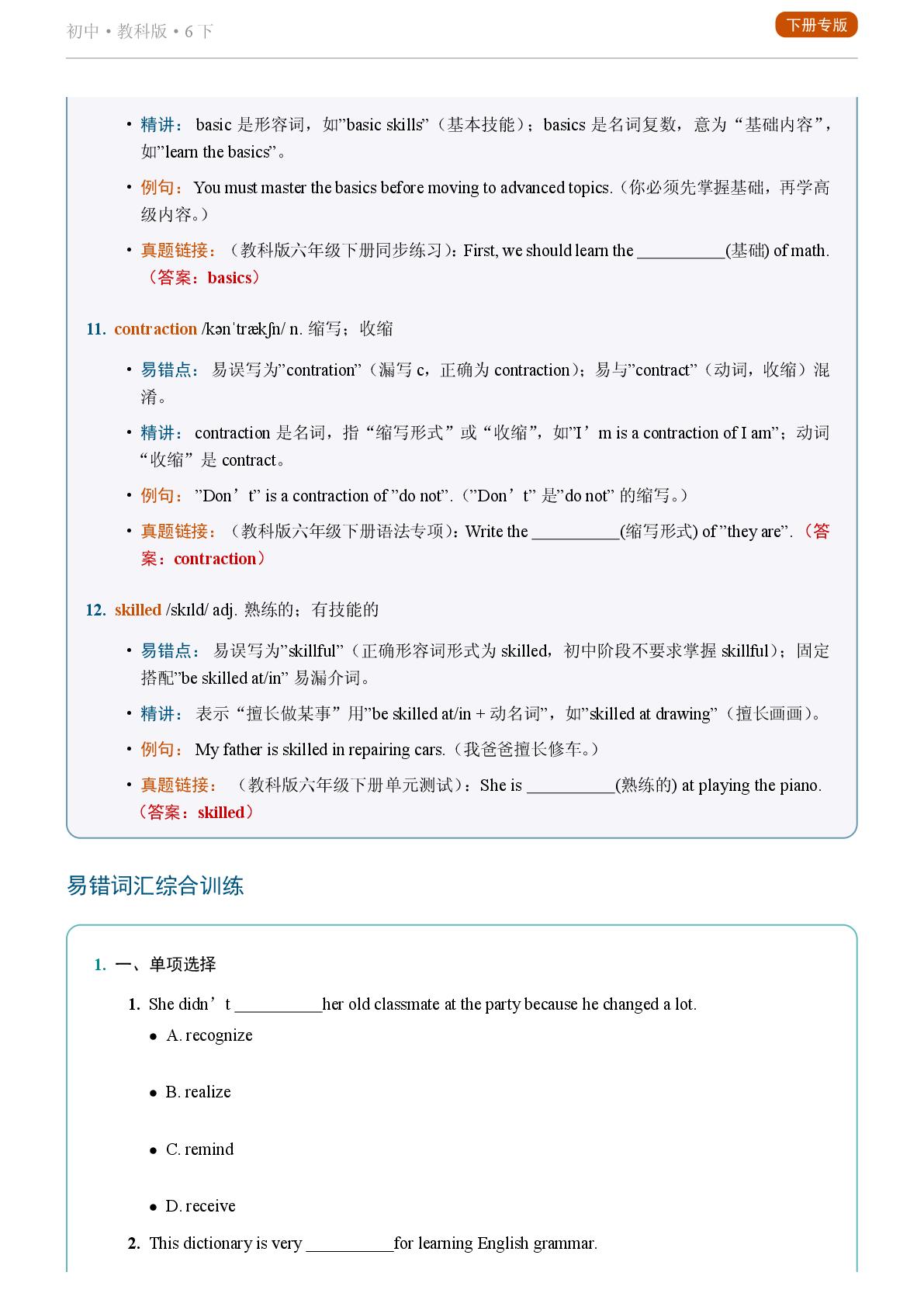
10.basics/'bersiks/n.基础:基本原理
·易错点:易误写为basic'”(形容词,基础的),忽略名词复数形式basics;易漏写s(basics表
示“基础知识”,必须用复数)。
初中·教科版·6下
下册专版
·精讲:basic是形容词,如basic skills”(基本技能):basics是名词复数,意为“基础内容”,
如'learn the basics”。
·例句:You must master the basics before moving to advanced topics.(你必须先掌握基础,再学高
级内容。)
·真题链接:(教科版六年级下册同步练习):First,.we should learn the
(基础曲of math.
(答案:basics)
11.contraction/kn'traek.[n/n.缩写;收缩
·易错点:易误写为”contration'”(漏写c,正确为contraction);易与”contract”(动词,收缩)混
淆。
·精讲:contraction是名词,指“缩写形式”或“收缩”,如T’m is a contraction of I am”;动词
“收缩”是contract。
·例句:Don’t”is a contraction of"do not'”.(Don’t”是”do not'”的缩写。)
·真题链接:(教科版六年级下册语法专项):Write the
(缩写形式)of”they are'”.(答
案:contraction)
12.skilled/skld/adj.熟练的;有技能的
·易错点:易误写为”skillful”(正确形容词形式为skilled,初中阶段不要求掌握skillful):固定
搭配be skilled at/in”易漏介词。
·精讲:表示“擅长做某事”用be skilled at//in+动名词”,如”skilled at drawing'”(擅长画画)。
·例句:My father is skilled in repairing cars.(我爸爸擅长修车。)
·真题链接:(教科版六年级下册单元测试):She is
(熟练的)at playing the piano
(答案:skilled)
易错词汇综合训练
1.一、单项选择
1.She didn't
her old classmate at the party because he changed a lot.
●A.recognize
·B.realize
●C.remind
·D.receive
2.This dictionary is very
for learning English grammar
初中·教科版·6下
下册专版
·A.useable
●B.useful
●C.useless
。D.using
3.My mother often
two hours cooking dinner for our family every day.
。A.takes
●B.costs
·C.spends
。D.pays
4.He didn't play computer games.He read a book
●A.instead
●B.instead of
●C.instead for
·D.instead with
5.It takes years to
a foreign language well.
●A.naster
●B.manage
●C.match
●D.mention
6.Asa
you should practice the basics every day.
。A.beginer
●B.beginner
。C.beginning
初中·教科版·6下
下册专版
·D.begins
7.We need to have a good
of English culture to learn the language better.
●A.understand
·B.understands
●C.understanding
●D.understood
8.Let's
a study group to help each other with English.
●A.organize
●B.orgnize
●C.organ
·D.organization
9.Learning to play the piano is a big
for me,but I will try my best.
·A.challenge
●B.chance
。C.change
。D.choice
10.You must learn the
of math before solving difficult problems.
●A.basic
●B.basics
·C.base
●D.bases
2.二、根据句意及汉语提示完成单词
1.He
(认出)his lost dog in the park yesterday.
2.This app is very
(有用的)to students who want to improve their English.
初中·教科版·6下
下册专版
3.My father
(half an hour reading newspapers every morning.
4.I don't like coffee.I'll have tea
(代替)
5.It is important to
(掌握)the basic skills of swimming.
6.She isa
(初学者)in playing the guitar,so she needs more practice
7.The teacher has a good
(理解)of the students'needs.
8.They plan to
(组织)a charity event next month
9.Climbing the mountain is a great
(挑战)for all of us.
10.You should learn the
(of English before learning advanced grammar
3.三、首字母填空
1.You need to r
the new words every day to remember them.
2.This book is u
for your study.You should read it.
3.My brother s
too much time playing video games last week
4.I didn't go to the cinema.I watched TV i
5.Tom
English,you need to practice speaking every day.
6.Asab
he should start with simple exercises
7.Her u
of the problem helped her solve it quickly.
8.They will o
a birthday party for their teacher.
9.The math exam is a c
for me,but I'll work hard.
10.The b
of any language is vocabulary and grammar.
4.四、用所给单词的适当形式填空
1.I didn't
(recognize)my old friend because he had changed a lot.
2.This tool is
(use)to farmers in their work
3.She
(spend)100 yuan on the new dress last week.
4.He walked to school instead of
(take)the bus
5.It'snot easy
(master)a foreign language in a short time
6.The
(begin)should follow the teacher's instructions carefully.
7.We need to improve our
(understand)of English literature.
8.They decided
(organize)a trip to the beach next Sunday.
9.Learning English is a
(challenge)task for many students.
初中·教科版·6下
下册专版
10.You must learn the
(basic)of cooking before making a big meal.
5.参考答案
·一、单项选择
1.A2.B3.C4.A5.A6.B7.C8.A9.A10.B
·二、根据句意及汉语提示完成单词
1.recognized 2.useful 3.spends 4.instead 5.master 6.beginner 7.understanding 8.organize 9.challenge
10.basics
·三、首字母填空
1recognize 2.useful 3.spent 4.instead 5.master 6.beginner 7.understanding 8.organize 9.challenge
10.basics
·四、用所给单词的适当形式填空
1.recognize 2.useful 3.spent 4.taking 5.to master 6.beginner 7.understanding 8.to organize 9.challeng-
ing 10.basics
资源预览图

1

2

3
4

相关资源
由于学科网是一个信息分享及获取的平台,不确保部分用户上传资料的 来源及知识产权归属。如您发现相关资料侵犯您的合法权益,请联系学科网,我们核实后将及时进行处理。