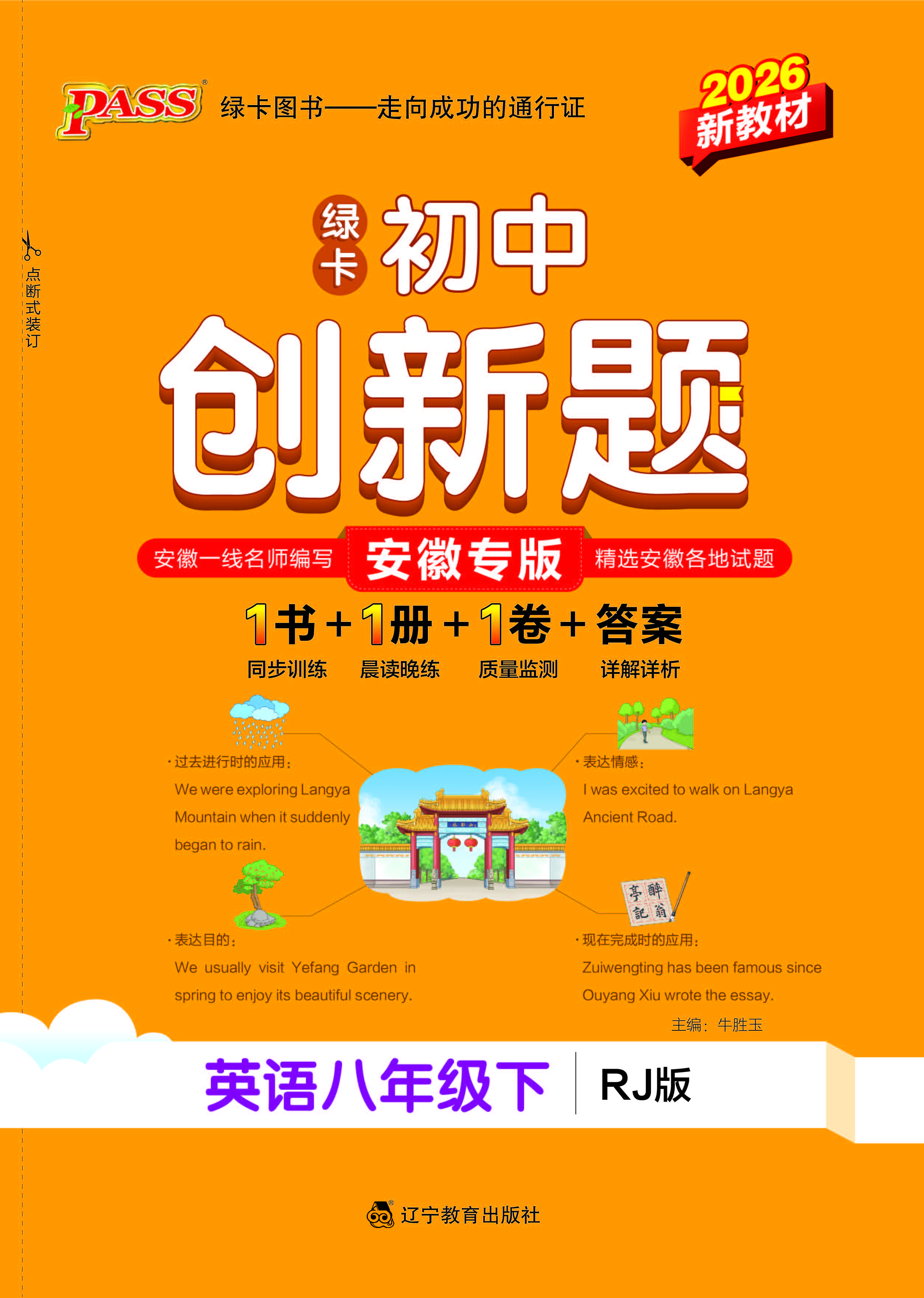
Unit 1 Section A (3a-3d)-【绿卡初中创新题】2025-2026学年八年级下册英语习题课件(人教版·新教材) 安徽专版
2026-01-17
|
19页
|
49人阅读
|
0人下载
教辅
资源信息
| 学段 | 初中 |
|---|---|
| 学科 | 英语 |
| 教材版本 | 初中英语人教版八年级下册 |
| 年级 | 八年级 |
| 章节 | 3a-3d |
| 类型 | 课件 |
| 知识点 | - |
| 使用场景 | 同步教学-新授课 |
| 学年 | 2026-2027 |
| 地区(省份) | 安徽省 |
| 地区(市) | - |
| 地区(区县) | - |
| 文件格式 | PPTX |
| 文件大小 | 2.08 MB |
| 发布时间 | 2026-01-17 |
| 更新时间 | 2026-01-17 |
| 作者 | 山东绿卡教育科技有限公司 |
| 品牌系列 | 绿卡创新题·初中系列 |
| 审核时间 | 2026-01-17 |
| 下载链接 | https://m.zxxk.com/soft/55990556.html |
| 价格 | 2.00储值(1储值=1元) |
| 来源 | 学科网 |
摘要:
该初中英语课件围绕Unit 1 "Time to Relax" Section A (3a—3d)展开,聚焦放松主题相关词汇、句型及语用能力。通过俗语运用(如“A journey of a thousand li begins with a single step”)、地域特色素材(如Huizhou ink)导入,连接词汇拼写、单项填空等基础练习与补全对话、完形阅读等提升训练,搭建从语言输入到输出的学习支架。
其亮点在于融合文化意识与语言能力培养,如单项填空中的“Huizhou ink”地域文化题、句子翻译中的“亳州古城”情境,帮助学生在语言学习中理解文化内涵。通过分层练习(基础单词拼写、提升完形阅读)和逻辑推理题(如补全对话语境分析),提升学生思维品质与语言运用能力。学生能在文化浸润中夯实基础、提升语用,教师可借助分层资源实现针对性教学,提高课堂效率。
内容正文:
2
Unit 1 Time to Relax
Section A (3a—3d)
3
练基础
练提升
目 录
4
练基础
Ⅰ. 根据首字母及汉语提示,完成下列单词的拼写
1. [俗语运用]A journey of a thousand li begins with a s________(单个的) step.
2.(吉林中考改编)Su Shi has a great influence on people because of his p________(诗).
3. There is a three-year program across China to help people m________(管理) their weight.
4. —If you clean your room, I’ll make a pie.
—That’s a d________(交易), Mum! I can do it!
5. The giant panda r________(回来)to its home in Beijing Zoo last week.
ingle
oems
anage
eal
eturned
目 录 导 航
Ⅱ
Ⅲ
Ⅳ
Ⅴ
Ⅵ
Ⅰ
5
Ⅱ. 单项填空
6. —Why do you love Chinese calligraphy?
—Its beautiful _____ bring peace to my heart.
A. shoots B. strokes C. speeches D. sentences
7. [地域特色]Huizhou _____ is famous for its excellent quality in painting.
A. tip B. stick C. oil D. ink
8. My grandpa always tells me not to _____ every time I fail.
A. meet up B. drop off C. give up D. hang up
B
D
C
目 录 导 航
Ⅱ
Ⅲ
Ⅳ
Ⅴ
Ⅵ
Ⅰ
6
9. In China, the bat is a symbol of happiness because the Chinese _____ “蝠” sounds like “福”.
A. character B. literature C. researcher D. disaster
10. —_____
—I am using a new learning app on my phone.
A. What do you do? B. What are you up to?
C. When do you use an app? D. How was your weekend?
A
B
目 录 导 航
Ⅱ
Ⅲ
Ⅳ
Ⅴ
Ⅵ
Ⅰ
7
Ⅲ. 根据汉语意思完成句子或翻译句子
11. 上周我花了一天时间探索亳州古城。
I _______ a day _________ Bozhou Ancient City last week.
12. 对别人微笑,你也会收到微笑作为回报。
Smile at others, and you will receive smiles ________ ________.
13. 你能告诉我怎么做饭吗?
Could you tell me ________ ________ ________?
14. 睡前喝些温牛奶是个好主意。
It’s a great idea ________ ________ some warm milk before going to bed.
spent
exploring
in
return
how
to
cook
to
drink
目 录 导 航
Ⅱ
Ⅲ
Ⅳ
Ⅴ
Ⅵ
Ⅰ
8
15. 第一步总是最难的。
_____________________________________________________________________
The first step is always the hardest/most difficult.
目 录 导 航
Ⅱ
Ⅲ
Ⅳ
Ⅴ
Ⅵ
Ⅰ
9
练提升
Ⅳ. 补全对话
A: Hey Chen Jie. 16. _____
B: Hi, Li Qing. I am watching the sky with my telescope(望远镜). I am interested in science.
A: 17. _____
B: On my sixth birthday, my dad bought me a telescope, and I started watching the sky.
A
D
目 录 导 航
Ⅱ
Ⅲ
Ⅳ
Ⅴ
Ⅵ
Ⅰ
10
A: That’s cool! Did your hobby cause any problems for your schoolwork?
B: 18. _____ Once, I missed a maths test because I stayed up late to study comets(彗星).
A: 19. _____
B: I finish homework first and then spend an hour studying stars every day.
A: Do your parents help you with your interests?
B: 20. _____
A: That’s really helpful.
B
G
E
目 录 导 航
Ⅱ
Ⅲ
Ⅳ
Ⅴ
Ⅵ
Ⅰ
11
Ⅴ. 完形填空
My mother was an artist. I could draw a little and I really enjoyed 21 . But I couldn’t draw as well as she did.
Once, I drew at a desk and asked her how I could improve. I 22 her to say something like “Practise for 10,000 hours and never give up”, but she only said, “Look at the things you want to draw.” Hearing her 23 , I thought she was wrong because I did exactly the same thing.
“You probably didn’t,” she explained. “ 24 , people seldom look at things carefully. They just 25 them quickly and then depend on their brains(大脑) to
目 录 导 航
Ⅱ
Ⅲ
Ⅳ
Ⅴ
Ⅵ
Ⅰ
12
imagine all the small 26 they miss. However, the brain fails, leading to 27 0 drawing.” Then I went to the kitchen to get an apple. When I 28 to the desk, I did as she told me, and looked long and hard at the object(物品) I wanted to draw: a 29 apple. I paid more attention to its details. I drew each part carefully and
30 to draw a good picture.
I loved the experience. It taught me to see something deeply and draw it carefully.
目 录 导 航
Ⅱ
Ⅲ
Ⅳ
Ⅴ
Ⅵ
Ⅰ
13
21. A. drawing B. dancing C. writing D. singing
22. A. told B. wished C. helped D. expected
23. A. jokes B. problems C. plans D. words
24. A. Actually B. Finally C. Suddenly D. Especially
25. A. look after B. look at C. look for D. laugh at
26. A. tools B. guides C. parts D. notes
27. A. poor B. special C. amazing D. new
28. A. added B. attended C. connected D. returned
29. A. sour B. single C. delicious D. sweet
30. A. failed B. offered C. forgot D. managed
A
D
D
A
B
C
A
D
B
D
目 录 导 航
Ⅱ
Ⅲ
Ⅳ
Ⅴ
Ⅵ
Ⅰ
14
Ⅵ. 阅读理解
What do you often do in your free time? Here are three teenagers’ answers.
I often use old clothes to make bags. I set up a website(网站) to sell the bags online. I also put them in my mother’s shop. Many customers think they are wonderful and buy them. Now I plan to write a new book on how to use old clothes.
—Maria from Russia
▲ The tea museum in Anhui is my favourite.I learn about the history of tea in this museum. I watch the tea art performances(表演). They show how to make a perfect cup of tea with tea sets.
—Lele from China
目 录 导 航
Ⅱ
Ⅲ
Ⅳ
Ⅴ
Ⅵ
Ⅰ
15
I often cook Chinese food at home when I am free. I can make dumplings and stir-fried eggs and tomatoes. My favourite is Yunnan Rice Noodles. To make the food, we need rice noodles, chicken soup, vegetables and eggs. My parents also cook Chinese food, especially Gongbao chicken.
—Angela from France
31. How many ways does Maria use to sell the bags?
A. One. B. Two. C. Three. D. Four.
B
目 录 导 航
Ⅱ
Ⅲ
Ⅳ
Ⅴ
Ⅵ
Ⅰ
16
32. [句子还原]Which of the following can be the best to fill in “ ▲ ” in Paragraph 3?
A. I often go to the bookshop. B. I like my tea set.
C. Museums often teach me a lot. D. I know nothing about tea.
33. What can we learn from the text?
A. The three teenagers are from different countries.
B. Maria wants to be a designer.
C. Lele enjoys visiting the art museum.
D. Angela’s parents don’t like Chinese food.
C
A
目 录 导 航
Ⅱ
Ⅲ
Ⅳ
Ⅴ
Ⅵ
Ⅰ
17
34. What is the text mainly about?
A. The sales for teenagers.
B. Performances for teenagers.
C. Teenagers’ housework at home.
D. Teenagers’ free-time activities.
D
目 录 导 航
Ⅱ
Ⅲ
Ⅳ
Ⅴ
Ⅵ
Ⅰ
18
19
$
资源预览图

1

2

3

4

5

6
相关资源
由于学科网是一个信息分享及获取的平台,不确保部分用户上传资料的 来源及知识产权归属。如您发现相关资料侵犯您的合法权益,请联系学科网,我们核实后将及时进行处理。