Unit 9 Section Ⅰ Topic talk & Lesson1(教用Word)-【金榜题名】2025-2026学年高一英语必修第三册高中同步学案(北师大版)
2026-04-15
|
32页
|
35人阅读
|
0人下载
教辅

资源信息
| 学段 | 高中 |
|---|---|
| 学科 | 英语 |
| 教材版本 | 高中英语北师大版必修第三册 |
| 年级 | 高一 |
| 章节 | Topic Talk,Lesson 1 Active Learning |
| 类型 | 教案-讲义 |
| 知识点 | - |
| 使用场景 | 同步教学-新授课 |
| 学年 | 2026-2027 |
| 地区(省份) | 全国 |
| 地区(市) | - |
| 地区(区县) | - |
| 文件格式 | DOCX |
| 文件大小 | 951 KB |
| 发布时间 | 2026-04-15 |
| 更新时间 | 2026-04-15 |
| 作者 | 梁山启智教育图书有限公司 |
| 品牌系列 | 金榜题名·高中同步学案 |
| 审核时间 | 2026-01-09 |
| 下载链接 | https://m.zxxk.com/soft/55856187.html |
| 价格 | 4.00储值(1储值=1元) |
| 来源 | 学科网 |
摘要:
本讲义围绕高中英语阅读策略与主动学习能力培养,系统梳理开启读书之旅的实操步骤、重点词汇(如approach, reflect, argue)、核心短语(如brush up on, end up doing)及关键句型(如as引导状语从句、if not省略结构),构建从阅读实践到语言知识再到学习策略的完整学习支架。
该资料以提升语言能力为基础,通过具体阅读步骤指导(如选书、营造环境)培养学生理解与表达能力,结合主动学习策略(提问、质疑、反思)发展思维品质,词汇句型的归纳拓展及即学活用练习强化学习能力。课中辅助教师高效授课,课后助力学生自主复习、查漏补缺,实现语言技能与学习素养的协同提升。
内容正文:
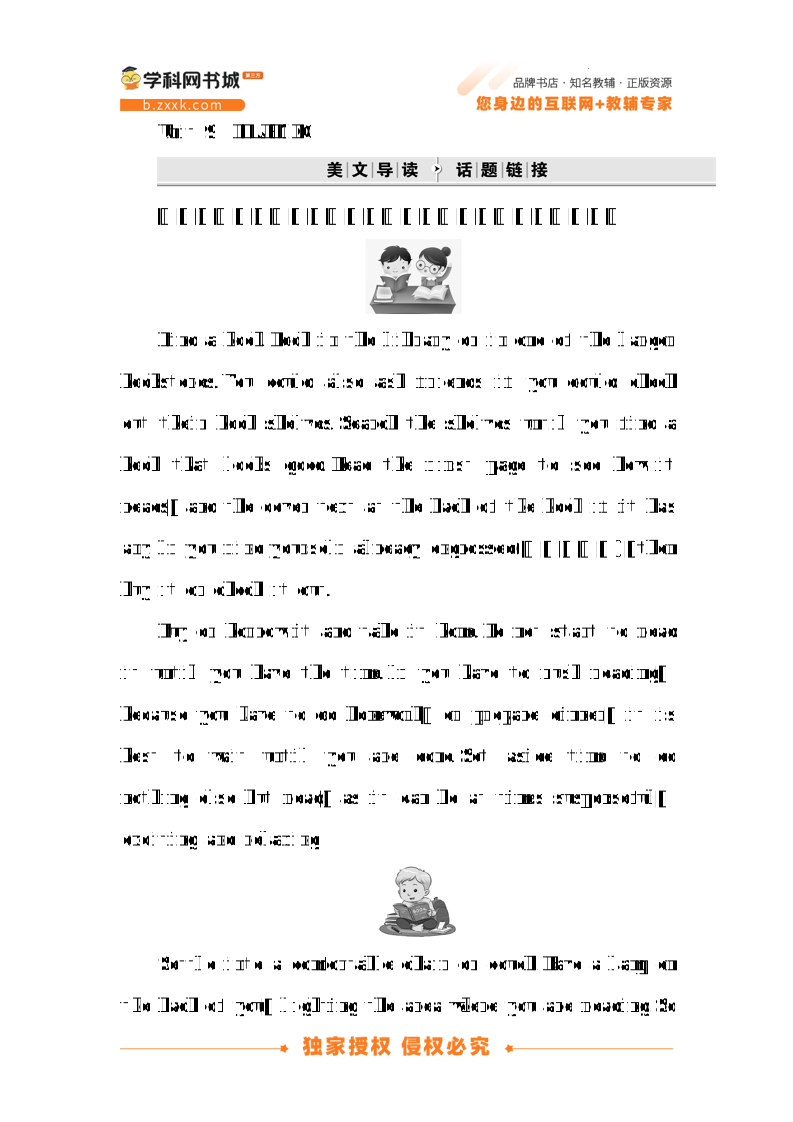
书是人类最好的朋友,但是你知道如何开启读书之旅吗?
Find a book.Look in the library or in one of the larger bookstores.You could also ask friends if you could check out their book shelves.Search the shelves until you find a book that looks good.Read the first page to see how it reads,and the cover text at the back of the book if it has any.If you find yourself already engrossed(全神贯注的),then buy it or check it out.
Buy or borrow it and take it home.Do not start to read it until you have the time.If you have to rush reading,because you have to do homework,or prepare dinner,it is best to wait until you are done.Set aside time to do nothing else but read,as it can be at times suspenseful,exciting and relaxing.
Settle into a comfortable chair or couch.Have a lamp on the back of you,lighting the area where you are reading.So that you do not have to get up soon after starting to read,make sure you have brought coffee,candy,popcorn,or any other refreshments you might want to have.Make sure the television is off and anything that could distract you is attended to.Take the phone off the hook,put earplugs in or ear defenders on.Get warm if you're going to be sitting still for a few hours.
Be calm and alert.You should be alert and your mind should be calm before you begin to read.Otherwise,your mind will wander.
Start the book by turning the pages.Do not think about anything else,but what you're reading.Put yourself into the action or location within the story.Once you get totally engrossed,it will be difficult to put the book down.
Read and really enjoy it.Reading is not running your eyes over a book.Read it actively and enjoy it completely.However,if you need to,read out the book fast,then you do not need to pay attention to every word.
根据短文内容回答下面的问题。
1.Why should you read a book unless you set aside time to do nothing but read?
答案:Because it can be at times suspenseful,exciting and relaxing.
2.Why should you be calm and alert when reading?
答案:Because your mind will wander.
Section Ⅰ Topic talk & Lesson 1
Ⅰ.重点单词
基础单词
1.approach n.方法
2.geometry n.几何(学)
3.partner n.搭档,同伴
4.assume vt.认为;假定,假设
5.automatic adj.自动的;无意识的
6.inner adj.内部的
7.outer adj.外部的,外面的
8.flexible adj.灵活的,可变通的
9.dinosaur n.恐龙
10.data n.资料;数据
拓展词汇
1.reflect vi.&vt.思考;映射;反射;思考→reflection n.反射;反映;映像
2.argue vi.争论→argument n.争吵,争论
3.promote v.促进,增进;晋升,提升→promotion n.晋级;增进
4.unlikely adj.不可能的→likely adj.可能的
5.exist vi.存在;生存→existence n.存在;生存
6.ignore v.忽视;不理;不管→ignorance n.无知;愚昧→ignorant adj.愚昧的,无知的
7.impression n.印象→impress vt.使印象深刻;使铭记→impressive adj.给人深刻印象的;感人的
Ⅱ.重点短语
1.learning process 学习过程
2.brush up (on) 温习,复习
3.reflect on 思考
4.argue with 争吵
5.be flexible in your opinions
灵活表达你的观点
6.end up doing 以做……而结束
7.in short 总之;简言之
8.find the truth 发现真相
9.get in the way 妨碍,阻碍
10.cannot help doing sth.
禁不住做某事
11.at the heart of... 在……的中心
12.be based on 以……为根据
Ⅲ.重点句型
1.As引导的方式状语从句
[仿写] 我希望别人怎样对待我,我就会怎样对待他们。
I'll behave toward them as I would like to be treated.
2.If not 省略结构
[仿写] 如果你喜欢,就去做吧! 如果不喜欢,就算了吧。
If you like it,just do it!If not,forget it!
3.It is true that...
[仿写] 也许这是真的,直到我们失去自己所拥有的东西时,才会认识到它的珍贵。
Maybe it is true that we do not know what we have got until we lose it.
Ⅰ.Look at the following pictures and discuss what active learners do.
a.
b.
c.
答案:a.Answer questions actively.
b.Ask questions.
c.Take notes.
Ⅱ.Look at the pictures and the title and predict what the text is probably about.
答案:The text is mainly about active learning and how to take an active role in learning.
Ⅰ.Read the text and match the main idea with each paragraph.
Para.1 A.Ask questions.
Para.2 B.Get to the truth.
Para.3 C.Listen to the outer voice.
Para.4 D.Focus on the message.
Para.5 E.Argue with your inner voice.
Para.6 F.What is active learning?
答案:Para.1-F Para.2-C
Para.3-E Para.4-A
Para.5-B Para.6-D
Ⅱ.Read the text carefully and choose the best answers.
1.Most people believe that .
A.we need to train ourselves to be better
learners
B.the human brain learns all by itself
C.we need to actively take part in the learning process
D.it isn't always true that the human brain is set to be “automatic”
2.How many suggestions are given in the text to take an active role in learning?
A.Five. B.Four.
C.Three. D.Six.
3.Which one is the easiest way to promote active learning?
A.Listening to the outer voice.
B.Arguing with your inner voice.
C.Asking questions.
D.Getting to the truth.
4.What can we learn from the text?
A.The outer voice expresses your personal opinions.
B.Active learners focus on what their brain is saying in the background.
C.Active learners accept everything they learn.
D.Active learners don't judge people based on first impressions or personal feelings.
答案:1.B 2.A 3.C 4.D
Ⅲ.Read the text and then fill in the form below.
Suggestions
Learning process
Listen to the
outer voice
The outer voice tells you about opinions from ①what you hear or read.Active learners are openminded and ②focus on what the speaker/writer is saying,not on what their brain is saying in the background.
Argue with your
inner voice
When your inner voice tells you a speaker/writer is wrong,③think about why the speaker/writer may be right.Be flexible in your opinions and you might end up ④agreeing with the speaker/writer after all.If not,at least you have “listened to” another point of view.
Ask questions
When you ⑤get information from someone,from books or the Internet,ask two,three,even five questions about the topic.The very act of ⑥working out questions will help you to achieve a higher level of understanding about the topic.
Get to the truth
Active learners don't accept everything they learn.They ⑦attempt to find the truth ⑧at the heart of each idea.Even when an idea sounds entirely unlikely,there may be an aspect of it that is based on truth.
续表
Focus on the
message
Active learners do not judge people based on ⑨first impressionsor personal feelings.Instead,they separate the message ⑩from the messenger.
Complete the passage according to the text.
Anyone can be an active learner if he/she trains automatically.Active learners don't pay too much attention 1.to the inner voice because it can stop them from fully 2.understanding(understand) what they're hearing or reading.To be 3.an active learner,you can also react to your inner voice,for example,arguing with your inner voice,and questioning your point of view.Ask as many 4.questions (question) as you can because the answers will lead you 5.to further learning,and the way of 6.working(work) out questions will help you 7.to achieve (achieve) a higher level of understanding about the topic.Don't accept everything you learn and try to find the 8.truth(true) at the heart of each idea so you can understand why people believe this.Finally,don't let your feelings get in the way when you're learning.Even if you cannot help 9.disliking(dislike) some people,you may still be able to learn 10.from them.
1.approach n.方法;途径;接近;接洽
v.靠近;接近;接洽
(教材P50)What is your learning approach to it?
你的学习方法是什么?
[归纳拓展]
at the approach of 在……快到的时候
an approach to doing sth.(做某事)的方法
be approaching 快到了
approach sb.on/about sth.
就某事与某人洽谈(商量、交涉)
[语境感悟]
I couldn't see Don, but as I approached the tractor he jumped out onto the road.
我没看到唐,但是当我靠近拖拉机时,他跳到了路上。
Upon approaching the house, I noticed my dad and mom standing beside the old truck, looking sad.
一走近房子,我就注意到我爸爸和妈妈站在旧卡车旁边,看起来很悲伤。
With the approach of winter the weather became colder.
随着冬天的临近,天气变得更冷了。
The path serves as an approach to the boat house.
这条小路通往船屋。
[名师点津]
表达“(做)某事的方法”有:the approach to(doing) sth./the way to do/of (doing) sth./the means of(doing) sth./the method of(doing) sth.
[即学活用]
(1)单句语法填空
①His approach to rice breeding(培育)also serves as a solution to food problems around the globe.
②They've taken a very cautious approach to handling(handle) the problem.
(2)完成句子
③Approaching the city center, we saw a stone statue of about 10 meters in height.
接近市中心时,我们看到了一座大约十米高的石雕。
④With the approach of his turn to perform, he felt his heart pounding heavily.
马上要到他表演了,他感到心怦怦直跳。
2.brush up (on)温习;复习
(教材P108)But I still need to brush up on some language points.
但是我还需要温习一些语言点。
[归纳拓展]
brush up against 轻轻触到;遇到
brush away 刷去
brush off 刷掉;不理; 漠视
[语境感悟]
I'll have to brush up my English before I go abroad.
出国前我要温习一下英语。
She never loses heart when she brushes up against setbacks.
她遭受挫折时从不灰心。
I had to brush away the tears from my eyes.
我的双眼涌满泪花,我只好赶紧擦掉。
No Chinese person can brush off that disgrace history.
没有一个中国人能洗刷掉那段屈辱的历史。
[即学活用]
完成句子
①He said he had to brush up on his history before the examination.
他说他得在考试前复习历史。
②He has brushed up against trouble recently.
最近他碰到了麻烦。
③I use one of my son's old toothbrushes and warm water to brush away the dust on the coat.
我用我儿子的一把旧牙刷和温水刷去大衣上的灰尘。
④Mud brushes off easily when it is dry.
泥巴干了容易刷掉。
3.reflect vi.& vt.仔细思考;表达(意见);反映
(教材P52)to reflect on 反思
[归纳拓展]
reflect on 思考
be reflected in 映在……中
reflect...from... 从某物表面反射(光、热、声等)
[语境感悟]
Their responses to the questions reflected their true belief that “I can see you only if you can see me, too.”
他们对问题的回答反映了他们的真实想法:“如果你也能看到我,我就能看到你。”
As the small boat moved gently along the river he was left speechless by the mountains being silently reflected in the water.
当小船沿着河轻轻移动时,群山在水中的沉默倒影使他说不出话来。
She was left to reflect on the implications of her decision.
由她负责考虑她这个决定会牵扯哪些问题。
She decided on reflection to accept his offer after all.
经过审慎的思考,她决定还是接受他的提议。
[即学活用]
(1)单句语法填空
①The start of a new year is a good time to reflect on the many achievements of the past.
②She could see her face reflected(reflect) in the water.
③This film is a real reflection(reflect) of the living conditions of people in the western region.
(2)完成句子
④People's lifestyles are reflected in languages.
人们的生活方式反映在语言上。
⑤The passage can be seen as the author's reflections upon a particular life experience.
这篇文章可以被看作是作者对于一次特殊的生活经历的反思。
4.argue vi.争吵,争论
(教材P52)Argue with your inner voice
与内心的声音争辩
[归纳拓展]
argue with 争吵
argue for 为……而争论;
为……而辩护;赞成
argue against 辩驳,反对
argue with sb.about/over sth.
与某人争辩某事
argue sb.into doing sth.
说服某人做某事
[语境感悟]
The mental health benefits from music can't be argued.
音乐对心理健康的好处是不容置疑的。
The committee is concerned about players' behaviour, especially arguing with referees.
委员会很关注运动员们的行为,特别是与裁判争吵的行为。
Scientists have been arguing for decades about whether the moon contains significant quantities of water.
几十年来,科学家们一直在争论月球上是否存在大量的水。
After some heated argument a decision was finally made.
激烈辩论以后终于做出了决定。
[即学活用]
(1)语法填空
①What I'm going to try to do in this class is argue for those views.
②They're always arguing(argue)with their parents about money.
③I've made this argument(argue), and not a few people would disagree with me.
(2)完成句子
④He was upset because his mother argued against his choice(反对他的选择).
⑤It is beyond argument(无可争辩) that there are still millions of people leading a hard life with hunger and coldness.
5.assume vt.认为;假定,假设
(教材P52)Most people assume that the human brain is set on “automatic”...
大多数人认为人的大脑是“自动”运行的……
[归纳拓展]
assume sb./sth.to be 假定/假设某人/某事为……
It is assumed that... 被认为……
assuming(that)... 假设/假定……
[语境感悟]
They were much stronger than modern humans, but it's long been assumed that human ancestors were smarter than the Neanderthals.
他们(尼安德塔人)比现代人强壮得多,但长期以来人们都认为人类祖先比尼安德塔人更聪明。
Assuming (that)he's still alive, how old would he be now?
假定他还活着,现在有多大年纪了?
You would be making an assumption that's not based on any fact that you could report.
你会做出不以你能报道的任何事实为依据的一种假设。
[即学活用]
(1)单句语法填空
①It is generally assumed that stress is caused by too much work.
②Scientists worked on the assumption(assume) that Cholera was spread by the germs.
(2)完成句子
③It is assumed that a student's daily life is as important as his learning experience.
人们认为一个学生的日常生活和他的学习经验一样重要。
④We assumed him to be the best writer of our time.
我们本以为他是这个时代最好的作家。
⑤Assuming that all the equipment is available, the next step is to install it.
假如所有的设备都是可用的,下一步就是安装它。
6.end up doing sth.以做某事而告终
(教材P53)Be flexible in your opinions and you might end up agreeing with the speaker/writer after all.
灵活处理你的意见,毕竟你最终可能会同意说话人或者作者的观点。
[归纳拓展]
end up with 以……结束(后接表具体事物的名词)
end up in 以……结束(后接表抽象概念的名词及地点名词)
end up as 最终成为……(后接表职位或身份的名词)
[语境感悟]
Our game always ends up in a quarrel.
我们总是以吵闹结束比赛。
He ended up as the head of the company.
他最后成为这家公司的老板。
If he carries on driving like that,he'll end up dead.
他如果继续照那样开车的话,早晚得死于非命。
[即学活用]
完成句子
①I ended up spending the night in the airport.
我结果是在机场过的夜。
②You'll end up in failure if you don't follow my advice.
如果你不听我的建议,你最终会失败的。
③She ended up her speech with a short poem.
她朗诵了一首小诗结束了她的演讲。
7.in short 总而言之;简单地说
(教材P53)In short:Do not stop being curious.
简而言之:一定要始终保持好奇心。
[归纳拓展]
be short for 为……的缩写/简称
be short of 缺乏;不足
for short 作为简称
[语境感悟]
In short,Internet voting,to some extent,is unfair,if immoral,and cannot be trusted.
总之,网络投票,如果操作不道德的话,在一定程度上是不公平的而且不能被信任。
In short,we must be prepared.
总而言之,我们要有准备。
We are short of hands.
我们缺少人手。
[即学活用]
用适当的介词填空
①My name is Thomas,and you can call me Tom for short.
②The usual word “pub” is short for “public house”.
③According to some scientists,we'll be short of energy in the near future.
④In short,we can't please everyone all the time.
8.impression n.印象;感想
(教材P53)Active learners do not judge people based on first impressions or personal feelings.
主动学习者不会根据第一印象或个人感受来判断一个人。
[归纳拓展]
leave/make an impression on sb.
给某人留下的印象
have a(n)...impression of...
对……有……印象
be under the impression that...
以为……;(通常指)误认为……
[语境感悟]
The experience left/made an unforgettable impression on me,which is of great significance to my growth.
那次经历给我留下了难以忘怀的印象,对我的成长有很大的意义。
I have a very good impression of him from the first.
他一开始就给我留下了很好的印象。
I was under the impression that we would have a good holiday,but it has been raining these days.
我原以为我们会有一个愉快的假期,但是近来老是下雨。
[即学活用]
完成句子
①All this left a deep impression on his young heart.
这一切给他那颗年轻的心留下了深刻的印象。
②I know you have a good impression of Tom,and Tom always thinks well of you.
我知道你对汤姆印象很好,汤姆对你的看法也很好。
③He was under the impression that they had become friends.
他误认为他们已经是朋友了。
9.attempt to尝试;试图
(教材P53)They attempt to find the truth at the heart of each idea.
他们努力从每个观点最核心的地方寻找真相。
[归纳拓展]
attempt at doing sth.
努力做某事;企图做某事
make an attempt to do sth.试图做某事
at the first attempt第一次尝试
[语境感悟]
He attempted to leave but was stopped.
他试图要走,但被拦住了。
The boys made an attempt to leave for camping but were stopped by their parents.
男孩子们想去野营但被他们的父母们拦住了。
He was as proud as a peacock when he passed his driving test at the first attempt.
他第一次尝试就通过了驾驶考试,因而得意洋洋。
[即学活用]
(1)单句语法填空
①Every time I attempted to persuade(persuade) her,I failed completely.
②Not many people can answer this question at the first attempt.
③He made an attempt to win(win) the first prize.
(2)一句多译
④我试图让她相信他是诚实的,但是徒劳无果。
A.I've made an attempt to convince her of his honesty,but in vain.
B.I've attempted to convince her of his honesty,but in vain.
C.I have tried to convince her of his honesty,but in vain.
10.be based on以……为根据
(教材P53)Even when an idea sounds entirely unlikely,there may be an aspect of it that is based on truth.
即使一个想法听起来完全不可能,但是它可能有一个方面是基于事实的。
[归纳拓展]
base...on/upon把……建立在……的基础上
at the base of以……为基点;在……的底部
[语境感悟]
Edison based his ideas on scientific experiment.
爱迪生的想法是建立在科学实验的基础上的。
The report is based entirely on facts.
这篇报道完全以事实为根据。
The camp was located at the base of the mountain.
那个营地位于那座山脚下。
[即学活用]
完成句子
①The story is based on real life.
那故事是根据现实生活而写的。
②You should base your opinion on facts.
你的意见都要以事实为根据。
③We live at the base of the atmosphere.
我们生活在大气的底部。
1.(教材P53)If you find your inner voice difficult to control,you can argue with it as most active learners do.
如果你发现自己内心的声音难以控制,你可以像大多数积极的学习者一样与之争辩。
[句式分析] 句中as引导方式状语从句。
(1)引导方式状语从句,意为“如同;按照……的方式”。
①When in Rome, do as the Romans do.
[谚语] 入乡随俗。
②Will you please do the experiment as I am doing?
请你按我的方法做这个实验好吗?
(2)引导时间状语从句,意为“随着……;当……的时候”。
③You will grow wiser as you grow older.
随着年龄增长你会变得越来越聪明。
(3)引导原因状语从句,“因为,由于”。
④She may need some help as she is new here.
她可能需要一些帮助,因为她是新来的。
(4)引导让步状语从句,“虽然,尽管”。
⑤Old as he is,he still jogs every day.
尽管他上了年纪,仍然每天慢跑。
[即学活用]
完成句子
①Just as I got to the school gate,I realized I had left my book in the bookstore.
当我到达校门口时,我意识到我把书忘在书店了。
②As an old saying goes,it is never too old to learn.
正如那句老话:活到老,学到老。
③Hard as he worked,he still failed to make both ends meet.
他尽管努力工作,仍未能做到收支平衡。
④I was watching the clock all through the meeting,as I had a train to catch.
我开会的时候一直在看表,因为我要赶火车。
2.(教材P53)If not,at least you have “listened to” another point of view.
如果不是这样的话,至少你听过另一种观点。
[句式分析] 句中If not为固定省略结构,意为“如果不是这样的话”。
[归纳拓展]
if so 假如这样的话
if any 即使有(任何)……,即使有……
if ever (即使有……也)极少,难得
if necessary 如果有必要的话
if possible 如果可能的话
[语境感悟]
①They think she may try to phone.If so,someone must stay here.
他们认为她可能来电话。要是这样的话,就得有人守在这儿。
②There are few people nowadays,if any,who remember him.
当今记得他的人,如有的话,也不多了。
③If possible,let me know beforehand.
如果可能,可在事前通知我。
④He seldom,if ever,goes to the movies by himself.
他不会,即使有也很少,单独去看电影的。
[即学活用]
完成句子
①If so,please respond to me as quickly as possible.
如果是这样的话,请尽快给我回信。
②I might see you tomorrow.If not,then it'll be Saturday.
我可能明天去看你。如果不是明天,那就在周六。
③The climate here is quite pleasant,the temperature rarely,if ever,reaching 30 ℃ in summer.
这里的气候宜人,如果曾经有,在夏季气温极少达到30摄氏度。
④If possible,I wish to go there next summer.
如果可能,我希望明年夏天去。
⑤If necessary,ring me at home.
如果必要,可往我家里打电话。
Ⅰ.单词拼写
1.It is not something outside; it is an inner(内部的)growth.
2.It can promote(促进)understanding between us and others.
3.He thought that if he couldn't see something,it didn't exist(存在).
4.The study was based on data(数据) from 2,100 women.
5.The intelligence,age and methods of study should not be ignored(忽视) as well.
6.The situation is unlikely(不大可能的) to change in the near future.
7.What if we were more flexible(灵活的)with what we could do with our time?
8.List the names of some types of dinosaurs(恐龙) you know of.
9.For most of us breathing is automatic(自动的).
10.Imagine that you and I go in outer(外部的) space.
Ⅱ.单句语法填空
1.What questions does the text make you reflect on?
2.But his assumption(assume) proved to be wrong.
3.If no one helps him he may end up being(be) a beggar.
4.You can actively argue with your mind.
5.What was your first impression (impress) of her?
6.In short,it is important that we do not give up when working towards our goals.
7.I love what I do.If not,I would force myself to.
8.It is true that the project was completed just in one year.
9.Choosing the subject is based(base) on this background.
10.As time went(go) by,we knew more and more about ourselves.
Ⅲ.完成句子
1.I reflected on(思考) this proposal for some time.
2.In short (总而言之),we live in an age of challenges.
3.We shall attempt to (尝试) answer it in this book.
4.All of the work we do is based on(以……为基础) science.
5.Do not argue with(争吵) the person if he/she disagrees with you.
学科网(北京)股份有限公司
$
资源预览图
1
2
3
相关资源
由于学科网是一个信息分享及获取的平台,不确保部分用户上传资料的 来源及知识产权归属。如您发现相关资料侵犯您的合法权益,请联系学科网,我们核实后将及时进行处理。