Unit 1 The media三-2025-2026学年高中英语必修第三册期末词汇复习(沪教版)
2025-12-29
|
10页
|
38人阅读
|
0人下载

资源信息
| 学段 | 高中 |
|---|---|
| 学科 | 英语 |
| 教材版本 | 高中英语沪教版必修第三册 |
| 年级 | 高一 |
| 章节 | Unit 1 The media |
| 类型 | 题集-专项训练 |
| 知识点 | 词汇 |
| 使用场景 | 同步教学-期末 |
| 学年 | 2025-2026 |
| 地区(省份) | 全国 |
| 地区(市) | - |
| 地区(区县) | - |
| 文件格式 | |
| 文件大小 | 142 KB |
| 发布时间 | 2025-12-29 |
| 更新时间 | 2025-12-29 |
| 作者 | 北京菁榕教育咨询有限公司 |
| 品牌系列 | - |
| 审核时间 | 2025-12-29 |
| 下载链接 | https://m.zxxk.com/soft/55692746.html |
| 价格 | 2.00储值(1储值=1元) |
| 来源 | 学科网 |
内容正文:
期末词汇复习
必修第三册·沪教版(上海教育出版社)·Unit1 Them edia三
一、
重点单词详解
1:disaster
一、核心考点
词性:名词(n.)
核心义:n.灾难:灾祸
二、构词法(词性转换)
词根:aster(n.星星,古希腊认为灾难与星象有关)
形容词:disastrous/drza:stras/(adj.灾难性的;损失惨重的)
副词:disastrously/dr'za:stresli/(adv.灾难性地;不幸地)》
三、用法与常见搭配
natural disaster(自然灾害)
disaster area(灾区)
cause a disaster(造成灾难)
suffer from a disaster(遭受灾难)
a disastrous event(灾难性事件)
disastrous consequences(灾难性后果)
be disastrous for(对…是灾难性的)
四、重点辨析
disaster vs.catastrophe:disaster泛指严重破坏或不幸事件;catastrophe语气更强,指毁
灭性的大灾难(如地震、海啸)。
五、作文高级句型
The government should take immediate measures to prevent such disasters,as a single mis-
take may lead to disastrous results.
政府应立即采取措施预防此类灾难,因为一个小小的失误就可能导致灾难性后果。
2:entertaining
一、
核心考点
词性:形容词(adj)
核心义:adj.有趣的;使人愉快的
二、构词法(词性转换)
词根:entertain/,ente'teIn/(v.娱乐;招待)
名词:entertainment/,enta'temmant/(n.娱乐;消遣)
形容词:entertaining(由entertain+-ing构成)
副词:entertainingly/,enta'ternmli/(adv.有趣地;使人愉快地)
三、用法与常见搭配
entertain sb.with sth.(用某物娱乐某人)
entertain guests(招待客人)
an entertaining story(有趣的故事)
find sth.entertaining(觉得某事有趣)
mass entertainment(大众娱乐)
provide entertainment(提供娱乐)
四、重点辨析
entertaining vs.amusing:entertaining侧重持续提供乐趣;amusing侧重短暂引人发笑。
五、作文高级句型
Reading entertaining books not only relaxes our minds but also broadens our horizons.
阅读有趣的书籍不仅能放松心情,还能开阔视野。
3:rare
、
核心考点
词性:形容词(ad.)
核心义:adj.稀有的;罕见的
二、构词法(词性转换)
副词:rarely/reali/(adv.很少;难得)
比较级:rarer/'reare()/(adj.更稀有的)
最高级:rarest./'eIst/(adj.最稀有的)
三、用法与常见搭配
rare animal/plant(珍稀动植物)
rare opportunity(难得的机会)
1 are metals(稀有金属)
rarely do sth.(很少做某事,位于句首时句子倒装)
arely if ever(几乎从不)
四、重点辨析
rare vs.scarce:rare侧重因珍贵而稀有;scarce侧重因短缺而难以获得(如食物、资源)。
五、作文高级句型
We should protect rare species,for they play an important role in maintaining ecological bal-
ance.
我们应该保护珍稀物种,因为它们在维持生态平衡中发挥着重要作用。
4:custom
一、
核心考点
词性:名词(n.)
核心义:n.风俗:习俗
二、
构词法(词性转换)
形容词:customary/'kAstameri/(adj.习惯的;惯例的)
动词:accustom/a'kAstam/(t.使习惯)
名词:
customer/'kAstam)y(n.顾客,与”习惯”同源,原指”习惯光顾某地的人)
三、用法与常见搭配
social custom(社会习俗)
follow the custom(遵循习俗)
break with custom(打破习俗)
accustom oneself to sth./doing sth.(使自己习惯某事/做某事)
be accustomed to(习惯于,=be used to)
It is customary to do sth.(做某事是惯例)
四、重点辨析
custom vs.habit:custom指群体长期形成的风俗;habit指个人习惯(如smoking habit)。
五、作文高级句型
Different countries have different customs,so we should learn to respect cultural differences
不同的国家有不同的习俗,因此我们应该学会尊重文化差异。
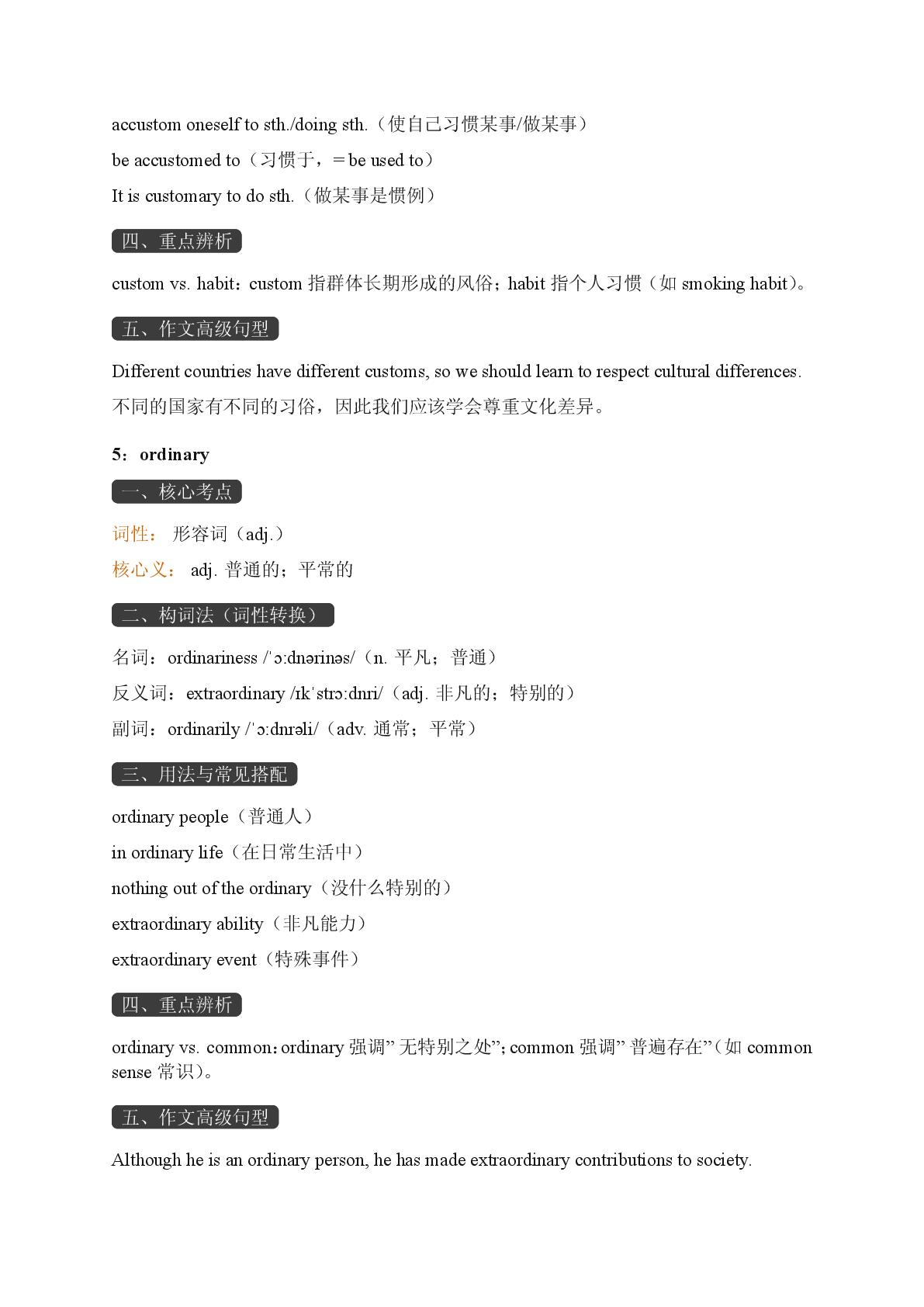
5:ordinary
一、核心考点
词性:形容词(adj.)
核心义:adj.普通的;平常的
、
构词法(词性转换)
名词:ordinariness /:dnerines/,(n.平凡;普通)
反义词:extraordinary/Ik'sto:dri/(adj.非凡的;特别的)
副词:ordinarily/'o:dnrali//(adv.通常;平常)
三、用法与常见搭配
ordinary people(普通人)
in ordinary life(在日常生活中)
nothing out of the ordinary(没什么特别的)
extraordinary ability(非凡能力)
extraordinary event(特殊事件)
四、重点辨析
ordinary vs.common:ordinary强调”无特别之处”;common强调’普遍存在”(如common
sense常识)。
五、作文高级句型
Although he is an ordinary person,he has made extraordinary contributions to society.
虽然他是一个普通人,但他为社会做出了非凡的贡献。
6:participate
一、核心考点
词性:动词(v.)
核心义:v.参加;参与(短语participate in的原形)
二、构词法(词性转换)
名词:participation /pa:,tsr'pern/(n.参与;参加)
形容词:participatory/pa:,tsr'pertari/(adj.参与式的)
三、用法与常见搭配
participate in sth.(参加某事,=take part in)
participate actively in(积极参与)
pa1 ticipate with sb.in(与某人一起参与)
encourage participation(鼓励参与)
active participation(积极参与)
四、重点辨析
participate vs.join:participate为不及物动词,需加in;join为及物动词,可直接加组织
或人(如join the club)。
五、作文高级句型
Students should participate in more social activities to develop their practical abilities.
学生应多参与社会活动以培养实践能力。
7:ought
一、
核心考点
词性:情态动词(v.aux.)
核心义:v.aux.应该;应当(短语ought to的原形)
二、构词法(无词性转换,情态动词)
否定式:ought not to(=oughtn'tto,不应该)
疑问式:Ought we to?(我们应该…吗?)
、
用法与常见搭配
ought to do sth.(应该做某事,语气比should稍强)
ought to have done sth.(本应该做某事而未做,含责备意)
ought to be(应该是)
四、重点辨析
ought to vs.should:ought to强调责任或义务;should更侧重建议或推测。
五、作文高级句型
We ought to protect the environment,for it is our duty to leave a better world for future gener-
ations
我们应该保护环境,因为为后代留下更美好的世界是我们的责任。
8:focus
核心考点
词性:动词(v.)、名词(n.)
核心义:v,集中(注意力、精力等)于:n.焦点;中心
二、构词法(词性转换)
形容词:focal/'fak/(adj山.焦点的;中心的)
过去式/过去分词:focused/focussed(两种拼写均正确)
现在分词:focusing/focussing
三、用法与常见搭配
focus on sth.(集中于某事)
focus one's attention/mind on(将注意力/心思集中于)
focs.on..(把…集中于…)
the focus of attention(注意力的焦点)
shift the focus(转移焦点)
四、重点辨析
focus on vs.concentrate on:两者均可表示”集中注意力”
二、词汇巩固练习
(一)单项选择(10题)
1.The earthquake caused a terrible_leaving thousands of people homeless.
A)disaster
B)catastrophe
C)accident
D)incident
2.The documentary was sothat I watched it twice in a row.
A)amused
B)entertaining
C)funny
D)interesting
3.Pandas are one of the world's most_animals and need our protection.
A)scarce
B)rare
C)common
D)usual
4.In many cultures,it is a_to exchange gifts during festivals
A)habit
B)custom
C)practice
D)tradition
5.Although he lives an life,he always helps others in need.
A)ordinary
B)common
C)regular
D)normal
6.All students are encouraged to in the school's volunteer programs.
A)join
B)attend
C)participate
D)take
7.Youto apologize for your rude behavior yesterday.
A)should
B)would
C)could
D)ought
8.The team needs to_on improving defense rather than attacking.
A)focus
B)concentrate
C)fix
D)center
9.It is for guests to bring a small gift when visiting someone's home in this country.
A)accustomed
B)customary
C)usual
D)habit
10.have I seen such a beautiful sunset in my life.
A)Seldom
B)Rarely
C)Hardly
D)Never
(二)根据提示补全句子(8题)
1.The storm had_(disaster)effects on the coastal villages.(形容词)
2.She told an(entertain)story about her childhood.(形容词)
3.This species of bird is extremely_(rarely)in this region.(形容词)
4.Itis_(custom)to bow when greeting someone in Japan.(形容词)
5.He has the_(able)to solve complex problems quickly.(名词,提示词:extraordinary)
6.We should encourage children's(participate)in sports activities.(
7.You_(ought)to have told me the truth earlier..(情态动词短语)
8.The meeting will(focus)on environmental protection measures.(
(三)首字母填空(10题)
1.Natural d like floods and earthquakes often cause great damage.
2.Watching movies is a popular form ofe for many people
3.This ancient coin is very rand worth a lot of money.
4.Different countries have different c,so we should respect cultural diversity.
5.My grandparents live a simple and o life in the countryside.
6.All students are required to pin the school's annual sports meet.
7.We o_to save water to protect our limited resources.
8.The company plans to f on developing new technology next year.
9.It is c_to shake hands when meeting someone for the first time in many Western coun-
tries.
10.R does she get angry,but this time she lost her temper.
(四)答案与解析
1.单项选择答案:A BBB A C D A BB
解析1(第1题):
考查disaster的用法。disaster表示”灾难;灾祸”,符合句意”地震造成了可怕的灾难,
导致数千人无家可归;catastrophe语气更强,指毁灭性的大灾难;accident指意外事故:
incident指小事件,均不符合语境,故选A。
解析2(第2题):
考查entertaining的用法。entertaining表示”有趣的;使人愉快的”,符合句意”这部
纪录片如此有趣,我连续看了两遍”;amused表示”被逗乐的”;fuy表示滑稽的”;
interesting表示”有趣的,但entertaining更强调娱乐性,故选B。
解析3(第4题):
考查custom的用法。custom表示”风俗;习俗”,符合句意”在许多文化中,节日期间
交换礼物是一种习俗;habit指个人习惯;practice指惯例;tradition指传统,但custom
更强调社会习俗,故选B。
2.补全句子答案:
1.disastrous 2.entertaining 3.rare 4.customary 5.extraordinary ability 6.participation 7.
ought 8.focus
3.首字母填空答案:
1.disaster 2.entertainment 3.rare 4.customs 5.ordinary 6.participate 7.ought 8.focus 9.
customary 10.Rarely
英语词汇复习手册·必修第三册·Unit1 The media三
资源预览图

1

2

3
4

相关资源
由于学科网是一个信息分享及获取的平台,不确保部分用户上传资料的 来源及知识产权归属。如您发现相关资料侵犯您的合法权益,请联系学科网,我们核实后将及时进行处理。