选修2 动名词作宾语的进阶用法包括介词后接动名词以及it作形式宾语动名词作真正宾语的结构-备战2025-2026学年高中英语上学期期末语法全解(沪教版)
2025-12-12
|
10页
|
81人阅读
|
2人下载

资源信息
| 学段 | 高中 |
|---|---|
| 学科 | 英语 |
| 教材版本 | 高中英语沪教版选择性必修第二册 |
| 年级 | 高二 |
| 章节 | - |
| 类型 | 题集-专项训练 |
| 知识点 | 语法 |
| 使用场景 | 同步教学-期末 |
| 学年 | 2025-2026 |
| 地区(省份) | 全国 |
| 地区(市) | - |
| 地区(区县) | - |
| 文件格式 | |
| 文件大小 | 118 KB |
| 发布时间 | 2025-12-12 |
| 更新时间 | 2025-12-12 |
| 作者 | 北京菁榕教育咨询有限公司 |
| 品牌系列 | - |
| 审核时间 | 2025-12-12 |
| 下载链接 | https://m.zxxk.com/soft/55406616.html |
| 价格 | 3.00储值(1储值=1元) |
| 来源 | 学科网 |
内容正文:
ENGLISH-选修2系列资料(沪教版)
Unit2动名词作宾语的进阶用法
考频分析
动名词作宾语的进阶用法是高中英语语法的重要考点,考频占语法总量的10%左右,涉及试卷多个核心
题型:单项选择1-2题、完形填空1-2题、语法填空1-2题、书面表达核心考察,直接影响句子结构的规
范性与表达的准确性。在语境理解类题目中,动名词在介词后的使用以及t作形式宾语时动名词作真正宾
语的结构辨析往往是解题关键。
考查内容
高中英语对动名词作宾语进阶用法的考察聚焦两大维度,覆盖结构特征与语境应用:
·介词后接动名词:常见介词(如in,on,at,with,without,.for,from等)后必须接动名词作宾语的固定搭
配及语境辨析;
·t作形式宾语、动名词作真正宾语:”主语+谓语+t+宾补+动名词短语”结构的识别,及与不定式作真
正宾语结构的对比应用。
精讲精练
知识点一:动名词作宾语的进阶用法
·介词后接动名词
-用法说明:介词后需接动名词(v-ig形式)作宾语,常见搭配包括介词+动名词、动词短语(动词+
介词)+动名词
-常见介词/短语:in(在…方面)、on(一…就)、at(擅长)、be interested in(对…感兴趣)、
look forward to(期待)、give up(放弃)
-例句:口She is good at singing.(介词at后接动名词singing)口They look forward to seeing you
soon.(短语look forward to后接动名词seeing)
·t作形式宾语、动名词作真正宾语
一用法说明:当动名词短语作宾语且其后有宾语补足语时,常用t作形式宾语,将真正宾语(动名词短
语)置于句末,结构为“主语+谓语+t+宾语补足语+动名词短语”
-常见谓语动词:find(发现)、think(认为)、feel(觉得)、consider(认为)
-例句:口I find it interesting learning English.(it为形式宾语,动名词短语learning English为真正宾
语)He thinks it no use arguing with her.(it为形式宾语,动名词短语arguing with her为真正宾语)
【即学即练】
1.【介词后接动名词】She is interested in一(paint)and often spends weekends in her studio.
2.【介词短语后接动名词】Ve look forward to_from you soon.
A.hear
B.hearing
C.heard
D.to hear
3.【it作形式宾语】I find_difficult learning French.
A.this
B.that
C.it
D.one
4.【动名词作真正宾语】He thinks_no use arguing with her..
A.it
B.this
C.that
D.what
5.【介词后接动名词】He apologized for一(attend)the meeting.
选修2|英语|沪教版
ENGLISH-选修2系列资料(沪教版)
知识点二:动名词作宾语的特殊用法和高频考点
·动名词的复合结构(逻辑主语+动名词)
1.构成规则
-逻辑主语为有生命的名词时,用名词所有格('s)或形容词性物主代词(my/his/her/our/their);逻
辑主语为无生命的名词或名词复数时,用名词普通格或宾格代词
2.用法场景
一主要用于句首作主语、介词后作宾语或动词后作宾语
一例句:
*口Tom's coming late made the teacher angry.(名词所有格Tom's作逻辑主语,动名词短语作主
语)
*口Idon't mind his/him smoking here..(形容词性物主代词his或宾格him作逻辑主语,动名词短
语作动词mind的宾语)
*口The success of the project depends on everyone working hard.(名词普通格everyone作逻
辑主语,动名词短语作介词on的宾语)
·接动名词和不定式意义不同的动词
1.核心动词及差异对比
-remember(记得):remember doing sth..(记得做过某事,动作已发生);remember to do sth.(记
得要做某事,动作未发生)
-forget(忘记):forget doing sth.(忘记做过某事,动作已发生);forget to do sth.(忘记要做某事,
动作未发生)
-regret(后悔):regret doing sth.(后悔做了某事,动作已发生);regret to do sth.(遗憾要做某事,
常接tell/inform/say等词)
-stop(停止):stop doing sth.(停止正在做的事);stop to do sth.(停下来去做另一件事)
-try(尝试/努力):try doing sth.(尝试做某事,看结果如何);try to do sth.(努力做某事,强调过程)
2.例句对比
-She remembered locking the door.(记得锁了门,已发生);Remember to lock the door when
you leave.(记得要锁门,未发生)
-口He forgot meeting her before.(忘记见过她,已发生);Don't forget to call me tomorrow.(别忘
了明天给我打电话,未发生)
-口I regret telling him the truth.(后悔告诉他真相,已发生);i regret to say that you didn't pass the
exam.(遗憾地说你没通过考试,未发生)
-口They stopped talking when the teacher came in..(老师进来时他们停止说话,停下手头事);He
stopped to talk to me on his way home.(他回家路上停下来和我说话,做另一件事)
-口Try adding some sugar to the coffee.(试着加糖,看味道如何);I tried to solve the problem but
failed.(努力解题,强调过程)
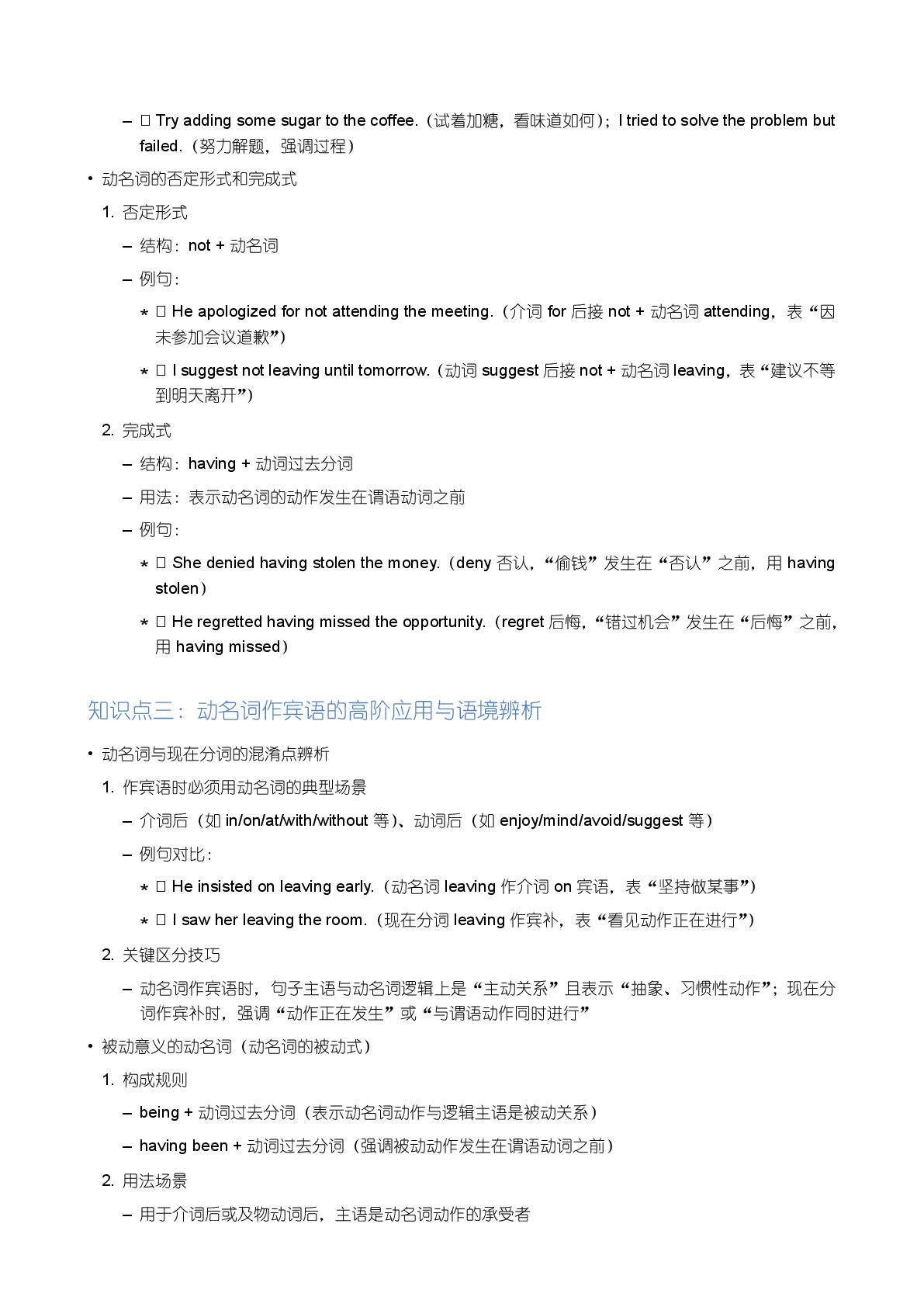
·动名词的否定形式和完成式
1.否定形式
-结构:not+动名词
-例句:
*☐He apologized for not attending the meeting.(介词for后接not+动名词attending,表“因
未参加会议道歉”)
*口I suggest not leaving until tomorrow.(动词suggest后接not+动名词leaving,表“建议不等
到明天离开”)
2.完成式
-结构:having+动词过去分词
一用法:表示动名词的动作发生在谓语动词之前
一例句:
*口She denied having stolen the money..(deny否认,“偷钱”发生在“否认”之前,用having
stolen)
*口He regretted having missed the opportunity..(regret后悔,“错过机会”发生在“后悔”之前,
用having missed)
知识点三:动名词作宾语的高阶应用与语境辨析
·动名词与现在分词的混淆点辨析
1.作宾语时必须用动名词的典型场景
-介词后(如in/on/at/with/without等)、动词后(如enjoy/mind/avoid,/suggest等)
一例句对比:
*口He insisted on leaving early.(动名词leaving作介词on宾语,表“坚持做某事”)
*I saw her leaving the room.(现在分词leaving作宾补,表“看见动作正在进行”)
2.关键区分技巧
一动名词作宾语时,句子主语与动名词逻辑上是“主动关系”且表示“抽象、习惯性动作”;现在分
词作宾补时,强调“动作正在发生”或“与谓语动作同时进行”
·被动意义的动名词(动名词的被动式)
1.构成规则
-being+动词过去分词(表示动名词动作与逻辑主语是被动关系)
-having been+动词过去分词(强调被动动作发生在谓语动词之前)
2.用法场景
一用于介词后或及物动词后,主语是动名词动作的承受者
-例句:
*☐She dislikes being interrupted while studying.(being interrupted表“被打断”,作dislike的
宾语)》
*☐The thief admitted having been caught by the police..(having been caught表“被抓”发生在
admitted之前)
·动名词在固定句型中的应用
1.There is no+动名词(表示“做某事是不可能的”)
-例句:There is no denying the fact that climate change is real.(不可否认气候变化的事实)
2.hat's the use/good of+动名词(表示“做某事没用”)
-例句:hat's the point of arguing about trivial things'?(争论小事有什么意义)
3.have difficulty/trouble(in)+动名词(表示“做某事有困难")
-例句:I had trouble finding his address.(我很难找到他的地址)
·高频易错动名词固定搭配(高中重点)
-口admit doing(承认做某事)→He admitted breaking the window.
-☐delay doing(推迟做某事)→They delayed holding the meeting.
-口escape doing(逃脱做某事)→She escaped being punished.
-口fancy doing(想要做某事)→Do you fancy going out for dinner?
-☐involve doing(涉及做某事)→The job involves working night shifts,
-口postpone doing(延期做某事)→Ne postponed traveling due to bad weather..
-☐risk doing(冒险做某事)→He risked losing his job to speak up.
-☐tolerate doing(容忍做某事)→lcan't tolerate being lied to.
选修2|英语|沪教版
ENGLISH-选修2系列资料(沪教版)
考法一:介词后接动名词的用法
·核心:识别介词或动词短语后的介词,选择动名词(~ig形式)作宾语
·真题1(语法填空):
-She is interested in_(paint)and often spends weekends in her studio
一答案:painting解析:介词in后需接动名词作宾语,paint的动名词形式为painting。
·真题2(单项选择):
We look forward to _from you soon.
A.hear
B.hearing
C.heard
D.to hear
-答案:B解析:固定短语look forward to中to为介词,后接动名词,hear的动名词形式为hearing。
考法二:动名词复合结构与介词搭配辨析
·核心:根据逻辑主语的类型(有生命/无生命)选择正确的所有格普通格形式,结合介词后必须接动名词
的规则,判断动名词复合结构的正确形式
·真题1(语法填空):
I have no objection to _(they)conducting the experiment here.
-答案:them解析:逻辑主语为复数人称代词,在介词to后作宾语,用宾格them作动名词conducting
的逻辑主语,构成动名词复合结构作介词宾语
·真题2(单项选择):
-The success of the event depends on
A.everyone's participating
B.everyone participating
C.everyone to participate
D.everyone participate
-答案:B解析:介词on后需接动名词作宾语,逻辑主语为无生命意义的不定代词everyone,用普通
格形式,构成”everyone participating”动名词复合结构,符合”介词+逻辑主语普通格+动名词”的用
法规则
考法三:动名词的综合应用与语境辨析
·核心:结合动名词的复合结构、否定形式、完成式及被动式,区分动名词与不定式的用法差异,并能在
具体语境中正确运用
·真题1(单项选择):
-I regret not_his advice,which made me miss the chance.
A.taking
B.to take
C.take
D.taken
-答案:A解析:regret doing sth.表示“后悔做了某事”,动作已发生;regret to do sth.表示“遗憾要
做某事”,动作末发生。此处“没采纳建议”是已发生的动作,且not需置于动名词之前,故选taking。
·真题2(语法填空):
The teacher didn't mind my_(arrive)late,but she said I should try_(be)on time next time
-答案:arriving to be解析:第一空,mind后接动名词作宾语,my为逻辑主语,arrive的动名词形式
为arriving;第二空,try to do sth.表示“努力做某事”,强调过程,故填tobe。
选修2|英语|沪教版
ENGLISH-选修2系列资料(沪教版)
解题小妙招
动名词解题妙招
介词之后动名跟,短语介词辨清楚;
复合结构看逻辑,有生命用所有格,无生命用普通格;
否定前置动名前,完成被动"having been done”;
regret doing表后悔,todo形式表遗憾;
mind后接动名词,try to do表努力;
主谓宾结构牢记,动名不作谓语用。
真题演练
演练一:单项选择试题(共10题)
1.I still remember the Great Wall for the first time when I was ten.
A.visiting
B.to visit
C.visit
D.visited
2.The manager suggested-the meeting until next Monday due to the bad weather.
A.postpone
B.to postpone
C.postponing
D.postponed
3.Don't forget the lights before leaving the classroom.
A.turning off
B.to turn off
C.turn off
D.turned off
4.She regrets_him the truth,which made their relationship worse.
A.telling
B.to tell
C.tell
D.told
5.The students stopped__when the teacher entered the classroom.
A.talk
B.to talk
C.talking
D.talked
6.I have difficulty this math problem.Could you help me?
A.solve
B.to solve
C.solving
D.solved
7.The success of the project depends on_hard.
A.everyone work
B.everyone working
C.everyone to work
D.everyone worked
8.He denied_the money from the drawer.
A.steal
B.to steal
C.stealing
D.stole
9.Remember_the door when you go out.
A.lock
B.to lock
C.locking
D.locked
10.I tried_some milk to the coffee,but it still tasted bitter.
A.add
B.to add
C.adding
D.added
演练二:填空试题(共10题)
1.She is good at_(swim)in the river.
2.I look forward to _(see)you again soon.
3.He gave up_(smoke)last year.
4.They are interested in_(study)English.
5.I find it difficult(learn)French.
6.She suggested _(go)to the park for a walk.
7.He admitted _(break)the window.
8.I don't mind(wait)for you here.
9.They succeeded in _(finish)the task on time
10.She is afraid of(fly)in an airplane.
演练三:语法填空试题(共10空)
Learning a foreign language can be challenging,but it is also very rewarding.Many people find 1.
_(learn)a new language difficult because they don't have enough practice.However,if you keep on
2.(study)every day,you will make progress.
One of the best ways to learn a language is 3.-(speak)it as much as possible.You can practice with
native speakers or join a language club.Don't be afraid of 4.-(make)mistakes,because mistakes are
part of the learning process.
Another important thing is 5.-(listen)to the language.You can listen to songs,watch movies or TV
shows in the language you are learning.This will help you improve your listening skills and learn new
vocabulary.
Reading is also very helpful.You can start with simple books and gradually move on to more difficult
ones.By 6.-(read),you will learn how to use the language correctly.
Remember 7.-(review)what you have learned regularly.This will help you remember the new words
and grammar rules.Don't forget 8._(do)your homework on time,as it is an important part of the learning
process.
Finally,try 9.-(have)fun while learning.If you enjoy 10.-(learn)the language,you will be more
motivated to continue
答案
演练一:单项选择
1.A2.C3.B4.A5.C6.C7.B8.C9.B10.C
演练二:填空试题
1.swimming 2.seeing 3.smoking 4.studying 5.learning
6.going 7.breaking 8.waiting 9.finishing 10.flying
演练三:语法填空
1.learning 2.studying 3.speaking 4.making 5.listening
6.reading 7.to review 8.to do 9.to have 10.learning
选修2|英语|沪教版
资源预览图

1

2

3
4

相关资源
由于学科网是一个信息分享及获取的平台,不确保部分用户上传资料的 来源及知识产权归属。如您发现相关资料侵犯您的合法权益,请联系学科网,我们核实后将及时进行处理。