必修第三册 UNIT 3 DIVERSE CULTURES(课后提能案)-【优学精研】2026年高考英语一轮总复习学用word(人教版)
2025-11-27
|
2份
|
7页
|
29人阅读
|
2人下载

资源信息
| 学段 | 高中 |
|---|---|
| 学科 | 英语 |
| 教材版本 | 高中英语人教版必修第三册 |
| 年级 | 高三 |
| 章节 | Unit 3 Diverse Cultures |
| 类型 | 题集-专项训练 |
| 知识点 | - |
| 使用场景 | 高考复习-一轮复习 |
| 学年 | 2026-2027 |
| 地区(省份) | 全国 |
| 地区(市) | - |
| 地区(区县) | - |
| 文件格式 | ZIP |
| 文件大小 | 164 KB |
| 发布时间 | 2025-11-27 |
| 更新时间 | 2025-11-27 |
| 作者 | 拾光树文化 |
| 品牌系列 | 优学精研·高考一轮总复习 |
| 审核时间 | 2025-11-27 |
| 下载链接 | https://m.zxxk.com/soft/55134944.html |
| 价格 | 2.00储值(1储值=1元) |
| 来源 | 学科网 |
内容正文:
UNIT 3 DIVERSE CULTURES
Ⅰ.阅读理解
A
(2025·福州联考)In 2016, British historian, author and broadcaster Michael Wood presented a series called The Story of China and made a film about the man who first inspired his love of the country, the 8th-century poet Du Fu.
The film, Du Fu: China’s Greatest Poet, has now inspired a book, In the Footsteps of Du Fu, recounting Wood’s travels while making it.He said it was a journey he was more than happy to retrace with viewers and readers, to enlighten them about his passion for Chinese culture.
China has the longest tradition of poetic writing in the world, and Wood said that it is this continuity and respect that has helped keep the works of Du Fu, written 1,300 years ago, so relevant and so admired in the 21st century.
“The majority of his work is from the period after the An Lushan Rebellion (755), which caused disaster when he was forced to take to the road with his family.”
“He’s not the only poet to live through disasters and write about them, but he’s the first to become the voice of his time,” he said.“He talks about surviving natural disasters and war, and what it’s like to be a refugee (难民).He was writing about the sort of scenes we still see all around the world in the modern day because he’d lived them himself.He took the part of the ordinary people, that’s a huge part of his story.”
Wood’s films have been screened in China, where he said audiences were interested and very receptive to see his outsider’s view of their own culture and history.
“I’m trying to extend knowledge of China in a sympathetic way, so when we sat down to start planning The Story of China, I said to the team that the key thing was that there should be empathy — I wanted viewers all over the world to think that they would like to be there with us.That’s the most important thing, everything else will just follow,” he said.
1.What is In the Footsteps of Du Fu mainly about?( )
A.The life experience of Du Fu. B.A collection of Du Fu’s poems.
C.Michael Wood’s personal journey. D.Michael Wood’s comments on Du Fu.
2.What makes Du Fu’s poems relevant in the 21st century?( )
A.Making documentaries. B.Writing books on Du Fu.
C.The tradition of writing poems. D.The practice of reciting poems.
3.What was special about Du Fu according to Michael Wood?( )
A.He lived in an age of wars. B.He voiced the people’s suffering.
C.He went through serious disasters. D.He wrote the largest number of poems.
4.What did Michael Wood pay special attention to when making The Story of China? ( )
A.Visiting museums. B.Interviewing experts.
C.Researching into historical facts. D.Putting himself in others’ shoes.
B
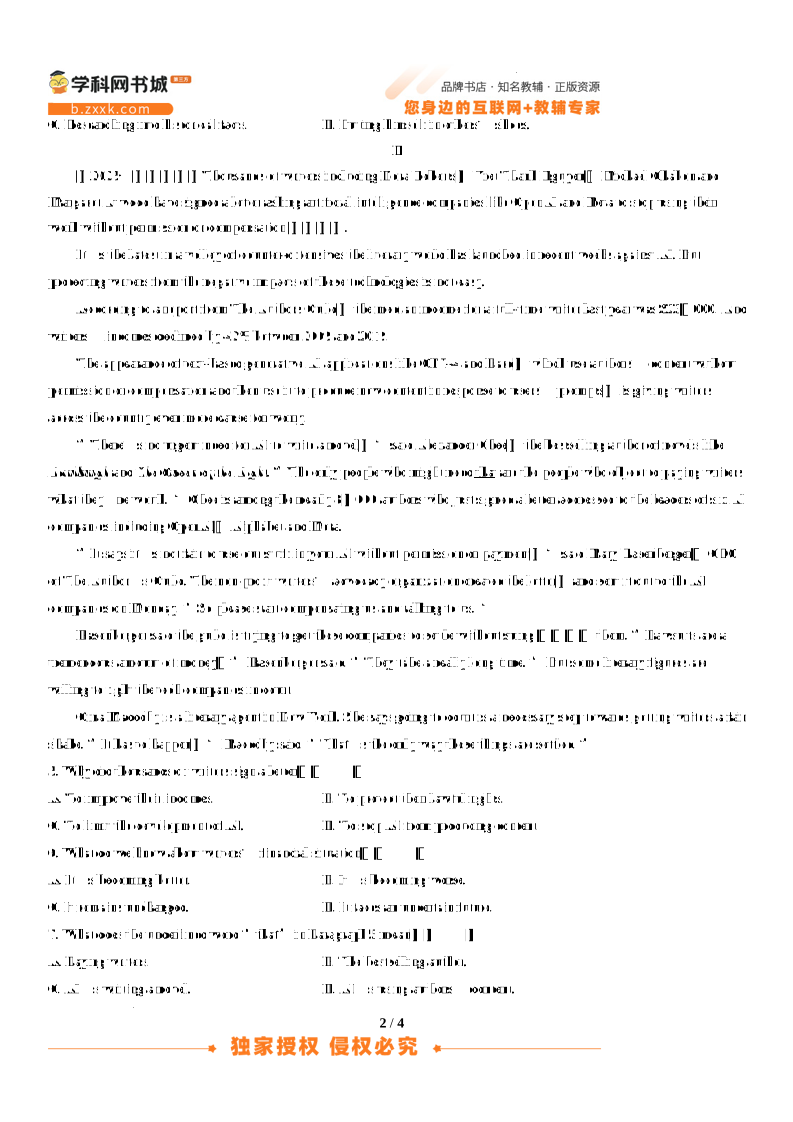
(2025·南通模拟)Thousands of writers including Nora Roberts, Viet Thanh Nguyen, Michael Chabon and Margaret Atwood have signed a letter asking artificial intelligence companies like OpenAI and Meta to stop using their work without permission or compensation (赔偿).
It’s the latest in a volley of counter-offensives the literary world has launched in recent weeks against AI.But protecting writers from the negative impacts of these technologies is not easy.
According to a report from The Authors Guild, the median income for a full-time writer last year was $23,000.And writers’ incomes declined by 42% between 2009 and 2019.
The appearance of text-based generative AI applications like GPT-4 and Bard, which use authors’ content without permission or compensation and then use it to produce new content in response to users’ prompts, is giving writers across the country even more cause for worry.
“There’s no urgent need for AI to write a novel,” said Alexander Chee, the bestselling author of novels like Edinburgh and The Queen of the Night.“The only people who might need that are the people who object to paying writers what they’re worth.” Chee is among the nearly 8,000 authors who just signed a letter addressed to the leaders of six AI companies including OpenAI, Alphabet and Meta.
“It says it’s not fair to use our stuff in your AI without permission or payment,” said Mary Rasenberger, CEO of The Author’s Guild.The non-profit writers’ advocacy organization created the letter, and sent it out to the AI companies on Monday.“So please start compensating us and talking to us.”
Rasenberger said the guild is trying to get these companies to settle without suing (起诉) them.“Lawsuits are a tremendous amount of money,” Rasenberger said.“They take a really long time.” But some literary figures are willing to fight the tech companies in court.
Gina Maccoby is a literary agent in New York.She says going to court is a necessary step towards getting writers a fair shake.“It has to happen,” Maccoby said.“That’s the only way these things are settled.”
5.Why did thousands of writers sign a letter?( )
A.To improve their incomes. B.To protect their lawful rights.
C.To limit the development of AI. D.To stop AI from producing content.
6.What do we know about writers’ financial situation?( )
A.It’s becoming better. B.It’s becoming worse.
C.It remains unchanged. D.It faces an uncertain future.
7.What does the underlined word “that” in Paragraph 5 mean?( )
A.Paying writers. B.The bestselling author.
C.AI’s writing a novel. D.AI’s using authors’ content.
8.On which issue are Mary Rasenberger and Gina Maccoby divided?( )
A.Whether to take legal action.
B.Whether to compensate writers.
C.Whether to punish the tech companies.
D.Whether to allow AI to use writers’ work.
Ⅱ.完形填空
(2025·成都联考)Uwe Kräuter is a German who came to China in the 1970s. He translated the script of The Teahouse into German, a well-known work by Chinese playwright Lao She, and 9 the play’s public performance in Germany, making his 10 to the cultural exchanges between the two countries.
“I’d seen The Teahouse several times, because the philosophy of life it 11 made me think of myself,” Kräuter said. “Lao She 12 together the fates of several generations all connected with one teahouse in Beijing and all the 13 were condensed (浓缩) into a few hours of drama. It’s simply amazing and I 14 to take the Chinese play and cast to Germany.”
At the mere mention of his 15 , his friends were all taken by surprise. “How can Germans 16 understand Chinese drama? You’re 17 !” they said. But Kräuter did not budge (妥协). In his spare time, he translated The Teahouse’s script into German. At the same time, he tried to 18 the Mannheim National Theater, one of the oldest playhouses in Germany.
To Kräuter’s 19 , Mannheim said “yes”. After some preparations, The Teahouse finally took to the German stage, which also 20 the overseas debut (首演) of modern Chinese drama.
“The play 21 to be a huge success. It was unbelievable that the audience was completely immersed in the plot and 22 . At the curtain call, the theater rang with thunderous applause,” Kräuter remembered.
The enthusiastic reviews weren’t 23 to ordinary audience, but also reached media outlets. Rhein-Neckar-Zeitung hailed The Teahouse as “a miracle from the Eastern stage”.
9.( )A.proposed B.improved C.facilitated D.confirmed
10.( )A.donation B.decision C.contribution D.reputation
11.( )A.conveyed B.promoted C.reminded D.indicated
12.( )A.mixed B.tied C.joined D.pulled
13.( )A.facts B.numbers C.actions D.events
14.( )A.decided B.demanded C.requested D.managed
15.( )A.point B.reason C.concept D.idea
16.( )A.possibly B.naturally C.formally D.basically
17.( )A.lying B.dreaming C.cheating D.thinking
18.( )A.discover B.persuade C.contact D.change
19.( )A.doubt B.delight C.regret D.disappointment
20.( )A.proved B.reflected C.stated D.marked
21.( )A.turned out B.took out C.made out D.worked out
22.( )A.condition B.environment C.performance D.structure
23.( )A.referred B.devoted C.provided D.limited
Ⅲ.语法填空
(2025·西安模拟)Dream of the Red Chamber, also 24. (know) as A Dream of Red Mansions, The Story of the Stone, or Chronicles of the Stone, is one of the masterpieces of Chinese fiction.The novel is generally acknowledged to be the 25. (great) of all Chinese novels.
The writer shows deep sympathy 26. the victims of feudal oppression (封建压迫), especially women like Daiyu and maids like Qingwen and Yuanyang.At the same time, he mercilessly exposes the true nature of the oppressors.All 27. events described in the novel point to the fact that feudalism, which had lasted for 2,000 years, was becoming rotten, and was about to start going downhill.The Jia family is a mirror 28. reflects this historical process.
The content and meaning of the novel are 29. rich and deep that a special kind of learning generally called “Red Studies” started shortly after the novel 30. (publish), and has been continued to this day.Various 31. (theory) have been put forward about the author and the novel.Even many details of the story have been explained in different ways by scholars.
Even today, many Chinese scholars devote their lifetime to 32. (study) Dream of the Red Chamber.And there 33. (be) many professional writers and also fans of Cao’s novel who are trying to rewrite the last 40 chapters of the “Dream”.
4 / 4
学科网(北京)股份有限公司
$
UNIT 3 DIVERSE CULTURES
Ⅰ.
语篇解读:本文是一篇说明文。2016年,英国历史学家、作家和广播员迈克尔·伍德制作了一部名为Du Fu: China’s Greatest Poet的电影。最近,他又出版了一部名为In the Footsteps of Du Fu的图书。
1.C 细节理解题。根据第二段可知,《追寻杜甫的足迹》一书主要讲述了迈克尔·伍德创作电影时的旅行经历。
2.C 细节理解题。根据第三段可知,中国拥有世界上最悠久的诗歌创作传统,伍德说,正是这种传承和敬畏,使杜甫1,300年前的作品在21世纪仍然如此重要和受人钦佩。
3.B 细节理解题。根据第五段可知,迈克尔·伍德认为:杜甫不是唯一一个经历灾难并将其写下来的诗人,但他是第一个成为那个时代代言人的诗人;另外,他代表了广大普通民众。
4.D 推理判断题。根据最后一段可知,迈克尔·伍德表示:“我试图以一种共情的方式扩展对中国的了解,所以当我们坐下来开始策划《中国故事》时,我对团队说,最为关键的是要有同理心。”由此推知,迈克尔·伍德策划《中国故事》时特别注意的是换位思考。
语篇解读:本文是一篇说明文。美国数千名作家签署了一封公开信,要求OpenAI和Meta等人工智能公司在未经许可或未付报酬的情况下停止使用他们的作品。
5.B 细节理解题。根据第一段可知,这些作家签署了一封公开信,其诉求是OpenAI和Meta等人工智能公司在未经许可或未付报酬的情况下停止使用他们的作品。显然他们这么做是为了保护他们的合法权益。
6.B 细节理解题。根据第三段可知,美国作家协会发布的一份报告显示,去年美国全职作家的收入中位数为2.3万美元。从2009年到2019年,作家的收入下降了42%。
7.C 代词指代题。根据第五段可知,作家Alexander Chee前面指出:“目前我们并不需要利用人工智能写小说。”他接着说:“唯一有此需要的可能是那些反对按作家的价值支付报酬的人。”显然,这里的that指代上文提到的“利用人工智能写小说”。
8.A 推理判断题。根据最后两段可知,Mary Rasenberger不主张起诉这些人工智能公司,而Gina Maccoby认为打官司是维护作家权益必须采取的措施。
Ⅱ.
语篇解读:本文是一篇记叙文。来自德国的Uwe Kräuter尝试把中国著名戏剧《茶馆》推向德国市场,结果大获成功。他为中德两国的文化交流作出了重大贡献。
9.C 根据下文可知,Uwe Kräuter做了大量工作,促进了戏剧《茶馆》在德国的上演。
10.C 根据上文the play’s public performance in Germany可知,Uwe Kräuter为中德两国的文化交流作出了贡献。
11.A 这里it conveyed是一个省略了which/that的定语从句,修饰前面的先行词the philosophy of life,表示“它所表达/传递的人生哲学”。
12.B 老舍把几代人的命运都与北京的一家茶馆联系在一起。 tie字面意思是“绑;系”,这里引申为“联系”。
13.D 在《茶馆》中,所有的事件都被浓缩在几个小时的戏剧里。
14.A 上文Kräuter对《茶馆》作了高度评价,因此他决定将《茶馆》搬到德国舞台上去。
15.D 上文提到的“将《茶馆》搬到德国舞台上去”是Kräuter的一个想法。
16.A 根据上文his friends were all taken by surprise可知,他周围的朋友都对他的想法表示吃惊。因此他们说:“德国人怎么可能理解中国戏剧?你这是在做梦!”
17.B 参见上题解析。
18.C 根据下文Mannheim said “yes”可知,Kräuter努力跟德国的曼海姆国家剧院联系。
19.B 由于曼海姆国家剧院答应了Kräuter的请求,他自然是非常高兴的。
20.D 《茶馆》最终登上了德国的舞台,这也标志着中国现代戏剧首次在海外亮相。
21.A 根据下文the theater rang with thunderous applause可知,《茶馆》结果是取得了巨大的成功。turn out结果是。
22.C 令人难以置信的是,观众完全沉浸在情节和表演中。谢幕时,剧院里响起雷鸣般的掌声。
23.D 对于《茶馆》的成功演出,热情的评论不限于普通观众,媒体也给予了高度评价。
Ⅲ.
语篇解读:本文是一篇说明文。文章简要介绍了中国“四大名著”之一——《红楼梦》。
24.known 考查非谓语动词。这里表示《红楼梦》以其他名称被人们所知,因此用表达被动概念的过去分词。
25.greatest 考查形容词最高级。本空前面的the以及本空后面的of all Chinese novels暗示这里应用形容词的最高级形式。
26.for 考查介词。show/feel/have sympathy for sb是固定搭配,表示“对某人产生同情”。
27.the 考查冠词。这里的events特指小说中提到的事件,因此用定冠词the。
28.that/which 考查定语从句。这里由关系代词that/which引导一个定语从句,that/which在从句中作主语。
29.so 考查连词。so ...that ...是固定句型,表示“如此……以至于……”。
30.was published 考查时态和语态。该小说是在过去“被出版”,因此用一般过去时的被动语态。
31.theories 考查名词复数。前面的Various一词暗示这里的名词需用复数形式。
32.studying 考查非谓语动词。devote ...to doing sth是固定句式,表示“致力于做某事”。
33.are 考查时态和主谓一致。根据语境可知,这里在描述现存的客观事实,因此应用一般现在时。
学科网(北京)股份有限公司
$
资源预览图

1
2

相关资源
由于学科网是一个信息分享及获取的平台,不确保部分用户上传资料的 来源及知识产权归属。如您发现相关资料侵犯您的合法权益,请联系学科网,我们核实后将及时进行处理。