Unit3 Welcome to reading 同步练 江苏省南京市金陵中学2025-2026学年译林版八年级英语上册
2025-11-11
|
6页
|
452人阅读
|
138人下载
内容正文:
江苏省南京市金陵中学2025-2026学年八年级英语上学期
8A unit3 Welcome to reading
一、单项选择(15分)
( ) 1. They plan a project about fighting ______air pollution.
A. to B. for C. from D. against
( ) 2. Pay attention in class, or you will in your studies.
A. fall over B. fall behind C. fall out D. fall down
( )3. _________ students know the importance of team spirit, our school has a sports meeting every year.
A.Help B.Helping C.To help D. With help
( )4. He can teach ______, so you don't need to teach ______.
A. himself; himself B. him; himself C. himself; him D. him; him
( )5. With the help of AI, we can ______ Chinese into any language.
A.translate B. change C. print D. predict
( )6. —Why did you ______ the book to the library so quickly?
—Because I finished reading it in one day and wanted others to enjoy it too.
A. Borrow B. return C. lend D. Keep
( ) 7. When you ____ problems, listen to others' advice and don't just stick to your own ideas.
A. give up B. look at C. run into D. think of
( )8. "Give a man a fish, and you feed him for a day. Teach a man to fish, and you feed him for a lifetime." tells us ______.
A. how often should we help others B. how we should help others
C.when we should help others D. why we should help
( )9. — Would you mind giving me some advice on learning English, Mr Wu?
— My pleasure. You can ______ some interesting English stories.
A deal with B. play with C. begin with D. help with
( )10. It's better to teach a man fishing than him fish.
A. to find B. giving C. to give D. finding
( )10.I use ________ app to study English for half ________ hour every day.
A. an; a B. a; an C. an; an D. a; a
三.阅读理解
A
Benjamin Franklin's famous lightning experiment (闪电实验) got many kids interested in science. But new research shows this story might not be true.The well - known story is that this American Founding Father and scientist flew a kite during a storm in 1752. At that time, people were very interested in electricity (电). They wanted to know if lightning was made by electricity or something else. Franklin was one of them. He flew the kite with a string tied to it.
A metal (金属) key was tied to the string. Lightning flash hit the kite, and electricity passed through the string to the key. Franklin then touched the key with his finger and got an electric shock. He said this proved (证明) lightning was a type of electricity.For many years, schools have taught the story of Franklin's lightning experiment. Thousands of children have been amazed by his bravery and his question of looking for the truth. However, the details of the experiment are not entirely true. Some scientists questioned what really took place.
The detail about the string and the key is true. But scientists all agree that if Franklin had really touched the key, he would surely have died from the electric shock.Additionally, fiction (虚构) is often more interesting than the truth. People have been more encouraged by Franklin's spirit of scientific exploration than by the facts themselves
.( ) 1. Why did Franklin start the lightning experiment according to the story?
A, To prove that lightning was a type of electricity. B.To show that he was brave.
C.To invent the famous kite. D.To teach children about science.
( ) 2. Which of the following details about Franklin's lightning experiment is TRUE?
A. Franklin got an electric shock and died after touching the key.
B. Franklin flew the kite when it was sunny.
C. String was tied to the kite and a metal key was tied to the string.
D. The kite was made of metal.
( ) 3. How do other scientists feel about Franklin's lightning experiment?
A. They think it is a perfect example of science. B.They believe the story is completely true.
C.They think Franklin was not brave. D.They are not sure if Franklin touched the key.
( ) 4. What does the author want to tell us in this passage?
A. Franklin was not a good scientist.
B. The spirit of scientific exploration is more important than the facts.
C. The story of Franklin's experiment is not worth telling.
D. Lightning experiments should not be taught in schools.
B
Students who learn languages often think they have memory (记忆) problems. They worry because they can’t remember words. In fact, the problem is usually with how they study.
To remember words better, you need to understand how memory works. There are two kinds of memory: short-term and long-term. When you see, hear or read something, it goes first into short-term memory. But short-term memory lasts for only a few seconds. You will only remember something longer if it goes into long-term memory. Your long-term memory is like a very big library with many, many books. And like a library, it’s organized (有条理的). When you put away a book or memory, you can’t just leave it anywhere. You have to choose a place where you can find it again.
How can you do this with vocabulary (词汇)? The answer is to work with the word and think about the word in new ways. You can do this by writing new sentences with this word. Even better, make a picture in your mind with the word. For example, if the word is “height”, you can think of the tallest person you know and try to guess his or her height. All of these activities are good ways to think about words. They make the meanings of words stronger in your long-term memory. And they give a way to find a word when you need it.
1.In the writer’s opinion, students can’t remember words because ________.
A.they have memory problems B.they are too worried
C.they don’t use a proper way D.they don’t like to study
2.Which is TRUE about memory according to the passage?
A.Short-term memory is seldom used.
B.What we see goes into long-term memory first.
C.We’ll forget a word soon if it goes into short-term memory.
D.We’ll never forget a word if it goes into long-term memory.
3.According to the passage, what can help us find a word in our long-term memory more easily?
A.Just reading the word.
B.Putting the word in short-term memory.
C.Connecting (联系) the word with other words we already know.
D.Using activities to make the word’s meaning stronger in long-term memory.
4.Which of the following is an example of “thinking about the word in new ways” mentioned in the passage?
A.Learning some grammar. B.Making a list of words with similar meanings.
C.Using the word to write a short story. D.Looking up the word in a dictionary.
5.This passage mainly tells us about ________.
A.students’ problems in language study B.how to make the meanings of words stronger
C.short-term and long-term memory D.how to improve ways to remember words
C
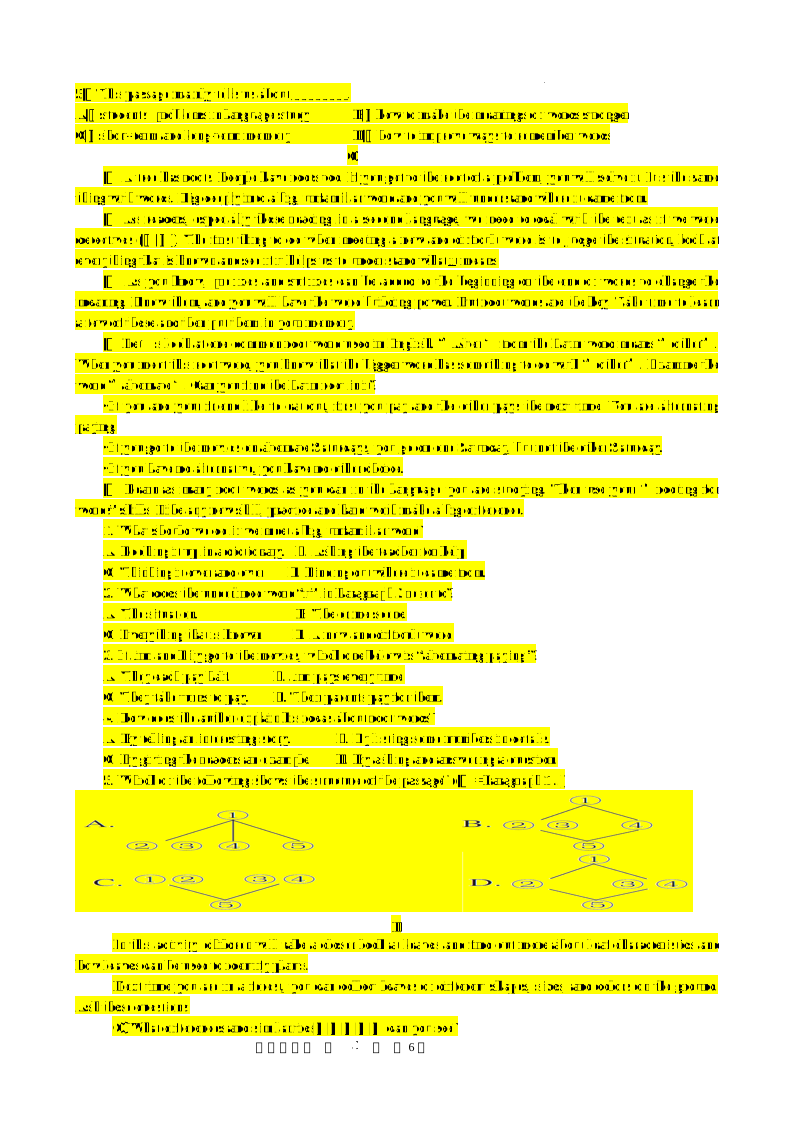
① A tree has roots. People have roots too. If you get to the root of a problem, you will solve it. It’s the same thing with words. Dig deeply into a big, unfamiliar word and you will understand where it came from.
② As readers, especially those reading in a second language, we need to deal with the text as if we were detectives (侦探). The first thing to do when meeting a new and difficult word is to judge the situation, look at everything that is known and see if it helps us to under stand what it means.
③ As you know, prefixes and suffixes can be added to the beginning or the end of words to change the meaning. Know them, and you will have the word building power. But root words are the key. Take time to learn a few of these and then put them in your memory.
④ Let’s look at one common root word used in English. “Alter” from the Latin word means “other”. When you meet this root word, you know that the bigger word has something to do with “other”. Examine the word “alternate”. Can you find the Latin root in it?
•If you and your friend like to eat out, first you pay and the other pays the next time. You are alternating paying.
•If you go to the movies on alternate Saturdays, you go on one Saturday, but not the other Saturday.
•If you have no alternative, you have no other choice.
⑤ Learn as many root words as you can in the language you are studying. Then use your “rooting for words” skills. Like any new skill, practice and hard work make a big difference.
1. What should we do if we meet a big, unfamiliar word?
A. Looking it up in a dictionary. B. Asking the teacher for help.
C. Thinking it over and over. D. Finding out where it came from.
2. What does the underlined word “it” in Paragraph 2 refer to?
A. The situation. B. The crime scene.
C. Everything that is known. D. A new and difficult word.
3. If Jim and Lily go to the movies, which one below is “alternating paying”?
A. They each pay half. B. Jim pays every time.
C. They take turns to pay. D. Their parents pay for them.
4. How does the author explain his ideas about root words?
A. By telling an interesting story. B. By listing some numbers in details.
C. By giving the readers an example. D. By asking and answering a question.
5. Which of the following shows the structure of the passage? (① =Paragraph 1...)
D
In this activity, children will take a closer look at leaves and find out more about leaf characteristics and how leaves can be used to identify plants.
Next time you are in a forest, you can collect leaves of different shapes, sizes, and colors on the ground. Ask these questions:
◯What differences and similarities(相似性) can you see?
◯What do the leaves feel like? Do they have hairs? Or teeth?
◯Can you find the tree that each leaf came from?
Explain that leaves can be used to identify trees. Use a field guide to identify a tree. Find a leaf from that tree, and compare the leaf in the field guide to the real-life leaf you found on the ground. How many other trees can you find with this same type of leaf?
The edges or margins (边缘) of leaves can give us clues to the tree’s identity.
Another characteristic to identify a tree is the way its leaves grow on the twigs (嫩枝). Even needle leaves grow in patterns. For example, leaves on pines may grow in clusters (簇) of two, three, or more.
Now, make prints of the leaves you collect. To make a leaf crayon rubbing, place a leaf on a smooth and hard surface, vein (叶脉) side up, and cover it with a piece of paper. Rub a crayon back and forth across the paper, directly above the leaf. What do you see? What will appear on the paper as you rub?
1.Children look at leaves and they can tell ________.
① what leaves look like ② how old the tree is
③ which tree the leaves come from ④ the weather in the future
A.①② B.②③ C.①③ D.①④
2.What can children take with them in order to identify trees?
A.A new camera. B.A small knife. C.A field guide. D.A city map.
3.To identify a pine, we can look at ________.
A.the margins of its leaves B.the way its leaves grow
C.the sizes of its leaves D.where the tree lives
4.After making prints of a leaf, you can ________.
A.know where to buy a leaf crayon B.tell how to identify a tree
C.guess where you collect the leaf D.see the leaf’s margin and veins on a paper
5.Which is the best title for the passage?
A.Looking at Leaves B.Identifying trees C.Collecting Leaves D.Making Prints of Leaves
四.七选五(5分)
Imagine you are collecting some information online. You open a video that might be useful to you. However, ten seconds later, it hasn’t even started to play yet. 1
Ramesh Sitaraman is a computer science professor. 2 In his study, people started to give up an online video after only two seconds of loading(加载)time. And if the video didn’t start playing another second later, more viewers would leave.
3 The Internet speed is so quick that we are used to receiving instant(立即的)satisfaction. We hope to get what we want without waiting. When we don’t get what we want shortly, we become worried or even so angry that we say rude words or throw things away.
But being patient doesn’t just save you trouble. 4 In some ways, many people, including Chinese astronaut Deng Qingming, owe(把…… 归因于)their success to their patience. Especially for Deng, he finally achieved his dream to the space after about 25 years of patient hard work.
5 Just as an old saying goes, “A moment of patience can prevent a serious accident; a moment of impatience can kill a life forever.”
A. It is also the key to your success in life.
B. Will you keep waiting patiently?
C. It can also help you improve your social skills.
D. He put 67 million people in a similar situation(情形).
E. Here are some tips on how to do with this situation.
F. The research showed that people are becoming less and less patient.
G. If you want to be successful, remember that it’s important to keep patient.
1. _________ 2. _________ 3. __________ 4. ___________ 5. ___________
五.词汇运用(10分)
1. She joined the _______________ (交谈)and shared her own opinion.
2. The journey was so interesting that the students enjoyed t .
3. Two __________ (意大利人) helped me find the way when I was lost in Rome.
4. Learning is a l journey because it brings something new every day.
5. This APP can __________ (to express the meaning of writing in a different language) simple messages into 24 different languages.
6.Her family _______________ (建立) the college in 1895.
7.The computer is one of the greatest inventions in the twentieth __________ (a period of 100 years).
8.The s _________ of China’s space programme is the result of many scientists’ hard work.
9.Franklin's ______________ (伟大) goes far beyond his work in science.
10.Everyone is born with some kind of ______________ (才能).
六.语法填空(10分)
Liang Wenfeng, the founder of DeepSeek, has made great success in the tech world. He was born in a small town in Guangdong. He showed his (1) ______ (usual) talent when he was young. When he was in middle school, he could solve many difficult Math problems that were beyond his classmates' abilities.In 2003, he (2) ______ (success) entered a top university to study computer science. During his college years, he was always the first one (3) ______ (arrive) at the laboratory and the last one to leave. He spent (4) ______ (count) hours researching new technologies.After graduation, Liang worked in a famous IT company for several years. There, he got a lot of practical experience. In 2015, he decided to start his own business. With his team's efforts, they (5) ______ (come) up with an excellent idea for an AI product.However, the road to success was not easy. They faced lots of difficulties. But Liang never gave (6) ______. He encouraged his team to keep (7) ______ (go). In 2023, their company DeepSeek finally launched a revolutionary AI model. This was the new (8) ______ (begin) and attracted the worldwide attention.Liang Wenfeng believes that technology should serve people. He often says that AI can change our lives for the (9) ______ (good) if we use it properly. His hard work has encouraged many young people to follow their dreams on the field of technology.Now, looking back on his journey, Liang is proud (10) ______ himself for studying AI. And he is still working hard to improve AI.
1. ______ 2. ______ 3. ______ 4. ________ 5. _________
6._______ 7. ______ 8. ______ 9. _________ 10. _________
七、阅读表达(7分)
For anyone experiencing the struggle of foreign language learning, here’s my way of learning Chinese.
Study abroad. Studying abroad is the best method to learn a foreign language, because although my Chinese is so poor right now. Every day I’m still listening so much. It helps me keep good level of Chinese.
Find friends who don’t speak English. Finding friends who don’t speak your mother tongue (母语) is the best way to improve. I liked to hang out with Korean and Japanese friends because they were also learning Chinese. We were asked not to speak English but Chinese. In this way, my Chinese skills improved a lot.
Go to KTV. Singing is such a great group activity. Ask your friends for a list of classic KTV songs and start learning your favourites. You’ll learn more grammar structures.
Watch vlogs. I love watching vlogs in Chinese because it’s another way to get used to hearing real-life conversations. And it is a good way to learn new slangs (俚语) and phrases.
I think language learning is sometimes difficult, but try to keep it fun!
1.What is the best method to learn a foreign language? (不超过5个词)
2.Why does the writer love watching vlogs in Chinese? (不超过15个词)
3.How many tips about improving Chinese are mentioned in the passage? (不超过5个词)
(
6
)八年级英语 第 页 共6页
学科网(北京)股份有限公司
$
资源预览图

1

2
3
相关资源
示范课
由于学科网是一个信息分享及获取的平台,不确保部分用户上传资料的 来源及知识产权归属。如您发现相关资料侵犯您的合法权益,请联系学科网,我们核实后将及时进行处理。