Unit 3 After-school activities Lesson 1 Let's play chess! 教学设计 2024-2025学年冀教版英语七年级下册
2025-09-05
|
4页
|
495人阅读
|
68人下载
普通
资源信息
| 学段 | 初中 |
|---|---|
| 学科 | 英语 |
| 教材版本 | 初中英语冀教版七年级下册 |
| 年级 | 七年级 |
| 章节 | Lesson 1 Let's play chess! |
| 类型 | 教案-教学设计 |
| 知识点 | - |
| 使用场景 | 同步教学-新授课 |
| 学年 | 2025-2026 |
| 地区(省份) | 全国 |
| 地区(市) | - |
| 地区(区县) | - |
| 文件格式 | DOCX |
| 文件大小 | 54 KB |
| 发布时间 | 2025-09-05 |
| 更新时间 | 2025-09-05 |
| 作者 | 匿名 |
| 品牌系列 | - |
| 审核时间 | 2025-09-05 |
| 下载链接 | https://m.zxxk.com/soft/53789602.html |
| 价格 | 0.00储值(1储值=1元) |
| 来源 | 学科网 |
摘要:
本文围绕冀教版七年级英语教材“课后活动”单元展开,核心知识点为课后活动相关词汇、句式及发音规则。承接日常交流背景,为后续深入学习英语交际奠基,呼应单元主题。通过词汇教学、听说练习等环节,培养学生语言、文化、思维及学习能力。
该设计亮点在于运用图片、角色扮演等多样教法。从学生层面看,提升语言运用与思维能力;从教师层面看,提供清晰授课路径;从课堂效果看,增强互动,有效突破教学难点。
内容正文:
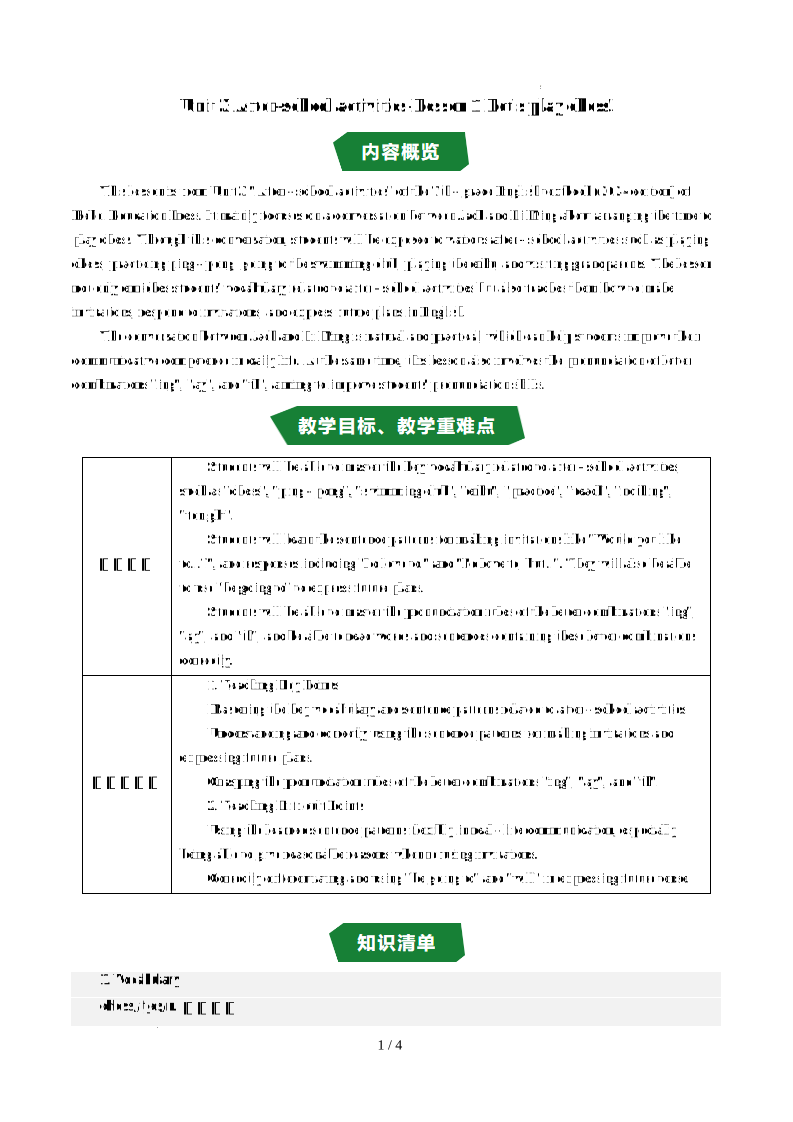
Unit 3 After-school activities-Lesson 1 Let's play chess!
This lesson is from Unit 3 "After - school activities" of the 7th - grade English textbook (2024 edition) of Hebei Education Press. It mainly focuses on a conversation between Jack and Li Ming about arranging the time to play chess. Through this conversation, students will be exposed to various after - school activities such as playing chess, practicing ping - pong, going to the swimming club, playing the erhu, and visiting grandparents. The lesson not only enriches students' vocabulary related to after - school activities but also teaches them how to make invitations, respond to invitations, and express future plans in English.
The conversation between Jack and Li Ming is natural and practical, which can help students improve their communicative competence in daily life. At the same time, this lesson also involves the pronunciation of letter combinations "ing", "ay", and "th", aiming to improve students' pronunciation skills.
教学目标
Students will be able to master the key vocabulary related to after - school activities, such as "chess", "ping - pong", "swimming club", "erhu", "practice", "teach", "nothing", "tonight".
Students will learn the sentence patterns for making invitations like "Would you like to...?", and responses including "I'd love to." and "I'd love to, but...". They will also be able to use "be going to" to express future plans.
Students will be able to master the pronunciation rules of the letter combinations "ing", "ay", and "th", and be able to read words and sentences containing these letter combinations correctly.
教学重难点
1. Teaching Key Points
Mastering the key vocabulary and sentence patterns related to after - school activities.
Understanding and correctly using the sentence patterns for making invitations and expressing future plans.
Grasping the pronunciation rules of the letter combinations "ing", "ay", and "th".
2. Teaching Difficult Points
Using the learned sentence patterns flexibly in real - life communication, especially being able to give reasonable reasons when refusing invitations.
Correctly differentiating and using "be going to" and "will" in expressing future tense.
1. Vocabulary
chess /tʃes/n. 国际象棋
ping - pong /ˈpɪŋ pɒŋ/n. 乒乓球
swimming club /ˈswɪmɪŋ klʌb/ 游泳俱乐部
erhu /ˈɜːhuː/n. 二胡
practice /ˈpræktɪs/v. 练习;训练 n. 练习;实践;惯例
teach /tiːtʃ/v. 教;讲授;教导
nothing /ˈnʌθɪŋ/pron. 没有什么;没有一件东西
tonight /təˈnaɪt/adv. 在今晚;在今夜 n. 今夜;今晚
2. Sentence Patterns
Making Invitations: Would you like to...?
Positive Responses: I'd love to.
Negative Responses: I'd love to, but...
Expressing Future Plans: be going to + do sth.
3. Pronunciation
ing /ɪŋ/ e.g. swimming, nothing
ay /eɪ/ e.g. maybe, always
th /θ/ e.g. nothing, Thursday
教学过程
1. Warming - up (5 minutes)
Greet the students as usual. Then, show some pictures of students doing different after - school activities on the PPT, such as playing basketball, reading books, dancing, etc. Ask students to look at the pictures and quickly say out the activities they see in Chinese. For example, when showing a picture of a student playing basketball, ask "What is he doing?" Encourage students to answer "打篮球".
Then, randomly choose several students and ask them "What do you usually do after school?" in Chinese. Let them answer briefly. This activity can quickly arouse students' interest and lead them into the topic of after - school activities.
2. Pre - listening (10 minutes)
Present the new words on the PPT one by one. Teach the pronunciation of each word clearly, and let students read after the teacher several times. For example, when teaching the word "chess", say "Read after me, chess, chess." Pay attention to the correct pronunciation of each word, especially for words with difficult pronunciation like "practice" and "erhu".
After teaching the words, show some pictures related to the new words again. Point to the pictures and ask students to say the corresponding English words. For example, point to a picture of a chessboard and ask "What's this?" Guide students to answer "chess". This can help students associate words with real - life objects and deepen their memory of new words.
Then, introduce the sentence patterns. Write "Would you like to...?" on the blackboard. Explain its meaning and usage, that is, it is used to make invitations. Give some examples, such as "Would you like to play football with me?" Then, teach the positive response "I'd love to." and the negative response "I'd love to, but...". Let students practice making invitations and responding in pairs. Walk around the classroom to monitor and help them.
3. While - listening (15 minutes)
Tell students that they are going to listen to a conversation between Jack and Li Ming about their after - school activities. Before listening, show the two questions on the PPT:
A. When will Jack and Li Ming play chess?
B. Who will teach Li Ming to play the erhu on Thursday?
Let students predict the answers according to their own guesses. This can stimulate their thinking and make them more focused when listening.
Play the recording of the conversation for the first time. Let students listen carefully and try to answer the two questions. After listening, ask several students to share their answers.
Play the recording again. This time, ask students to listen more carefully and complete the activity - day - student matching task on the handout. The task is to match the activities (playing chess, practicing ping - pong, going to the swimming club, playing the erhu, visiting grandparents) with the corresponding days (Monday, Tuesday, Wednesday, Thursday, Friday) and students (Jack or Li Ming).
Check the answers together. Explain the key points in the conversation, such as why Li Ming can't play chess with Jack on Tuesday (because he practices ping - pong on Tuesdays), and how they finally decide to play chess (tonight).
4. Post - listening (10 minutes)
Divide the students into pairs. Let them role - play the conversation between Jack and Li Ming. Encourage them to use their own voices and body languages to make the role - play more vivid. Walk around the classroom to monitor and give guidance. After several pairs have finished role - playing, invite some pairs to come to the front of the classroom to show their performance. Praise their good performance and give some suggestions for improvement.
Then, conduct a group discussion. Divide the students into groups of four. Ask each group to discuss and make a list of their group members' after - school activities in a week. Each group member should share their own after - school activity plans. After the discussion, ask each group to choose a representative to report their group's discussion results to the whole class. For example, the representative can say "In our group, Tom plays basketball on Monday, Lucy practices the piano on Wednesday...".
5. Pronunciation Teaching (5 minutes)
Write some words containing the letter combinations "ing", "ay", and "th" on the blackboard, such as "swimming", "maybe", "nothing", "Thursday". Read these words one by one, emphasizing the pronunciation of the letter combinations. Let students listen carefully and imitate.
Then, play the pronunciation part of the recording. Let students listen and repeat after the recording. Pay attention to the intonation and rhythm.
After that, ask students to find more words with these letter combinations in their textbooks or in their daily lives. Invite several students to share the words they find, and then read these words together.
6. Summary and Homework (5 minutes)
Summarize the key points of this lesson with the students, including the new words, sentence patterns, and pronunciation rules. Review the important knowledge points again to strengthen students' memory.
Assign homework:
Ask students to write a short passage about their own after - school activity plans for next week, using at least three sentence patterns learned in this lesson.
Let students practice reading the conversation between Jack and Li Ming fluently at home and record their reading. They can send the recording to the teacher through the class group app.
教学反思
After teaching this lesson, I found that most students were interested in the topic of after - school activities and were actively involved in classroom activities. The use of pictures and real - life examples in the warming - up and pre - listening stages effectively helped students understand new words and sentence patterns. However, during the while - listening stage, some students had difficulty in extracting key information quickly, especially in the activity - day - student matching task. In the future, more listening practice with different levels of difficulty should be provided to improve students' listening skills.
In the post - listening role - play and group discussion, students showed strong communication skills. But some students were a bit shy when expressing themselves in English. More encouragement and opportunities for them to speak English should be given. Regarding the pronunciation teaching, students basically mastered the pronunciation rules of the three letter combinations, but more practice is still needed to make their pronunciation more accurate and natural. Overall, through this teaching reflection, I will adjust my teaching methods and strategies in the next class to better meet the learning needs of students.
2 / 37
学科网(北京)股份有限公司
学科网(北京)股份有限公司
$$
资源预览图
1

2
相关资源
由于学科网是一个信息分享及获取的平台,不确保部分用户上传资料的 来源及知识产权归属。如您发现相关资料侵犯您的合法权益,请联系学科网,我们核实后将及时进行处理。