Unit 3 Curious minds A An inborn ability (Viewing and listening)教学设计 2025-2026学年沪教版(五四学制)(2024)八年级英语上册
2025-08-31
|
5页
|
58人阅读
|
75人下载
普通
资源信息
| 学段 | 初中 |
|---|---|
| 学科 | 英语 |
| 教材版本 | 初中英语沪教版(五四学制)八年级上册 |
| 年级 | 八年级 |
| 章节 | A An inborn ability (Viewing and listening) |
| 类型 | 教案-教学设计 |
| 知识点 | - |
| 使用场景 | 同步教学-新授课 |
| 学年 | 2025-2026 |
| 地区(省份) | 全国 |
| 地区(市) | - |
| 地区(区县) | - |
| 文件格式 | DOCX |
| 文件大小 | 54 KB |
| 发布时间 | 2025-08-31 |
| 更新时间 | 2025-08-31 |
| 作者 | 匿名 |
| 品牌系列 | - |
| 审核时间 | 2025-08-31 |
| 下载链接 | https://m.zxxk.com/soft/53696938.html |
| 价格 | 0.00储值(1储值=1元) |
| 来源 | 学科网 |
摘要:
该初中英语教学设计聚焦“天生能力”主题,围绕talent、gift等核心词汇,“have a natural talent for”等表达及“It is amazing that...”等句型展开。通过展示莫扎特等名人图片引发“天赋是否天生”讨论,搭建从生活认知到语言学习的支架,梳理词汇积累到听说运用的脉络。
资料融合语言能力与思维品质培养,听中采用三级听力训练(主旨理解、细节填表、复杂内容分析),结合预测、记关键词策略;听后设“天赋与努力”小组讨论及“ talent scout”角色扮演,让学生在真实语境中运用语言。提升学生听说效率与批判性思维,为教师提供分层教学活动设计,助力课堂互动。
内容正文:
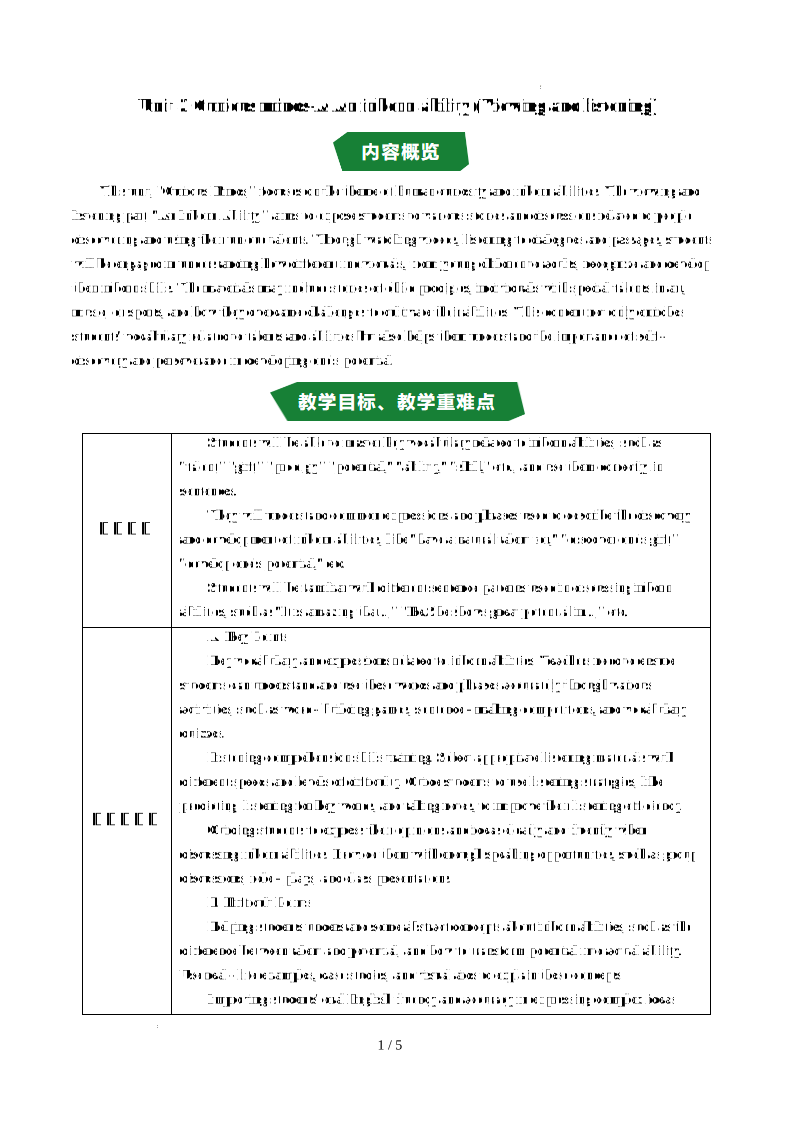
Unit 3 Curious minds-A An inborn ability (Viewing and listening)
This unit, "Curious Minds," focuses on the theme of human curiosity and inborn abilities. The viewing and listening part, "An Inborn Ability," aims to expose students to various stories and discussions related to people discovering and using their unique talents. Through watching videos, listening to dialogues and passages, students will be engaged in understanding how different individuals, from young children to adults, recognize and develop their inborn skills. The materials may include stories of child prodigies, individuals with special talents in art, music, or sports, and how they overcame challenges to cultivate their abilities. This content not only enriches students' vocabulary related to talents and abilities but also helps them understand the importance of self - discovery and perseverance in developing one's potential.
教学目标
Students will be able to master key vocabulary related to inborn abilities, such as "talent," "gift," "prodigy," "potential," "ability," "skill," etc., and use them correctly in sentences.
They will understand common expressions and phrases used to describe the discovery and development of inborn abilities, like "have a natural talent for," "discover one's gift," "develop one's potential," etc.
Students will be familiar with different sentence patterns used in discussing inborn abilities, such as "It is amazing that...," "He/She shows great potential in...," etc.
教学重难点
A. Key Points
Key vocabulary and expressions related to inborn abilities. Teachers need to ensure students can understand and use these words and phrases accurately through various activities, such as word - building games, sentence - making competitions, and vocabulary quizzes.
Listening comprehension skills training. Select appropriate listening materials with different speeds and levels of difficulty. Guide students to use listening strategies, like predicting, listening for key words, and taking notes, to improve their listening efficiency.
Guiding students to express their opinions and ideas clearly and fluently when discussing inborn abilities. Provide them with enough speaking opportunities, such as group discussions, role - plays, and class presentations.
B. Difficult Points
Helping students understand some abstract concepts about inborn abilities, such as the difference between talent and potential, and how to transform potential into actual ability. Use real - life examples, case studies, and visual aids to explain these concepts.
Improving students' oral English fluency and accuracy in expressing complex ideas about inborn abilities. Teachers need to correct students' language mistakes in a timely and appropriate way, and encourage them to practice speaking more outside of class.
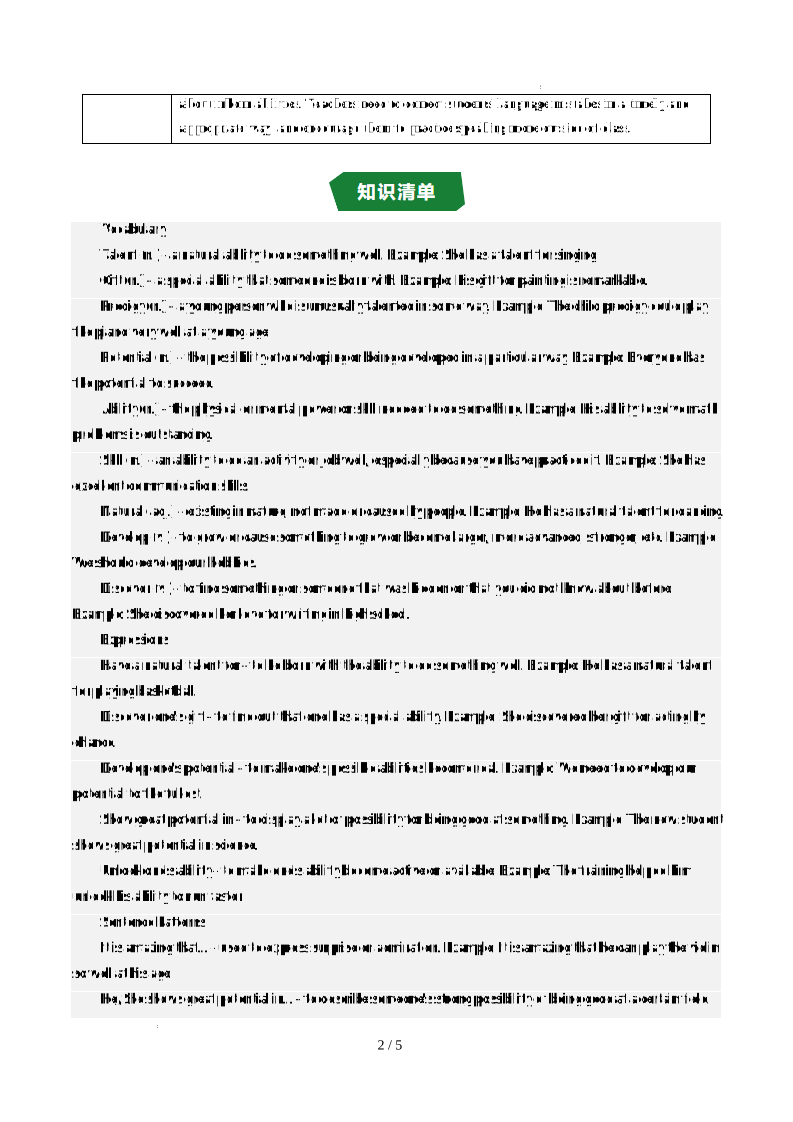
Vocabulary
Talent (n.) - a natural ability to do something well. Example: She has a talent for singing.
Gift (n.) - a special ability that someone is born with. Example: His gift for painting is remarkable.
Prodigy (n.) - a young person who is unusually talented in some way. Example: The child prodigy could play the piano very well at a young age.
Potential (n.) - the possibility of developing or being developed in a particular way. Example: Everyone has the potential to succeed.
Ability (n.) - the physical or mental power or skill needed to do something. Example: His ability to solve math problems is outstanding.
Skill (n.) - an ability to do an activity or job well, especially because you have practiced it. Example: She has excellent communication skills.
Natural (adj.) - existing in nature; not made or caused by people. Example: He has a natural talent for dancing.
Develop (v.) - to grow or cause something to grow or become larger, more advanced, stronger, etc. Example: We should develop our hobbies.
Discover (v.) - to find something or someone that was hidden or that you did not know about before. Example: She discovered her love for writing in high school.
Expressions
Have a natural talent for - to be born with the ability to do something well. Example: He has a natural talent for playing basketball.
Discover one's gift - to find out that one has a special ability. Example: She discovered her gift for acting by chance.
Develop one's potential - to make one's possible abilities become real. Example: We need to develop our potential to the fullest.
Show great potential in - to display a lot of possibility for being good at something. Example: The new student shows great potential in science.
Unlock one's ability - to make one's ability become active or available. Example: The training helped him unlock his ability to run faster.
Sentence Patterns
It is amazing that... - used to express surprise or admiration. Example: It is amazing that he can play the violin so well at his age.
He/She shows great potential in... - to describe someone's strong possibility of being good at a certain field. Example: She shows great potential in painting.
Everyone has the potential to... - to state that every person has the possibility to do something. Example: Everyone has the potential to learn a new language.
教学过程
A. Lead - in (5 minutes)
Show students some pictures of famous people with special talents, such as Mozart (a musical prodigy), Yo - Yo Ma (a famous cellist), and Serena Williams (a great tennis player). Ask students to look at the pictures and guess what talents these people have.
T: Look at these pictures, class. Can you tell me who they are and what special talents they might have?
Ss: Mozart is a musician, he can play the piano very well. Yo - Yo Ma is a cellist, and Serena Williams is a great tennis player.
Then, start a simple class discussion:
T: Do you think these talents are inborn or learned? Why do you think so?
Encourage several students to share their opinions. This will arouse students' interest in the topic of inborn abilities and lead to the next part of the class.
B. Pre - listening (10 minutes)
Present new vocabulary related to inborn abilities on the blackboard or through a PPT. Explain the meanings and usages of these words briefly.
Talent: a natural ability to do something well. We can say "He has a talent for dancing."
Gift: a special ability that someone is born with. For example, "Her gift for singing is amazing."
Prodigy: a young person who is unusually talented. "The child prodigy showed great skills in math."
Potential: the possibility of developing. "Everyone has the potential to be successful."
Divide students into pairs. Let them practice using these new words to make sentences about talents they know. Walk around the classroom to monitor and offer help if necessary.
T: Now, work with your partner. Use these new words to make sentences about talents. For example, you can say "My friend has a talent for drawing."
After a few minutes, ask some pairs to share their sentences with the class.
C. While - listening (15 minutes)
First listening
Play a short dialogue about a boy who has a natural talent for music. The dialogue may include information like how the boy discovered his talent, what difficulties he faced in developing it, and his future plans.
T: Now, listen carefully to this dialogue. Try to get the main idea. What is the boy's talent?
After playing the dialogue, ask students to answer the question.
Ss: The boy has a talent for music.
Second listening
Play the dialogue again. This time, ask students to listen for specific details and fill in a table on the handout. The table may include columns like "Talent," "How discovered," "Difficulties," and "Future plans."
T: Listen again. Pay attention to the details and fill in the table on your handout.
After listening, check the answers with the class.
Third listening
Play a longer passage about different people's inborn abilities and how they developed them. This passage may cover more complex situations and ideas.
T: Now, we will listen to a passage. Try to understand the main points and take some notes if necessary.
After playing the passage, ask students some comprehension questions, such as "What are the common ways people discover their inborn abilities according to the passage?" or "What are the important factors in developing inborn abilities?"
D. Post - listening (10 minutes)
Group discussion
Divide students into groups of four or five. Give each group a topic related to inborn abilities, such as "Do you think inborn abilities are more important than hard work?" or "How can we discover our own inborn abilities?"
T: Now, discuss the topic in your groups. Each group member should share their opinions.
Walk around the groups to listen to their discussions and offer guidance if needed. After about 5 minutes, ask each group to choose a representative to share the group's discussion results with the class.
Role - play
Present a situation to the students: A talent scout is looking for students with special talents in the school. Each student in the group needs to introduce their inborn talent (real or imagined) to the talent scout.
T: In your groups, one of you will be the talent scout, and the others will be students introducing their talents. Use the vocabulary and expressions we learned today.
Let the students perform the role - play for a few minutes. Then, ask some groups to show their role - play in front of the class.
E. Summary and Homework (5 minutes)
Summary
Summarize the key vocabulary, expressions, and sentence patterns about inborn abilities with the class. Review the main ideas of the listening materials and the results of the group discussions.
T: Class, let's review what we have learned today. Who can tell me some of the new words about talents?
Ss: Talent, gift, potential...
T: Very good. And what are some expressions we learned?
Ss: Have a natural talent for, discover one's gift...
Homework
Ask students to write a short passage about an inborn ability they wish they had. They need to include why they want this ability, how they think they could develop it, and what they would do with this ability if they had it.
T: For your homework, write a passage about an inborn ability you wish you had. Remember to use the words and expressions we learned today.
教学反思
After teaching this viewing and listening class, I found that students were generally interested in the topic of inborn abilities. The lead - in part with pictures of famous talented people successfully attracted their attention and engaged them in the initial discussion. However, in the vocabulary teaching stage, some students had difficulty in differentiating between similar words like "talent" and "gift." In the future, more examples and comparison exercises could be provided to help them better understand the nuances.
During the listening process, most students could grasp the main ideas of the dialogues and passages, but some still had trouble catching specific details. This indicates that more listening practice with different types of materials and more guidance on listening strategies are needed. The group discussion and role - play activities were quite effective in getting students to use the language they learned. However, some students were a bit shy and did not actively participate. In the next class, I will try to create a more relaxed and encouraging atmosphere to make all students more willing to speak. Overall, this class laid a good foundation for students to further explore the theme of inborn abilities, and I will adjust my teaching methods based on these reflections to improve teaching effectiveness.
2 / 37
学科网(北京)股份有限公司
学科网(北京)股份有限公司
$$
资源预览图
1
2
相关资源
由于学科网是一个信息分享及获取的平台,不确保部分用户上传资料的 来源及知识产权归属。如您发现相关资料侵犯您的合法权益,请联系学科网,我们核实后将及时进行处理。