Unit 2 Go for it!-Presenting ideas 教学设计 2024-2025学年外研版英语七年级下册
2025-08-26
|
4页
|
308人阅读
|
86人下载
普通
资源信息
| 学段 | 初中 |
|---|---|
| 学科 | 英语 |
| 教材版本 | 初中英语外研版七年级下册 |
| 年级 | 七年级 |
| 章节 | Presenting ideas |
| 类型 | 教案-教学设计 |
| 知识点 | - |
| 使用场景 | 同步教学-新授课 |
| 学年 | 2025-2026 |
| 地区(省份) | 全国 |
| 地区(市) | - |
| 地区(区县) | - |
| 文件格式 | DOCX |
| 文件大小 | 49 KB |
| 发布时间 | 2025-08-26 |
| 更新时间 | 2025-08-26 |
| 作者 | 匿名 |
| 品牌系列 | - |
| 审核时间 | 2025-08-26 |
| 下载链接 | https://m.zxxk.com/soft/53616442.html |
| 价格 | 0.00储值(1储值=1元) |
| 来源 | 学科网 |
内容正文:
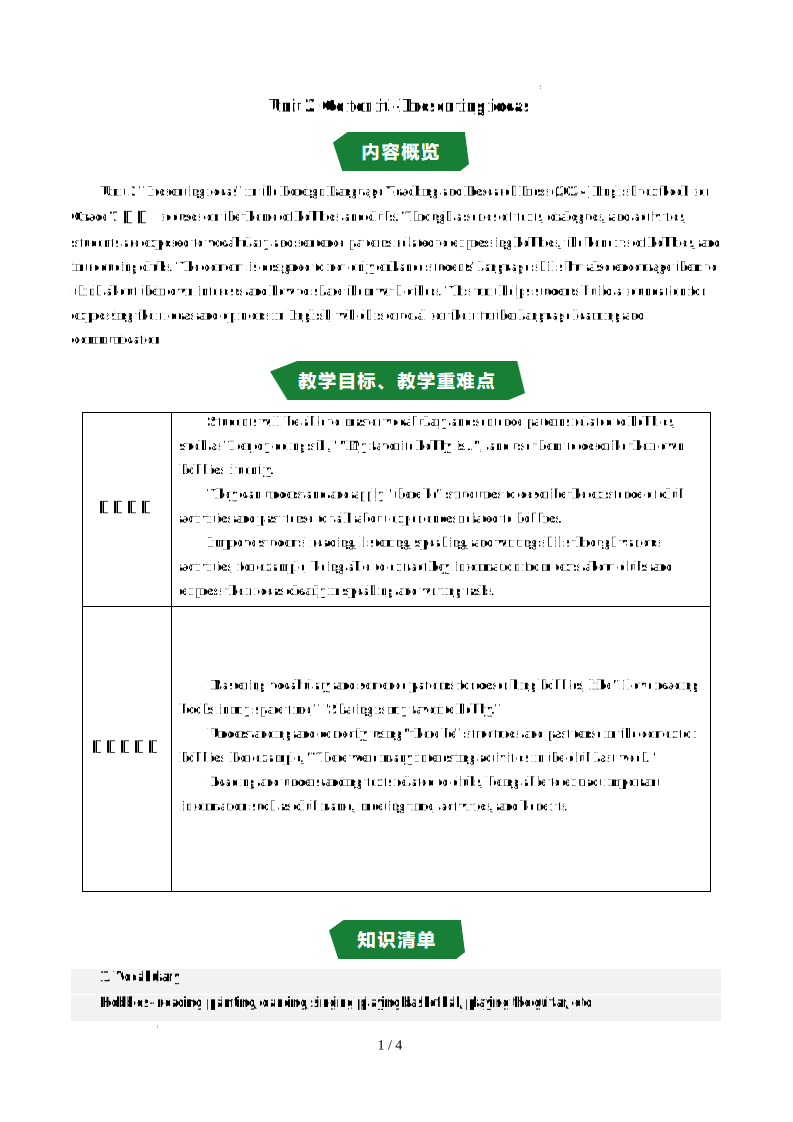
Unit 2 Go for it!-Presenting ideas
Unit 2 "Presenting ideas" in the Foreign Language Teaching and Research Press (2024) English textbook for Grade 7 上册 focuses on the theme of hobbies and clubs. Through a series of texts, dialogues, and activities, students are exposed to vocabulary and sentence patterns related to expressing hobbies, the benefits of hobbies, and introducing clubs. The content is designed to not only enhance students' language skills but also encourage them to think about their own interests and how to share them with others. This unit helps students build a foundation for expressing their ideas and opinions in English, which is crucial for their further language learning and communication.
教学目标
Students will be able to master vocabulary and sentence patterns related to hobbies, such as "I enjoy doing sth.," "My favorite hobby is...", and use them to describe their own hobbies fluently.
They can understand and apply "there be" structures to describe the existence of club activities and past tense to talk about experiences related to hobbies.
Improve students' reading, listening, speaking, and writing skills through various activities, for example, being able to extract key information from texts about clubs and express their ideas clearly in speaking and writing tasks.
教学重难点
Mastering vocabulary and sentence patterns for describing hobbies, like "I love reading books in my spare time," "Skating is my favorite hobby."
Understanding and correctly using "there be" structures and past tense in the context of hobbies. For example, "There were many interesting activities in the club last week."
Reading and understanding texts related to clubs, being able to extract important information such as club name, meeting time, activities, and benefits.
1. Vocabulary
Hobbies - reading, painting, dancing, singing, playing basketball, playing the guitar, etc.
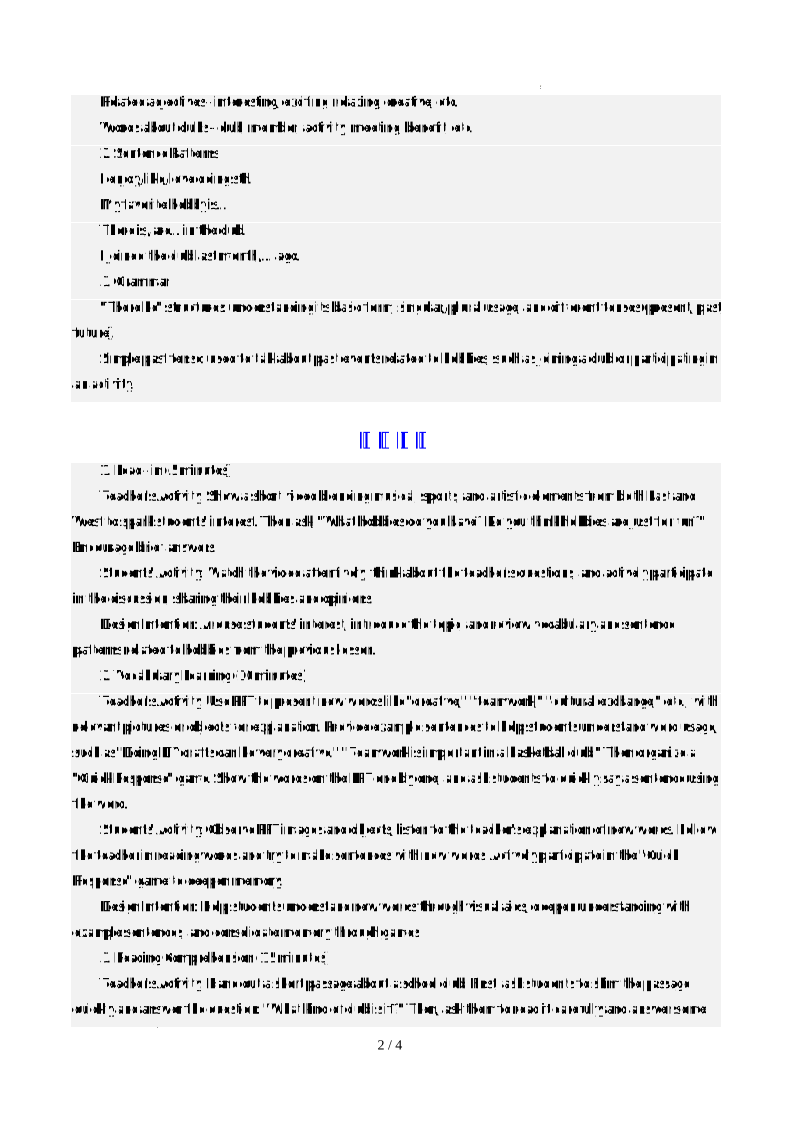
Related adjectives - interesting, exciting, relaxing, creative, etc.
Words about clubs - club, member, activity, meeting, benefit, etc.
2. Sentence Patterns
I enjoy/like/love doing sth.
My favorite hobby is...
There is/are... in the club.
I joined the club last month/... ago.
3. Grammar
"There be" structures: understanding its basic form, singular/plural usage, and different tenses (present, past, future).
Simple past tense: used to talk about past events related to hobbies, such as joining a club or participating in an activity.
教学过程
1. Lead - in (5 minutes)
Teacher's Activity: Show a short video blending musical, sports, and artistic elements from both East and West to spark students' interest. Then ask, "What hobbies do you have? Do you think hobbies are just for fun?" Encourage brief answers.
Students' Activity: Watch the video attentively, think about the teacher's questions, and actively participate in the discussion, sharing their hobbies and opinions.
Design Intention: Arouse students' interest, introduce the topic, and review vocabulary and sentence patterns related to hobbies from the previous lesson.
2. Vocabulary Learning (10 minutes)
Teacher's Activity: Use PPT to present new words like "creative," "teamwork," "cultural exchange," etc., with relevant pictures or objects for explanation. Provide example sentences to help students understand word usage, such as "Doing DIY crafts can be very creative." "Teamwork is important in a basketball club." Then organize a "Quick Response" game. Show the words on the PPT one by one, and ask students to quickly say a sentence using the word.
Students' Activity: Observe PPT images and objects, listen to the teacher's explanation of new words. Follow the teacher in reading words and try to make sentences with new words. Actively participate in the "Quick Response" game to deepen memory.
Design Intention: Help students understand new words through visual aids, deepen understanding with example sentences, and consolidate memory through games.
3. Reading Comprehension (15 minutes)
Teacher's Activity: Hand out a short passage about a school club. First, ask students to skim the passage quickly and answer the question: "What kind of club is it?" Then, ask them to read it carefully and answer some detailed questions, such as "When and where does the club meet?", "What activities does the club have?", "What are the benefits of joining this club?" After that, explain some difficult sentences and new grammar points that appear in the passage, especially the "there be" structures.
Students' Activity: Read the passage as required, answer the questions, and listen carefully to the teacher's explanation of difficult points. Underline the sentences with "there be" structures and try to understand their usage.
Design Intention: Improve students' reading skills, help them extract key information from texts, and at the same time, introduce and explain important grammar points in context.
4. Group Discussion (10 minutes)
Teacher's Activity: Divide students into groups of four or five. Pose the question: "If you could start a new club at school, what kind of club would it be? Discuss the name, activities, meeting time and place, and benefits of your club." Walk around the classroom, listen to students' discussions, and offer guidance when necessary.
Students' Activity: In groups, discuss the plan for a new club. Each member contributes ideas, and one member takes notes. Use the vocabulary and sentence patterns they have learned to express their ideas.
Design Intention: Promote students' collaborative learning ability, encourage them to use the learned language knowledge to express their ideas, and develop their creative thinking.
5. Conclusion and Homework Assignment (5 minutes)
Teacher's Activity: Summarize the key points of this class, including new vocabulary, sentence patterns, and grammar. Remind students of the importance of hobbies and clubs. Then assign homework: "Write a short passage about the club your group designed in class. Include all the information you discussed, such as the name, activities, meeting time, place, and benefits."
Students' Activity: Listen to the teacher's summary, take notes if necessary, and write down the homework assignment.
Design Intention: Reinforce students' understanding of the content learned in class and consolidate knowledge through homework.
教学反思
After teaching this unit, several aspects need to be reflected on. In terms of teaching methods, the use of videos and games in the lead - in and vocabulary learning stages was effective in attracting students' attention and making the learning process more engaging. However, in the group discussion part, some students were a bit shy to express their ideas, and the group dynamics could have been better managed. Maybe more guidance on how to start the discussion and how to encourage every member to participate could be provided next time.
Regarding students' learning, most students seemed to have grasped the basic vocabulary and sentence patterns related to hobbies and clubs. But when it came to applying them in real - life - like situations, such as the group discussion, some students still made mistakes in grammar and vocabulary usage. This indicates that more practice in context is needed. Also, in the reading comprehension section, some students had difficulty understanding long and complex sentences. More reading strategies should be taught in future classes to help them improve their reading skills. Overall, adjustments should be made in future teaching to better meet students' needs and improve the teaching effect.
2 / 37
学科网(北京)股份有限公司
学科网(北京)股份有限公司
$$
资源预览图
1
2
相关资源
由于学科网是一个信息分享及获取的平台,不确保部分用户上传资料的 来源及知识产权归属。如您发现相关资料侵犯您的合法权益,请联系学科网,我们核实后将及时进行处理。