Unit 4 课时1 Reading(分层作业)英语沪教版八年级上册
2025-07-02
|
2份
|
14页
|
468人阅读
|
41人下载
内容正文:
Unit 4 Inventions
课时1 Reading 分层作业
核心知识速记
03拓展培优
01基础达标
05思维进阶
02能力提升
(
词汇
wheel
n.
轮,车轮
central
adj
.
在中心的
although
conj
.
虽然
;
尽管
attach
v
.
把…附上
pull
v
.
拉、拽
international
adj
.
国际的
technique
n.
技巧
doubt
n.
疑问
personally adv.就个人意见
depend on 依赖
句型
1.Although this meant that people could travel further and faster, transporting large amount of goods was still a difficult job.
尽管这意味着人们能够更远更快地旅行,运输大量货物仍然是一项艰难的工作。
)
一、单词默写。
1. _______ /wi:l/ n. 轮;车轮 2. ________ /ɔːl'ðəʊ/ conj. 虽然;尽管;即使
3. __________ /'sentrəl/ adj. 在中心的 4. ________ /pʊl/ v. 拉;拽;扯;拖
5. _______ /ˌɪntə'næʃnəl/ adj. 国际的 6.________ /dɪ'pend/ v. 需要;依靠 7.________ /daʊt/ n. 疑惑;疑问 8.________ /'pɜ:sənəli/ adv. 就个人意见
二、词组默写。
1. 决定做某事 _______________________ 2. 步行 _______________________
3. 继续做某事 _______________________ 4. 发生 _______________________
5. 把…固定到…上 ___________________ 6. 国际贸易 _______________________
7. 依赖于 _______________________ 8. 毫无疑问 _________________
三、根据要求完成句子
1. 人们互相依赖。
People ______ ______ ______ ______?
2. Sam把自行车拴在了树上。
Sam ______ his bike ______ ______ ______.
3. 后来,他们意识到他们可以使用轮子运输人和货物。
Later, they ______ that they could use wheels ____ __________ people and things.
4. 这一发明提高了国内和国际的贸易。
This invention _________ _________ and _____________ trade.
5. 结果,在轮子被发明后,第一条石子路出现了。
____ ____ ________, the first road ______ _____ stone appeared after the arrival of the wheel.
6. 毫无疑问,轮子是史上最重要的发明之一。
______ ______, the wheel is one of ______ _______ ___________ _________ of all time.
7. 冒险故事发生在哪里?
Where did the adventures ______ ______?
8. 他每天步行去学校。
He ______ ______ ________ ____ ______ every day.
四 、用括号内所给词的适当形式填空。
1. Be careful with your ____________(personally) information.
2. We can go for a walk in ________(center) park.
3. He decided __________(have) a rest after the long journey.
4. The photo was printed on all the ___________(nation) newspapers.
5. Wheels allow inventors __________(build) all types of machines.
五、阅读短文,用所给词适当形式填空。
Embroidery (刺绣) was often regarded as “women’s work” in the past. And it was not common for a boy 1 (learn) it. Therefore, Fu Jian’s parents didn’t want 2 (he) to work in this industry at first. But Fu didn’t care. He believed he could do it well.
Fu was born into an embroidery family in Yangzhou. His mother is 3 master craftswoman (女工匠) of Suzhou embroidery. Fu fell in love with this beautiful art when he was four years old. In his last year of high school, Fu set his life goal 4 (clear). “Although many people know about this traditional art, I want to help them learn 5 (much) about it,” he said.
After 6 (graduate) from college, Fu and his mother built a research center of Suzhou embroidery. Since then, he 7 (invent) many new stitches (针法). He has also trained many 8 (worker).
Fu spends a lot of time 9 his works. Even so, he enjoys it. “I often work late into midnight, 10 I never feel tired. I think that’s because I’m doing what I love,” said the 37-year-old.
六、阅读还原。
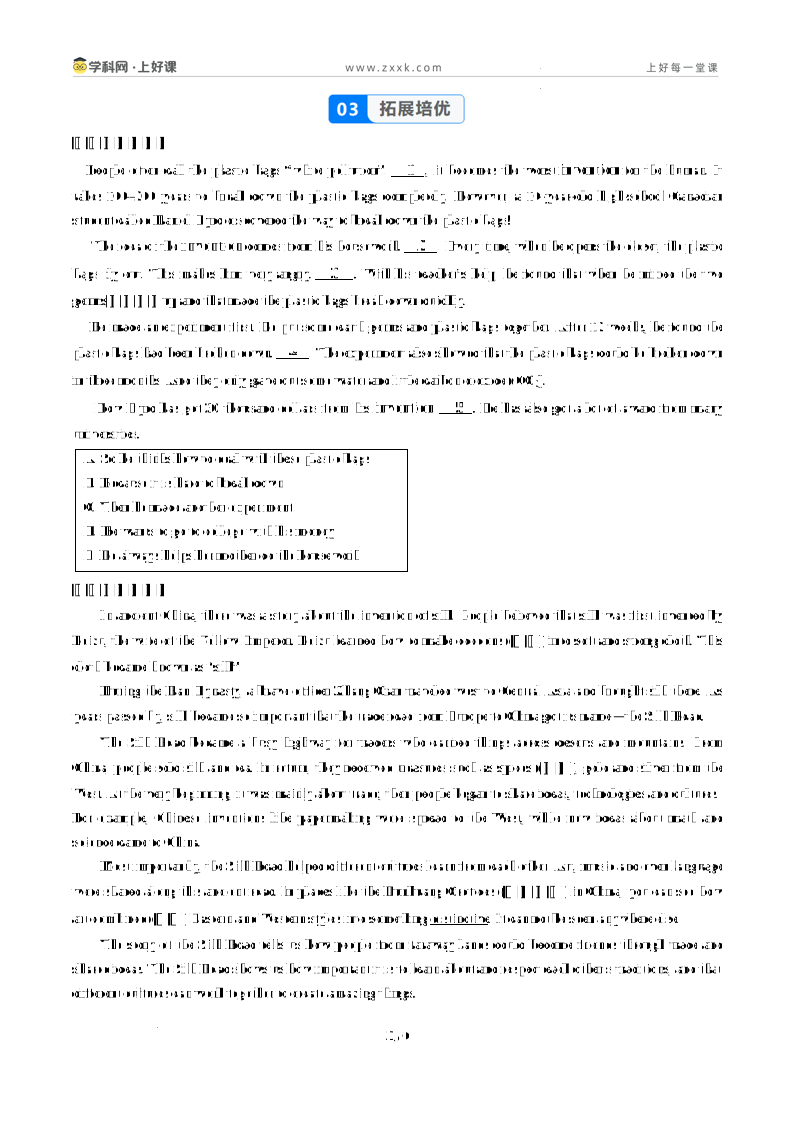
People often call the plastic bags “white pollution”. 1 , it becomes the worst invention for the human. It takes 100–200 years to break down the plastic bags completely. However, a 16-year-old high-school Canadian student called Daniel Byrd discovered the way to break down the plastic bags!
The idea of the invention comes from his housework. 2 . Every time, when he opens the closet, the plastic bags fly out. This makes him very angry. 3 . With his teacher’s help, he found that when he mixed the two germs(细菌)up and that made the plastic bags break down quickly.
He made an experiment first. He put some earth germs and plastic bags together. After 12 weeks, he found the plastic bags had been broken down. 4 . The experiment also showed that the plastic bags could be broken down in three months. And they only gave out some water and little carbon dioxide (CO2).
Now Byrd has got 30 thousand dollars from his invention. 5 . He has also got a lot of award from many universities.
A. So he thinks how to deal with these plastic bags
B. Because it is hard to break down
C. Then he made another experiment
D. He wants to go to college with his money
E. He always helps her mother do the housework
七、阅读理解。
In ancient China, there was a story about the invention of silk. People believed that silk was first invented by Leizu, the wife of the Yellow Emperor. Leizu learned how to make cocoons (蚕茧) into soft and strong cloth. This cloth became known as “silk”.
During the Han Dynasty, a brave officer Zhang Qian traveled west to Central Asia and brought silk there. As years passed by, silk became so important that the trade road from Europe to China got its name—the Silk Road.
The Silk Road became a busy highway for traders who carried things across deserts and mountains. From China, people sold silk and tea. In return, they received treasures such as spices (香料), gold and silver from the West. At the very beginning, it was mainly about trade; then people began to share ideas, technologies and cultures. For example, Chinese inventions like papermaking were spread to the West, while new ideas about math and science came to China.
Most importantly, the Silk Road helped different cultures learn from each other. Art, music and even language were shared along this ancient road. In places like the Dunhuang Grottoes (敦煌石窟) in China, you can see how art combined (融合) Eastern and Western styles into something distinctive. It can not be seen anywhere else.
The story of the Silk Road tells us how people from faraway lands could become friends through trade and shared ideas. The Silk Road shows us how important it is to learn about and respect each other’s traditions, and that different cultures can work together to create amazing things.
( )1. Who invented silk in ancient China?
A.Leizu. B.The kings. C.Zhang Qian. D.The Yellow Emperor.
( )2. What was spread from China to the West according to paragraph 3?
A.Silk and gold. B.Tea and papermaking. C.Spices and silver. D.New ideas of science.
( )3. What is the right order of the following facts from the passage?
① Zhang Qian traveled west with silk.
②Art and language were shared along the Silk Road.
③ Traders from China and the West exchanged things.
④The Chinese were ordered to keep the secret of making silk.
A.①→④→③→② B.①→③→④→② C.④→①→③→② D.④→③→②→①
( )4. What does the underlined word “distinctive” mean in paragraph 4?
A.Special. B.Public. C.Popular. D.Strong.
( )5. What does the story of the Silk Road mainly tell us?
A.The change of world trade. B.The introduction of silk cloth.
C.The influence of technology in history. D.The importance of cross-cultural communication.
八、完形填空。
Many of the most useful things around us were invented by mistake, such as the Velcro TM strip (维可牢尼龙搭扣), potato chips and tea were accidents.
The Velcro TM strip was 1.________ in Austria by a mountaineer called George de Mestral, and one day in 1949, when he took his dog for a walk, the dog picked up many burrs (芒). George tried to pull them out but didn’t succeed. When he got home, he put one of the burrs under his microscope and saw that it was covered in tiny hooks (钩) which made it so 2.________ to remove the burrs from his dog. This gave him the 3.________, and soon Velcro TM strip was born.
The potato chip was invented in 1853 by George Crum, a 4.________ who worked in a restaurant in America. One day, a customer in the restaurant sent back his plate of fried potatoes because they were cut too 5.________. George was so angry that he cut a potato into very thin slices and fried them. Then he put lots of salt on them. He 6.________ that the customer would hate them, but the customer loved them and asked for more.
The most 7.________ drink in the world, after water of course, is tea. It’s another common thing that was invented 8.________. It was invented in China around 5,000 years ago by a Chinese emperor called Shen Nong. The emperor was boiling water to drink over an open fire when some leaves fell into the water from a nearby plant. The emperor 9.________ that the leaves in the water produced a pleasant smell. He tasted the hot water and found it was quite delicious. And this is the 10.________ that tea was invented.
( )1. A.used B.shared C.sold D.invented
( )2. A.nervous B.difficult C.dangerous D.boring
( )3. A.advice B.hope C.test D.idea
( )4. A.cook B.waiter C.cleaner D.manager
( )5. A.small B.big C.thick D.thin
( )6.A.thought B.regretted C.imagined D.explained
( )7.A.expensive B.popular C.interesting D.delicious
( )8.A.gradually B.directly C.accidentally D.suddenly
( )9.A.noticed B.ordered C.knew D.said
( )10.A.place B.plan C.time D.way
A new invention in China
Part 1: Read and Explore
We all know “Four Great Inventions” in ancient China are important symbols of the country. Now China has new “Four Great Inventions”. They are changing people’s lives in China and maybe all over the world. And mobile payment is one of them.
The mobile payment was first used in 2004 and widely used in 2013. Now, mobile payment has become a part of Chinese people’s everyday life. It’s a way to make payments by using a mobile device.
With mobile payment, there’s no need to carry money because everything can be done simply on the phone. This method of payment is becoming increasingly popular, especially in China. There are two main mobile payment services that are commonly used by people in China. “My wallet is no longer in use. I can buy and eat anything with my smart phone,” said Lin, “Now people can even pay by their faces or hands.” People think this kind of technology makes their lives much more convenient. With mobile payment, lots of transactions (交易) can be done in seconds. This is useful in busy environments like markets or during online shopping.
However, there are also some concerns (顾虑) with mobile payment. People worry about the safety of their personal information and money. Even so, the convenience and efficiency of mobile payment continue to attract a growing number of users worldwide.
Part 2: Skills Challenge
Task 1: Cultural background
1. What are the“Four Great Inventions” in ancient China?
____________________________________________________________________________________________
Task 2: Critical Thinking(根据文章内容回答下列问题 )
1. What is mobile payment?
____________________________________________________________________________________________
2. How many ways of payment does the passage mention? What are they?
____________________________________________________________________________________________
3. What do people think of mobile payment?
____________________________________________________________________________________________
____________________________________________________________________________________________
Task 3: Creative Project
假设你是移动支付研究员,请提供一些减少支付风险的建议,用英语简单说明。
When we make mobile payment, we can ______________________________________. Also, we should ______________________________________ and ______________________________________ .
(
1
/
7
)
学科网(北京)股份有限公司
$$
Unit 4 Inventions
课时1 Reading 分层作业
核心知识速记
04拓展培优
01基础达标
07思维进阶
02能力提升
(
词汇
wheel
n.
轮,车轮
central
adj
.
在中心的
although
conj
.
虽然
;
尽管
attach
v
.
把…附上
pull
v
.
拉、拽
international
adj
.
国际的
technique
n.
技巧
doubt
n.
疑问
personally adv.就个人意见
depend on 依赖
句型
1.Although this meant that people could travel further and faster, transporting large amount of goods was still a difficult job.
尽管这意味着人们能够更远更快地旅行,运输大量货物仍然是一项艰难的工作。
)
一、单词默写。
一、单词默写。
1. _______ /wi:l/ n. 轮;车轮 2. ________ /ɔːl'ðəʊ/ conj. 虽然;尽管;即使
3. __________ /'sentrəl/ adj. 在中心的 4. ________ /pʊl/ v. 拉;拽;扯;拖
5. _______ /ˌɪntə'næʃnəl/ adj. 国际的 6.________ /dɪ'pend/ v. 需要;依靠 7.________ /daʊt/ n. 疑惑;疑问 8.________ /'pɜ:sənəli/ adv. 就个人意见
【答案】wheel;although;central;pull;international;depend; doubt; personally
二、词组默写。
1. 决定做某事 _______________________ 2. 步行 _______________________
3. 继续做某事 _______________________ 4. 发生 _______________________
5. 把…固定到…上 ___________________ 6. 国际贸易 _______________________
7. 依赖于 _______________________ 8. 毫无疑问 _________________
【答案】1. decide to do sth.; 2. on foot; 3. continue doing; 4. take place ; 5. attach...to...; 6. international trade ;
7. depend on ; 8. without doubt
三、根据要求完成句子
1. 人们互相依赖。
People ______ ______ ______ ______?
2. Sam把自行车拴在了树上。
Sam ________ his bike ______ ______ ______.
3. 后来,他们意识到他们可以使用轮子运输人和货物。
Later, they ________ that they could use wheels ____ __________ people and things.
4. 这一发明提高了国内和国际的贸易。
This invention _________ _________ and _____________ trade.
5. 结果,在轮子被发明后,第一条石子路出现了。
____ ____ ________, the first road ______ _____ stone appeared after the arrival of the wheel.
6. 毫无疑问,轮子是史上最重要的发明之一。
______ ______, the wheel is one of ______ _______ ___________ _________ of all time.
7. 冒险故事发生在哪里?
Where did the adventures ______ ______?
8. 他每天步行去学校。
He ______ ______ ________ ____ ______ every day.
【答案】1. depend on each other;2. attached; to the tree;3. realized; to transport;4. increased; national;international 5. As a result; made of;6. Without doubt; the most important inventions;7. take place;8. goes to school on foot
四 、用括号内所给词的适当形式填空。
1. Be careful with your ____________(personally) information.
2. We can go for a walk in ________(center) park.
3. He decided __________(have) a rest after the long journey.
4. The photo was printed on all the ___________(nation) newspapers.
5. Wheels allow inventors __________(build) all types of machines.
【答案】personal;central;to have;national;to build
五、阅读短文,用所给词适当形式填空。
Embroidery (刺绣) was often regarded as “women’s work” in the past. And it was not common for a boy 1 (learn) it. Therefore, Fu Jian’s parents didn’t want 2 (he) to work in this industry at first. But Fu didn’t care. He believed he could do it well.
Fu was born into an embroidery family in Yangzhou. His mother is 3 master craftswoman (女工匠) of Suzhou embroidery. Fu fell in love with this beautiful art when he was four years old. In his last year of high school, Fu set his life goal 4 (clear). “Although many people know about this traditional art, I want to help them learn 5 (much) about it,” he said.
After 6 (graduate) from college, Fu and his mother built a research center of Suzhou embroidery. Since then, he 7 (invent) many new stitches (针法). He has also trained many 8 (worker).
Fu spends a lot of time 9 his works. Even so, he enjoys it. “I often work late into midnight, 10 I never feel tired. I think that’s because I’m doing what I love,” said the 37-year-old.
【答案】1.to learn 2.him 3.a 4.clearly 5.more 6.graduating 7.has invented 8.workers 9.on 10.but
【导语】本文讲述了付健对刺绣的热爱和自身的努力,他发明了许多新针法,培训了许多刺绣工人。
1. 句意:男孩学习刺绣并不常见。it is adj.to do sth“做某事……”,动词不定式作真正的主语,故填to learn。
2. 句意:因此的父母起初不想让他从事这个行业。动词后用人称宾格,故填him。
3. 句意:母亲是苏州刺绣的女工匠大师。根据“master craftswoman”可知,不定冠词表示泛指,master是辅音音素,a符合句意,故填a。
4. 句意:高中最后一年,傅明确了自己的人生目标。根据“set his life goal”可知,副词修饰动词,clearly符合句意,故填clearly。
5. 句意:虽然很多人知道这门传统艺术,但我想帮助他们更深入了解它。根据“help them learn”可知,了解更多,需要比较级,more符合句意,故填more。
6. 句意:此后他发明了许多新针法,还培养了许多工人。根据“Since then”可知,时态是现在完成时,主语是单数,has invented符合句意,故填has invented。
7. 句意:在大学毕业之后,傅坚和妈妈创建了一个苏绣研究中心。 “After”是个介词,后接动词ing形式。
8. 句意:他还培养了许多工人。根据“many”可知,后接名词复数,workers符合句意,故填workers。
9. 句意:傅在作品上花费大量时间。spend time on sth.“在……花了时间”,固定搭配。故填on。
10.句意:我经常工作到深夜,但从不觉疲惫。前后两句是转折关系,but符合句意,故填but。
六、阅读还原。
Dogs are our friends. They are always with us on the earth. 1.______
Dogs are smart and cute. Some of them are big and some are small, but they are all good at running. They are funny and they like to play with people.
2.______Whether we are happy or not, they are always with us. But for bad people or strangers (陌生人), they can be very scary.
3.______There are many kinds of dogs and most of them are useful to us. A sheep dog can
help the farmers. A watch dog can keep our houses safe. 4.______And a guide dog can help
blind people walk. Pet dogs are our favorites. They are really cute and bring us much fun.
Dogs are great animals. 5.______
A.Dogs can help us a lot.
B.Why do we like them so much ?
C.A police dog can help the police with their work.
D.We should love them.
E.Dogs are faithful (忠诚的) and friendly to us
F. My mother’s favourite animals are dogs, too.
【答案】BEACD
【解析】
试题分析:这篇短文主要讲述环保问题,文章介绍,加拿大的一名高中生丹尼尔通过实验发明了一种能让塑料袋化解的办法。这也让他获得了许多奖金。
1. 根据下文It is reported that it takes 100-200 years to break down the plastic bags completely的描述可知,因为它很难化解,所以叫做“白色污染”。故应选B.
2. 根据前文The idea of the invention comes from his housework的描述可知,丹尼尔经常帮助妈妈做家务。故应选E,
3. 根据前文when he opens the closet,the plastic bags fly out.This makes him very angry的描述可知,由于塑料袋到处飞,因此丹尼尔考虑如何解决塑料袋问题。故选A。
4. 根据下文The experiment also showed that the plastic bags could be broken down in three months的描述可知,丹尼尔做的另一个实验也表明塑料袋可以在3个月内化解。故选C.
5. 联系上下文的描述可知,丹尼尔用发明得来的钱上了大学,同时在大学里也得到了许多奖金,故应选D.考点:科普环保类短文阅读
七、阅读理解。
In ancient China, there was a story about the invention of silk. People believed that silk was first invented by Leizu, the wife of the Yellow Emperor. Leizu learned how to make cocoons (蚕茧) into soft and strong cloth. This cloth became known as “silk”.
During the Han Dynasty, a brave officer Zhang Qian traveled west to Central Asia and brought silk there. As years passed by, silk became so important that the trade road from Europe to China got its name—the Silk Road.
The Silk Road became a busy highway for traders who carried things across deserts and mountains. From China, people sold silk and tea. In return, they received treasures such as spices (香料), gold and silver from the West. At the very beginning, it was mainly about trade; then people began to share ideas, technologies and cultures. For example, Chinese inventions like paper making were spread to the West, while new ideas about math and science came to China.
Most importantly, the Silk Road helped different cultures learn from each other. Art, music and even language were shared along this ancient road. In places like the Dunhuang Grottoes (敦煌石窟) in China, you can see how art combined (融合) Eastern and Western styles into something distinctive. It can not be seen anywhere else.
The story of the Silk Road tells us how people from faraway lands could become friends through trade and shared ideas. The Silk Road shows us how important it is to learn about and respect each other’s traditions, and that different cultures can work together to create amazing things.
( )1. Who invented silk in ancient China?
A.Leizu. B.The kings. C.Zhang Qian. D.The Yellow Emperor.
( )2. What was spread from China to the West according to paragraph 3?
A.Silk and gold. B.Tea and paper making. C.Spices and silver. D.New ideas of science.
( )3. What is the right order of the following facts from the passage?
① Zhang Qian traveled west with silk.
②Art and language were shared along the Silk Road.
③ Traders from China and the West exchanged things.
④The Chinese were ordered to keep the secret of making silk.
A.①→④→③→② B.①→③→④→② C.④→①→③→② D.④→③→②→①
( )4. What does the underlined word “distinctive” mean in paragraph 4?
A.Special. B.Public. C.Popular. D.Strong.
( )5. What does the story of the Silk Road mainly tell us?
A.The change of world trade. B.The introduction of silk cloth.
C.The influence of technology in history. D.The importance of cross-cultural communication.
【答案】ABCAD
【解析】
【导语】本文介绍了丝绸之路的由来以及跨文化交流的重要性。
1. 细节理解题。根据“People believed that silk was first invented by Leizu,the wife of the Yellow Emperor.”可知丝绸是嫘祖发明的。故选A。
2. 细节理解题。根据“From China,people sold silk and tea.In return,they received treasures such as spices,gold and silver from the West.”和"For example,Chinese inventions like paper making were spread to the West,"可知丝绸、茶叶和造纸从中国运到西方。故选B。
3. 细节理解题。根据第一段"Following kings’ orders,the Chinese kept the secret of making silk for centuries."可知丝绸制作方法一直是保密的,即④,直到后来“During the Han Dynasty,the brave officer Zhang Qian traveled west as far as Central Asia and brought silk there."张骞把丝绸带去西方,即①,然后开始有丝绸之路。故选C。
4. 词句猜测题。根据“you can see how art pieces combined Eastern and Western styles into something distinctive.”可知中西方文化融合会出来特殊的东西。故选A。
5. 推理判断题。根据“The story of the Silk Road tells us how people from faraway lands could become friends through trade and shared ideas.”可知丝绸之路的故事告诉我们以前的人们会通过贸易和分享成为朋友,因此介绍了跨文化交流的重要性。故选D。
八、完形填空。
Many of the most useful things around us were invented by mistake, such as the Velcro TM strip (维可牢尼龙搭扣), potato chips and tea were accidents.
The Velcro TM strip was 1.________ in Austria by a mountaineer called George de Mestral, and one day in 1949, when he took his dog for a walk, the dog picked up many burrs (芒). George tried to pull them out but didn’t succeed. When he got home, he put one of the burrs under his microscope and saw that it was covered in tiny hooks (钩) which made it so 2.________ to remove the burrs from his dog. This gave him the 3.________, and soon Velcro TM strip was born.
The potato chip was invented in 1853 by George Crum, a 4.________ who worked in a restaurant in America. One day, a customer in the restaurant sent back his plate of fried potatoes because they were cut too 5.________. George was so angry that he cut a potato into very thin slices and fried them. Then he put lots of salt on them. He 6.________ that the customer would hate them, but the customer loved them and asked for more.
The most 7.________ drink in the world, after water of course, is tea. It’s another common thing that was invented 8.________. It was invented in China around 5,000 years ago by a Chinese emperor called Shen Nong. The emperor was boiling water to drink over an open fire when some leaves fell into the water from a nearby plant. The emperor 9.________ that the leaves in the water produced a pleasant smell. He tasted the hot water and found it was quite delicious. And this is the 10.________ that tea was invented.
( )1. A.used B.shared C.sold D.invented
( )2. A.nervous B.difficult C.dangerous D.boring
( )3. A.advice B.hope C.test D.idea
( )4. A.cook B.waiter C.cleaner D.manager
( )5. A.small B.big C.thick D.thin
( )6.A.thought B.regretted C.imagined D.explained
( )7.A.expensive B.popular C.interesting D.delicious
( )8.A.gradually B.directly C.accidentally D.suddenly
( )9.A.noticed B.ordered C.knew D.said
( )10.A.place B.plan C.time D.way
【答案】DBDAC ABCAD
【解析】
【导语】本文介绍了一些因意外发明的事物,如维可牢尼龙搭扣,薯片和茶,并讲述了发明过程。
1. 句意:维可牢尼龙搭扣是在奥地利由一位名叫乔治·德·梅斯特拉尔的登山者发明的。
used使用;shared分享;sold售卖;invented发明。根据“when he took his dog for a walk,”可知,下文讲述了尼龙搭扣发明的过程,故选D。
2. 句意:当他回到家,他把其中一根芒刺放在显微镜下观察,发现它布满了微小的钩子,这使得把芒刺从他的狗身上弄下来变得非常困难。
nervous紧张的;dificult困难的;dangerous危险的;boring无聊的。根据“George tried to pull them out without much success.”可知,移除芒刺是困难的,故选B。
3. 句意:这给了他这个想法,很快维可牢尼龙搭扣就诞生了。
advice建议;hope希望;test测试;idea想法。根据“soon Velcro TM strip was born”可知,此处指观察芒刺让乔治产生了发明尼龙搭扣的想法,故选D。
4. 句意:薯片是1853年由在美国一家餐厅工作的厨师乔治·克伦发明的。
cook厨师;waiter服务员;cleaner清洁工;manager经理。根据“George was so angry that he cut a potato into very thin slices andfried them.Then he put lots of salt on them.”可知,乔治的工作是厨师,故选A。
5. 句意:一天,餐厅里的一位顾客退回了他的一盘炸土豆,因为它们切得太厚了。
small小的;big大的;thick厚的;thin薄的。根据“He cut a potato into very thin slices”可知,他把土豆切得很细,说明之前切得厚,顾客不满意,故选C。
6. 句意:他认为顾客会讨厌它们,但顾客很喜欢并要求再来一些。
thought认为;regretted后悔;imagined想象;explained解释。根据“the customer would hate them,”可知,此处表示他的想法,他认为顾客会不喜欢切得很细的土豆,故选A。
7. 句意:世界上除了水之外最受欢迎的饮品是茶。
expensive昂贵的;popular受欢迎的;interesting有趣的;delicious美味的。根据“drink in the world,after water of course,is tea”并结合常识可知,茶应该是被人们广泛接受的,也就是受欢迎的,故选B。
8. 句意:它是另一种偶然被发明出来的常见物品。
gradually逐渐地;directly直接地;accidentally偶然地;suddenly突然地。根据“Many of the most useful things around us wereinvented by mistake."并结合下文可知,茶也是偶然发明,故选C。
9. 句意:这位帝王注意到水中的树叶散发出宜人的气味。
noticed注意到;ordered命令;knew知道;said说。根据“the leaves in the water produced a pleasant smell"”可知,此处是注意到茶叶的气味,故选A。
10. 句意:这就是茶被发明的方式。
place地方;plan计划;time时间;way方式。根据“tea was invented.”可知,这里说这是发明茶的方式,故选D。
A new invention in China
Part 1: Read and Explore
We all know “Four Great Inventions” in ancient China are important symbols of the country. Now China has new “Four Great Inventions”. They are changing people’s lives in China and maybe all over the world. And mobile payment is one of them.
The mobile payment was first used in 2004 and widely used in 2013. Now, mobile payment has become a part of Chinese people’s everyday life. It’s a way to make payments by using a mobile device.
With mobile payment, there’s no need to carry money because everything can be done simply on the phone. This method of payment is becoming increasingly popular, especially in China. There are two main mobile payment services that are commonly used by people in China. “My wallet is no longer in use. I can buy and eat anything with my smart phone,” said Lin, “Now people can even pay by their faces or hands.” People think this kind of technology makes their lives much more convenient. With mobile payment, lots of transactions (交易) can be done in seconds. This is useful in busy environments like markets or during online shopping.
However, there are also some concerns (顾虑) with mobile payment. People worry about the safety of their personal information and money. Even so, the convenience and efficiency of mobile payment continue to attract a growing number of users worldwide.
Part 2: Skills Challenge
Task 1: Cultural background
1. What are the“Four Great Inventions” in ancient China?
____________________________________________________________________________________________
Task 2: Critical Thinking(根据文章内容回答下列问题 )
1. What is mobile payment?
____________________________________________________________________________________________
2. How many ways of payment does the passage mention? What are they?
____________________________________________________________________________________________
3. What do people think of mobile payment?
____________________________________________________________________________________________
____________________________________________________________________________________________
Task 3: Creative Project
假设你是移动支付研究员,请提供一些减少支付风险的建议,用英语简单说明。
When we make mobile payment, we can ______________________________________. Also, we should ______________________________________ and ______________________________________ .
【答案】
Task 1
1. Paper making, printing, gunpowder and compass.
Task 2
1. To pay with smartphones.
2. Four. Cash, smart phone, faces and hands.
3. People think it makes their lives much more convenient. But people worry about the safety of their personal information and money.
Task 3
pay attention to the surroundings; lock our phones in time; never click on links in texts or emails to download apps; never share your passwords or text codes with anyone ! (答案不唯一)
(
1
/
6
)
学科网(北京)股份有限公司
$$
资源预览图

1

2
3
所属专辑

相关资源
示范课
由于学科网是一个信息分享及获取的平台,不确保部分用户上传资料的 来源及知识产权归属。如您发现相关资料侵犯您的合法权益,请联系学科网,我们核实后将及时进行处理。