Unit 6 Earth First Using Language Grammar 课件-2024-2025学年高中英语外研版(2019)必修第二册
2025-06-19
|
43页
|
1283人阅读
|
6人下载
普通
资源信息
| 学段 | 高中 |
|---|---|
| 学科 | 英语 |
| 教材版本 | 高中英语外研版必修第二册 |
| 年级 | 高一 |
| 章节 | Using language |
| 类型 | 课件 |
| 知识点 | - |
| 使用场景 | 同步教学-新授课 |
| 学年 | 2024-2025 |
| 地区(省份) | 全国 |
| 地区(市) | - |
| 地区(区县) | - |
| 文件格式 | PPTX |
| 文件大小 | 78.69 MB |
| 发布时间 | 2025-06-19 |
| 更新时间 | 2025-06-19 |
| 作者 | 匿名 |
| 品牌系列 | - |
| 审核时间 | 2025-06-19 |
| 下载链接 | https://m.zxxk.com/soft/52642716.html |
| 价格 | 1.00储值(1储值=1元) |
| 来源 | 学科网 |
内容正文:
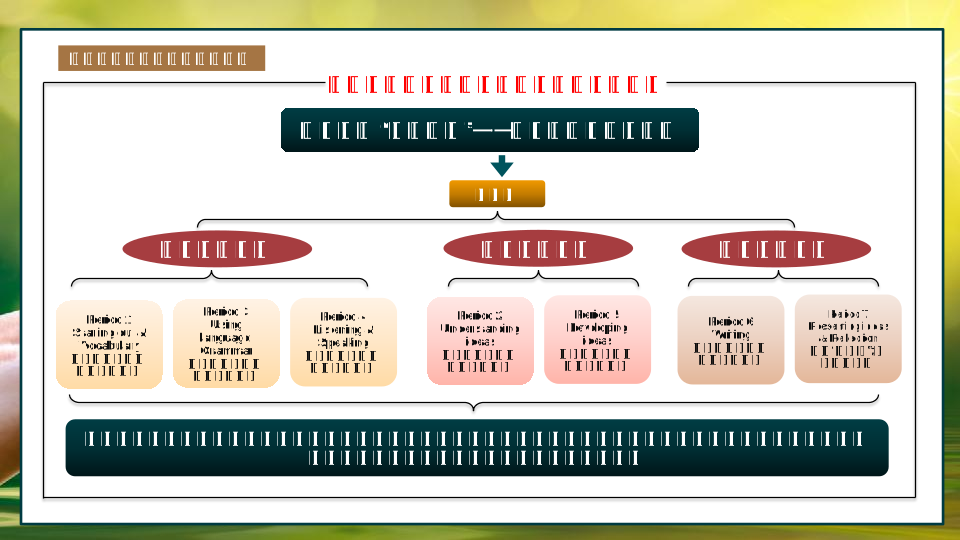
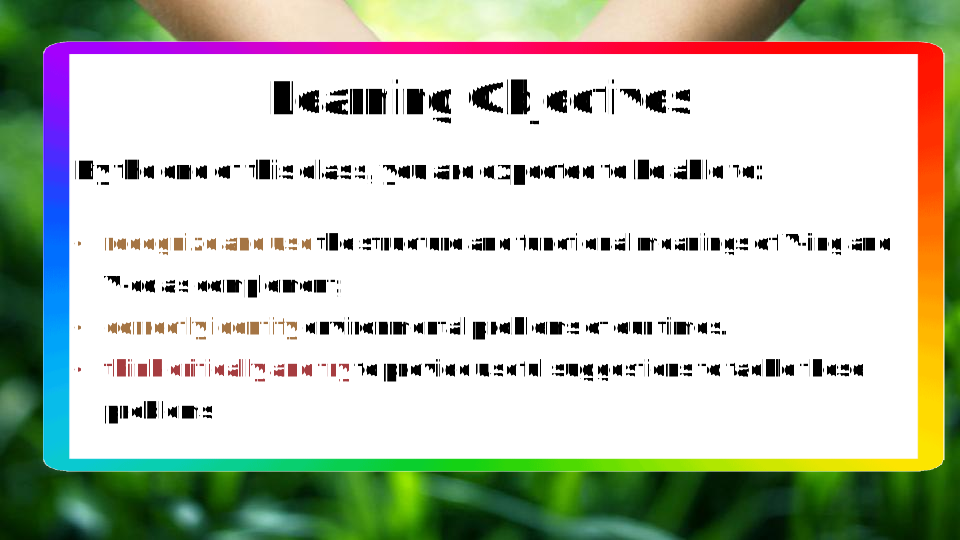
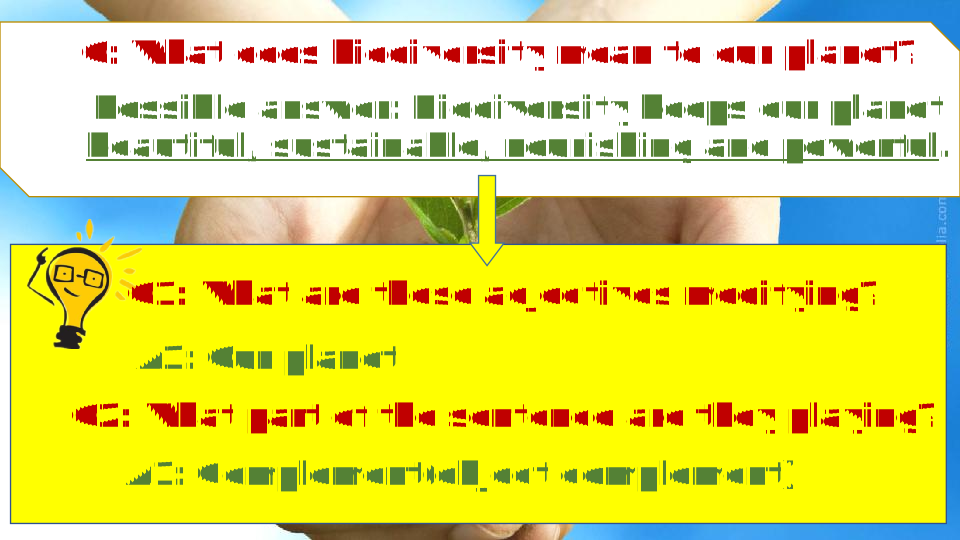
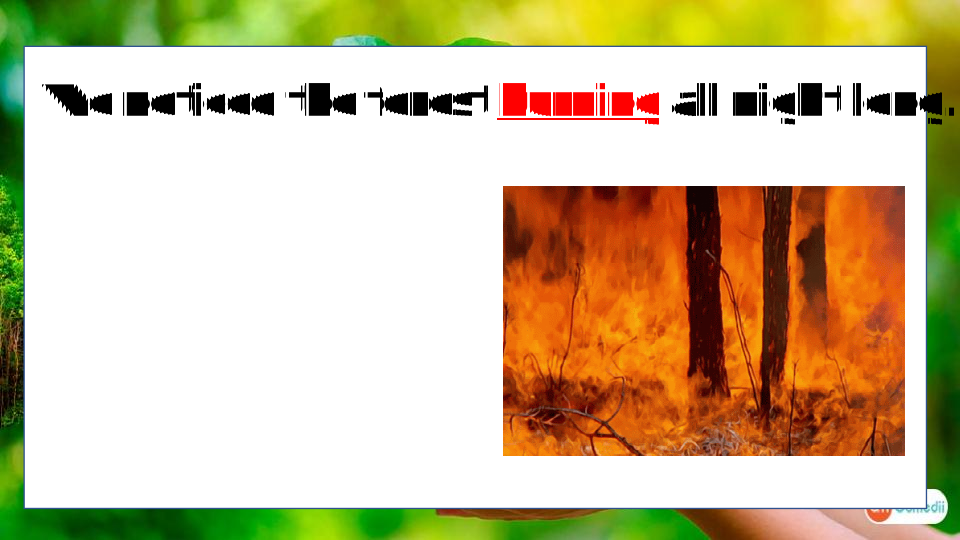
大观念视角下的单元整体学习 主题语境 “人与自然”——关爱地球、保护环境 正视环保问题 单元大观念:正视全球面临的环保问题,了解先进的环保理念,增强环保意识,践行绿色生活方式,树立共同关爱地球,保护环境,与自然和谐相处的价值观。 子主题 Period 1 Starting out & Vocabulary 感知环境问题;学习主题语块 把握主题,建立各语篇关联,形成大观念 Period 3 Using language: Grammar 关注海洋环境;聚焦人类活动 Period 4 Listening & Speaking 讨论雾霾污染;礼貌打断他人 增强环保意识 践行环保理念 Period 2 Understanding ideas 打破传统观念;重新认识鲨鱼 Period 5 Developing ideas 了解先进理念;真正绿色生活 Period 6 Writing 宣传光盘行动;环保共同参与 Period 7 Presenting ideas & Reflection 关注“碳足迹”;回顾单元内容 Book 2 Unit 6 Earth first -ing and –ed as complement. Using Language Grammar Learning Objectives By the end of this class, you are expected to be able to: recognize and use the structure and functional meanings of V-ing and V-ed as complement; correctly identify environmental problems of our times. think critically and try to provide useful suggestions to tackle these problems Watch the video and think about the question. Q: What does biodiversity mean to our planet? Q: What does biodiversity mean to our planet? Possible answer: Biodiversity keeps our planet beautiful, sustainable, nourishing and powerful. Q1: What are these adjectives modifying? Q2: What part of the sentence are they playing? A1: Our planet A1: Complement(object complement) We noticed the forest burning all night long. He saw the sharks being killed cruelly. Don’t you see our earth burning? Didn’t you hear the elephant crying for help? With water polluted, fish couldn’t survive in this river. With air filled with poisonous chemicals, we need masks to breathe. With their fins cut off, the sharks are thrown back into the sea and left to die. taken away 1) see, watch, hear, feel, smell, find, listen to, look at, notice, observe, catch等感官动词(perceptives)后接现在分词作宾语补足语,表示该动作正在进行。 Visitors in the nature park were curiously observing the tiger hunting for food. Summary 13 2) keep, have, get, leave, set等使役动词(causatives)后接现在分词作宾语补足语,表示“使处于某种状态”。 We should not stand by and leave all those plastic wastes lying on the beach forever. 14 3) see, hear, notice, observe, watch, feel, find 等感官动 词(perceptives)后接过去分词作宾语补足语,表示该动作与宾语之间是被动关系或者该动作已经完成。 Finding the river heavily polluted, the rich man decided to donate 1 million to help clean the river. 15 4) have, get, make, leave, keep 等使役动词(causatives)后接过去分词作宾语补足语,表示动作由他人完成。 We should think of a way to have the ocean cleaned up for the sea animals. 16 Practice (1)When I was on my way to school this morning, I saw two women_(argue). (2) He was just about to sit down when he felt something_ (move)near his feet. (3)On the bank of the river,we found him _ (lie)on a bench,with his eyes_(fix)on a kite in the sky. (4) I stood on the bridge and watched boats _(pass)by. (5) Don’t keep the children _(work)on their lessons all day. arguing moving lying fixed passing working 17 Practice (1) He is very popular among his students as he always tries to make them_(interest )in his lectures. (2)When we saw the road_(block)with snow, we decided to spend the holiday at home. (3)Let’s have all the windows_(clean). (4)Before driving into the city,you are required to get your car _(wash). (5) Even the best writers sometimes find themselves _(lose)for words. interested blocked cleaned lost washed 18 Practise 1). When _(heat), water will be changed into vapour. While _ (heat) water, we can change it into vapour. 2) The question _ (discuss) at the meeting yesterday is of quite importance. The question _ (discuss) at the meeting now is of quite importance. The question _ (discuss) at the meeting tomorrow is of quite importance. heated heating discussed being discussed to be discussed 1. I heard someone _(knock) at the door when I was watching TV. 2. Do you see a girl _(dress) in red? 3. We watched the plane _(take) off at the airport. 4. With the money _ (lose), he couldn’t buy any ticket. 5. She feels herself _(get) younger and younger. 6. With summer _ (come) on, it’s time to buy cool clothes. Activity 7 Filling into the blanks with the correct form. knocking dressed take lost getting coming Practice (1) 他们把门锁了好长一段时间。 They_for a long time.$ (2) 不要让窗户像这样一直破着。 Don’t _like this all the time. (3) 我昨天让人修了我的自行车。 I _yesterday. (4) 玛丽的手表在前几天被人偷了。 Mary_the other day. (5) 当我们到学校时,我们看见门锁着。 When we got to school, we_. kept the door locked leave the window broken had my bike repaired had her watch stolen saw the door locked 21 Read the passage (P65) and choose the correct form of the verbs. Pay attention that the options are not necessarily complements. Attracted / Attracting by mermaids since she was a child, Hannah Fraser created her first tail when she was only nine years old. Now, she is a model and performance artist devoted / devoting to ocean conservation. She can be seen worn / wearing mermaid clothing and dived / diving up to 50 feet underwater to swim with dolphins, sharks and whales. Activity 3 (P65) Rewrite the underlined sentences in the interview, using the –ing and –ed forms to make it more compact and coherent. Here, you can see dramatic landscapes changing from mountains to grasslands, forests to rivers. Activity 3 (P65) In recent years, we have seen large areas of wetland damaged by human activity. This includes keeping the original environment untouched, … Dealing with global warming Share what you know about these expressions. water conservation LED bulb renewable energy carbon footprint greenhouse effect reusable water bottle Activity 4 (P66) adj. 可更新的,可再生的,可续订的 n. 可再生资源 adj. 可重复使用的 Complete the brochure with the expressions. reusable water bottle carbon footprint renewable energy LED bulb Water conservation greenhouse effect Activity 5 (P66) reduce to 减少到 (同义decrease) reduce by 减少了 The farmer workers reduce to 60% . The farmer workers reduce by 40% . (增加 increase/rise) the +比较级,the +比较级 越... , 越... The harder you work, the more chances you will have. The longer you live in this city, the healthier you will become. 30 31 32 What environmental problem is it? Why is there this problem in some certain cities? How does government solve this problem? And what should we do? Smog 与前面的global warming 相关联 33 Did You Know? Smog comes from the words “smoke” and “fog”, and it is used to describe the air pollution in cities caused mainly by traffic and factories. Smog can be dangerous because it causes severe breathing problems and infections. Environmental problems to be solved 启动计时器 34 Listen to the lecture and choose the topics that are covered. (P67) 1. What the word “smog” means. 2. When the word “smog” appeared. 3. What caused smog in the past. 4. What causes smog now. 5. The effects of smog on the environment. 6. How governments try to reduce smog. 7. What will happen if we don’t reduce smog. smoke and fog 1900s coal chemicals take measures 启动计时器 时间到! 启动计时器 时间到! Listen again and complete the slides. (P67) Smog in the past • Term created in: 1 _ • Big problem in London: 2 _ in December 1952 • Causes of the problem: burning too much coal and 3 _ 1900s The Great Smog no wind Listen again and complete the slides. (P67) Smog in the present • Causes of the problem: 4 _ and factories • Measures: rules about using 5 _ in factories and 6 _ in the city centre chemicals coming from chemicals requirements of traffic paying to drive Learning to learn A polite interruption is usually framed as a request for permission to interrupt someone, often starting with If ..., May I ...? or Can I ...? This may be preceded with an apology such as Sorry, ... or Excuse me, ... Usually we interrupt someone when they pause for breath, or during the slight pause between spoken clauses. 39 Useful expressions Please feel free to stop me if you have any questions. Sorry to interrupt, but ... I'm afraid... Excuse me, but can I just ask...? Is it OK if I jump in for a second? Well,... Could I just stop you again to check ... ? Sorry. I've made a mistake. Do you mind if I ask another question? You're right, ... Group the following sentences into the right section. polite interruption sincere correction 启动计时器 时间到! Useful expressions Please feel free to stop me if you have any questions. Sorry. I've made a mistake. You're right, ... I'm afraid... Well,... Sorry to interrupt, but ... Excuse me, but can I just ask...? Could I just stop you again to check ... ? Do you mind if I ask another question? Sorry, but I was wondering whether ... Is it OK if I jump in for a second? Group the following sentences into the right section. polite interruption sincere correction PERCEPTIVES CAUSATIVES -ing -ed OBJECT see, watch, hear, feel, smell, find, listen to, look at, notice, observe have, get, make, leave, keep Thanks Blues 145795.8 $
资源预览图
1
2
3

4
5
6
相关资源
由于学科网是一个信息分享及获取的平台,不确保部分用户上传资料的 来源及知识产权归属。如您发现相关资料侵犯您的合法权益,请联系学科网,我们核实后将及时进行处理。