语法点3 现在进行时(语法培优)-【培优计划】2024-2025学年四年级下册英语 同步复习(外研版 一起)
2025-04-22
|
2份
|
7页
|
256人阅读
|
18人下载

资源信息
| 学段 | 小学 |
|---|---|
| 学科 | 英语 |
| 教材版本 | 小学英语外研版(一起)(2012)四年级下册 |
| 年级 | 四年级 |
| 章节 | - |
| 类型 | 题集-专项训练 |
| 知识点 | - |
| 使用场景 | 同步教学-新授课 |
| 学年 | 2025-2026 |
| 地区(省份) | 全国 |
| 地区(市) | - |
| 地区(区县) | - |
| 文件格式 | ZIP |
| 文件大小 | 1.60 MB |
| 发布时间 | 2025-04-22 |
| 更新时间 | 2025-04-22 |
| 作者 | 大连众里文化发展有限公司 |
| 品牌系列 | 培优计划·小学检测卷 |
| 审核时间 | 2025-04-22 |
| 下载链接 | https://m.zxxk.com/soft/51725413.html |
| 价格 | 2.00储值(1储值=1元) |
| 来源 | 学科网 |
内容正文:
61
9.painted 10.became
语法点三
Ⅰ.
1.happening 2.singing 3.drawing
4.having 5.writing 6.making
7.swimming 8.running 9.clapping
10.beginning
Ⅱ.1.are 2.am 3.is 4.is 5.are
Ⅲ.1.is
playing 2.having 3.writing
4.are
swimming 5.watching;
watching
6.am
having 7.visiting 8.talking;
talking
9.are
playing 10.cutting
Ⅳ.1.C 2.C 3.C 4.A 5.B
6.B 7.B 8.A 9.A 10.B
11.B 12.B 13.C 14.B 15.C
Ⅴ.1.They
arent
doing
the
housework.
2.Are
the
students
cleaning
the
classroom?
Yes,
they
are.
No,
they
arent.
3.What
are
you
doing
in
the
playground?
4.What
is
Tom
doing
in
his
room?
5.Im
listening
to
music
now.
Ⅵ.1.He
is
flying
a
kite.
2.I
am
playing
the
erhu.
3.drawing
a
picture
4.Hes
reading
the
newspaper.
5.They
are
singing.
语法点四
Ⅰ.1.to
have 2.go
3.wil
play/are
going
to
play
4.write;
make 5.visit
Ⅱ.1.C 2.D 3.B 4.B 5.D
6.C 7.D 8.B 9.D 10.B
Ⅲ.1.Im
going
to
Shanghai.
(答案不唯一)
2.I
wil
read
books.
(答案不唯一)
3.What
wil
you
do
next
week?
4.Are
you
going
to
visit
Australia?
5.How
wil
Dad
go
to
Beijing
tomorrow?
Ⅳ.1.are
you
going
to
do;
am
going
to
2.Wil;
go;
weekend;
wil;
is
going
to
buy
3.are;
going
to
4.am
going
to
5.wil
meet
at
Ⅴ.1.We/I
wil
go
to
Australia/Sydney.
2.play
the
piano(this
weekend)
3.Im
going
to
fly
a
kite.
4.Im/Were
going
to
the
Great
Wal/Beijing.
5.I/We
wil
get
up
at
7
oclock
next
week.
6.I/We
wil
go
to
Dalian
by
plane.
7.No,
he
isnt.
8.I
wil
read
a
book.
语法点五
Ⅰ.1.does;
do
2.studies 3.goes
4.watches 5.Does;
read 6.do;
have
7.does;
do 8.has 9.dont
watch
10.doesnt
go 11.do;
do 12.teaches
13.take 14.is 15.likes
Ⅱ.1.A 2.C 3.C 4.C 5.D
6.A 7.D 8.C 9.B 10.B
11.C 12.C 13.C 14.C 15.B
Ⅲ.1.Daniel
doesnt
watch
TV
every
evening.
2.Does
Amy
like
playing
computer
games?
No,
she
doesnt.
3.What
do
you
often
do
in
the
park?
4.Where
does
John
come
from?
5.Simon
and
Daniel
dont
like
going
skating.
6.Does
your/my
grandma
live
in
New
York?
7.Why
does
she
like
koalas?
8.What
time/When
does
Tom
usualy
go
to
school?
Ⅳ.1.A Does 2.B like 3.A likes
4.A teaches 5.A doesnt
Ⅴ.1.He
goes
to
work
by
car.
(答案不唯一)
2.She
usualy
goes
to
bed
at
9
oclock.
(答案
不唯一)
3.I
often
play
with
my
sister.
(答案不唯一)
4.Yes,
I/we
do./No,
I/we
dont.
5.Yes,
he
does./No,
he
doesnt.
Ⅵ.1.A 2.B 3.C 4.A 5.C
阶段巩固
Ⅰ.
1.B 2.A 3.B 4.C 5.C
6.B 7.B 8.A 9.C 10.B
Ⅱ.
1.costs 2.are 3.write 4.is
sleeping
5.have 6.got 7.happened 8.wil
draw
9.eat 10.wil
go
Ⅲ.
1.Welcome 2.Be 3.are 4.looks
5.writing 6.played 7.picked
8.wil/am
going
to
learn 9.didnt
play
10.going;
going;
have
11.like;
likes 12.is
reading
13.wil
go/are
going 14.is
listening
15.did;
do
Ⅳ.
1.This
machine
makes
crisps.
2.This
computer
is
not
beautiful
or
helpful.
3.Dont
wear
this
hat.
4.What
is
he
doing?
/What
is
he
drawing?
/
Who
is
drawing
books
and
birds?
5.Whats
the
time
now?
/What
time
is
it
now?
6.I
played
the
piano
yesterday.
7.
We
wil
go
to
the
park
to
play
next
Sunday./We
are
going
to
go
to
the
park
to
play
next
Sunday.
8.Jack
didnt
climb
up
the
hil.
9.
Who
wil
see
some
museums?
/
What
wil
she
see?
/What
wil
she
do?
10.He
went
to
work.
(答案不唯一)
Ⅴ.1.A 2.C 3.B 4.B 5.C
Ⅵ.1.get 2.begins 3.do
4.helps
5.works
语法测评卷(一)
Ⅰ.1.put 2.waited 3.learnt/learned
4.heard 5.sent 6.costs 7.running
8.shouts 9.ate 10.tidied
Ⅱ.1.was 2.was 3.are 4.was 5.be
6.Are 7.are 8.is 9.are 10.is
Ⅲ.1.went 2.was 3.have 4.draw 5.play
6.walk 7.doing 8.Stop 9.bought
10.goes 11.to
take 12.Dont
jump
13.likes 14.are
working 15.are
talking
16.does;
come 17.stays 18.Do;
speak
19.doesnt
have 20.write
Ⅳ.1.C 2.A 3.C 4.C 5.B
6.C 7.C 8.C 9.C 10.B
Ⅴ.1.I
went
to
Hong
Kong.
(答案不唯一)
2.What
wil
Sam
do
this
Saturday?
3.What
time/When
does
Dad
often
have
breakfast?
4.What
are
you
doing
in
the
UK?
5.Dont
walk
on
the
grass.
6.Where
does
he
live?
7.What
did
she
do
yesterday?
8.These
are
his
fathers
favourite
things.
9.No,
it
isnt.
10.Im
going
to
visit
Beijing./
Were
going
to
visit
Beijing.
Ⅵ.1.B does 2.B walk 3.C no
4.C footbal 5.C play 6.B have
7.B putting 8.B these 9.A I/B
having 10.A Why
Ⅶ.Passage
1
1.is 2.goes 3.comes 4.asks 5.are
6.was 7.go 8.answer 9.could 10.put
Passage
2
1.were 2.lived 3.sat 4.talked
11
语法点三
现在进行时
语法一点通/
读一读,学会现在进行时的用法
含 义
现在进行时主要用来表示正在进行或发生的动作。
链 接 教 材 功 能 句 式
1.Were
having
a
party.
我们正在举办聚会。
2.Whats
happening
now?
现在正在发生什么事?
3.Tom
is
singing.
汤姆正在唱歌。
4.Hes
drawing
books
and
birds.
他正在画书和鸟。
1.现在进行时肯定句的构成
主语+be(am/is/are)+动词现在分词+其他.
例:They
are
working
now.
他们现在正在工作。
2.现在进行时否定句的构成
主语+be(am/is/are)+not+动词现在分词+其他.
例:They
are
not
working
now.
他们现在没在工作。
3.现在进行时一般疑问句的构成
Be(Am/Is/Are)+主语+动词现在分词+其他?
肯定回答:Yes,
主语+be(am/is/are).
否定回答:No,
主语+be(am/is/are)+not.
例:1.—Are
they
working
now?
他们在工作吗?
—Yes,
they
are.
是的,他们在工作。
2.—Are
you
playing
basketbal
now?
你正在打篮球吗?
—No,
Im
not.
不,我没在打篮球。
1.常与现在进行时
连用的时间状语:
now,
at
present(目
前),these
days,this
month等。
2.有时候,句中虽然
没有时间状语,但
有look,listen等
词时,也可以表明
动作正在发生,所
以可以用现在进
行时。
有些 动 词,如 have
(有),want,like等,
通常不能用于现在
进行时中。
例:I
like
China.不能
说 成 Im
liking
China.
12
4.动词现在分词的变化规则
一般情况下,直接在动词词尾加-ing
shout—shouting
sleep—sleeping
laugh—laughing
study—studying
以不发音的e结尾的动词,先去掉e,再加-ing
dance—dancing make—making
take—taking ride—riding
以一个辅音字母结尾的重读闭音节单词,
先双写词尾的辅音字母,再加-ing
cut—cutting clap—clapping
run—running skip—skipping
swim—swimmingstop—stopping
get—getting shop—shopping
put—putting
以ie结尾的动词,把ie变成y,再加-ing lie—lying tie—tying
语法自主测/
测一测,看你掌握了多少
Ⅰ.写出下列动词的现在分词。
1.happen— 2.sing—
3.draw— 4.have—
5.write— 6.make—
7.swim—
8.run—
9.clap— 10.begin—
13
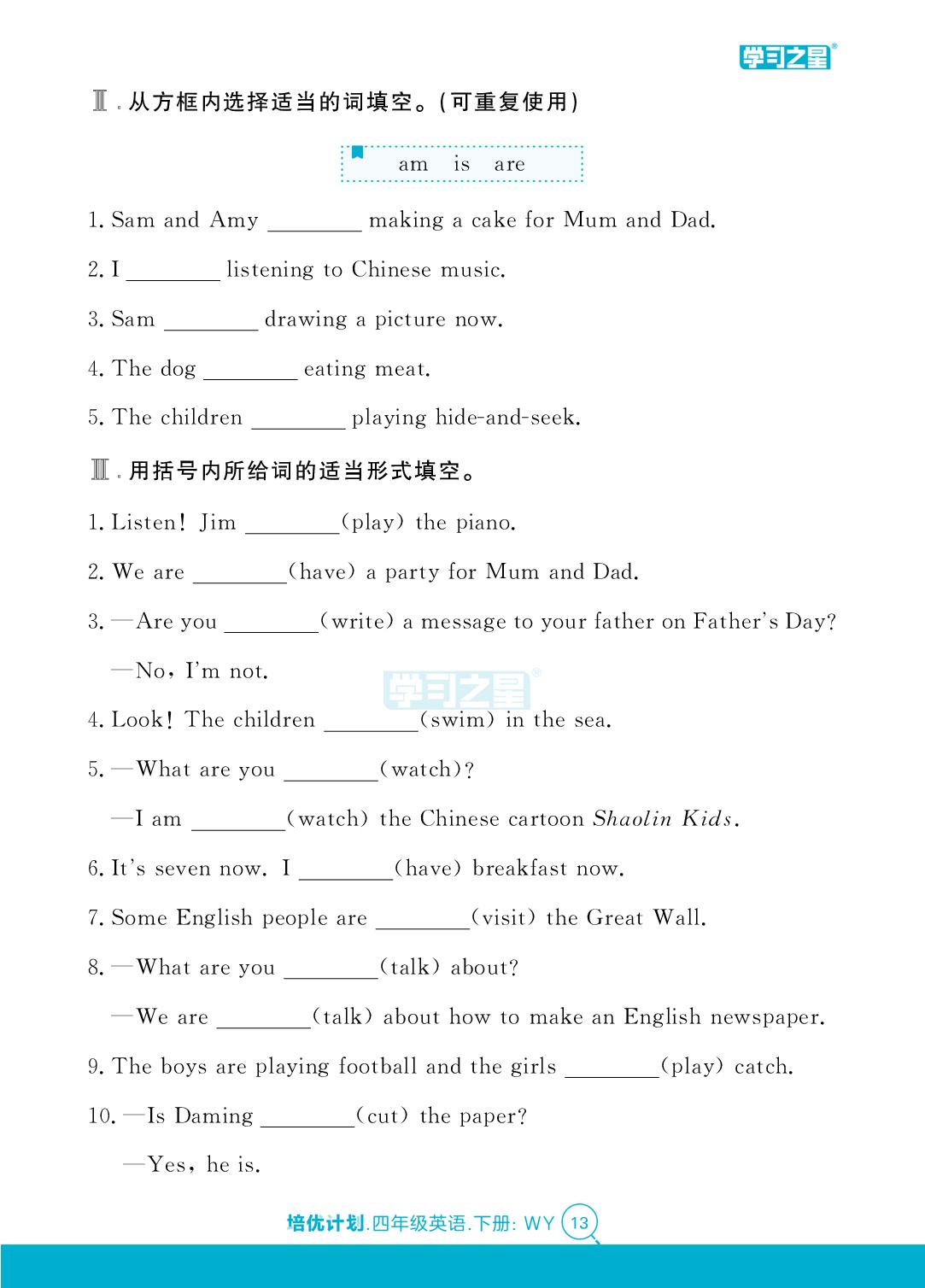
Ⅱ.从方框内选择适当的词填空。(可重复使用)
am is are
1.Sam
and
Amy
making
a
cake
for
Mum
and
Dad.
2.I listening
to
Chinese
music.
3.Sam
drawing
a
picture
now.
4.The
dog eating
meat.
5.The
children
playing
hide-and-seek.
Ⅲ.用括号内所给词的适当形式填空。
1.Listen! Jim
(play)
the
piano.
2.We
are
(have)
a
party
for
Mum
and
Dad.
3.—Are
you
(write)
a
message
to
your
father
on
Fathers
Day?
—No,
Im
not.
4.Look!
The
children
(swim)
in
the
sea.
5.—What
are
you
(watch)?
—I
am
(watch)
the
Chinese
cartoon
Shaolin
Kids.
6.Its
seven
now.
I
(have)
breakfast
now.
7.Some
English
people
are
(visit)
the
Great
Wal.
8.—What
are
you
(talk)
about?
—We
are
(talk)
about
how
to
make
an
English
newspaper.
9.The
boys
are
playing
footbal
and
the
girls
(play)
catch.
10.—Is
Daming (cut)
the
paper?
—Yes,
he
is.
14
Ⅳ.单项选择。
( )1.Look,
who
over
there?
A.singing B.sings C.is
singing
( )2.Its
eight
oclock.
The
students
an
English
class.
A.have B.having C.are
having
( )3.Listen!
The
baby
in
the
next
room.
A.crying B.cried C.is
crying
( )4.Look!
The
children
new
sweaters.
A.are
wearing B.wearing C.wears
( )5.Dont
talk
here.
My
parents
.
A.is
sleeping B.are
sleeping C.sleeping
( )6.Tom
in
a
factory.
His
sisters
in
a
hospital.
A.work;
work B.works;
work C.work;
works
( )7.Who
English
in
your
class
now?
A.speak B.is
speaking C.speaks
( )8.Look!
Mr
Smith
the
windows.
A.is
cleaning B.clean C.cleans
( )9.We
music
and
often
to
music.
A.like;
listen
B.likes;
listens
C.like;
are
listening
( )10.She
up
at
six
in
the
morning
yesterday.
A.get B.got
C.getting
15
( )11.On
Sundays
he
sometimes
his
clothes
and
sometimes
some
shopping.
A.wash;
do B.washes;
does C.washes;
do
( )12.I
usualy
milk
and
bread
for
breakfast,
but
Jim
some
eggs
for
breakfast.
A.have;
have B.have;
has C.has;
have
( )13.Look!
Lucy
is
a
new
bike
today.
A.jumping B.running C.riding
( )14.The
children
footbal
now.
A.is
playing B.are
playing C.play
( )15.They
TV.
They
are
doing
their
homework.
A.are
watching
B.cant
watching
C.arent
watching
Ⅴ.按要求完成下列句子。
1.They
are
doing
the
housework.
(改为否定句)
2.The
students
are
cleaning
the
classroom.
(改为一般疑问句,并做肯定
和否定回答)
3.Im
playing
footbal
in
the
playground.
(对画线部分提问)
4.Tom
is
reading
books
in
his
room.
(对画线部分提问)
5.I
listen
to
music
in
the
evening.
(用now改写句子)
16
Ⅵ.看图回答问题。
1.—What
is
the
boy
doing?
—
2.—What
are
you
doing?
—
3.—Are
you
doing
your
homework?
—No.
Im
.
4.—Whats
he
doing?
—
5.—What
are
they
doing?
—
资源预览图

1

2
3

相关资源
由于学科网是一个信息分享及获取的平台,不确保部分用户上传资料的 来源及知识产权归属。如您发现相关资料侵犯您的合法权益,请联系学科网,我们核实后将及时进行处理。