2025届北京市朝阳区高三下学期4月六校联考英语试题
 切换试卷
切换试卷
2025-04-13
|
14页
|
196人阅读
|
22人下载
资源信息
| 学段 | 高中 |
|---|---|
| 学科 | 英语 |
| 教材版本 | - |
| 年级 | 高三 |
| 章节 | - |
| 类型 | 试卷 |
| 知识点 | - |
| 使用场景 | 同步教学-阶段检测 |
| 学年 | 2025-2026 |
| 地区(省份) | 北京市 |
| 地区(市) | 北京市 |
| 地区(区县) | 朝阳区 |
| 文件格式 | DOCX |
| 文件大小 | 54 KB |
| 发布时间 | 2025-04-13 |
| 更新时间 | 2025-05-02 |
| 作者 | 学科网试题平台 |
| 品牌系列 | - |
| 审核时间 | 2025-04-13 |
| 下载链接 | https://m.zxxk.com/soft/51580992.html |
| 价格 | 1.50储值(1储值=1元) |
| 来源 | 学科网 |
内容正文:
2025北京朝阳高三4月六校联考
英语
2025.04
(考试时间90分钟 满分100分)
本试卷共9页。考生务必将答案答在答题卡上,在试卷上作答无效。
第一部分:知识运用 (共两节,共30分)
第一节 完形填空(共10小题;每小题1.5分,共15分)
阅读下面短文,掌握其大意,然后从各题所给的A、B、C、D四个选项中,选出可以填入空白处的最佳选项。
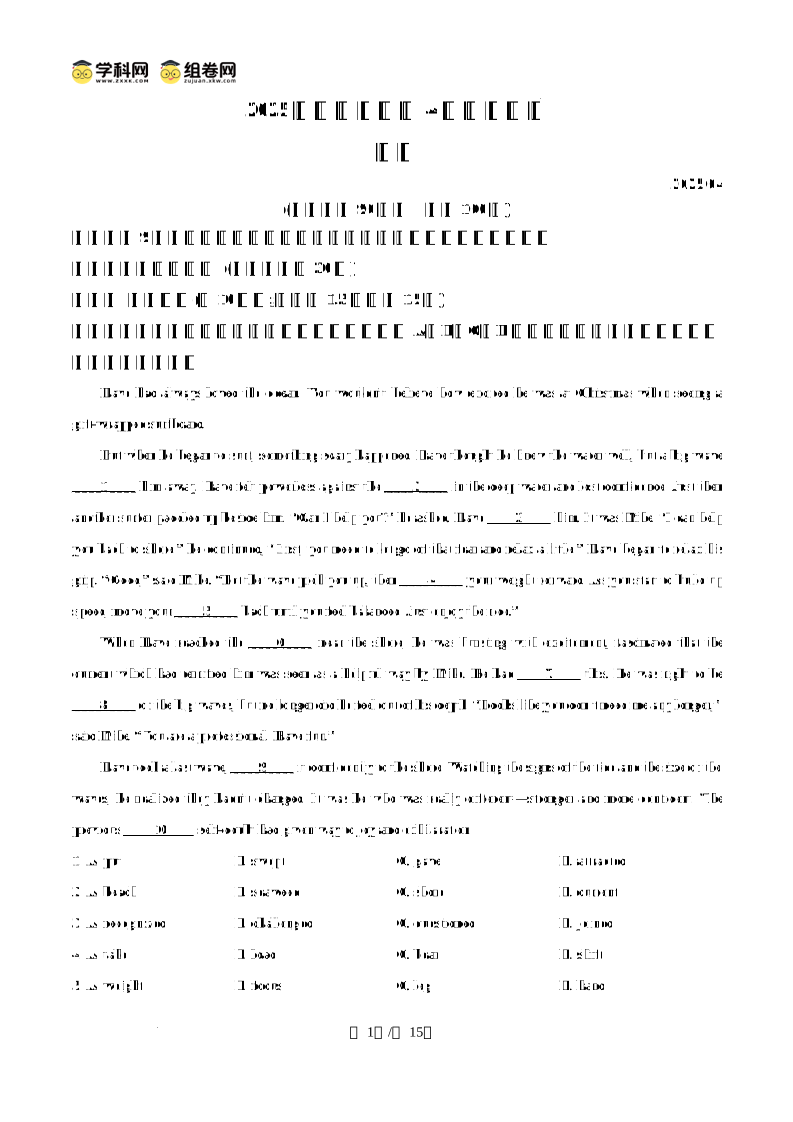
Dave had always loved the ocean. You wouldn’t believe how excited he was at Christmas when seeing a gift-wrapped surfboard.
But when he began to surf, something scary happened. Dave thought he knew the water well, but a big wave ____1____ him away. Dave felt powerless against the ____2____ in the deep water and lost confidence. Just then another surfer paddled up beside him. “Can I help you?” he asked. Dave ____3____ him. It was Mike. “I can help you back to shore.” he continued, “First, you need to let go of that fear and relax a little.” Dave began to relax his grip. “Good,” said Mike. “Let the wave pick you up, then ____4____ your weight forward. As you start to build up speed, move your ____5____ back until you feel balanced. Just enjoy the ride.”
When Dave reached the ____6____ near the shore, he was bursting with excitement, fascinated that the current which had terrified him was seen as a helpful way by Mike. He had ____7____ this. He was right to be ____8____ of the big waves, but no longer did he feel out of his depth. “Looks like you don’t need me any longer,” said Mike. “You are a professional. Have fun.”
Dave took a last wave, ____9____ it confidently to the shore. Watching the signs of the tide and the size of the waves, he realized they hadn’t changed. It was he who was really different—stronger and more confident. The previous ____10____ self-doubt had given way to joy and exhilaration.
1. A. put B. swept C. gave D. attracted
2. A. beach B. seaweed C. shore D. current
3. A. recognized B. challenged C. questioned D. joined
4. A. take B. load C. bear D. shift
5. A. weight B. focus C. leg D. hand
6. A. sands B. shallows C. boats D. tents
7. A. quit B. shared C. doubted D. grasped
8. A. cautious B. tired C. afraid D. sceptical
9. A. fighting B. riding C. breaking D. beating
10. A. self-respect B. self-confidence C. self-criticism D. self-doubt
第二节 语法填空(共10小题;每小题1.5分,共15分)
A
阅读下列短文,根据短文内容填空。在未给提示词的空白处仅填写一个适当的词,在给出提示词的空白处用括号内所给词的正确形式填空。
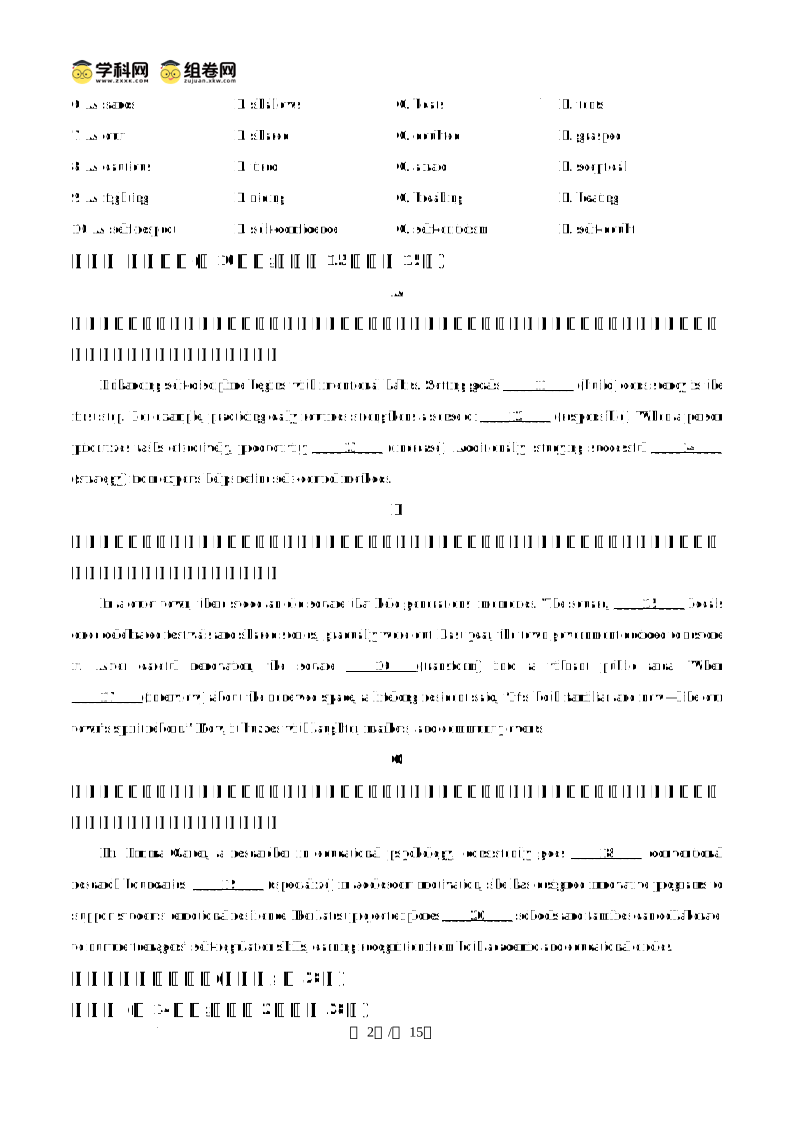
Enhancing self-discipline begins with intentional habits. Setting goals ____11____ (build) consistency is the first step. For example, practicing daily routines strengthens a sense of ____12____ (responsible). When a person prioritizes tasks effectively, productivity ____13____ (increase). Additionally, studying successful ____14____ (strategy) from experts helps refine self-control methods.
B
阅读下列短文,根据短文内容填空。在未给提示词的空白处仅填写一个适当的词,在给出提示词的空白处用括号内所给词的正确形式填空。
In a quiet town, there stood an old square that held generations’ memories. The square, ____15____ locals once celebrated festivals and shared stories, gradually wore out. Last year, the town government decided to restore it. After careful renovation, the square ____16____(transform) into a vibrant public area. When ____17____(interview) about the renewed space, a lifelong resident said, “It’s both familiar and new—like our town’s spirit reborn.” Now, it buzzes with laughter, markets, and community events.
C
阅读下列短文,根据短文内容填空。在未给提示词的空白处仅填写一个适当的词,在给出提示词的空白处用括号内所给词的正确形式填空。
Dr. Emma Carter, a researcher in educational psychology, consistently goes ____18____ conventional research boundaries. ____19____ (specialize) in adolescent motivation, she has designed innovative programs to support students’ emotional resilience. Her latest project explores ____20____ schools and families can collaborate to nurture teenagers’ self-regulation skills, earning recognition from both academic and educational circles.
第二部分:阅读理解(共两节; 共38分)
第一节 (共14小题;每小题2分,共28分)
A
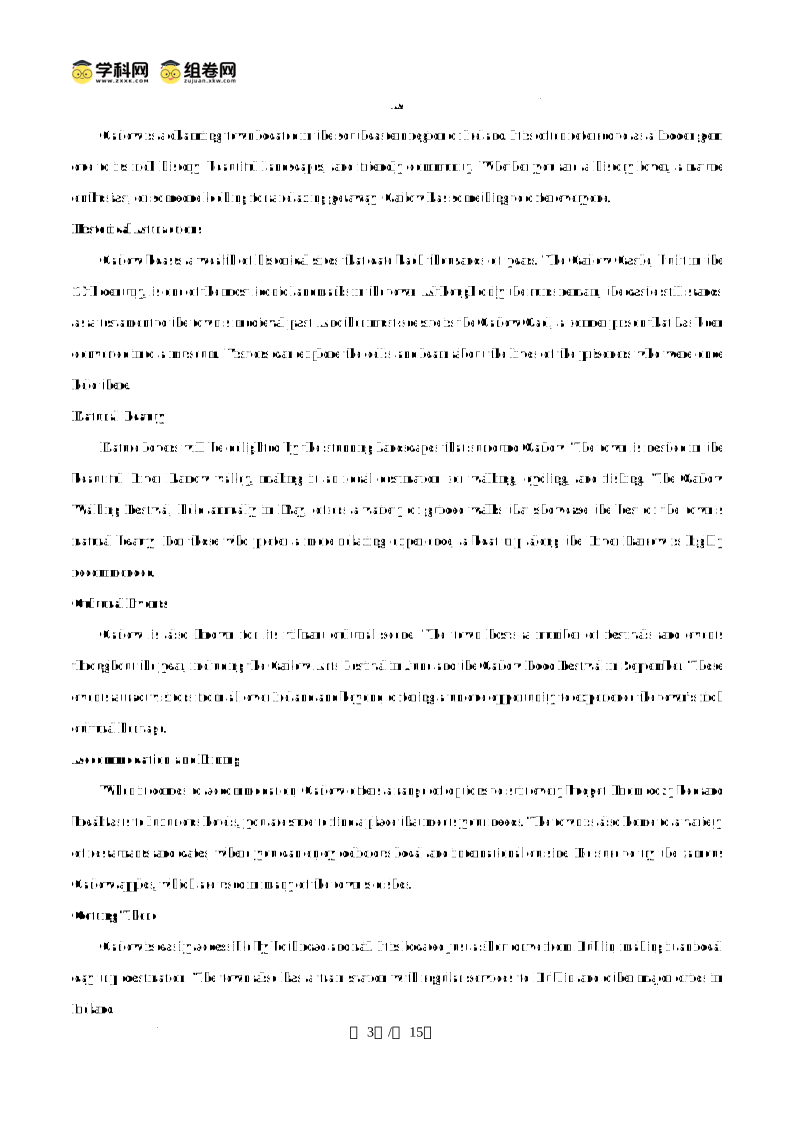
Carlow is a charming town located in the southeastern region of Ireland. It is often referred to as a hidden gem due to its rich history, beautiful landscapes, and friendly community. Whether you are a history lover, a nature enthusiast, or someone looking for a relaxing getaway, Carlow has something to offer everyone.
Historical Attractions
Carlow boasts a wealth of historical sites that date back thousands of years. The Carlow Castle, built in the 13th century, is one of the most iconic landmarks in the town. Although only the ruins remain, the castle still stands as a testament to the town’s medieval past. Another must-see site is the Carlow Gaol, a former prison that has been converted into a museum. Visitors can explore the cells and learn about the lives of the prisoners who were once held there.
Natural Beauty
Nature lovers will be delighted by the stunning landscapes that surround Carlow. The town is nestled in the beautiful River Barrow valley, making it an ideal destination for walking, cycling, and fishing. The Carlow Walking Festival, held annually in May, offers a variety of guided walks that showcase the best of the town’s natural beauty. For those who prefer a more relaxing experience, a boat trip along the River Barrow is highly recommended.
Cultural Events
Carlow is also known for its vibrant cultural scene. The town hosts a number of festivals and events throughout the year, including the Carlow Arts Festival in June and the Carlow Food Festival in September. These events attract visitors from all over Ireland and beyond, offering a unique opportunity to experience the town’s rich cultural heritage.
Accommodation and Dining
When it comes to accommodation, Carlow offers a range of options to suit every budget. From cozy bed and breakfasts to luxurious hotels, you are sure to find a place that meets your needs. The town is also home to a variety of restaurants and cafes, where you can enjoy delicious local and international cuisine. Be sure to try the famous Carlow apples, which are used in many of the town’s dishes.
Getting There
Carlow is easily accessible by both road and rail. It is located just a short drive from Dublin, making it an ideal day trip destination. The town also has a train station with regular services to Dublin and other major cities in Ireland.
For More Information
For more information about Carlow and its attractions, visit the official tourism website at www.tourismcarlow.com. You can also contact the Carlow Tourist Information Centre at+353(0)59 913 0100.
21. Which of the following best describes the purpose of the Carlow Gaol?
A. It serves as a historical prison still in use.
B. It is a museum showcasing the history of Carlow.
C. It is a cultural center for hosting festivals and events.
D. It is a site to explore former prisoners’ lives through cell tours.
22. What can be learned about Carlow from the passage?
A. Carlow is located far from major cities in Ireland.
B. Carlow has a well-developed transportation system.
C Carlow is primarily known for its historical significance.
D. Carlow is a popular destination for international tourists.
23. What is the main purpose of the passage?
A. To introduce the history of Carlow.
B. To describe the natural beauty of Carlow.
C. To promote Carlow as a tourist destination.
D. To provide information on cultural events in Carlow.
B
The image of that staircase never left my mind. It had been forty years since I graduated high school, but the staircase haunted my memories.
Boys would sit on both sides of the staircase, rating the girls as we walked by. If they thought a girl was really ugly, they barked. Every time I walked up or down those stairs, the barks, woofs, and laughter rang in my ears.
“Just ignore them,” my mother advised. And I did. On the surface. But inside the painful message that I was ugly rooted deep into my soul.
Eventually, I graduated, got accepted to college on the West Coast, and left small-town Colorado behind me. I earned a degree in Communications, launched a rewarding career as a writer and teacher, got married, and raised two amazing boys. But when I looked in the mirror, the doubts returned.
Then I got an invitation to my fortieth high school reunion. I didn’t like high school, but I wanted to go back and tell those boys off. I wanted to tell them how hurtful and unkind they were. And I wanted to show them they were wrong. I had a husband, a family and all the things they’d made me feel I wasn’t worthy of.
I practiced my speech in my mind as I ran errands (差事), cooked dinner, and exercised at senior aerobics. In September, I drove down to the town where I’d spent my high school years. I put on my favorite blouse, touched up my make-up, and steeled myself for the Friday night opening reception.
Maybe it’s true that memory is the first thing to go. On the night, people greeted me politely, drinks in hand, flattering me with “You haven’t changed at all.” I’d look at the face and study the nametag with the graduation photo, but it didn’t ring a bell most of the time.
Had I completely erased that whole period of my life from my memory? Was I at the wrong reunion? No, some women remembered my mother being their Girl Scout leader. Others had kind things to say about my father, a local college professor. My planned speech wilted (枯萎) on my lips. Instead, I chatted breezily about my two grown sons, living in Seattle, and writing résumés for Boeing workers. People were nice enough, but aside from a couple of friends, I felt like I was talking to strangers.
It was pointless to hold a grudge (怨恨) against people I couldn’t even recognize. I was only hurting myself by replaying those memories in my mind. I knew I needed to forgive. A dark sorrow lifted from my soul. I felt happier, more self-confident and attractive.
Back home, our senior fitness instructor noticed that I was wearing a new T-shirt. “You are really rockin’ that shirt,” she said.
I smiled. She’d said that before, but this time I believed it.
24. Why did the author decide to attend the 40th high school reunion?
A. To meet her old teachers. B. To prove her career success.
C. To apologize for past misunderstandings. D. To confront hurtful boys and show her worth.
25. What can we learn from this passage?
A. The author fought against her bullies directly.
B. The reunion attendees were mostly strangers.
C. The author’s career success healed her trauma.
D. The instructor’s compliment was first genuinely embraced.
26. What can be inferred about the author’s feelings after the high school reunion?
A. Confused and sad. B. Angry and proud.
C. Relieved and confident. D. Disappointed and regretful.
27. Which is the best title for the passage?
A. The Power of Letting Go B. A Surprising Reunion Letter
C. Finding Friends in Strangers D. The Painful High School Years
C
Give a group of scientists the same data and the same research question, and they should come up with similar answers — in theory. But they don’t, according to a paper published last month in BMC Biology, which finds that 246 ecologists analyzing the same data sets reached widely varying conclusions, with some finding effects in totally opposite directions.
The paper is the latest in a line of “many analyst” projects that examine how results can vary because of scientists’ decisions during data analysis — and the first to study the effects in ecology. Past work has mostly focused on psychology and other behavioral sciences. “I was really excited to see this study. I have noticed an unfortunate hubris self-confidence in other domains that say, well, we have our house in better order.” says University of Bern metascientist Ian Hussey.
Elliot Gould, a Ph.D. student at the University of Melbourne, was skeptical that ecology has its house in better order. Ecologists deal with complex systems that contain a huge amount of natural variability and have to make many decisions about what kind of statistical analyses to run. To find out how much those decisions affect the results, Gould recruited 246 ecologists, working in 174 teams, to answer two different research questions, each based on a single data set.
The first question asked how the growth of blue tit chicks is influenced by competition with siblings in the nest. The analysis teams came up with a wide range of answers: Five found no relationship between brood size and chick size, five found mixed results, and 64 found that chicks grew more slowly if they had more siblings, but with different levels of certainty and effect sizes. The second question is whether the amount of grass cover affected the success and survival of the Eucalyptus seedlings. The teams who analyzed this data set did not agree at all: Eighteen concluded that more grass cover hampered Eucalyptus survival, six said it improved survival, and 31 found the grass had no effect.
The findings match up with the results of previous many-analyst studies and show the powerful role of subjective researcher choices in scientific projects. In some cases, there is established best practice to guide analysts — but other choices are more arbitrary. Gould says researchers have to decide which variables to control for and how to deal with missing data, adding that those different choices can kind of multiply.
It’s impossible to know whether the problem affects an entire field from just one or two examples, says Eötvös Loránd University metascientist Balazs Aczel. To find out, he is running a project to have multiple analysts each tackle a question from 100 randomly chosen social science papers. But similar findings have popped up in a range of fields — including neuroscience and economics — and suggest “we are facing a very serious issue,” he says. But not all researchers think the findings are so alarming.
28. What does Ian Hussey really mean by his words in Paragraph 2?
A. The houses in the University of Bern are in better order.
B. The scientists’ decisions in the fields of ecology are in better order.
C. The studies in ecology have the same effects as those in behavioral sciences.
D The research on psychology and behavioral sciences are unfortunate hubris.
29. What can we learn from this passage?
A. Researchers’ individual choices in scientific studies matter a lot.
B. Gould thinks the effects of researchers’ different choices are limited.
C. The “many analyst” projects can help ecologists make good conclusions.
D. The growth of blue tit chicks is slower when having more siblings in the nest
30. What will the author most probably write after the last paragraph of the article?
A. To present the findings of the project that Balazs Aczel is running.
B. To explain why the results of “many-analyst” studies are not very severe.
C. To introduce the serious effects due to subjective researcher choices.
D. To inspire the researchers in the entire field to tackle the analysis problem.
D
The artificial intelligence (AI) sector has oscillated between enthusiasm and skepticism in recent years. Tech giants including Alphabet, Amazon, and Microsoft collectively poured nearly 200 billion into AI infrastructure in 2024 alone, surpassing the GDP of nations like Hungary or New Zealand. Nvidia, dominating the AI-chip market, witnessed its valuation skyrocket to 3.4 trillion as chip sales doubled — a growth rate three times faster than the semiconductor industry average. Meanwhile, server providers like Dell reported unprecedented demand, with AI server shipments jumping 78% year-on-year, signaling AI’s transformative potential across industries from drug discovery to autonomous driving.
Yet beneath the surface, challenges loom. Training advanced AI models consumes staggering energy — equivalent to powering 15 million US households annually — raising concerns about long-term viability (可持续性). In regions like Ireland, data centers already consume 18% of national electricity, straining aging power grids. Server manufacturers and energy firms struggle to meet data-center demands, with delivery delays for AI-optimized servers extending to 48 weeks in 2024. Critics argue that current investments mirror past tech bubbles: the $200 billion AI infrastructure spending represents 65% of the 1999 dot-com bubble’s peak investment adjusted for inflation. Alan Smith, a tech analyst, defends the spending, “AI’s capacity to revolutionize healthcare—such as cutting cancer drug development time from 10 years to 18 months — justifies short-term costs.” However, opponents counter that profit-driven corporations prioritize market dominance over ethical considerations, citing Meta’s 2023 AI ethics board disbandment as evidence.
Amid these mounting pressures, competition is going to further complicates the landscape of AI development. Upstart (新兴的) firms like UK-based Graphcore and China’s Cambricon challenge industry leaders by creating compact, energy-efficient AI tools. For instance, startups now offer specialized chips such as Graphcore’s IPU (Intelligence Processing Unit) at 40% lower costs than Nvidia’s products, democratizing access to AI technology. This fragmentation mirrors the 1980s PC market shakeup, where IBM’s dominance was eroded by agile competitors. Investors, initially infatuated with AI’s promise, grow wary of over-commitment. A recent McKinsey survey revealed 62% of shareholders believe AI firms must clarify their financial strategies within two years, a demand intensified by OpenAI’s $540 million quarterly losses despite ChatGPT’s success.
In addition, the environmental effects make it increasingly urgent to tackle this challenge head-on. Data centers account for 3% of global electricity use — a figure matching aviation’s carbon footprint — projected to triple by 2030. The International Energy Agency warns that unregulated AI growth could increase global CO₂ emissions by 1.5% annually, undermining climate goals. While companies like Microsoft invest in renewable energy, constructing solar farms to power Arizona data centers, critics demand stricter regulations. The EU’s proposed Artificial Intelligence Act now includes provisions requiring energy transparency for AI systems. Dr. Emily Zhou, a sustainability researcher at Tsinghua University, warns, “Unless accompanied by robust regulatory measures, AI’s ecological environment risks offsetting its technological advancements, as exemplified by China’s carbon tax initiative targeting data centers — a policy framework to balance industrial progress with environmental management.”
As the AI sector grapples with escalating energy consumption, ethical controversies, and speculative investment patterns, the AI industry stands at a crossroads. Its potential to reshape economies is undeniable — PwC estimates AI could contribute $15.7 trillion to global GDP by 2030—but unchecked growth risks ecological harm and market instability. The 2024 global AI Governance Summit highlighted the need for international standards, yet consensus remains elusive. But, the path forward requires both technological breakthroughs and a shift in priorities — making carbon-neutral data centers and transparent AI governance essential, not optional.
31. Regarding Alan Smith’s defence of AI spending, the author is ______.
A. supportive B. doubtful C. critical D. unconcerned
32. What does the word “infatuated” underlined in Paragraph 3 most probably mean?
A. Shocked. B. Protected. C. Attracted. D. Challenged.
33. What can we learn from this passage?
A AI’s environmental costs may reduce its benefits without policy intervention.
B. Renewable energy investments can resolve sustainability issues completely.
C. Stricter regulations should prioritize ecological protection over market instability.
D. Tech companies’ ethical considerations are sufficient to address energy demands.
34. Which would be the best title for the passage?
A. AI Investment: Balancing Short-Term Costs and Long-Term Viability
B. Data Centers’ Energy Use: The Hidden Crisis Behind AI Development
C. When Innovation Breeds Chaos: Why AI Development Must Slow Down
D. Artificial Intelligence: Navigating Transformation Amid Emerging Challenges
第二节 (共5小题; 每小题2分,共10分)
根据短文内容,从短文后的七个选项中选出能填入空白处的最佳选项。选项中有两项为多余选项。
Have you ever wondered why some jokes make you burst into uncontrollable laughter while others barely elicit (引出) a smile? The answer lies in the intricate dance between cognitive and emotional processes that occurs when we encounter humor.
Let’s start with the cognitive side of things. ____35____ We’re not just passively receiving information; we’re actively processing it, making connections, and trying to make sense of what we’re experiencing.
____36____ The emotional side of humor is equally important and often intertwined with our cognitive processes. When we find something funny, we experience a range of positive emotions—joy, amusement, surprise, and sometimes even a touch of mischievous delight. These emotional responses are what make humor such a powerful force in our lives.
Interestingly, the relationship between cognition and emotion in humor isn’t always straightforward. Sometimes, we might understand a joke on a cognitive level but not find it particularly amusing. Other times, we might laugh at something without fully understanding why it’s funny. ____37____
Our cognitive and emotional responses to humor aren’t static. ____38____ A joke that had you rolling on the floor as a teenager might elicit nothing more than a groan in your adult years. Conversely, you might find yourself chuckling (轻声笑) at a subtle bit of wordplay that would have gone right over your head in your younger days.
The cognitive and emotional processes involved in humor might seem trivial. ____39____ But when we consider how pervasive humor is in our daily lives, it becomes clear that understanding these processes can have far-reaching implications for our well-being and social interactions.
A. After all, it’s just a laugh, right?
B. But cognition is only half the story.
C. They can change over time as we grow, learn, and experience new things.
D. Our brains start to look for patterns and make predictions when we hear a joke.
E. Individual differences play a significant role in humor perception and appreciation.
F. This complexity is part of what makes humor such a rich area of study for psychologists.
G. When we hear a joke or see something funny, our brains shift into high-speed working mode.
第三部分 书面表达(共两节,32分)
第一节(共4小题;第40、41题各2分,第42题3分,第43题5分,共12分)
阅读下面短文,根据题目要求用英文回答问题。
It happens just about every time I go to a restaurant with my daughter. I open the menu and scan the options. Then I glance at the children’s menu. Often the menu is pretty similar, with the same pasta and tomato sauce. But the items on the children’s menu are usually less expensive, and I’ll think to myself: Wow, good deal.
If I think again for a moment, though, the deal isn’t really a deal. After all, I estimated the cost of the pasta based on the adult menu, not on the actual cost of making some cheap bow-tie noodles and serving them simply with a red sauce.
My faulty reasoning is the product of anchoring, a cognitive bias (认知偏差) that can weaken our critical thinking. According to researchers, anchoring is when people rely on irrelevant but easily accessible facts to make judgments. Our minds give too much weight to initial impressions or numbers that influence our subsequent thoughts. In my case, the prices on the adult menu shaped or anchored my judgment about the value of the items on the children’s menu.
Anchoring is everywhere in the retailing world. It’s a way to make customers feel like they’re getting a good deal. People tend to love big stores that offer huge “discounts” off highly inflated (膨胀的) “original” prices that have little to do with the item’s actual value. Studies show that anchoring effects persist no matter how weak the connection between the anchor and the actual decision. They also indicate that anchoring affects all kinds of decisions, even those made by experts who should know better.
The phenomenon of anchoring shows that while we think of ourselves as rational and logical beings, unrelated details can have an incredible influence on our reasoning. We must make sure that we find effective solutions or we might be a victim of anchoring, dragged down by our bias, whether we notice it or not.
40. According to researchers, what is anchoring?
___________________________________________________________________________________________
41. How do retailers take advantage of anchoring?
___________________________________________________________________________________________
42. Please decide which part is false in the following statement, then underline it and explain why.
▶ Anchoring effects can have a big influence on our reasoning, but if the connection between the anchor and the actual decision is weak, the effects will be gone.
___________________________________________________________________________________________
43. How can we avoid becoming a victim of anchoring?(In about 40 words)
___________________________________________________________________________________________
第二节(共20分)
44. 假设你是红星中学高三学生李华。你的英国好友Jim所在学校正在征集关于培养“数字素养”(digital literacy)的做法,他想投稿,发来邮件寻求你的建议。请你用英文给他回复,内容包括:
1.你的建议;
2.就以上建议给出理由。
注意:1.字数100字左右,字迹工整;
2.开头和结尾已给出,不计入总字数。
Dear Jim,
____________________________________________________________________________________________________________________________________________________________________________________________________________________________________________________________________________________
Yours,
Li Hua
2025北京朝阳高三4月六校联考
英语
2025.04
(考试时间90分钟 满分100分)
本试卷共9页。考生务必将答案答在答题卡上,在试卷上作答无效。
第一部分:知识运用 (共两节,共30分)
第一节 完形填空(共10小题;每小题1.5分,共15分)
阅读下面短文,掌握其大意,然后从各题所给的A、B、C、D四个选项中,选出可以填入空白处的最佳选项。
【1~10题答案】
【答案】1. B 2. D 3. A 4. D 5. A 6. B 7. D 8. C 9. B 10. D
第二节 语法填空(共10小题;每小题1.5分,共15分)
A
【11~14题答案】
【答案】11. to build
12. responsibility
13. increases
14. strategies
B
【15~17题答案】
【答案】15 where
16. was transformed
17. interviewed
C
【18~20题答案】
【答案】18. beyond
19 Specializing
20. how
第二部分:阅读理解(共两节; 共38分)
第一节 (共14小题;每小题2分,共28分)
A
【21~23题答案】
【答案】21. D 22. B 23. C
B
【24~27题答案】
【答案】24. D 25. D 26. C 27. A
C
【28~30题答案】
【答案】28. B 29. A 30. B
D
【31~34题答案】
【答案】31. B 32. C 33. A 34. D
第二节 (共5小题; 每小题2分,共10分)
根据短文内容,从短文后的七个选项中选出能填入空白处的最佳选项。选项中有两项为多余选项。
【35~39题答案】
【答案】35. G 36. B 37. F 38. C 39. A
第三部分 书面表达(共两节,32分)
第一节(共4小题;第40、41题各2分,第42题3分,第43题5分,共12分)
【40~43题答案】
【答案】40. According to researchers, anchoring is when people rely on irrelevant but easily accessible facts to make judgments.
41. Retailers take advantage of anchoring by offering huge “discounts” off highly inflated “original” prices that have little to do with the item’s actual value, making customers feel like they’re getting a good deal.
42. Anchoring effects can have a big influence on our reasoning, but if the connection between the anchor and the actual decision is weak, the effects will be gone.
Because studies show that anchoring effects persist no matter how weak the connection between the anchor and the actual decision.
43. We should be aware of the anchoring bias, not rely solely on initial information, and make decisions based on objective facts.
第二节(共20分)
【44题答案】
【答案】Dear Jim,
I’m glad to hear from you and offer my suggestions on developing digital literacy.
First, take online courses related to digital skills. In the digital age, such courses can provide systematic knowledge and help you keep up with the latest trends. Second, actively participate in digital projects or competitions, which can enhance your practical ability and problem-solving skills in a digital environment. Moreover, join digital communities. Communicating with like-minded people there can broaden your horizons and expose you to diverse ideas.
I hope these suggestions will be helpful to you. Looking forward to your good news.
Best regards,
Yours,
Li Hua
第1页/共1页
学科网(北京)股份有限公司
$$
资源预览图
1
2
3
相关资源
由于学科网是一个信息分享及获取的平台,不确保部分用户上传资料的 来源及知识产权归属。如您发现相关资料侵犯您的合法权益,请联系学科网,我们核实后将及时进行处理。