主题范畴二 人与社会-【加速度中考】2025年内蒙古中考英语情境作业本(外研版)
2025-06-06
|
2份
|
9页
|
56人阅读
|
1人下载

资源信息
| 学段 | 初中 |
|---|---|
| 学科 | 英语 |
| 教材版本 | - |
| 年级 | 九年级 |
| 章节 | - |
| 类型 | 题集-专项训练 |
| 知识点 | - |
| 使用场景 | 中考复习 |
| 学年 | 2025-2026 |
| 地区(省份) | 内蒙古自治区 |
| 地区(市) | - |
| 地区(区县) | - |
| 文件格式 | ZIP |
| 文件大小 | 3.06 MB |
| 发布时间 | 2025-06-06 |
| 更新时间 | 2025-06-06 |
| 作者 | 加速度中考 |
| 品牌系列 | 加速度中考·情境作业本 |
| 审核时间 | 2025-03-18 |
| 下载链接 | https://m.zxxk.com/soft/51074624.html |
| 价格 | 8.00储值(1储值=1元) |
| 来源 | 学科网 |
内容正文:
主题语篇素养精练
主题范畴二 人与社会
子主题三 社会服务与人际沟通
Ⅰ. 1. A 2. C 3. B 4. B 5. C 6. C 7. A 8. C 9. A
10. C 11. B 12. B 13. B 14. C 15. A
Ⅱ. 1. D 2. E 3. B 4. A 5. C
Ⅲ. 1. Its “oasis” . 2. On March 12, 2008.
3. It is nearly 100 km.
4. It refers to Shi Guangyin and his grandson.
5. He has a strong mind and is a selfless man. /
子主题四 文学、艺术与体育
Ⅰ. 1. C 2. B 3. D 4. A 5. D 6. B 7. C 8. B 9. C
10. D
Ⅱ. 1. A 2. D 3. B 4. C
Ⅲ. 1. wife 2. paint 3. finished 4. him 5. visitors 6. with
7. stole 8. when 9. museum 10. valuable
子主题五 历史、社会与文化
Ⅰ. 1. C 2. C 3. A 4. C 5. B 6. A 7. C 8. A 9. B
10. C 11. C 12. B 13. B 14. C 15. A
Ⅱ. 1. B 2. C 3. E 4. D 5. A
Ⅲ. 1. 9 / nine 2. chuitiao 3. he has become an adult
4. 知天命 5. the different titles
子主题六 科学与技术
Ⅰ. 1. A 2. D 3. C 4. B 5. A 6. B 7. D 8. D 9. B
10. A
Ⅱ. 1. A 2. B 3. C 4. A
Ⅲ. 1. travel 2. known 3. designed 4. cars 5. powerful
6. bottom 7. recently 8. through 9. stopping 10. ideas
一材多练 1. A 2. A
12
主题范畴二 人与社会
子主题三 社会服务与人际沟通
Ⅰ. 完形填空[2024 河南改编]
Last night, Frank had a
dream about the coming math
test, which troubled him very
much these days. So he was in a
1 mood (心情) when he
woke up.
Uncle Robin once told Frank about “ white
noise”—noise made by a fan or soft rain is a (n)
2 of white noise. Frank had tried it and it
really worked! After that, whenever he felt
worried about something, he would 3 white
noise with his headphones.
With the 4 of the math test still in his
mind, Frank went to get his headphones. He
5 he had left them on his desk, but they were
gone. His little brother Andy was always 6
his things—without asking. He ran into his
brothers room and started shouting at him in
7 . “Where are my headphones? You cant
just take my things! Or Ill take yours!” He
grabbed (抓起) one of his brothers toys and
8 it on the ground, breaking it into two
pieces. Andy started to 9 , and Frank stormed
out, feeling better.
Franks mom heard the shouting and went into
Andys room. “Hey,” she said 10 , “stop for
a second and tell me how youre feeling. ” Mom
never shouted. Frank knew that she thought it was
11 to talk about feelings instead of getting
angry.
“ He always does this, Mom!” Frank
shouted. “Ill have a math test and and I had
a bad dream” Frank 12 shouting. In a
calm (平静的) voice, he said, “I 13 what I
did was bad. Im sorry, Andy. I really get mad
14 you take things without asking, but
breaking your toy wasnt right. I will buy you a
new one. ”
Franks mom said, “Well done, Frank, and,
Andy, ask 15 next time, OK?”
“OK, Im sorry too,” said Andy and they all
smiled.
1. A. bad B. strange C. clear
2. A. list B. gift C. example
3. A. talk about B. listen to C. turn down
4. A. results B. thoughts C. prizes
5. A. expected B. decided C. remembered
6. A. repairing B. cleaning C. borrowing
7. A. anger B. fear C. shame
8. A. tied B. burnt C. threw
9. A. cry B. rest C. help
10. A. sadly B. shyly C. softly
11. A. worse B. better C. quicker
12. A. kept B. stopped C. enjoyed
13. A. wish B. know C. hear
14. A. unless B. before C. when
15. A. first B. late C. again
Ⅱ. 阅读理解[2024 青岛改编]
Active Listening
When we talk, we typically expect others to
listen with attention. But when someone else is
speaking, are we showing them the same
politeness?
Listening well doesnt come naturally to most
people. 1 This also means we often dont
really focus on what people are saying. One way to
listen with more care and attention is to practice
active listening.
2 Active listening is not only hearing
someones words but also taking notes of their
nonverbal ( 非 口 头 的 ) communication.
85
Nonverbal communication can include body
language, the tone ( 语 气 ) and their talking
speed. By practicing active listening, we can hold
onto important information better and show care to
others. This useful skill makes others want to
discuss things with us.
To get better at active listening, give the
speaker your complete attention. 3 it is easier
said than done. Stopping thinking about your
phone and clearing your mind of your own thoughts
are the first steps. 4 its easier to give your
complete attention to the speaker.
Another way to practice active listening is to
notice body language. Research shows that 55%
of face-to-face communication is nonverbal, 38%
vocal (噪音的) and 7% words. 5 With that
in mind, you can give proper replies like nodding,
smiling or looking at them politely.
Now do you know how to listen actively?
A. By forgetting those things that could influence
you,
B. Although this may seem clear and easy to
notice and understand,
C. When someone is speaking, their body
language is giving information, too.
D. Because most of us live in a busy world, we
care about certain things and miss the rest.
E. Active listening is focusing on what someone is
communicating and giving your understanding.
Ⅲ. 读写实践
治沙英雄石光银
Shi Guangyin was born in Dingbian County,
Shaanxi Province in 1952. He is a hero of the
sand control.
In his childhood, his 5-year-old friend was
killed by the strong sand. In order to avoid the
sand, his family moved nine times. So he decided
to fight against it to the end.
In 1972, the 20-year-old Shi Guangyin led
the villagers to plant popular trees and willow trees
(柳树). After three years, he managed more than
10,000 mu of desert sand and successfully set up
the first desert oasis in his hometown.
In the spring of 1986, he led the villagers to
fight the desert named “Wolf Sand” for the third
time. By developing sand barriers (屏障) to stop
the hit of sand, about 80% of the plants were able
to stay alive all the time.
On March 12, 2008, his only son died in a
car accident while fighting against the sand. He
continued his action against the sand although he
was in great pain.
What he did completely changed the terrible
environment of “ Sand drives people back ”.
Today, the nearly 100 km long green barrier has
been created, the desert is full of laughter of
animals, and the villagers pockets are getting
fatter and fatter.
Shis grandson is now also taking up the
important task. Both of them appeared at the 2024
CCTV Spring Festival Gala. They hope that more
and more young people will work on the sand
control so that more deserts will be decorated with
green all year round.
1. Which English word in the
passage means “绿洲”?
Its “oasis” .
2. When did Shi Guangyins son die in a car
accident?
On March 12, 2008.
3. How long is the green barrier that has been
created today?
It is nearly 100 km.
4. Who does the underlined part
“Both of them” refer to?
It refers to Shi Guangyin and his
grandson.
5. What do you think of Shi Guangyin?
He has a strong mind and is a selfless
man. / (言之有理即可)
86
子主题四 文学、艺术与体育
Ⅰ. 完形填空
The 90-year-old Bob from the UK is no
stranger to exercise. He began running at the age
of 30. Since then, he has 1 over 30 marathons
(马拉松) and half marathons. But what he loves
most is the parkrun, a 5-kilometer community
event. People can walk, jog, run or volunteer
together every weekend.
Even right after leaving the hospital, Bob turns
up at the 2 parkrun on time. For him, running
isnt just exercise, but a way to 3 others. These
days, Bobs times are 4 longer than they used to
be. In February, he finished his 400th parkrun in 49
minutes. But speed isnt Bobs goal — its helping
others. “I just hope I can encourage others to keep
5 , even if they only walk. I tell them if I can do
it, so can they. They have no 6 ,” he says.
Bob is well 7 encouraging anyone who
finds it difficult to complete their 5 kilometers. If
theres a lady behind him near the finish line,
hell politely let her pass him. Hes a 8 .
Bob shares his 9 on how to achieve a
lifetime of running. “Life is taking one small step
at 10 time,” Bob says. “ And although
sometimes it will be difficult, you should enjoy
every step. ”
1. A. kept up with B. looked forward to
C. taken part in D. stayed away from
2. A. daily B. weekly C. monthly D. yearly
3. A. invite B. follow
C. welcome D. encourage
4. A. a little B. little C. a few D. few
5. A. thinking B. helping C. learning D. trying
6. A. idea B. excuse C. interest D. choice
7. A. excited about B. close to
C. known for D. different from
8. A. kind neighbor B. true gentleman
C. strong sportsman D. honest partner
9. A. work B. dream
C. advice D. problem
10. A. the B. an C. / D. a
Ⅱ. 阅读理解[2024 重庆 B 卷]
新类型语篇·简版小说
On Saturday morning, all the summer world
was sweet and fresh. There was cheer in every
face and a spring in every step, except Tom
Sawyer.
Aunt Polly made him paint their fence (栅
栏) as a punishment. It was 90 feet long and 9
feet high. He stared at the fence, and all gladness
left him. He painted one board and stopped.
“This will take forever,” he sighed (叹气).
He knew the boys with all kinds of toys would
soon come along and make fun of him — the very
thought of it burnt him like fire. At this dark and
hopeless moment, an idea came to him! He went
back to work quietly.
Ben Rogers came along the road. He was
singing happily and carrying a big apple.
Tom went on painting — paid no attention to
him. Ben stared a moment and called Tom.
No answer. Tom surveyed his last touch
with the eye of an artist, then he gave his brush
another gentle sweep. Ben called him again.
“Why, its you, Ben! I wasnt noticing. ”
Tom turned suddenly and said.
“ Im going to swim,” said Ben. “ Do you
want to come? Oh, you have to work, dont you?
What a pity!”
“Im not working. ” Tom answered carelessly.
“Well, maybe it is working, but I like it. ”
“What?” shouted Ben. “You like it?”
“Well, I dont see why I shouldnt,” Tom
kept painting, and said. “Boys dont get to paint
a fence every day. ”
That put the thing in a new light. Ben
87
stopped eating his apple and watched Tom for a
while. Tom swept his brush gently back and forth.
The fence looked clean and white. Before long,
Ben really wanted to paint, too! “ Let me try a
little,” he begged (乞求) Tom.
Tom considered, “No, Ben, I cant. Aunt
Polly warned me to do it well. Only one boy in a
thousand has the talent to paint. ”
“Oh, please, Tom,” said Ben. “ I can do
it. Ill be very careful. Ill give you half my
apple. Wait, Ill give you all of it. ”
Tom gave Ben his brush with worry on his
face but joy in his heart. Tom rested under the
tree. He ate the apple and smiled.
Other boys came, too. By early that
afternoon, Tom had got many new toys, ▲
Aunt Polly was so pleased that she gave Tom a
shiny red apple.
1. What did Aunt Polly make Tom do as a
punishment? A
A. She made him paint their fence.
B. She made him plant the trees.
C. She made him carry some apples.
D. She made him work with Ben.
2. Why did Tom survey his last touch with the eye
of an artist? D
A. Because he really loved to paint the fence.
B. Because he didnt want to have a talk
with Ben.
C. Because he wanted to be an artist when he
grew up.
D. Because he wanted to make Ben interested in
his work.
3. Which sentence can be put in the ▲ ?
B
A. and he had returned the apple to Ben.
B. and the fence had got three coats of paint.
C. but other boys had made fun of him.
D. but he had finished the work by himself.
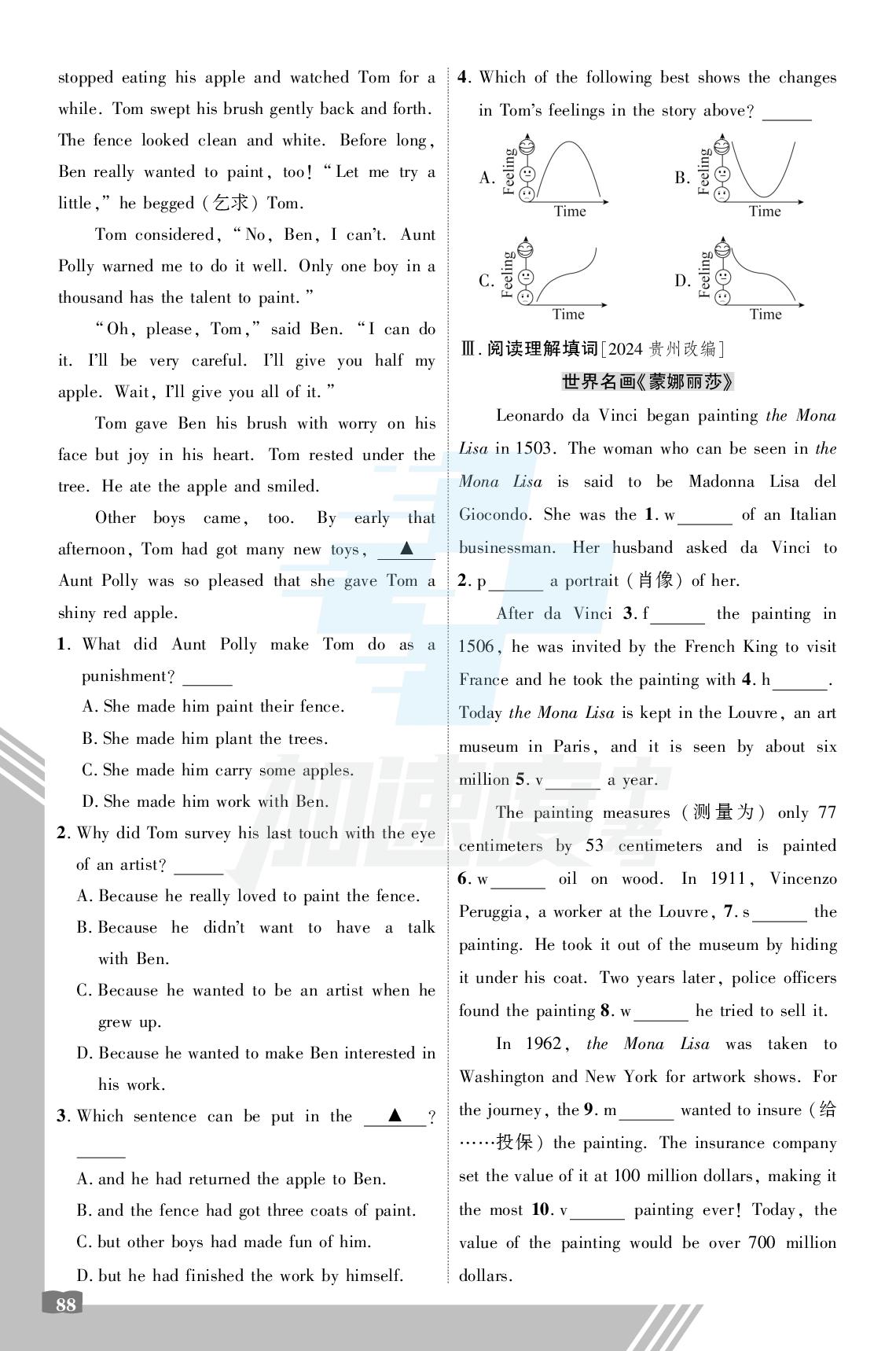
4. Which of the following best shows the changes
in Toms feelings in the story above? C
A. B.
C. D.
Ⅲ. 阅读理解填词[2024 贵州改编]
世界名画《蒙娜丽莎》
Leonardo da Vinci began painting the Mona
Lisa in 1503. The woman who can be seen in the
Mona Lisa is said to be Madonna Lisa del
Giocondo. She was the 1. w of an Italian
businessman. Her husband asked da Vinci to
2. p a portrait (肖像) of her.
After da Vinci 3. f the painting in
1506, he was invited by the French King to visit
France and he took the painting with 4. h .
Today the Mona Lisa is kept in the Louvre, an art
museum in Paris, and it is seen by about six
million 5. v a year.
The painting measures (测量为) only 77
centimeters by 53 centimeters and is painted
6. w oil on wood. In 1911, Vincenzo
Peruggia, a worker at the Louvre, 7. s the
painting. He took it out of the museum by hiding
it under his coat. Two years later, police officers
found the painting 8. w he tried to sell it.
In 1962, the Mona Lisa was taken to
Washington and New York for artwork shows. For
the journey, the 9. m wanted to insure (给
……投保) the painting. The insurance company
set the value of it at 100 million dollars, making it
the most 10. v painting ever! Today, the
value of the painting would be over 700 million
dollars.
88
子主题五 历史、社会与文化
Ⅰ. 完形填空
Lian Po and Lin Xiangru were two important
people in the State of Zhao. Lian was a brave
1 , and Lin was an excellent advisor. Lian
was famous for winning battles ( 战 役 ) and
making his 2 scared. He once led the Zhao
army to victory against the State of Qi. Everyone
3 him for his bravery. Lin, on the other
hand, was clever and knew how to use 4 to
solve problems. He once saved the Heshibi 5
the King of Zhao and became a trusted advisor.
But there was a problem. Lian felt worried
after Lin got a 6 position than him. He
thought he should be given greater honor because
of his achievements on the battlefield, 7 Lin
achieved success just through his skills in
speaking and debating (辩论). Sometimes, Lian
even spoke ill of Lin behind his back.
Lin didnt want any trouble, so he 8
meeting Lian. He didnt want to argue or fight.
Lian thought he was winning because it 9 that
Lin was scared of him. Lins friends, however,
were 10 about this. They thought Lin was too
kind and weak. But Lin explained that he didnt
have 11 to fight Lian because it would harm
their country. He believed that if they 12
together, the State of Zhao would become
powerful.
When Lian heard this, he felt ashamed. He
realized he was being foolish and 13 caused
trouble for their country. So he said sorry to Lin,
and they became good friends. They worked
together to serve the State of Zhao and 14
personal problems. Lian and Lin showed us that
even if we have differences, we can still put aside
our pride and achieve great things when we pay
full 15 to whats best for the greater good as
friends.
1. A. banker B. doctor C. general
2. A. friends B. kids C. enemies
3. A. admired B. interviewed C. noticed
4. A. guns B. knives C. words
5. A. as B. for C. from
6. A. higher B. lower C. larger
7. A. since B. until C. while
8. A. avoided B. continued C. remembered
9. A. found B. appeared C. mentioned
10. A. quiet B. surprised C. upset
11. A. plans B. powers C. reasons
12. A. mixed B. pulled C. got
13. A. ever B. also C. almost
14. A. helped with B. dealt with C. forgot about
15. A. attention B. sense C. review
Ⅱ. 阅读理解
Todays teens have grown up online. 1
They do homework online. And surely, they get
their news online. But because they are so
comfortable with the Internet, they seldom
question the news stories online.
Now William Colglazier, a history teacher at
a high school in America, is teaching his students
how to think critically (批判性地) about online
information and recognize a fake (假的) news
story.
His idea came from a study on peoples online
reasoning (推理) at Stanford University. 2
Most middle school students in the study could not
tell the difference between an advertisement and a
news story, and high school and college students
fully trusted the websites ending in “. org”.
89
The good news is that, according to
Colglazier, once teens realize theyve been
cheated, they have strong will to tell truth from
lies. “ 3 and how to recognize when others
use poor argumentation (论据),” he said. Some
of the advice that Colglazier offers his students
includes moving off the site to find more
information about the site, the writers motivations
(动机) and the organization behind the news story.
4 He hopes more kids would think
critically when they read news online. “ 5 ”
he said. “ If people cant tell real news from fake
news, the results can be frightening. ”
A. The Internet is both beautiful and ugly,
B. They make friends online.
C. The study found that young people lack ability
to reason about the information on the Internet.
D. Colglazier shared some of his courses with
other teens in Teen Vogue.
E. But they need some advice on how to find
evidence (证据),
Ⅲ. 读写实践
古代年龄称谓
What age does doukou nianhua refer to? In
one of his poems, Tang Dynasty poet Du Mu once
compared girls around the age of 13 to cardamom
(豆蔻) flowers in the bud. Since then, doukou
nianhua has been used to describe teen girls of
this age.
Ancient Chinese people liked to describe
someones age using titles, rather than the exact
number. For example, chuitiao, meaning
“straight hair”, referred to a hairstyle that was
popular for very young children in ancient China.
It was used for children from 3 to 8 years old.
Zongjiao, meaning “twisted horn”, was used
to describe children from 9 to 14 years old. Back
then, children would divide their hair into two
halves and twist each half into a knot (结) on the
top of their head, just like two horns.
Shufa, meaning to tie ones hair up, was
used for boys who had reached the age of 15. Boys
would let down their “ twisted horns” and tie up
their hair in a bunch ( 一 束 ) when they
turned 15.
Ruoguan, or “ junior cap”, was used for
young men in their twenties. These men would go
to a hat-wearing ceremony when they turned 20 to
show that they had become adults.
The “year of independence” was when a man
turned 30.
At the age of 40, one “ will not become
puzzled”.
When a man turned 50, he had reached the
“year of understanding the mandate (命令) of
heaven”, meaning to become aware of ones fate
and no longer make any useless efforts.
Finally, if you were lucky to live past one
hundred years, you would be titled qiyi.
———素材选自《二十一世纪学生英文报》
1. There are titles to describe
peoples ages in the passage.
2. Children from 3 to 8 years old can be described
as .
3. When a man turned 20, they would go to a hat-
wearing ceremony to show that .
4. The underlined words in
Paragraph 8 mean “ ” in
Chinese.
5. The passage talks about
of different ages in ancient times.
90
子主题六 科学与技术
Ⅰ. 完形填空
Linlin is helping his grandfather clean the
storeroom. Suddenly he found two old 1 . His
grandfather took these two televisions out and
2 them to Linlin. The first one was black and
white. It was bought in the 1980s. At that time
nobody in their hutong owned a TV except them.
All the families were 3 see this electronic
equipment when it arrived. Grandfather put a tall
antenna (天线) on the roof so they could get the
signals. He still remembered the time that they
spent with that TV. All the 4 and some
neighbors gathered together to watch the TV
programs.
Then grandfather pointed to the second one.
They could use a remote control (遥控器) to
5 this color TV or change the programs. This
television has brought more 6 to children.
Grandfather said, “What a useful invention the
television was!”
Dozens of years passed, the television has
changed greatly since its birth, especially the
shape and the function. Now Linlin can not only
watch TV programs 7 play games on them.
He can even use his voice or his gestures to
control the modern televisions. They are also able
to 8 Linlin soon. Also, Linlin projects (投
射) music, videos, images, and more from his
mobile device onto the TV 9 . Sometimes
Linlin also has video calls with his friends. Linlin
10 that maybe televisions will be smarter and
smarter.
1. A. televisions B. computers
C. telephones D. radios
2. A. separated B. concluded
C. organized D. introduced
3. A. afraid of B. bored with
C. excited to D. nervous to
4. A. truck drivers B. family members
C. police officers D. street cleaners
5. A. turn on B. turn down
C. break up D. take off
6. A. pain B. happiness
C. courage D. luck
7. A. and B. or
C. so D. but
8. A. recycle B. recall
C. report D. reply
9. A. bottom B. screen
C. model D. cover
10. A. supposes B. records
C. expresses D. wonders
Ⅱ. 阅读理解[2024 龙东地区改编]
新类型语篇·图示
Lu Ban was a famous
inventor.
He created the Luban
Lock to see how clever
his son was.
It took his son a whole
night to put it back.
One day, Lu Ban cut his
hand on a leaf. He came
up with a good idea. He
invented the saw.
91
续表
Watching his mother
making a quilt (被子),
Lu Ban created the ink
line to mark a straight
line on wood to saw it
properly.
The plane (刨子) was
invented to make flat
surfaces (平整的表面)
on the wood.
1. Why did Lu Ban invent the Luban Lock? A
A. To see if his son was clever.
B. To have fun.
C. To lock the door.
D. To prepare a gift.
2. How did Lu Ban invent the saw? B
A. He got the idea from marking a straight line.
B. He got the idea from cutting his hand on a
leaf.
C. He got the idea from using the Luban Lock.
D. He got the idea from making flat surface.
3. Whats the plane used for? C
A. Sawing the wood.
B. Flying in the sky.
C. Making the wood flat.
D. Lock the door.
4. What do you think of Lu Ban according to the
information above? A
A. Creative. B. Kind.
C. Brave. D. Strong.
Ⅲ. 词语运用
太阳能汽车
A team of students at a university in the
Netherlands has created a car thats completely
powered by the sun. The car, called Stella Terra,
is the first solar-powered car that can 1.
( travel) for a long time without needing to be
charged (充电).
The students are 2. k as Solar Team
Eindhoven. To create a car that could deal with
the kind of tough (艰难的) driving, the students
3. (design) the car from top to bottom.
On top, of course, were the solar panels.
Most solar panels are only about 20% efficient(高
效率的). That means they waste about 80% of
the sunlight they get. But the 4. ( car)
solar panels are 97% efficient. Thanks to Stella
Terras 5. ( power) solar panels, when
its sunny, it can run for 710 kilometers a day.
On the 6. b , the team designed a
special system to help the car deal with the heavy
shaking that comes when driving over rough roads.
The team 7. (recent) took the car on its
biggest test — a challenging 1,000-kilometer test
drive across Morocco. The car had to travel
8. t forests and dry river beds. It had to
drive across desert sand and up mountain roads.
The car succeeded in doing all of this, without
ever 9. (stop) at a recharging station.
The team is very proud of their car, and they
say they wont be upset if car companies start to
copy their 10. i . In fact, they hope that
Stella Terra will help inspire car companies to
work on similar projects.
———素材选自《英语周报》
1. Why wont the team be upset if car
companies start to copy their ideas? A
A. Because they hope Stella Terra will help
car companies to work well on similar
projects.
B. Because they hope car companies will
ask them to work on the similar projects.
C. Because they are very proud of Stella
Terra, which was designed by themselves.
D. Because the car has succeeded in the
biggest test drive across Morocco.
2. In what part of the newspaper can we see
this passage? A
A. Science and technology.
B. Nature and geography.
C. Society and culture.
D. Sports and health.
92
资源预览图

1

2

3
4

相关资源
由于学科网是一个信息分享及获取的平台,不确保部分用户上传资料的 来源及知识产权归属。如您发现相关资料侵犯您的合法权益,请联系学科网,我们核实后将及时进行处理。