九年级上册-【加速度中考】2025年内蒙古中考英语情境作业本(外研版)
2025-04-21
|
2份
|
11页
|
32人阅读
|
0人下载

资源信息
| 学段 | 初中 |
|---|---|
| 学科 | 英语 |
| 教材版本 | - |
| 年级 | 九年级 |
| 章节 | - |
| 类型 | 题集-专项训练 |
| 知识点 | - |
| 使用场景 | 中考复习 |
| 学年 | 2025-2026 |
| 地区(省份) | 内蒙古自治区 |
| 地区(市) | - |
| 地区(区县) | - |
| 文件格式 | ZIP |
| 文件大小 | 1.35 MB |
| 发布时间 | 2025-04-21 |
| 更新时间 | 2025-04-21 |
| 作者 | 加速度中考 |
| 品牌系列 | 加速度中考·情境作业本 |
| 审核时间 | 2025-03-18 |
| 下载链接 | https://m.zxxk.com/soft/51074615.html |
| 价格 | 10.00储值(1储值=1元) |
| 来源 | 学科网 |
内容正文:
九年级上册
课时 17 Modules 1 ~ 2
Ⅰ. 补全对话
A: Liu Xing, Im really interested in Chinese
festivals. What festivals do Chinese people
celebrate?
B: There are many, like the Spring Festival, the
Mid-Autumn Festival, the Double Ninth
Festival and so on.
A: 1. ?
B: I like the Double Ninth Festival best.
A: 2. ?
B: It falls on the ninth day of the ninth month of
the lunar calendar. Double nine means
“ forever ” in China. And it is also called
“Chongyang Festival” .
A: 3. ! What do
people usually do on this day?
B: People usually eat Chongyang cakes as one of
the traditional customs on the day. And many
people drink chrysanthemum (菊花) wine to
help keep healthy.
A: OK, I see. 4. ?
B: It shows peoples greatest respect, care and
love for the old.
A: Thank you for telling me so much. I hope to
join you in the festival this year.
B: 5. .
Ⅱ. 完形填空
人与自然———自然生态
喀斯特负地形———天坑
A team of Chinese scientists have found a new
giant sinkhole (天坑). Its 192 meters 1 .
What did they find at the 2 ? An ancient
forest!
This 3 discovery was found in Leye
County, in Guangxi Zhuang Autonomous Region.
Leye County 4 “ the museum of sinkholes”.
People have 5 about 30 sinkholes there so far.
How do sinkholes form?
“China has a karst landscape (喀斯特地
貌),” Veni told Live Science. Karst landscapes
are made when rainwater runs through little cracks
(裂缝) in the 6 . The cracks 7 grow
into tunnels (隧道) and then big caves. Over
time, a cave can get too 8 . Its ceiling then
falls slowly, opening up huge sinkholes.
Veni called Chinas sinkholes “ wonderful ”
because of 9 great sizes.
10 are sinkholes important?
Besides looking cool, karst caves and
sinkholes can be the 11 to all kinds of
plants, animals and microbes (微生物). The
newly discovered one has ancient trees up to 40
meters tall. “I wouldnt be surprised to know that
some species (物种) in these caves have never
been 12 or described by science until now,”
said the leader of exploration team, Chen Lixin.
This is 13 the sinkholes are separated from
the outside world. That 14 an environment
for new species to form.
Sinkholes also have deep stores of
underground water. “They are like natures water
tubs. They bring 15 to 700 million people
worldwide,” Veni told Live Science.
1. A. tall B. deep C. thin
2. A. end B. top C. bottom
3. A. terrible B. amazing C. early
4. A. is known as B. is proud of C. is similar to
5. A. made B. dug C. found
6. A. floor B. tree C. ground
7. A. luckily B. easily C. slowly
8. A. small B. big C. straight
9. A. his B. your C. their
10. A. Why B. When C. Where
11. A. room B. home C. house
12. A. reported B. sold C. saved
33
13. A. because B. until C. whether
14. A. hurts B. provides C. protects
15. A. rain B. snow C. water
Ⅲ. 阅读理解[2024 滨州改编]
人与社会———历史、社会与文化
自贡灯会的特色灯笼
Zigong, in Sichuan Province, is home to
Chinese lanterns. Zigong lantern is known as the
best lantern in the world. The Zigong Lantern
Festival dates back to the Tang Dynasty. The
festival has rapidly developed with traditional
culture and modern technologies. In 2008, the
Zigong Lantern Festival was listed as a national
intangible cultural heritage(国家级非物质文化
遗产), becoming a shining name card for Chinese
culture to go out into the world.
“ Making a huge lantern for exhibition
requires 17 steps,” said Wan Songtao, an
inheritor ( 传承人) of Zigong lantern-making.
“Each step is finished by a team instead of a
single maker,” Wan added. The sundial (日晷),
a kind of lantern, made by Wans team, for
example, took about 80 makers over 50 days to
complete the whole process. Unlike the lanterns in
other places, Zigong lanterns use modern
technologies such as AI, mechanical engineering,
and holography (全息摄影术). They are perfect
combinations ( 结 合 ) of lights, sounds and
movements.
Whats more, the theme of the lantern can be
chosen in different ways. “Anything that can be
designed on a lantern can make a wonderful show,
and everyone is encouraged to turn their ideas into
real works,” said Zhang Fanglai, a leading
researcher at the Colorful Lantern Museum of
China. And the rich themes of Zigong lanterns
show the spirit of creativity and warmth from the
bottom of the local peoples heart.
The government encourages local people to
learn lantern-making widely. Without doubt, at
the heart of the Zigong Lantern Festivals success
is the local tradition of pulling together. Zigong
lanterns are getting more and more popular.
Driven by the collective efforts of the whole city,
they have reached over 80 countries. Its believed
that Zigong lanterns will reach every corner of the
world in the future.
1. Which of the following poets could probably
enjoy Zigong lanterns? B
A. Cao Cao. B. Li Bai.
C. Tao Yuanming. D. Cao Zhi.
2. What can we infer (推断) from Paragraph 2?
C
①Holography is a kind of traditional technology.
② Its hard for makers to complete a huge
lantern for exhibition.
③Zigong lanterns are different from the lanterns
in other places.
④The workers of Zigong lantern making work
together in a team.
A. ①②③ B. ①④ C. ②③④ D. ②③
3. What does the underlined word “ they ” in
Paragraph 4 refer to? B
A. People in Zigong.
B. Zigong lanterns.
C. The makers of Zigong lanterns.
D. Many museums.
4. Which of the following best
shows the structure of this passage? A
(① = Paragraph 1, ② = Paragraph 2)
A. B.
C. D.
34
课时 18 Modules 3 ~ 4
Ⅰ. 补全对话
A: Hello. 1
B: Hi, Steve. This is Ben. 2
A: Im doing housework.
B: 3
A: Yes. I usually clean my room and make the
bed every morning before school. 4
B: I always help my mother wash the dishes and
take out the rubbish.
A: What do you think of doing housework?
B: 5 Oh, by the way, Im calling to ask you
if you can see a movie with me tonight.
A: Good idea! Im free tonight.
B: Lets meet at 7:00 in front of Wanda Cinema.
A: OK, see you then.
A. Its very interesting and relaxing!
B. Thank you!
C. Steve speaking.
D. How about you?
E. What are you doing?
F. Would you like to go with me?
G. Do you usually do housework at home?
Ⅱ. 阅读理解[2024 吉林改编]
人与社会———历史、社会与文化
“中国航天之父”———钱学森
Qian Xuesen was a great scientist. 1 He
is also known as “ the King of the Rocket. ”
Thanks to his research, Chinas space technology
has progressed in a rapid way.
Qian was born in Shanghai on December
11th, 1911. 2 After graduation, he worked
in America for a few years. In the early 1950s, he
heard that New China had been founded (建立),
and he decided to give up the good working
conditions in America. Although the American
government tried to stop him from leaving, he
succeeded in coming back to China in 1955.
3 Then it became the leading
organization for Chinas rocket and air travel. At
that time, the conditions in China were too hard.
4 On April 24, 1970, Chinas first man-made
satellite ( 卫 星 ), “ Dongfanghong I ” was
successfully sent into the air.
A student of Qian Xuesen, Zhu Yilin, once
said, “ I learned professional knowledge and
working spirit from Mr. Qian. 5 When New
China needed scientists badly, he returned to help
in the rocket industry. ”
A. I sensed his deep love for our country, too.
B. At the age of 24, he went to America to study.
C. But Qian and his team still faced the difficulties
bravely.
D. He is known as “ the Father of Chinas Space
Program. ”
E. In 1956, Qian Xuesen suggested starting a
special organization.
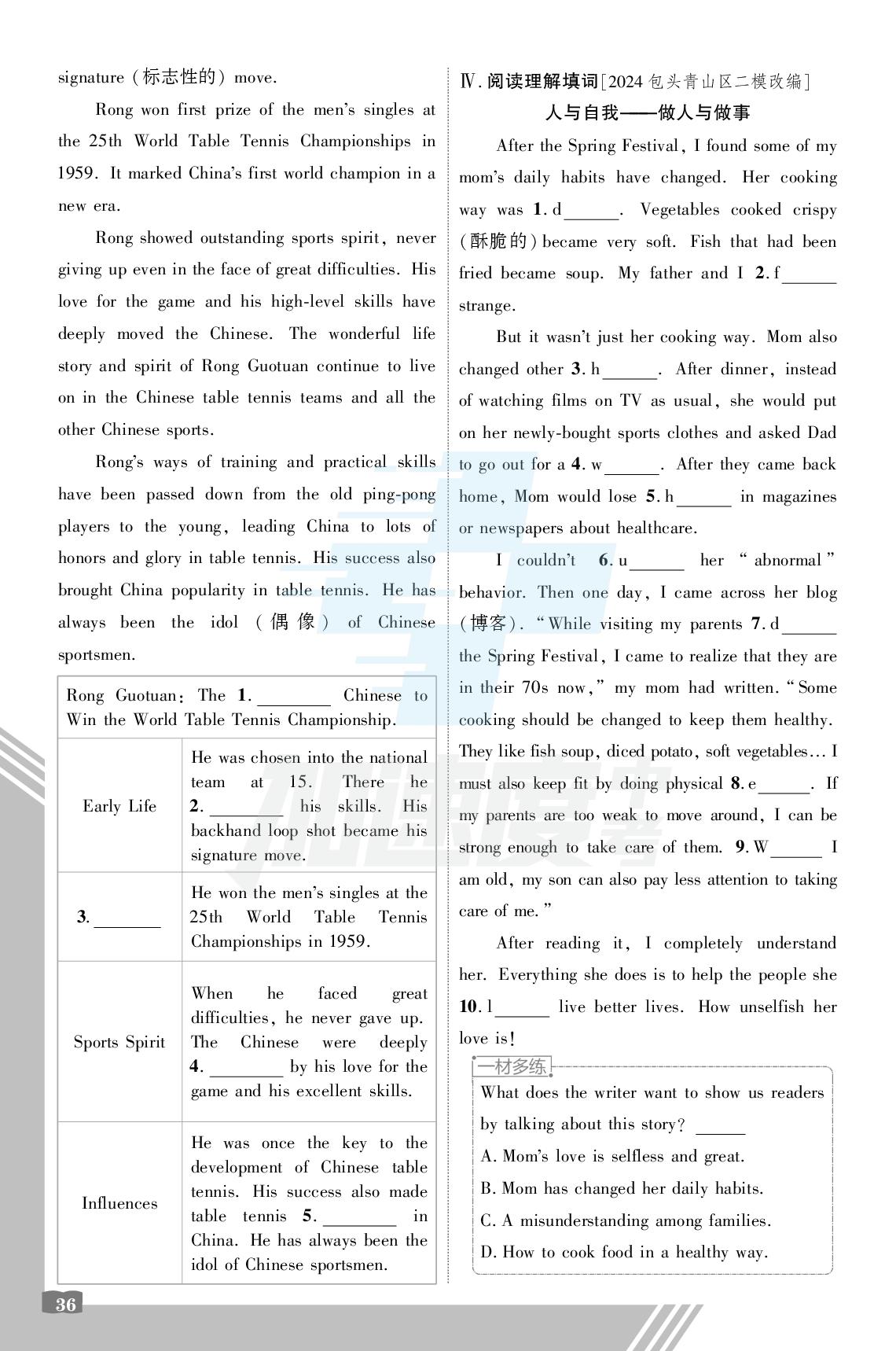
Ⅲ. 读写实践[2024 宜宾改编]
人与社会———文学、艺术与体育
中国体育运动健将———容国团
One of the greatest sportsmen in China is the
ping-pong player Rong Guotuan. He was the first
one to win the World Table Tennis Championship
for China and is considered as the most important
one in starting the golden era of Chinese table
tennis. He was born on August 10th, 1937, into a
fisherman family in Guangdong.
Rong showed great interest and talent in table
tennis from a young age. At 15, he was chosen
into the national team, where his skills were
improved. His backhand loop shot became his
35
signature (标志性的) move.
Rong won first prize of the mens singles at
the 25th World Table Tennis Championships in
1959. It marked Chinas first world champion in a
new era.
Rong showed outstanding sports spirit, never
giving up even in the face of great difficulties. His
love for the game and his high-level skills have
deeply moved the Chinese. The wonderful life
story and spirit of Rong Guotuan continue to live
on in the Chinese table tennis teams and all the
other Chinese sports.
Rongs ways of training and practical skills
have been passed down from the old ping-pong
players to the young, leading China to lots of
honors and glory in table tennis. His success also
brought China popularity in table tennis. He has
always been the idol ( 偶 像 ) of Chinese
sportsmen.
Rong Guotuan: The 1. Chinese to
Win the World Table Tennis Championship.
Early Life
He was chosen into the national
team at 15. There he
2. his skills. His
backhand loop shot became his
signature move.
3.
He won the mens singles at the
25th World Table Tennis
Championships in 1959.
Sports Spirit
When he faced great
difficulties, he never gave up.
The Chinese were deeply
4. by his love for the
game and his excellent skills.
Influences
He was once the key to the
development of Chinese table
tennis. His success also made
table tennis 5. in
China. He has always been the
idol of Chinese sportsmen.
Ⅳ. 阅读理解填词[2024 包头青山区二模改编]
人与自我———做人与做事
After the Spring Festival, I found some of my
moms daily habits have changed. Her cooking
way was 1. d . Vegetables cooked crispy
(酥脆的) became very soft. Fish that had been
fried became soup. My father and I 2. f
strange.
But it wasnt just her cooking way. Mom also
changed other 3. h . After dinner, instead
of watching films on TV as usual, she would put
on her newly-bought sports clothes and asked Dad
to go out for a 4. w . After they came back
home, Mom would lose 5. h in magazines
or newspapers about healthcare.
I couldnt 6. u her “ abnormal ”
behavior. Then one day, I came across her blog
(博客). “While visiting my parents 7. d
the Spring Festival, I came to realize that they are
in their 70s now,” my mom had written. “ Some
cooking should be changed to keep them healthy.
They like fish soup, diced potato, soft vegetables I
must also keep fit by doing physical 8. e . If
my parents are too weak to move around, I can be
strong enough to take care of them. 9. W I
am old, my son can also pay less attention to taking
care of me. ”
After reading it, I completely understand
her. Everything she does is to help the people she
10. l live better lives. How unselfish her
love is!
What does the writer want to show us readers
by talking about this story? A
A. Moms love is selfless and great.
B. Mom has changed her daily habits.
C. A misunderstanding among families.
D. How to cook food in a healthy way.
36
课时 19 Modules 5 ~ 6
Ⅰ. 补全对话
A: Hi! How is everything going?
B: 1. .
A: Are you free now?
B: 2. . Whats up?
A: Its not easy for me to say this but Im a bit
angry. 3. .
B: Maybe Cindy didnt mean to break your cup.
Theres no need to be angry. But if you are
angry, there is a way.
A: 4. ?
B: Write down your feelings on paper, and then
throw it away. It is a good way to let out
anger.
A: Sounds good. Ill have a try. 5.
.
B: Youre welcome. Have a nice day.
Ⅱ. 完形填空
人与自我———做人与做事
Imagine youre taking an exam, and you find
it difficult to answer those questions. Time is
running out. Would you waste the little chance
that you get in cheating (作弊)? 1 , some of
us have once cheated in the test. Certainly, its
not correct. Its important to 2 the rules
because the world would turn into a total mess
without rules.
However, with the time passing by and the
3 of the society, some rules have become
barriers (障碍) to peoples success. Arnold once
said, “ We have so many rules in life about
everything. But its 4 to be a creator if youre
too well-behaved. You have to think outside
the box. ”
Not all rules are equal (平等的). Some are
created to control people, 5 become old and
boring. So sometimes, its OK to break the rules.
In 1823, William Webb Ellis was a pupil at
Rugby School(拉格比公学). He 6 playing
football in the old way, so he took the ball in his
arms and ran with it 7 a school football
match. Rugby(橄榄球), the game we know and
love today, was 8 .
Each person has his own values (价值观).
Before you break the rules, think over whether it
will go against your values. And the moment you
decide to do that, you must be ready to face the
bad 9 .
All in all, rules are used to help us. So, we
have reason to believe that breaking rules is
necessary at times, especially when they prevent
us from becoming 10 . Of course, one can be
a fan of breaking the rules, but cant be a fan of
breaking the laws.
1. A. Probably B. Lastly
C. Finally D. Mainly
2. A. break B. make
C. follow D. change
3. A. encouragement B. development
C. agreement D. movement
4. A. powerful B. surprising
C. attractive D. impossible
5. A. other B. others
C. another D. the other
6. A. got bored with B. was proud of
C. was afraid of D. was thankful to
7. A. among B. before C. during D. after
8. A. finished B. allowed C. born D. sold
37
9. A. minds B. replies
C. reasons D. results
10. A. younger B. better
C. happier D. funnier
Ⅲ. 阅读理解[2024 长春改编]
人与自我———生活与学习
新类型语篇·图示
Sunshine Art Museum
Place:On the north side of King Square
Arriving Here:Subway stations:
Nelson Street (2-minute walk)
Embankment (3-minute walk)
Charing Cross (7-minute walk)
Opening Hours:Mon. —Sat. 10 a. m. —4 p. m.
Prices:Adults: $10 / person
Children under 12: Free
Connect with us: Call 723-1182 for more
information.
Hope you enjoy your time here with this guide!
1. Which subway station is the closest to the
museum? B
A. King Square. B. Nelson Street.
C. Embankment. D. Charing Cross.
2. The sign means you can C here.
A. have a meal B. enjoy photos
C. ask for information D. buy a present
3. We can find Museum Shop C .
A. in East Garden
B. next to Dining Space
C. across from Lost & Found
D. between Ancient Arts and Modern Arts
4. Where is the text probably taken from? A
A. A visitor guide. B. A shopping list.
C. A street map. D. A travel diary.
Ⅳ. 词语运用
人与自我———做人与做事
In a town, there was a wise man. He usually
listened to 1. ( people) problems and
tried to give them advice.
The wise man gave good advice to these
people in order to help them to solve their
2. ( problem ). But they never
3. (real) took his advice. In fact, most
people just enjoyed 4. ( complain ).
They didnt want to listen to the wise man.
The wise man thought of a good idea. Every
time someone came to him with their complaints,
he would tell them 5. funny story. The
6. ( one ) time they heard it, they
laughed. When they came back again with the old
complaints, the man would 7. ( tell )
them the same old story. It became less and less
interesting as time went by.
Finally one man said, “ Wise man,
8. do you always tell the same story over
and over again? It isnt funny at all. ”
The wise man 9. ( answer), “ If
you cant laugh at the same story over and over
again, then why do you always complain
10. the same things over and over
again?”
There is no meaning in worrying or
complaining about something if you cant or
wouldnt solve it.
38
课时 20 Modules 7 ~ 9
Ⅰ. 补全对话
(A reporter is interviewing a basketball player. )
Jim: Hi, Tom! Your class is the champion this
year. Congratulations!
Tom: Thank you.
Jim: 1
Tom: Yes, I felt really nervous at first. It was a
hard game.
Jim: I watched the game online. 2 What do
you think is the secret of success?
Tom: 3
Jim: We can see that all of you tried your best to
fight till the last minute. 4
Tom: We look up to them. They brought out the
best in us. We became friends after the
game.
Jim: Pretty good. 5
Tom: All of us have learned that nothing is more
important than the team spirit.
A. It was not easy to win the game.
B. How do you like the opponents(对手) in the
final?
C. What have you learned from the game?
D. It is that we never give up.
E. Did you feel nervous in the final game?
Ⅱ. 完形填空
人与社会———文学、艺术与体育
《凿壁偷光》
There are many great stories in Chinese
history. This is one of the most educational
stories.
Kuang Heng was a very famous person in the
Western Han Dynasty. He was born in a 1
family. He liked 2 very much. He needed to
work in the daytime, so he had to read books
during the night. But he was too poor to buy a
3 .
One day, he found that his neighbor had
candles, but the light couldnt go through the
wall. After thinking for a while, he had an idea.
He 4 a small hole in the wall in his house so
that he could use the light from his neighbors
house to read books. From that day on, he read
books every night 5 the light went out. After
some days, in his 6 there were no books for
him to read. Then he went to a rich mans house
and worked for him without 7 any money.
Hearing this, the rich man thought that Kuang
Heng was 8 but still asked, “You mean you
will work for me for free. But why?” Kuang Heng
replied, “Well, I only want to borrow your books
to read. Thats enough. ”
The rich man was 9 touched and he
agreed. Kuang Heng read the books in the rich
mans house one by one. Finally, he 10 a
great scholar(学者).
If you are still worried about reading books,
its necessary for you to learn from Kuang Heng.
1. A. rich B. small C. poor D. big
2. A. buying B. overcoming
C. acting D. reading
3. A. candle B. house C. book D. candy
4. A. found B. hung C. dug D. put
5. A. if B. until
C. although D. because
6. A. group B. library C. school D. house
7. A. asking for B. giving back
C. paying for D. laying out
8. A. simple B. smart C. serious D. stupid
9. A. suddenly B. carefully
C. deeply D. luckily
10. A. met B. became
C. shook D. caught
39
Ⅲ. 阅读理解[2024 扬州改编]
人与社会———历史、社会与文化
新类型语篇·简版小说
One day in autumn, Squire Gordon, my
master, went on a trip into town. John, my
caretaker, went with him. I pulled the cart. The
weather was rainy and windy, but we travelled
happily.
Gordons business took a long time. We
didnt leave until late afternoon. The wind was
then much higher. My master said to John, “ I
have never been out in such a storm!” Mr Gordon
and John could not see well in the rain.
We came to a wooden bridge. It was very
nearly dark. We could just see that the water was
over the middle of the bridge. But as that
happened sometimes when the floods were out, my
master did not stop. The moment my feet touched
the first part of the bridge, I felt sure there was
something wrong. I dare (敢于) not go forward,
and I made a dead stop. “Go on, Beauty,” said
my master, and he gave me a touch with the whip
(鞭子), but I dare not move. He gave me a
sharp cut and I jumped, but I dare not go
forward.
“Theres something wrong, sir,” said John,
and he got out and tried to lead me forward.
“Come on, Beauty. ” But I knew that the bridge
was not safe.
Just then the man on the other side saw us.
“Hey! Halloo! Stop!” he cried.
“Whats the matter?” shouted my master.
“The bridge is broken in the middle, and
part of it is carried away. If you go onto it, youll
be into the river. ”
“ Thank you for saving us, Beauty!” said
John. He gently turned me round to the right hand
road by the river side. It grew darker and darker,
stiller and stiller.
When we returned home, the Squire told Mrs
Gordon, “Black Beauty saved our lives. He knew
the bridge was dangerous. ”
John took me to the stable. Oh! What a good
supper he gave me that night! What a nice bed of
straw! I was glad of it, for I was tired.
— Adapted from Black Beauty
1. What was the weather like when Gordon, John
and Beauty left town for home? B
A. The rain came to a stop.
B. There was a heavy storm.
C. It was sunny and windy.
D. The wind was much gentler.
2. Which of the following is the correct order of the
story? A
a. The man warned them not to cross the broken
bridge.
b. The master touched Black Beauty with the
whip.
c. Black Beauty was well rewarded for his
decision.
d. Black Beauty refused to obey his master at
the bridge.
e. They three came to a wooden bridge, ready to
cross the river.
A. ebdac B. bdaec C. edcab D. dbeca
3. Which detail supports the main idea that Black
Beauty knew the bridge was dangerous? C
A. Mr Gordon and John could not see well in the
rain.
B. We could just see that the water was over the
middle of the bridge.
C. He gave me a sharp cut and I jumped, but I
dare not go forward.
D. He gently turned me round to the right hand
road by the river side.
4. According to the passage, what is Black Beauty
like? A
A. Brave and smart.
B. Modest and hard-working.
C. Impolite and fearful.
D. Impatient and unwise.
40
课时 21 Modules 10 ~ 12
Ⅰ. 补全对话
A: Jenny, 1. ?
B: Its an old photo of our classmates.
A: Can I have a look at it?
B: Of course. Here you are.
A: 2. ?
B: It was taken 20 years ago. We all looked
young at that time.
A: You are right. How I wish we could go back to
school!
B: Me, too. I miss Mr White, our art teacher.
A: He was the most popular teacher among us. I
guess he has retired (退休).
B: Not yet. But he doesnt teach art now.
A: 3. ?
B: Guess what? Math!
A: Impossible! I remember Mrs James taught
math.
B: She has retired and gone abroad with her
husband. Was she your favorite teacher?
A: Yes, she was. 4.
?
B: She is fine. She will be back next month.
Then lets visit her together.
A: 5. .
Ⅱ. 阅读理解[2024 通辽]
人与自然———环境保护
三江源自然保护区
On a cold day in winter, a 13-year-old boy,
living in Qinghai Province, was heading down a
mountaintop with his family. Suddenly, they saw
two snow leopards ( 雪 豹 ) near the Lancang
River. “I see them for the first time. They look so
cool!” he said.
Since the mid-20th century, the area of
snow, grasslands and lakes in Sanjiangyuan has
become smaller because of climate change and
human activities. Many wild animals in the area
have died out. Snow leopards are endangered.
Later, China set up Sanjiangyuan Nature
Reserve (保护区) to better protect the area and
the wildlife there. In these years, the number of
wild animals has been increasing. More than 70,
000 Tibetan antelopes (藏羚羊) live there now.
And over 1,000 snow leopards can be found in the
area. Its higher than the average number around
the world.
The local people have improved their
understanding about environmental protection and
have tried hard to protect the environment in
Sanjiangyuan over the years. They still live on
selling caterpillar fungus (冬虫 夏 草) theyve
found in grasslands. In the past, they carried food
with them in plastic bags and left the bags and
food waste behind. But now the local people have
realized they should live together with nature in
harmony. They often pick up waste on the
grasslands. People also take their plastic bags and
food waste down the mountain after eating. The
local environment has taken on a new look. Many
young people there said, “We will continue to
guard our home and make it more beautiful. ”
1. What can we know from Paragraph 1 and
Paragraph 2? A
A. Snow leopards are in danger.
B. A boy raised two snow leopards at home.
41
C. Two snow leopards first appeared near the
Yellow River.
D. The grasslands and lakes in Sanjiangyuan
have disappeared.
2. Why did China build Sanjiangyuan Nature
Reserve? B
A. To develop the local tourist industry.
B. To improve the natural environment.
C. To provide a home for more people.
D. To find the source of three rivers.
3. The local people in Sanjiangyuan has changed
their way of D .
A. making a living
B. crossing the grasslands
C. carrying food with them
D. dealing with waste
4. What does the underlined word “ harmony ”
mean? B
A. 智慧 B. 和谐
C. 伤害 D. 忠诚
5. What can we infer from the passage? C
A. The local people wont sell caterpillar fungus
any more.
B. Many young people choose to leave
Sanjiangyuan.
C. The future of Sanjiangyuan Nature Reserve
will be better and better.
D. The number of Tibetan antelopes in
Sanjiangyuan is the smallest.
Ⅲ. 词语运用
人与社会———历史、社会与文化
北京中轴线
begin it tradition add include
center back build plan important
Have you learned about axial symmetry (轴
对称) in math? If a city shows axial symmetry,
1. central axis is the key line. In July
2024, the “ Beijing Central Axis: A Building
Ensemble Exhibiting the Ideal Order of the
Chinese Capital ” was 2. to the
UNESCO World Heritage List, becoming Chinas
59th World Heritage Site.
The Beijing Central Axis has a group of
3. and historical sites that shape
Beijings old city. Running 7. 8 kilometers from
north to south in central Beijing, this area
4. 15 key parts, such as the Bell and
Drum Towers in the north and Yongdingmen Gate
in the south.
The building of the Beijing Central Axis
5. in the 13th century and took shape in
the 16th century. According to Lyu Zhou, director
of the National Heritage Center at Tsinghua
University, this idea of city planning dates
6. to the Kaogongji (《 考 工 记 》),
written before 221 BC. This book explains how to
7. a capital city.
The Beijing Central Axis shows 8.
Chinese ideas of “ zhong ” and “ he ”. For
example, the royal palace was placed at the
9. to show imperial power, with other
10. buildings placed around it to create
a sense of harmony.
“Beijings unique (独一无二的) and great
order is created by this central axis,” said Liang
Sicheng ( 1901—1972 ), a famous Chinese
architect (建筑师).
———素材选自《二十一世纪学生英文报》
42
九年级上册
课时 17 Modules 1 ~ 2
Ⅰ. 1. Which festival do you like best
2. When is it
3. That sounds interesting
4. Whats the meaning of this festival
5. Welcome to join us
Ⅱ. 1. B 2. C 3. B 4. A 5. C 6. C 7. C 8. B 9. C
10. A 11. B 12. A 13. A 14. B 15. C
Ⅲ. 1. B 2. C 3. B 4. A
课时 18 Modules 3 ~ 4
Ⅰ. 1. C 2. E 3. G 4. D 5. A
Ⅱ. 1. D 2. B 3. E 4. C 5. A
Ⅲ. 1. First 2. improved 3. Achievement 4. moved
5. popular
Ⅳ. 1. different 2. felt 3. habits 4. walk 5. herself
6. understand 7. during 8. exercise 9. When
10. loves
一材多练 A
课时 19 Modules 5 ~ 6
Ⅰ. 1. Not bad / Pretty good /
2. Yes, I am
3. Cindy broke my cup
4. What is it / What should I do /
5. Thank you / Thanks for your advice
Ⅱ. 1. A 2. C 3. B 4. D 5. B 6. A 7. C 8. C 9. D
10. B
Ⅲ. 1. B 2. C 3. C 4. A
Ⅳ. 1. peoples 2. problems 3. really 4. complaining
5. a 6. first 7. tell 8. why 9. answered
10. about
课时 20 Modules 7 ~ 9
Ⅰ. 1. E 2. A 3. D 4. B 5. C
10.
Ⅱ. 1. C 2. D 3. A 4. C 5. B 6. D 7. A 8. D 9. C
B
Ⅲ. 1. B 2. A 3. C 4. A
课时 21 Modules 10 ~ 12
Ⅰ. 1. whats this / that / it
2. When was it taken
3. What does he teach (now) / Which subject does he teach
(now)
4. How is she (now)
5. Good idea / OK / Sounds good / Sounds great
Ⅱ. 1. A 2. B 3. D 4. B 5. C
Ⅲ. 1. its 2. added 3. buildings 4. includes
5. began 6. back 7. plan 8. traditional 9. center
10. important
9
资源预览图

1

2

3
4

相关资源
由于学科网是一个信息分享及获取的平台,不确保部分用户上传资料的 来源及知识产权归属。如您发现相关资料侵犯您的合法权益,请联系学科网,我们核实后将及时进行处理。