八年级上册-【加速度中考】2025年内蒙古中考英语情境作业本(外研版)
2025-04-13
|
2份
|
11页
|
41人阅读
|
0人下载

资源信息
| 学段 | 初中 |
|---|---|
| 学科 | 英语 |
| 教材版本 | - |
| 年级 | 九年级 |
| 章节 | - |
| 类型 | 题集-专项训练 |
| 知识点 | - |
| 使用场景 | 中考复习 |
| 学年 | 2025-2026 |
| 地区(省份) | 内蒙古自治区 |
| 地区(市) | - |
| 地区(区县) | - |
| 文件格式 | ZIP |
| 文件大小 | 1.82 MB |
| 发布时间 | 2025-04-13 |
| 更新时间 | 2025-04-13 |
| 作者 | 加速度中考 |
| 品牌系列 | 加速度中考·情境作业本 |
| 审核时间 | 2025-03-18 |
| 下载链接 | https://m.zxxk.com/soft/51074612.html |
| 价格 | 10.00储值(1储值=1元) |
| 来源 | 学科网 |
内容正文:
第一部分 教材基础知识精练
八年级上册
课时 8 Modules 1 ~ 2
Ⅰ. 1. A 2. F 3. B 4. G 5. D
Ⅱ. 1. D 2. A 3. C 4. E 5. B
Ⅲ. 1. easy 2. answers 3. Imagine / Guess 4. solve
5. healthy
Ⅳ. 1. relaxing 2. a 3. started 4. advice 5. from
6. usually 7. So 8. saved 9. plants 10. nicer
课时 9 Modules 3 ~ 4
Ⅰ. 1. Whats up 2. Why is it important
3. How do you prepare for the game
4. No wonder you could win the game
5. Yes, Id like to
Ⅱ. 1. A 2. A 3. B 4. D 5. C 6. B 7. D 8. C
9. B 10. A
Ⅲ. 1. D 2. B 3. B 4. A
6. cheap 7. getting 8. connected 9. easily 10. bu
Ⅳ. 1. surprise 2. largest 3. countries 4. started 5. and
y
课时 10 Modules 5 ~ 6
Ⅰ. 1. B 2. E 3. G 4. C 5. D
Ⅱ. 1. B 2. B 3. C 4. C 5. B 6. A 7. C 8. A 9. B
10. C 11. C 12. B 13. B 14. A 15. B
Ⅲ. 1. D 2. D 3. B
课时 11 Modules 7 ~ 9
Ⅰ. 1. C 2. F 3. B 4. E 5. D
Ⅱ. 1. B 2. D 3. A 4. B
Ⅲ. 1. In 1868.
2. They feel hopeful about the future.
3. Yes, she does.
4. Jo advises her sisters to buy what they need and work hard
enough to make it.
5. I think its interesting. /
Ⅳ. 1. canceled 2. to live 3. Luckily 4. till / until
5. a 6. toys 7. brought 8. of / about 9. thankful
10. kindness
课时 12 Modules 10 ~ 12
Ⅰ. 1. G 2. C 3. F 4. B 5. D
10.
Ⅱ. 1. C 2. A 3. B 4. A 5. B 6. D 7. B 8. C 9. A
C
Ⅲ. 1. A 2. B 3. D 4. B 5. C
Ⅳ. 1. caught 2. oldest 3. Westerner 4. changes 5. culture
6. pass 7. buildings 8. so 9. seen 10. daily
8
八年级上册
课时 8 Modules 1 ~ 2
Ⅰ. 补全对话
(Two classmates, Lucy and Mike, are discussing
study skills. A is for Lucy; B is for Mike)
A: Have you ever heard of using the SQ3R method?
B: Oh, I havent heard of it. 1
A: Its a study method that helps you understand
what you read.
B: 2
A: Sure. First, you can start your learning by
surveying the book, asking questions,
reading, reciting, and reviewing.
B: 3 Ill give it a try.
A: Another thing that is helpful is to take notes in
different colors.
B: Really? How does that work?
A: Well, you can write down key things in red
and highlight important things in yellow. Use
different colors to group the same topics.
B: That makes sense. 4
A: Yes, thats true. Studying a few hours before
bed and reviewing the important things in the
morning can make it easier to remember what
you have learned.
B: 5 Ill certainly try them out.
A: Youre welcome. I believe you can make great
progress.
A. What is it?
B. That sounds helpful.
C. Have you tried it before?
D. Thanks for sharing these methods.
E. I dont have time to study before bed.
F. Can you explain it to me in more detail?
G. And I heard that studying before bed is helpful.
Ⅱ. 阅读理解
人与自我———生活与学习
Some people learn a second language easily.
Other people have trouble leaning a new language.
1 There are several ways to help you learn
English more easily and to make your learning
more interesting.
First, feel positive about learning English. If
you believe that you can learn, you will learn. Be
patient. You dont have to understand everything
all at once. Often you will make mistakes when
you are learning something new. 2
Second, practice using your English. For
example, you can write a journal, or a diary every
day. Soon, you will feel more comfortable writing
your ideas in English. 3 In addition, try to
speak English every day. You can practice with your
classmates after class. You might make mistakes,
but its no worry. Gradually you will feel confident
when you write and speak in English.
4 You can write your learning
experience in your journal. After each class,
think about it. Do you answer questions correctly
in class? Do you understand the teacher? Perhaps
the lesson is a bit difficult, but you can try to
understand it. Write these reflections in your
journal in English.
You should be positive about learning English.
5 It is important to practice every day. You can
make a record of your achievements. Make learning
English fun and have more confidence in yourself.
A. We can learn from our mistakes.
B. You should believe that you can do it.
C. After several weeks, your writing will improve.
D. How can you learn a new language, such as
English?
E. Third, keep a record of your language learning
experience.
15
Ⅲ. 读写实践
人与自我———生活与学习
批判性思维
Critical thinking ( 批 判 性 思 维) is about
thinking better. Training your critical thinking
skills can open up a door to a better world. But
the journey of being a person with critical thinking
is difficult.
Train your questioning skills.
Asking questions is perhaps the key act of
critical thinking. If you dont know what questions
to ask, you may as well not get the answer.
Finding the answer is what critical thinking is all
about.
Think several steps ahead.
Once the problem you are working on begins,
use your imagination to guess what the possible
futures will be.
Spare at least 30 minutes a day to improve
your brain function.
Spend 30 minutes in your busy day making
your brain more powerful. There are a few ways
that you can do this:
●Try to be active in finding the solution to a
problem a day.
●Find the time to exercise regularly.
●Eating the right kinds of foods is to keep
your brain in good health.
Critical Thinking
It is not 1. to be a person with critical
thinking.
Ways to
Improve
Your
Critical
Thinking
Think critically by asking questions and
finding 2. .
3. the possible futures once the
problem begins.
Spend 30 minutes a day training your
brain function.
●Try to 4. a problem a day
actively.
●Do regular exercise every day.
●Eat right kinds of foods to keep your
brain 5. .
As long as you keep practicing, you can improve your
critical thinking a lot.
Ⅳ. 词语运用[2024 淮安改编]
人与社会———历史、社会与文化
You may think it is impossible for people in
flats to have a beautiful garden. Thats not true!
The rooftop gardens (屋顶花园) are becoming
more and more popular in big cities now. It is a
nice way to turn an empty space into a pretty and
1. (relax) area.
Rooftop gardens seem very modern. But in
fact, it has 2. long history. More than
2,000 years ago ancient people 3.
( start ) to build the rooftop gardens. Those
gardens had the same purpose. If an enemy army
attacked the city, they might destroy the citys
food which could keep people alive. So the
4. ( advise ) of moving the farming
places to the top of the houses was given.
Todays rooftop gardens are different
5. the old ones. They also have other
uses. For example, the plants in the garden take
in more heat. The temperature in the house below
is 6. ( usual ) lower in summer.
7. the air conditioner (空调) is less
often used. More energy can be 8.
(save).
However, a rooftop garden needs more care.
First of all, build a fence (栅栏) around it. The
wind may blow your plants down from the roof.
You dont want anyone to get hurt, do you? Also,
remember that rooftop gardens get more sunshine.
If you have 9. ( plant ) that shouldnt
stay in it for too long, you may have to put them
in the shade sometimes.
Its not easy to look after a rooftop garden,
but if you put your heart into it, you will make
your little part of the city much 10.
(nice). And it will make you feel comfortable and
relaxed.
16
课时 9 Modules 3 ~ 4
Ⅰ. 补全对话
A: You look excited. 1.
?
B: We just won a basketball game. Its quite
important for us.
A: Congratulations! 2.
?
B: Because we beat the strongest team in our
school. Weve never beaten it before.
A: Wow. Great! Your team is the strongest now.
B: Haha. We are looking forward to winning the
final.
A: I remember seeing you practice after school.
3. ?
B: We practice hard every day.
A: 4. . By the way,
when is the final?
B: Next Thursday afternoon. Would you like to
cheer us on?
A: 5. .
B: Thats great. Thank you! See you then.
Ⅱ. 完形填空
人与社会———科学与技术
Can you imagine taking a flying taxi to the
airport? Can you imagine jumping over 1 city
streets at rush hour to get where you want to go far
faster than you could in a car? Believe it or not,
you might be able to do these things in an electric
air taxi sooner than you think.
In June, the FAA — the government group in
charge of Americas skies — 2 to allow a
company called Joby Aviation to start testing their
new air taxi.
Joby has been making and testing flying taxis
since 2017. 3 this is the first time theyre
testing a taxi thats been built in a factory. Before
that, all their 4 were made by hand.
By 2025, Joby hopes to start 5
passengers for money. Joby also expects their air
taxis to 6 a ride-sharing service in the air.
Just like you might use an app to order a car to
pick you up, you could use an app to 7 an air
taxi.
Although the idea of flying taxis is 8 ,
some people have concerns about them. The taxis
may be quieter than helicopters (直升机), but
theyll still be adding noise and traffic to our
skies. Some people worry that only rich people
will be able to afford to use them.
Still, it seems likely that air taxis will be part
of the future of 9 . The FAA says, “Maybe
we could see air taxis in the 10 by 2024
or 2025. ”
1. A. crowded B. quiet C. difficult D. rich
2. A. agreed B. refused C. failed D. preferred
3. A. And B. But C. Unless D. Although
4. A. buses B. trains C. trucks D. taxis
5. A. thanking B. changing
C. carrying D. preparing
6. A. improve B. provide C. repair D. stop
7. A. buy B. see C. drive D. order
8. A. possible B. terrible C. exciting D. boring
9. A. science B. travel C. culture D. education
10. A. skies B. waters C. trees D. films
Ⅲ. 阅读理解
人与社会———文学、艺术与体育
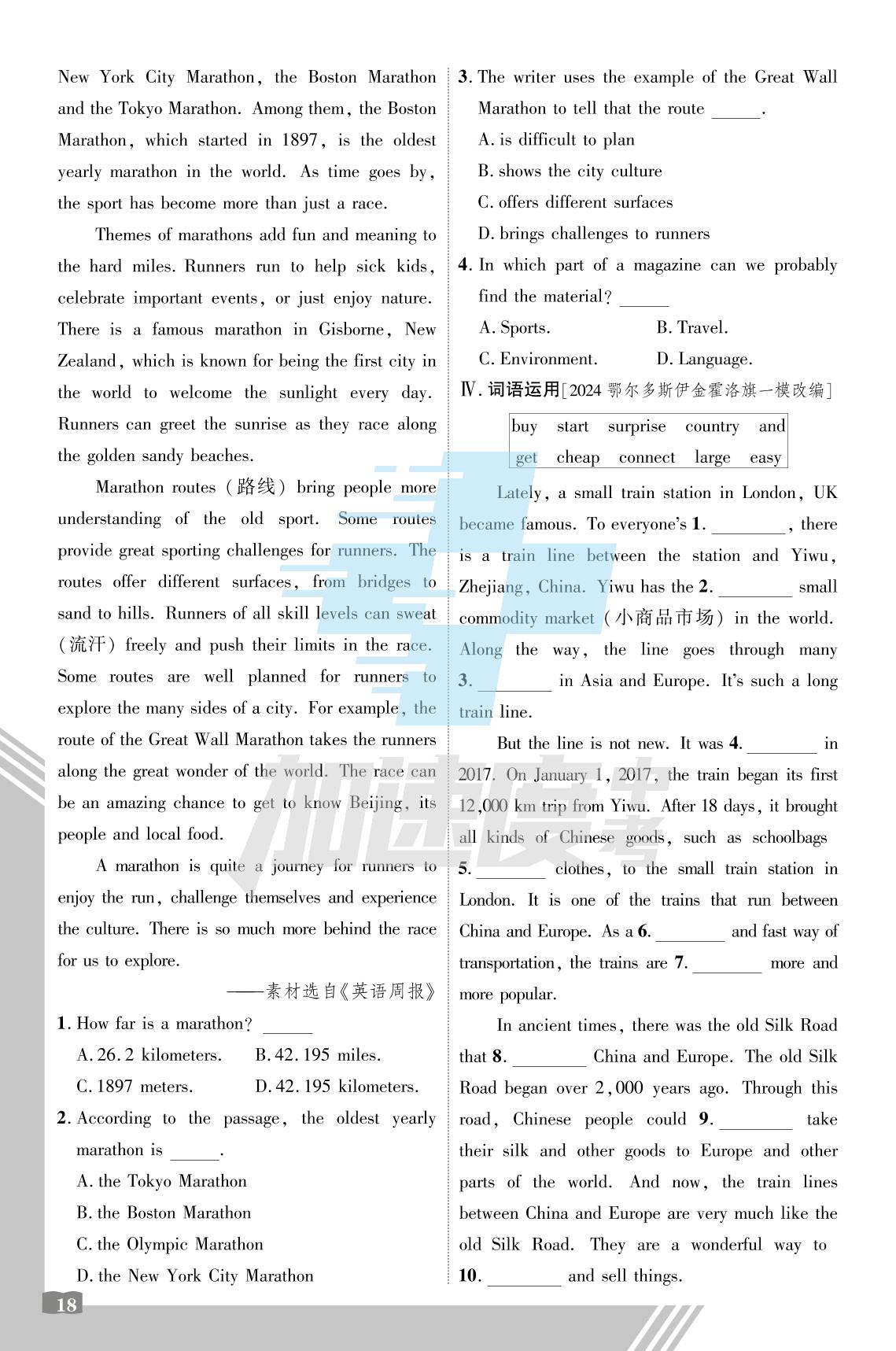
A marathon (马拉松赛跑) is a long-running
race of 42. 195 kilometers. The first Olympic
Marathon was held in Athens. Now,many cities
host their own marathons every year. Some of the
best-known marathons around the world are the
17
New York City Marathon, the Boston Marathon
and the Tokyo Marathon. Among them, the Boston
Marathon, which started in 1897, is the oldest
yearly marathon in the world. As time goes by,
the sport has become more than just a race.
Themes of marathons add fun and meaning to
the hard miles. Runners run to help sick kids,
celebrate important events, or just enjoy nature.
There is a famous marathon in Gisborne, New
Zealand, which is known for being the first city in
the world to welcome the sunlight every day.
Runners can greet the sunrise as they race along
the golden sandy beaches.
Marathon routes (路线) bring people more
understanding of the old sport. Some routes
provide great sporting challenges for runners. The
routes offer different surfaces, from bridges to
sand to hills. Runners of all skill levels can sweat
(流汗) freely and push their limits in the race.
Some routes are well planned for runners to
explore the many sides of a city. For example, the
route of the Great Wall Marathon takes the runners
along the great wonder of the world. The race can
be an amazing chance to get to know Beijing, its
people and local food.
A marathon is quite a journey for runners to
enjoy the run, challenge themselves and experience
the culture. There is so much more behind the race
for us to explore.
———素材选自《英语周报》
1. How far is a marathon? D
A. 26. 2 kilometers. B. 42. 195 miles.
C. 1897 meters. D. 42. 195 kilometers.
2. According to the passage, the oldest yearly
marathon is B .
A. the Tokyo Marathon
B. the Boston Marathon
C. the Olympic Marathon
D. the New York City Marathon
3. The writer uses the example of the Great Wall
Marathon to tell that the route B .
A. is difficult to plan
B. shows the city culture
C. offers different surfaces
D. brings challenges to runners
4. In which part of a magazine can we probably
find the material? A
A. Sports. B. Travel.
C. Environment. D. Language.
Ⅳ. 词语运用[2024 鄂尔多斯伊金霍洛旗一模改编]
buy start surprise country and
get cheap connect large easy
Lately, a small train station in London, UK
became famous. To everyones 1. , there
is a train line between the station and Yiwu,
Zhejiang, China. Yiwu has the 2. small
commodity market (小商品市场) in the world.
Along the way, the line goes through many
3. in Asia and Europe. Its such a long
train line.
But the line is not new. It was 4. in
2017. On January 1, 2017, the train began its first
12,000 km trip from Yiwu. After 18 days, it brought
all kinds of Chinese goods, such as schoolbags
5. clothes, to the small train station in
London. It is one of the trains that run between
China and Europe. As a 6. and fast way of
transportation, the trains are 7. more and
more popular.
In ancient times, there was the old Silk Road
that 8. China and Europe. The old Silk
Road began over 2,000 years ago. Through this
road, Chinese people could 9. take
their silk and other goods to Europe and other
parts of the world. And now, the train lines
between China and Europe are very much like the
old Silk Road. They are a wonderful way to
10. and sell things.
18
课时 10 Modules 5 ~ 6
Ⅰ. 补全对话
A: Welcome to our show, Miss Penguin! 1
B: I am from the Antarctic (南极洲).
A: 2
B: Sure. My hometown is quite cold. But the air
is clean and there is almost no pollution.
A: How can you live in such cold weather? Do
you feel cold?
B: No, I dont feel cold at all. Look at me. 3
A: Miss Penguin, are you a bird?
B: Thats a good question. But I dont know,
either. 4
A: Well, you cant fly like birds.
B: Thats true. But I have a very special ability of
my own.
A: A special ability? 5
B: I can jump into the icy water to catch fish at a
very high speed.
A. Who are you?
B. Where are you from?
C. I am always asking myself this question, too.
D. What is it exactly?
E. Could you please tell us something about your
hometown?
F. How old are you?
G. Its easy for me to keep myself warm because I
have very thick fat in my body.
Ⅱ. 完形填空
人与社会———文学、艺术与体育
In Flanders, a small town in Belgium, lived
a little boy called Nello. His parents died when he
was two. Then he lived with his grandpa in a
small house. Life was 1 for them.
Every morning, Nellos grandpa collected
fresh milk. He then put the milk onto a cart (手
拉车), and sent it to the city. 2 a little
older, Nello tried to help his grandpa travel from
Flanders to the city.
One day, as Nello and his grandpa were
going home from the city, they saw a large dog
3 on the side of the road.
“What happened?” asked Nello. “Is the dog
4 ?” His grandpa examined the dog and said
to Nello, “The dog is 5 ill. We have to take
him to a vet (兽医), or he will die. ” Then, his
grandpa put the dog on the cart and the two went
home. 6 , the dog was abandoned (抛弃)
because of his serious illnesses. Seeing the dying
dog, Nello was heart-broken. He 7 to take
good care of the dog. Nello and his grandpa did
not have enough to eat, but he 8 fed the dog
with milk and bread. Day by day, the dog could
stand on his feet and became stronger.
“Lets name him Patrasche,” said Nello one
day to his grandpa. “ Good idea,” 9 his
grandpa. From then on, Patrasche became a
10 of the family.
One day, as Nello and his grandpa were
ready to 11 their journey to the city,
Patrasche stood in front of the cart.
“Out of the way, Patrasche,” said Nello.
“Well be late. ” But Patrasche 12 to move.
“What does he want to do?” asked Nello.
His grandpa smiled and said, “I believe our
Patrasche wants to help pull the cart. ”
Never had anyone treated Patrasche 13
as Nello and his grandpa. Patrasche was thankful
for the 14 he received, so he wanted to help.
From then on, people in town would 15
a large dog pulling a cart with milk with the
19
grandpa pushing behind, and Nello helping at the
side.
(Adapted from A Dog of Flanders)
1. A. safe B. hard C. busy
2. A. Giving up B. Growing up C. Taking in
3. A. running B. eating C. lying
4. A. sad B. lazy C. dead
5. A. heavily B. seriously C. early
6. A. In fact B. At times C. By accident
7. A. agreed B. preferred C. decided
8. A. still B. only C. even
9. A. listened B. replied C. found
10. A. sign B. wish C. member
11. A. try B. borrow C. start
12. A. expected B. refused C. promised
13. A. fairly B. nicely C. patiently
14. A. kindness B. present C. service
15. A. call B. see C. keep
Ⅲ. 阅读理解
人与自然———自然生态
Tibetan antelopes were
one of Chinas top ten most
endangered animals. Every
year from May to August on
the Qinghai-Xizang Plateau (青藏高原), Tibetan
antelopes travel hundreds of kilometers to have
their babies.
Their trip is hard. They have to cross
railways and roads. Some antelopes die because of
the bad weather. Some die because of the
accidents. The food and water shortages are also
problems for them.
To make their trip easier, people have made
more than 30 “ wildlife corridors (通道)”. A
wildlife corridor can be natural or man-made. If
highways or cities get in the animals way, they
can still move freely and safely through the
corridor. Tibetan antelopes are careful about
dangers around them. So China makes special
corridors under highways or railway bridges. The
corridors are big. Antelopes can easily look
around when they pass through. According to
some research, the population of Tibetan antelopes
in China has been recovering little by little and is
presently more than 300,000.
In Europe, there are small and dark tunnels
(隧道) for small animals, like mice and turtles
(海龟). In the US, people make ropes or bridges
between trees for squirrels (松鼠). People are
trying hard to make corridors for animals lives.
It is not hard to get along with wild animals.
Just give them a little more space. They can have
a bigger chance to live better.
1. What makes Tibetan antelopes trip hard
according to the text? D
a. The human hunting. b. The accidents.
c. The bad weather.
d. The water shortage.
e. The natural enemy attack.
A. b,d,e B. a,b,d C. a,c,e D. b,c,d
2. How do people help the Tibetan antelopes?
D
A. They make small and dark tunnels for them.
B. They make boats for them to cross the rivers.
C. They make ropes or bridges between trees for
them.
D. They make special corridors under highways
or railway bridges.
3. What is the structure of the
passage? (P = Paragraph) B
A. B.
C. D.
20
课时 11 Modules 7 ~ 9
Ⅰ. 补全对话
A: Hi, Mark!
B: Hi, Tina! Where are you going?
A: Im going to the library to borrow a book for my
sister. 1
B: Have you ever read it?
A: 2
B: How do you like it?
A: It is fantastic. And I cant put it down.
B: Who is it written by?
A: Hemingway, an American writer.
B: Whats it about?
A: Its about an old fisherman. 3 But he
doesnt give up and proves (证明) himself by
catching a big fish.
B: 4
A: Because we can learn his attitude to life and
the spirit of fighting for it from the book.
B: Great! 5
A. No, I havent read it before.
B. Everyone thinks he is too old to catch fish.
C. Its name is The Old Man and the Sea.
D. Im looking forward to reading it.
E. Why is it worth reading?
F. Yes, I have.
G. The book is Little Women.
Ⅱ. 阅读理解
人与社会———历史、社会与文化
The human population is growing rapidly. For
most of human history, there were fewer than 1
billion people on Earth. In 1800, there were
nearly 1 billion people. As the Industrial
Revolution (工业革命) began, rapid population
growth appeared. Human population increased
over 5 billion in the next 200 years. Today, weve
had over 8 billion people in the world.
Take India for example. In 1947, at the time
of independence, its population was about 340
million. However, the number doubled between
1947 and 1981. By 2001, it was over one billion.
According to the UN, India has over 1. 4 billion
people in 2023 and has surpassed (超过) China
to become the country with the largest population
in the world.
You may wonder what has caused the rapid
growth rate (比率) for humans in the past 200
years. The most important reason is that the death
rate has been reduced because of changes in
public health and sanitation (公共卫生). For
example, more and more people are able to drink
clean water. Also, new medical technology has
helped people live longer than before.
Surely, population growth can improve the
development of the world. However, there are also
some disadvantages. In a way, it is growing at a
cost, especially to the environment. Large
population will lead to heavy traffic and a lot of
pollution. Whats more, it will put pressure on
food and water supplies (供给).
Although human population continues to
grow, the rate of human population growth has
fallen. This means that the population is not
growing as quickly as it did in the past. According
to the latest report, the human population is
expected to reach 10. 4 billion in 2100.
1. What was the human population in 2000
according to the passage? B
A. About 5 billion. B. About 6 billion.
C. About 7 billion. D. About 8 billion.
2. What is Paragraph 2 mainly about? D
A. What Indias history was like.
B. How India won independence.
C. Why India has a large population.
D. How Indias population has changed.
3. Which of the following best explain the
underlined word in Paragraph 4? A
21
A. Bad results. B. Discussions.
C. New changes. D. Improvements.
4. What is the writers purpose of writing this
passage? B
A. To call on us to protect the environment.
B. To let us know more about world population.
C. To advise us to learn about the worlds history.
D. To tell us not to worry about the growing
population.
Ⅲ. 读写实践[2024 长春改编]
人与社会———文学、艺术与体育
Have you ever read Little Women by US writer
Louisa May Alcott? The classic has been changed
into plays, films and television programs many
times because of its popularity since it came out in
1868. It tells a story of a mother raising her four
daughters, while their dad is away fighting a war.
Meg, the eldest, wants to live a better life very
much. Jo, the second-born, wants nothing more
than to be a writer. Beth is a sweet girl who loves
music and always brings joy to others. The
youngest daughter, Amy, dreams of being an
artist. After reading Little Women, I have a feeling
of warmth and kindness from the family.
In the following scene, the girls talk about
what they can buy with the very little money they
have. They feel hopeful about the future even
though their dreams may not come true.
“ I cant expect anything from Mother or
you. I know I only have one dollar with me.
Although it isnt that much, it works. I can at
least buy the book Undine and Sintran for
myself. Ive wanted it so long,” said Jo.
“I planned to spend mine on new music,”
said Beth. “ I shall get a nice box of drawing
pencils. I really need them,” said Amy.
“ Mother didnt say anything about our
money, but she does wish us to get something.
Lets each buy what we need. Im sure we work
hard enough to make it,” cried Jo.
1. When did Little Women come out?
In 1868.
2. How do the girls feel even though their dreams
may not come true?
They feel hopeful about the future.
3. Does Jo want to be a writer?
Yes, she does.
4. What does Jo advise her sisters to do at last?
Jo advises her sisters to buy what they
need and work hard enough to make it.
5. What do you think of Little Women?
I think its interesting. /
Ⅳ. 词语运用
One Saturday afternoon in February, I was in
my house with my child. Suddenly, I found that
my autistic (自闭症的) sons room was burning.
In a few minutes, the fire spread across the living
room and then the whole house. Both my son and
I escaped from the fire without being hurt.
However, we lost all of our money. So our travel
plan had to be 1. ( cancel) . I watched
the fire go up through the roof. We lost our home.
We had nowhere 2. ( live).
3. ( lucky), we had insurance (保
险). But we had to live with friends and depend on
what other people gave us 4. we could
receive some money. My autistic son really had
problems dealing with any changes. He couldnt even
accept to wear 5. pair of new shoes. So we
told him softly that all of his clothes and 6.
(toy) were gone. Thankfully, on the second day,
his head teacher 7. (bring) him his some
old things from his school.
Thinking 8. what happened, I felt
scared. I was just 9. ( thank) that both
my kid and I were alive. People went out of their
way to help us. Their 10. (kind) is the
thing that has really stuck in my mind.
22
课时 12 Modules 10 ~ 12
Ⅰ. 补全对话[2024 呼和浩特第四中学二模]
A: Hello, Tony! Guess where I am now! Im in
Hohhot! People here are kind. 1
B: You must be very excited.
A: 2
B: Why?
A: Because I know little about their customs.
B: Dont worry. I can help you.
A: Thats great! 3
B: Of course. And when you meet them,
remember to say hello first. When entering a
yurt (蒙古包), dont step on the threshold
(门槛).
A: OK. Anything else?
B: When you enter the yurt, you will be offered
some food. Dont refuse it, even if youre not
hungry. 4
A: OK. Thank you very much for your advice.
B: Youre welcome. 5
A. Yes, you must get there on time.
B. Or youll be considered impolite.
C. Yeah, but Im a little nervous, too.
D. Hope you enjoy yourself tomorrow.
E. I dont know what gift I will give them.
F. Am I supposed to prepare a gift before going
there?
G. A local family just invited me to have dinner
at their yurt tomorrow.
Ⅱ. 完形填空[2024 长沙改编]
人与社会———社会服务与人际沟通
中国国际救援队
The China International Search and Rescue
Team (CISAR) was formed in 2001. It 1
help and hope to those whose lives are changed by
a storm, an earthquake, or any other natural
disaster.
After long and 2 training, the Chinese
team went on its first international rescue (救援)
tasks in 2003. That year, the team helped save
lives after earthquakes in Algeria and Iran. It was
the first time that the CISAR had worked outside
China, and the team 3 high praise for their
bravery and skills. Since then, the CISAR has
completed lots of rescue 4 — they braved
terrible conditions to rescue people in Indonesia,
Haiti and Pakistan.
Rescue workers are trained to find people,
treat injuries (伤痛), and 5 food, water,
and other things. They have to be able to do
difficult work when it is very dangerous. For
example, there is usually no electricity or water
6 a disaster happens, and there may be
illnesses and accidents. Rescue workers get to
save lives, but they must also deal with the dead.
That means they have to be 7 in both body
and mind. Rescue workers must have big hearts,
too. It takes lots of love and courage to risk their
own lives to 8 someone elses. The members
of the CISAR are always 9 go wherever help
is needed.
Rescue workers leave their homes and
families for a job that offers little 10 and less
sleep. We cant imagine how much they have
sacrificed (牺牲) selflessly. We dont even know
most of their names. They are really unsung (默
默无闻的) heroes!
1. A. closes B. sells C. brings D. turns
2. A. careful B. poor C. useless D. natural
3. A. gave B. won
C. missed D. dropped
4. A. tasks B. mistakes C. excuses D. lessons
23
5. A. give up B. hand out C. cut down D. pick up
6. A. until B. before C. since D. after
7. A. weak B. strong C. slow D. quick
8. A. waste B. enjoy C. save D. teach
9. A. ready to B. friendly to
C. filled with D. satisfied with
10. A. call B. food C. pay D. water
Ⅲ. 阅读理解[2024 广安]
人与自然———自然生态
新类型语篇·天气预报
The graphics (图表) show the weather report
for City G today and the following six days.
1. Whats the date today in City G? A
A. Its 13th May. B. Its 14th May.
C. Its 15th May. D. Its 16th May.
2. Whats the temperature at 10 ∶ 00 am today in
City G? B
A. Its 21℃ . B. Its 23℃ .
C. Its 25℃ . D. Its 24℃ .
3. Henry is in City G today. What will most
probably happen to him according to the
graphics? D
A. He will wash his car.
B. He will catch a cold.
C. He will ride fast on the road.
D. He will wear coats.
4. What will the weather be like on Wednesday in
City G? B
A. It will be rainy. B. It will be sunny.
C. It will be cloudy. D. It will be windy.
5. According to the weather report, the highest
temperature of this week will be on C .
A. Sunday B. Saturday
C. Friday D. Thursday
Ⅳ. 词语运用
人与社会———历史、社会与文化
老北京的胡同文化
building catch culture Western
so daily see old pass change
One afternoon in a bookstore, I found a book
called The Last Days of Old Beijing(《再会,老北
京》) by US writer Michael Meyer. The name
1. my eye and made me think about my
home city, Beijing, and its past.
Meyers writing takes us back in time to Beijing
about 20 years ago. In 2005, Meyer moved into a
shared courtyard (庭院) home in one of Beijings
2. neighborhoods, Dashilan, on one of
its hutong. There he taught English at a local
school and became the only 3. there
living among local people.
Meyer saw some of the great 4. this
neighborhood went through. The old houses made
way for high-rise buildings and shopping malls.
However, some parts of old Beijings 5.
stayed strong in the face of rapid change. People still
kept traditions like putting up Spring Festival
couplets ( 对 联 ) and artists worked hard to
6. down skills like acrobatics (杂技).
Meyer shows us how these traditions helped people
hold onto their roots as old 7. went away
around them.
I was born in Beijing in the 2010s,
8. I know more about the citys modern
side. Reading The Last Days of Old Beijing opened
my eyes to new sides of the city that I hadnt
9. before. Those small details of
10. life in the old neighborhoods
touched my heart.
———素材选自《二十一世纪学生英文报》
24
资源预览图

1

2

3
4

相关资源
由于学科网是一个信息分享及获取的平台,不确保部分用户上传资料的 来源及知识产权归属。如您发现相关资料侵犯您的合法权益,请联系学科网,我们核实后将及时进行处理。