专题04 记叙文阅读 15篇(名校模拟+地区真题)-冲刺2025年中考英语必考题型终极预测(浙江专用)
2025-03-06
|
2份
|
41页
|
254人阅读
|
14人下载

资源信息
| 学段 | 初中 |
|---|---|
| 学科 | 英语 |
| 教材版本 | - |
| 年级 | 九年级 |
| 章节 | - |
| 类型 | 题集-专项训练 |
| 知识点 | - |
| 使用场景 | 中考复习 |
| 学年 | 2025-2026 |
| 地区(省份) | 浙江省 |
| 地区(市) | - |
| 地区(区县) | - |
| 文件格式 | ZIP |
| 文件大小 | 366 KB |
| 发布时间 | 2025-03-06 |
| 更新时间 | 2025-03-06 |
| 作者 | Easy English初高中英语精品 |
| 品牌系列 | - |
| 审核时间 | 2025-03-06 |
| 下载链接 | https://m.zxxk.com/soft/50832980.html |
| 价格 | 3.00储值(1储值=1元) |
| 来源 | 学科网 |
内容正文:
冲刺2025年中考英语必考题型终极预测(浙江专用)
专题04 记叙文阅读 15篇(名校模拟+地区真题)
(24-25九年级下·浙江温州·开学考试)When Peng Jingxuan began playing the guzheng on the streets of France in 2018, she did not expect that the traditional instrument would change her life.
Peng began to study the guzheng when she was 7 years old. In 2017, she went to France to study for a master's degree in music. There, Peng was deeply drawn to the various performances by artists playing musical instruments on the streets.
But she seldom saw Chinese instruments played on the streets. So, in the summer of 2018, she took her guzheng and began to perform on the streets. She was surprised to find that very few people in France knew about the Chinese guzheng.
“I wanted to make this known to more people,” Peng said.
She began to do street performances to sharpen her skills. The more Peng played on the streets, the greater sense of responsibility she felt to spread Chinese music and culture.
To make this traditional Chinese instrument better known to people in France, Peng carefully chose each song、She chose to focus on traditional guzheng pieces and a number of pop songs with strong Chinese influences.
Considering that the audience might not be familiar with Chinese songs and that might make it hard for foreigners to fully understand her performances, Peng came up with nice adaptations (改编) of the songs, receiving positive opinions from audiences. For example, she prefaced (为……写序言) Big Fish, a song from a Chinese film, with explanations in French, mainly introducing the movie.
“To see the guzheng become popular and get more people to know about it, understand it, and love it, I think this is the biggest wish of Chinese artists playing the traditional musical instrument,” she said.
1.What do you know about Peng?
A.She got a master’s degree in music in China. B.She began to study the guzheng in 2017.
C.She liked the performances on the streets. D.She has studied the guzheng for seven years.
2.What does the underlined word “this” in Paragraph 4 refer to?
A.Peng’s skill. B.The Chinese guzheng.
C.Peng’s performance. D.A Chinese artist.
3.What did Peng do to help foreigners better understand her performances?
A.She created new songs all by herself. B.She organized a traditional musical team.
C.She introduced her experience to them. D.She did song adaptations for the audience.
4.What’s the passage mainly about?
A.Chinese music and culture. B.Street performances around the world.
C.A traditional Chinese song. D.A girl’s dream and responsibility.
【答案】1.C 2.B 3.D 4.D
【导语】本文是一篇记叙文。主要讲述了彭静旋在法国街头演奏古筝,旨在传播中国音乐和文化的故事。
1.细节理解题。根据“There, Peng was deeply drawn to the various performances by artists playing musical instruments on the streets.”可知她喜欢街头的表演,所以C选项正确。故选C。
2.词义猜测题。根据“She was surprised to find that very few people in France knew about the Chinese guzheng.”以及“I wanted to make this known to more people”可知,她Traveling around the world is cool but paying惊讶于很少有法国人了解中国古筝,所以她想让更多人知道的“this”指的是中国古筝。故选B。
3.细节理解题。根据“Considering that the audience might not be familiar with Chinese songs and that might make it hard for foreigners to fully understand her performances, Peng came up with nice adaptations (改编) of the songs,”可知,考虑到观众可能不熟悉中国歌曲,这会让外国人难以完全理解她的表演,所以彭对歌曲进行了改编来帮助外国人更好地理解她的表演。故选D。
4.主旨大意题。这是关于彭静旋在法国街头演奏古筝,旨在传播中国音乐和文化的故事。文章围绕彭静旋展开,讲述她学习古筝、在法国街头表演古筝以及为了让更多人了解中国古筝所做的努力,体现了她的梦想(让更多人了解中国古筝)和责任感(觉得有责任传播中国音乐文化)。所以文章主要讲的是一个女孩的梦想和责任。故选D。
(24-25九年级下·浙江舟山·开学考试)On a sunny morning, Tom left his home and arrived at the bus station quite early for Paris bus. The bus to Paris would not leave until 11:55. At that moment, he saw a lot of people waiting in the station. Some were standing in line, others were walking around. There was a group of school girls. Their teacher was trying to keep them in line. Tom looked around but there was no place for him to sit.
He walked into the station cafe. Then he looked up at the menu board and ordered something to drink. After that, he looked up at the clock there. It was only 11:40. He found a seat and sat down before a large mirror on the wall. Just then, Mike, one of Tom’s workmates came in and sat with Tom.
“Hi! Tom. What time is your bus?” Mike asked, smiling.
“Hey! There’s plenty of time yet,” answered Tom.
“Well, I’ll get you some more tea then,” said Mike.
They talked happily while drinking. Then Tom looked at the clock again. “Oh! It’s going backward (倒行)!” he cried, “a few minutes ago it was 11:40 and now it’s 11:30.”
“You’re looking at the clock in the mirror, Tom.” said Mike. Tom was so sad. Finally, he found out that the time in the mirror may be not the real time. But it was too late to catch the bus for Paris. Unluckily, the next bus was not to leave for another hour. Since then Tom has never liked mirrors.
1.Tom went into the station cafe because ________.
A.Mike asked him to have a cup of tea
B.he didn’t like to stay with the schoolgirls
C.he wanted to have a drink with his workmate there
D.it was quite early and he couldn’t find a seat in the station
2.What time was it in fact when Tom looked at the clock in the mirror ________?
A.Half past twelve B.Twenty to twelve
C.Half past one D.Half past eleven
3.From the story we know that when we look at a clock in a mirror, we will find ________.
A.the time is right B.it’s going slower
C.it’s going backward D.it’s going faster
4.Which of the following is the title of the story?
A.The Clock In The Mirror B.Not A Careful Man
C.Missing A Bus D.The Mirror of the Station
【答案】1.D 2.A 3.C 4.A
【导语】本文讲述了汤姆去巴黎,在车站等车时,因时间尚早且站内没座位而进入咖啡馆,误看镜子里的时钟,最终错过班车的故事。
1.细节理解题。根据第一段“On a sunny morning, Tom left his home and arrived at the bus station quite early for Paris bus.”以及“Tom looked around but there was no place for him to sit.”和第二段“He walked into the station cafe.”可知,汤姆去车站咖啡馆是因为时间还早,并且在车站找不到座位。故选D。
2.推理判断题。汤姆看到镜子里的时钟显示11:30,他以为时间倒退了,实际镜子中的成像与现实是相反的。镜子里时钟时针在11和12之间靠近12,分针指向6,那么实际时间时针应在12和1之间靠近12,分针同样指向6,即12:30,故选A。
3.细节理解题。根据“‘Oh! It’s going backward (倒行)!’ he cried, ‘a few minutes ago it was 11:40 and now it’s 11:30.’”以及“You’re looking at the clock in the mirror, Tom.”可知,当我们看镜子里的时钟时,会觉得时间在倒走。故选C。
4.最佳标题题。通读全文可知,整个故事围绕汤姆误看镜子里的时钟,导致错过班车展开,镜子里的时钟是关键线索。故选A。
(24-25九年级下·浙江温州·开学考试)
On cold winter days in Beijing, some restaurants are spreading warmth by offering free dishes to people in need, such as taxi drivers and street cleaners. In this way, they are making a difference to the lives of many.
For example, Wang Hong, the boss of a barbecue restaurant, has been offering free drinks to delivery drivers and street cleaners since 2012. Recently, he started a free-meal project with the help of the neighborhood. For him, it’s personal. “When I first came to the city, I had nothing. I was learning in a restaurant. People helped me even though they didn’t know me.” he said, “This is my way of giving back to the society and teaching my child to be thankful.” His restaurant welcomes anyone in need. The meals are simple but hearty— a bowl of soup, with rice, noodles or dumplings. “We try to serve food people like.” he said, “And there is always something to satisfy everyone.”
Wang is not alone. Yushiji, another restaurant also offers meals to the people in need at a low price. For just 12 yuan, customers can enjoy a hot, hearty meal that usually costs much more. According to the manager of the restaurant, Li Jun, customers in need can get either beef soup with a Chinese pancake or noodles with mutton. Noodles are refilled free.
Delivery drivers like Fan Xingang often come and eat here. “My friends told me about this place. It’s not just good for the low price.” Fan said, “They show us respect and kindness.”
Beyond Beijing, similar actions can be seen in Shanghai, Tianjin, Heze and Yinchuan. The hot meal on cold winter days is warming up more people in need, one meal at a time.
1.Why does Wang Hong offer free drinks and meals?
A.To attract more customers. B.To pay back to the society.
C.To help his child study better. D.To get on well with neighbors.
2.What might Fan Xingang agree with?
A.Delivery drivers get a high pay. B.The meals fill both stomach and heart.
C.There is no free lunch in the world. D.Restaurants should help people in need.
3.What can we infer from the last paragraph?
A.Beijing takes lead in many ways. B.People shouldn’t show off wealth.
C.Kindness spreads widely in cities. D.More people need help in big cities.
4.What’s the structure of the whole passage?
A. B. C. D.
【答案】1.B 2.B 3.C 4.A
【导语】本文是一篇记叙文。主要讲述了一些餐馆在冬天通过向出租车司机和街道清洁工等有需要的人提供免费菜肴来传递温暖。
1.细节理解题。根据第二段“This is my way of giving back to the society and teaching my child to be thankful.”可知,这是我回馈社会的方式,也是我教会孩子感恩的方式。故选B。
2.推理判断题。根据第四段“They show us respect and kindness.”可知,这些地方对外卖员表示尊重和友善,所以,饭菜既填饱了肚子又温暖了心。故选B。
3.推理判断题。根据最后一段“Beyond Beijing, similar actions can be seen in Shanghai, Tianjin, Heze and Yinchuan. The hot meal on cold winter days is warming up more people in need, one meal at a time.”可知,除北京外,上海、天津、菏泽和银川等地也采取了类似的行动,在寒冷的冬天,一顿热饭让更多需要帮助的人感到温暖,这些说明了善意在城市的各个角落广泛传播。故选C。
4.篇章结构题。通读全文可知,第一段引出话题,总述一些餐馆为需要帮助的人提供免费的菜肴;第二、三、四段分别举例;第五段总结提升,讲述了传递温暖的人的感受。所以,文章结构为“总—分—总”。故选A。
(24-25九年级下·浙江衢州·开学考试)My brother Cody and I were in the back seat playing the guessing game I See when the snowstorm started.
“I see something green,” Cody said. “The green highway sign?” I guessed, although it was hard to read it. I looked around. “The green hat on the girl in the car behind us?”
“Yes!” Cody laughed. “Your turn.”
Dad spoke to Mom, “I don’t like the looks of this. It’s getting harder to see anything.”
Suddenly, Dad stopped the car. We found the car nearly hit the tree on the roadside. Nobody talked. Cody and I stopped playing I See. It was like we were all helping Dad by keeping silent.
“We need to get off and wait out this storm,” Dad said. “But I can hardly see the road, not to mention an exit (出口).”
Just then, I saw a red, blinking light high in the sky. “I see something red!” I shouted. “Not now, Kenny,” Dad shouted.
“They were red words,” I continued.
“Let’s forget about the games,” Mom said.
“But I had seen it. It was like one of those really tall signs that flash GAS or FOOD that we’ve seen near exit.”
“You’re right. There’s an exit!” Mom cried, pointing ahead. Dad carefully drove the car towards it. Finally we could see the red sign was just in front of us: EAT HERE. Dad let out a big breath. We slipped and slid our way into the parking lot. Then we got off and moved into the small restaurant. A moment later, another family came in behind us. I saw the girl with the green hat.
“We followed your car’s taillights here,” her mom told us. “We would never have found this place without you.”
“We wouldn’t have found it, either,” Dad said, winking at me, “if we weren’t riding with someone who’s very good at I See.”
1.What did Cody refer to when he said he saw something green?
A.A hat. B.A car. C.A tree. D.A sign.
2.When did Cody and “I” realize it was dangerous to drive in the snowstorm?
A.Before they began the game. B.After the car suddenly stopped.
C.When they heard what their father said. D.While they were trying to read highway signs.
3.How might the parents feel when hearing “I see something red” at first?
A.Uneasy. B.Sorry. C.Impatient. D.Tired.
4.What Dad said probably mean in the last paragraph?
A.He found his sons had great fun together.
B.It was lucky for him to travel with the family.
C.“I” was really good at playing guessing games.
D.It was “I” who should be thanked for finding the exit.
【答案】1.A 2.B 3.C 4.D
【导语】本文是一篇记叙文。文章主要讲述在暴风雪中,“我”和哥哥Cody在车后座玩“我看到了”的游戏,途中车差点撞树,后来“我”通过游戏看到红色出口指示牌,一家人找到出口进入餐馆的故事。
1.细节理解题。根据第二段“‘The green hat on the girl in the car behind us?’‘Yes!’ Cody laughed.”可知,Cody说看到绿色的东西指的是后面车里女孩戴的绿色帽子。故选A。
2.细节理解题。根据第五段“Suddenly, Dad stopped the car. We found the car nearly hit the tree on the roadside. Nobody talked. Cody and I stopped playing I See.”可知,车突然停下,他们发现车差点撞到路边的树后,Cody和“我”意识到暴风雪中开车很危险。故选B。
3.细节理解题。根据第七段“‘Not now, Kenny,’ Dad shouted.” 以及第九段“‘Let’s forget about the games,’ Mom said.”能看出,父母一开始听到“我看到红色的东西”时,表现得不耐烦,让“我”别玩游戏了。故选C。
4.词句猜测题。根据最后一段“‘We wouldn’t have found it either,’ Dad said, winking at me, ‘if we weren’t riding with someone who’s very good at I See.’”,结合前文是“我”看到红色的出口指示牌,所以爸爸的意思是多亏“我”发现了出口。故选D。
(24-25九年级上·浙江宁波·阶段练习)One beautiful winter morning, a little boy of 10 years old or so went to a grocery shop to make a telephone call. Clearly, he changed his tone of voice while speaking over the phone. When all this was happening, the store owner observed and listened with great interest to the conversation that followed:
“Madam, I am a poor boy. Can you give me a job cutting grass on your lawn?” the little boy asked.
“Sorry, I already have someone to cut my lawn,” the woman at the other end of the phone line replied.
“Madam, I will cut your lawn for half the price of the person who cuts your lawn now”
“I’m very satisfied with the person who is presently cutting my lawn. He is doing a good job.”
“Madam, I’ll even sweep your curb, so on Sunday you will have the prettiest lawn in all of Palm beach, Florida.”
“No, thank you.”
Instead of getting angry, the little boy smiled and put back the receiver gently.
The store owner, who was listening to the conversation, walked over to the boy and said, “Son, I like your attitude (态度) and I would like to offer you a job.”
“No, thanks. But I appreciate your offer.”
“But you were really pleading for a job when you were talking to the lady over the phone.”
“No sir, I was just checking my performance on the job I already have. I am the one who is working for that lady I was talking to!” the little boy replied.
1.What did the boy offer to do for the woman?
A.Work for half the price of the other person.
B.Cut the woman’s lawn for free.
C.Sweep the curb for half the price of others.
D.Have the prettiest beach in Florida.
2.After hanging up the phone, the boy felt _____.
A.sad B.angry C.happy D.nervous
3.Hearing the conversation, the store-owner might think ______
A.the boy rea needed a job.
B.the boy was not good at cutting lawns.
C.the boy actually wanted to help.
D.the boy was telling lies all the time.
4.Which of the following words can best show the boy’s attitude toward the job?
A.Hopeless. B.Careless. C.Joking. D.Serious.
【答案】1.A 2.C 3.A 4.D
【导语】本文是一篇记叙文。文章讲述了一个10岁左右的小男孩在杂货店打电话的故事,通过这个故事展现了男孩的聪明、自信和积极态度。
1.细节理解题。根据“Madam, I will cut your lawn for half the price of the person who cuts your lawn now”可知,他愿意以现有人的一半价格来割草。故选A。
2.细节理解题。根据“Instead of getting angry, the little boy smiled and put back the receiver gently.”可知,男孩挂电话后感到开心,而不是生气或难过。故选C。
3.推理判断题。根据“Son, I like your attitude (态度) and I would like to offer you a job.”可知,店主听到男孩在电话中拼命争取工作,可能会认为男孩真的需要一份工作。故选A。
4.观点态度题。通读全文可知,男孩在电话中努力争取工作,提出了各种优惠条件,最后他透露自己就是那个女人的雇工,他只是在测试自己的工作表现。这表明他对工作非常认真。故选D。
(24-25九年级上·浙江宁波·阶段练习)After not swimming in big races for over four years, China’s Olympic champion Sun Yang is back! Even though he is 32 years old, he is still one of the best swimmers in China.
On Aug 25, Sun won the men’s 400m freestyle race at the National Summer Swimming Championships in Hefei, Anhui. He finished in 3 minutes and 49.58 seconds. This wasn’t his fastest time ever, but it was still a big win because he worked very hard over the past four years.
Sun became famous after winning China’s first Olympic gold medal in men’s swimming at the London 2012. He also won more gold medals at the Rio 2016.
In 2020, Sun was given an eight-year ban (禁赛) because of a problem with a doping test (药检), but it was later shortened to four years and three months. This stopped him from swimming in the Tokyo and Paris Olympics. During the ban, Sun trained on his own, without the support of a professional team. He worked so hard that he didn’t take a single day off from training.
“The past four years were so hard, tougher (艰难) than being born again, which made me enjoy each and every race even more.” said Sun after his win. “To be able to stand on top of the podium (领奖台) at my first meet in over four years, I feel like everything has paid off.”
Sun Yang’s return to the top shows us that never giving up can lead to success.
1.How long couldn’t Sun Yang swim in big races because of a doping test problem?
A.Eight years. B.Three years and four months.
C.Four years. D.Four years and three months.
2.What did Sun Yang do during his ban from swimming?
A.He stopped training completely.
B.He trained with a professional team.
C.He focused more on other sports.
D.He trained very hard every day.
3.What does the underlined word “This” refer to?
A.The doping test problem.
B.The long ban from swimming.
C.Sun’s win at a swimming championship.
D.The men’s 400m freestyle race.
4.In which section of a newspaper may this passage appear?
A.Science Study. B.Sports News. C.Teenagers’ Life. D.Travel Stories.
【答案】1.D 2.D 3.C 4.B
【导语】本文是一篇记叙文。文章主要讲述了中国游泳奥运冠军孙杨在经历了四年多的禁赛之后重返赛场并取得胜利的故事。
1.细节理解题。根据“In 2020, Sun was given an eight-year ban (禁赛) because of a problem with a doping test (药检), but it was later shortened to four years and three months.”可知孙杨被禁赛四年三个月,故选D。
2.细节理解题。根据“During the ban, Sun trained on his own, without the support of a professional team. He worked so hard that he didn’t take a single day off from training.”可知,孙杨在禁赛期间独自训练,并且非常努力,没有休息过一天。故选D。
3.词句推测题。根据“He finished in 3 minutes and 49.58 seconds. This wasn’t his fastest time ever, but it was still a big win because he worked very hard over the past four years.”可知,划线单词指的是孙杨在比赛中获胜这件事。故选C。
4.推理判断题。通读全文可知,这篇文章主要讲述了孙杨在游泳领域的复出和成就,属于体育新闻的范畴。因此,它最有可能出现在报纸的体育新闻板块。故选B。
(24-25九年级下·浙江温州·开学考试)When I was growing up. I had an old neighbour named Dr Gibbs who was a lot nicer than many of the adults in our community.
When Dr Gibbs wasn’t saving lives, he was planting trees. His house sat on ten acres, and his life’s goal was to make it a forest.
The good doctor had some interesting theories on plant care and growth. He never watered his new trees. Once I asked why. He said that watering plants spoiled (宠坏) them so that each following tree generation would grow weaker. So you have to make things difficult for them and weed out (淘汰) the weaker trees early on.
He talked about how watering trees made for shallow roots (根), and how trees that weren’t watered had to grow deep roots in search of water. Then I understood that deep roots were to be treasured.
I remembered he planted an oak and, instead of watering it every morning, he beat it with a rolled-up newspaper. Smack! Slap! Pow! I asked him why he did that, and he said it was to get the tree’s attention.
Dr Gibbs passed away a couple of years after I left home. Every now and again, I walked by his house and looked at the trees that I’d watched him plant some twenty-five years ago. They’re extremely tall, big since they have deep roots now. However, the trees in my garden trembled in a cold wind although I had watered them for several years.
It seemed that adversity provided these trees with benefits that comfort never could do. I stood there deep in thought.
Every night before I go to bed, I check on my two sons. I stand over them and watch their little bodies, the rising and falling of life within. I often pray (祈祷) for them. Mostly I pray that their lives will be easy. But I think it’s time to change my prayer because now I know my children are going to encounter hardship. There’s always a cold wind blowing somewhere. What we need to do is to pray for deep roots, so when the rains fall and the winds blow, we won’t be torn apart.
1.How did Dr Gibbs grow new trees?
A.He tried to spoil them. B.He talked to them often.
C.He never watered them. D.He took good care of them.
2.What does the underlined word “adversity” probably mean in Paragraph 7?
A.Cold treatment. B.A difficult situation.
C.Thoughtful care. D.A pleasant experience.
3.Which of the following may be the writer’s best prayer for his two sons now?
A.I wish them good luck so that they can meet people like Dr Gibbs.
B.I wish them cool rest under the tree to keep away from the hot sun.
C.I wish them beautiful wings, with which they can fly high in the sky.
D.I wish them strong wills to take up the unexpected challenges in the life.
4.Which of the following can be the best title of this passage?
A.To Keep Away From Pain B.To Grow Deep Roots
C.A Wise Doctor D.My Valuable Memory
【答案】1.C 2.B 3.D 4.B
【导语】本文是一篇记叙文。通过对Dr. Gibbs植树之道的描写,告诉了我们一个做人的道理,要想面对人生的风风雨雨,我们必须有一个坚强的基础。
1.细节理解题。根据“He never watered his new trees.”可知,Dr. Gibbs种新树时从不浇水。故选C。
2.词义猜测题。根据“However, the trees in my garden trembled in a cold wind although I had watered them for several years.”以及上文提到的那些树因为没有浇水而根扎得很深,由此可推测出“adversity”指的是困难的处境,即B选项“a difficult situation”。故选B。
3.推理判断题。根据“What we need to do is to pray for deep roots, so when the rains fall and the winds blow, we won’t be torn apart.”可知,作者认为应该让孩子有强大的内心去面对生活中的困难,所以现在对儿子最好的祈祷应该是希望他们有坚强的意志去应对生活中的意外挑战。故选D。
4.最佳标题题。文章通过Dr. Gibbs种树的理念以及自己儿子的事情,强调了让孩子经历困难,扎根深处的重要性,所以B选项“To Grow Deep Roots”(深扎根)最能概括文章主旨。故选B。
(24-25九年级下·浙江温州·开学考试)“China is full of surprises,” says Jerry Kowal, a 34-year-old American YouTuber known online as “GuoJierui” in China. With over 2 million fans, Jerry travels across China, filming videos about local food, technology, and daily life. His journey began eight years ago, and now he calls China his “second home”.
Jerry grew up in New York. In 2016, he visited China for the first time and was amazed by everything he saw. “I tried hot pot in Chongqing and rode high-speed trains. It was so different from America!” he says. Soon, he started sharing his experiences online. His first video about spicy Chinese food got thousands of views.
Learning Chinese was hard at first. Jerry laughs, “I mixed up words like ‘mao’ (cat) and ‘mianbao’ (bread). But people here are patient.” He also made many Chinese friends. During the COVID-19 pandemic, he stayed in China and filmed how communities worked together. “I saw kindness everywhere,” he says.
Jerry’s videos show both modern and traditional sides of China. In one video, he tastes stinky tofu in Changsha. In another, he visits high-tech companies in Shenzhen. “I want people to see the real China,” he explains. His fans love how he tries new things. Once, he even learned to make dumplings from a Beijing grandma! Chinese viewers often leave comments like, “Jerry, you understand China better than us!” Foreign fans say his videos help them learn about Chinese culture. A teacher from Canada wrote, “My students watch Jerry’s videos to practice English and discover China.”
Jerry hopes to visit all 34 provinces in China. Next month, he’ll explore Tibet. “China is huge and colorful. I’ll never stop sharing its stories,” he smiles. For him, every video is a bridge between cultures. “When we understand each other, the world becomes smaller,” he adds.
1.What first encouraged Jerry to share videos about Chinese experience?
A.The hope for a second home. B.His first trip to China in 2016.
C.The delicious food in China. D.His interest in ancient history.
2.What challenge did Jerry face according to the text?
A.Mixing up Chinese words at first. B.Finding video ideas during COVID-19.
C.Traveling to faraway Chinese provinces. D.Making enough money from YouTube.
3.What is Paragraph 4 mainly about?
A.Why Jerry films Chinese videos. B.What Jerry’s online videos are about.
C.How people can learn Chinese. D.How Jerry understands Chinese culture.
4.What is the main purpose of the article?
A.To suggest Chinese traveling videos on YouTube.
B.To build a bridge between China and the world.
C.To compare Chinese and American lifestyles.
D.To introduce an American sharing Chinese culture.
【答案】1.B 2.A 3.B 4.D
【导语】本文主要讲述了Jerry在中国的经历以及分享视频的目的。
1.细节理解题。根据第二段“In 2016, he visited China for the first time and was amazed by everything he saw. ‘I tried hot pot in Chongqing and rode high-speed trains. It was so different from America!’ he says. Soon, he started sharing his experiences online. His first video about spicy Chinese food got thousands of views.”可知,他在2016年第一次去中国的旅行鼓励Jerry分享有关中国经历的视频。故选B。
2.细节理解题。根据第三段“Jerry laughs, ‘I mixed up words like ‘mao’(cat) and ‘mianbao’ (bread). But people here are patient.’ ”可知,Jerry一开始面临的是中文词汇。故选A。
3.段落大意题。根据“Jerry’s videos show both modern and traditional sides of China. In one video, he tastes stinky tofu in Changsha. In another, he visits high-tech companies in Shenzhen. “I want people to see the real China,” he explains. His fans... discover China.”可知,本段列举了Jerry视频的内容如臭豆腐、高科技公司、包饺子。故选B。
4.主旨大意题。通读全文可知,全文围绕Jerry在中国的经历展开,介绍他如何通过视频分享中国文化。故选D。
(24-25九年级·浙江绍兴·自主招生)Traveling around the world is cool but paying for it is not. There is a choice—doing house sitting jobs, including walking a dog, cleaning kitty litter and milking cows. It’s a win-win, says Maureen Murphy, who spends 95 percent of her time staying in other people’s houses.
Although she has a mailbox in Texas, Murphy is rarely there. She is a professor at the University of Maryland but she teaches online. One of her requirements is that wherever she goes, it depends on the Internet connection.
“My life is a big adventure,” Murphy said. “I never stay anywhere too long. I am going to my next learning experience, and meet the wonderful people of the world.”
Murphy began her travel in 2010 and has done many house sitting jobs. She milked a cow in the Blue Mountains. She saw the penguins on Phillip Island and took a helicopter tour above the Twelve Apostles. She also watched the fireworks from a boat in the harbor near the Opera House on New Year’s Eve in Sydney.
“In Fiji I took a trip to Mantaray Island Resort where I swam with a manta. It was the most unforgettable experience of a lifetime,” she says.
Some homeowners need sitters to care for only their houses, do simple tasks like collecting mail and watering plants. Others want people to live in their homes to make it easier to take care of their pets. So traveling by doing sitting jobs has become a trend.
Trusted House sitters has members in more than 130 countries. New sitters are encouraged to start out locally, because it gives them the chance to explore a new part of their local area, spokesman Liam Beauchamp-Jones says.
And for the sitters, the advantages are numerous. Murphy adds, “Going to new places, trying new food, exploring and touring and of course, meeting new people!”
1.Which is the most unforgettable experience for Murphy?
A.Milking a cow in the Blue Mountains.
B.Seeing the penguins on Phillip Island.
C.Swimming with a manta at Mantaray Island Resort.
D.Watching fireworks from a boat in Sydney.
2.What does Murphy think of her sitting jobs in other areas?
A.It improves her social skills.
B.It makes online teaching popular.
C.It makes a difference to her life.
D.It gives her the most unforgettable experience.
3.What can we infer from Paragraph 6?
A.Sitters are really in need.
B.Sitters prefer to walk dogs.
C.Traveling has enjoyed popularity.
D.People don’t like strangers living with them.
4.What does the underlined word “it” in Paragraph 7 probably refer to?
A.Trusted House sitters. B.A local sitting job.
C.Trying new food. D.Training of new sitters.
【答案】1.C 2.C 3.A 4.B
【导语】本文是一篇记叙文。本文通过讲述Murphy的故事,介绍了通过做房屋看护工作来旅行的趋势。
1.细节理解题。根据“‘In Fiji I took a trip to Mantaray Island Resort where I swam with a manta. It was the most unforgettable experience of a lifetime,’ she says.”可知,Murphy在Mantaray Island Resort与魔鬼鱼游泳的经历是她一生中最难忘的经历。故选C。
2.观点态度题。根据“‘My life is a big adventure,’ Murphy said. ‘I never stay anywhere too long. I am going to my next learning experience, and meet the wonderful people of the world.’”可知,Murphy认为她的生活是一个大冒险,她不断去新的地方学习新的事物,并结识世界各地的人,这说明她的房屋看护工作对她的生活产生了重大影响。故选C。
3.细节理解题。根据“Some homeowners need sitters to care for only their houses, do simple tasks like collecting mail and watering plants. Others want people to live in their homes to make it easier to take care of their pets.”可知,有些房主需要看护人来照顾他们的房子,而有些人则希望有人住在他们的家里以便更容易照顾宠物,这表明看护人的需求是真实存在的。故选A。
4.词句猜测题。根据“New sitters are encouraged to start out locally, because it gives them the chance to explore a new part of their local area, spokesman Liam Beauchamp-Jones says.”可知,这里的“it”指的是“start out locally”,即新看护人被鼓励从本地开始,因为这给了他们探索本地新区域的机会。故选B。
(24-25九年级·浙江温州·自主招生)The first Starbucks coffee shop opened in 1971 in downtown Seattle, Washington, in the United States. It was a small coffee shop that roasted (烘烤) its own coffee beans. The coffee shop’s business did well, and by 1981 there were more Starbucks stores in Seattle.
Things did begin to change for the company in 1981. That year, Howard Schultz met the three men who owned Starbucks. Schultz worked in New York for a company that made kitchen equipment. He noticed that Starbucks ordered a large number of special coffee makers, and he wanted to know more about the company. Schultz went to Seattle to see what Starbucks did, and he liked what he saw. He wanted to become part of the company. In 1982, the original Starbucks owners hired (雇佣) Schultz as the company’s head of marketing.
In 1983, Schultz traveled to Italy. The special atmosphere (气氛) of the coffee bars there caught his eyes. To Schultz it seemed that Italians spent the daily lives in three places: home, work, and coffee bars. His experience in Italy gave Schultz a new idea for Starbucks back in Seattle.
Schultz created an atmosphere for Starbucks coffee shops that was comfortable, and relaxing, and customers (顾客) everywhere seemed to like it. Between 1987 and 1992, Starbucks opened 150 new stores—and that was only the beginning. In fact, by the year 2000, three new Starbucks stores opened somewhere around the world ever day.
Today, Starbucks has thousands of stores, including stores in twenty-six countries. One thing that helps make Starbucks succeed in cities outside the United States is the way Starbucks works with local stores and restaurants. By working together with a store already in the city, Starbucks gets to understand customers in the city. This understanding helps Starbucks open stores in the right places for their customers.
1.The passage tells us that from 1971 to 1981 Starbucks ________.
A.grew quickly every year B.was only a small company
C.made special coffee makers D.belonged to Howard Schultz
2.According to the passage we know that Howard Schultz was ________.
A.a coffee seller from New York B.the man who changed the company
C.an Italian kitchen maker D.one of the three owners of Starbucks
3.What helps Starbucks succeed outside the United States?
A.Opening as many stores as possible. B.Making customers relaxing and comfortable.
C.Learning about customers in other countries. D.Working only with some big restaurants.
4.What’s the main topic of the passage?
A.How Starbucks has grown. B.How Starbucks treats customers.
C.How Starbucks makes coffee. D.How Starbucks does business.
【答案】1.B 2.B 3.C 4.A
【导语】本文主要讲述了星巴克是如何由一家小公司发展成现在的规模的。
1.细节理解题。根据第一段“It was a small coffee shop that roasted (烘烤) its own coffee beans.”可知在1971年到1981年期间星巴克还只是一家小公司,故选B。
2.细节理解题。根据“Schultz created an atmosphere for Starbucks coffee shops that was comfortable, and relaxing, and customers (顾客) everywhere seemed to like it.”及第四段内容可知Howard Schultz改变了星巴克,故选B。
3.细节理解题。根据“One thing that helps make Starbucks succeed in cities outside the United States is the way Starbucks works with local stores and restaurants...This understanding helps Starbucks open stores in the right places for their customers.”可知,星巴克之所以在美国以外发展得好是因为学习了其他国家的文化,了解当地客户需求。故选C。
4.主旨大意题。通读全文可知本文主要是讲星巴克是如何发展的,故选A。
(24-25九年级·浙江温州·自主招生)“Hold on a second, Dilly,” said Father as we were leaving for school the other morning. “Would you mind telling me why you’re asking all these questions? It’s starting to get me bored.”
I think mother and we felt exactly the same. Ever since he’d woken up, Dilly had been bothering the three of us with lots of amazingly silly questions, like what was our address and where did we spend our holiday last year? He must have known the answers, so what was going on in his small, dishonest mind?
“I’m not sure if I should,” said Dilly, giving Father a strange look. “I haven’t finished my investigating (调查) yet...”
It took a while, but Father finally succeeded in getting him to explain. I’d already worked it out, though. The “investigating” bit had given it away. I had realized Dilly was pretending to be a detective (侦探), and that was because of the TV program we had watched with Mother and Father the night before.
It had been the latest part of Inspector Duff, Dinosaur Detective. Inspector Duff is good at solving difficult cases. He does it by asking for questions, although sometimes he has to take strong actions to find out the truth.
1.The writer of the passage thought that Dilly ________.
A.was quite silly and funny B.liked to ask others for help
C.knew the answers to his questions D.hated to think for himself
2.When Dilly asked the questions, his father ________.
A.offered answers happily B.became bored with them
C.went away at once D.pretended not to hear him
3.We know from the passage that ________.
A.Inspector Duff is a TV program B.Father is interested in Dilly’s questions
C.Dilly wants to trouble his family D.Dilly’s family doesn’t like him at all
【答案】1.C 2.B 3.A
【导语】本文主要讲述了Dilly由于看了一个关于侦探的电视节目后,喜欢扮演侦探,提各种问题。
1.细节理解题。由第二段“He must have known the answers”可知作者认为Dilly是知道这些问题的答案的,故选C。
2.细节理解题。由第一段“It’s starting to get me bored.”可知父亲对Dilly问的这些问题厌倦了,故选B。
3.细节理解题。由第四段“I had realized Dilly was pretending to be a detective (侦探), and that was because of the TV program we had watched with Mother and Father the night before.”和第五段“It had been the latest part of Inspector Duff, Dinosaur Detective.”可知Inspector Duff是一个电视节目,故选A。
(24-25九年级上·浙江杭州·期末)In our lives, we often have someone we look up to. For me, that person is my older brother, John.
John is a doctor. He always works really hard. He tries to do nice things and be helpful to the world. He is always good to his loving wife. And he is also a kind father with two clever and hard-working daughters. Though he lives a busy life, he always makes time for his little brother. If I need any advice after a hard time, he is always there.
John’s nine years older than me. Even when we were kids, he always made a good example, always studying, reading and helping out around the house. But we also always had lots of fun, playing games and going on adventures.
As men, we don’t always say we love each other. We know, John knows I love him. And he knows I’m proud of him. I tell him that often. Sometimes I feel myself in his shadow (阴影). But now I try to start my own way. And he often tells me that he too is proud of me. That really means a lot.
1.Whom does the underlined words “his little brother” refer to (指代) in Para.2?
A.John’s wife’s brother. B.The writer.
C.John’s little son. D.The writer’s little brother.
2.What is John like according to the writer?
A.He never knows I love him. B.He is kind and always helps others.
C.He never played when he was young. D.He works too hard to care about others.
3.Why does the writer sometimes feel himself in his brother’s shadow?
A.Because his brother is older and taller than him.
B.Because his brother always walks with big steps.
C.Because his brother sets a good example for him.
D.Because his brother knows how to live a long life.
4.What can we learn from the story?
A.The writer takes pride in John. B.John never admire the writer.
C.John doesn’t love the writer as before. D.The writer wants to hear love from John.
【答案】1.B 2.B 3.C 4.A
【导语】本文讲了作者敬仰哥哥约翰,他善良、勤奋,是榜样,作者以他为傲并努力走出他的阴影。
1.词句猜测题。根据“Though he lives a busy life, he always makes time for his little brother. If I need any advice after a hard time, he is always there.”可知,此处“his little brother”指“I”,即本文的作者。故选B。
2.细节理解题。根据“He always works really hard. He tries to do nice things and be helpful to the world.”可知,他很善良,总是帮助别人。故选B。
3.推理判断题。根据“Even when we were kids, he always made a good example, always studying, reading and helping out around the house.”可推测,因为约翰树立了一个好榜样,作者感到被他的光环所掩盖,故选C。
4.推理判断题。根据“In our lives, we often have someone we look up to. For me, that person is my older brother, John.”、“And he often tells me that he too is proud of me. That really means a lot.”及全文可知,整篇文章主要描述了作者对其兄约翰的仰慕和尊敬,从而表明作者为约翰感到自豪,故选A。
(2025·浙江温州·一模)
Eliud Kipchoge was born in a small village in Kenya. As the smallest of the four children in his family, little Kipchoge often rode his bicycle to sell milk. He also had to run 3.2 kilometres to get to school.
For a long time, running was just a hobby. Then he met Patrick Sang who later became his long-term coach. In 2002, Kipchoge started training for 5,000 metres and got the 2003 world 5000m title. This was what happened before he turned to marathons in 2013. Over the next ten years, he achieved great success in marathons, including two Olympic gold medals, two world records, and the sub-two-hour marathon in 2019, proving what he has said, “no human is limited (有限的).”
Kipchoge focuses on his goals and challenges his limits. He became the “Marathon King” not just because of his running talent and strict training, but also through strong willpower and a deep love for running. For years, he led a simple life and followed a strict daily plan.
A surprising turn in Kipchoge’s career (事业) came during the 2024 Paris Olympics. Suffering from great pain, Kipchoge had to withdraw from the marathon at the 31-kilometre mark. He lost the chance for a third Olympic gold. “There are things you can’t prevent, what has happened has happened. One way to deal with things is to tell myself to move on,” he said after the race.
Eliud Kipchoge’s success in marathon history will remain in the coming years. Just as he said, “It’s not just about running to win or breaking records. It’s about the satisfaction you feel after finishing a marathon—knowing that you can run anything, that you can achieve anything in this world.”
1.What do we know about Kipchoge when he was a child?
A.He went to school by bike. B.He sold milk to make money.
C.He was the only child in the family. D.He was born in a city in Kenya.
2.When did Kipchoge start marathons?
A.In 2002. B.In 2003. C.In 2013. D.In 2019.
3.What does the underlined word withdraw mean in Paragraph 4?
withdraw [wɪð'drɔ:]
①v. to leave a place
②v. to take something away
③v. to stop taking part in an activity
④v. to stop giving help or money to someone
A.① B.② C.③ D.④
4.Which sentence can best describe Eliud Kipchoge?
A.Knowledge starts with practice.
B.Actions speak louder than words.
C.The first step is always the hardest.
D.Nothing is impossible to a willing heart.
【答案】1.B 2.C 3.C 4.D
【导语】本文主要讲述了来自肯尼亚的Eliud Kipchoge被誉为历史上跑得最快的马拉松运动员,介绍了他的经历。
1.细节理解题。根据“As the smallest of the four children in his family, little Kipchoge often rode his bicycle to sell milk.”可知,他在童年时期骑自行车卖牛奶挣钱。故选B。
2.细节理解题。根据“In 2002, Kipchoge started training for 5,000 metres and got the 2003 world 5000m title. This was what happened before he turned to marathons in 2013.”可知,他在2013年开始转向马拉松。故选C。
3.词句猜测题。根据“Suffering from great pain, Kipchoge had to withdraw from the marathon at the 31-kilometre mark.”可知,由于伤痛,他不得不退出马拉松,此处withdraw意为“停止某种活动”,即第③个释义“v. to stop taking part in an activity”。故选C。
4.推理判断题。根据“It’s about the satisfaction you feel after finishing a marathon—knowing that you can run anything, that you can achieve anything in this world.”可知,Eliud Kipchoge觉得跑完马拉松后那种特别开心的感觉,就像知道自己能战胜所有困难,以后不管定下什么目标都能做到!由此可知,我们可用“有志者事竟成”这句话来描述Eliud Kipchoge。故选D。
(24-25九年级上·浙江金华·期末)So I put on the clothes and practised walking like a girl. “What do you think, Jim?”
“Very good, Huck. Nobody will know you’re really a boy! Ha ha ha!”
I took the canoe (独木舟) and paddled across the river to the town. Very soon I met a woman and we started talking. She told me that her husband and another man were looking for a runaway slave (奴隶).
“They’re going to Jackson’s Island tonight to catch him,” she said.
①I hurried back to the cave to tell him.
“Jim! They know you’re here. They’re coming to get you tonight. We must leave now!”
We put all our things, including the canoe, on the big raft (木筏) and set off down the river for the town of Cairo, where the Mississippi and the Ohio rivers meet.
②We didn’t get to Cairo. We ran into a thick fog (雾) on the river one night and we couldn’t see a yard in front of us. The next day it cleared but there was no sight of a town that looked like Cairo.
“Maybe we missed it in the fog,” Jim said.
③So we continued drifting down the river because the raft couldn’t sail back up the river against the current.
We had a few adventures on the way but nobody caught us. Our life on the raft was very pleasant and I was enjoying myself. During the day we made a camp under the trees and slept. As soon as it got dark we set off again. Jim made a special platform on the raft where we could make a small fire to cook fish. After dinner we swam in the moonlight or lay on our backs looking at the stars. ④Then one morning something happened and our lives changed.
I was paddling up a side river to look for berries for breakfast when two men suddenly ran out of the woods.
“Help! Please help us!” they shouted, “Some men with dogs are chasing us! They want to kill us!?”One of the men was about seventy years old, the other was about thirty, and they both had very old, dirty clothes.
I felt sorry for them. I told them to get onto the raft and we paddled back to the camp.
(Adapted from The Adventures of Huckleberry Finn by Mark Twain)
1.Why did Huck dress up like a girl?
A.To play a game. B.To be safe. C.To be beautiful. D.To practising performing.
2.Which is the best place for the sentence “This wasn’t good news for Jim.”?
A.① B.② C.③ D.④
3.The underlined word “it” in the passage refers to ________.
A.the river B.the yard C.the fog D.the town
4.According to the passage, what may Huck be like?
A.Clever and kind. B.Lazy and stupid.
C.Honest and humorous. D.Popular and generous.
【答案】1.B 2.A 3.C 4.A
【导语】本文是改编自《哈克贝利·费恩历险记》,这一章节讲述的是Huck和Jim乘坐木筏逃亡的故事情节。
1.细节理解题。根据“You’re really a boy! Ha ha ha!”和“I took the canoe (独木舟) and paddled across the river to the town.”以及下文可知,为了安全,Huck打扮成女孩。故选B。
2.推理判断题。句子“This wasn’t good news for Jim.”意为“这对Jim来说并不是好消息。”由此可知,其前应是关于Jim的消息。根据“They’re going to Jackson’s Island tonight to catch him,”可知Huck遇到的那个妇人告诉Huck当晚有人要去岛上抓Jim。因此该句应位于①处。故选A。
3.词句猜测题。根据“We ran into a thick fog (雾) on the river one night and we couldn’t see a yard in front of us.”可知,他们在河面上遇到了厚厚的一层雾,看不清前方的情况,到了第二天雾才散去,因此代词it应是指“雾”。故选C。
4.推理判断题。根据这篇节选的故事情节可知Huck帮助Jim进行逃亡,安排逃亡的事宜,由此可见,他很聪明;由文章结尾处可知他看到两个男人向他求救,因可怜他们就把他们带回营地,可看出他心地善良。故选A。
(24-25九年级上·浙江宁波·期末)I used to be really shy. When I first came to this new school, I became even shyer. But once I talked to my classmate in a math class. And then, I was punished to write a five-page passage about “Why I Shouldn’t Talk in Class”. It seemed like it would take me all night!
After getting home, I spent some time feeding and playing with my cat first, so that I can avoid the hard task. When I finally started writing, I began with the reasons my teacher Ms. Black would like. I wrote that talking in class stopped me and my classmates from learning. After finishing one paragraph, I found it difficult to continue. I thought for a long time and then got an idea. What if talking led to a bad life like becoming a criminal? If I didn’t get an education and dropped out (辍学), I might steal things and go to the prison (监狱). And when I got out, people would say, “She used to talk in class.” The pages began flying by.
When my mom came home from work, I was still complaining (抱怨), “Five pages? It’s impossible!” Mom said, “You should keep writing. I want to read it when you finish.” After dinner, I gave the passage to mom. I thought she would scold (指责) me or at least tell me to learn a lesson. But she laughed and laughed while reading.
The next day, when Ms. Black read my passage to the class, everyone laughed. I knew they weren’t laughing at me. They were laughing because I had the ability to tell a funny story. My confidence still needed to grow, but I knew I wouldn’t be shy while writing.
1.What was the writer punished to do?
A.To be sent to the prison. B.To clean the blackboard.
C.To stand in the classroom. D.To write a five-page passage.
2.What does the underlined sentence in Para.2 mean?
A.The pages flew into the sky. B.The wind blew so strongly.
C.The writer wrote the passage fast. D.The time went by quickly.
3.Why did everyone laugh when Ms. Black read the passage?
A.The writer was very funny. B.The passage was really funny.
C.The class laughed at the writer. D.Ms. Black told a funny story.
4.What might the writer do in the future writing classes?
A.She might be more active in writing. B.She might refuse to write any passages.
C.She might ask others to write for her. D.She might only write about funny things.
【答案】1.D 2.C 3.B 4.A
【导语】本文主要讲述了作者很腼腆,曾经在数学课上说话,被老师惩罚写一篇5页的文章;通过这次的经历,作者发现自己写作时一点也不害羞,找到了自己的闪光点。
1.细节理解题。根据“And then, I was punished to write a five-page passage about ‘Why I Shouldn’t Talk in Class’. ”可知,作者被惩罚写一篇5页“为什么在课堂上不应该讲话?”的文章。故选D。
2.词句猜测题。根据“After finishing one paragraph, I found it difficult to continue. I thought for a long time and then got an idea. What if talking led to a bad life like becoming a criminal? If I didn’t get an education and dropped out (辍学), I might steal things and go to the prison (监狱). And when I got out, people would say, ‘She used to talk in class.’”可知,作者想到了一个好主意“What if talking led to a bad life like becoming a criminal?”,因此作者很快完成了文章,因此推测划线句子“The pages began flying by”,表示作者写得非常快。故选C。
3.细节理解题。根据“They were laughing because I had the ability to tell a funny story.”可知,同学们因为作者写的文章很有趣才笑的。故选B。
4.推理判断题。根据“My confidence still needed to grow, but I knew I wouldn’t be shy while writing”可知,作者在写作时不害羞,推测可知,作者在写作课上会非常的积极。故选A。
学科网(北京)股份有限公司
$$
冲刺2025年中考英语必考题型终极预测(浙江专用)
专题04 记叙文阅读 15篇(名校模拟+地区真题)
(24-25九年级下·浙江温州·开学考试)When Peng Jingxuan began playing the guzheng on the streets of France in 2018, she did not expect that the traditional instrument would change her life.
Peng began to study the guzheng when she was 7 years old. In 2017, she went to France to study for a master's degree in music. There, Peng was deeply drawn to the various performances by artists playing musical instruments on the streets.
But she seldom saw Chinese instruments played on the streets. So, in the summer of 2018, she took her guzheng and began to perform on the streets. She was surprised to find that very few people in France knew about the Chinese guzheng.
“I wanted to make this known to more people,” Peng said.
She began to do street performances to sharpen her skills. The more Peng played on the streets, the greater sense of responsibility she felt to spread Chinese music and culture.
To make this traditional Chinese instrument better known to people in France, Peng carefully chose each song、She chose to focus on traditional guzheng pieces and a number of pop songs with strong Chinese influences.
Considering that the audience might not be familiar with Chinese songs and that might make it hard for foreigners to fully understand her performances, Peng came up with nice adaptations (改编) of the songs, receiving positive opinions from audiences. For example, she prefaced (为……写序言) Big Fish, a song from a Chinese film, with explanations in French, mainly introducing the movie.
“To see the guzheng become popular and get more people to know about it, understand it, and love it, I think this is the biggest wish of Chinese artists playing the traditional musical instrument,” she said.
1.What do you know about Peng?
A.She got a master’s degree in music in China. B.She began to study the guzheng in 2017.
C.She liked the performances on the streets. D.She has studied the guzheng for seven years.
2.What does the underlined word “this” in Paragraph 4 refer to?
A.Peng’s skill. B.The Chinese guzheng.
C.Peng’s performance. D.A Chinese artist.
3.What did Peng do to help foreigners better understand her performances?
A.She created new songs all by herself. B.She organized a traditional musical team.
C.She introduced her experience to them. D.She did song adaptations for the audience.
4.What’s the passage mainly about?
A.Chinese music and culture. B.Street performances around the world.
C.A traditional Chinese song. D.A girl’s dream and responsibility.
(24-25九年级下·浙江舟山·开学考试)On a sunny morning, Tom left his home and arrived at the bus station quite early for Paris bus. The bus to Paris would not leave until 11:55. At that moment, he saw a lot of people waiting in the station. Some were standing in line, others were walking around. There was a group of school girls. Their teacher was trying to keep them in line. Tom looked around but there was no place for him to sit.
He walked into the station cafe. Then he looked up at the menu board and ordered something to drink. After that, he looked up at the clock there. It was only 11:40. He found a seat and sat down before a large mirror on the wall. Just then, Mike, one of Tom’s workmates came in and sat with Tom.
“Hi! Tom. What time is your bus?” Mike asked, smiling.
“Hey! There’s plenty of time yet,” answered Tom.
“Well, I’ll get you some more tea then,” said Mike.
They talked happily while drinking. Then Tom looked at the clock again. “Oh! It’s going backward (倒行)!” he cried, “a few minutes ago it was 11:40 and now it’s 11:30.”
“You’re looking at the clock in the mirror, Tom.” said Mike. Tom was so sad. Finally, he found out that the time in the mirror may be not the real time. But it was too late to catch the bus for Paris. Unluckily, the next bus was not to leave for another hour. Since then Tom has never liked mirrors.
1.Tom went into the station cafe because ________.
A.Mike asked him to have a cup of tea
B.he didn’t like to stay with the schoolgirls
C.he wanted to have a drink with his workmate there
D.it was quite early and he couldn’t find a seat in the station
2.What time was it in fact when Tom looked at the clock in the mirror ________?
A.Half past twelve B.Twenty to twelve
C.Half past one D.Half past eleven
3.From the story we know that when we look at a clock in a mirror, we will find ________.
A.the time is right B.it’s going slower
C.it’s going backward D.it’s going faster
4.Which of the following is the title of the story?
A.The Clock In The Mirror B.Not A Careful Man
C.Missing A Bus D.The Mirror of the Station
(24-25九年级下·浙江温州·开学考试)
On cold winter days in Beijing, some restaurants are spreading warmth by offering free dishes to people in need, such as taxi drivers and street cleaners. In this way, they are making a difference to the lives of many.
For example, Wang Hong, the boss of a barbecue restaurant, has been offering free drinks to delivery drivers and street cleaners since 2012. Recently, he started a free-meal project with the help of the neighborhood. For him, it’s personal. “When I first came to the city, I had nothing. I was learning in a restaurant. People helped me even though they didn’t know me.” he said, “This is my way of giving back to the society and teaching my child to be thankful.” His restaurant welcomes anyone in need. The meals are simple but hearty— a bowl of soup, with rice, noodles or dumplings. “We try to serve food people like.” he said, “And there is always something to satisfy everyone.”
Wang is not alone. Yushiji, another restaurant also offers meals to the people in need at a low price. For just 12 yuan, customers can enjoy a hot, hearty meal that usually costs much more. According to the manager of the restaurant, Li Jun, customers in need can get either beef soup with a Chinese pancake or noodles with mutton. Noodles are refilled free.
Delivery drivers like Fan Xingang often come and eat here. “My friends told me about this place. It’s not just good for the low price.” Fan said, “They show us respect and kindness.”
Beyond Beijing, similar actions can be seen in Shanghai, Tianjin, Heze and Yinchuan. The hot meal on cold winter days is warming up more people in need, one meal at a time.
1.Why does Wang Hong offer free drinks and meals?
A.To attract more customers. B.To pay back to the society.
C.To help his child study better. D.To get on well with neighbors.
2.What might Fan Xingang agree with?
A.Delivery drivers get a high pay. B.The meals fill both stomach and heart.
C.There is no free lunch in the world. D.Restaurants should help people in need.
3.What can we infer from the last paragraph?
A.Beijing takes lead in many ways. B.People shouldn’t show off wealth.
C.Kindness spreads widely in cities. D.More people need help in big cities.
4.What’s the structure of the whole passage?
A. B. C. D.
(24-25九年级下·浙江衢州·开学考试)My brother Cody and I were in the back seat playing the guessing game I See when the snowstorm started.
“I see something green,” Cody said. “The green highway sign?” I guessed, although it was hard to read it. I looked around. “The green hat on the girl in the car behind us?”
“Yes!” Cody laughed. “Your turn.”
Dad spoke to Mom, “I don’t like the looks of this. It’s getting harder to see anything.”
Suddenly, Dad stopped the car. We found the car nearly hit the tree on the roadside. Nobody talked. Cody and I stopped playing I See. It was like we were all helping Dad by keeping silent.
“We need to get off and wait out this storm,” Dad said. “But I can hardly see the road, not to mention an exit (出口).”
Just then, I saw a red, blinking light high in the sky. “I see something red!” I shouted. “Not now, Kenny,” Dad shouted.
“They were red words,” I continued.
“Let’s forget about the games,” Mom said.
“But I had seen it. It was like one of those really tall signs that flash GAS or FOOD that we’ve seen near exit.”
“You’re right. There’s an exit!” Mom cried, pointing ahead. Dad carefully drove the car towards it. Finally we could see the red sign was just in front of us: EAT HERE. Dad let out a big breath. We slipped and slid our way into the parking lot. Then we got off and moved into the small restaurant. A moment later, another family came in behind us. I saw the girl with the green hat.
“We followed your car’s taillights here,” her mom told us. “We would never have found this place without you.”
“We wouldn’t have found it, either,” Dad said, winking at me, “if we weren’t riding with someone who’s very good at I See.”
1.What did Cody refer to when he said he saw something green?
A.A hat. B.A car. C.A tree. D.A sign.
2.When did Cody and “I” realize it was dangerous to drive in the snowstorm?
A.Before they began the game. B.After the car suddenly stopped.
C.When they heard what their father said. D.While they were trying to read highway signs.
3.How might the parents feel when hearing “I see something red” at first?
A.Uneasy. B.Sorry. C.Impatient. D.Tired.
4.What Dad said probably mean in the last paragraph?
A.He found his sons had great fun together.
B.It was lucky for him to travel with the family.
C.“I” was really good at playing guessing games.
D.It was “I” who should be thanked for finding the exit.
(24-25九年级上·浙江宁波·阶段练习)One beautiful winter morning, a little boy of 10 years old or so went to a grocery shop to make a telephone call. Clearly, he changed his tone of voice while speaking over the phone. When all this was happening, the store owner observed and listened with great interest to the conversation that followed:
“Madam, I am a poor boy. Can you give me a job cutting grass on your lawn?” the little boy asked.
“Sorry, I already have someone to cut my lawn,” the woman at the other end of the phone line replied.
“Madam, I will cut your lawn for half the price of the person who cuts your lawn now”
“I’m very satisfied with the person who is presently cutting my lawn. He is doing a good job.”
“Madam, I’ll even sweep your curb, so on Sunday you will have the prettiest lawn in all of Palm beach, Florida.”
“No, thank you.”
Instead of getting angry, the little boy smiled and put back the receiver gently.
The store owner, who was listening to the conversation, walked over to the boy and said, “Son, I like your attitude (态度) and I would like to offer you a job.”
“No, thanks. But I appreciate your offer.”
“But you were really pleading for a job when you were talking to the lady over the phone.”
“No sir, I was just checking my performance on the job I already have. I am the one who is working for that lady I was talking to!” the little boy replied.
1.What did the boy offer to do for the woman?
A.Work for half the price of the other person.
B.Cut the woman’s lawn for free.
C.Sweep the curb for half the price of others.
D.Have the prettiest beach in Florida.
2.After hanging up the phone, the boy felt _____.
A.sad B.angry C.happy D.nervous
3.Hearing the conversation, the store-owner might think ______
A.the boy rea needed a job.
B.the boy was not good at cutting lawns.
C.the boy actually wanted to help.
D.the boy was telling lies all the time.
4.Which of the following words can best show the boy’s attitude toward the job?
A.Hopeless. B.Careless. C.Joking. D.Serious.
(24-25九年级上·浙江宁波·阶段练习)After not swimming in big races for over four years, China’s Olympic champion Sun Yang is back! Even though he is 32 years old, he is still one of the best swimmers in China.
On Aug 25, Sun won the men’s 400m freestyle race at the National Summer Swimming Championships in Hefei, Anhui. He finished in 3 minutes and 49.58 seconds. This wasn’t his fastest time ever, but it was still a big win because he worked very hard over the past four years.
Sun became famous after winning China’s first Olympic gold medal in men’s swimming at the London 2012. He also won more gold medals at the Rio 2016.
In 2020, Sun was given an eight-year ban (禁赛) because of a problem with a doping test (药检), but it was later shortened to four years and three months. This stopped him from swimming in the Tokyo and Paris Olympics. During the ban, Sun trained on his own, without the support of a professional team. He worked so hard that he didn’t take a single day off from training.
“The past four years were so hard, tougher (艰难) than being born again, which made me enjoy each and every race even more.” said Sun after his win. “To be able to stand on top of the podium (领奖台) at my first meet in over four years, I feel like everything has paid off.”
Sun Yang’s return to the top shows us that never giving up can lead to success.
1.How long couldn’t Sun Yang swim in big races because of a doping test problem?
A.Eight years. B.Three years and four months.
C.Four years. D.Four years and three months.
2.What did Sun Yang do during his ban from swimming?
A.He stopped training completely.
B.He trained with a professional team.
C.He focused more on other sports.
D.He trained very hard every day.
3.What does the underlined word “This” refer to?
A.The doping test problem.
B.The long ban from swimming.
C.Sun’s win at a swimming championship.
D.The men’s 400m freestyle race.
4.In which section of a newspaper may this passage appear?
A.Science Study. B.Sports News. C.Teenagers’ Life. D.Travel Stories.
(24-25九年级下·浙江温州·开学考试)When I was growing up. I had an old neighbour named Dr Gibbs who was a lot nicer than many of the adults in our community.
When Dr Gibbs wasn’t saving lives, he was planting trees. His house sat on ten acres, and his life’s goal was to make it a forest.
The good doctor had some interesting theories on plant care and growth. He never watered his new trees. Once I asked why. He said that watering plants spoiled (宠坏) them so that each following tree generation would grow weaker. So you have to make things difficult for them and weed out (淘汰) the weaker trees early on.
He talked about how watering trees made for shallow roots (根), and how trees that weren’t watered had to grow deep roots in search of water. Then I understood that deep roots were to be treasured.
I remembered he planted an oak and, instead of watering it every morning, he beat it with a rolled-up newspaper. Smack! Slap! Pow! I asked him why he did that, and he said it was to get the tree’s attention.
Dr Gibbs passed away a couple of years after I left home. Every now and again, I walked by his house and looked at the trees that I’d watched him plant some twenty-five years ago. They’re extremely tall, big since they have deep roots now. However, the trees in my garden trembled in a cold wind although I had watered them for several years.
It seemed that adversity provided these trees with benefits that comfort never could do. I stood there deep in thought.
Every night before I go to bed, I check on my two sons. I stand over them and watch their little bodies, the rising and falling of life within. I often pray (祈祷) for them. Mostly I pray that their lives will be easy. But I think it’s time to change my prayer because now I know my children are going to encounter hardship. There’s always a cold wind blowing somewhere. What we need to do is to pray for deep roots, so when the rains fall and the winds blow, we won’t be torn apart.
1.How did Dr Gibbs grow new trees?
A.He tried to spoil them. B.He talked to them often.
C.He never watered them. D.He took good care of them.
2.What does the underlined word “adversity” probably mean in Paragraph 7?
A.Cold treatment. B.A difficult situation.
C.Thoughtful care. D.A pleasant experience.
3.Which of the following may be the writer’s best prayer for his two sons now?
A.I wish them good luck so that they can meet people like Dr Gibbs.
B.I wish them cool rest under the tree to keep away from the hot sun.
C.I wish them beautiful wings, with which they can fly high in the sky.
D.I wish them strong wills to take up the unexpected challenges in the life.
4.Which of the following can be the best title of this passage?
A.To Keep Away From Pain B.To Grow Deep Roots
C.A Wise Doctor D.My Valuable Memory
(24-25九年级下·浙江温州·开学考试)“China is full of surprises,” says Jerry Kowal, a 34-year-old American YouTuber known online as “GuoJierui” in China. With over 2 million fans, Jerry travels across China, filming videos about local food, technology, and daily life. His journey began eight years ago, and now he calls China his “second home”.
Jerry grew up in New York. In 2016, he visited China for the first time and was amazed by everything he saw. “I tried hot pot in Chongqing and rode high-speed trains. It was so different from America!” he says. Soon, he started sharing his experiences online. His first video about spicy Chinese food got thousands of views.
Learning Chinese was hard at first. Jerry laughs, “I mixed up words like ‘mao’ (cat) and ‘mianbao’ (bread). But people here are patient.” He also made many Chinese friends. During the COVID-19 pandemic, he stayed in China and filmed how communities worked together. “I saw kindness everywhere,” he says.
Jerry’s videos show both modern and traditional sides of China. In one video, he tastes stinky tofu in Changsha. In another, he visits high-tech companies in Shenzhen. “I want people to see the real China,” he explains. His fans love how he tries new things. Once, he even learned to make dumplings from a Beijing grandma! Chinese viewers often leave comments like, “Jerry, you understand China better than us!” Foreign fans say his videos help them learn about Chinese culture. A teacher from Canada wrote, “My students watch Jerry’s videos to practice English and discover China.”
Jerry hopes to visit all 34 provinces in China. Next month, he’ll explore Tibet. “China is huge and colorful. I’ll never stop sharing its stories,” he smiles. For him, every video is a bridge between cultures. “When we understand each other, the world becomes smaller,” he adds.
1.What first encouraged Jerry to share videos about Chinese experience?
A.The hope for a second home. B.His first trip to China in 2016.
C.The delicious food in China. D.His interest in ancient history.
2.What challenge did Jerry face according to the text?
A.Mixing up Chinese words at first. B.Finding video ideas during COVID-19.
C.Traveling to faraway Chinese provinces. D.Making enough money from YouTube.
3.What is Paragraph 4 mainly about?
A.Why Jerry films Chinese videos. B.What Jerry’s online videos are about.
C.How people can learn Chinese. D.How Jerry understands Chinese culture.
4.What is the main purpose of the article?
A.To suggest Chinese traveling videos on YouTube.
B.To build a bridge between China and the world.
C.To compare Chinese and American lifestyles.
D.To introduce an American sharing Chinese culture.
(24-25九年级·浙江绍兴·自主招生)Traveling around the world is cool but paying for it is not. There is a choice—doing house sitting jobs, including walking a dog, cleaning kitty litter and milking cows. It’s a win-win, says Maureen Murphy, who spends 95 percent of her time staying in other people’s houses.
Although she has a mailbox in Texas, Murphy is rarely there. She is a professor at the University of Maryland but she teaches online. One of her requirements is that wherever she goes, it depends on the Internet connection.
“My life is a big adventure,” Murphy said. “I never stay anywhere too long. I am going to my next learning experience, and meet the wonderful people of the world.”
Murphy began her travel in 2010 and has done many house sitting jobs. She milked a cow in the Blue Mountains. She saw the penguins on Phillip Island and took a helicopter tour above the Twelve Apostles. She also watched the fireworks from a boat in the harbor near the Opera House on New Year’s Eve in Sydney.
“In Fiji I took a trip to Mantaray Island Resort where I swam with a manta. It was the most unforgettable experience of a lifetime,” she says.
Some homeowners need sitters to care for only their houses, do simple tasks like collecting mail and watering plants. Others want people to live in their homes to make it easier to take care of their pets. So traveling by doing sitting jobs has become a trend.
Trusted House sitters has members in more than 130 countries. New sitters are encouraged to start out locally, because it gives them the chance to explore a new part of their local area, spokesman Liam Beauchamp-Jones says.
And for the sitters, the advantages are numerous. Murphy adds, “Going to new places, trying new food, exploring and touring and of course, meeting new people!”
1.Which is the most unforgettable experience for Murphy?
A.Milking a cow in the Blue Mountains.
B.Seeing the penguins on Phillip Island.
C.Swimming with a manta at Mantaray Island Resort.
D.Watching fireworks from a boat in Sydney.
2.What does Murphy think of her sitting jobs in other areas?
A.It improves her social skills.
B.It makes online teaching popular.
C.It makes a difference to her life.
D.It gives her the most unforgettable experience.
3.What can we infer from Paragraph 6?
A.Sitters are really in need.
B.Sitters prefer to walk dogs.
C.Traveling has enjoyed popularity.
D.People don’t like strangers living with them.
4.What does the underlined word “it” in Paragraph 7 probably refer to?
A.Trusted House sitters. B.A local sitting job.
C.Trying new food. D.Training of new sitters.
(24-25九年级·浙江温州·自主招生)The first Starbucks coffee shop opened in 1971 in downtown Seattle, Washington, in the United States. It was a small coffee shop that roasted (烘烤) its own coffee beans. The coffee shop’s business did well, and by 1981 there were more Starbucks stores in Seattle.
Things did begin to change for the company in 1981. That year, Howard Schultz met the three men who owned Starbucks. Schultz worked in New York for a company that made kitchen equipment. He noticed that Starbucks ordered a large number of special coffee makers, and he wanted to know more about the company. Schultz went to Seattle to see what Starbucks did, and he liked what he saw. He wanted to become part of the company. In 1982, the original Starbucks owners hired (雇佣) Schultz as the company’s head of marketing.
In 1983, Schultz traveled to Italy. The special atmosphere (气氛) of the coffee bars there caught his eyes. To Schultz it seemed that Italians spent the daily lives in three places: home, work, and coffee bars. His experience in Italy gave Schultz a new idea for Starbucks back in Seattle.
Schultz created an atmosphere for Starbucks coffee shops that was comfortable, and relaxing, and customers (顾客) everywhere seemed to like it. Between 1987 and 1992, Starbucks opened 150 new stores—and that was only the beginning. In fact, by the year 2000, three new Starbucks stores opened somewhere around the world ever day.
Today, Starbucks has thousands of stores, including stores in twenty-six countries. One thing that helps make Starbucks succeed in cities outside the United States is the way Starbucks works with local stores and restaurants. By working together with a store already in the city, Starbucks gets to understand customers in the city. This understanding helps Starbucks open stores in the right places for their customers.
1.The passage tells us that from 1971 to 1981 Starbucks ________.
A.grew quickly every year B.was only a small company
C.made special coffee makers D.belonged to Howard Schultz
2.According to the passage we know that Howard Schultz was ________.
A.a coffee seller from New York B.the man who changed the company
C.an Italian kitchen maker D.one of the three owners of Starbucks
3.What helps Starbucks succeed outside the United States?
A.Opening as many stores as possible. B.Making customers relaxing and comfortable.
C.Learning about customers in other countries. D.Working only with some big restaurants.
4.What’s the main topic of the passage?
A.How Starbucks has grown. B.How Starbucks treats customers.
C.How Starbucks makes coffee. D.How Starbucks does business.
(24-25九年级·浙江温州·自主招生)“Hold on a second, Dilly,” said Father as we were leaving for school the other morning. “Would you mind telling me why you’re asking all these questions? It’s starting to get me bored.”
I think mother and we felt exactly the same. Ever since he’d woken up, Dilly had been bothering the three of us with lots of amazingly silly questions, like what was our address and where did we spend our holiday last year? He must have known the answers, so what was going on in his small, dishonest mind?
“I’m not sure if I should,” said Dilly, giving Father a strange look. “I haven’t finished my investigating (调查) yet...”
It took a while, but Father finally succeeded in getting him to explain. I’d already worked it out, though. The “investigating” bit had given it away. I had realized Dilly was pretending to be a detective (侦探), and that was because of the TV program we had watched with Mother and Father the night before.
It had been the latest part of Inspector Duff, Dinosaur Detective. Inspector Duff is good at solving difficult cases. He does it by asking for questions, although sometimes he has to take strong actions to find out the truth.
1.The writer of the passage thought that Dilly ________.
A.was quite silly and funny B.liked to ask others for help
C.knew the answers to his questions D.hated to think for himself
2.When Dilly asked the questions, his father ________.
A.offered answers happily B.became bored with them
C.went away at once D.pretended not to hear him
3.We know from the passage that ________.
A.Inspector Duff is a TV program B.Father is interested in Dilly’s questions
C.Dilly wants to trouble his family D.Dilly’s family doesn’t like him at all
(24-25九年级上·浙江杭州·期末)In our lives, we often have someone we look up to. For me, that person is my older brother, John.
John is a doctor. He always works really hard. He tries to do nice things and be helpful to the world. He is always good to his loving wife. And he is also a kind father with two clever and hard-working daughters. Though he lives a busy life, he always makes time for his little brother. If I need any advice after a hard time, he is always there.
John’s nine years older than me. Even when we were kids, he always made a good example, always studying, reading and helping out around the house. But we also always had lots of fun, playing games and going on adventures.
As men, we don’t always say we love each other. We know, John knows I love him. And he knows I’m proud of him. I tell him that often. Sometimes I feel myself in his shadow (阴影). But now I try to start my own way. And he often tells me that he too is proud of me. That really means a lot.
1.Whom does the underlined words “his little brother” refer to (指代) in Para.2?
A.John’s wife’s brother. B.The writer.
C.John’s little son. D.The writer’s little brother.
2.What is John like according to the writer?
A.He never knows I love him. B.He is kind and always helps others.
C.He never played when he was young. D.He works too hard to care about others.
3.Why does the writer sometimes feel himself in his brother’s shadow?
A.Because his brother is older and taller than him.
B.Because his brother always walks with big steps.
C.Because his brother sets a good example for him.
D.Because his brother knows how to live a long life.
4.What can we learn from the story?
A.The writer takes pride in John. B.John never admire the writer.
C.John doesn’t love the writer as before. D.The writer wants to hear love from John.
(2025·浙江温州·一模)
Eliud Kipchoge was born in a small village in Kenya. As the smallest of the four children in his family, little Kipchoge often rode his bicycle to sell milk. He also had to run 3.2 kilometres to get to school.
For a long time, running was just a hobby. Then he met Patrick Sang who later became his long-term coach. In 2002, Kipchoge started training for 5,000 metres and got the 2003 world 5000m title. This was what happened before he turned to marathons in 2013. Over the next ten years, he achieved great success in marathons, including two Olympic gold medals, two world records, and the sub-two-hour marathon in 2019, proving what he has said, “no human is limited (有限的).”
Kipchoge focuses on his goals and challenges his limits. He became the “Marathon King” not just because of his running talent and strict training, but also through strong willpower and a deep love for running. For years, he led a simple life and followed a strict daily plan.
A surprising turn in Kipchoge’s career (事业) came during the 2024 Paris Olympics. Suffering from great pain, Kipchoge had to withdraw from the marathon at the 31-kilometre mark. He lost the chance for a third Olympic gold. “There are things you can’t prevent, what has happened has happened. One way to deal with things is to tell myself to move on,” he said after the race.
Eliud Kipchoge’s success in marathon history will remain in the coming years. Just as he said, “It’s not just about running to win or breaking records. It’s about the satisfaction you feel after finishing a marathon—knowing that you can run anything, that you can achieve anything in this world.”
1.What do we know about Kipchoge when he was a child?
A.He went to school by bike. B.He sold milk to make money.
C.He was the only child in the family. D.He was born in a city in Kenya.
2.When did Kipchoge start marathons?
A.In 2002. B.In 2003. C.In 2013. D.In 2019.
3.What does the underlined word withdraw mean in Paragraph 4?
withdraw [wɪð'drɔ:]
①v. to leave a place
②v. to take something away
③v. to stop taking part in an activity
④v. to stop giving help or money to someone
A.① B.② C.③ D.④
4.Which sentence can best describe Eliud Kipchoge?
A.Knowledge starts with practice.
B.Actions speak louder than words.
C.The first step is always the hardest.
D.Nothing is impossible to a willing heart.
(24-25九年级上·浙江金华·期末)So I put on the clothes and practised walking like a girl. “What do you think, Jim?”
“Very good, Huck. Nobody will know you’re really a boy! Ha ha ha!”
I took the canoe (独木舟) and paddled across the river to the town. Very soon I met a woman and we started talking. She told me that her husband and another man were looking for a runaway slave (奴隶).
“They’re going to Jackson’s Island tonight to catch him,” she said.
①I hurried back to the cave to tell him.
“Jim! They know you’re here. They’re coming to get you tonight. We must leave now!”
We put all our things, including the canoe, on the big raft (木筏) and set off down the river for the town of Cairo, where the Mississippi and the Ohio rivers meet.
②We didn’t get to Cairo. We ran into a thick fog (雾) on the river one night and we couldn’t see a yard in front of us. The next day it cleared but there was no sight of a town that looked like Cairo.
“Maybe we missed it in the fog,” Jim said.
③So we continued drifting down the river because the raft couldn’t sail back up the river against the current.
We had a few adventures on the way but nobody caught us. Our life on the raft was very pleasant and I was enjoying myself. During the day we made a camp under the trees and slept. As soon as it got dark we set off again. Jim made a special platform on the raft where we could make a small fire to cook fish. After dinner we swam in the moonlight or lay on our backs looking at the stars. ④Then one morning something happened and our lives changed.
I was paddling up a side river to look for berries for breakfast when two men suddenly ran out of the woods.
“Help! Please help us!” they shouted, “Some men with dogs are chasing us! They want to kill us!?”One of the men was about seventy years old, the other was about thirty, and they both had very old, dirty clothes.
I felt sorry for them. I told them to get onto the raft and we paddled back to the camp.
(Adapted from The Adventures of Huckleberry Finn by Mark Twain)
1.Why did Huck dress up like a girl?
A.To play a game. B.To be safe. C.To be beautiful. D.To practising performing.
2.Which is the best place for the sentence “This wasn’t good news for Jim.”?
A.① B.② C.③ D.④
3.The underlined word “it” in the passage refers to ________.
A.the river B.the yard C.the fog D.the town
4.According to the passage, what may Huck be like?
A.Clever and kind. B.Lazy and stupid.
C.Honest and humorous. D.Popular and generous.
(24-25九年级上·浙江宁波·期末)I used to be really shy. When I first came to this new school, I became even shyer. But once I talked to my classmate in a math class. And then, I was punished to write a five-page passage about “Why I Shouldn’t Talk in Class”. It seemed like it would take me all night!
After getting home, I spent some time feeding and playing with my cat first, so that I can avoid the hard task. When I finally started writing, I began with the reasons my teacher Ms. Black would like. I wrote that talking in class stopped me and my classmates from learning. After finishing one paragraph, I found it difficult to continue. I thought for a long time and then got an idea. What if talking led to a bad life like becoming a criminal? If I didn’t get an education and dropped out (辍学), I might steal things and go to the prison (监狱). And when I got out, people would say, “She used to talk in class.” The pages began flying by.
When my mom came home from work, I was still complaining (抱怨), “Five pages? It’s impossible!” Mom said, “You should keep writing. I want to read it when you finish.” After dinner, I gave the passage to mom. I thought she would scold (指责) me or at least tell me to learn a lesson. But she laughed and laughed while reading.
The next day, when Ms. Black read my passage to the class, everyone laughed. I knew they weren’t laughing at me. They were laughing because I had the ability to tell a funny story. My confidence still needed to grow, but I knew I wouldn’t be shy while writing.
1.What was the writer punished to do?
A.To be sent to the prison. B.To clean the blackboard.
C.To stand in the classroom. D.To write a five-page passage.
2.What does the underlined sentence in Para.2 mean?
A.The pages flew into the sky. B.The wind blew so strongly.
C.The writer wrote the passage fast. D.The time went by quickly.
3.Why did everyone laugh when Ms. Black read the passage?
A.The writer was very funny. B.The passage was really funny.
C.The class laughed at the writer. D.Ms. Black told a funny story.
4.What might the writer do in the future writing classes?
A.She might be more active in writing. B.She might refuse to write any passages.
C.She might ask others to write for her. D.She might only write about funny things.
学科网(北京)股份有限公司
$$
资源预览图

1
2
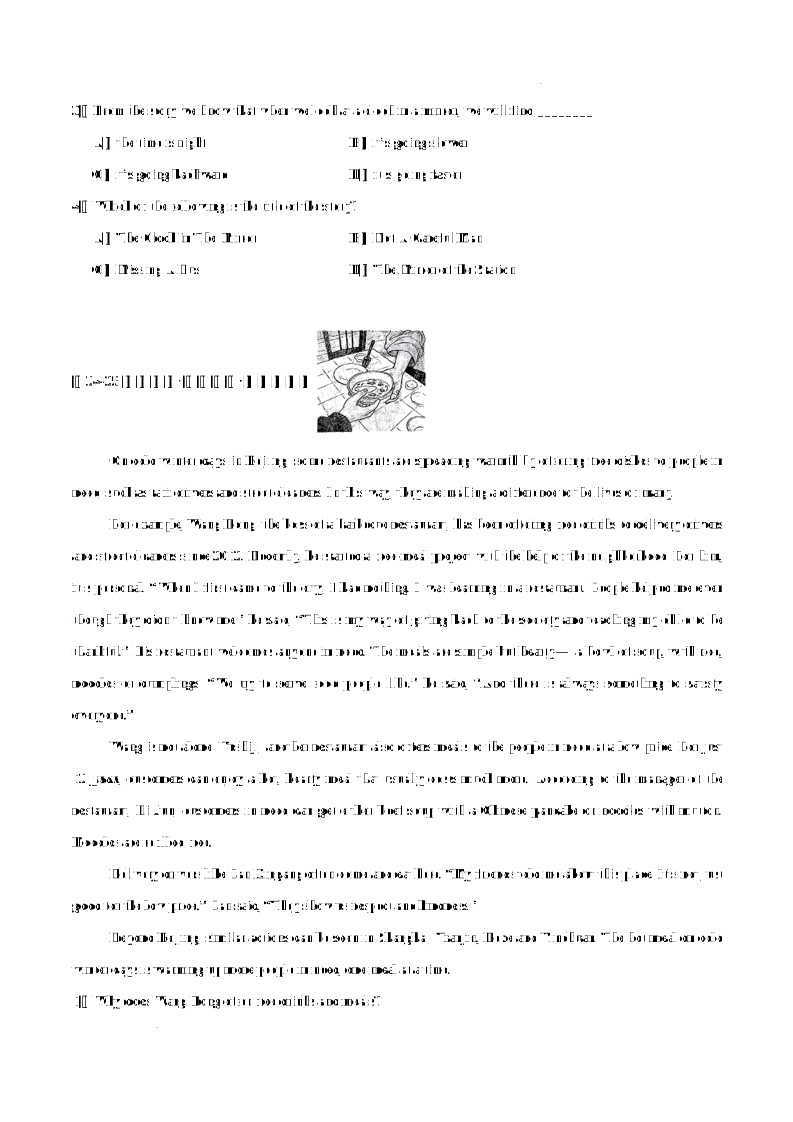
3

相关资源
由于学科网是一个信息分享及获取的平台,不确保部分用户上传资料的 来源及知识产权归属。如您发现相关资料侵犯您的合法权益,请联系学科网,我们核实后将及时进行处理。