Unit 5 Lesson 1 Enlightening a Mind 课文填空-2024-2025学年高中英语北师大版(2019)选择性必修第二册
2025-01-12
|
7页
|
589人阅读
|
3人下载
普通
资源信息
| 学段 | 高中 |
|---|---|
| 学科 | 英语 |
| 教材版本 | 高中英语北师大版选择性必修第二册 |
| 年级 | 高二 |
| 章节 | Lesson 1 Enlightening a Mind |
| 类型 | 学案-导学案 |
| 知识点 | - |
| 使用场景 | 同步教学-新授课 |
| 学年 | 2024-2025 |
| 地区(省份) | 全国 |
| 地区(市) | - |
| 地区(区县) | - |
| 文件格式 | DOCX |
| 文件大小 | 53 KB |
| 发布时间 | 2025-01-12 |
| 更新时间 | 2025-01-12 |
| 作者 | 星星泡饭加个荷包蛋 |
| 品牌系列 | - |
| 审核时间 | 2025-01-12 |
| 下载链接 | https://m.zxxk.com/soft/49940365.html |
| 价格 | 0.50储值(1储值=1元) |
| 来源 | 学科网 |
内容正文:
U5 L1 Enlightening a Mind 启迪心灵
Helen Keller was an __________(极其,非常) special girl. By the time( ) she was seven years old, she still couldn’t speak, read or write and __________(need) to have everything _________(do) for her. This was ________ she couldn’t see or hear. With these _______________
______(严重的限制/约束) to her communication, Helen’s behaviour was often unbearable. She was sometimes __________(令人烦恼的), __________(固执的) and angry, and ________________(有...习惯/倾向) break things when no one understood her.
海伦•凯勒是一个非常特殊的女孩。她七岁时,仍不会说话,不能读书也不会写字,一切都需要别人照顾。这是因为她看不见也听不见。这些严重的障碍限制了海伦的正常交流,也让她的行为常常令人难以忍受。海伦有时很烦人、很固执,而且很易怒。如果没有人能理解她的意思,她就会摔东西。
1. have / get sth. done 结构用来表达要别人为自己做某事
I fix the car. (自己修理) I have my car fixed.(请别人帮我修理)
e.g ① We’re going to have a video of the wedding _______(make).
② I’ll have the washing machine________(repair) soon.
2. This / That / It is/was because... 这是因为…(因)
This / That / It is/was why... 这是为什么… (果)
e.g ① You can’t sleep well. This is_______you are anxious.
② You are anxious. This is_______you can’t sleep well.
Helen’s parents got a __________(卓越的) teacher recommended to them, a woman __________(name) Anne Sullivan. Anne was a teacher and former student at a school for the blind in Boston. She__________________(有视力问题) early in life as well so she could_________(理解) Helen’s __________(difficulty).
海伦的父母经人推荐,聘请了一位名叫安妮·莎莉文的优秀老师。安妮曾是波士顿一所盲人学校的老师,也曾在那儿上过学。她小时候也视力有障碍,所以更能理解海伦所面临的困境。
recommended / named过去分词做后置定语
① Most of the people _________(invite) to the meeting were my old friends.
② The medical team _________(consist) of five experienced doctors and ten skilled nurses will be sent to earthquake-hit areas.
Anne’s technique to teach Helen language was simple and __________(简单的) . Anne ______ (spell) words by writing on Helen’s hand so that Helen could get a mental picture of the words. She __________(start) with the word “doll”. She would let Helen play with the doll, and then spell the letters “D-O-L-L” on her hand. When they __________(起初) did this, Helen __________(think) it was a game. She _______(write) about her ________(excite) later in her book, The Story of My Life:
安妮教海伦学习语言的方法简单明了。她先在海伦手上拼写单词,使海伦联想到单词的画面。安妮给海伦拼写的第一个词是“doll”。她先让海伦和洋娃娃玩耍,然后在海伦的手上拼写“D-O-L-L”。刚开始海伦以为这是在玩游戏。后来在《我的人生故事》一书中,海伦描述了自己的兴奋之情:
“__________(run)downstairs to my mother, I held up my hand and made the letters for ‘doll’. I did not know _______ I was spelling a word or even t_____words existed; I was __________(simple) making my fingers go in monkey-like imitation.”
“我跑下楼去见我母亲,举起手来,也给她拼写字母组成‘doll’。可我那时并不知道自己在拼写单词,甚至压根不知道词汇的存在。我仅仅是亦步亦趋地用手指模仿老师。”
When they were at the well( ) one day, Anne put one of Helen’s hands under the ________(水流) of water. As the water flowed over Helen’s hand, Anne __________(拼写出) “W-A-T-E-R” into Helen’s other hand. As Anne wrote on Helen’s hand, Helen suddenly realised ______the __________(move) of the fingers meant the cool liquid flowing over her hand. This __________(宝贵的) knowledge gave her hope and joy. Finally, she got the world of words __________(open) up to her.
一天,她们在井边,安妮把海伦的一只手放在水流下。水缓缓流过海伦的手掌,安妮在她的另一只手上拼写“W-A-T-E-R”。安妮在海伦手上写的时候,海伦突然意识到,手指的动作代表的是流过自己手掌的清凉的液体。这宝贵的知识给她带来希望和快乐。终于,她打开了语言世界的大门。
Now that Helen _______(理解) the key to language, she was very eager to learn more and use it as much _____ she could. Children _______ can see and hear learn language __________(easy), but for Helen, it was____________________(一个逐渐的,有时痛苦的过程). However, because Helen was so __________(热心的,热衷的) about learning, the results were amazing.
由于海伦理解了语言的关键,她非常渴望学习更多语言,并且尽可能运用它。正常的孩子能听、能看,学起语言来很容易。但对海伦来说,学习语言是个渐进的过程,有时会很痛苦。然而,因为海伦对学习极高的热情,学习成果令人吃惊。
句型公式:as...as sb. can could...
e.g 为了帮助解决这个问题,我尽可能多地去跑步。
To help deal with the problem, I go running ______________________.
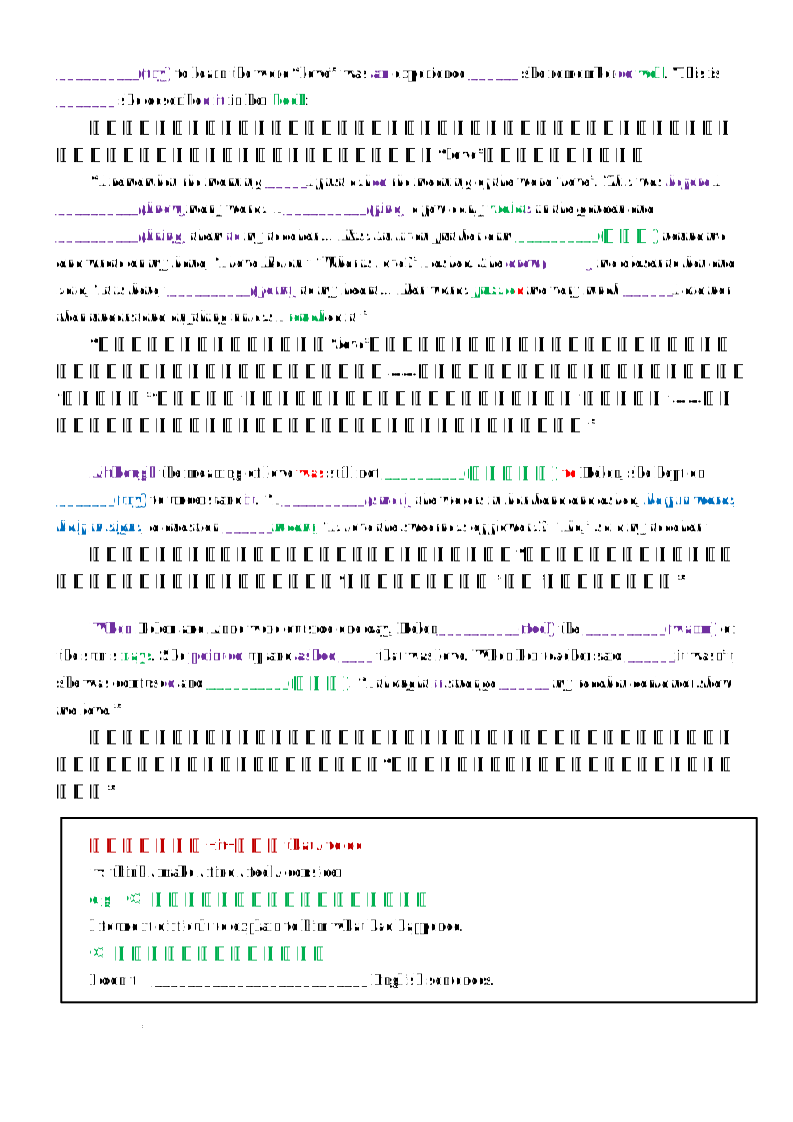
As Helen’s knowledge and vocabulary __________(扩大), she asked more and more questions. This soon led her to discover more __________(复杂的) words and changed her thinking process. __________(try) to learn the word “love” was an experience ______ she remembered well. This is _______ she described it in her book:
随着海伦知识和词汇量的不断扩大,她提出的问题也越来越多。这使她学会了更复杂的单词,从而改变了思维的过程。她很清楚地记得,学习“love”这个单词的难忘经历。
“I remember the morning _____I first asked the meaning of the word ‘love’. This was before I __________(know)many words. I __________(find) a few early violets in the garden and __________(bring) them to my teacher ... Miss Sullivan put her arm __________(轻柔地) round me and wrote on my hand, ‘I love Helen.’ ‘What is love?’ I asked. She drew( ) me closer to her and said, ‘It is here,’__________(point) to my heart ... Her words puzzled me very much ______I did not then understand anything unless I touched it.”
“我记得有一天早上,我第一次问‘love’这个词的含义。那时我的词汇量还很有限。我在花园里发现了早开的紫罗兰,摘下一些带给老师……莎莉文老师温柔地搂着我,在我的手上写着:‘我爱海伦。’‘什么是爱?’我问道。她把我拉到身边,指着我的心脏说,‘爱在这里。’……她的话令我非常困惑,因为以往我只有触碰到实际物体,才能理解它的意思。”
Although the meaning of love was still not __________(显而易见的) to Helen, she kept on _______(try) to understand it. “I __________(smell) the violets in her hand and asked, half in words, half in signs, a question ______meant, ‘Is love the sweetness of flowers?’ ‘No,’ said my teacher.’
尽管对海伦来说,爱的意义还不明确,但她一直试着理解。“我闻了闻她手里的紫罗兰,半拼写半比划地问了个问题,意思大概是‘爱是花朵的香味吗?’‘不,’我的老师回答道。”
When Helen and Anne were outside one day, Helen__________(feel) the __________(warm) of the sun’s rays. She pointed up and asked ____ that was love. When her teacher said ______it wasn’t, she was confused and __________(失望的). “I thought it strange ______ my teacher could not show me love.”
一天和老师在室外,海伦感受到了阳光的温暖。她指了指太阳,问老师那是不是爱,老师说不是,海伦感到更困惑了,而且有些失望。“我觉得很奇怪,因为我的老师不能给我表示什么是爱。”
句型公式:动词+it+宾补+that / to do
★ think / make / find / feel / consider
e.g ① 我发现把发生的一切解释给他听很难。
l found it difficult to explain to him what had happened.
② 我觉得理解英语句子并不难。
I don’t __________________________ English sentences.
The word “think” was also a difficult one for Helen because it is _____________________(如此一个抽象的概念). However, one day as she was working on a simple task, she __________(取得了突破). She was making necklaces ______ the help of Anne when she noticed that she __________(make) some mistakes. Because she was uncertain how to fix them, she __________(停下来认真思考) . As she did this, Anne touched Helen’s __________(前额) and wrote the word “think” on her hand. “In a flash I knew ______the word was the name of the process ______ was going on in my head.”
“think”这个词对海伦来说也很难理解,因为它很抽象。然而有一天,在做一项简单的任务时,她取得了突破。她正在安妮的帮助下做项链,这时她发现自己犯了一些错。海伦不确定该如何解决,便停下来认真思考。在她思考的时候,安妮点了点海伦的额头,在她的手上写“think”这个词。“瞬间我就明白了,我头脑中进行的活动就是这个词的意思。”
感叹句:such a/an+adj.+n. so+adj.+a/an+n.
She is _____ a lovely girl. She is _____ lovely a girl.
It was the first time Helen __________(understand) such a __________(复杂的) word—a word for something she couldn’t touch. At that moment, her mind returned to the word “love”. As she thought about its meaning again, the sun _____________(出现). She pointed______the sun and asked her teacher again if that was love. Anne answered Helen by __________(explain) ______love was like the sun and clouds __________(在某种程度上).
那是海伦第一次明白复杂词语的意思,她触摸不到的抽象词语。这时,海伦又想起了“love”。她再次思考“love”是什么意思,恰巧这时太阳出来了。海伦指着太阳又问老师那是不是爱。安妮解释道,爱在某种程度上就像太阳和云彩。
这是某人第一次做某事:
It was the first time (that)...... had done It is the first time (that)...... have/has done
e.g ① 这是我第一次访问中国。
It was the first time I _____________(visit) China.
② 这是我第一次见到大熊猫。
It is the first time I _____________(see) a panda.
“You cannot touch the clouds, you know; but you feel the rain... You cannot touch love either; but you feel the__________(sweet)______ it pours into everything. __________(with)love you would not be happy or want to play.”
“你知道吗,你摸不到云彩,但是你能感觉到雨……你也触摸不到爱,但是你能感觉到爱给万物带来的甜蜜。没有爱,你就不会快乐,也不会想玩耍。”
without引导的含蓄虚拟条件句:
① 与现在事实相反,would / could / might (not) + do sth.
没有空气的话,人类不能在地球上生存。
Without air, man _____________on the earth.
② 与过去事实相反,would / could / might (not) + have done sth.
没有你的帮助,我上周考试可能不能通过了。
Without your help, I ___________________the exam last week.
③ 与将来事实相反,would / could / might (not) + do sth.
要是没有你的票,我明天就不能去听音乐会了。
Without your ticket, I _________________go the the concert tomorrow.
In that __________(生动的时刻), Helen finally__________(understand) the beautiful __________(true) of the word “love”.
就在那个动人的时刻,海伦终于明白了“love”这个词语蕴含的美丽的真谛。
★本课必背短语
by the time 到....时候
have a tendency to do sth. 有做某事的倾向
recommend to 推荐给
as well 也
relate to 理解
start with 从...开始
hold up 举起,抓住
flow over 流过
now that 既然,由于
the key to . .....的关键
be eager to do sth. 渴望做某事
be enthusiastic about 对...热情,热衷于
lead sb. to do sth. 引领某人做某事
point to 指向
keep on doing sth. 持续做某事
with the help of 在...的帮助下
in a flash 瞬间
come out 出来
in a way 在某种程度上
pour into 倾注
Exercise:
1. What’s the main idea of the text?
A. The process of Helen Keller’s learning Braille.
B. Helen Keller’s experience in language learning.
C. Anne Sullivan’s methods of teaching Helen Keller.
D. The story between Helen Keller and her teacher Anne Sullivan.
2. Why did Helen have a tendency to break things?
A. Because she was troublesome.
B. Because she was stubborn.
C. Because she desired for understanding.
D. Because she hated others’ sympathy.
3. What did Anne suffer from early in life?
A. Reading disability. B. Poor grades at school.
C. Eyesight problems. D. Communication restrictions.
4. What do you think of Anne’s teaching technique?
A. Simple but dull. B. Complex and boring.
C. Interesting but complex. D. Simple and straightforward
5. Why was the word“love”difficult for Helen to learn?
A. Because she didn’t want to learn words.
B. Because she knew nothing about feeling.
C. Because it was an abstract concept.
D. Because she didn’t love other people.
6. From the passage we can know that ______.
A. Helen knew well on how to learn abstract words.
B. Helen had some difficulty learning words that she couldn’t touch.
C. Helen gave up trying when she couldn’t understand the meaning of “love”.
D. Helen could learn language easily like the children who could see and hear.
学科网(北京)股份有限公司
学科网(北京)股份有限公司
$$
资源预览图

1

2
3

相关资源
示范课
由于学科网是一个信息分享及获取的平台,不确保部分用户上传资料的 来源及知识产权归属。如您发现相关资料侵犯您的合法权益,请联系学科网,我们核实后将及时进行处理。